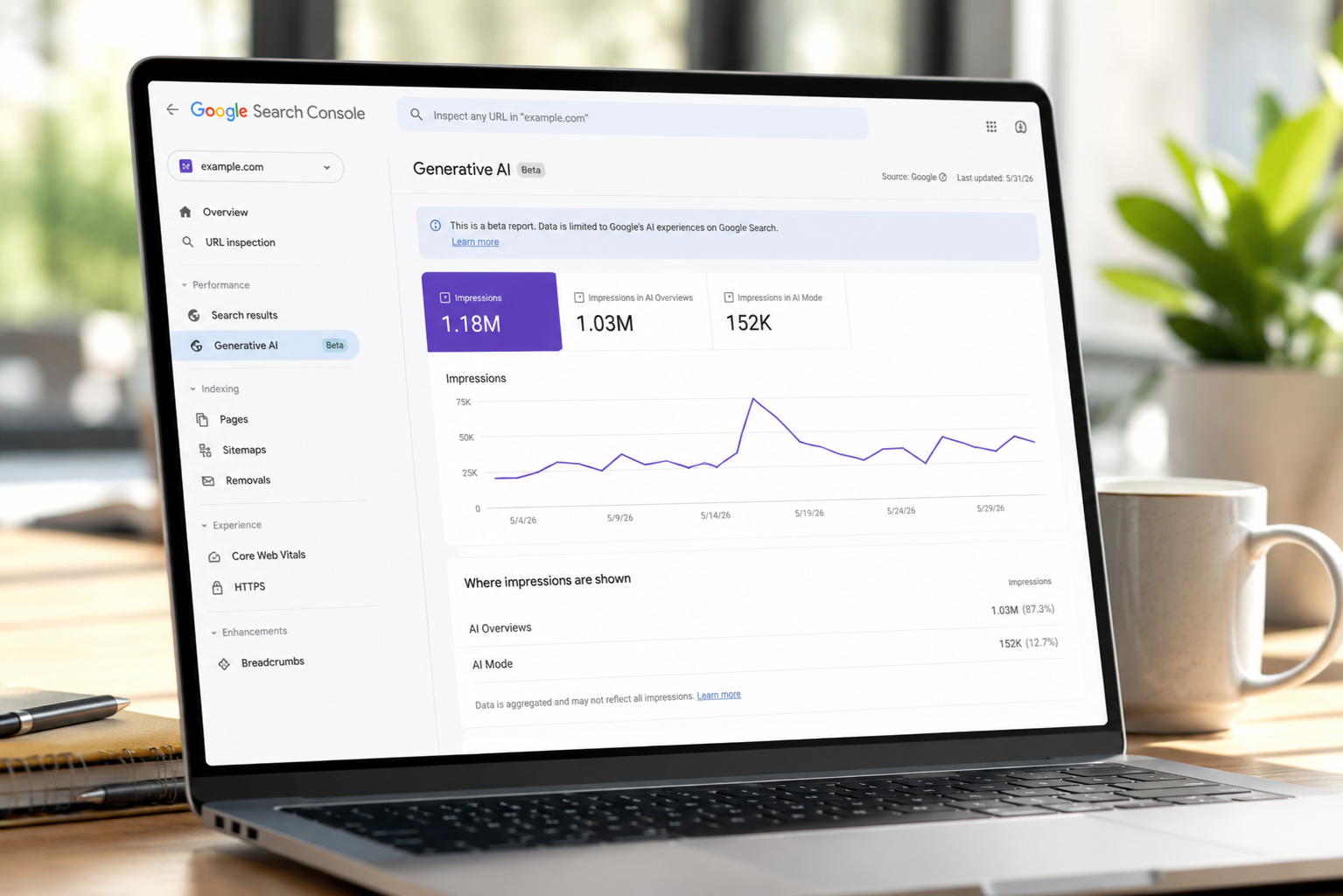
For two years, marketers asked a version of the same question with growing impatience: when will Google give us a way to measure AI search the way Search Console and Analytics let us measure traditional search? When AI Overviews started displacing blue links at scale, the tooling simply didn't exist. You could watch your organic traffic soften and have no clean way to see whether your content was appearing inside AI answers, let alone what that visibility was worth.
As of this month, that question has its first real answer. On June 3, 2026, Google shipped dedicated AI search reporting inside Search Console. The catch — and the reason we're writing this — is that it's genuinely hard to find: it's a staged beta, it lives in its own view separate from the report you're used to, and plenty of people who have access don't realize it's there. So below you'll find exactly where it is and how to open it, followed by an honest accounting of what it measures, what it doesn't, and when the fuller toolkit you're really after is likely to exist.
What Google Actually Launched
The announcement came straight from Google's own Search Central blog. On June 3, 2026, Google launched new Search Generative AI performance reports in Search Console, including dedicated reports for Search and Discover, to help site owners understand their site's visibility within generative AI features such as AI Overviews and AI Mode. Google
The key word is dedicated. AI-feature data had technically been folded into the overall numbers before, but it wasn't separable. This data was already included in the overall performance report, but Google is now launching a separate view dedicated specifically to visibility from generative AI features. That separation is the breakthrough: for the first time you can answer "am I showing up inside Google's AI answers?" as a distinct question from "how am I doing in regular search?" Google
How to Find the Report (Because It's Buried)
This is the part most coverage skips. The report isn't where your instincts say it should be, and it won't appear for everyone, so here's the concrete path. The fastest route is the direct link; if that doesn't load the view, the numbered steps and the "don't see it?" troubleshooting below will tell you why.
A few things worth calling out from the official documentation, because they explain the most common "where is it?" confusion. First, it really is gated: Google is rolling the report out to a subset of website owners, allowing for thorough testing before rolling it out further, so not all properties have access yet. Second, there's an eligibility floor and an opt-out trap: you may not see it if your site hasn't received enough impressions in generative AI features, or because you've excluded your site from Search generative AI features — to be eligible for display, make sure you've included your site in those features. That second point catches people who (sometimes unknowingly) toggled themselves out of AI surfaces. googlegoogle
Once you're in, the report behaves like a stripped-down version of the performance report you already know. The default view shows impressions — how many times links to your site were shown in a generative AI feature — and you can regroup the data using the dimension tabs above the table: pages, countries, and dates, plus devices. There's also a familiar deduplication rule: if two results from the same site appear in a generative AI feature, they count as a single impression in the chart total. And you can pull the data out — the report provides an export button to download both the chart and table data. google + 2
The full official walkthrough lives on Google's help page, which is embedded in the steps above and linked again at the end of this post.
What the Report Shows — and What It Conspicuously Doesn't
This is where you have to read carefully, because the gap between what launched and what marketers actually want is the whole story.
What you get is a clean, five-dimension view of visibility. The reports cover impressions — how often your URLs appeared inside AI Overviews, AI Mode, or generative Discover features — broken down by pages, countries, devices, and dates. For top-of-funnel-heavy businesses, that alone is meaningful: for fintech, edtech, travel, and ecommerce businesses where informational queries dominate the top of the funnel, these reports give the first real measure of AI-surface visibility. 6sMarketer6sMarketer
But now the absences, which are substantial. The report is impressions-only. There are no clicks, no CTR, no average position, no query-level breakdown, and no split between AI Overviews and AI Mode — you cannot measure downstream traffic from this report alone. That last point is the crux. The most-quoted summary of the launch put it precisely: it answers "how visible am I in AI search?" but still not "how much traffic is AI search actually sending me?" — the measurement gap is half-closed, not closed. Digital Applied TeamDigital Nomads HQ
So the right way to interpret this data is as a signal of resonance, not a traffic ledger. The correct way to read impressions-only data is as a resonance signal, not a traffic metric — a page that earns heavy AI impressions is content the model finds worth citing. One practical wrinkle if you're in the beta: the data has almost no history to lean on, since the report appears to begin around mid-May 2026 with no backfill, and that start date sits inside a core-update window, which complicates early read-throughs. Digital Applied TeamDigital Applied Team
Why This Launch Matters More Than the Feature Set Suggests
It would be easy to look at "impressions only" and shrug. That would miss the more important signal, which is about Google's posture, not its current metrics.
For a long time Google was noncommittal — even discouraging — about whether this kind of dedicated reporting was coming at all. One practitioner who has tracked it closely noted that when Google first introduced its generative search experience in 2023 and expanded testing through 2024, one of the biggest unknowns was reporting, with very little shared about how performance data would be measured — and Google had previously said this kind of reporting wasn't planned. Shipping a dedicated report is a reversal. Rich Sanger SEO
Analysts read it the same way. The launch signals that Google recognizes AI Overviews and AI Mode as distinct traffic channels — not just extensions of standard organic search — an acknowledgment that visibility in generative AI features now deserves its own measurement framework. Once a platform concedes that a channel needs its own measurement, the metrics tend to follow. The first version is rarely the last. Stan Ventures
So When Does the Full Toolkit Arrive?
This is the heart of the original question — not "is there anything?" but "when will there be something as complete as Search Console and Analytics are for classic search?" Based on what Google has said and how these rollouts behave, here's a grounded read.
Google has been explicit that this is a starting point. The team wrote that they are continuing to work with site owners to understand what insights and data would be most helpful, "such as adding additional metrics over time" — language that suggests the current set is not the final state. Google's own help page echoes this directly about scope: the report currently includes AI Overviews and AI Mode, and Google expects to update that list over time as it develops Search. Independent observers reached the same conclusion: this feels like Version 1.0 rather than the final destination, with Google gathering feedback and likely to expand reporting in future updates. PPC Land + 2
Reading the tea leaves responsibly: the most-requested missing piece is the click-and-traffic layer — connecting AI visibility to what actually lands on your site and converts. Given that Google launched into a controlled beta and is explicitly soliciting feedback (the help page even includes a dedicated feedback form), the realistic expectation is incremental expansion over the quarters following this launch rather than one comprehensive release. I'd caution against pinning a specific date on it; Google hasn't committed to one, and anyone claiming to know exactly when clicks and query data arrive is guessing. We can say the direction (more metrics, toward the click/traffic layer) and the trajectory (iterative, feedback-driven) with confidence — just not the calendar.
The Limit Google's Tools Will Always Have
Here's the thing the question itself can obscure: Google's reporting, however good it gets, only ever covers Google'ssurfaces. AI search isn't just Google.
The generative search landscape spans ChatGPT, Perplexity, Gemini, Copilot, and others — and your visibility inside ChatGPT or Perplexity will never appear in Google Search Console, by definition. This is why, even with the new reports, the prevailing advice is to keep a multi-tool stack. Practitioners are advised to continue using third-party SEO tools like Semrush, Ahrefs, Authoritas, and Advanced Web Ranking, which still provide capabilities Google's reports currently do not, including query-level tracking, competitor visibility, and AI Overview monitoring. Rich Sanger SEO
So the most useful reframe of "when will Google have a complete AEO/GEO measurement suite?" is this: Google will keep improving measurement of its own AI surfaces, probably substantially, over the coming year-plus. But a completepicture of your AI search presence — across every engine your customers actually use — is unlikely to ever come from a single Google dashboard. The right mental model isn't "wait for Google to build the one tool." It's "assemble the measurement layer," with Google's new report as one valuable input among several.
What to Do With This Right Now
The practical posture, whether or not you're in the beta, is straightforward.
If you have access, treat the new report as a resonance and content-validation signal. Look for trends rather than just visibility — compare AI visibility against changes in organic impressions, clicks, CTR, and conversions to understand whether AI exposure is helping or hurting overall performance. The pages racking up AI impressions are telling you what the model finds citable; that's a direct signal for where to deepen and expand. Rich Sanger SEO
And keep it in perspective. The reporting layer is new, but it doesn't change the fundamentals. Treat this as a new measurement layer, not a new SEO strategy — the introduction of AI reporting doesn't fundamentally change best practices, so continue creating useful content, building authority, and maintaining strong technical foundations. Measurement tells you how you're doing; it doesn't replace the evidence-based, citable content that earns the visibility in the first place. Rich Sanger SEO
The Bottom Line
The two-year wait for Google to measure AI search is over — sort of. As of June 3, 2026, Search Console has a dedicated generative-AI performance report, and it's a real milestone. But it's hard to find (a staged beta in its own view), it's a Version 1.0 (impressions only — no clicks, queries, or traffic), and it's limited to Google's own surfaces. The gap is half-closed.
The fuller toolkit — something that connects AI visibility to traffic and conversions the way Analytics does for clicks — is clearly on Google's roadmap, but on an iterative timeline Google hasn't dated and no one should pretend to. And even when it matures, it will only ever see Google's slice of a multi-engine world. The brands that measure AI search well over the next few years won't be the ones waiting for one perfect dashboard. They'll be the ones combining Google's improving first-party data with third-party monitoring across every engine their customers use — paired with content actually worth citing.
If you want to check whether you have the report right now, use the direct link in the walkthrough above, and keep Google's official help page handy: https://support.google.com/webmasters/answer/16984139
Want help building a measurement stack that actually captures your AI search presence — across Google and beyond? Ritner Digital helps businesses find, interpret, and act on AI visibility while the tooling is still taking shape. Get in touch with us →
Frequently Asked Questions
Does Google now have a tool to measure AI search, GEO, and AEO?
Partially, as of this month. On June 3, 2026, Google launched dedicated Search Generative AI performance reports in Search Console for AI Overviews and AI Mode, giving site owners a separate view of their visibility within generative AI features. It's a real first step, but it measures only visibility on Google's own surfaces — not the full GEO/AEO picture across every AI engine. Google
Where do I find the Generative AI performance report?
It's in Search Console, but in its own view separate from the standard report. The fastest route is the direct link (search.google.com/search-console/performance/search-analytics/ai) while signed in to your property; otherwise look for the dedicated "Generative AI" view in the Performance section. The steps box above walks through it, and Google's official help page is at support.google.com/webmasters/answer/16984139.
Why can't I see the report in my account?
Two common reasons. First, it's gated: Google is rolling it out to a subset of website owners for testing, so not all properties have access yet. Second, eligibility: you may not see it if your site hasn't received enough impressions in generative AI features, or because you've excluded your site from Search generative AI features. Check that you haven't opted your site out of AI features. googlegoogle
What metrics does the report actually show?
Visibility, grouped four ways. The default view shows impressions — how many times links to your site appeared in a generative AI feature — and you can regroup the data by pages, countries, devices, and dates. You can also export both the chart and table data. google
Does it show clicks or traffic from AI search?
No — and this is the biggest limitation. There are no clicks, no CTR, no average position, no query-level breakdown, and no split between AI Overviews and AI Mode; you cannot measure downstream traffic from this report alone. As one summary put it, it answers "how visible am I in AI search?" but still not "how much traffic is AI search sending me?" — the gap is half-closed, not closed. Digital Applied TeamDigital Nomads HQ
How should I interpret impressions-only data?
As a resonance signal, not a traffic number. A page that earns heavy AI impressions is content the model finds worth citing. Use it to see what's working as source material, then compare it against your other metrics — look for trends, comparing AI visibility against changes in organic impressions, clicks, CTR, and conversions to understand whether AI exposure is helping or hurting. Digital Applied TeamRich Sanger SEO
When will Google add clicks, queries, and traffic data?
Google hasn't committed to a date, but it's signaled more is coming. The team said they are continuing to work with site owners on what data would be most helpful, "such as adding additional metrics over time." Independent observers agree — this feels like Version 1.0 rather than the final destination. Expect incremental expansion over the coming quarters rather than one big release; anyone naming a specific date is guessing. PPC LandRich Sanger SEO
Will this report cover ChatGPT, Perplexity, and Gemini too?
No. By definition, Google's reporting only covers Google's own surfaces (AI Overviews and AI Mode), so your visibility inside ChatGPT or Perplexity will never appear here. Practitioners are advised to keep using third-party tools like Semrush, Ahrefs, Authoritas, and Advanced Web Ranking for query-level tracking, competitor visibility, and AI Overview monitoring that Google's report doesn't provide. Rich Sanger SEO
Does this change my SEO or GEO strategy?
Not the fundamentals. Treat this as a new measurement layer, not a new strategy — it doesn't change best practices, so keep creating useful content, building authority, and maintaining strong technical foundations. Better measurement tells you how you're doing; it doesn't replace the citable content that earns visibility in the first place. Rich Sanger SEO
How are impressions counted if my page shows up twice?
They're deduplicated. If two results from the same site appear in a generative AI feature, they count as a single impression in the chart total. This matches how the standard performance report handles the same situation. google