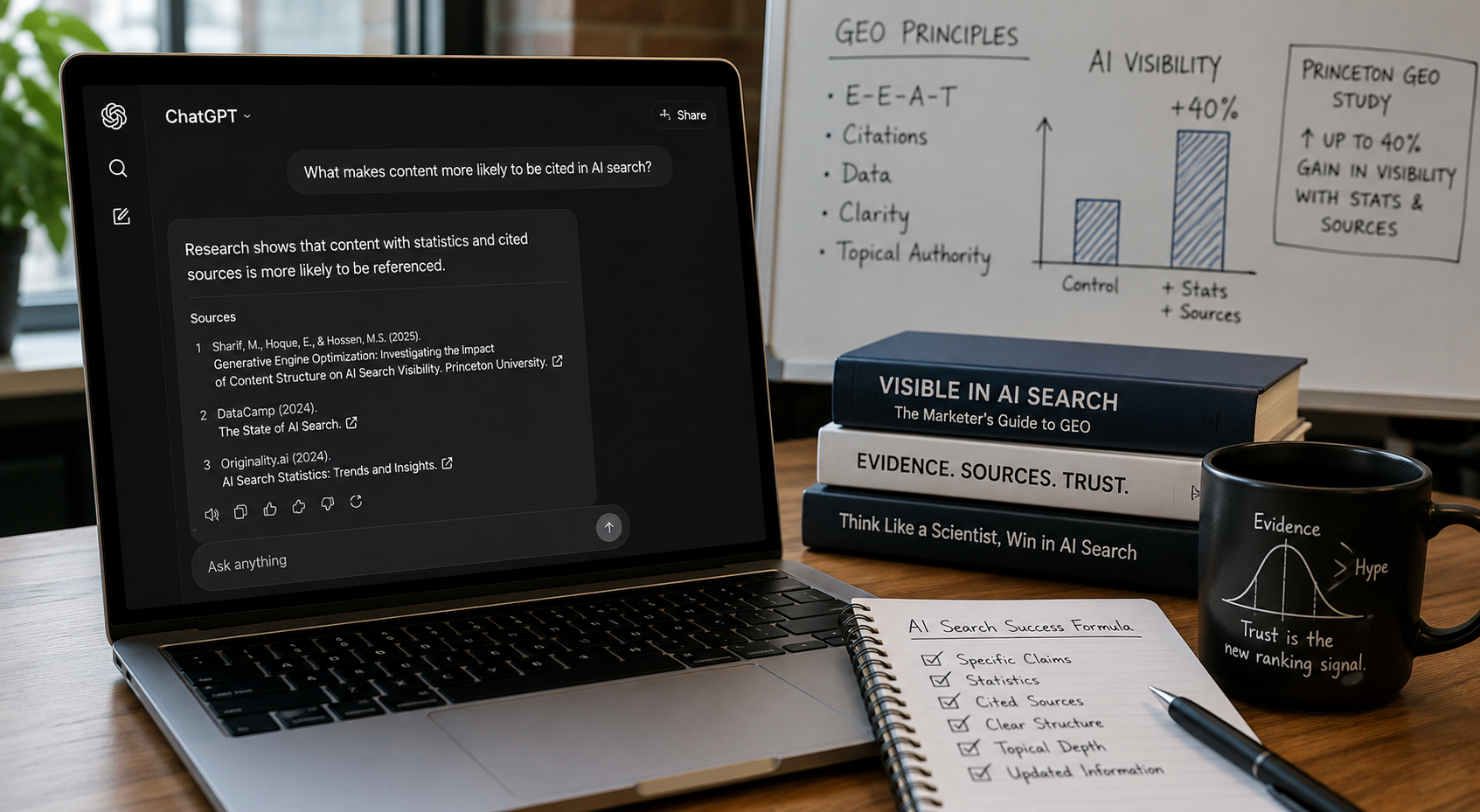
There's a quiet irony in how artificial intelligence is reshaping marketing. For years, the discipline drifted toward persuasion as performance art — punchy copy, bold claims, vibes over evidence. "Industry-leading." "Game-changing." "Our customers love us." The looser the claim, the easier it was to write. Now the fastest-growing discovery channel on the internet — AI search across ChatGPT, Perplexity, Gemini, and Google's AI Overviews — has begun systematically rewarding the opposite instinct. It rewards the marketer who behaves less like a copywriter and more like a scientist: someone who makes specific, falsifiable claims, cites their sources, shows their methodology, and treats every assertion as something that has to earn its place.
This isn't a stylistic preference. It's baked into how these systems decide what to repeat. Understanding why is the difference between guessing at AI visibility and engineering it.
Why AI Engines Behave Like Cautious Peer Reviewers
To see why rigor wins, you have to understand what an AI engine is actually doing when it answers a question. It isn't ranking a list of links and handing you ten options. It's synthesizing a single answer and deciding, claim by claim, which sources are safe enough to repeat.
That word — safe — is the key. An AI engine that confidently states something false is a liability for the company that built it. So these systems are, by design, conservative about what they assert. As one analysis puts it, AI engines are risk-minimizing systems that preferentially cite verifiable, attributable data over derivative content. They are looking for the informational equivalent of a well-sourced expert witness, not a confident stranger at a party. Ziptie
This is why the mechanics of citation happen at a granular level. Modern AI search largely runs on retrieval-augmented generation, which means the model pulls the most relevant external documents in real time, synthesizes an answer, and cites the sources it drew from — so citation decisions happen at the passage level, not the page level. The engine isn't asking "is this a good website?" so much as "is this specific sentence something I can stand behind?" That single shift changes everything about how content should be built. You are no longer optimizing a page to rank. You are arming individual claims to survive scrutiny. Frase
A scientist already knows how to do this. A scientist writes so that any single sentence can be checked, traced, and defended in isolation. That is now, quite literally, the unit of optimization.
The Evidence: Rigor Is the Single Most Effective Tactic
This isn't a hunch dressed up as strategy. The foundational research on AI visibility points the same direction with unusual consistency.
The field itself was named in a controlled experiment. In November 2023, a team at Princeton University led by Pranjal Aggarwal published the paper that introduced the term Generative Engine Optimization, defined a measurement framework, and ran the first controlled experiment comparing content strategies for AI visibility. That study didn't just theorize — it tested tactics against tens of thousands of queries and measured what actually moved citations. Sunil Pratap Singh
The headline finding reads like a thesis statement for scientific thinking. The Princeton GEO framework identified "Statistics Addition" and "Cite Sources" as the top-performing optimization techniques, boosting visibility by up to 40% in generative engine responses. Adding verifiable numbers and citing credible sources weren't minor tweaks; they were the most powerful levers available. One breakdown of the paper found that adding statistics to content improved AI visibility by 41% — the single most effective optimization technique tested. ConvertMateZiptie
The effect is even more dramatic for the underdog. For sites that aren't already dominant, rigor is a great equalizer: the Princeton paper documented a 30–40% improvement for content with proper citations, and for lower-ranked websites the boost was as large as 115.1% for sites ranked fifth in Google search results. If you can't win on brute domain authority, you can win on evidence. That should be enormously encouraging to any smaller business willing to do the work. DerivateX
And the reason it works is precisely the peer-reviewer logic from above. Generative engines are trained to weight content that itself cites credible sources; the presence of citations functions as a trust signal at the claim level, because it provides verifiable backing the model can attribute. When you cite a credible source, you're not just decorating your claim — you're handing the AI the safety it needs to repeat you. DerivateX
Specificity Is the Native Language of Citable Content
If there's a single habit that separates scientific writing from marketing writing, it's specificity. A scientist would never write "results improved significantly" without a number, a method, and a comparison. AI engines reward that same discipline.
The contrast is stark and measurable. Quantitative claims receive 40% higher citation rates than qualitative statements; content featuring original statistics and research findings sees 30–40% higher visibility in LLM responses. The practical instruction that follows is almost a writing rule: replace "significantly improves" with "improves by 40% according to X study," and make every claim link to a verifiable source. Discovered LabsDiscovered Labs
Notice how that mirrors the structure of a scientific claim: an effect size, an attribution, and a source. The vague version — "significantly improves" — is exactly what a peer reviewer would flag and an AI engine will skip. The specific version gets extracted and repeated. As one guide frames the rewrite, instead of "AI search is growing fast," write "AI search engines now process over 1 billion queries per day, according to OpenAI's Q1 2026 disclosure" — a specific number, a named source, and the year are the format that gets cited. DerivateX
This extends to how you describe your own results. Case studies framed like experiments outperform case studies framed like boasts. "Increased revenue by 47% over 6 months" is more extractable than "significantly improved performance." Same outcome, radically different citability — because one is a measurement and the other is an adjective. Geoptie
Show Your Sources — Even Your Competitors'
Here's the part that feels counterintuitive to a traditional marketer, and obvious to a scientist: citing other people's work makes your work more credible.
It seems almost paradoxical at first. Citing other credible sources within your content increases your likelihood of being cited by AI; it signals thoroughness and trustworthiness. A scientist understands this instinctively — a paper with no references isn't bold, it's suspect. The references are part of what makes the work trustworthy. AI engines apply the same heuristic, treating outbound citations as evidence of research rigor. Geoptie
There's even a practical density target that researchers and practitioners converge on. Aim for 5–8 external citations to authoritative sources per 1,000 words; this density demonstrates research rigor without overwhelming readers, and academic research, government data, and authoritative industry reports signal thoroughness. Direct quotation helps too: the Princeton study found that quotation marks around expert attribution function as a credibility signal that AI models heavily reward. ALM CorpDerivateX
The mental model to adopt is citation hygiene borrowed wholesale from academia. LLMs are designed to provide evidence-based responses, so your content needs proper citation hygiene, just like academic writing. If that sounds like extra work, that's rather the point — the friction is what filters out the unrigorous, and the channel pays you for clearing it. Discovered Labs
Authority Is Earned and Triangulated, Not Asserted
Scientific credibility doesn't come from a single paper claiming greatness. It comes from independent replication — other researchers, in other places, finding the same thing. AI engines evaluate brands in a strikingly similar way.
The old SEO framework of expertise, authoritativeness, and trustworthiness hasn't been discarded; it's been automated. The long-standing E-E-A-T framework still applies, but now those traits are being approximated algorithmically as engines decide what qualifies as trustworthy at scale, using observable signals like citation frequency, domain reputation, and content freshness as proxies for credibility. The engine can't interview you, so it triangulates your reputation from how the rest of the web treats you. Search Engine Land
This is where a crucial nuance — and a genuinely scientific habit of mind — separates the sophisticated marketer from the naive one. One of the most-cited statistics in the field is that brand mentions correlate with AI citations far more strongly than backlinks do. But the careful reading matters enormously: the research does not say brand mentions cause AI citations — it says they are correlated. The actual driver is entity recognition: brands mentioned frequently across independent, credible sources have stronger entity signals, and stronger entity signals make AI citation more likely. Confusing correlation with causation here would send you chasing raw mention volume instead of building the underlying credibility that produces both. Sunil Pratap Singh
That distinction is the whole game in miniature. A scientist asks "what's the actual mechanism?" rather than "what's correlated with success?" The marketer who internalizes that builds genuine cross-web authority — consistent information across Wikipedia, reviews, social media, industry publications, and your own site strengthens citation likelihood — instead of gaming a proxy metric that will eventually stop working. Geoptie
Treat Every Page as a Falsifiable Claim
The scientific method has a quiet, demanding test at its core: a claim is only meaningful if it can be checked. There's a content audit that applies exactly this standard, and it's the single most clarifying exercise in GEO.
The audit is brutal in its simplicity. Read each paragraph of your published content in isolation. Does it answer a specific question? Does it contain a verifiable claim anchored to a named entity? Can it be attributed to your site without the surrounding context? If the answer to any of these is no, that paragraph is not AI-citable regardless of how strong the page is overall. Sunil Pratap Singh
This is the peer-review test applied to marketing copy. Most marketing prose fails it instantly, because most marketing prose is connective tissue — transitions, hype, atmosphere — rather than standalone, checkable assertions. The fix is to write in self-contained, verifiable units. It pairs naturally with structure that AI engines already favor: maintain fact density with statistics and specific examples every 150–200 words, favor verifiable claims over opinion-heavy prose, and use clear question-and-answer pairs, which are among the most reliably cited content formats. Frase
Freshness is part of the rigor, too — science values current evidence, and so do these systems. AI crawlers strongly prefer fresh content: 65% of AI bot hits target content less than one year old, and content updated within 30 days can receive over 3x more citations. A claim that was true three years ago and never revisited reads, to a cautious engine, like a citation risk. Updating your evidence isn't busywork; it's maintaining the validity of your claims. ConvertMate
Why This Is Good News for Honest Businesses
It would be easy to read all this as a new set of hoops to jump through. It's better understood as a correction — and a genuinely hopeful one.
For most of the digital era, the loudest and best-funded voices tended to win visibility. AI search tilts the field back toward the substantive. AI engines evaluate content-level signals that traditional SEO doesn't address, such as factual density, source attribution, and answer targeting — and sites with strong SEO but weak GEO optimization often underperform in AI citations. The most durable signal is also the most honest one: factual density combined with source attribution is the most impactful signal, and content that makes specific, verifiable claims consistently outperforms content that relies on unsupported opinions. openbytopenbyt
It even opens a real door for newcomers, the way good science lets an unknown researcher overturn a famous one with better evidence. New domains can build credibility through verifiable author expertise, comprehensive source attribution, original research, and consistent accuracy. You don't have to be the biggest brand in your category. You have to be the most rigorous, the most specific, and the most trustworthy source on the questions your customers are asking. openbyt
The highest expression of this is producing the evidence yourself. Your own original data and experiments will outperform citing others' statistics — first-party research is the highest-value content for AI citation. Original research compounds, becoming the thing other sources cite: original data that journalists, bloggers, and other AI systems cite creates a compounding citation network that benefits every piece of content on your domain. A company that runs its own studies and publishes the methodology isn't just marketing — it's contributing to the record, and the engines reward contributors. Zadro WebEnrichlabs
The Bottom Line
The marketers who will win AI search are not the cleverest copywriters or the loudest brands. They're the ones who adopt the habits of a working scientist: make specific claims, attach real numbers, cite credible sources, distinguish correlation from causation, show the methodology, and update the evidence as it changes. AI engines behave like cautious peer reviewers because being wrong is expensive for them — and they reward the sources that make being right easy.
This is, in the end, a return to substance. The discipline that makes content citable by a machine is the same discipline that makes it genuinely trustworthy to a human: rigor, specificity, honesty, and evidence. The brands that learn to think like scientists won't just rank in AI answers. They'll deserve to.
Want to become the source AI engines trust in your industry? Ritner Digital helps businesses build the kind of rigorous, evidence-backed, citable content that wins visibility across AI search and traditional search alike. Get in touch with us →
Frequently Asked Questions
Why do AI search engines reward rigorous, evidence-based content?
Because they're built to minimize the risk of saying something false. AI engines are risk-minimizing systems that preferentially cite verifiable, attributable data over derivative content. They behave like cautious peer reviewers, and the citation decision happens at a granular level — these systems pull relevant documents in real time and cite sources at the passage level, not the page level. A well-sourced claim is simply safer for the engine to repeat. ZiptieFrase
What's the single most effective thing I can do to get cited by AI?
Add specific statistics and cite credible sources. The Princeton GEO framework identified "Statistics Addition" and "Cite Sources" as the top-performing optimization techniques, boosting visibility by up to 40%. One analysis found that adding statistics improved AI visibility by 41% — the single most effective technique tested. ConvertMateZiptie
Does adding citations really help, even for smaller sites?
Yes — and it helps underdogs most. The Princeton paper documented a 30–40% improvement for content with proper citations, and for lower-ranked websites the boost was as large as 115.1% for sites ranked fifth in Google. If you can't win on domain authority, rigor is the great equalizer. DerivateX
Should I cite my competitors or other external sources?
Counterintuitively, yes. Citing other credible sources within your content increases your likelihood of being cited by AI; it signals thoroughness and trustworthiness. A practical target: 5–8 external citations to authoritative sources per 1,000 words demonstrates research rigor without overwhelming readers. Think of it as academic citation hygiene applied to marketing. GeoptieALM Corp
How specific does my content actually need to be?
Very. Quantitative claims receive 40% higher citation rates than qualitative statements. The rule of thumb is to replace "significantly improves" with "improves by 40% according to X study," and make every claim link to a verifiable source. Even your own results should read like measurements — "increased revenue by 47% over 6 months" is more extractable than "significantly improved performance." Discovered Labs + 2
Is it true that brand mentions matter more than backlinks for AI citations?
They correlate more strongly, but that's widely misread. The research does not say brand mentions cause AI citations — it says they are correlated. The actual driver is entity recognition: brands mentioned frequently across independent, credible sources have stronger entity signals, and stronger signals make citation more likely. Chasing raw mention volume misses the real mechanism, which is genuine cross-web credibility. Sunil Pratap Singh
How can I tell if my existing content is "AI-citable"?
Run the isolation test. Read each paragraph on its own: Does it answer a specific question? Does it contain a verifiable claim anchored to a named entity? Can it be attributed to your site without the surrounding context? If any answer is no, that paragraph isn't AI-citable regardless of how strong the page is overall. Most marketing prose fails this test because it's hype rather than checkable assertion. Sunil Pratap Singh
Does the age of my content matter?
Yes — AI engines favor fresh evidence. 65% of AI bot hits target content less than one year old, and content updated within 30 days can receive over 3x more citations. Updating your statistics and sources is part of keeping your claims valid, not busywork. ConvertMate
Is E-E-A-T still relevant in the age of AI search?
It's more relevant — just automated. The long-standing E-E-A-T framework still applies, but those traits are now approximated algorithmically, using signals like citation frequency, domain reputation, and content freshness as proxies for credibility. The engine can't interview you, so it triangulates your trustworthiness from how the rest of the web treats you. Search Engine Land
Can a new or unknown brand realistically compete?
Yes, with deliberate effort. New domains can build credibility through verifiable author expertise, comprehensive source attribution, original research, and consistent accuracy. The strongest move is producing evidence yourself — your own original data and experiments outperform citing others' statistics; first-party research is the highest-value content for AI citation. openbytZadro Web