How Many Sessions a Month Makes a Website a "Publisher"? The Real Numbers in 2026
Type "how many sessions to be a publisher" into Google and you'll find a swamp of contradictory answers — 10,000, 25,000, 50,000, 100,000 — most of them quoting requirements that changed a year ago. So let's settle it properly.
The short answer: there is no official session count that makes you a publisher. "Publisher" isn't a license — it's a label applied by whoever is gatekeeping something you want: an ad network, Google News, a programmatic exchange, or an advertiser's media buyer. Each gatekeeper draws the line at a different number, and in 2026 those numbers just moved dramatically.
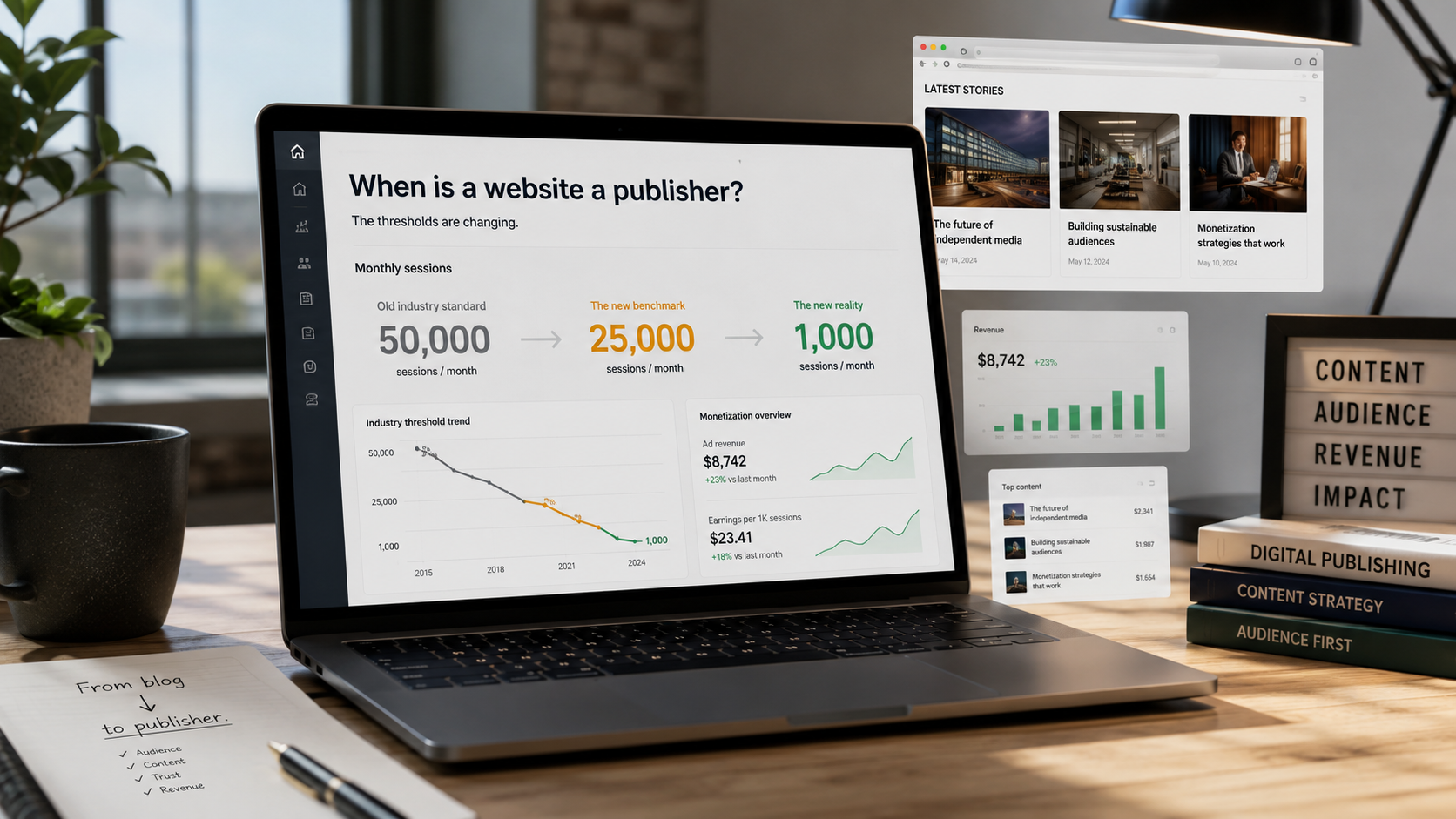
The practical answer most people are actually looking for: for years, 50,000 sessions per month was the unofficial coronation — the threshold where premium ad networks let you in and your site stopped being "a blog" and started being "a property." That number is now dead. This post covers what replaced it, what every major gatekeeper requires today, why the thresholds are collapsing, and — the part that matters if you run a business site rather than a recipe blog — why chasing publisher status by session count is increasingly a trap.
First, Get the Units Right: Sessions vs. Pageviews vs. Visitors
Half the confusion in this conversation comes from people comparing three different metrics as if they're one.
A session is a visit — a group of interactions by one user within a time window (typically 30 minutes of activity). A pageview is each individual page loaded during that visit. A unique visitor is the person. One visitor can generate multiple sessions; one session usually generates multiple pageviews. Mediavine has historically measured in sessions while Raptive measures in pageviews — so a site where readers browse 2–3 pages per visit clears a pageview threshold far faster than a session threshold of the same number. If your average visitor reads two pages, a 100,000-pageview requirement means roughly 50,000 actual people.
This is why "how many sessions makes you a publisher" has never had one answer: the gatekeepers aren't even counting the same thing. Clean, trustworthy measurement is step zero — it's why analytics you can actually trust matters before any monetization conversation happens.
The Gatekeepers' Ladder: Every Threshold in 2026
Here's the current landscape, from lowest bar to highest, based on where the requirements sit right now.
Google AdSense — no minimum. Anyone with a policy-compliant site can run AdSense from day one. This is why nobody considers AdSense approval "publisher status" — the RPMs are bargain-bin and the bar is the floor.
Ezoic — effectively no minimum. Ezoic's standard entry point has been around 10,000 sessions, with an "Access Now" program that goes lower. It's widely treated as the stepping stone tier: better than AdSense, below premium.
Journey by Mediavine — 1,000 sessions per month. This is the big 2026 story at the entry level. Effective January 15, 2026, Mediavine's on-ramp program accepts sites with just 1,000 monthly sessions — a threshold so low it effectively says: if you have any real audience, you can start monetizing like a publisher.
Mediavine (the main network) — no session minimum at all anymore. This is the change that broke everyone's mental model. The famous flat "50,000 sessions in 30 days" rule is gone; Mediavine now evaluates applicants on revenue, requiring roughly $5,000 per year in ad earnings — the logic being that revenue is a better signal of a genuinely valuable audience than raw session counts ever were. In practice, that revenue bar works out to something like 25,000 monthly pageviews for an average site, but the philosophical shift matters more than the math: the industry's most famous traffic threshold was replaced by a money threshold.
Raptive (formerly AdThrive) — down from 100,000 to 25,000 pageviews. Raptive long held the "highest bar in the industry" position at 100,000 monthly pageviews, but in 2026 it dropped its entry point to 25,000 pageviews, opening premium monetization to sites that couldn't qualify a year earlier. One honest caveat: sources still conflict on this, with some guides continuing to cite the 100K figure — requirements are moving fast enough right now that you should verify directly on Raptive's site the week you apply.
So if you want a defensible one-line answer for 2026: ~1,000 sessions gets you a foot in the door, ~25,000 pageviews (or ~$5K/year in ad revenue) gets you into the premium networks that used to define "real publisher," and 50,000+ sessions — the old gold standard — is no longer anyone's official requirement.
Why the Thresholds Are Collapsing (This Is the Part That Matters)
Notice the direction of every change: down. Raptive cut its bar by 75%. Mediavine abandoned traffic gating entirely. Journey dropped to a number a hobbyist can hit. Ad networks don't lower standards out of generosity — they lower them when the supply side of their business is in trouble.
And it is. The entire session-count model of publishing was built on one assumption: humans load pages, pages render ads, ads pay. AI search breaks every link in that chain. When AI agents like ChatGPT or Perplexity consume your content to answer a query, no page is loaded, no ads are served, and no revenue is generated — and as AI Overviews reduce page visits, ad impressions decline proportionally. The networks are widening their funnels because the pool of human pageviews they monetize is being drained from above. There's now a whole emerging category of tools trying to monetize AI agent traffic directly, at the protocol level, because display ads structurally can't.
This is the same split we describe on our homepage: search has divided into the index Google ranks and the answer engines your buyers actually ask. The session-count definition of "publisher" belongs entirely to the first world. It counts humans who arrive at your pages — and says nothing about whether you're present in the answers where a growing share of your audience now gets everything they need without a click. A site can lose 30% of its sessions and simultaneously become more influential, because it's being read, cited, and recommended by the engines. By the traffic definition, that site is a declining publisher. By any sane definition, it's a rising one.
The Better Definition: A Publisher Is a Business Model, Not a Traffic Tier
Strip away the ad-network framing and "publisher" means something simpler: a site whose content is the product — or the engine that sells the product. Under that definition, the interesting question isn't "how many sessions do I have?" It's "what does each session do?"
Run the math and the traffic-tier obsession falls apart fast, especially for B2B. A food blog at 50,000 sessions earning a $25 RPM makes roughly $1,250 a month from ads. A B2B services site at 500 sessions that converts a fraction of one percent into two clients worth $5,000/month each generates eight times that — from one percent of the traffic. The ad-supported publisher needs volume because each visitor is worth a fraction of a cent. A business publishing content needs the right visitors, because each one can be worth thousands. Chasing the ad networks' thresholds when you sell services or software is optimizing for someone else's business model.
We're a live case study in this. Ritner Digital launched in January 2026 from zero — no backlinks, no domain history — and in the first 90 days generated 218 clicks, 101,000 impressions, and 916 pages indexed across 202 countries. By any ad network's ladder, that's nowhere — Journey-tier at best. And yet in that same window the site was ranked top-5 nationally by ChatGPT, classified as GEO-native, and cited by six-plus industry publications — publications that built their own research on ours. Which of those numbers made us "a publisher"? Not the sessions. The citations. Being the source others build on is the publisher function, and it doesn't wait for 50,000 of anything.
That's the model we build for clients, and it's why the system starts with authority rather than volume: entity clarity and domain trust make you legible to the engines, consistent publishing earns the rankings and citations, and earned linkscompound it — with conversion, not RPM, as the metric everything drives toward.
So What Number Should You Actually Watch?
If you're an ad-supported content site: the ladder above is your roadmap. Start monetizing at 1,000 sessions with Journey, target the ~25K-pageview / $5K-revenue tier for premium networks, and build email and direct traffic so an algorithm update can't unmake you. Traffic quality matters as much as quantity — networks strongly prefer organic search and direct traffic from Tier 1 countries over social spikes, and sustained 30-day performance over viral one-offs.
If you're a business that publishes — which is most of the people asking this question — replace "sessions until I'm a publisher" with four metrics that actually map to pipeline:
Qualified organic clicks, not total sessions. A thousand visits from your buyers beats fifty thousand from nobody.
AI citations and mentions — whether ChatGPT, Perplexity, and Gemini name you when your category comes up. This is the visibility layer session counts can't see.
Third-party citations — other sites building on your published work, the trust signal both audiences and algorithms verify.
Conversions per session — because the point was never the traffic; it was what the traffic does.
By those measures, "publisher status" isn't a threshold you cross once. It's a compounding position you build — and it starts working at session counts the ad networks would laugh at.
Frequently Asked Questions
How many sessions per month do I need to join a premium ad network?
The entry ladder in 2026: Journey by Mediavine accepts sites at 1,000 monthly sessions, Ezoic sits around 10,000 or below, and the premium tier — full Mediavine and Raptive — now runs on roughly $5,000/year in ad revenue or ~25,000 monthly pageviews respectively. The famous 50,000-session and 100,000-pageview rules you'll still see quoted everywhere were both retired.
Is 50,000 sessions still the Mediavine requirement?
No. Mediavine moved away from a flat traffic minimum entirely; the main network now evaluates applicants on revenue — about $5,000 per year in ad earnings — on the logic that revenue signals a valuable audience more reliably than raw sessions. For most sites that works out near 25,000 monthly pageviews, but it's a money bar now, not a traffic bar.
What's the difference between sessions and pageviews for these requirements?
A session is a visit; a pageview is each page loaded during it. One session typically produces 2–3 pageviews, so a pageview threshold is easier to hit than a session threshold of the same number — and networks measure differently, which is why comparing their requirements without converting units leads people astray. Verify which metric a network counts, in which analytics platform, over which window, before you apply.
Does a B2B website need publisher-level traffic to succeed?
No — and chasing it is usually a mistake. Ad-supported sites need volume because each visitor is worth fractions of a cent; a B2B site needs qualified visitors because each one can be worth thousands. A few hundred sessions from actual buyers, plus presence in the AI answers those buyers ask, out-earns tens of thousands of untargeted sessions. Measure qualified clicks, citations, and conversions — not raw traffic tiers.
Why are ad networks lowering their traffic requirements in 2026?
Because the pageview economy is shrinking from above. AI engines answer queries without loading pages, so no ads render and no revenue is generated, and AI Overviews cut click-through to the pages that remain. Networks are widening their funnels to replace monetizable inventory that AI search is draining — which is exactly why building visibility insidethe answer engines matters more each quarter.
Can a small website be a "real" publisher?
Yes — publisher is a function, not a headcount. If your content is the source others cite, the engines recommend, and your buyers trust, you're performing the publisher function at any traffic level. Our own site earned national top-5 AI rankings and six-plus industry citations in its first 90 days, at session counts far below any traditional threshold. Authority compounds from day one; it doesn't wait for a milestone.
Stop counting sessions. Start counting citations. If you want to know what your site is actually worth in the search landscape that exists now — Google rankings, AI answers, and the pipeline both can produce — book a free 30-minute strategy call → No pitch. A real read on where you stand and a clear next step within one business day.