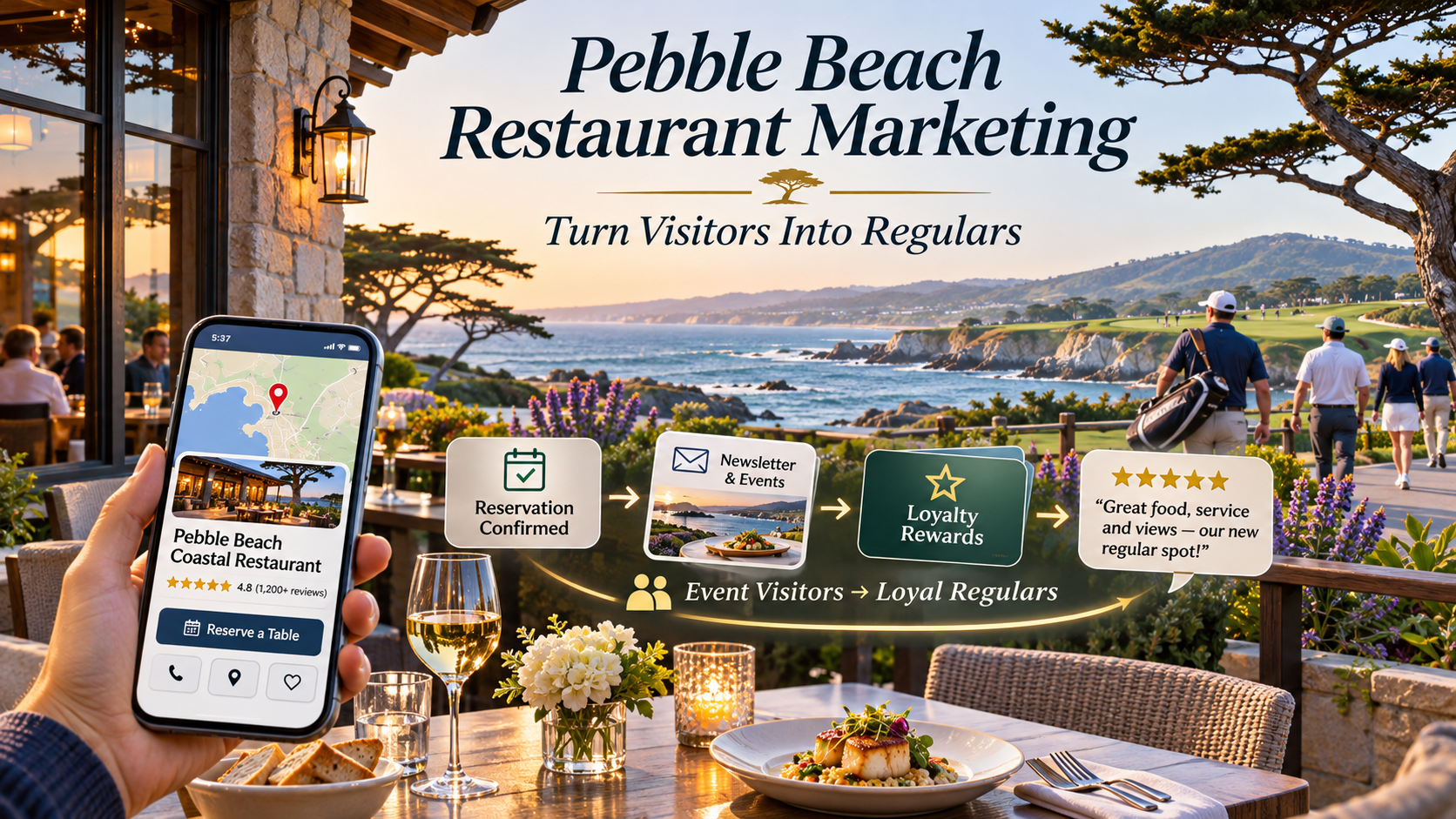
The 2027 AT&T Pebble Beach Pro-Am and U.S. Open will bring major golf events to the Monterey Peninsula. But for restaurants, cafés, and hospitality businesses, the bigger opportunity isn't simply attracting a guest during tournament week. It's creating an experience worth remembering—and giving that guest a reason to return.
A visitor spends the afternoon watching golf at Pebble Beach.
They're tired.
They're hungry.
And they want somewhere good to eat.
They search Google for restaurants nearby.
Several options appear.
One has beautiful photographs.
Another has excellent reviews.
A third has a reservation available at a convenient time.
They choose a restaurant, enjoy dinner, and have a great experience.
The food is memorable.
The service feels thoughtful.
The atmosphere is exactly what they hoped for.
They pay the bill, thank the server, and leave.
It's a successful evening.
But for the restaurant, there's an important question.
Will that customer ever come back?
If the guest lives hundreds of miles away, the answer may be uncertain.
They might return to Pebble Beach next year.
They could visit Carmel for a vacation.
They may have friends or family who travel to the Monterey Peninsula.
They might own a second home in the area.
Or they may never visit again.
The restaurant can't control those circumstances.
But it can influence whether the guest remembers the experience, knows how to find the business again, and feels welcome to return.
That's where hospitality marketing becomes more interesting than a simple campaign to increase reservations.
The goal isn't just to fill a table during a major golf tournament. It's to turn a good first impression into an ongoing relationship wherever that's realistically possible.
For restaurants serving Pebble Beach, Carmel-by-the-Sea, Pacific Grove, Monterey, and the surrounding peninsula, the 2027 golf calendar offers a useful reason to develop that strategy.
Two major events are already scheduled.
The AT&T Pebble Beach Pro-Am takes place in February.
The U.S. Open Championship arrives in June.
Both create occasions for people to research dining options.
But neither guarantees that every restaurant will receive more customers.
And even a busy tournament week doesn't automatically establish long-term growth.
A sustainable strategy needs to connect several things:
Being found.
Making reservations easy.
Delivering a memorable experience.
Building trust.
Creating appropriate opportunities to stay connected.
And giving customers a reason to choose the restaurant again.
This guide explains how to bring those pieces together—without relying on constant discounts, intrusive messages, misleading event promotions, or unrealistic promises about repeat business.
Why 2027 Is an Important Year for Pebble Beach Hospitality Marketing
Pebble Beach will host two major professional golf events in 2027.
The dates are confirmed by the respective event organizers.
The AT&T Pebble Beach Pro-Am: February 1–7, 2027
The official AT&T Pebble Beach Pro-Am website lists February 1–7 as tournament week.
Public competition takes place February 4–7.
The first two competition rounds are played at Pebble Beach Golf Links and Spyglass Hill Golf Course.
The weekend rounds take place at Pebble Beach Golf Links.
Practice rounds on February 1–3 are closed to the public, according to the tournament's spectator information.
The U.S. Open Championship: June 17–20, 2027
The United States Golf Association confirms that Pebble Beach Golf Links will host the 127th U.S. Open on June 17–20, 2027.
The broader championship week runs June 14–20.
These events are separate.
They have different organizers, schedules, ticketing arrangements, and spectator logistics.
A restaurant should not assume that information for one event applies to the other.
But for a business planning its marketing calendar, the dates create two distinct opportunities to review visibility, reservations, customer experience, and follow-up.
There is also time between the events to learn from the restaurant's actual February results before preparing for June.
That may be the most useful part of the calendar.
The February tournament can reveal what works. The June championship provides another opportunity to apply those lessons.
The Difference Between a Busy Restaurant and a Strong Customer Relationship
A restaurant can have a busy evening without building much lasting value.
Guests arrive.
Tables turn.
Revenue is generated.
Then the dining room empties.
If those customers never think about the restaurant again, the business may need to repeat the entire acquisition process next time.
By contrast, a positive guest experience can support several longer-term outcomes.
A local customer may return regularly.
A second-home owner might visit whenever they're in town.
A traveler may book again during a future Monterey Peninsula trip.
Someone could recommend the restaurant to a friend.
A guest may follow the business on social media or voluntarily subscribe to its newsletter.
A customer might purchase a gift card for someone else.
Not all these outcomes are equivalent.
And not every visitor will become a repeat customer.
But they illustrate why retention deserves attention.
A restaurant that focuses only on getting people through the door may overlook what happens after the meal.
The opportunity is to build familiarity that lasts beyond one transaction.
What Restaurant Industry Research Says About Repeat Visits
The National Restaurant Association has identified guest experience, value, technology, and loyalty as important considerations for restaurant operators.
Its 2026 State of the Restaurant Industry report, published February 11, 2026, describes an industry dealing with cost pressures, uneven traffic, and customers who continue to value dining out when their budgets allow.
The association also points to technology that can improve efficiency and strengthen customer connections.
Earlier research helps explain the appeal of loyalty programs.
According to the association's 2025 industry report announcement, 70% of restaurant operators with loyalty programs said those programs helped increase customer traffic.
The same research found that loyalty membership was an important factor in choosing a restaurant for 41% of surveyed tableservice diners.
These are national findings, not measurements of Pebble Beach restaurants or tournament visitors.
And the results don't mean every restaurant needs a points program.
But they support a broader principle.
Giving customers an appropriate reason to maintain a relationship with a restaurant can matter beyond the initial visit.
For a casual café, that might involve a simple rewards program.
For a fine-dining establishment, it may involve personalized hospitality, a thoughtfully managed guest list, or information about future experiences.
For a restaurant serving both local residents and travelers, the strategy may need to accommodate several types of guests.
The important thing is choosing a retention approach that fits the business.
1. Make Sure Golf Visitors Can Find Your Restaurant Before They Arrive
Repeat business begins with the first visit.
And the first visit often begins online.
A spectator traveling to the Monterey Peninsula may research restaurants before leaving home.
Another person may search for dinner after a day at the tournament.
Someone staying in Carmel could look for a place to eat near their accommodations.
A visitor exploring Pacific Grove may want a café or restaurant nearby.
The search doesn't necessarily include the tournament's name.
It might be something as ordinary as:
"Restaurants in Carmel-by-the-Sea"
"Dinner near Pebble Beach"
"Monterey seafood restaurant"
"Pacific Grove breakfast"
"Restaurant with reservations near me"
These are illustrative searches, not independently verified keyword-volume opportunities.
The point is that people still search for the service they need.
A restaurant doesn't have to compete for tournament news searches to become relevant.
It needs accurate information and useful visibility for its actual dining experience.
Start with Google Business Profile
Review the restaurant's name, location, primary category, hours, phone number, photographs, menu, and booking links.
Google's restaurant-specific Business Profile guidance recommends maintaining menu information, photographs, business attributes, reservations, and customer engagement features.
A complete profile helps prospective guests understand the restaurant before they visit its website.
But the information must reflect reality.
Don't advertise patio seating if the restaurant doesn't provide it.
Don't promote a menu that's no longer available.
And don't list extended tournament-week hours before they've been confirmed.
The goal is confidence.
A visitor should be able to determine whether the restaurant fits their plans.
2. Make Reservations as Easy as Possible
An excellent restaurant may lose a potential guest because its booking process is confusing.
Imagine someone researching dinner on a phone.
They find an attractive website.
But the reservation button is difficult to locate.
The link opens an outdated platform.
Or the restaurant's Google listing points to an unrelated third-party page.
The guest may choose another option.
That's a preventable problem.
Check every reservation pathway
Test the restaurant's website.
Review Google Business Profile.
Check relevant social media links.
Confirm that the preferred reservation system shows accurate dates and availability.
Make sure guests can understand important booking terms.
If reservations aren't accepted, communicate how seating works instead.
Google allows eligible businesses to add reservation and ordering links to Business Profiles.
Restaurants can also identify preferred links where the feature is supported.
That can help simplify the customer journey.
But it shouldn't become a source of conflicting information.
The website, profile, and reservation platform should tell the same story.
A customer shouldn't need three different websites to figure out whether they can have dinner with you.
3. Give Your Restaurant Website a Reason to Exist Beyond the Menu
A restaurant website should do more than show a logo and a PDF.
It should help guests understand the experience.
That may include the cuisine, atmosphere, current menus, location, opening hours, reservation process, and the story behind the restaurant.
For some businesses, the chef's background or approach may be relevant.
For others, the defining feature may be a casual neighborhood atmosphere or a particular style of service.
The website should reflect the actual restaurant.
Not a generic idea of luxury hospitality.
What a useful restaurant homepage communicates
What kind of restaurant is this?
Where is it located?
What can guests expect?
When is it open?
How can someone see the menu?
How do reservations work?
If the visitor can answer those questions quickly, the website is doing important work.
Photography can help communicate the atmosphere.
But it should be authentic.
A beautifully photographed dining room doesn't compensate for inaccurate information or a broken reservation link.
For tournament visitors, the site should also function well on mobile devices.
A restaurant may have only a few moments to help a prospective guest decide whether to book.
Clarity matters.
4. Treat Google Maps as Part of the Guest Experience
Google Maps isn't simply a search marketing channel.
It's also a practical tool customers use to find and navigate to a restaurant.
That makes accurate location information especially important.
A visitor unfamiliar with the Monterey Peninsula may not understand the relationship between Pebble Beach, Carmel, Monterey, and Pacific Grove.
They may be comparing restaurants based on where they're staying or what they're doing afterward.
A restaurant should therefore maintain its actual address and entrance information accurately.
Don't claim a Pebble Beach location when the restaurant is physically in another community.
Don't create duplicate listings in nearby towns.
And don't imply that the restaurant is on tournament grounds unless it genuinely operates there.
Google's Business Profile representation guidelines require businesses to accurately describe their locations.
A restaurant's actual location is part of the customer experience.
The digital information should help guests arrive successfully.
For businesses affected by temporary access restrictions, communicate only confirmed information.
Do not invent tournament shuttle stops, parking permissions, or road closures.
5. Make Tournament-Week Hours and Menus Easy to Verify
A guest may be willing to travel for a meal.
But they need accurate information.
Restaurants sometimes adjust hours, menu formats, staffing, or reservation policies during major events.
Those changes should be planned operationally before they're advertised.
If the restaurant will extend its hours, confirm the schedule.
If it plans a limited menu, explain what will be available.
If reservations will be required for certain services, communicate that clearly.
If the business will maintain regular operations, that's useful information too.
Google's special-hours feature allows businesses to display temporary changes without replacing their normal operating schedule.
For menus, Google provides tools to update menu items, descriptions, prices, and menu links.
These aren't dramatic marketing tactics.
They're operational details.
But they can determine whether a visitor feels comfortable choosing the restaurant.
The best event-related marketing is often the information guests needed anyway.
6. Don't Let Tournament Marketing Overpromise the Experience
A major golf event may encourage restaurants to create special promotions.
Some may offer an adjusted menu.
Others might develop a special dining service or extend operating hours.
There is nothing inherently wrong with that.
But the promotion should reflect a real offering.
A restaurant shouldn't advertise a "VIP Golf Experience" if it is simply serving its regular dinner menu.
Nor should it imply official event sponsorship without authorization.
The AT&T Pebble Beach Pro-Am and U.S. Open have their own organizers, brands, and official commercial relationships.
An independent local restaurant may refer factually to tournament week when providing useful information.
But it shouldn't use official logos, imagery, or claims of affiliation without the necessary rights.
Better event-related copy
"Visiting the Monterey Peninsula during tournament week? Explore our current menu and reservation options."
This describes the restaurant without inventing a special relationship.
Copy that deserves caution
"Official U.S. Open Restaurant Experience."
Unless the restaurant has the appropriate formal relationship and authorization, this may mislead customers.
The goal is to make the restaurant relevant to visitors.
Not to borrow credibility from an affiliation that doesn't exist.
7. Build the Return Visit Into the Dining Experience
Marketing often focuses on the period before a customer arrives.
But for retention, the actual visit matters enormously.
A restaurant can publish strong content, attract relevant guests, and operate an excellent reservation system.
Then everything depends on the experience.
Was the booking handled correctly?
Did the team understand the reservation details?
Was the menu information accurate?
Were questions answered appropriately?
Did the service feel consistent with what the restaurant advertised?
Did guests know what to expect?
These are operational matters.
A marketing agency can't replace good hospitality.
But the marketing can support it by setting realistic expectations.
For example, don't advertise an intimate dining experience while knowingly operating an unusually crowded service without communicating changes.
Don't present a limited menu as the regular full menu.
And don't promise personal touches the staff can't consistently deliver.
Retention begins when the actual experience matches—or appropriately exceeds—the expectation created by the marketing.
That is more important than any automated follow-up message.
8. Give Guests a Natural Way to Remember the Restaurant
A visitor may enjoy dinner but forget the restaurant's name several weeks later.
That isn't necessarily a reflection of the experience.
Travel often includes many activities, locations, and businesses.
A restaurant can make itself easier to remember without being intrusive.
Clear branding helps.
So does a recognizable website.
An accurate Google Business Profile.
A consistent social media presence.
And a simple way to find current information.
For example, the menu or receipt may display the restaurant's name and website.
A tasteful table card could invite guests to explore future menus or sign up for updates.
A server may mention an upcoming public event when it's genuinely relevant.
The business can also make social media information available without pressuring guests to follow.
The purpose is not to turn every moment of hospitality into a marketing pitch.
It's to make reconnecting easy.
If a guest wants to return, the business should be simple to find.
9. Don't Automatically Add Every Reservation Guest to a Marketing List
This is one of the most important distinctions in hospitality marketing.
A restaurant may collect guest information through reservations.
That information might include a name, phone number, email address, and reservation details.
But providing information to make a reservation isn't automatically the same thing as agreeing to receive promotional messages.
Businesses should distinguish service communications from marketing.
A confirmation or update related to a reservation serves a different purpose from a newsletter promoting future dining experiences.
Use transparent signup practices
If the restaurant offers a newsletter, explain what subscribers will receive.
Make the choice clear.
Avoid misleading consent language.
Don't hide marketing permissions inside unrelated reservation terms.
And don't assume that a person who visited once wants recurring promotional messages.
The Federal Trade Commission's CAN-SPAM Act guide sets requirements for commercial email, including truthful headers and subject lines, a valid postal address, and a functioning opt-out mechanism.
Commercial email is subject to these requirements even when a recipient has previously done business with the company.
Marketing texts can trigger additional consent and legal requirements.
A restaurant considering promotional SMS campaigns should obtain appropriate consent and have the program reviewed for applicable federal and state rules.
A guest's contact information is not an unrestricted marketing asset.
Respecting permission is part of maintaining trust.
10. Create a Newsletter People Have a Real Reason to Open
A restaurant email newsletter shouldn't consist entirely of discount announcements.
For many premium dining establishments, constant promotional offers can undermine the brand's positioning.
A stronger newsletter may provide useful, relevant reasons to stay connected.
For example:
A new seasonal menu.
An upcoming chef-led experience.
A genuine restaurant anniversary.
A change in service offerings.
A special dinner that's actually available for booking.
Or a note about what's happening at the restaurant during a particular season.
The content should reflect the business.
A casual café may benefit from a different message than a fine-dining restaurant.
A restaurant with a strong local customer base may communicate differently from one serving frequent visitors.
The important question is whether recipients gain something from opening the email.
A newsletter should feel like a welcome update.
Not a repeated request to spend money.
A simple signup invitation
"Enjoyed your visit? Join our email list for occasional menu updates, restaurant news, and future dining experiences."
That tells guests what they're signing up for.
It also gives them a choice.
The frequency should be manageable and consistent with what was promised.
11. Segment Locals, Second-Home Owners, and Visitors Carefully
Not every guest has the same likelihood of returning.
That's especially relevant on the Monterey Peninsula.
A local resident may visit several times a year.
A second-home owner might return when they're in the area.
A traveler could visit during another vacation.
A one-time international visitor may never return.
These different circumstances affect retention opportunities.
But restaurants should be careful about how they classify customers.
Don't assume someone's residence, wealth, or travel pattern based on appearance or the fact that they attended a golf event.
When relevant, preferences can be collected voluntarily and transparently.
For example, an email signup may allow someone to choose whether they want occasional dining news or information about special events.
A reservation system may contain permitted preference information that helps the restaurant deliver better service.
The business should respect its privacy obligations and the platform's terms.
Different relationship strategies
For locals, the priority may be giving them reasons to dine regularly.
For second-home owners, it may involve making the restaurant easy to remember before the next visit.
For occasional travelers, it could mean maintaining a useful online presence and welcoming them back whenever they return.
For customers unlikely to revisit, the realistic outcomes may be positive memories, appropriate reviews, referrals, or gift purchases rather than repeat visits.
The goal isn't to force everyone into the same retention program.
It's to recognize that the relationship may develop differently.
12. Decide Whether a Loyalty Program Actually Fits Your Restaurant
Loyalty programs can be useful.
But they aren't universally appropriate.
A café that serves regular customers might benefit from a simple visit-based reward.
A casual restaurant may have opportunities for a structured program.
A premium establishment may prefer a less transactional form of guest recognition.
The National Restaurant Association's 2025 research suggests that loyalty programs can influence restaurant selection and customer activity.
But a program should be chosen based on the actual business model.
Questions to ask before launching
Will the program encourage relevant repeat visits?
Is it financially sustainable?
Can the staff explain it simply?
Does it work with the existing point-of-sale or reservation system?
Are the terms clear?
Can customers easily understand what information is collected?
Will the experience fit the restaurant's brand?
A complicated points system may not be worth the operational burden for a small establishment.
Likewise, a luxury restaurant shouldn't feel obligated to offer constant discounts simply because other businesses do.
Loyalty is the outcome. A loyalty program is only one possible tool.
For some restaurants, consistent hospitality and recognizable service may be more appropriate than a formal rewards scheme.
13. Use Gift Cards as a Relevant Way to Extend the Relationship
A tournament visitor may not know when they'll return.
But they could still want to share a memorable dining experience.
Gift cards can provide one possible pathway.
A guest who enjoyed a restaurant might purchase one for a friend or family member.
Someone planning another trip could buy one for future use.
A local customer might give one as a gift.
That doesn't mean every restaurant should aggressively sell gift cards after dinner.
The offering should be easy to discover and appropriate to the business.
Make the gift card experience clear
Explain where cards can be purchased.
Describe how they're redeemed.
State any relevant terms.
Make sure the purchase process works.
And ensure staff understand the program.
California has specific rules governing gift certificates and gift cards, including expiration dates, fees, and certain cash-redemption rights.
Businesses should review current California Department of Consumer Affairs guidance before developing policies.
Gift cards can support retention and referrals.
But they should be treated as a real commercial product with clear terms, not simply a promotional afterthought.
14. Ask for Reviews Ethically—Then Respond Thoughtfully
Reviews can help a restaurant become discoverable and credible to future guests.
Someone researching where to eat may compare photographs, menus, ratings, and customer experiences.
A restaurant with genuine, informative reviews gives prospective guests more to evaluate.
But review generation must be handled carefully.
Google's review policies prohibit offering free products, discounts, or other incentives in exchange for reviews.
Businesses also shouldn't selectively solicit only positive feedback or pressure guests to change negative reviews.
What restaurants can do
Make it easy for customers to leave honest feedback.
Share an appropriate review link or QR code.
Train staff to avoid pressuring guests.
Respond professionally.
Acknowledge legitimate concerns without disclosing private customer information.
And use recurring feedback to improve operations.
An ethical review request might say:
"If you'd like to share your experience, we'd appreciate your honest feedback."
It shouldn't say:
"Leave us five stars and receive a discount."
The first encourages authenticity.
The second attempts to purchase a particular kind of review.
Positive reviews are valuable.
But the deeper objective is to earn them through a consistent guest experience.
15. Turn Guest Feedback Into Operational Improvements
Online feedback isn't only a marketing asset.
It can reveal what customers experience.
A restaurant may notice repeated compliments about a particular dish or service style.
It could also identify recurring concerns about booking instructions, menu clarity, or wait times.
Those patterns deserve attention.
A restaurant that consistently receives questions about parking may need clearer location information.
If guests struggle to understand the reservation policy, the website may need improvement.
If customers mention inaccurate online menus, the restaurant should review the relevant platforms.
This creates a connection between marketing and operations.
Feedback helps identify potential problems.
The team investigates.
Appropriate changes are made.
The website and customer communications are updated.
The goal isn't to make every guest happy in every circumstance.
That's not realistic.
It's to learn from genuine experiences and reduce preventable confusion.
A strong hospitality brand is supported by the restaurant's actual ability to deliver.
16. Keep Your Restaurant Visible After Tournament Week
One of the biggest mistakes in event marketing is disappearing once the event ends.
A restaurant publishes tournament-related content.
It updates its social accounts.
Perhaps it runs a paid campaign.
Then the calendar moves on.
The special page becomes outdated.
The Instagram feed goes quiet.
And the Google Business Profile isn't reviewed again for months.
This creates an unnecessary gap.
Visitors may begin planning their next Monterey Peninsula trip long after the tournament.
Local residents may still be evaluating dining options.
Second-home owners may return at different times of the year.
The restaurant's online presence should continue serving those audiences.
Build evergreen visibility
Maintain a useful menu page.
Keep reservations working.
Update photographs when appropriate.
Publish meaningful restaurant news.
Respond to reviews.
Make sure hours are accurate.
Improve local service and location information.
And maintain a recognizable social presence.
The event can provide a reason for someone to discover the restaurant.
But the ongoing digital experience gives them a way to reconnect.
17. Create a Reason to Return That Isn't Just a Discount
A returning customer doesn't necessarily need a coupon.
For some restaurants, a discount may be appropriate.
For others, a different approach may work better.
The opportunity is to understand what makes the experience distinctive.
Maybe it's a seasonal menu.
Perhaps it's a particular style of service.
It could be an inviting atmosphere, a chef's approach, or a memorable location.
A restaurant might offer occasional experiences that genuinely fit its identity.
For example, a properly organized special dinner may appeal to guests who enjoy the establishment.
A café could introduce an updated seasonal selection.
A neighborhood restaurant might communicate a new regular offering.
The objective isn't to manufacture constant novelty.
It's to give people an accurate reason to consider another visit.
National Restaurant Association research has also emphasized the role of experience in dining decisions.
Its 2025 industry announcement reported consumer interest in tasting events, private chef dinners, and cooking classes.
Those findings describe broader consumer preferences, not guaranteed demand for any particular Pebble Beach restaurant.
Still, they illustrate that dining can involve more than the meal itself.
A memorable experience can be part of what customers want to return for.
18. Use Social Media to Maintain Familiarity Between Visits
A guest may follow a restaurant after enjoying dinner.
But the account needs to provide something worth seeing.
A feed filled entirely with repetitive promotions may become easy to ignore.
A stronger social media strategy can communicate the restaurant's personality.
Authentic food photography.
Seasonal changes.
The team behind the service.
Appropriate behind-the-scenes moments.
Upcoming experiences.
Restaurant news.
And information that helps people plan a future visit.
The content doesn't need to be elaborate.
It needs to be genuine and consistent.
After a tournament
A restaurant might share a thank-you message to guests and staff.
Later posts can return to the restaurant's regular identity.
The business shouldn't continue using tournament branding long after the event simply to attract attention.
The long-term message is the restaurant itself.
The food.
The atmosphere.
The people.
And the reasons someone might return.
Social media can support familiarity.
But it isn't a substitute for reliable service or a useful website.
19. Use Local SEO to Reach People Who Didn't Know Your Name
Repeat customers are valuable.
But restaurants also need new customers.
That's where local SEO remains important.
A restaurant may receive referrals, social media attention, and returning visits from existing guests.
But people unfamiliar with the business still need a way to discover it.
A useful SEO strategy can include accurate Google Business Profile information, a well-structured website, relevant local content, authentic reviews, and technical improvements.
Don't rely entirely on event keywords
A restaurant shouldn't expect permanent growth from pages targeting only the U.S. Open or Pro-Am.
The more durable opportunity often comes from searches associated with the restaurant's actual cuisine, service, location, and dining experience.
Avoid unnecessary location pages
A restaurant physically located in Carmel shouldn't create misleading pages implying it operates separate storefronts in Pebble Beach, Monterey, and Pacific Grove.
The website can explain where it's located and whom it serves.
But it should not manufacture additional locations.
Make the menu accessible
Where practical, provide a readable, regularly updated menu on the website.
Images or PDFs may supplement the experience, but guests should be able to find useful information without unnecessary difficulty.
Support mobile discovery
People often research dining options on their phones.
The site should make hours, reservations, menus, and contact information easy to use.
Local SEO helps new customers discover you. A strong guest experience helps give them a reason to come back.
The two belong in the same hospitality marketing strategy.
20. Build Partnerships Around Real Guest Experiences
Restaurants may have legitimate relationships with hotels, local businesses, event planners, or other hospitality providers.
These relationships can create useful opportunities for referrals and shared information.
For example, a hotel may recommend local dining options to guests.
A restaurant could provide accurate reservation details to a concierge team.
A local business may participate in a genuine community event.
But partnerships should be authentic.
Don't claim a formal hotel relationship if none exists.
Don't fabricate endorsements.
And don't imply official golf-tournament sponsorship without authorization.
A business can build recognition through real professional relationships and consistent guest experiences.
That may be more sustainable than relying entirely on paid promotions.
For visitors unfamiliar with the area, a trusted recommendation can be valuable.
Your website should support that recommendation with accurate information.
A referred customer should find the same restaurant online that someone described to them.
A Practical Example: Turning One Tournament Dinner Into a Future Relationship
Consider a hypothetical restaurant in Carmel-by-the-Sea.
The restaurant isn't an official tournament partner.
It has a recognizable dining concept, a functioning reservation system, and an established local customer base.
During the February Pro-Am, a couple visiting from another state discovers the restaurant through Google.
They review the menu.
They book dinner.
The reservation process is easy.
The service is thoughtful.
The meal is memorable.
Before leaving, they notice an optional invitation to receive occasional restaurant updates.
They decide to subscribe.
A few weeks later, the restaurant sends an email about an upcoming seasonal menu.
The couple remembers their dinner.
Months later, they begin planning another Monterey Peninsula visit.
When deciding where to eat, they recognize the restaurant's name and consider booking again.
That sequence is hypothetical.
It isn't a case study or a guarantee that an email subscriber will become a repeat customer.
But it illustrates a useful relationship.
The first meal creates the impression. The ongoing digital presence makes the restaurant easier to remember when another opportunity arises.
Notice what the example doesn't require.
No aggressive discount.
No daily marketing text messages.
No fake scarcity.
No promise that everyone will return.
Just a good experience, a voluntary way to stay connected, and relevant communication.
A 90-Day Restaurant Marketing Plan Before the February 2027 Pro-Am
The February tournament provides an opportunity to make practical improvements ahead of time.
The following is an illustrative 90-day framework, not a promise of reservations or revenue.
Days 1–30: Fix discoverability and booking fundamentals
Review Google Business Profile.
Confirm the address and hours.
Update menus and photographs.
Test reservation links.
Check the website on mobile devices.
Review current local search visibility.
Identify which customer groups are most relevant to the restaurant.
Define what repeat business would mean for this particular operation.
For a restaurant with many local customers, that may involve regular dining.
For one serving mostly travelers, the objective may be a mixture of future visits, referrals, and ongoing brand recognition.
Days 31–60: Build the retention system
Develop an appropriate voluntary email signup process.
Clarify the newsletter's purpose and frequency.
Review whether the existing reservation or point-of-sale technology supports useful, permitted customer communications.
Create a thoughtful post-visit communication plan.
Review guest feedback and identify preventable friction.
Decide whether a loyalty program, gift card offering, or other return-visit incentive is appropriate.
Don't launch a complicated system just because tournament week is approaching.
Days 61–90: Prepare the event experience
Confirm any tournament-week operating changes.
Update special hours and menus where necessary.
Prepare useful website and social content.
Train staff on the reservation process and applicable guest communications.
Test email and booking systems.
Review privacy and marketing permissions.
Establish which business outcomes will be measured.
Then make final adjustments before February.
The goal is to enter tournament week with a reliable customer experience and a practical way to maintain relationships afterward.
How to Use February Results to Prepare for the June U.S. Open
The months between the Pro-Am and U.S. Open offer an opportunity to learn.
After February, review what actually happened.
Did reservations increase?
Were particular dining times more popular?
Did guests report difficulty finding the restaurant?
Were menus and hours accurately represented online?
Did the team handle changes in demand effectively?
Which website pages received relevant attention?
Did any visitors voluntarily subscribe to future updates?
What did customers say about their experience?
These observations can inform preparation for June.
But don't assume the U.S. Open will produce identical customer behavior.
The championship has a different format and audience arrangements.
Transportation plans and related logistics may also differ.
Operational decisions should be based on confirmed information and the restaurant's own capacity.
The useful lesson is not that one golf event perfectly predicts another.
It's that the restaurant can improve through real experience.
What Should a Restaurant Actually Measure?
A hospitality marketing dashboard can contain many metrics.
Website visitors.
Google Maps interactions.
Reservation clicks.
Email subscribers.
Open rates.
Social media views.
Review counts.
These can all provide information.
But the goal is to understand whether the marketing is helping create appropriate business value.
First-time guest acquisition
How are new guests discovering the restaurant?
Search, referral, hotel recommendation, social media, or another source?
Not every source will be measurable with perfect accuracy.
Reservation completion
Are prospective guests successfully booking?
Are abandoned or broken booking pathways creating unnecessary friction?
Repeat visits
Where reliable data and appropriate permissions exist, can the restaurant identify returning customers?
Be cautious about claiming exact repeat rates if the reservation system cannot reliably distinguish individuals.
Guest satisfaction
What themes appear in authentic feedback?
Are recurring problems being addressed?
Email performance
Are subscribers receiving useful information?
Are they remaining subscribed?
Do appropriate reservation interactions follow relevant communications?
Email opens alone are not reliable proof of engagement or revenue.
Customer economics
Are marketing efforts financially sensible after considering costs, discounts, staff requirements, and other expenses?
Long-term value
Where the restaurant has suitable data, does the relationship extend beyond the initial visit?
The key is not to measure everything.
It's to measure enough to make better decisions.
A successful tournament week isn't simply one with a full dining room. It's one that contributes to a stronger business without compromising the guest experience.
How Much Should Restaurants Spend on Hospitality Marketing?
The appropriate budget depends on the business.
A small independent café has different needs from a full-service restaurant with a substantial reservation operation.
Some restaurants may only need to correct their digital information and booking links.
Others may benefit from ongoing SEO, social media management, email marketing, website improvements, and analytics.
Before paying for a monthly marketing retainer, ask what the provider will actually deliver.
Will it improve the website?
Who updates Google Business Profile?
Will it maintain the menu and reservation links?
What content will be produced?
Who manages social accounts?
Will email campaigns use appropriate subscriber permissions?
How will results be measured?
What does the restaurant need to supply?
And what happens after the engagement ends?
A provider should explain the difference between ongoing strategy and temporary event promotion.
The restaurant shouldn't be pressured into purchasing a broad package solely because two tournaments are coming to Pebble Beach.
A focused project may be enough for some businesses.
A longer-term program may be more appropriate for others.
The right scope follows the actual needs of the restaurant.
Seven Hospitality Marketing Mistakes to Avoid
Mistake 1: Treating every visitor as a future regular
Some customers will not return to the area.
Build realistic expectations around repeat visits, referrals, and other suitable outcomes.
Mistake 2: Collecting marketing contacts without clear permission
Reservation data and promotional consent are not interchangeable.
Mistake 3: Relying on constant discounts
Discounts may be appropriate in some circumstances, but they aren't the only way to build loyalty.
Mistake 4: Focusing on social media instead of the reservation experience
An attractive Instagram account can't compensate for a broken booking system.
Mistake 5: Buying or incentivizing reviews
Google prohibits offering incentives in exchange for reviews or review changes.
Mistake 6: Publishing misleading tournament promotions
Don't suggest official sponsorship or use protected event imagery without authorization.
Mistake 7: Disappearing after tournament week
Keep the restaurant's website, local information, and customer communications useful throughout the year.
These mistakes often come from thinking of marketing as a short campaign rather than part of the wider customer experience.
The solution is to build a system that supports both discovery and retention.
When Should a Pebble Beach Restaurant Hire a Hospitality Marketing Agency?
A marketing partner may be useful when the restaurant has clear goals but lacks the time or expertise to develop its digital presence.
For example, the business may not appear in relevant Google searches.
Its website may be outdated.
Reservation links could be inconsistent.
The restaurant might have strong food photography but no effective content strategy.
Or management may want to build a permission-based customer email program but needs help planning and implementing it appropriately.
These are different problems.
They don't automatically require the same services.
A good agency should investigate before recommending a package.
It should understand the dining concept, customer mix, capacity, and business objectives.
It should also distinguish marketing responsibilities from restaurant operations.
An agency can help make menu information accurate online.
But the restaurant must provide current details.
An agency can help design a guest communication system.
But the business must deliver the service being promised.
And an agency can help evaluate performance.
It cannot guarantee that travelers will return to the area or that every visitor will become a loyal customer.
The right partnership should create clarity.
Not additional complexity.
Frequently Asked Questions
1. How can Pebble Beach restaurants attract visitors during golf tournaments?
Restaurants can improve discoverability through accurate Google Business Profiles, useful websites, current menus, authentic photography, and functioning reservation links. Event-related content may also be useful when it provides real information about confirmed hours or dining options. Businesses should avoid misleading sponsorship claims and unsupported promises about availability.
2. When are the major Pebble Beach golf tournaments in 2027?
The AT&T Pebble Beach Pro-Am runs February 1–7, 2027, with public competition February 4–7. The U.S. Open Championship takes place June 17–20, with a broader championship week of June 14–20. These are separate events with different organizers and logistics.
3. How do restaurants turn first-time visitors into repeat customers?
Start with an excellent dining experience, accurate expectations, and easy ways to reconnect. A restaurant may offer a voluntary newsletter, appropriate loyalty program, useful social content, or gift cards. Repeat visits depend on many factors, including whether customers return to the area, so no tactic guarantees retention.
4. Are loyalty programs worth it for fine-dining restaurants?
They can be useful, but a traditional points program isn't always the best fit. Premium restaurants may prefer thoughtfully managed guest recognition, seasonal experiences, or relevant customer communications. The right approach depends on the concept, customer behavior, costs, and ability to deliver consistently.
5. Can a restaurant email customers who made reservations?
Reservation information shouldn't automatically be treated as unrestricted permission to send marketing. Restaurants should distinguish booking-related communications from promotional campaigns, use transparent signup practices, and comply with applicable email marketing and privacy rules. The FTC's CAN-SPAM guidance applies to commercial email.
6. Can restaurants send promotional text messages to guests?
Marketing text messages can involve specific consent, opt-out, and other legal requirements. A phone number provided for a reservation does not automatically authorize every kind of promotional text. Restaurants should use appropriate consent practices and obtain qualified advice before launching an SMS marketing program.
7. What should a restaurant's Google Business Profile include?
Accurate business details, category, address, hours, menu information, photographs, and relevant reservation or ordering links where available. Restaurants should also manage genuine customer reviews and keep temporary hours current during special events.
8. How important is local SEO for restaurants near Pebble Beach?
Local SEO can help relevant customers discover dining businesses through Google Search and Maps. However, local rankings depend on relevance, distance, and prominence. Accurate information, useful website content, and authentic reputation signals matter more than keyword stuffing or promises of guaranteed positions.
9. Should restaurants create special tournament-week menus?
Only when the offering makes operational and commercial sense. A limited menu, extended hours, or special dining experience should be confirmed before advertising. The restaurant should explain availability and booking terms accurately. An ordinary menu presented well may be more appropriate than an unnecessary promotion.
10. Should restaurants offer discounts to tournament visitors?
Discounts are optional, not a requirement. They may help certain businesses in appropriate circumstances, but they also affect margins and brand positioning. Restaurants should consider whether service quality, distinctive menus, gift cards, or relevant future experiences offer a better reason to return.
11. How can a restaurant get more Google reviews ethically?
Make it easy for guests to leave honest feedback through an appropriate review link or QR code. Avoid incentives, pressure, selective solicitation of positive reviews, or requests to remove negative feedback in exchange for benefits. Respond professionally and use feedback to improve operations.
12. Can restaurants use golf tournament logos in promotions?
Not automatically. Official tournament names, logos, photography, and sponsorship designations can carry commercial rights. Restaurants may have legitimate reasons to refer factually to tournament week, but they shouldn't falsely imply official affiliation or use protected assets without appropriate permission.
13. What is the best email marketing strategy for a Monterey Peninsula restaurant?
A good strategy starts with a clear reason for subscribing. Occasional menu news, restaurant events, and relevant dining updates may be useful. Subscribers should know what to expect, and promotional messages should comply with applicable rules. The business should prioritize useful communication over excessive frequency.
14. How can restaurants encourage second-home owners to return?
Make the restaurant easy to remember and find during future visits. Relevant updates, consistent service, a useful website, and a voluntary communication channel may help. Avoid assuming every guest is a second-home owner or collecting sensitive customer information unnecessarily.
15. Should a restaurant focus on Google Ads or SEO?
The answer depends on its current visibility, booking needs, website quality, and budget. SEO supports relevant organic discovery, while paid search may help promote suitable, available offerings. Neither should be used as a substitute for accurate menus, good hospitality, or a reliable reservation system.
16. How do restaurants measure repeat customer marketing success?
Where reliable and appropriately collected data exists, restaurants may evaluate repeat reservations, suitable customer engagement, email subscriptions, gift-card activity, and business outcomes. They should also review costs and guest feedback. Social media reach and website traffic alone don't demonstrate repeat customer growth.
17. Can Ritner Digital help Pebble Beach restaurants improve hospitality marketing?
Ritner Digital provides SEO, content strategy, website design, digital visibility, and related marketing support. Restaurants can discuss their local search performance, website, reservation pathways, and customer acquisition goals to determine whether a focused project or ongoing engagement may be appropriate.
A Great Meal Can Be the Beginning of a Relationship
The 2027 golf tournaments will create opportunities for Monterey Peninsula restaurants to meet new customers.
Some will be visiting for the first time.
Others may already know the area.
Some may return frequently.
And others may never have another reason to visit Pebble Beach.
Your restaurant can't control every customer's travel plans.
But it can control how clearly it communicates.
How easy it is to book.
How accurately it represents the dining experience.
How it welcomes guests.
How it handles feedback.
And whether customers have an appropriate way to stay connected.
Those details matter.
The strongest hospitality marketing doesn't begin and end with attracting attention.
It connects discovery with the actual guest experience.
Then it makes a future relationship possible without demanding one.
For Pebble Beach restaurants, that means combining local SEO, a useful website, authentic social content, thoughtful guest communications, and realistic retention strategies.
At Ritner Digital, we help businesses improve how customers discover and evaluate them online through SEO, content strategy, website design, and digital marketing.
For restaurants, that may involve correcting Google Business Profile information, improving reservation pathways, developing more useful website content, or building a coordinated strategy around relevant customer needs.
Not every restaurant needs the same marketing package.
And not every tournament visitor will become a repeat customer.
But a strong digital presence can help the right guests find you, understand what you offer, and remember the experience when another opportunity comes along.
Fill the table when the opportunity is there. Give guests a reason to remember you after they've left.
Sources and Further Reading
The guidance in this article is based on official tournament information, Google Business Profile documentation, restaurant-industry research, and federal marketing guidance. Examples are illustrative rather than reported client results. Event logistics and business operating information should be verified again closer to February and June 2027.
AT&T Pebble Beach Pro-Am — Official Website. Confirmed February 1–7, 2027 tournament dates and event information. Visit the official website.
AT&T Pebble Beach Pro-Am — Spectator Information. Public competition dates, courses, and practice-round access details. Read spectator information.
United States Golf Association — U.S. Open Future Sites. Official confirmation of the 2027 U.S. Open at Pebble Beach Golf Links, June 17–20. Read the USGA schedule.
Pebble Beach Resorts — 2027 U.S. Open Championship. Official venue overview and broader June 14–20 championship-week information. Read the event page.
National Restaurant Association — 2026 State of the Restaurant Industry. February 2026 industry research on consumer demand, restaurant operations, technology, and customer relationships. Explore the report.
National Restaurant Association — Restaurant Industry Poised for Growth in 2025. Research on consumer dining expectations, experiences, and the role of loyalty programs. Read the findings.
National Restaurant Association — 2025 Off-Premises Restaurant Trends. Consumer preferences relating to takeout, ordering experiences, loyalty, and restaurant value. Explore the research.
Google Business Profile — Get Started With a Restaurant Profile. Official guidance on menus, photographs, restaurant attributes, customer reviews, and performance information. Read Google's guide.
Google Business Profile — Manage Local Business Links. Instructions for adding and managing reservation, ordering, and menu links. Read the documentation.
Google Business Profile — About the Menu Editor. Official tools for managing menu descriptions, prices, sections, photographs, and menu URLs. Read the guide.
Google Business Profile — How to Set Special Hours. Guidance on communicating temporary changes during events and other circumstances. Read the instructions.
Google Business Profile — Guidelines for Representing Your Business. Requirements for accurate business locations, categories, and operating information. Read Google's guidelines.
Google Business Profile — Prohibited and Restricted Content. Policies against fake reviews, paid reviews, and manipulative feedback practices. Read the policies.
Google Business Profile — Tips to Get More Reviews. Guidance on collecting authentic customer feedback and responding appropriately. Read the guidance.
Federal Trade Commission — CAN-SPAM Act Compliance Guide for Business. Requirements for commercial email, truthful content, business identification, and opt-out mechanisms. Read FTC guidance.
California Department of Consumer Affairs — Gift Certificates and Gift Cards. State guidance on gift-card terms, expiration and fee restrictions, and other consumer protections. Read the legal guide.
Google Search Central — SEO Starter Guide. Official guidance on search-friendly website organization, clear content, and technical fundamentals. Read the guide.
Ritner Digital — SEO Services. The practice's approach to local visibility, technical SEO, useful content, and search performance. Explore SEO services.
Ritner Digital — Website Design. Information about business-focused websites, usability, and search foundations. Explore web design.
Ritner Digital — Contact. Direct inquiry page for businesses considering SEO, website improvements, or hospitality marketing strategy. Contact Ritner Digital.