How Smart Brands Are Using AI to Turn One Piece of Content into 20
Here's an equation most marketing teams aren't running. A single well-researched, thoroughly edited blog post takes four to six hours of human work to produce well. It gets published, shared once or twice on social, maybe sent in an email newsletter, and then quietly retires from active duty — accessed only by people who find it through search.
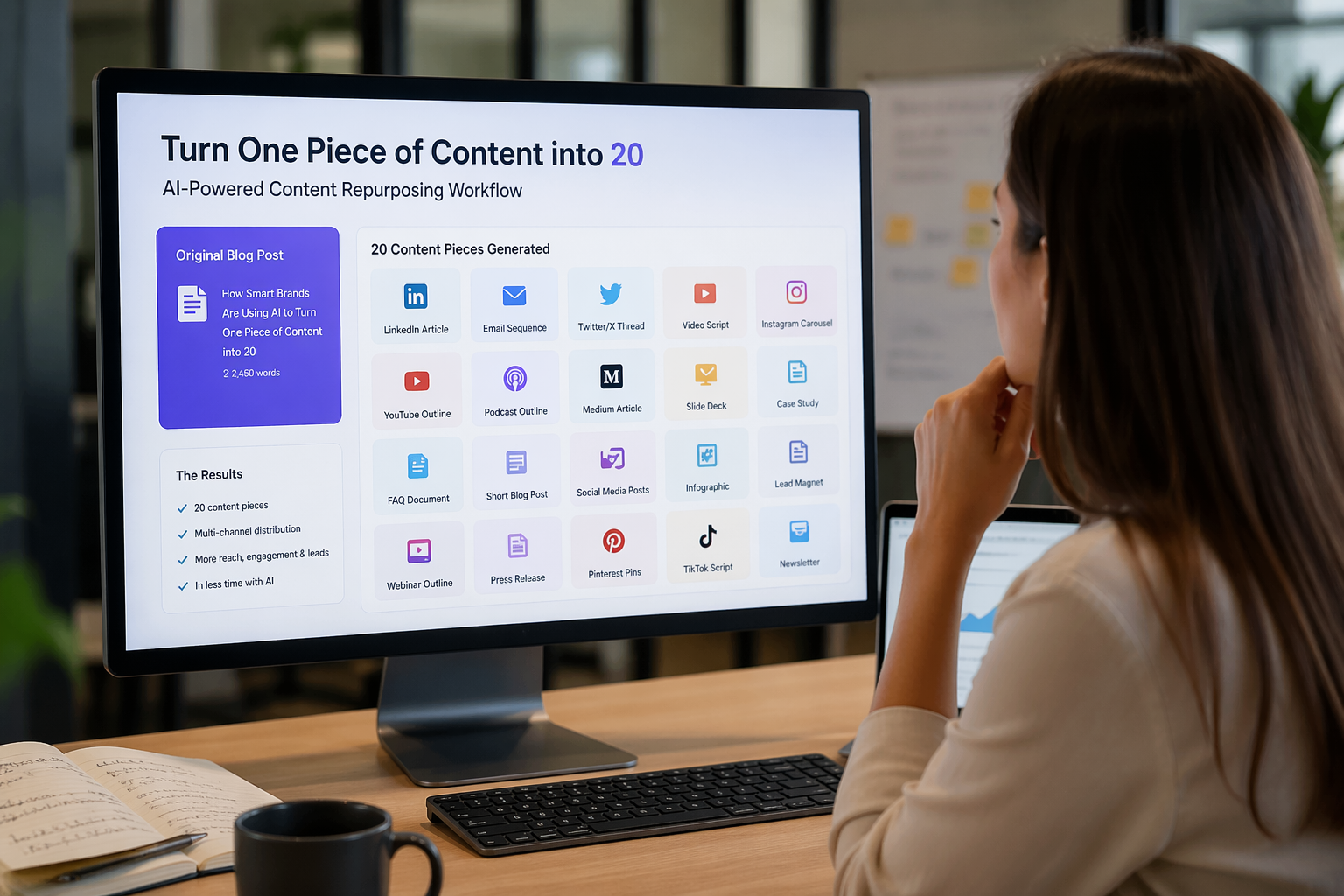
That same post, in a properly built AI-assisted repurposing workflow, becomes a LinkedIn article, a five-part email sequence, a ten-tweet thread, three Instagram carousels, a YouTube Short script, a podcast episode outline, four standalone social posts, two email subject line tests, a newsletter digest, a quote graphic, a FAQ expansion, an updated version with current statistics, and a distribution asset for the next six weeks.
Twenty pieces of content. One research investment. The four to six hours of original work multiplied across channels and formats that would have collectively taken forty or fifty hours to produce from scratch.
Content repurposing saves 60 to 80% of creation time, boosts overall content output by 40%, and cuts production costs by up to 65% when AI-driven. Companies that repurpose content get 76% more traffic than those that don't. Yet only 35% of marketers are actively repurposing — leaving a massive efficiency gap between top performers and everyone else. Autofaceless
This guide covers how the smart brands are building that gap — and how to close it.
Why Most Brands Underinvest in Repurposing
The awareness that repurposing works is nearly universal. The execution discipline to do it systematically is rare — and understanding why helps explain what the brands doing it well are doing differently.
46% of marketers identified content repurposing as the single best-performing content marketing strategy, more than content creation or content updating separately. Yet 48% of B2B marketers simultaneously identify not enough content repurposing as one of their biggest challenges in scaling content production. Shno
The gap between knowing it works and actually doing it systematically comes from two problems. First, most teams treat repurposing as creative work — each platform adaptation feels like a new writing project requiring fresh thinking and original effort. Second, without AI, repurposing genuinely is time-consuming: manually adapting a 2,000-word blog post for LinkedIn, Twitter, Instagram, and email took four to five hours of work that felt like duplicated effort rather than leveraged investment.
AI eliminates both problems. It handles the reformatting, resizing, tone adjustment, and platform-specific adaptation mechanically — at the speed of prompting. What was a four-hour manual project becomes a forty-minute automated process with human review. That change in economics is what makes systematic repurposing viable for teams of any size.
The Source Content Requirement
Before the repurposing workflow, one prerequisite: not all content is equally repurposable, and attempting to repurpose thin content produces thin derivatives.
The key to repurposing is the information density of the source. Use 2,000-plus word blog posts or ten-plus minute videos as your source. Thin sources produce thin derivatives. Mirra
The best repurposing sources are content pieces that contain multiple distinct insights, specific data points, a clear framework or methodology, real examples or case studies, and a clear central argument. A 500-word overview post that summarizes existing information has limited repurposing value because there's not enough substance to atomize. A 2,500-word guide built around original insight, verified statistics, and a distinctive perspective contains enough material to fuel a month of derivative content.
Focus on assets that have already proved their worth for your target audience — articles, in-depth guides, webinars, sales calls, customer interviews, research reports, whitepapers, and podcast episodes. These content pieces are information-dense, making them a great source for multiple bite-sized assets your potential buyers will love. Distribution AI
When you're choosing what to repurpose, prioritize your highest-performing existing content — the posts with the most organic traffic, the most time-on-page, the most social shares, or the most conversion events. These pieces have already demonstrated that the idea resonates. Repurposing them extends that proven resonance across channels rather than gambling on whether a new piece will land.
The Three-Phase Repurposing Framework
The brands systematically turning one piece into twenty aren't winging it on each piece — they're running the same framework every time.
Phase 1: Atomization. Break the source post into its component parts. Identify every distinct insight, statistic, framework element, case study, example, and quotable claim in the piece. A 2,500-word blog post typically contains ten to fifteen distinct "atoms" — discrete ideas that stand on their own without requiring the surrounding context of the full post.
List these atoms explicitly before generating any derivative content. This is the strategic work that determines what derivative pieces you can produce. An atom that is too abstract or context-dependent won't work as a standalone social post. An atom that contains a specific statistic, a counterintuitive claim, or a concrete how-to step works well across multiple formats.
Phase 2: Format Mapping. Match each atom to the platforms and formats where it will resonate based on the platform's native content language and your audience's behavior on each channel. Not every atom works on every platform. A detailed process framework works on LinkedIn and in email. A single striking statistic works on Twitter and Instagram. A step-by-step how-to works on YouTube and TikTok. An expert opinion or positioning statement works as a quote graphic.
Phase 3: AI-Assisted Reformatting. Generate the derivative content for each atom-format pairing using AI, with platform-specific prompts that enforce the native language of each channel. Review each output for brand voice accuracy and platform-fit. Approve, lightly edit, and schedule.
Repurposing multiplies distribution reach by three to five times. Teams that systematically repurpose content reach significantly more of their target audience per hour of creative effort compared to those who publish and move on. Digital Applied
The 20-Piece Repurposing Playbook
Here is the specific map of derivative pieces that a strong 2,500-word blog post can produce, with the AI prompt approach for each:
Long-form text derivatives (4 pieces):
LinkedIn native article — Reduce the word count by 30 to 40%, add a personal perspective that makes it feel like thought leadership rather than a blog post cross-posted, and include LinkedIn-specific CTAs. Prompt: "Adapt this blog post into a 1,200-word LinkedIn article. Reduce it by 35%, add a first-person perspective from [author name], and format it for LinkedIn's professional audience. Remove anything that requires visiting the original post to make sense."
Twitter/X thread — Extract the five to seven most striking claims or insights and build a ten-tweet thread with a hook tweet, supporting argument tweets, and a summary tweet with CTA. Prompt: "Turn this blog post into a 10-tweet thread. Lead with the most surprising or counterintuitive insight as the hook tweet. Each subsequent tweet should be one clear, standalone insight. End with a CTA tweet."
Email newsletter version — A 300-word digest of the key takeaways with a link to the full post. Prompt: "Write a 300-word email newsletter section summarizing the three most important insights from this post. Use a conversational tone. End with a single sentence CTA linking to the full post."
Updated version with current statistics — After any piece has been live for three to four months, AI can identify the statistics most likely to have been superseded and generate a research brief for updating them.
Short-form social derivatives (6 pieces):
Three Instagram carousels — Each carousel covers one distinct section of the post as a five to seven-slide visual breakdown. Prompt: "Extract three distinct insights from this post that would work as Instagram carousel content. For each, write slide copy for a 6-slide carousel: title slide, four insight slides with one key point each, and a CTA slide."
Three standalone social posts — One for LinkedIn (professional framing), one for Twitter (punchy and specific), one for Facebook or Instagram (conversational and accessible). Prompt: "Write three social media posts based on this article: one for LinkedIn (150 words, professional), one for Twitter (240 characters, punchy), one for Instagram (150 words, conversational). Each should highlight a different key insight."
Video and audio derivatives (4 pieces):
YouTube Short or TikTok script — A 60-second script built around the single most striking insight or statistic in the post. Prompt: "Write a 60-second script for a YouTube Short or TikTok based on this blog post. Lead with the most surprising insight as a hook in the first three seconds. Structure: hook, one data point, two examples, clear CTA."
Long-form YouTube video script outline — A structured outline for a 7 to 10-minute video covering the post's full content with engagement prompts and section transitions.
Podcast episode outline — A conversational framework for discussing the post's content as a podcast segment, with suggested talking points and discussion questions.
Webinar or presentation outline — A slide-by-slide breakdown of the post's content formatted for a live or recorded presentation.
Email marketing derivatives (3 pieces):
Five-part email sequence — Each email in the sequence covers one major section of the post with a daily drip format, building from context to recommendation. Prompt: "Turn this blog post into a 5-email drip sequence. Each email should be 200 words, cover one main section of the post, and end with a micro-CTA that leads to the next email."
Five subject line variations — Generated for A/B testing of the newsletter linking to the original post.
Re-engagement email — A single email for subscribers who haven't engaged recently, framed around the post's most compelling insight.
SEO and search derivatives (3 pieces):
FAQ expansion — AI generates ten additional questions the post's topic could address, with 100-word answers to each, formatted for FAQPage schema. This can be added to the original post or published as a companion piece.
Related topic brief — A content brief for a companion post addressing the most common follow-up question the original post raises.
Meta title and description variations — Three to five alternatives to test for the original post's search appearance.
The AI Prompts That Make This Fast
The efficiency of this workflow depends on prompt quality. Here are the two master prompts that handle most of the generation work:
The atomization prompt: "Read this blog post and identify 12 to 15 distinct insights, data points, frameworks, examples, and quotable claims. List each one as a single sentence. Note which ones would work as standalone social content and which require context from the full post."
The batch social prompt: "Based on this list of [X] content atoms from the blog post below, generate the following for each atom: a LinkedIn post (150 words, professional tone), a Twitter post (under 240 characters, punchy), and a one-sentence quote graphic text. Label each output clearly."
These two prompts, run in sequence after a post is published, generate most of the social derivative content in a single session. The remaining pieces — the email sequence, video scripts, carousel copy — each take one additional targeted prompt.
Companies implementing AI-driven content repurposing are reducing production costs by up to 65%. AI tools handle the mechanical aspects of repurposing — reformatting, resizing, transcribing, summarizing, and adapting tone — while humans focus on strategy and quality control. Autofaceless
The Brand Voice Requirement for Repurposing
Repurposing at scale introduces the same brand voice risk as production at scale: if the derivative content sounds like generic AI output rather than your specific brand, the efficiency gain comes at a brand quality cost.
When evaluating the best content repurposing software, look for brand voice memory — the most advanced platforms allow you to upload your style guide so the AI doesn't just summarize your content, it speaks like you. Roketto
Whether you use a dedicated repurposing platform or general-purpose AI, include your brand voice document in every repurposing prompt. The five to ten minutes of voice calibration investment per batch prevents the hours of editorial correction that undifferentiated AI outputs require.
Each platform also has its own native voice requirements. LinkedIn rewards professional authority and personal perspective. Twitter rewards specificity and compression. Instagram rewards accessibility and warmth. Your brand voice is the constant across all of these — the platform voice is the variable. Effective repurposing prompts specify both.
What This Changes for Your Content Program
Repurposing content increases results by 75% without a proportional increase in investment. Companies executing active content repurposing strategies see double the engagement rates compared to those relying solely on original content. Shno
The strategic implication is straightforward but significant: the ROI calculation for creating a single piece of high-quality pillar content changes entirely when a repurposing workflow is attached to it. A post that costs four hours to produce and generates twenty derivative pieces has a fundamentally different economics than a post that costs four hours and generates one derivative piece.
This changes where content investment should go. A smaller number of genuinely excellent pillar pieces — deeply researched, originally insightful, thoroughly edited — generates more total content and more total distribution than twice as many average posts produced without a repurposing workflow attached.
Think of repurposing as content ROI maximization, not recycling. Strategically repurposing eight pillar pieces can generate the same impact as creating twenty from scratch. Mirra
The brands building this competitive advantage now are producing more content, reaching more platforms, building more topical authority, and earning more distribution — from the same original investment that their competitors are getting one use from. That gap compounds.
Ready to Build a Content Repurposing Engine?
At Ritner Digital, we help businesses build AI-powered content repurposing workflows — the atomization framework, the platform-specific prompt library, the brand voice system, and the distribution calendar — that turn every piece of pillar content into a multi-channel content program.
If your best content is doing one job when it could be doing twenty, let's build the system that changes that.
Contact Ritner Digital today to schedule a free content strategy consultation and find out what a properly built repurposing workflow looks like for your business.
Sources: AutoFaceless, Mirra, Digital Applied, Distribution AI, SHNO, Wellows, Greenmo Space, HelloRoketto
Frequently Asked Questions
What is content repurposing and how is it different from just reposting content?
Content repurposing means transforming one source piece into multiple formats optimized for different platforms and audiences — not copying and pasting the same content across channels. Reposting is distributing identical content to multiple platforms. Repurposing is adapting the core ideas, insights, and information into the native language of each platform. A blog post's central insight becomes a 60-second TikTok script, not a screenshot of the blog paragraph. A framework from a research report becomes a LinkedIn carousel, not a link to the report. The distinction matters because platform algorithms actively suppress content that doesn't feel native, and audiences on different platforms have different expectations for format, length, tone, and structure. Effective repurposing adapts the substance while preserving the brand voice — which is precisely where AI-assisted workflows excel.
What type of content makes the best source material for repurposing?
Information-dense, long-form content that has already demonstrated audience resonance. The best sources are posts and pieces that contain multiple distinct insights, specific data points, a clear framework or methodology, real examples or case studies, and a defensible central argument. A 2,500-word guide built around original insight and verified statistics typically contains ten to fifteen distinct atoms — discrete ideas that can each become standalone derivative content. A 500-word overview that summarizes publicly available information has limited repurposing value because there's not enough substance to atomize into twenty distinct pieces. When choosing what to repurpose, prioritize your highest-performing existing content — the pieces that have already proven they resonate with your audience are the ones whose derivative content is most likely to perform.
How do I maintain brand voice when AI is adapting content across multiple platforms?
Include your brand voice document in every repurposing prompt. The most common repurposing quality failure is AI-adapted content that meets the platform's native format requirements but sounds like no one in particular — it's professional but generic, or conversational but anonymous. The fix is specifying both your brand voice and the platform voice in every generation prompt. Your brand voice is the constant: the tone descriptors, the things you never say, the specific ways your organization explains complex concepts. The platform voice is the variable: LinkedIn rewards professional authority and personal perspective, Twitter rewards specificity and compression, Instagram rewards accessibility and warmth. A prompt that specifies both — "adapt this for LinkedIn's professional format while maintaining [brand]'s direct, jargon-free tone" — produces content that feels native to the platform and distinctive to your brand simultaneously.
How long does the repurposing workflow actually take per blog post?
With AI assistance and a structured workflow, a 2,500-word blog post can be repurposed into twenty derivative pieces in approximately 90 to 120 minutes of total work — including human review and light editing. The atomization step takes about fifteen minutes to generate and review a list of twelve to fifteen content atoms. The batch social prompt generates most of the social derivative content in twenty to thirty minutes. The email sequence, video scripts, and carousel copy each take an additional ten to fifteen minutes per format with targeted prompts. Human review and brand voice editing adds roughly thirty minutes across all twenty pieces. Compare this to the four to five hours that manual repurposing previously required per major piece, and the economics of systematic repurposing become obvious. The upfront investment in prompt templates and a brand voice document reduces each subsequent repurposing session by another twenty to thirty minutes.
Won't publishing the same content across multiple platforms hurt my SEO?
Not if you're doing genuine platform-native adaptation rather than exact duplication. Search engines index content that is substantially different in structure, length, and framing as distinct pieces even when they share the same core ideas. A 2,500-word blog post and a 1,200-word LinkedIn article built from the same source are not duplicate content in any meaningful sense — they're different documents sharing similar subject matter, which is true of most content on any given topic. The specific risk to avoid is publishing raw transcripts or near-identical text on multiple domains without canonical tags. The practical safeguard is including a canonical note in any LinkedIn article or third-party publication pointing to the original post on your own site, which is a thirty-second addition that prevents any confusion about the primary source.
What is content atomization and how does it work in practice?
Content atomization is the process of breaking a source piece into its component ideas — the distinct insights, data points, frameworks, examples, case studies, and quotable claims that the piece contains. Think of the original post as a compound and atomization as separating it into its constituent elements. A 2,500-word post on AI content strategy might contain atoms like: "74% of new web pages contain AI-generated content," "the three-phase repurposing framework," "why generic AI content fails quality evaluation at months three to four," "the five-minute opening rewrite that changes post performance," and so on. Each atom can stand alone — it conveys a complete idea without requiring the surrounding context of the full post. Atoms that require too much surrounding context to make sense as standalone content should be grouped rather than used individually. The atomization step takes about fifteen minutes with AI assistance and is the strategic foundation of the entire repurposing workflow.
How do I decide which platforms to repurpose content for?
Start with the platforms where your target audience actually spends time, not the platforms where you feel obligated to maintain a presence. Then match content format to platform strength. LinkedIn is where B2B audiences research professionally — long-form articles, insight-driven posts, and case study content perform well. Twitter and X reward compressed specificity — single striking statistics, counterintuitive claims, and punchy how-to threads. Instagram and TikTok reward visual and video formats — carousels, short-form video scripts, and quote graphics. Email rewards depth and directness — digest versions of long posts and multi-part nurture sequences. YouTube rewards comprehensive how-to content and expert explanation. You don't need to repurpose to every platform from every piece. Map your top three audience platforms, build repurposing templates for each, and run every pillar piece through that set consistently rather than trying to cover every platform sporadically.
Should I repurpose old content or only new content?
Both — with different prioritization logic. For new content, build the repurposing workflow into the publishing process so every pillar piece generates its derivative content within the first week of publication, capturing the attention window when the topic is freshest and your original post is gaining initial traction. For old content, prioritize your highest-traffic existing pieces — the posts that still generate meaningful organic visits but have never had a repurposing pass. These represent the highest ROI opportunity because the audience validation already exists. A post that has been generating traffic for two years and has never been repurposed is leaving a significant distribution and engagement advantage uncaptured. Run your top twenty to thirty traffic-driving posts through the atomization framework and build out their derivative content as a one-time repurposing sprint — the output will outperform new posts on less proven topics.