How to Get More Google Reviews for Your Cleveland Business
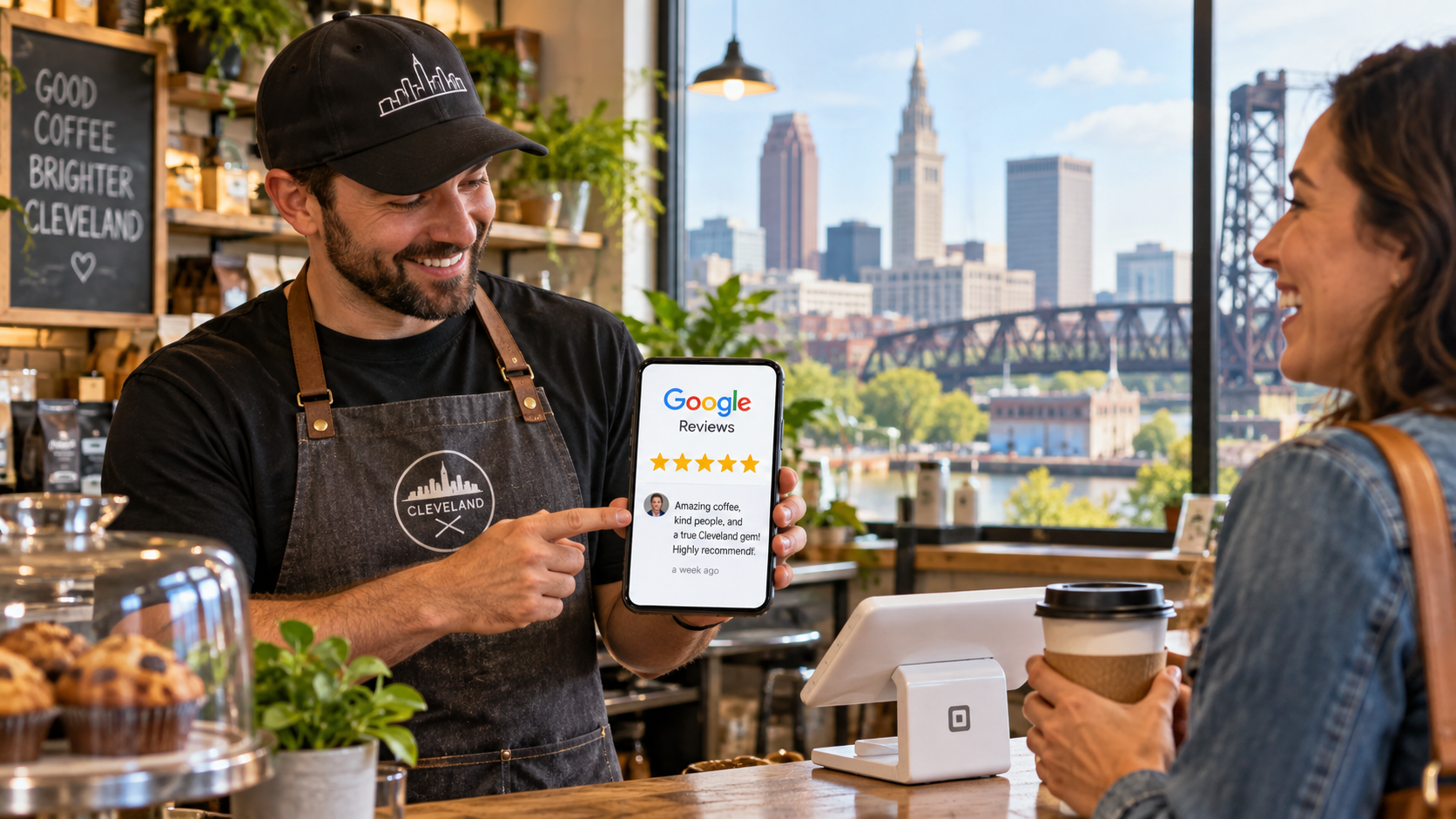
A potential customer searches Google for the service your Cleveland business provides.
Your company appears.
So do three competitors.
All four businesses offer roughly the same service.
All four are located within a reasonable distance.
All four have professional websites.
But one competitor has:
4.8 stars and 347 Google reviews.
Your business has:
4.3 stars and 31 reviews.
Which company is the customer going to investigate first?
There is no guarantee they will choose the company with the most reviews.
But reviews can strongly influence the decision.
Google itself says that more reviews and positive ratings can help a business's local ranking, while reviews and helpful responses can also help a company stand out to potential customers.
Consumers rely heavily on reviews as well.
BrightLocal's 2026 Local Consumer Review Survey found that 97% of surveyed U.S. consumers read online reviews for local businesses. It also found that expectations around review quantity, star rating, recency, and business responses have increased.
That makes reviews important for two different reasons.
They can support your local SEO strategy.
And they can influence what happens after someone finds your business.
For Cleveland contractors, law firms, restaurants, medical practices, professional services, retailers, home-service companies, and other local businesses, the objective should not be to manufacture hundreds of reviews as quickly as possible.
The objective should be to create a repeatable system that generates authentic feedback from real customers over time.
That means knowing:
When to ask
How to ask
How to make reviewing easy
Who should receive requests
How to respond
What Google prohibits
What the FTC prohibits
How to handle negative reviews
How to measure progress
This guide explains how to build that system.
Why Google Reviews Matter for Cleveland Local SEO
Google Maps visibility is largely driven by three broad concepts:
relevance, distance, and prominence.
Google describes prominence as how well-known a business is and says this can incorporate information such as links and reviews. Google specifically states that more reviews and positive ratings can help local rankings.
That does not mean:
100 reviews = position one.
Google does not publish a formula like that.
Your local rankings may also depend on:
Business category
Searcher's location
Business location
Website relevance
Local authority
Links
Competition
Business information
Other local signals
Reviews are one part of the system.
But they are a particularly visible part because customers can see them directly in Google Search and Maps.
That creates a rare situation where the same asset can potentially influence both:
visibility
and:
conversion.
Reviews Can Help Customers Choose Between Similar Businesses
Imagine someone searching:
roofing contractor Cleveland
They find two companies.
The first has 27 reviews.
The second has 312.
That does not automatically make the second roofer better.
But review quantity provides additional evidence that more people have interacted with the company.
Now add star ratings.
Then review recency.
Then detailed customer comments.
Then owner responses.
The review profile begins telling a story about the business.
BrightLocal's 2026 survey found that 92% of respondents cared about star ratings when choosing a business. Thirty-one percent said they would only use a business with at least a 4.5-star rating, while 68% required at least four stars.
Those are consumer-survey findings, not Google's ranking thresholds.
Google does not require a 4.5-star rating to rank.
But customers may establish their own thresholds before calling.
Review Recency Matters to Customers
Would you rather evaluate a company based on 50 reviews from 2019 or 50 reviews from the last year?
Most customers want evidence that reflects the business today.
Businesses change.
Employees change.
Ownership changes.
Service quality changes.
BrightLocal found that 74% of respondents focused on reviews from the previous three months, while 44% identified a review posted within the last month as a trust factor.
That is one reason a review strategy should be continuous.
Do not collect 100 reviews during one campaign and then stop asking customers for two years.
Your objective should be a natural ongoing flow of feedback as customers continue doing business with you.
There is an important distinction here:
Google officially confirms that review quantity and positive ratings can help local ranking. Google does not publicly provide a formula saying a particular review frequency or “velocity” directly improves rankings.
Recency is nevertheless important to customers.
That alone makes consistent review acquisition worthwhile.
The Simplest Way to Get More Reviews: Ask
This sounds obvious.
Many businesses still do not do it consistently.
A customer completes a successful project.
They thank the contractor.
The contractor says:
“Glad you like it.”
Then everyone moves on.
No review request happens.
BrightLocal's 2026 research found that 83% of consumers who were asked to leave a review reported that they went on to leave one, while 28% said they would always write a review when asked.
You do not need a complicated reputation-management system before asking your first customer.
You need a good customer experience and an easy path to leave feedback.
Create Your Official Google Review Link
Google Business Profile provides an official review-request link.
Google also allows businesses to generate a QR code that sends customers to the review experience.
Google recommends using the link or QR code in places such as receipts, thank-you emails, post-chat interactions, and printed materials inside the business. Google currently notes that the QR code must be generated through a computer browser rather than the mobile app.
To get yours, open your Business Profile while logged into the account that manages it, select the reviews area, choose the option to get more reviews, and copy the review link or save the QR code.
Keep that link somewhere your team can access easily.
You will use it repeatedly.
Remove Friction From the Review Process
Every unnecessary step lowers the likelihood that someone completes your request.
Compare these experiences.
Option A
You tell a customer:
Search our company name on Google, find the right Cleveland location, click Reviews, find the button to leave a review, sign in, and submit it.
Option B
You send the customer one link.
They tap it.
The review screen opens.
Option B is obviously better.
The same principle applies to QR codes.
If a restaurant guest can scan a code on a receipt, that is easier than remembering the business name later.
If a contractor sends a direct review link after the final walkthrough, the homeowner does not need to search for the correct listing.
Make legitimate reviewing easy.
Ask at the Right Moment
Timing matters.
You generally want to request feedback after the customer has experienced enough of your service to form a genuine opinion.
For a contractor, that might be after project completion.
For an auto repair shop, it may be shortly after the vehicle is returned.
For a restaurant, it might be after the dining experience.
For a professional service business, it may be after a meaningful milestone in the relationship.
For a retailer, it may be after the customer has had enough time to use the product.
There is no universal “perfect day.”
The right moment is the point at which the customer has had a real experience worth reviewing.
Ask While the Positive Experience Is Still Fresh
Do not wait six months after completing a successful project to request feedback.
The customer may still like your company.
But they may no longer remember specific details.
When someone has just expressed satisfaction, the experience is fresh.
That can be a natural time to say:
We're glad you were happy with the experience. If you're willing, we'd appreciate an honest Google review. I'll send you the direct link so it's easy.
Notice what this request does not say.
It does not ask for five stars.
It does not dictate what the customer should write.
It asks for an honest review.
Create a Standard Review Request Workflow
The best review strategy is not:
“Remember to ask customers when we think about it.”
Build the request into the business process.
For example:
Service completed → customer confirms satisfaction → review request sent → optional reminder → review monitored → response posted.
That process can be partly manual or partly automated.
The important part is consistency.
A Cleveland HVAC company performing 150 service calls per month has a substantial review opportunity if requests are built into its follow-up process.
If technicians remember to ask only five customers, most of that opportunity is wasted.
Use Email Review Requests
Email works well for businesses that already send:
Receipts
Invoices
Project-completion notices
Appointment follow-ups
Customer satisfaction emails
A review request does not need to be long.
For example:
Thanks for choosing ABC Company. If you'd like to share your experience, we'd appreciate an honest Google review. Your feedback helps us understand how we're doing and helps other local customers learn about our business.
Then provide the direct Google review link.
Do not bury the link below five paragraphs of promotional copy.
Make the intended action obvious.
Use SMS Review Requests
Text messaging can work especially well when customers already communicate with the company by phone or SMS.
A simple message might say:
Thanks for choosing ABC Company today. If you have a moment, we'd appreciate an honest Google review: [review link]
Keep it simple.
Be mindful of applicable texting and consent requirements for your messaging program.
A review request should not become an excuse to add people to unrelated promotional campaigns without appropriate permission.
Use QR Codes for In-Person Businesses
Google's built-in review QR code is particularly useful for businesses with physical locations.
A Cleveland restaurant could place it on a receipt.
A retailer could add it near checkout.
An auto repair shop could include it on a service invoice.
A salon could display it near the front desk.
A medical practice needs more caution around patient privacy and professional requirements, but may still develop a compliant general review-request process appropriate to its organization.
The QR code should not dominate the customer experience.
It simply provides an easy path for customers who want to share feedback.
Train Employees to Ask Naturally
A review request should not sound robotic.
Employees do not need to deliver the exact same memorized sentence.
Give them the principle instead.
For example:
Customer expresses clear satisfaction.
Employee:
That's great to hear. If you have a minute later, we'd really appreciate an honest Google review. I can send you a link.
That sounds natural.
Compare it with:
Please scan this QR code and provide us with a five-star review mentioning my name and the services you received.
The second request is more manipulative and can create policy problems.
Train employees to ask for genuine feedback—not ratings.
Do Not Ask Only the Customers You Think Will Give Five Stars
This practice is sometimes called review gating.
A business first asks customers:
Were you happy?
Satisfied customers are sent to Google.
Unhappy customers are sent to an internal feedback form and never shown the Google review option.
That creates a distorted review pool.
Google's policies prohibit merchants from selectively soliciting positive reviews and discourage attempts to manipulate ratings.
FTC guidance similarly warns businesses against asking only customers they believe will provide positive feedback because that practice can misrepresent customer sentiment.
A safer approach is straightforward:
Give legitimate customers an equal opportunity to provide honest feedback.
Never Offer Discounts or Free Products for Google Reviews
This is one of the most important distinctions in review marketing.
The FTC rule does not universally prohibit every incentive for every review on every platform. It prohibits compensation or incentives conditioned on the review expressing a particular sentiment, and other FTC disclosure requirements may also apply.
But Google Maps has a stricter platform policy.
Google prohibits businesses from offering incentives such as:
Payment
Discounts
Free goods
Free services
in exchange for posting a review.
So for Google reviews, do not offer:
“Leave a review and get 10% off.”
Do not offer:
“Five-star review = free appetizer.”
Do not offer:
“Review us and get entered to win a gift card.”
Even if you say the review can be honest, Google's platform policy prohibits incentivized review posting.
For Google, the clean strategy is simple:
Ask. Do not pay.
Never Buy Google Reviews
There is no legitimate SEO advantage worth the risk of fake reviews.
Google's Maps policy requires reviews to reflect genuine experiences and prohibits paid reviews, fabricated engagement, multiple-account manipulation, and other attempts to distort ratings.
Federal rules create additional exposure.
The FTC's Consumer Reviews and Testimonials Rule took effect on October 21, 2024. It addresses practices including fake reviews, buying reviews conditioned on positive or negative sentiment, undisclosed insider reviews, review suppression, and deceptive review websites.
The FTC has continued enforcing those standards. In late 2025, the agency sent warning letters to businesses concerning potential violations involving fake reviews and five-star incentives.
If an SEO vendor promises:
“100 five-star Google reviews this month guaranteed.”
that should be a major warning sign.
Do Not Have Employees Pretend to Be Customers
Employee reviews can create obvious credibility issues.
The FTC's guidance discusses company insiders and the importance of clearly disclosing material connections when they provide endorsements or reviews.
The cleaner approach is not to manufacture customer sentiment through employees.
Your actual customers should tell the story.
Do Not Write Reviews for Customers
A customer says:
“I'll leave a review. What should I write?”
Do not hand them a completed paragraph and tell them to paste it.
You can encourage them to discuss their genuine experience, but the review should reflect their own opinion and language.
Google prohibits businesses from soliciting reviews containing specific content.
Authenticity also makes reviews more persuasive.
Real customers do not all write in the same marketing voice.
That is a good thing.
Do Not Ask Customers to Stuff Reviews With Keywords
Local SEO advice sometimes encourages businesses to tell customers:
Make sure you mention “Cleveland bathroom remodeling contractor” in your review.
Avoid that.
You can list your services accurately on Google Business Profile and your website.
Google also notes that when customers review certain service businesses, it may ask them which service was performed, using information from the business's service list, website, and standard job categories.
Let the customer's review remain natural.
If they genuinely write:
ABC replaced our roof at our Lakewood home.
great.
If they naturally mention:
They remodeled our Cleveland Heights kitchen.
also great.
But the business should not script those phrases.
Review Quality Matters More Than Repeating Keywords
A detailed authentic review can answer questions prospective customers care about.
For example:
The crew arrived when promised, explained the work clearly, kept the house clean, and finished our bathroom renovation on schedule.
That review communicates:
Reliability
Communication
Cleanliness
Type of service
Project execution
Those details may be much more persuasive than:
Great company!
Businesses should focus on creating experiences that customers naturally want to describe.
Fix Operational Problems Before Pushing Harder for Reviews
Sometimes a business wants more five-star reviews when the real problem is the customer experience.
Look at recurring criticism.
Do customers repeatedly mention:
Phone calls not returned
Long wait times
Missed appointments
Confusing bills
Poor communication
Dirty facilities
Late delivery
Rude employees
More review requests will not fix those issues.
They may amplify them.
Reviews can function as operational intelligence.
If ten unrelated customers complain about the same thing, investigate the process.
A better business tends to create a better review profile over time.
Respond to Positive Reviews
Google encourages businesses to reply to reviews and says helpful responses demonstrate that the company values customer feedback.
Do not use the exact same response 300 times.
Instead of:
Thanks for your review!
every time, consider:
Thank you, Sarah. We're glad the team could make the kitchen-remodeling process easier and that you're happy with the finished space. We appreciate you choosing us.
Keep responses appropriate to the industry.
Healthcare, legal, financial, and other confidentiality-sensitive industries need additional caution about acknowledging customer relationships or details publicly.
Respond to Negative Reviews Professionally
A negative review feels personal when it concerns a company you built.
Publicly fighting the reviewer rarely improves the situation.
Your response is not only for that customer.
Future customers will read it.
A useful structure is:
Acknowledge the feedback.
Stay professional.
Avoid admitting something you cannot verify.
Avoid sharing private information.
Provide an appropriate method for continuing the conversation privately.
You might say:
Thank you for sharing your feedback. We're sorry to hear that your experience did not meet expectations. We'd appreciate the opportunity to learn more and address your concerns. Please contact our office at [contact method].
Do not reveal confidential customer information merely to prove the reviewer wrong.
Respond Quickly—but Do Not Sacrifice Quality
Customers increasingly expect businesses to engage with reviews.
BrightLocal's 2026 survey found that 89% of respondents expected businesses to respond to reviews, and 81% expected a response within a week. It also found that 80% were more likely to use businesses that responded to every review, while generic responses could negatively affect customer perception.
That does not mean every review requires an immediate response at midnight.
Build a reasonable internal standard.
For example:
Check reviews every business day and respond within one to three business days when possible.
The exact workflow depends on the business.
Consistency matters more than panic.
Personalize Review Responses
Templates save time.
They should be starting points, not copy-and-paste machines.
BrightLocal found that 50% of respondents said generic or templated business responses could make them less likely to choose the company.
You can create internal frameworks such as:
Thank them → reference something appropriate → reinforce appreciation.
Then customize the wording.
A restaurant might respond differently to a guest celebrating an anniversary than to someone praising takeout.
A contractor might acknowledge the project type.
An auto repair shop may thank someone for trusting the team with their vehicle.
Human responses should sound human.
Can You Remove a Bad Google Review?
Sometimes.
But not simply because the review is negative.
Google says businesses can report reviews that violate its policies, but it will not remove a review merely because the business disagrees with it.
Potential policy issues might include:
Spam
Fake engagement
Harassment
Profanity
Off-topic content
Conflicts of interest
Other prohibited material
Use Google's official reporting process.
If Google determines there is no violation, an eligible review may remain online.
Your best response to a legitimate negative review is usually to address the customer concern professionally and improve the underlying process where necessary.
What If the Review Is Completely Fake?
Document what you know.
Then report the review through Google Business Profile.
Google provides a Reviews Management Tool where businesses can submit reviews for removal, monitor the decision, and in eligible cases submit a one-time appeal if Google initially finds no violation.
Do not mobilize employees to attack the reviewer.
Do not post fake positive reviews to bury it.
Use the platform's process.
Do Not Threaten Customers Over Legitimate Negative Reviews
The FTC's Consumer Reviews and Testimonials Rule addresses review suppression and prohibits certain unfounded or groundless legal threats intended to prevent or remove negative consumer reviews.
Businesses have legal rights when genuinely defamatory or unlawful content is involved.
But:
“Delete your one-star review or we'll sue you.”
should not become a reputation-management strategy.
If a review raises a serious legal issue, seek qualified legal advice rather than conducting the dispute in the Google review thread.
How Many Google Reviews Does Your Cleveland Business Need?
There is no universal target.
A business does not automatically need:
100 reviews.
Or:
500 reviews.
Or:
1,000 reviews.
The appropriate benchmark depends heavily on the competitive environment.
Search the important terms your customers use.
For example:
HVAC contractor Cleveland
dentist Cleveland
personal injury lawyer Cleveland
restaurant Ohio City
electrician Cleveland
Then evaluate the legitimate businesses appearing prominently.
Look at:
Review quantity
Star rating
Recency
Review detail
Owner responses
This gives you a market-specific benchmark.
A company competing against businesses with 20 to 60 reviews faces a different environment from one competing against companies with 1,500.
Do Not Chase Review Count at the Expense of Quality
Suppose Company A has:
4.9 stars from 150 reviews
and Company B has:
3.6 stars from 400 reviews.
More reviews do not automatically make Company B more attractive.
Google says both review quantity and positive ratings can contribute to local ranking.
Customers evaluate multiple factors as well.
The goal should be a strong, authentic overall reputation—not merely the biggest number in the market.
What Is a Good Google Star Rating?
There is no universal Google ranking threshold.
Google does not say:
You must have 4.7 stars to rank.
Consumer expectations, however, have increased.
BrightLocal's 2026 research found that 31% of respondents would only use businesses with ratings of at least 4.5 stars and 68% required at least four stars.
That means a business sitting at 3.8 stars may face a conversion problem even if it ranks well.
The correct solution is not to manipulate reviews.
Improve customer experience and consistently invite real customers to share honest feedback.
Can One-Star Reviews Destroy Your Rating?
One negative review affects a business with ten reviews much more than a company with 500.
Google calculates the displayed score from the average of published ratings and says that after a new review is posted it can take up to two weeks for the displayed review score to update.
Do not panic over one legitimate critical review.
A naturally growing review profile will usually contain a range of experiences.
A profile containing nothing but hundreds of suspiciously identical five-star reviews may actually look less credible to sophisticated customers.
What Should New Cleveland Businesses Do?
New businesses face a difficult problem:
They have little social proof because they have had few customers.
Start asking from the beginning.
Do not wait until you have been open a year.
Once customers have genuinely completed transactions or received services, invite them to review the experience.
BrightLocal's research found that nearly half of surveyed consumers would not use businesses with fewer than 20 reviews, which illustrates the trust hurdle new companies can face.
That finding does not mean every new company must magically acquire 20 reviews immediately.
It means social proof becomes increasingly valuable as the customer base develops.
Multi-Location Businesses Need a Review Strategy for Every Location
Suppose your business has offices in:
Cleveland
Westlake
Beachwood
Do not send every customer to the Cleveland location's review page.
Send customers to the profile corresponding to the location they genuinely interacted with.
Each real location should build its own reputation.
Otherwise, one profile may accumulate 800 reviews while a second legitimate office has 12.
That can make the second location less competitive and less persuasive.
Do Reviews Move When a Business Relocates?
Google says that when a business moves but keeps the same business name, reviews will generally transfer to the updated Business Profile automatically.
For duplicate profiles and certain other situations, Google may support review transfer through its procedures.
Google specifically advises businesses not to create a new Business Profile merely because the physical location or ownership changed.
Before creating another listing, understand how Google handles the change.
You do not want years of legitimate customer feedback stranded on an old profile unnecessarily.
Reviews Are Valuable Beyond Google Maps Rankings
Reviews do not end their job after helping a customer evaluate your Google listing.
They can send customers deeper into the buying journey.
BrightLocal found that after reading positive reviews, 54% of respondents visited the business's website. It also found that 85% said positive reviews made them more likely to use a company.
That means your website needs to support the trust created by your reviews.
If someone moves from your Google profile to your website and finds:
Broken pages
Old information
Poor design
No clear service descriptions
No contact information
the review advantage can disappear.
Reviews and website SEO should support each other.
Use Reviews to Understand Your Positioning
Read your positive reviews closely.
Customers may repeatedly praise things your marketing barely mentions.
Perhaps contractors repeatedly hear:
Your communication was excellent.
A restaurant repeatedly hears:
The staff made our anniversary special.
A professional service firm repeatedly hears:
They explained everything clearly.
Those patterns can reveal genuine differentiators.
You can then strengthen your website messaging around those themes—without fabricating testimonials or claims.
Your customers may understand your strongest value proposition better than your marketing team does.
Use Negative Reviews as Research Too
Positive reviews reveal strengths.
Negative reviews reveal friction.
Suppose several Cleveland customers mention:
Parking is confusing.
You may not need an SEO campaign to fix that problem.
You may need a parking section on the website and clearer directions in the appointment confirmation.
If several reviewers say:
Nobody answered the phone.
You may have an operations problem.
Review analysis can improve:
Customer service
Website content
FAQs
Staff training
Scheduling
Communication
That makes reviews useful even when they do not directly affect rankings.
Should You Put Google Reviews on Your Website?
Displaying genuine testimonials or reviews on your website can provide useful social proof.
But be accurate.
Do not:
Invent reviews
Change a three-star review into a five-star testimonial
Rewrite customer statements until their meaning changes
Present sponsored endorsements as ordinary customer feedback
The FTC distinguishes consumer reviews from testimonials used in advertising and applies rules against fake or false testimonials.
If you republish a customer's review, preserve its meaning and consider the permissions and industry-specific obligations applicable to your business.
Highly regulated industries may need additional review.
What About Healthcare Reviews?
Healthcare organizations need particular caution.
A patient can publicly disclose their own information.
That does not necessarily give the provider permission to confirm the relationship or discuss treatment publicly.
Responses to healthcare reviews should therefore be designed with privacy and compliance requirements in mind.
Instead of saying:
We're sorry your knee surgery follow-up last Thursday was delayed.
a practice may use a more general response that does not publicly confirm treatment details.
Healthcare businesses should coordinate review-response policies with appropriate privacy and compliance professionals.
What About Law Firm Reviews?
Law firms also need additional caution around:
Confidentiality
Client identity
Case details
Results
Testimonials
Attorney advertising requirements
A client may publicly discuss their case.
The attorney should not assume that gives the firm permission to reveal additional confidential information in a response.
Legal practices should maintain review-response procedures consistent with the applicable professional-conduct rules.
What About Restaurants?
Restaurants often have a high volume of reviews and faster feedback cycles.
That creates both opportunity and workload.
Establish a routine for reviewing:
Google
Yelp
OpenTable
Tripadvisor
Other important restaurant platforms
Do not spend every morning fighting customers online.
Look for patterns.
If three reviews this week mention excessively slow Friday-night service, that information may be operationally useful.
What About Contractors?
Contractors can generate particularly valuable reviews because projects often have high financial stakes.
A detailed review can communicate:
Type of project
Communication
Timeliness
Cleanliness
Professionalism
Outcome
Ask at a natural completion point, such as after the final walkthrough or successful project closeout.
The same principle applies to roofers, electricians, plumbers, remodelers, HVAC companies, concrete contractors, and other home-service businesses.
Build Reviews Into Your CRM
For service businesses with a CRM, make the review request part of the customer lifecycle.
For example:
Job marked completed → wait appropriate interval → send review request → log request date → optional reminder → stop sequence.
The system should not harass customers indefinitely.
A reasonable reminder can help someone who intended to review but forgot.
Sixteen texts over three weeks will probably have the opposite effect.
Should You Automate Review Requests?
Automation can improve consistency.
It should not eliminate judgment.
Automation works particularly well when the completion event is clear:
Invoice paid
Appointment completed
Job closed
Order fulfilled
Reservation completed
But monitor the system.
You do not want to automatically request a review five minutes after an unresolved complaint was opened.
Technology should support the customer experience, not ignore it.
Give Customers Multiple Ways to Provide Feedback
Google reviews are valuable.
They should not necessarily be your only customer-feedback mechanism.
A business may also use:
Customer surveys
Internal feedback forms
Email support
Phone follow-up
The important distinction is that internal feedback should not be used to selectively block dissatisfied customers from having the same opportunity to leave a public Google review.
Use internal feedback to improve the business.
Use legitimate public review requests consistently.
A Practical Cleveland Review Acquisition System
For many local businesses, the system can remain simple.
The process does not require manipulating the customer.
It simply makes authentic feedback easier to provide.
Measure Your Review Program
Track progress monthly.
Useful metrics include:
Total Google reviews
Are you gaining reviews consistently?
Average rating
Is customer satisfaction improving or declining?
Reviews received this month
Is the request process actually being used?
Response rate
Are you responding consistently?
Response time
Are reviews sitting unanswered for months?
Location performance
Do individual offices have major reputation gaps?
Review themes
What are customers repeatedly saying?
Then connect this with:
Google Maps visibility
Calls
Website visits
Leads
Sales
Do not assume every ranking change happened because of reviews.
Local SEO is multifactorial.
Do More Reviews Guarantee Higher Google Maps Rankings?
No.
Google says review quantity and positive ratings can help local ranking, but it also says local results are mainly based on relevance, distance, and prominence.
A business with 500 reviews may still rank below a company with 150 if the second company is:
More relevant
Closer to the searcher
Better categorized
More prominent in other ways
Reviews strengthen a local SEO strategy.
They do not replace one.
Reviews + Local SEO: The Bigger Picture
A strong Cleveland local SEO strategy can include:
Google Business Profile optimization
so Google accurately understands the business.
Service pages
so the website clearly explains what you do.
Location content
so the site establishes geographic relevance.
Local backlinks
so the business builds authority and prominence.
Reviews
so customers and Google have additional evidence of real-world activity and reputation.
Conversion optimization
so visibility becomes calls, appointments, reservations, orders, or leads.
Reviews work best when they support all the other pieces.
Common Google Review Mistakes
Businesses frequently hurt their reputation programs by chasing shortcuts.
Common problems include asking for five-star reviews instead of honest reviews, buying feedback, offering discounts for Google reviews, asking only happy customers, telling reviewers exactly what to write, ignoring negative feedback, replying with angry public arguments, using identical responses on every review, asking inconsistently, and focusing on review quantity without fixing recurring customer problems.
The alternative is less exciting but much more sustainable:
Serve customers well, ask consistently, make reviewing easy, and respond professionally.
Frequently Asked Questions
Do Google reviews help local SEO?
Yes.
Google states that more reviews and positive ratings can help your local ranking.
Reviews are part of Google's broader prominence assessment, alongside other information about the business.
How can my Cleveland business get more Google reviews?
Create your official Google review link or QR code and incorporate review requests into your normal customer process.
Ask genuine customers after they have had a real experience with the business.
Google specifically recommends sharing review links or QR codes through receipts, thank-you emails, chat interactions, and physical displays where appropriate.
How do I get a Google review link?
Open your verified Business Profile, select the reviews section, choose Get more reviews, and copy the review link.
Google also allows you to download a review QR code from a desktop browser.
Can I text customers a Google review link?
Yes, provided your messaging practices comply with any applicable consent and communications requirements.
The request should ask for genuine feedback and link directly to the appropriate Business Profile.
Can I email customers for Google reviews?
Yes.
Thank-you emails and service-completion emails are common places to include an honest review request.
Google itself identifies thank-you emails as an appropriate place to share its review link.
Can I offer a discount for a Google review?
No.
Google prohibits incentives such as payments, discounts, free goods, or free services in exchange for posting reviews.
Can I offer a gift card for an honest Google review?
Google's policy prohibits incentives in exchange for posting reviews, even when the request is not explicitly conditioned on a five-star rating.
Do not incentivize Google reviews.
What does the FTC say about incentivized reviews?
The FTC's Consumer Reviews and Testimonials Rule prohibits businesses from providing compensation or incentives conditioned on reviews expressing a particular positive or negative sentiment.
Additional disclosure rules and FTC Act considerations can also apply to incentivized endorsements.
Google's own review platform policy is stricter and prohibits incentives for Google Maps reviews generally.
Can I ask only happy customers for reviews?
That is not a good review strategy.
Google prohibits businesses from selectively soliciting positive reviews as part of rating manipulation.
FTC guidance also warns against asking only customers expected to leave positive feedback.
What is review gating?
Review gating generally refers to screening customers before requesting public reviews and directing only satisfied customers to review platforms while diverting dissatisfied customers elsewhere.
Avoid it.
Give genuine customers a fair opportunity to provide honest feedback.
Can I ask for a five-star review?
Ask for an honest review instead.
Do not pressure customers to provide a particular rating.
The credibility of your review profile depends on authentic experiences.
Can I tell customers what to write?
Do not script Google reviews or require customers to mention specific words.
Google's policies prohibit attempts to manipulate review content.
Let customers describe the experience in their own language.
How many Google reviews should my business have?
There is no universal number.
Compare your review profile with legitimate competitors ranking for the searches and locations important to your business.
Review expectations can vary dramatically between industries.
Is 4.5 stars a good Google rating?
Google does not publish a 4.5-star ranking requirement.
However, BrightLocal's 2026 consumer survey found that 31% of respondents would only use businesses with ratings of at least 4.5 stars, indicating that higher ratings can materially influence customer choice.
Do recent reviews matter?
They matter strongly to consumers.
BrightLocal found that 74% of surveyed consumers focused on reviews from within the previous three months.
Google does not publish a specific formula saying a particular number of recent reviews guarantees better rankings.
How often should I ask customers for reviews?
Build review requests continuously into your normal customer process rather than running occasional review drives.
The appropriate frequency depends on how often your business serves customers.
How quickly should I respond to Google reviews?
Google encourages businesses to respond to reviews.
BrightLocal's 2026 survey found that 81% of respondents expected businesses to respond within a week.
A reasonable operational goal for many businesses is to monitor reviews frequently and respond within a few business days.
Should I respond to every Google review?
Google encourages review responses.
Consumer research from BrightLocal found stronger willingness to use businesses that consistently respond to reviews.
Whether every single review requires a detailed response depends on the business, but leaving large numbers of reviews unanswered can make the profile appear neglected.
Should I use the same response template?
Templates can help staff work efficiently, but customize them.
BrightLocal found that generic responses could negatively affect customer perceptions.
Can I delete negative Google reviews?
Business owners cannot simply delete customer reviews.
You can report reviews that violate Google's content policies.
Google says negative reviews are not automatically eligible for removal simply because a business disagrees with them.
What should I do with a fake review?
Report it through Google Business Profile or the Reviews Management Tool.
Google allows businesses to check the status of reports and, in eligible cases, submit a one-time appeal.
Can I buy Google reviews?
No legitimate reputation strategy should involve buying fake reviews.
Google prohibits paid and fabricated review engagement.
The FTC also prohibits specified deceptive practices involving fake reviews and testimonials.
Can employees review our business?
Using employees to create what appear to be independent customer reviews raises obvious credibility and disclosure concerns.
FTC rules and guidance address insider reviews and material connections.
Build your profile primarily from authentic customers.
Do reviews containing keywords improve rankings?
Google does not provide a public formula saying businesses should make customers include keywords in reviews.
Do not script review language.
Let customers describe their experiences naturally.
Should multiple business locations share one review profile?
Generally, customers should review the legitimate location they interacted with.
Each eligible Business Profile represents its own location and should develop its own reputation.
Will my reviews disappear if I move?
Google says reviews can generally move with a business that relocates while retaining the same name, and it provides procedures for certain duplicate-profile situations.
Do not automatically create a brand-new Business Profile when relocating.
Why did my Google star rating not update after a new review?
Google says it can take up to two weeks for the displayed review score to update after a new review.
Are Google reviews more important than my website?
They serve different purposes.
Reviews build trust and support local visibility.
Your website explains your services, expertise, locations, processes, pricing where appropriate, and how to become a customer.
BrightLocal found that 54% of surveyed consumers visited a business's website after reading positive reviews.
The two channels should support each other.
Can reviews help AI search visibility?
AI recommendation systems increasingly encounter review data and broader online reputation signals, although no platform publishes a simple formula guaranteeing recommendations based on Google review count.
The safest strategy is to maintain authentic reviews alongside accurate business information, strong website content, and broader local authority.
What is the best Google review strategy?
For most Cleveland businesses, the fundamentals are straightforward:
Deliver a strong customer experience.
Ask genuine customers for honest feedback.
Send them the direct Google review link.
Never incentivize or buy Google reviews.
Respond professionally.
Monitor feedback.
Use what customers tell you to improve the business.
That strategy may sound less exciting than a “100 reviews in 30 days” scheme.
It is also far more sustainable.
A 30-Day Google Review Plan for Cleveland Businesses
If your business currently asks for reviews inconsistently, the first month should focus on creating the system rather than chasing an arbitrary number.
During the first week, claim or confirm access to your Google Business Profile, generate the official review link and QR code, document your current review count and rating, and review Google's current review policies.
During the second week, identify the natural point in your customer journey where a review request belongs. Write a short email or SMS request, train customer-facing employees, and decide who monitors incoming reviews.
During the third week, begin sending requests consistently to genuine customers who complete the normal customer journey. Respond to incoming reviews and document any recurring positive or negative themes.
During the fourth week, review the data. How many customers were asked? How many reviews arrived? Were requests sent consistently? How quickly did the team respond? Did any process problems appear in customer feedback?
Then continue the system.
The objective is not a one-month campaign.
It is a permanent reputation-management process.
Sources
Google Business Profile Help — Tips to Improve Your Local Ranking on Google. Google's official guidance confirms that local results are primarily influenced by relevance, distance, and prominence and states that more reviews and positive ratings can help local ranking.
Google Business Profile Help — Tips to Get More Reviews. Official guidance on legitimate review acquisition and Google's prohibition against incentives for reviews.
Google Business Profile Help — Create a Google Link or QR Code to Request Reviews. Official instructions for generating and sharing Google review links and QR codes.
Google Business Profile Help — Manage Customer Reviews. Google's instructions for reading, responding to, editing responses to, and sharing reviews.
Google Maps User Generated Content Policy — Prohibited and Restricted Content. Google's policies covering fake engagement, paid reviews, incentives, rating manipulation, and biased review practices.
Google Business Profile Help — Report Inappropriate Reviews. Google's official process for reporting reviews, checking removal decisions, and submitting eligible appeals.
Federal Trade Commission — Consumer Reviews and Testimonials Rule: Questions and Answers. FTC guidance regarding fake reviews, review incentives, insider reviews, suppression, and deceptive review practices.
Federal Trade Commission — Soliciting and Paying for Online Reviews. FTC guidance on requesting reviews, selective solicitation, employee and family reviews, and incentives.
Federal Trade Commission — Final Rule Banning Fake Reviews and Testimonials. Official announcement and explanation of the FTC's Consumer Reviews and Testimonials Rule.
BrightLocal — Local Consumer Review Survey 2026. Research involving 1,002 U.S. adults examining review usage, star-rating expectations, recency, review requests, responses, and purchase behavior.
Get More Reviews and Improve Your Cleveland Local SEO
Ritner Digital helps Cleveland businesses build local SEO strategies around Google Business Profile optimization, authentic review growth, Google Maps visibility, stronger websites, and the searches that generate real customers.
If your business is struggling to earn reviews consistently, compete against businesses with stronger Google profiles, or turn local search visibility into qualified leads and customers, we can help build a strategy around your market and growth goals.