How to Rank for "Best Checking Account" in Your Local Market
Every bank and credit union marketer has had the same thought: we have a genuinely great checking account — why aren't we ranking when people search "best checking account"? It's a reasonable question with an uncomfortable answer. If you search "best checking account" right now, the entire first page belongs to a handful of national aggregators. The top results are NerdWallet, Bankrate, CNBC Select, WalletHub, and U.S. News — publishers who have built enormous teams around exactly this query. NerdWallet, for instance, took a close look at around 100 financial institutions and rated them across five weighted categories and 30 subcategories. Bankrate reviewed checking accounts from over 100 banks and credit unions. NerdWalletBankrate
You are not going to outrank them for the bare term, and you shouldn't spend your budget trying. But here's the good news this article is built around: you don't need to. The version of this query that actually sends you ready-to-act customers — the local version — is winnable, and the aggregators are structurally weak there. This guide shows you how to claim it.
First, Accept the Reality of the National SERP
It's worth being clear-eyed about why the national term is a losing battle, because that clarity reshapes your whole approach. The aggregator pages dominating "best checking account" are massive, deeply researched, and updated constantly. Bankrate's editorial team validates its rate information regularly, typically biweekly. WalletHub compared over 650 of the most popular checking accounts to build its rankings. These pages also carry years of domain authority and thousands of backlinks. BankrateWallethub
Trying to beat them head-on with a single "best checking account" page is the most common and most wasteful mistake a financial institution can make here. The smarter move is to compete where Google's own algorithm hands local institutions an advantage that no national aggregator can replicate: proximity and local relevance.
The Winning Strategy: Target the Localized Version of the Query
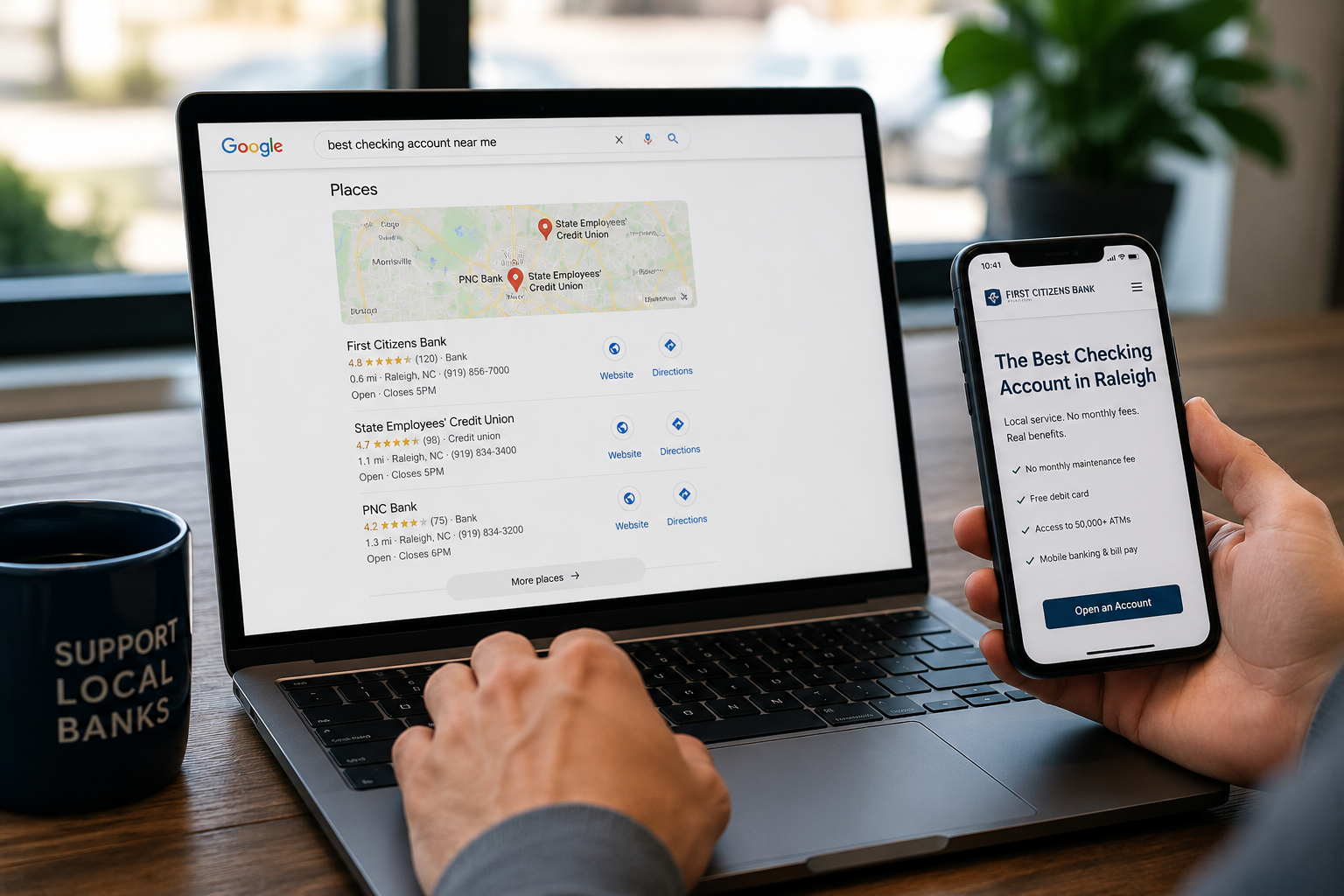
The whole game is reframing the keyword. Instead of "best checking account," you target "best checking account in [your city]," "best checking account near me," and the branch-level local searches that surround them. These localized searches do two things the national term doesn't: they signal a searcher who is actually in your service area, and they frequently trigger Google's Local Pack — the map-based box of three business listings that appears above the regular organic results.
That Local Pack is your highest-value target. It pulls from a completely different source than the aggregator-dominated organic listings. The Local Pack is triggered by searches with local intent like "chiropractor near me," and these results come from Google Business Profiles, not your website — Google chooses which businesses to feature based on location, number of reviews, star rating, business hours, and relevance. Crucially, the Local Pack appears above the organic listings and sometimes even above paid ads, and the people clicking it are ready to move: searchers using local queries are typically looking to take immediate action, whether making a call, visiting a store, or booking a service. Salem Surround + 2
So the strategy splits into two fronts: dominating the Local Pack (driven by your Google Business Profile) and ranking the localized organic page (driven by your website). Let's take each.
Front 1: Dominate the Local Pack
The Local Pack is governed by three factors — relevance, proximity, and prominence — and while you can't change where your branches sit, you have real control over the other two. Proximity of the business from the searcher is the most important ranking signal in local search, which is exactly why a community institution can beat a national brand here: your branch is physically closer to the local searcher than a neobank with no address in town. Localranking
Here's what to optimize.
Claim and fully complete a Google Business Profile for every branch. One listing per physical location, not one for the whole institution. An incomplete or unverified profile is the most common reason a branch fails to appear in local results at all. Select the correct category, keep hours accurate, and add fresh photos.
Treat reviews as an ongoing engine, not a one-time number. This is where most banks misunderstand the algorithm. It's a common misconception that the business with the most Google reviews wins — Google's algorithm has more of a "what have you done for me lately?" attitude, and the number of reviews you get per month and how recent your last review was often outweigh the total count for map pack positions. These metrics are review velocity and review recency. As the same analysis puts it bluntly: if you have 500 reviews but haven't received a new one since 2024, a competitor with 100 fresh reviews from the last month will likely blow past you. Search Engine LandSearch Engine Land
The practical takeaway is to build a steady review-generation habit. Train branch staff to ask satisfied members after positive interactions, make leaving a review frictionless with QR codes, and respond promptly to every review that comes in.
Connect each profile to a dedicated local page, not your homepage. This is a high-leverage step many institutions skip. Many businesses link their GBP to their homepage and stop there — for multi-location businesses this is a mistake. Linking your GBP to a hyper-local city page instead of the homepage reinforces "entity alignment," and when the information on your GBP matches a unique, highly relevant page on your site, Google's confidence in your location increases, often leading to a jump in the local pack. Search Engine Land
Front 2: Rank the Localized Organic Page
Alongside the Local Pack, you want a page on your own site engineered to rank for the localized query and to convert the visitor once they arrive. This is the page your Google Business Profile links to, and it's where you can actually use "best"-adjacent language in a compliant, customer-focused way.
Build a genuinely local, genuinely helpful comparison page. The aggregators win nationally partly because they answer the question thoroughly. You can out-localize them. Study what makes their pages work — major finance publishers rank checking accounts using a familiar format: fresh updates, comparison tables, "best for" winners, pros and cons, fees, APY, ATM access, account types, methodology, FAQs, and internal links — and adapt that structure for your market. A page like "How to Choose the Best Checking Account in [City]" can capture the same intent while sidestepping the compliance problem of declaring yourself "the best." Envelopebudgeting
Answer the criteria real searchers care about. People searching for the best checking account are weighing a consistent set of factors. When selecting a checking account, consumers consider fees for maintaining a low balance, the availability of nearby institution locations, and the user-friendliness of the mobile app — and broadly, the best accounts offer low fees, high APY, and ATM reimbursement. Address each of these honestly on your page. Your local presence is itself a differentiator worth emphasizing, since if a searcher wants in-person support, a traditional bank or branch-based institution makes more sense than a no-fee online-only account. Wallethub + 2
Lead with your local advantages. Where you genuinely shine against the SoFis and Chimes of the aggregator lists — in-person service, community roots, local decision-making, relationship banking — say so plainly. These are exactly the attributes a national comparison table flattens out and a local searcher is often looking for.
Don't Forget the Compliance Angle
A quick but important note: the reason you reframe "best" into customer-focused language isn't only about beatable keywords — it's about staying compliant. Superlative claims about financial products invite regulatory scrutiny. Framing your page around "how to choose," "what to look for," and "comparing your options in [city]" keeps your legal team comfortable while capturing the same search intent. And keep your rate and fee information accurate and current; a page claiming a checking APY that no longer matches reality is both a trust problem and a compliance risk, especially given how frequently rates move with Fed decisions.
Put It Together: A Practical Sequence
If you're starting from scratch, work in this order:
Audit and complete every branch's Google Business Profile, fixing categories, hours, photos, and NAP consistency first.
Launch a review-generation routine at the branch level to build velocity and recency — the single biggest Local Pack lever within your control.
Build a localized checking-account page per market, structured like the best comparison content but centered on your city and your local advantages.
Link each GBP to its matching local page to reinforce entity alignment.
Track your Local Pack position for "checking account [city]" and "near me" variants, and refresh the page and reviews continuously.
Local Pack visibility doesn't appear overnight, but it's reachable. With consistent optimization, businesses often see results within one to three months, and the payoff is durable: ranking in the Local Pack connects you with nearby customers exactly when they're ready to take action, and the rewards in calls, foot traffic, and customer trust are well worth the effort. Salem SurroundSalem Surround
Frequently Asked Questions
Can a community bank or credit union rank for "best checking account"?
Not for the bare national term — that page is dominated by aggregators. NerdWallet alone rates around 100 institutions across 30 subcategories, and similar publishers own those results. But you absolutely can rank for the localized version — "best checking account in [city]" and "near me" searches — where Google rewards proximity and local relevance that national sites can't match. NerdWallet
Why do NerdWallet and Bankrate always rank first for these searches?
Because they've built enormous, constantly updated resources specifically for these queries. Bankrate reviewed checking accounts from over 100 banks and credit unions and validates the information regularly, typically biweekly, on top of years of domain authority. Competing head-on for the national term is a losing investment; competing locally is not. BankrateBankrate
What's the most important factor for ranking in the Local Pack?
Proximity matters most, but among the factors you control, review activity is decisive. The number of reviews you get per month and how recent your last review was often outweigh total review count for map pack positions — so a steady stream of fresh reviews beats a large but stale pile. Maintaining a complete, accurate Google Business Profile for each branch is the foundation underneath that. Search Engine Land
Should each branch have its own page and Google Business Profile?
Yes. Each physical location needs its own claimed, complete Google Business Profile, and ideally its own local landing page. Linking your GBP to a hyper-local city page rather than your homepage reinforces entity alignment, and when the GBP and page match, Google's confidence in your location increases, often lifting your local pack position. Search Engine Land
Is it a compliance problem to say we have the "best" checking account?
It can be, which is one more reason to reframe. Building your page around "how to choose the best checking account in [city]" or "comparing checking accounts in [area]" captures the same search intent while avoiding unsubstantiated superlative claims — an approach compliance teams are far more comfortable approving.
Ready to Own "Best Checking Account" in Your Market?
You can't beat NerdWallet nationally — but you can own the local search results where your future members and customers actually live, and where they're ready to walk into a branch. Ritner Digital helps banks and credit unions dominate the Local Pack and rank the localized pages that turn high-intent searches into new accounts.
Get in touch with Ritner Digital → to build a local search strategy that puts your institution at the top of "best checking account" results in your market.
Sources
NerdWallet — 11 Best Checking Accounts of June 2026
Bankrate — Best Checking Accounts of June 2026
WalletHub — Best Checking Accounts
Salem Surround — How to Rank in the Google Local Pack: The Complete Guide
Search Engine Land — 5-Step Google Business Profile Audit to Improve Local Rankings
Local Ranking — Local Rank Checker, Tracker, GBP Audit
Envelope — Best Checking Accounts in 2026
CNBC Select — Best Credit Union Checking Accounts of 2026