SEO for Mortgage Lenders: How to Capture Home Loan Searches Before Big Banks Do
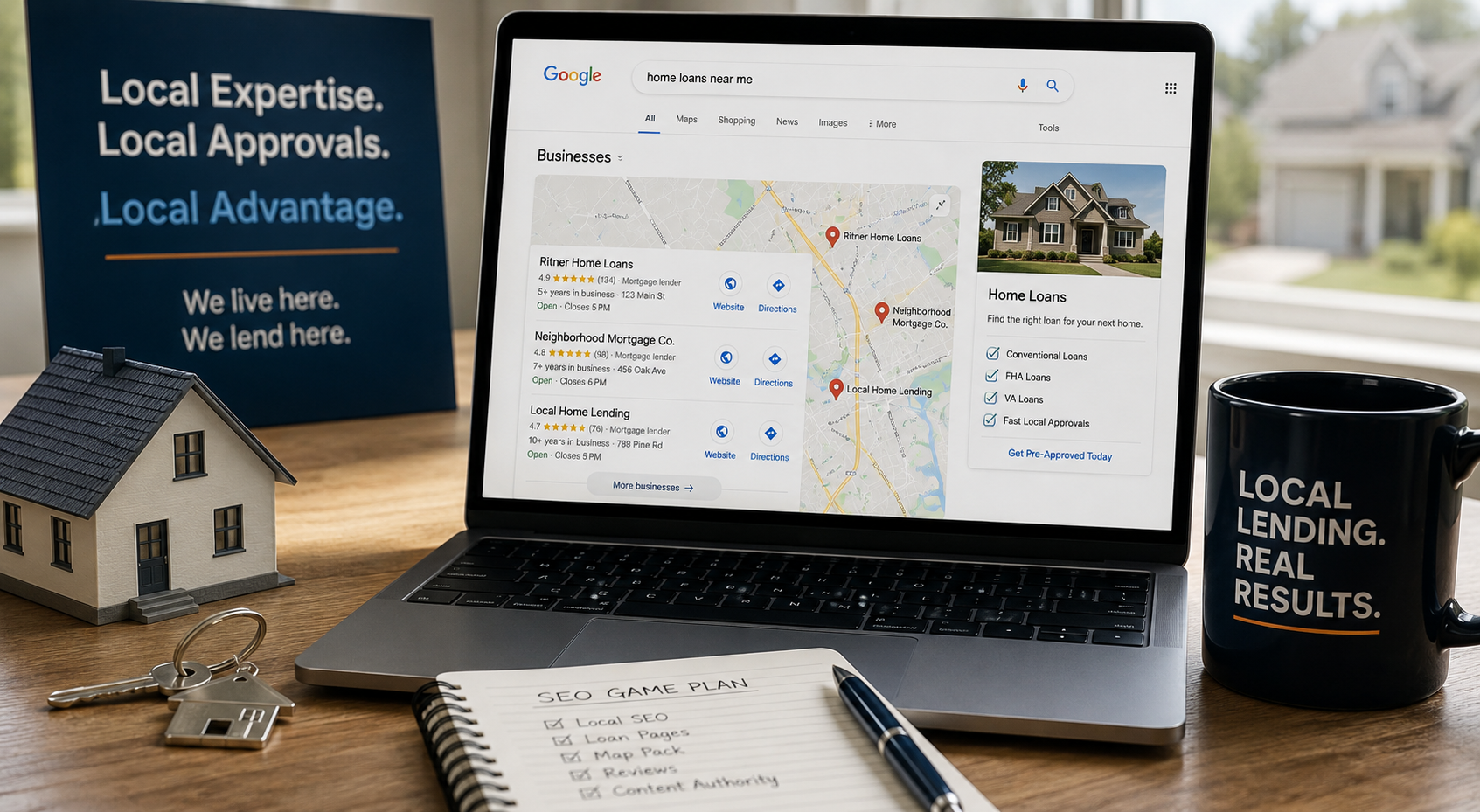
The mortgage business is brutally competitive online, and it's easy to feel outgunned. Big banks spend millions on advertising, online lenders dominate paid search, and comparison sites fight for every click. When a borrower searches "best mortgage rates," they're met with a wall of national giants. Your SEO strategy must account for hyper-local competition while competing against national giants like Rocket Mortgage, NerdWallet, and Zillow — companies with unlimited budgets for Google Ads and content marketing. TrafficworxGarit Boothe Digital
But here's the opening those budgets can't close: they can't replicate what you offer — local expertise and personal service. And the stakes for capturing even a sliver of that search traffic are enormous. With average commissions of $5,000+ per loan and the potential for repeat business and referrals, even a few organic leads each month can significantly impact your bottom line. This guide lays out how mortgage lenders can intercept home loan searches in their market before the big banks ever enter the picture. Garit Boothe DigitalTrafficworx
Why SEO Beats Bought Leads for Mortgage Lenders
Before the tactics, it's worth understanding why organic search is uniquely valuable in mortgage — because it reframes SEO from a cost into an asset. The mortgage industry runs heavily on purchased leads, and those leads have a fatal flaw: you're never the only lender who bought them. Unlike buying shared leads — which are often sold to multiple lenders simultaneously, leading to a race to the bottom on price — organic generation builds a direct bridge between lender and borrower. Salesforce
Organic leads are fundamentally better leads. They're exclusive to you, meaning you aren't competing with five other lenders for the same person's attention, and they tend to convert at higher rates because the prospect has already interacted with your brand, building trust before the first conversation. As one mortgage SEO firm frames it, one closed loan from organic search can pay for months of SEO investment, and unlike purchased leads, these borrowers came to you — they're not shopping five other lenders simultaneously. SalesforceTrafficworx
There's also a timely reason this matters more than ever in 2026. With the trigger lead ban effective March 2026 reducing third-party lead supply, loan officers who built organic first-party leads are now insulated from rising aggregator prices — making SEO more valuable than ever. The lenders who invested in organic search early are now structurally protected from the lead-cost squeeze. LeadPops
The Core Strategy: Win Local and Specific, Skip the National Terms
The single most important strategic decision is choosing the right battles. You won't beat Rocket Mortgage for "mortgage rates," and trying to is a waste of budget. Instead, you compete where Google's algorithm gives local lenders an edge.
The mechanic here is simple but powerful. Instead of just targeting "FHA mortgage" — competing against lenders all across the country — optimize your webpage for "FHA mortgage in [city]." Google tailors SERPs based on location, so if you operate in a specific area and optimize a page for "FHA mortgage in [your city]," someone searching for that loan product near you is more likely to find you. Bankingbridge
These long-tail, geo-specific terms are where the real opportunity lives. Terms like "VA loan lender in Austin" or "FHA mortgage broker Denver" face less competition while attracting highly qualified prospects. The same applies broadly: phrases like "first-time home buyer programs [city]" or "refinance rates for veterans" have lower search volume but higher conversion rates, and these specific targets often face less competition from national lenders. iMark InfoTechGarit Boothe Digital
And the urgency is real, because the big players are moving into your backyard. As national lenders increase their local search investment, independent mortgage brokers must execute flawless local SEO or risk being priced out of their own markets. Kaleidico
Map Keywords to the Borrower Journey
Homebuyers don't decide on a lender in a single search. Homebuyers don't wake up one morning and immediately search for a mortgage lender — they go through distinct stages, and your strategy needs to address each one. The lender who shows up early — during the research phase — earns trust that pays off at decision time. The borrower who finds your helpful content about FHA loans today becomes the client who calls you when they're ready to buy in three months. iMark InfoTechTrafficworx
Build content for each stage of the funnel:
Research phase: "How much house can I afford" or "FHA vs. conventional loan." This is broad educational content like "What is DTI?" or "How does a mortgage prequalification work?" TrafficworxRankWriters
Rate shopping: "Current mortgage rates" or "mortgage rates [city]." Trafficworx
Lender search: "Mortgage broker near me" or "best mortgage lender [city]." Trafficworx
Pre-approval: "Get pre-approved for mortgage" or "mortgage pre-approval [city]." Trafficworx
The smart move is interlinking these stages so a researcher flows toward conversion. Create content for each stage of the journey, then interlink them — someone searching "how much house can I afford" ends up on your pre-approval page a few clicks later. LeadPops
Build Dedicated Loan-Product Pages (Silos)
A scattershot site won't rank. The lenders winning organic search build deep, dedicated pages for each loan product and program. Dedicated pages for FHA loans, VA loans, refinancing, and first-time homebuyer programs help rank for specific, high-conversion keywords and match user intent. Padula Media
This is also where you out-depth the national players. In 2026, ranking for "mortgage" is not enough — you must own the "program context" by building out deep silos for specific loan products like FHA, VA, DSCR, Jumbo, and USDA. A useful rule of thumb for structuring this: each core keyword should correspond to a single page on your website, and for a niche business like mortgage lending you'd ideally aim for at least 20 core keywords, meaning 20 dedicated pages. Padula Media
The advantage you have over a big bank's generic loan page is local, proprietary knowledge that AI and national sites can't replicate. Generic AI can tell a user the national interest rate trend, but it cannot tell them that a specific neighborhood in your city is eligible for specialized municipal down-payment assistance programs or that local property tax assessments are about to shift. Combine product silos with hyper-local market detail and you create pages no national lender can match. Fuel Online
Dominate the Local Map Pack
For local lenders, the map pack — the top three local results with a map — is the highest-value real estate in mortgage search. For local brokers, the map pack is the entire game. Your Google Business Profile is what drives it, and most lenders treat it as an afterthought. Fuel Online
Most mortgage brokers treat Google Business Profile as a set-it-and-forget-it checkbox. That's a mistake — your GBP is a second website, one Google shows above organic results for local searches. Optimize it deliberately: LeadPops
Pick the right category. Choose "Mortgage Broker" or "Mortgage Lender," not the generic "Financial Services," and add every city and zip code you serve, not just your office address. LeadPops
List every loan type you offer — purchase loans, refinancing, FHA, VA, jumbo, first-time buyer programs — on the profile.
Keep it active. Post rate updates, market news, home buying tips, and recent closings with permission — active profiles outrank dormant ones. Trafficworx
Make Reviews and Trust Signals a Priority
Mortgage is the definition of a high-trust purchase, which makes reputation a direct ranking and conversion factor. In mortgage lending, your online reputation directly impacts conversions — people aren't just looking for information, they're looking for reassurance that they're making the right choice with a credible lender. iMark InfoTech
Reviews are the engine here, and they're easy to collect at the right moment. Request reviews when clients close — they're excited about their new home and grateful for your help — and send a direct link to make it easy. Specificity in reviews matters: reviews mentioning specific help like "got me approved despite credit issues" or "found a great rate" resonate with borrowers in similar situations. TrafficworxTrafficworx
Beyond reviews, display the credentials that establish legitimacy. Your NMLS number should be prominently visible, and you should showcase professional certifications, awards, and industry memberships. You can also borrow authority by association: linking your practice to industry leaders like Fannie Mae, Freddie Mac, and the Mortgage Bankers Association tethers your site to the high-authority financial neighborhood of the web. iMark InfoTechFuel Online
Get the Technical and Mobile Basics Right
None of this works on a slow or clunky site, and mortgage search skews heavily mobile. Mobile search will account for over 75% of mortgage-related queries by 2026, making desktop optimization secondary to mobile user experience. A blunt self-test from one mortgage SEO guide: pull up your website on your phone — if it takes more than 2 seconds to load, you're already losing, because Google uses mobile-first indexing, meaning your mobile site is your site in Google's eyes. KaleidicoLeadPops
And don't neglect conversion once visitors arrive. Most mortgage professionals focus on driving more traffic when they should first optimize conversion rates for existing traffic — it's cheaper and faster than SEO campaigns targeting competitive keywords. A fast, frictionless mobile application path turns the organic traffic you earn into actual funded loans. Kaleidico
Don't Forget AI Search
Borrowers increasingly research home loans through AI tools, and being absent from those answers means losing a growing share of the market. If your content is not AI-ready, you may be invisible to an entire generation of borrowers using AI to research home loans, credit tips, DPA programs, and refinance options. The example to internalize: when a user asks ChatGPT "What credit score do I need to qualify for an FHA loan in Pennsylvania?", AI tools pull from structured, high-quality content — and if your site isn't built to serve those answers, your competitors will be featured instead. RankWritersRankWriters
The fix overlaps neatly with good SEO: structure your content to lead with direct, technical answers to complex mortgage questions, since AI Overviews look for concise, accurate "answer capsules." Fuel Online
Set Realistic Expectations
SEO is a pipeline you build, not a switch you flip. A realistic mortgage SEO timeline looks like this: months 1-3 are foundation building with minimal results; months 4-6 bring first-page rankings for long-tail keywords; months 7-12 deliver significant traffic and lead flow; and year 2 and beyond is compound growth and market domination. The lenders who win are simply the ones who don't quit. The brokers who quit at month 3 wonder why SEO "doesn't work" — the ones who stay the course are the ones you're competing against for those top 3 positions. LeadPopsLeadPops
Measure what actually matters to your business, not vanity metrics. Track organic lead volume — actual form fills and calls, not traffic — cost per organic lead, organic-lead-to-application rate, and revenue from closed loans sourced from SEO. When you tie SEO to funded loans, the case for sustained investment makes itself. LeadPops
Frequently Asked Questions
Can a local mortgage lender really compete with big banks in search?
Yes — by not fighting them where they're strongest. National giants like Rocket Mortgage, NerdWallet, and Zillow have unlimited budgets, but they can't replicate local expertise and personal service. Focus on geo-specific, loan-product-specific terms and the local map pack, where national lenders often take a one-size-fits-all approach with content that's broad, impersonal, or not optimized for local markets. Garit Boothe DigitalRankWriters
What keywords should mortgage lenders target?
Local and product-specific long-tail terms. Terms like "VA loan lender in Austin" or "FHA mortgage broker Denver" face less competition while attracting highly qualified prospects, and you should build dedicated pages for each loan type. The trick is optimizing for "[loan type] in [city]" rather than the national term, since Google tailors results by location. iMark InfoTechBankingbridge
Why are organic leads better than purchased mortgage leads?
Because they're exclusive and pre-qualified by trust. Shared leads are sold to multiple lenders simultaneously, leading to a race to the bottom on price, while organic leads are exclusive to you and convert at higher rates because the prospect has already interacted with your brand. This matters even more now that the March 2026 trigger lead ban has reduced third-party lead supply. SalesforceLeadPops
How important is mobile for mortgage SEO?
Critical. Mobile search will account for over 75% of mortgage-related queries by 2026, and Google's mobile-first indexing means your mobile site is your site in its eyes. A site that loads slowly or is hard to use on a phone loses borrowers before they ever see your rates. KaleidicoLeadPops
How long does mortgage SEO take to produce leads?
Plan on a year-long ramp with compounding returns after. Expect minimal results in months 1-3, first-page rankings for long-tail keywords in months 4-6, significant traffic and lead flow in months 7-12, and compound growth in year 2 and beyond. Consistency is the deciding factor between lenders who win and those who give up early. LeadPops
Ready to Capture Home Loan Searches in Your Market?
Every borrower in your area is searching for answers about rates, programs, and lenders right now — and a big bank or aggregator is happy to take that lead off your hands. Ritner Digital helps mortgage lenders build the local pages, product silos, and map-pack presence that intercept those searches and turn them into exclusive, high-intent leads you don't have to share.
Get in touch with Ritner Digital → to build a mortgage SEO strategy that puts your loan officers in front of borrowers before the big banks do.
Sources
RankWriters — SEO for Mortgage Lenders: Compete with Big Banks via AI
LeadPops — SEO for Mortgage Brokers: Top Strategies to Rank Higher in 2026
Garit Boothe Digital — SEO for Mortgage Brokers: Strategies to Beat the Competition
iMark Infotech — Mortgage Lender SEO: Converting Searchers to Borrowers
TrafficWorx — SEO for Mortgage Brokers: Rank Higher, More Leads
Kaleidico — 2026 SEO Statistics for Mortgage Professionals
Banking Bridge — How Mortgage Lenders Can Improve Mortgage SEO
Salesforce — Mortgage Lead Generation: Top Strategies
Padula Media — SEO for Mortgage Brokers: Dead Simple Guide
Fuel Online — 12 Best Mortgage SEO Companies for 2026