How to Switch SEO Agencies Without Losing Everything: The Complete Guide
Switching SEO agencies is one of the highest-stakes decisions a marketing team makes — and one of the least documented. There's plenty of content about how to hire an agency. Almost nothing about how to leave one safely, what you're owed when you do, or how to build a relationship with the next one that doesn't end the same way.
This guide exists to fill that gap.
Over the course of this series, we've covered every dimension of the agency transition process — from the pre-signing audit that tells you whether an agency is worth hiring, to the handoff checklist that protects your assets when you leave, to what a genuinely healthy agency relationship looks like once you've found the right partner. Each post goes deep on its topic. This one connects them.
If you're considering a switch, mid-transition, recovering from a bad experience, or simply want to understand how this process should work before you ever need it — start here. Follow the links to the full posts when you want to go deeper on any specific topic.
Why Switching SEO Agencies Goes Wrong
Before getting into the framework, it's worth understanding the failure modes — because the problems that derail agency transitions are remarkably consistent.
The most common is access. Agencies often hold logins, manage properties inside their own accounts, and control infrastructure that businesses assume they own. When the relationship ends, clients discover that their Google Ads account, their Search Console property, their website hosting, or their GA4 setup lived inside the agency's systems — and leaving means losing years of data, history, and audience assets they can't easily rebuild.
The second is documentation. An agency that never documented their strategy, their technical decisions, their link building history, or their keyword targeting rationale takes that institutional knowledge with them. The incoming agency starts blind, spending the first 90 days reconstructing what should have been handed over.
The third is timing. SEO doesn't pause while you transition. A gap between your old agency's last day and your new agency's first active week means monitoring stops, work stops, and problems can compound undetected.
The fourth — and the one that's hardest to see until you're in it — is starting the new relationship without fixing the conditions that made the old one fail. If you don't know what a healthy agency relationship looks like, what honest reporting looks like, and what to audit before you sign, you risk recreating the same dynamic with a different agency.
This series addresses all four. Here's how the pieces fit together.
The Framework: Four Phases of a Safe Agency Transition
Think of a safe agency transition in four phases: evaluate, protect, transition, and build. Each phase has its own priorities, its own risks, and its own posts in this series that go deep on the details.
Phase One: Evaluate Before You Commit
The time to audit an agency is before you sign the contract — not three months in when the red flags you missed at the pitch have become expensive problems. Most businesses evaluate agencies on how well they present rather than how well they deliver. A rigorous pre-signing audit closes that gap.
What this phase covers:
Evaluating the agency's own digital presence as the most honest signal of their actual capabilities. Interrogating case studies for specificity, relevance, and methodology — not just outcome numbers. Understanding who will actually work on your account, not just who presents in the pitch. Reading the proposal critically for specificity versus generic service descriptions. Scrutinizing the contract for notice periods, work product ownership, account ownership language, and auto-renewal clauses. Checking the agency's reputation through independent review sources, not just their curated reference list. And asking the questions that make agencies uncomfortable — because the answers are the most revealing part of any evaluation.
The post that goes deep: How to Audit an Agency Before You Sign Anything →

How to Audit an Agency Before You Sign Anything
A polished proposal and a confident pitch tell you an agency is good at winning business. They tell you almost nothing about whether the agency is good at the actual work. This is the complete pre-signing audit framework — how to evaluate an agency's real capabilities, who will actually work on your account, what the contract should say, and the questions that separate agencies worth hiring from agencies worth avoiding.
Phase Two: Protect Your Assets Before You Leave
Once you've decided to make a change, the priority shifts to asset protection — making sure everything that belongs to you is in your hands before the old agency's last day. This is where most transitions go wrong, and where the damage tends to be most lasting.
What this phase covers two things — what to ask for, and how to handle the handoff:
From your old agency, you are owed your complete keyword strategy, all content produced during the engagement, full technical SEO documentation including the redirect map, the complete link building record including the disavow file, all reporting archives, access to every account and property, and any strategy documents or research produced on your behalf. This is not a courtesy — it's work product you paid for, and it belongs to you.
The handoff process itself — confirming account access, sequencing the transition, building in overlap time if possible, and assembling the package your new agency needs on day one — determines how much momentum you lose in the transition. A well-executed handoff loses almost none. A poorly executed one can cost months of recovery.
The posts that go deep: The SEO Agency Handoff Checklist: Everything You Need Before You Switch →
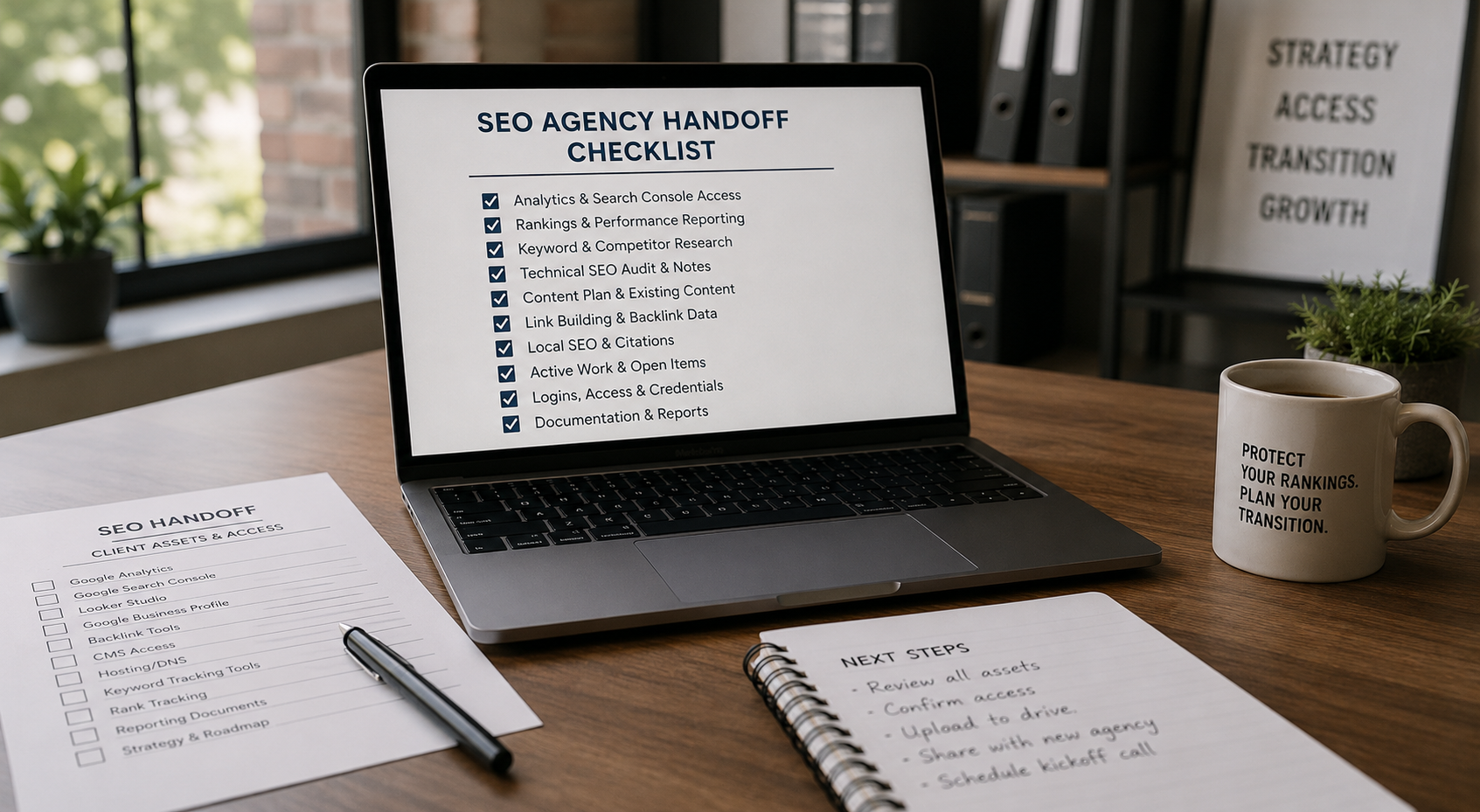
The SEO Agency Handoff Checklist: Everything You Need Before You Switch
Switching SEO agencies goes wrong in predictable ways — lost access, missing documentation, and gaps in active work that quietly erode rankings you spent years building. This checklist covers every asset, account, and piece of documentation you need to secure before your current agency's last day, so your transition protects what you've built instead of undoing it.
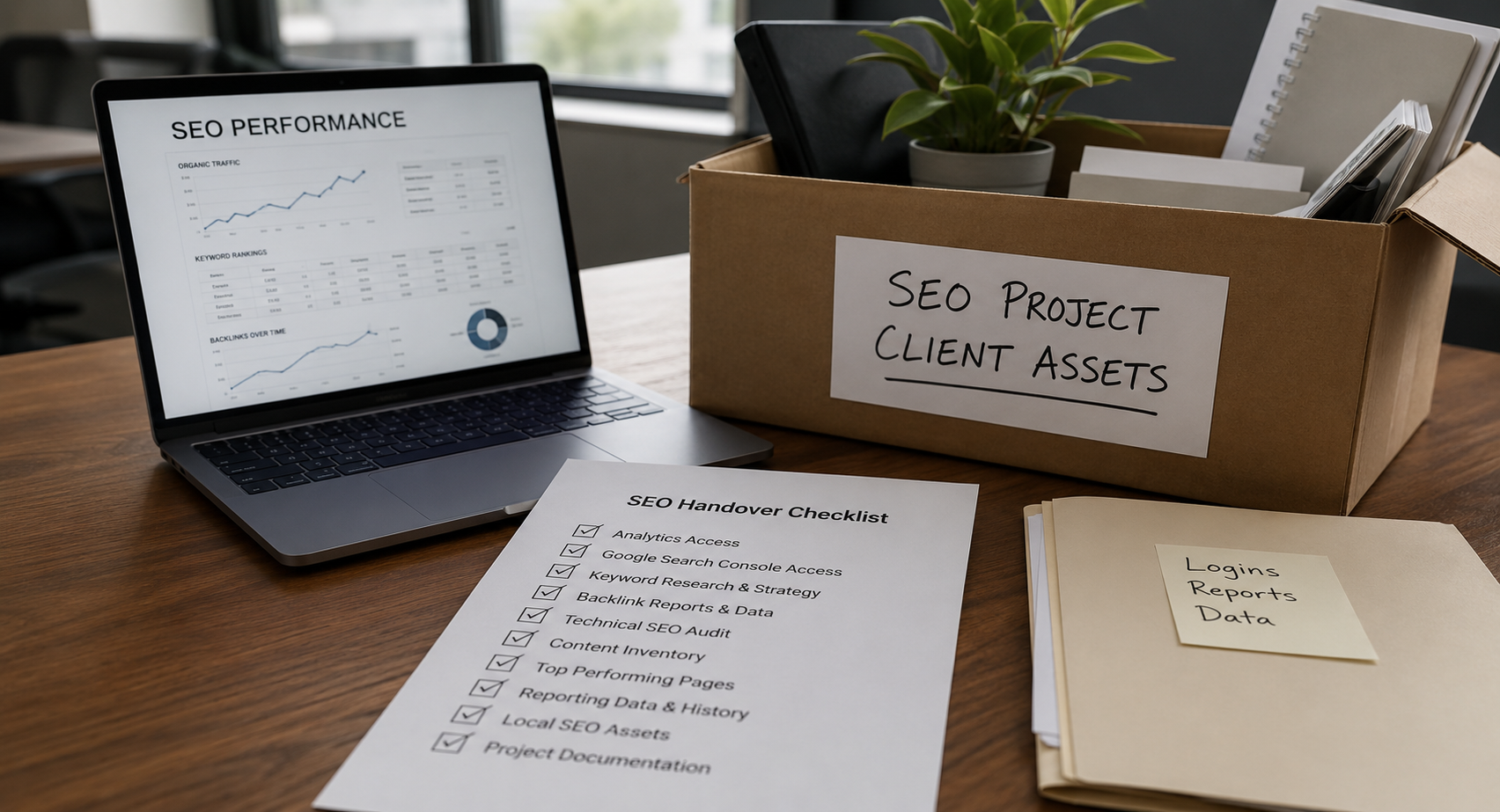
What Your Old SEO Agency Should Give You Before They Leave
When an SEO agency relationship ends, most clients ask for their logins back and call it done. But there's a lot more that belongs to you — keyword strategies, link building records, technical documentation, content archives, and years of reporting data that your next agency needs to hit the ground running. Here's the complete list of what you're owed and how to make sure you get it.
Phase Three: Secure Your Digital Assets
Parallel to the handoff process is a separate and equally important audit of ownership across your entire digital marketing stack. Two assets in particular deserve their own attention: your Google Ads account and your website.
Google Ads account ownership is one of the most misunderstood and highest-stakes questions in any agency transition. There are two fundamentally different account structures — one where the account is yours and the agency has been granted access, and one where the account lives inside the agency's systems and they control it entirely. The difference is invisible from the inside and catastrophic when you try to leave. Losing an agency-owned Google Ads account means losing campaign history, Quality Scores, remarketing audiences, and the account's performance record with Google — all of which take time and money to rebuild.
Website ownership is equally complex when an agency built the site. Who owns the domain? Who controls the hosting? Who owns the code? What platform is the site built on and how portable is it? What happens to your forms, tracking, integrations, and design files when the agency leaves? These questions have real answers — and the wrong answers can mean your website goes offline, your conversion tracking breaks, or you discover your site was built on a proprietary platform you can't take anywhere.
The posts that go deep: Who Owns Your Google Ads Account? →

Who Owns Your Google Ads Account? (And Why the Answer Matters More Than You Think)
Most businesses assume they own their Google Ads account. Many don't. When an agency relationship ends badly, clients discover their campaigns, conversion history, remarketing audiences, and Quality Scores all lived inside an account the agency controlled — and walked away with. Here's how Google Ads account ownership actually works, how to check your current situation, and how to make sure it never becomes a problem.

What Happens to Your Website When You Leave Your Agency?
Most businesses assume they own their website. But if an agency built it, registered the domain, set up the hosting, or built it on a proprietary platform, the reality can be very different. This post covers every dimension of website ownership — domain, hosting, code, design files, integrations, and content — and exactly what to do if the answers aren't what you hoped.
Phase Four: Build a Relationship Worth Keeping
Getting safely out of a bad agency relationship and into a new one is only half the work. The other half is making sure the new relationship has the foundations to be genuinely productive — and knowing how to recognize and respond to problems early enough that they don't compound into another painful transition.
Honest reporting is the clearest ongoing signal of agency health. An agency that reports honestly — connecting activity to outcomes, surfacing what isn't working alongside what is, providing competitive context, and writing reports you can actually understand — is an agency operating with integrity. The red flags in SEO reporting are consistent enough to be catalogued: traffic growth without segmentation, rankings for keywords nobody searches, no conversion data, activity metrics without outcome context, cherry-picked date ranges, vanity metrics as the lead story, and reports that never acknowledge challenges. Knowing what to look for changes the conversation with your agency and tells you quickly whether the relationship is sustainable.
What a healthy relationship looks like goes beyond the absence of red flags. It has its own positive characteristics — honest expectations set from the start, a clear and documented scope, proactive communication that doesn't require you to chase information, strategic thinking that goes beyond task execution, genuine accountability on both sides, results defined and measured honestly, and a culture of candor that allows hard conversations to happen before problems become crises. The relationships that hold up longest are the ones where both parties show up with mutual respect and a genuine commitment to each other's success. That's not a high bar. It's just not always the norm.
The posts that go deep: Red Flags in SEO Reporting: What Your Agency Might Be Hiding →

Red Flags in SEO Reporting: What Your Agency Might Be Hiding in Plain Sight
Every month the report arrives and everything looks good on paper — traffic up, rankings improved, targets hit. But the phone isn't ringing more and the leads aren't increasing. If that gap feels familiar, the problem might be your reports. Here are the ten biggest red flags in SEO reporting, from cherry-picked date ranges to activity metrics with no outcome data, and what your agency should be showing you instead.

What a Healthy Agency-Client Relationship Actually Looks Like
A healthy agency-client relationship isn't just the absence of red flags. It has its own positive qualities — a specific kind of communication, a specific kind of accountability, and a specific kind of trust that gets built through consistent behavior rather than promised in a sales pitch. Here's what it looks like in practice, what both sides have to contribute to make it work, and how to know whether the relationship you're in has the foundation to be genuinely productive.
The Full Series at a Glance
For quick reference, here is every post in the series with a one-line summary of what it covers:
How to Audit an Agency Before You Sign Anything — The complete pre-signing evaluation framework: how to assess real capabilities, scrutinize proposals and contracts, verify reputation independently, and ask the questions that separate agencies worth hiring from agencies worth avoiding.
The SEO Agency Handoff Checklist: Everything You Need Before You Switch — Every account, asset, and document you need to secure before your current agency's last day, organized by category and prioritized by urgency.
What Your Old SEO Agency Should Give You Before They Leave — The complete list of deliverables you are owed at the end of any agency engagement — from keyword strategy and content archives to link building records and technical documentation — and how to ask for them without it becoming a fight.
Who Owns Your Google Ads Account? — How Google Ads account ownership actually works, why the structure matters enormously when a relationship ends, how to check your current situation, and what to do if the account isn't in your name.
What Happens to Your Website When You Leave Your Agency? — Domain ownership, hosting control, platform portability, code ownership, design files, content, forms, tracking, and integrations — every dimension of website ownership you need to understand before parting ways with an agency that built or manages your site.
Red Flags in SEO Reporting: What Your Agency Might Be Hiding — The ten most common patterns in SEO reporting that obscure real performance: from traffic growth without segmentation to activity metrics without outcomes to reports you can't understand without a glossary.
What a Healthy Agency-Client Relationship Actually Looks Like — The positive characteristics of a genuinely productive agency relationship: honest expectations, clear scope, proactive communication, strategic partnership, mutual accountability, and the culture of candor that makes hard conversations possible before they become crises.
Who This Series Is For
This series was written for a few specific situations.
You're unhappy with your current agency and considering a change. Start with the red flags in SEO reporting post to assess whether what you're experiencing is genuinely a problem, then move to the audit post to understand what you should be looking for in a replacement, and the handoff checklist to start protecting your assets before you give notice.
You're mid-transition and things are more complicated than you expected. The posts on what your old agency should give you, Google Ads account ownership, and website ownership will help you identify what you're owed, how to pursue it, and what to do if you can't get it.
You're about to start a new agency relationship and want to do it right from the beginning. The pre-signing audit post is the place to start. The healthy relationship post describes what you're aiming to build. The reporting red flags post tells you what to watch for once the engagement is underway.
You've been burned before and want to understand why. Most agency relationship failures follow predictable patterns. This series names them specifically, which makes it easier to recognize them early in a new relationship — when there's still time to address them — rather than only in retrospect.
The Bottom Line
Switching SEO agencies safely is not complicated. It is thorough. It requires asking the right questions before you sign, knowing what's yours before you leave, understanding how your digital assets are structured before you discover the answer the hard way, and building the next relationship on a foundation that gives it a real chance to work.
None of this requires legal expertise, technical knowledge, or a confrontational approach. It requires knowing what to look for, what to ask for, and what good actually looks like — which is exactly what this series is designed to give you.
If you're navigating any part of this process and want a straight conversation about where you stand and what your options are, we're here for that.
Ready to Make a Change the Right Way?
At Ritner Digital, we've been on both sides of this process — inheriting situations where clients lost significant assets in a badly managed transition, and executing clean handoffs that protected everything a business spent years building. We know what good looks like and we know what it costs when the process isn't handled carefully.
If you're thinking about making a change, want a second opinion on your current situation, or simply want to know what working with us would look like — let's talk.
No sales pressure. Just an honest conversation about where you are and what makes sense next.
This is the pillar post for Ritner Digital's series on switching SEO agencies safely. Each linked post goes deep on its specific topic. All posts in the series include FAQs covering the most common questions on each subject.
Frequently Asked Questions
Do I need to read the entire series or can I just read the posts relevant to my situation?
You can absolutely jump straight to the posts most relevant to where you are right now. If you're mid-transition and worried about your assets, start with the handoff checklist and the post on what your old agency should give you. If you're evaluating a new agency, start with the pre-signing audit. If you're unhappy with your current agency but not sure whether to leave, start with the reporting red flags post — it will help you diagnose whether what you're experiencing is a real problem or a fixable one. The pillar post exists to connect the pieces and give you a map of the full territory. The individual posts are where the actionable detail lives.
How long does a full agency transition typically take when done properly?
From the decision to leave to a new agency operating at full capacity, plan for three to four months minimum. The first month covers giving notice, beginning the asset protection and handoff process, and finalizing your new agency selection. The second month covers the formal handoff, access transfers, and new agency onboarding. The third month is when your new agency moves from orientation into active execution. Rushing any part of this — particularly the handoff and onboarding phases — tends to create problems that take longer to fix than the time you saved by moving fast.
What if I'm locked into a long-term contract with my current agency?
Start by reading your contract carefully — specifically the termination, notice, and auto-renewal clauses. Many contracts that appear to lock you in for twelve months have provisions for early termination for cause, which may be triggered by consistent failure to deliver contracted services, material misrepresentation, or breach of contract terms. Even without a for-cause exit, some agencies will negotiate an early release rather than maintain a relationship with a client who has clearly decided to leave — a difficult relationship serves neither party. If the contract is genuinely binding, use the remaining time productively: begin the asset audit, document what you should be receiving in the handoff, and start the evaluation process for your next agency so you're ready to move the moment the contract allows.
Can I run the new agency evaluation process while still working with my current agency?
Yes, and you should. Shopping for a replacement before formally ending the current relationship is completely standard practice. Give yourself enough lead time to complete a thorough evaluation — three to four weeks minimum for a significant engagement — so you have your next agency identified and under contract before you trigger the notice period with your current one. The only things to be mindful of are any exclusivity or confidentiality clauses in your current contract that might restrict sharing proprietary work product with third parties during the active engagement.
What's the most expensive mistake people make when switching SEO agencies?
Losing their Google Ads account history is probably the single most costly mistake in pure dollar terms — because it means rebuilding campaign performance from scratch, paying higher CPCs during the learning period, and losing remarketing audiences that took years to build. A close second is losing the link building record and disavow file, because without those, the incoming agency is managing the link profile blind and the disavow protections stop working. Both of these are entirely preventable with the right account structure and a thorough handoff process — which is exactly why those topics have their own dedicated posts in this series.
Should I tell my current agency I'm evaluating replacements?
Generally no, and there's no obligation to. The dynamic of an agency relationship changes when the client signals they're shopping for a replacement — sometimes for the better, sometimes significantly for the worse. It's not uncommon for agencies to reduce the quality of attention on an account they know they're losing, or conversely to suddenly become very attentive in ways that make the decision harder without addressing the underlying issues. Make your decision, give formal notice once it's made, and use the notice period to execute a professional and thorough offboarding rather than a prolonged negotiation about whether to stay.
How do we make sure our SEO equity is protected during the transition?
Several things protect SEO equity during a transition. Maintaining the redirect map so no existing URLs break. Preserving the site's technical health during any platform or hosting migration. Avoiding aggressive on-page changes in the first 60 to 90 days of the new agency relationship until they've had time to understand what's working and why. Ensuring Search Console access is continuous so any indexing or crawling issues are caught immediately. And giving your new agency the full keyword and ranking history so they can identify what positions are most at risk and prioritize protecting them before building new ones.
Is there a right time of year to switch SEO agencies?
Avoid switching during your business's peak season if at all possible. The transition and onboarding period — even a well-executed one — involves some degree of disruption and reduced output, and that disruption is most costly when marketing performance matters most. Q1 is often a natural time for agency transitions because budgets reset, annual contracts expire, and businesses are reassessing their marketing partnerships as part of broader planning. If your situation is urgent — a fundamentally broken relationship, significant assets at risk — don't wait for the calendar. The cost of staying in a bad relationship longer than necessary usually outweighs the cost of an off-cycle transition.
What should we include in the brief to our new agency on day one?
A thorough day-one brief should include confirmed access to every relevant account and property, the technical audit and outstanding issues log, the full keyword list and keyword-to-URL mapping, the complete link profile export and any existing disavow file, the last twelve months of reporting and the organic traffic baseline, any content in progress that needs to be picked up, the competitive landscape and tracked competitor list, and contact information for your web developer, hosting provider, and any other technical stakeholders the agency will need to work with. The more complete this package is, the faster your new agency moves from orientation to execution — and the less of your budget goes toward reconstructing information that should have been handed over.
How does this series connect to Ritner Digital's broader approach to SEO?
Everything in this series reflects how we think about the agency relationship and our own obligations to clients. We structure every engagement so clients own their accounts, receive honest reporting, understand the strategy behind the work, and could leave with everything they need to continue without us if they chose to. We don't build dependency into our client relationships because we don't think that's how trust gets built or how good work gets done. If that approach sounds like what you've been looking for, we're happy to show you what it looks like in practice. Start the conversation here →