How to Use AI to Personalize Content for Every Stage of the Funnel
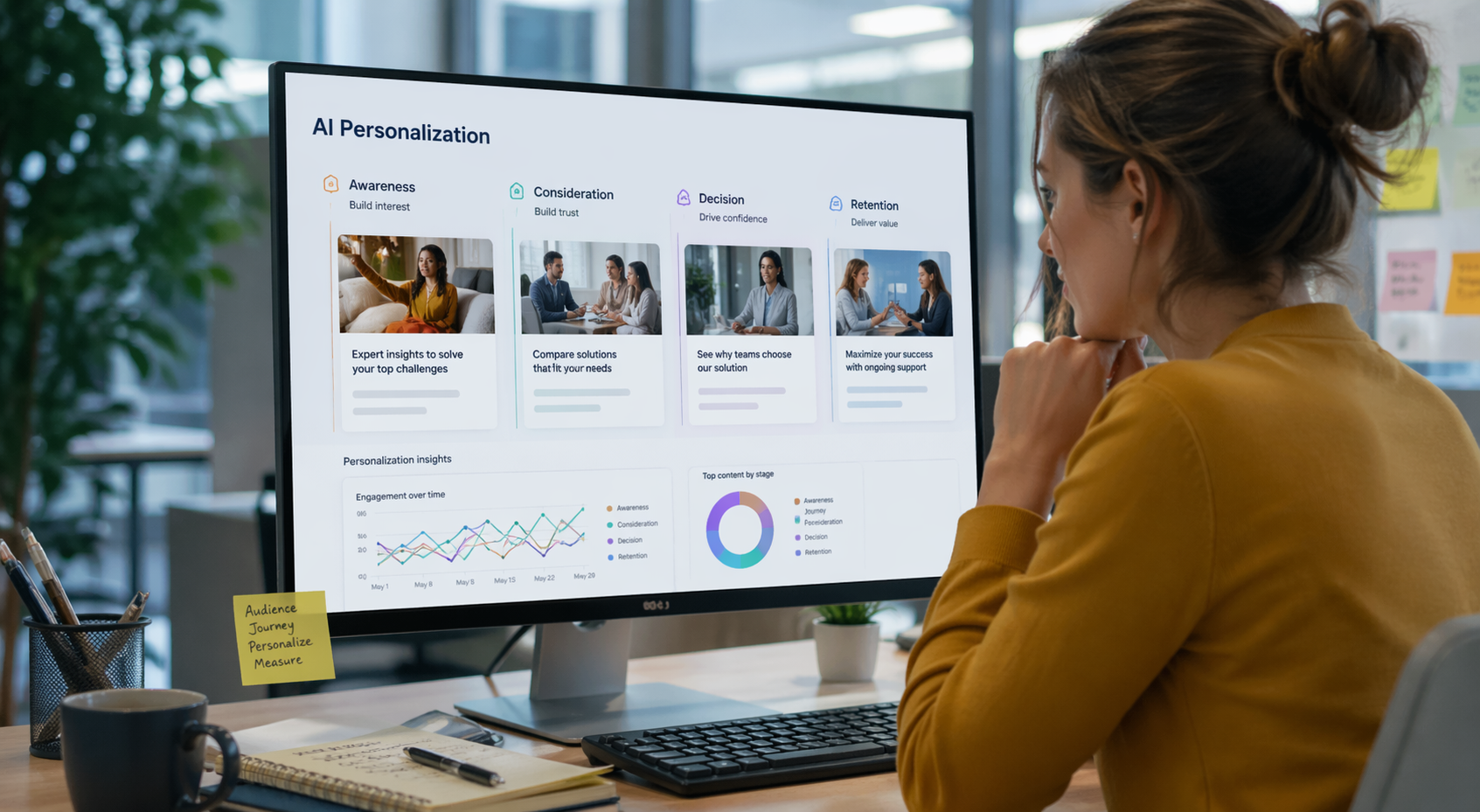
Most businesses treat personalization as a feature of their email platform — first name in the subject line, maybe a segment or two based on purchase history. That's not personalization. That's personalization theater, and buyers in 2026 have stopped being impressed by it.
Buyers today don't move through a neat funnel. They bounce between AI search results, social feeds, YouTube deep dives, comparison pages, and your pricing page — all before your sales team even knows they exist. And when you finally do show up in their world, they expect you to already understand what they're struggling with. Evenbound
AI has made genuine, scalable, behavior-driven personalization possible for businesses of every size — not just enterprises with dedicated data science teams. The risk isn't missing a headline trend. It's delivering generic experiences that underperform while competitors personalize every touch. Aidigital
This guide walks through how to use AI to personalize content at every stage of the funnel — from the first awareness touchpoint through conversion and retention — with specific tactics for each stage and the data infrastructure required to make it work.
Why Funnel-Stage Personalization Matters More Than Ever
The argument for funnel-stage personalization isn't theoretical. It's showing up in conversion data across every channel and industry.
71% of consumers expect personalized interactions from brands they engage with, and AI is the primary tool now enabling content teams to deliver individualized experiences at scale. Shno Expectation has become the baseline — and generic, one-size-fits-all content doesn't just underperform. It actively signals to prospects that you don't understand their situation.
The underlying issue is that different funnel stages have fundamentally different psychological needs. A prospect encountering your brand for the first time needs education and trust-building. A prospect who has visited your pricing page three times needs a reason to commit and objection resolution. A recent customer needs onboarding support and expansion signals. Sending the same content to all three is not just inefficient — it's actively damaging to the relationship at two of those three stages.
Generic, one-to-many campaigns now struggle to maintain relevance. By 2026, buyers expect personalized touches at every stage of their journey. Relying purely on mass communications fails to create the engagement needed for meaningful connections. Robotic Marketer
The Data Foundation: What AI Needs to Personalize Effectively
Before getting into stage-by-stage tactics, it's worth being clear about what AI-powered personalization requires. The capability comes from the data — and specifically from the quality and breadth of the signals you're feeding the system.
The most successful 2026 marketing strategies aggregate insights from first-party and zero-party sources. First-party data — gathered from owned properties like websites or apps — offers a direct view of behaviors. Zero-party data, willingly shared by customers via quizzes, forms, or preference centers, delivers valuable declared interests and intent. When marketers combine these sources, AI marketing shifts from guesswork to intelligence. Robotic Marketer
The practical data signals that enable funnel-stage personalization include: pages visited and time spent on each, content downloaded or viewed, email engagement by topic and format, pricing page visits and return frequency, product or service pages viewed, form responses and quiz answers, CRM stage and lead score, industry and company size from enrichment data, and behavioral sequences that indicate intent escalation.
With rising customer acquisition costs and disappearing cookies, the smartest brands in 2026 are focused on activating data across the funnel, turning quiz and preference data into personalized journeys that convert. Klaviyo If you don't have a clean first-party data infrastructure — events tracked in GA4, behavior data flowing into your CRM, and a clear behavioral trigger framework — AI personalization cannot function at the level described in this guide. Building that foundation is the prerequisite.
Top of Funnel (TOFU): AI-Personalized Awareness Content
Top-of-funnel content serves one purpose: reaching the right people at the moment they're first becoming aware of the problem your business solves, and earning enough trust to bring them deeper into your ecosystem.
The personalization challenge at TOFU is that you know very little about most visitors. The AI opportunity is using the signals you do have — search query, referral source, industry signals from firmographic data, and initial page behavior — to serve content that feels immediately relevant rather than generic.
A Director of Operations searching "reduce manual workflows" should land on content framed specifically for their operational pain — not a generic article about automation. Evenbound This is the most fundamental TOFU personalization principle: match the specific framing of your content to the specific pain that brought someone to your site. AI can do this at scale by dynamically adjusting headlines, intros, and CTAs based on the referring query or source.
Practical TOFU AI personalization tactics:
Dynamic content blocks by traffic source — a visitor arriving from a LinkedIn ad targeting manufacturing companies should see manufacturing-specific use cases and social proof on your landing page, not generic messaging. AI personalization tools like Mutiny, Intellimize, or HubSpot Smart Content can serve different content blocks to different audience segments automatically.
AI-powered blog topic personalization — identify which topic clusters your best customers engaged with before converting, and use that data to weight your content recommendations for first-time visitors who share firmographic or behavioral similarities.
Personalized lead magnets — rather than offering one gated piece to all visitors, use AI to match the lead magnet to the topic cluster that brought the visitor to your site. Someone reading about productivity tools should be offered a productivity-specific resource, not a generic industry report.
AI organizes campaign flows based on previous behaviors and predictive insights, eliminating guesswork in message delivery. The system segments audiences for personalized paths, sending unique follow-ups to a lead who watched a webinar versus one who requested a demo. Robotic Marketer
Middle of Funnel (MOFU): AI-Personalized Consideration Content
Middle-of-funnel is where intent becomes visible — and where most content programs fail because they treat MOFU as a generic nurture sequence rather than a personalization opportunity.
A prospect in the consideration stage is actively evaluating their options. They're reading comparison content, returning to your pricing page, downloading detailed guides, and assessing whether your solution fits their specific situation. The content that converts at this stage is the content that addresses their specific use case, role, and objection — not the content that explains what your product does to everyone.
MOFU is where intent becomes clear if you know how to capture it. A prospect who revisits your pricing page should have your system shift them to BOFU messaging automatically. Not in a week. Not after three emails. Immediately. Evenbound
Practical MOFU AI personalization tactics:
Behavioral trigger sequences — when a prospect performs a high-intent action (pricing page visit, demo video view, case study download), AI should immediately trigger content calibrated to that intent level rather than continuing the generic nurture sequence they were in. The content should address the questions someone at that stage is actually asking.
Role-based content delivery — AI enrichment tools like Clearbit or Apollo can identify the job title of a prospect and adjust the content they receive accordingly. A CFO evaluating your product needs ROI and cost justification content. A Director of Operations needs implementation complexity and workflow integration content. Same product, completely different content needs.
Comparison and objection content — AI can identify which competitor pages or comparison search queries a prospect came from, and serve content that directly addresses the comparison they're actively making. This is one of the highest-leverage MOFU personalization tactics available.
Dynamic case study matching — AI can match prospects to case studies from their industry, company size, or use case automatically, rather than presenting a single "customer stories" page. A prospect from a 200-person SaaS company should see case studies from 200-person SaaS companies — not enterprise financial services success stories.
AI-driven predictive analytics use historical customer data alongside real-time behaviors to forecast intent and optimize campaigns. By partnering predictive models with first- and zero-party customer data, marketers can automatically identify high-value opportunities and reduce churn risk. Robotic Marketer
Bottom of Funnel (BOFU): AI-Personalized Conversion Content
Bottom-of-funnel personalization is the highest-stakes, highest-ROI personalization investment. The prospect is ready to make a decision — the content at this stage is the difference between winning or losing the deal.
At BOFU, the personalization requirement shifts from "relevant to your situation" to "directly addresses your specific objection." A prospect who has visited your pricing page four times and hasn't converted has a specific hesitation — price, implementation complexity, competitive comparison, or internal approval barrier. Generic BOFU content doesn't resolve any of those. Personalized BOFU content addresses the specific friction point that's preventing conversion.
BOFU personalization means tailoring content by role, industry, and behavior so buyers trust you more than the other tabs they have open. Sales teams should receive AI-generated summaries of account behavior before every call — with recommended objections they're likely to have. Evenbound
Practical BOFU AI personalization tactics:
Intent-based landing page personalization — visitors arriving from high-intent queries or returning from specific referral sources should see landing pages with messaging, social proof, and CTAs calibrated to that intent level. A returning visitor who has already read three case studies doesn't need education — they need a clear, low-friction next step.
AI-powered sales enablement — CRM integrations with AI enrichment can automatically surface the full behavioral history of a prospect before a sales conversation: pages visited, content consumed, emails engaged with, time spent on pricing. By mapping data flows between engagements, marketers can pinpoint where leads drop off and automate corrective actions to improve funnel performance. Robotic Marketer
Personalized ROI calculators — tools that pull firmographic data to pre-populate industry benchmarks into ROI calculators create a dramatically more relevant bottom-funnel experience than generic calculators where prospects input all their own data.
Urgency and scarcity personalization — AI can identify which prospects are in active evaluation cycles based on behavioral intensity and timing signals, and trigger personalized urgency content (limited implementation slots, cohort start dates, pricing lock deadlines) at the moment when it will be most persuasive rather than on a generic drip schedule.
Post-Purchase: AI-Personalized Retention and Expansion Content
The funnel doesn't end at conversion — and for many businesses, the post-purchase stage is where the majority of lifetime value is either captured or lost. AI-powered personalization for retention and expansion follows the same behavioral trigger logic as pre-purchase content, applied to customer health signals, usage data, and expansion intent.
AI-driven predictive analytics use historical customer data alongside real-time behaviors to forecast intent and optimize campaigns. Such strategies lead to more relevant campaigns and higher conversion rates at every stage of the funnel — including retention. Robotic Marketer
Practical retention and expansion AI personalization tactics:
Onboarding content personalized to use case — rather than sending all new customers the same onboarding sequence, AI can route customers to onboarding content calibrated to the specific use case they purchased for. A customer who bought to solve a sales process problem should receive different onboarding content than one who bought to solve a reporting problem — even if it's the same product.
Engagement gap detection and intervention — AI can identify customers whose product engagement has dropped below healthy thresholds and trigger personalized re-engagement content before they churn. This is dramatically more effective than fixed-schedule check-in emails that go out regardless of customer health signals.
Expansion trigger content — usage data that indicates a customer is approaching the limits of their current plan, or behavioral signals indicating they've started solving a problem your expanded product could address, should automatically trigger personalized expansion content. The timing — based on behavior, not calendar — is what makes this convert.
Health-score-based content journeys — customers at different health score levels need different content. A champion customer is a candidate for case study participation and referral programs. A at-risk customer needs intervention and success content. AI can maintain separate content journeys for each health segment and move customers between them automatically as their health score changes.
The Technology Stack for AI-Powered Funnel Personalization
The tactics above require a connected technology stack. Here's the minimum viable infrastructure:
Data collection and unification. GA4 for web behavior tracking with events configured for all meaningful actions. A CRM that captures all prospect and customer interactions. An enrichment tool that adds firmographic data (company size, industry, job title) to contact records automatically.
Personalization execution. Website personalization tools (Mutiny, Intellimize, or HubSpot Smart Content) for dynamic on-site content blocks. Marketing automation platform with behavioral triggers rather than purely time-based sequences. Email personalization that goes beyond merge tags to content block selection based on behavior and segment.
AI-powered analysis. Predictive lead scoring that identifies which behavioral sequences predict conversion. Content recommendation engines that serve the most relevant next piece based on current engagement history. Churn prediction models that flag at-risk customers before they cancel.
Marketing automation will move from scheduled workflows to self-optimizing systems that plan, execute, and adjust campaigns across channels in real time. Predictive models built on first-party data will analyze behavior and adapt creative, timing, and channel mix dynamically. Klaviyo
You don't need all of this from day one. Start with behavioral trigger sequences in your existing marketing automation platform — identifying three to five high-intent behaviors and building specific content responses to each. Prove the conversion lift. Then expand the infrastructure as the ROI justifies it.
Where to Start: The Quick Wins
If AI-powered funnel personalization feels overwhelming, here are the three highest-ROI starting points that don't require a full technology overhaul:
Pricing page return trigger. When a prospect visits your pricing page more than once without converting, immediately trigger a personalized email sequence that addresses the most common objections for their segment. This single behavior is one of the strongest intent signals in a typical B2B funnel and is often completely ignored.
Referral source landing page personalization. Create three to five versions of your primary landing page — one for each major traffic source or audience segment — and use your existing CMS or a simple personalization tool to serve the right version. Industry-specific social proof, relevant messaging, and calibrated CTAs by source consistently outperform generic landing pages.
Case study matching by industry. When a prospect downloads a case study, trigger a follow-up that surfaces additional case studies from their specific industry rather than a generic "you might also like" sequence. AI tools or simply smart segmentation logic can handle this without significant technical investment.
Start small with the flows and modules that prove lift quickly. Then scale what works across segments and channels. The data makes it clear — it's worth the effort. involve.me
Ready to Build a Personalized Content Funnel?
At Ritner Digital, we help businesses design and implement AI-powered content personalization strategies — from the data infrastructure to the behavioral trigger logic to the content itself — that deliver genuinely relevant experiences at every stage of the buyer journey.
If your content is treating all prospects the same regardless of where they are in their buying decision, you're leaving conversion on the table at every stage of the funnel.
Contact Ritner Digital today to schedule a free funnel personalization audit and find out where your content program has the highest-leverage personalization opportunities.
Sources: Evenbound, Klaviyo, Robotic Marketer, AI Digital, Typeface, KISWorks, SHNO
Frequently Asked Questions
What is funnel-stage content personalization and why does it matter?
Funnel-stage content personalization means delivering different content to prospects based on where they are in their buying journey — what they know, what they're evaluating, and what's preventing them from converting — rather than sending the same content to everyone regardless of intent level. It matters because the psychological needs of a first-time visitor are completely different from those of a prospect who has visited your pricing page four times. Educational content sent to someone ready to buy creates friction. Conversion-focused content sent to someone just discovering your brand feels aggressive and premature. AI makes it possible to detect where someone is in their journey from behavioral signals and serve content calibrated to that specific stage automatically and at scale.
What data do I need to start personalizing content with AI?
You need behavioral signals from your own properties — pages visited, content downloaded, emails engaged with, pricing page visits, and return frequency — flowing into a system that can act on them. At minimum this means GA4 configured with meaningful event tracking, a CRM capturing prospect interactions, and a marketing automation platform that supports behavioral triggers rather than purely time-based sequences. Firmographic enrichment data — company size, industry, job title — adds a second personalization dimension that doesn't depend on the prospect having taken specific actions. Zero-party data collected through quizzes, preference centers, and forms adds the third dimension of declared intent. You don't need all three from day one. Start with behavioral signals from your existing tracked events and build from there.
What is the difference between behavioral trigger personalization and standard drip sequences?
A standard drip sequence sends content on a fixed calendar — email one on day one, email two on day three, email five on day fourteen — regardless of what the prospect is actually doing. Behavioral trigger personalization sends content in response to specific actions the prospect takes, regardless of timing. When a prospect visits your pricing page, the trigger fires immediately — not because it's day seven of their nurture sequence. When a prospect downloads a competitive comparison guide, a trigger fires content that addresses that specific comparison — not the next scheduled email in a generic sequence. The difference in conversion rate is significant because the content arrives at the moment of peak relevance rather than on an arbitrary schedule that may bear no relationship to the prospect's actual decision timeline.
How do I personalize content by industry or role without building hundreds of separate assets?
Use modular content architecture rather than completely separate pieces for every segment. A single case study page can swap the headline, the featured customer, and the industry-specific statistics based on the visitor's detected or declared industry — while the page structure and conversion elements remain consistent. An email can serve different paragraphs based on job title while keeping the subject line, opening, and CTA consistent. Landing pages can swap the hero headline, the primary use case description, and the social proof section based on traffic source while keeping the form and offer identical. This modular approach means you're creating content variants rather than entirely separate pieces — dramatically reducing the production burden while delivering meaningfully different experiences to different segments.
What is the single highest-ROI personalization tactic for a business just getting started?
The pricing page return trigger. When a prospect visits your pricing page more than once without converting, they have a specific hesitation — price, implementation complexity, competitive comparison, or internal approval process — and they haven't found the answer that resolves it. Identifying those return visitors and immediately triggering a personalized email sequence that addresses the most common objections for their segment is one of the highest-leverage personalization tactics available. It requires minimal technology — most marketing automation platforms support this behavioral trigger — and it addresses a prospect at the precise moment of peak buying intent. The conversion lift from this single tactic consistently justifies the broader personalization investment that follows.
How does AI personalization work for retention and post-purchase content, not just acquisition?
Post-purchase personalization follows the same behavioral trigger logic as pre-purchase, applied to product usage data and customer health signals rather than prospect engagement data. An AI system monitoring usage data can identify customers whose engagement has dropped below healthy thresholds — pages visited, features used, logins per week — and trigger re-engagement content before those signals escalate to churn. It can identify customers approaching plan limits and trigger timely expansion content. It can detect behavioral patterns that indicate a champion user who would be receptive to a case study or referral request. The timing advantage of AI-powered retention personalization is particularly significant: triggering intervention content when usage data shows early warning signs is dramatically more effective than fixed-schedule check-in emails that arrive regardless of whether the customer needs them.
What are the privacy considerations for AI-powered content personalization?
Personalization effectiveness depends directly on data quality and consent, and the two are increasingly linked. Regulations in the US and internationally are tightening around behavioral tracking and data use, and third-party cookie deprecation has reduced the availability of cross-site behavioral data. The practical response is to invest in first-party data — events tracked on your own properties — and zero-party data that prospects and customers willingly share. Transparency about how data is used actually increases the quantity and quality of data customers share: consumers are more likely to engage and share data when they trust a brand's transparency. Build personalization on consented, first-party behavioral data, be transparent about what you're collecting and why, and treat zero-party data from quizzes and preference centers as your highest-quality personalization input rather than a secondary signal.
How do I measure whether my AI personalization efforts are actually improving conversion?
Measure conversion rate by segment and stage rather than aggregate site conversion, which can mask large improvements in specific journeys. Set up A/B tests where personalized experiences are the variant and generic experiences are the control — for each behavioral trigger you implement, measure whether the triggered sequence outperforms the generic nurture sequence it replaces. Track step-level conversion rates through your funnel, not just top-line lead or sale rates, because personalization improvements often show up most clearly in specific stage transitions like pricing page to demo request rather than in the overall funnel aggregate. For retention personalization, measure churn rate by health score segment and expansion revenue from accounts where expansion content was triggered versus accounts where it wasn't. The combination of A/B testing at the tactic level and funnel-stage conversion tracking gives you the granular data needed to identify which personalization investments are delivering and which need adjustment.