Local SEO for Baseball Equipment Stores and Bat Shops
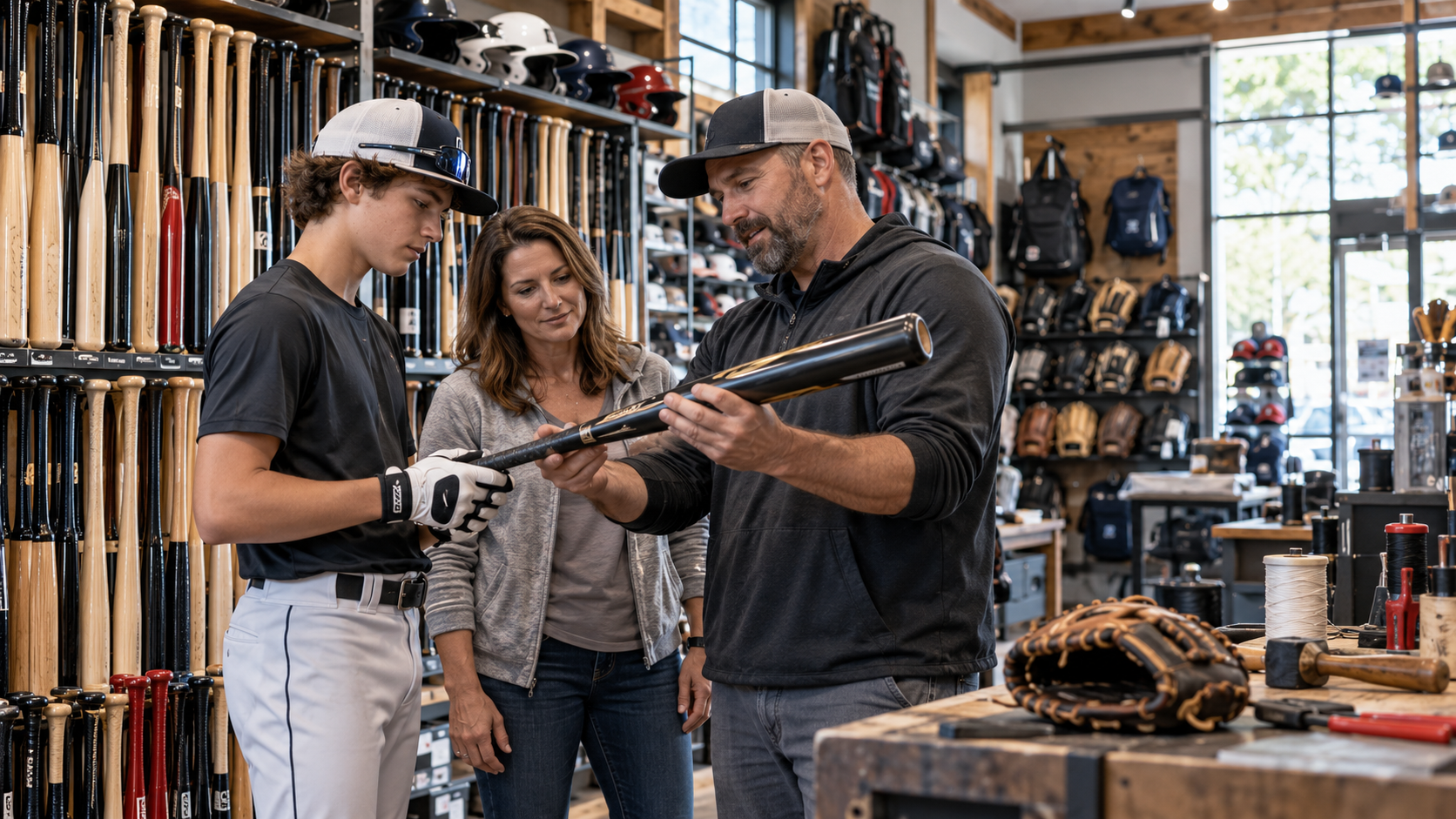
If you own an independent baseball shop, you already know the pitch you're up against. Amazon has every bat ever made and ships it tomorrow. Big-box sporting goods chains have a store in every shopping center and a marketing budget bigger than your annual sales. On price and selection, you'll lose that fight most of the time.
But that's not the fight your customers are having. A parent standing in your store isn't asking "where is this bat cheapest?" They're asking "which bat is legal in my son's league?", "what length should he swing?" and "can you fix the web on this glove before Saturday?" Those questions don't get answered well by a product listing. They get answered by someone who knows baseball.
This guide is about winning the searches where your expertise matters: bat fitting, bat rules, glove relacing and repair, team orders, and "in stock near me" searches from parents who need gear before tomorrow's game. It covers your Google Business Profile, service pages, local inventory in Google, content that ranks, partnerships with teams and leagues, and getting named when parents ask AI where to buy.
Where a local shop still wins
Independent baseball stores win in the places where buying gear is confusing, urgent or hands-on. Those are also the places where search volume comes from people who are ready to act.
Confusing: bat rules. Youth bat standards change, and parents can't keep up. USA Baseball's USABat standard is used by national organizations including Little League, Babe Ruth and Cal Ripken, PONY, AABC and others, according to the USABat FAQ. And in July 2026, USA Baseball and the NFHS announced that high school baseball will allow USABat -4, -5 and -6 bats starting in 2028, alongside the -3 BBCOR bats in use now. Every one of those changes creates a wave of "which bat is legal" questions. A shop that answers them clearly becomes the local authority.
Urgent: game tomorrow. A cracked bat, a torn glove lace, a missing cup or a lost batting helmet the night before a game. Shipping, even fast shipping, doesn't help. "Baseball store open now" and "batting helmet in stock near me" are searches a local shop can win outright.
Hands-on: fit and feel. Bat length and weight, glove size and pattern, catcher's gear fit, cleat sizing for growing kids. Parents want someone to put the bat in their kid's hands and watch them swing.
Services only you offer. Glove relacing, glove steaming and break-in, re-gripping bats, repairs, team uniform orders, embroidery. Many big-box stores don't offer these, and Amazon can't.
The SEO strategy follows directly: build your online presence around services, expertise and local availability, not around competing product-for-product with a national catalog. Those are the searches where a small shop can outrank much bigger competitors, because Google weighs relevance, distance and prominence for local results, not company size.
Service pages: your biggest advantage
The single most useful thing most baseball shops can do for search is give each service its own page. These pages target searches with clear intent and weak competition, and every visitor is someone who needs to come to your store.
Services worth their own page, if you offer them:
Bat fitting. How you help players choose length, weight and drop, what you look at, whether there's a charge, and whether players can take swings in a cage or hitting area.
Glove relacing and repair. What you fix, typical turnaround, and rough pricing. Photos of before-and-after repairs help a lot here.
Glove steaming and break-in. What the service involves, how long it takes, and your honest take on when it helps.
Bat re-gripping and grip tape. Quick, cheap, and a common "near me" search.
Catcher's gear fitting. Helmet, chest protector and leg guard sizing by age.
Team orders. Uniforms, team bat bags, embroidery, minimum order sizes, lead times and a quote form.
Bat rules help. A page explaining which bats each local league and level allows, covered in the next section.
Each service page should answer what a parent needs to know before walking in:
What the service is, in plain words
Price or a starting price
Turnaround time, especially for glove repairs during the season
Whether they need an appointment or can walk in
What to bring
Photos of the work
Title the pages the way people search. "Glove Relacing and Repair in [Town] | [Shop Name]" will rank far more easily than a page called "Services." Google's SEO Starter Guide recommends descriptive URLs and titles that clearly describe each page, and it notes that keyword stuffing is against Google's spam policies. Write naturally and let each page focus on one service.
Then list the same services on your Google Business Profile, and link each service page from your homepage. Services are what separate you from every other store selling the same bats.
Bat rules content: become the local authority
"Is this bat legal for Little League?" might be the most common question in any baseball shop. It's also a question parents type into Google and ChatGPT every spring. A clear, current bat rules page is one of the most valuable pieces of content a shop can publish, because the answer changes and most parents can't find a simple explanation.
The basics as of September 2026, from USA Baseball:
That 2028 change is a real opportunity. Every high school family with a middle schooler will be asking whether they should buy a BBCOR bat now or wait, and whether a -5 is allowed. A shop that publishes a plain-English explainer this fall, and updates it as new bats arrive, can own that conversation locally.
How to build the page:
Organize it by league and age, the way parents think: "Little League," "Babe Ruth and Cal Ripken," "High school." Name the actual local leagues in your area where you can.
Show what the approved mark looks like, with your own photos of bats in your store.
Link to the official source for every rule: USA Baseball, the league's own rulebook, or the tournament's page. You're explaining, not ruling.
Add a "last reviewed" date and actually review it before each season. Google's helpful content guidance warns against updating dates without real changes, so only change the date when you've checked the rules.
End with an offer: "Not sure? Bring the bat in and we'll check it for free."
This page does more than rank. It builds trust. A parent who learns from your page that their old bat is still legal may not buy a new one today, but they'll remember who told them the truth, and they'll come back when the next bat really is needed.
Google Business Profile for a baseball shop
For a local store, the Business Profile is often the whole shopping experience. A parent searches "baseball store near me," checks your hours, looks at a few photos and reviews, and drives over. Make every part of that profile work.
Category. Choose the primary category that best matches your store, such as a sporting goods store, and add secondary categories only where they're true. Google's category guide explains how primary and secondary categories work.
Products. Google's local ranking tips note that retail businesses can show in-store products on their profile. Add your core categories and best sellers: youth bats, BBCOR bats, gloves, catcher's gear, batting helmets, cleats. Keep them current.
Services. List bat fitting, glove relacing, glove repair, glove steaming, re-gripping and team orders separately. This is where you show what big-box stores don't do.
Hours, including the rush. Baseball retail is seasonal. If you extend hours before opening day or during tryout season, set special hours so Google shows them correctly. If you close earlier in winter, update that too.
Photos. The bat wall, the glove selection, the hitting area if you have one, a glove mid-relace, your storefront and parking. Google recommends business-specific photos, and they help parents know they're in the right place.
Posts. New bat releases, bat rule changes, glove repair turnaround times during peak season, team order deadlines, and "Just in: 2027 USA BBCOR bats" when they arrive.
Answers for Ask Maps. Google replaced its old Q&A section with Ask Maps. BrightLocal reports it answers questions using your profile, reviews and website first. If someone asks Maps "Do they relace gloves?" or "Do they carry left-handed catcher's mitts?", the answer depends on what you've published.
Show what's in stock, right in Google
The most direct way to compete with next-day shipping is to show that the bat, glove or helmet is on your shelf right now. Google lets local stores do that.
Google Merchant Center offers free local listings and local inventory ads, which let retailers show in-store products and availability to nearby shoppers on Google. Free local listings cost nothing. Local inventory ads are the paid version. Both need a Merchant Center account and in-store inventory data, and Google supports several ways to provide it, including point-of-sale integrations and automatic syncing from an online store.
Google makes a strong case for the paid version too. On the same help page, it says retailers who use local inventory ads alongside Shopping ads see a 21% increase in store visits and a 9% increase in online conversions for products available in store. Those are Google's own numbers about its own ads, so treat them as a reason to test, not a guarantee.
What to know before you start:
Check your point-of-sale system first. Many modern POS systems can connect to Google and keep inventory counts current automatically. Manual spreadsheets go stale fast in peak season.
Start with the products people search for urgently. Batting helmets, youth bats that meet USABat, catcher's gear, cups, batting gloves, cleats. These are the "need it before Saturday" items.
Keep it accurate. Showing a bat as in stock when it isn't is worse than not showing it at all. Google's local inventory policies set requirements for accuracy.
Link it to your Business Profile so products show alongside your store information.
If full inventory feeds aren't realistic for your shop yet, add your main product categories to your Business Profile and keep a "What's in stock" section on your website updated weekly during the season. It's not as powerful as a live feed, but it answers the question every parent is asking: "Can I get it today?"
Product and category pages without a giant catalog
You don't need thousands of product pages to compete. In fact, trying to copy the national sites usually backfires. Pages filled with the same manufacturer descriptions that appear on hundreds of other sites give Google no reason to rank yours.
Google's SEO Starter Guide says unique, useful content is likely to influence search presence more than anything else, and warns against copying or rehashing what others have already published. For a shop, that means focusing on a smaller set of pages where you add something the manufacturer's blurb doesn't.
Category pages that work well for baseball shops:
Youth bats by league. "USABat bats for Little League" with the bats you carry, sorted by length and drop, and a note on how to pick a size.
BBCOR bats for high school, with a clear section on the 2028 change.
Gloves by position and age. Infield, outfield, first base, catcher's mitts, with your own sizing chart.
Catcher's gear by age. Sets and individual pieces, with fitting tips.
Local team gear. If you supply uniforms or gear for local leagues and schools, a page per team or league (with their permission) captures searches like "[League name] uniform."
On each page, add the things only you can offer: a staff pick with a short honest reason, a fitting tip, in-store availability, and an invitation to come try it. If your staff reviews gear, follow Google's guidance on writing high-quality reviews, which values first-hand testing, evidence and honest pros and cons.
If you sell online, add product structured data so Google can show price and availability, and keep it accurate. Google's product structured data overview explains the options for both product snippets and merchant listings.
If you don't sell online, that's fine. Category pages that show what you carry in store, with prices or price ranges and a "call to check stock" or "reserve for pickup" option, can still rank for local searches and bring people through the door.
Team, league and school partnerships
A local baseball shop is part of the baseball community in a way no national retailer can be. Those relationships drive sales, and they also create the local links Google uses to judge prominence.
Partnerships that bring both customers and links:
Little League and rec league sponsorships. Many leagues list sponsors on their websites, which puts your name in front of every family. Separately, share your bat rules page with the league, since it's genuinely useful to their parents.
Official uniform or equipment supplier. If you outfit a league, travel program or high school team, ask to be listed as their supplier with a link.
Bat check nights before the season. Offer to check bats for a league before opening day, free. Leagues often promote this to their families, and it brings parents into the store.
Clinics with local coaches. Host a glove care or bat fitting night with a respected local instructor. Both of you can promote it, and it gives local media a story.
Training facilities. Facilities often get asked where to buy gear. A mutual referral relationship, and a link from their "Resources" or "Partners" page, helps both businesses.
League discounts. A simple discount for registered league families gives leagues a reason to tell their parents about you.
One caution: keep any league discount about the gear, not about reviews. Google's review policies prohibit offering discounts or other incentives in exchange for reviews.
A note on sponsorship links. Google's spam policies treat links given in exchange for money, goods or services as link schemes unless they're marked as sponsored. So a sponsor-page link should carry a sponsored or nofollow tag. Those links still send league families to your store, which is the real point. The links that carry SEO weight are the earned ones, like a league linking to your bat rules page because it's genuinely useful to their parents, or a local paper covering your bat check night.
Reviews and the in-store experience
Your biggest advantage over an online listing is the conversation at the counter. Reviews are how that advantage shows up in search. BrightLocal's Local Consumer Review Survey 2026 found 97% of consumers read reviews for local businesses, 74% care most about reviews from the last three months, and 83% of people asked to leave a review went on to leave one.
A baseball shop has natural moments to ask every customer:
At checkout, with a small card or receipt line that has your Google review QR code
In a follow-up text or email after a glove repair pickup or a team order delivery
On the tag attached to a relaced glove: "Thanks for trusting us with your glove. Tell other players about your experience on Google."
Keep the ask clean. Google's review policies prohibit offering discounts or free services in exchange for reviews, asking only happy customers, and directing staff to request reviews that include specific content, including staff names. So ask everyone, the same way, and let them say what they honestly think. Many will mention the fitting help or the fast glove repair on their own, because that's what they remember.
Reply to every review with something specific. BrightLocal found 89% of consumers expect a response, and templated replies put off half of them. When a review mentions a problem, such as a repair that took too long or a bat that was out of stock, acknowledge it and say what you're doing about it.
The in-store experience is what makes the reviews worth reading. A few things that consistently set local shops apart, and give customers something real to talk about:
A place to take swings with a bat before buying, even if it's a net and a tee
Staff who know the local leagues and their bat rules
Honest advice, including "your current bat is still legal, you don't need a new one"
Fast turnaround on glove repairs in season
Remembering returning families and their kids' positions
AI search: getting named when parents ask where to buy
Parents increasingly ask AI tools for buying advice. BrightLocal's 2026 survey found use of ChatGPT and similar tools for local recommendations rose from 6% to 45% in a year. For a baseball shop, the questions look like this:
"Where can I get a glove relaced near me?"
"Best place to buy a youth baseball bat in [town] where they help with sizing"
"Is a -5 bat legal for high school baseball?"
"Which stores near me carry left-handed catcher's mitts?"
Notice that two of those are questions, not store searches. AI tools often answer the question first, then suggest where to go. A shop that has published a clear bat rules explainer and a glove repair page gives the AI both the answer and the store to recommend.
Google's own guide to generative AI search says its AI features rely on its core search systems, and that Business Profiles and Merchant Center help local businesses and products show up in AI responses. It also says content with a unique, first-hand point of view does better than commodity content, and that you don't need special files like llms.txt.
What that means for a shop:
Answer real questions in plain text. Bat rules, sizing, glove care, repair turnaround. Your staff answer these all day. Write the answers down.
Keep your Business Profile and inventory current, so tools pulling from Google have accurate data.
Earn reviews that reflect your services. You can't script them, but customers who get great fitting help or a fast repair tend to mention it.
Be consistent everywhere. Same name, hours, phone and services across your site, Google, Apple Maps, Yelp and league partner pages.
Before each season, ask ChatGPT, Gemini and Google's AI Mode the questions your customers ask. Note whether you're named, what's said, and which sources are cited. Then fix the gaps you control.
Measuring store visits, service bookings and sales
For a retail shop, the goal of SEO is people through the door and services booked. Here's what to watch:
Compare each month to the same month last year, not the month before. Baseball retail is so seasonal that February-to-March growth tells you almost nothing. February this year against February last year tells you a lot.
Give changes time to work. Google's SEO Starter Guide notes some changes take effect in hours and others take several months. Publish your bat rules page and service pages in the fall, and judge them by how the spring rush goes.
Want to know how your shop stacks up?
You can't outspend Amazon or the big-box chains. You don't need to. You need to be the shop that shows up when a parent searches for glove relacing, bat help or a helmet they need by Saturday.
We'll run a free visibility check on your store. You'll get a plain-English read on how you show up in Google, Google Maps and AI tools like ChatGPT for the searches where local shops can win, plus what we'd fix first before the spring rush. Whether or not you hire us, you'll know exactly where you stand.
Get your free visibility check →
A real reply from the founder within one business day. No pressure, no pitch deck.
Frequently asked questions
Can a local baseball store really compete with Amazon in search?
Not on every product search, and it doesn't need to. Local stores can win searches where expertise, services and same-day availability matter: bat fitting, glove relacing, bat rules questions and "in stock near me" searches. Google ranks local results on relevance, distance and prominence, not company size.
What pages should a baseball shop's website have?
A homepage, one page per service (bat fitting, glove relacing and repair, glove steaming, re-gripping, team orders), a bat rules page, category pages for key gear by age and position, and a contact and directions page.
How can I show my in-store inventory on Google?
Google Merchant Center offers free local listings and paid local inventory ads, which show in-store products and availability to nearby shoppers. You'll need a Merchant Center account and inventory data, often synced from your point-of-sale system.
What bat standards should my bat rules page cover?
At minimum, USABat for youth leagues such as Little League, Babe Ruth and Cal Ripken, and PONY; BBCOR for high school; and the 2028 high school change that allows USA BBCOR and USABat -4, -5 and -6 bats. Also note that travel tournaments may set their own bat rules. Link to official sources for each.
Are current BBCOR bats still legal in high school after 2028?
According to USA Baseball's July 2026 announcement, currently approved BBCOR bats will remain compliant in high school baseball indefinitely. Bats with the new USA BBCOR mark are expected in stores around July 2027.
Should I list glove repair prices on my website?
Yes, or at least starting prices. Parents compare options, and a clear price and turnaround time make it easy to choose you. Add before-and-after photos to show the quality of the work.
Can I offer a discount for Google reviews?
No. Google's review policies prohibit offering discounts or free services in exchange for reviews. Ask every customer the same way with a review link or QR code, and let them write what they honestly think.
Do league sponsorship links help SEO?
Sponsorships are great for reaching league families, but under Google's spam policies, links given in exchange for money or goods should be marked as sponsored. The links that help SEO most are earned ones, like a league linking to your bat rules page because it's useful.
How do I get recommended by ChatGPT for baseball gear?
Publish clear answers to the questions your staff get every day, keep your Business Profile and inventory current, keep your details consistent across the web, and earn honest reviews. Test what AI tools say before each season and fix gaps you control.
When should a baseball shop do SEO work?
In the fall and early winter. Service pages, bat rules content and Business Profile updates published then have time to rank before the spring rush, when parents are searching hardest.
Sources
USABat, Frequently asked questions
USA Baseball, High school baseball to expand drop weight options under USA BBCOR and USABat (July 8, 2026)
Google Business Profile Help, Tips to improve your local ranking on Google
Google Business Profile Help, Manage your business category
Google Business Profile Help, Set special hours
Google Business Profile Help, Tips for business-specific photos
Google Business Profile Help, Business Profile performance and insights
Google Merchant Center Help, Local inventory ads and free local listings overview
Google Merchant Center Help, Local inventory ads and free local product listings policies
BrightLocal, Local Consumer Review Survey 2026 (February 2026)
BrightLocal, Goodbye Google Q&A: It's time to Ask Maps (April 2026)
Google Search Central, SEO Starter Guide
Google Search Central, Creating helpful, reliable, people-first content
Google Search Central, Write high quality reviews
Google Search Central, Product structured data
Google Search Central, Spam policies for Google web search
Google Search Central, Optimizing your website for generative AI features on Google Search (updated July 2026)
Google, Search Console