Local SEO for Cincinnati: Google Business Profile, Reviews, and the Neighborhood Factor
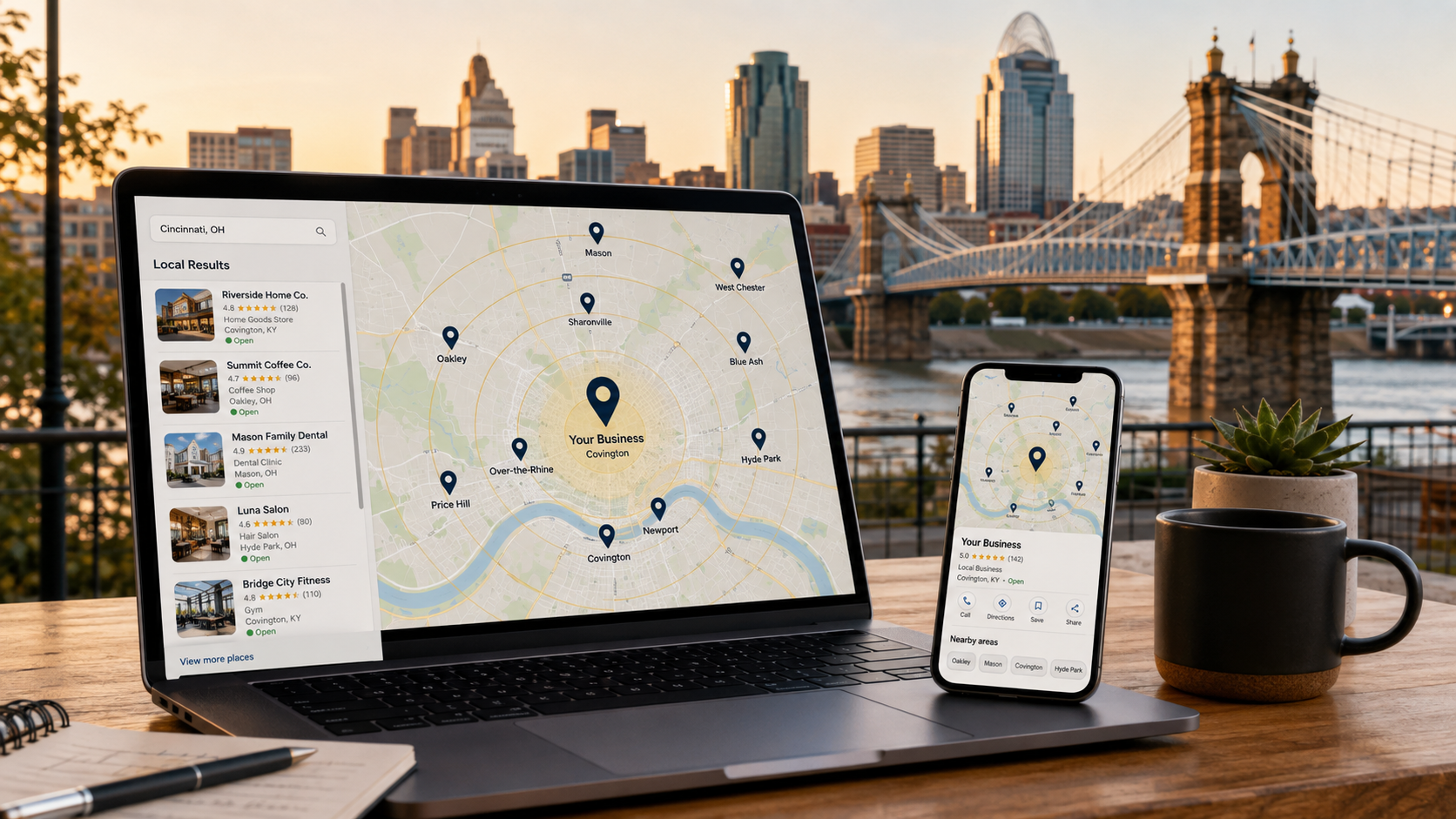
Cincinnati isn't one search market. It's fifty of them — Oakley and OTR, Mason and Milford, and a whole second state across the river. Here's how local search actually gets won here: the three levers Google itself says decide local rankings, the numbers behind each one, and the neighborhood strategy that lets a small business beat bigger competitors block by block.
Here's a search that happens thousands of times a day across greater Cincinnati: someone's AC dies in Blue Ash, or they need a dentist in Covington, or their brakes start grinding in West Chester — and they pull out their phone and type the service plus "near me."
What happens in the next three seconds is the most valuable real estate in local business. Google shows a map with three names on it. Roughly 76% of local searches happen on smartphones, and the intent is immediate — 88% of people who search for a local business on mobile call or visit within 24 hours. The three businesses in that map pack aren't competing for a click. They're splitting a customer.
Local SEO is the discipline of being one of those three names — and in a metro like Cincinnati, it plays by rules that reward small businesses more than almost any other channel, if you understand the machine. This is the complete playbook: how Google decides local rankings, the two levers every business controls (your Google Business Profile and your reviews), and the third factor most businesses never strategize at all — geography itself, which in a fragmented, two-state metro like this one is the difference between winning your block and disappearing everywhere.
How Google decides who's on the map (straight from Google)
Strip away every guru theory and Google's local algorithm comes down to three factors the company states outright in its own documentation: relevance (how well your profile matches what was searched), distance (how close you are to the searcher or the place they named), and prominence (how well-known and trusted you appear — links, mentions, and explicitly, per Google, "more reviews and positive ratings can help your business's local ranking").
Notice what that framework implies. Relevance is built by completeness — Google matching "transmission repair Sharonville" to your listing requires your listing to actually say those things. Prominence is built by reputation — reviews, citations, mentions. And distance is built by... being where you are. You can't move your shop. But you can absolutely change which locations you're relevant and prominent for — which is the entire neighborhood strategy we'll get to.
One more number for weight: marketers surveyed on local ranking factors put Google Business Profile signals at roughly 32% of the local pack algorithm — the single heaviest category. Which is why the playbook starts there.
Lever 1: The Google Business Profile — the highest-ROI page you don't pay for
Your GBP is not a directory listing. It's a landing page Google shows before your website, on the surface where 97% of people learn about local businesses — and the data on treating it seriously is almost embarrassing:
Complete profiles are about 70% more likely to attract location visits and 50% more likely to lead to purchases than incomplete ones.
Complete listings can earn up to 7x more clicks than unfinished ones.
Listings updated monthly perform roughly 32% better in engagement and conversions than stale ones.
Profiles with real photos see about 42% more direction requests and 35% more website clicks than those without.
The work, concretely: claim and verify the profile (you'd be surprised); choose the right primary category and every applicable secondary one; write a description that says what you do and where in plain language; list every service; load real photos of real work and real people, and keep adding them; keep hours ruthlessly accurate; post monthly at minimum; and turn on messaging if you'll actually answer. None of this is sophisticated. All of it is measurable relevance in Google's framework — and it's the fastest-moving piece of the whole discipline, with local-pack visibility typically responding in 4–12 weeks rather than the longer arc website SEO runs on.
One ownership warning from our agency red-flags checklist: the profile must live in an account you control. Agencies that register your GBP under their own account are building a hostage, not a listing.
Lever 2: Reviews — the prominence engine you already earned
Reviews are the rare ranking factor Google confirms in plain English — prominence, per Google's own documentation, is built partly on "how many reviews you have," with more and better ratings helping local ranking. They're also the conversion layer: around 90% of consumers read reviews before choosing a local business, and most filter for 4 stars and up before they ever compare services or prices.
The strategy has three verbs, and most Cincinnati businesses only do the first one accidentally:
Earn. Systematically, not passively. The businesses winning map packs ask every happy customer, at the moment of satisfaction, with a direct link that takes ten seconds. Volume and recency both matter — a 4.8 across 240 recent reviews beats a 5.0 across 12 old ones on both algorithm and human.
Answer. All of them, including the rough ones. Businesses that respond promptly see about 19% more click-throughs, and a calm, specific reply to a bad review is read by hundreds of future customers who care less about the complaint than about how you handled it. An unanswered one-star sits there compounding; an answered one becomes a demonstration.
Showcase. Pull the best ones onto your website and service pages, where they double as conversion proof and fresh, keyword-rich local content. Review strategy — earning, answering, showcasing — sits inside the core local SEO work we do precisely because it feeds relevance, prominence, and conversion at once.
Lever 3: The neighborhood factor — Cincinnati's actual cheat code
Here's what makes local SEO in Cincinnati different from local SEO in a compact city: greater Cincinnati is a federation of small markets wearing one name. Hyde Park, Oakley, OTR, Clifton, Westwood; the northern ring of Blue Ash, Mason, West Chester, Fairfield; the east toward Milford and Anderson; and then the state line — Covington, Newport, Florence, and the rest of Northern Kentucky, which is functionally the same metro and legally a different world.
Google's distance factor means every one of those places generates its own map pack. The searcher in Mason and the searcher in Newport typing the identical query see different winners. Which produces the strategic insight most businesses miss entirely: you are not competing for "Cincinnati." You're competing for a ring of neighborhoods around your location — and each one is a separately winnable prize.
The playbook that follows from that:
Build real neighborhood and suburb pages. Not ten copy-pasted pages with the town name swapped — Google and humans both see through that. Real ones: the services you actually deliver in West Chester, jobs you've done there, the specific things West Chester customers ask, directions and drive times from your shop. One genuinely useful page per priority area, built out over months. This is content-system work, and it's the core of what we build — pages designed to be the answer for a place, not just to mention it.
Set your service area honestly and precisely. GBP lets service-area businesses declare where they work. Declaring the whole tri-state dilutes you everywhere; declaring your genuine strong zone concentrates relevance where distance already favors you.
Earn citations that anchor you geographically. Local mentions — chamber listings, community sites, tri-state directories, local news — reinforce both relevance and prominence for your area. A Covington business mentioned by Covington institutions is, in the algorithm's eyes, of Covington in a way no keyword stuffing achieves.
Expand ring by ring. Win the map pack where you are. Then take the next suburb out, then the next. This is how a small business with one location beats a bigger competitor spraying the whole metro: they're mediocre in fifty neighborhoods; you're dominant in five, then eight, then twelve. The businesses that stall for years are almost always the ones that aimed at "Cincinnati" on day one.
Mind the river. The Ohio–Kentucky line is invisible to your customers and weirdly visible to algorithms and directories, which often treat NKY as a separate market. If you serve both sides, your profile, pages, and citations need to say so explicitly — and it's worth testing how AI assistants handle you across the line, because AI search inherits and amplifies these geographic quirks. When we ran thirty AI prompts for a client an hour from Cincinnati, the sharpest finding was exactly this shape: dominant at home, invisible one ring out — and nobody knew until it was tested.
How the three levers feed each other
The reason this playbook compounds is that nothing in it works alone. The complete profile makes reviews easier to leave and more visible once left. The reviews build the prominence that lifts every neighborhood you target. The neighborhood pages give the profile and the AI engines something substantive to cite, and give customers from each suburb a reason to convert — which produces more reviews naming those suburbs, which is relevance again. Six months of all three running together beats three years of any one alone. (And a note if you're starting this on a small, settled website: the early weeks can wobble while Google re-evaluates — normal, temporary, and explained here — so judge the first quarter by the leading indicators, not the phone.)
The five most common Cincinnati local SEO mistakes
After enough audits, the failure patterns repeat: an unclaimed or agency-owned GBP; a profile treated as set-and-forget when monthly-updated listings outperform stale ones by a third; review requests left to chance while a competitor systematizes them; one "Cincinnati" page expected to rank in forty suburbs it never mentions; and inconsistent name-address-phone details scattered across old directories, quietly eroding the trust every other effort is building. None of these requires budget to fix. All of them require somebody actually owning the channel — which, as we've written before, is the real dividing line between businesses that win local search and businesses that merely exist in it.
Frequently asked questions
What is local SEO and why does it matter for Cincinnati businesses?
Local SEO is the work of ranking in Google's map pack and local results when nearby customers search for what you do. It matters because the intent is immediate — 88% of mobile local searchers call or visit within 24 hours — and because Cincinnati's fragmented geography means dozens of separate neighborhood markets, each winnable by a small business that targets it deliberately.
How does Google decide local rankings?
Three factors, per Google's own documentation: relevance (how well your profile matches the search), distance (how close you are to the searcher), and prominence (how known and trusted you are — links, mentions, and review quantity and quality). You control relevance through profile completeness and content, and prominence through reviews and citations; distance you work around with the neighborhood strategy.
How long does local SEO take to work in Cincinnati?
Faster than website SEO. Google Business Profile optimization typically moves local-pack visibility in 4–12 weeks; reviews compound within the first couple of months; neighborhood pages follow the longer content curve of 3–6 months. The full month-by-month arc, with checkpoints you can hold a vendor to, is in our Cincinnati timeline guide.
Do Google reviews really affect rankings, or just reputation?
Both, and Google says so directly: prominence is based partly on "how many reviews you have," and "more reviews and positive ratings can help your business's local ranking". They're also the conversion layer — about 90% of consumers read reviews before choosing — so review strategy pays twice: once in the algorithm, once in the human.
Can a small business really outrank bigger Cincinnati competitors locally?
Yes — it's the one arena where the algorithm is on your side. Distance means every neighborhood has its own contest, complete profiles beat big incomplete ones, and a systematized review flow beats a famous name with stale ratings. The winning pattern is ring-by-ring: dominate your immediate area, then expand suburb by suburb, rather than fighting metro-wide head terms where scale wins.
Should Cincinnati businesses do local SEO themselves or hire it out?
The fundamentals — claiming the profile, completing it, asking for reviews — any owner can and should do this week. The compounding layers — neighborhood content, citation building, ongoing optimization, and now AI search visibility— are where sustained expertise earns its fee, at Cincinnati market rates we've broken down honestly. Either way, apply the same test: countable work, monthly, tied to leads.
The bottom line
Local SEO in Cincinnati comes down to three levers, and Google has told everyone what they are: be relevant through a complete, active Business Profile; be prominent through reviews you systematically earn, answer, and showcase; and turn distance from a constraint into a strategy by winning the metro the way it's actually built — neighborhood by neighborhood, ring by ring, on both sides of the river. The data behind every lever is public, the fastest wins land in weeks, and the whole discipline favors the small business that commits over the big one that coasts.
If you want to know exactly where you stand before you commit — which map packs you're in, which suburbs you're invisible in, what your profile and reviews are actually signaling, and whether AI assistants name you when your neighbors ask — that's the free visibility check. Plain English, real data, and what we'd fix first, whether or not you hire us.
Get your free visibility check →
Sources
Google Business Profile Help: How to improve your local ranking — relevance, distance, prominence
WiserNotify: Google Business Profile statistics — completeness, visits, purchases, review behavior, mobile share
Cube Creative: Complete listings earn up to 7x more clicks
Content by Cass (SQ Magazine data): Monthly-updated listings perform ~32% better
Zipdo: Photos drive 42% more direction requests and 35% more website clicks
SQ Magazine: Prompt review responders see ~19% more click-throughs
Search Endurance: GBP signals ≈32% of local pack ranking weight
The Trust Agency: 88% of mobile local searchers act within 24 hours; local campaign timelines
SEOTakeoff: GBP visibility wins in 4–12 weeks