Local SEO for New Jersey Law Firms: Why You're Losing Cases to the Firm Across Route 70
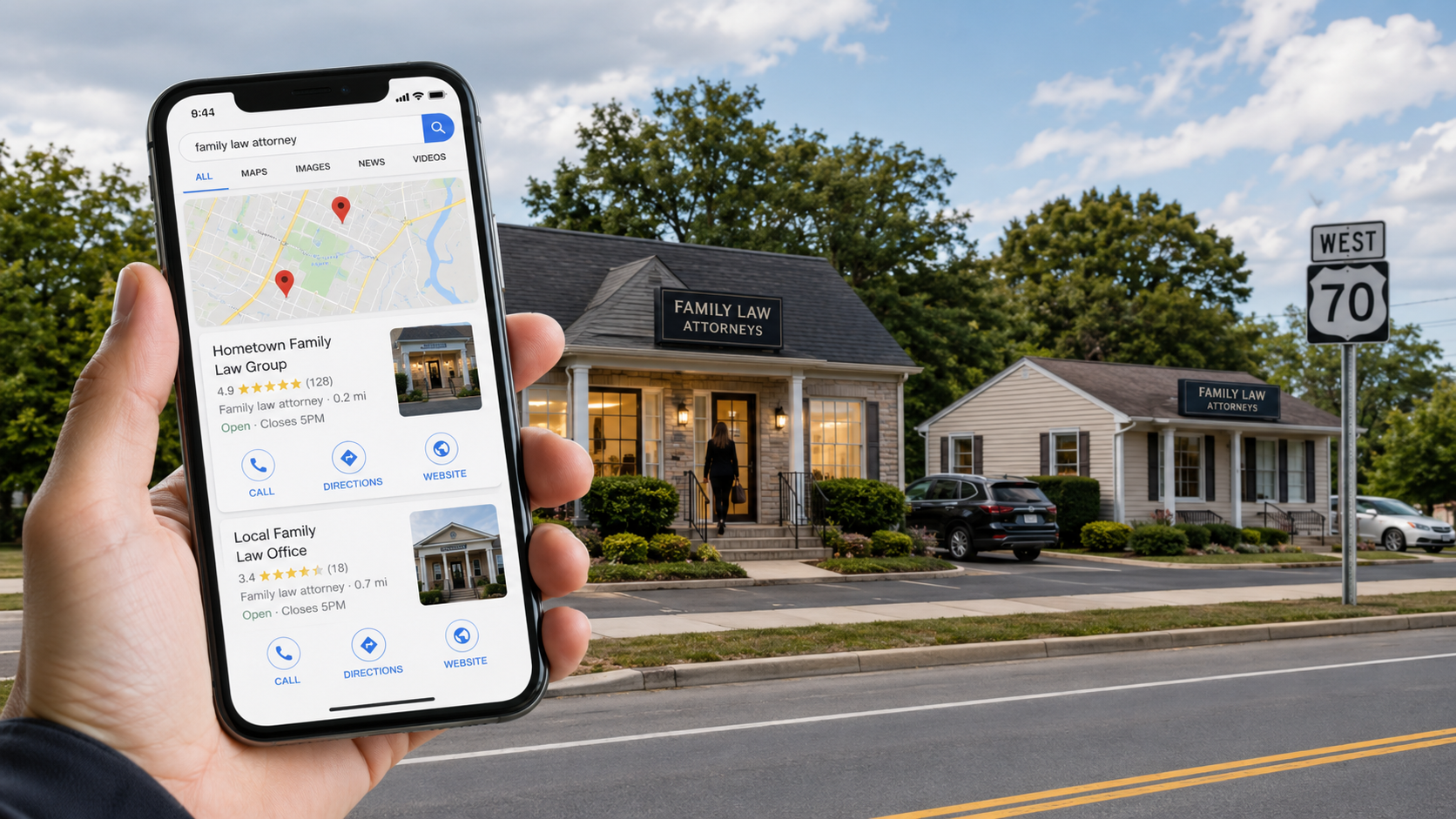
There are two family law firms a half mile apart on the Route 70 corridor in Cherry Hill. Similar credentials, similar years in practice, similar results in front of the same Camden County judges. One of them signed nine new matters last month from people who found them online. The other got two — and one of those was a referral who would have called anyway.
The difference between those two firms was not decided in a courtroom. It was decided in about four seconds, on a phone screen, by a stressed-out person typing "divorce lawyer cherry hill" at 10:40 on a Tuesday night — and by everything both firms had or hadn't built to be standing there when that search happened.
This article is the honest breakdown of that gap: how legal clients actually find and choose firms now (with the research cited), the three surfaces where NJ firms win or lose, exactly what the winning firm across the highway is doing differently, and the 90-day plan to close it. If you'd rather see how we approach the niche as a whole first, our law firm marketing page is the overview; this is the field guide.
How Legal Clients Actually Choose (The Data Nobody at the Firm Wants to Hear)
Attorneys tend to believe two comfortable things: that clients come from reputation and referrals, and that the best lawyer wins. The consumer research says the process is messier — and far more winnable:
Nearly everyone starts online. Per data compiled from Clio's Legal Trends research, 96% of people seeking legal help start their search online, and iLawyerMarketing's consumer study found 92% would use Google as their primary way to search for attorneys. Even referrals get vetted digitally: Martindale-Avvo found that 46% of consumers who received a personal referral checked the lawyer's reviews before contacting them. Your referral pipeline runs through your Google presence whether you like it or not.
They shop, hard. Only 11% of legal consumers hired the first attorney they contacted, and 78.9% contacted more than one — iLawyerMarketing's study puts it at nearly 80% talking to three or more firms. You are always in a comparison, even when the client arrived warm.
They move fast once they move. Three in ten hire within three days of realizing they need a lawyer; half decide within a week. And the brutal one: 80% will contact another attorney if they don't hear back within 48 hours.The average firm's response time is measured in hours-to-days. The gap between those two numbers is where signed retainers go to die.
The economics reward the winners disproportionately. Legal is one of the highest-converting organic niches that exists — SEO conversion rates in legal reach 7%+, roughly triple the cross-industry average — because legal searchers aren't browsing; they have a problem with a deadline. High intent, high case values, high competition. That's the whole niche in six words.
Put it together and the uncomfortable truth emerges: in 2026, "the best lawyer" is invisible to a client who never finds them, and "the firm that got the case" is usually the firm that was findable, credible, and responsive in a 72-hour window. That's not a statement about justice. It's a statement about distribution.
The Three Surfaces Where NJ Firms Win or Lose
Every prospective client's search plays out across three surfaces, and the firm across Route 70 is probably beating you on at least two:
Surface 1: The map pack. For "near me" and "[practice area] + [town]" searches, Google's local 3-pack sits above nearly everything, and it's driven by proximity, review profile, and Google Business Profile quality. This is where the phone calls live — and where most firms' presence is an unclaimed-or-neglected profile with 14 reviews, half from staff.
Surface 2: Organic results. The practice-area and question searches — "how is alimony calculated in NJ," "penalties for first DUI in New Jersey," "do I need a lawyer for an expungement in Camden County." These searches happen earlier in the client's crisis, which means the firm that answers them meets the client before anyone else exists. This surface is won with content, and almost no local NJ firm is genuinely trying.
Surface 3: AI answers. The newest and least defended. Legal is among the highest-adoption categories for AI-assisted research — people ask ChatGPT things they're embarrassed to ask humans, and "who's a good family lawyer near Marlton, I need payment plans" is exactly the kind of context-rich question AI assistants now answer with two or three firm names. The selectivity is extreme — ChatGPT recommends only about 1.2% of local businesses versus 35.9% achieving map-pack visibility — and Google's own AI Overviews now appear on more local-type queries than the traditional map pack does. We published a 5-minute protocol for checking whether your firm shows up; run it with your top three matter types before reading further. If a competitor's name comes back, you now know exactly what this article is worth.
What the Firm Across Route 70 Is Actually Doing Differently
Having audited firms on both sides of this gap, the winning pattern is consistent — and none of it is magic:
1. Their reviews are a system, not an accident. Volume, recency, and detail: closed matter → review request, every time, with a direct link, often mentioning the attorney by name and the matter type (within what confidentiality allows). This matters more in legal than almost anywhere: 47% of consumers won't use a business with fewer than 20 reviews, and 74% specifically look for reviews from the last three months. A firm with 130 recent, specific reviews versus your 19 from 2022 isn't slightly ahead in the map pack — it's playing a different sport. (One NJ-specific note: attorney reviews and testimonials intersect with the Rules of Professional Conduct on advertising — build the system with the rules in mind, which is entirely doable and no excuse for not building it.)
2. One page per matter type, per market — written for clients, not colleagues. The losing firm has a "Practice Areas" page listing eleven services in one paragraph each. The winning firm has a full page for divorce, another for custody, another for DUI, another for expungement — each answering the questions clients actually type, in plain English, with the process, the timeline, the county-specific details (Camden County's courthouse is not an abstraction to your client), and what it costs or how fees work. Clients told Martindale-Avvo exactly what they want before contacting anyone: reviews and location within their practice area of need, plus clear answers about process and cost. Pages that deliver that don't just rank — they pre-sell.
3. They answer the earlier questions too. The winning firm publishes — steadily, not heroically — on the questions people search before they search for a lawyer. That content wins Surface 2, feeds Surface 3 (AI engines measurably favor fresh, specific, quotable content — the same GEO fundamentals we've written about for NJ businesses), and does it all within advertising-rule guardrails because education isn't solicitation.
4. Their intake matches their marketing. This is the one that hurts, because firms spend thousands generating inquiries and then lose them to an unanswered contact form, a voicemail box, or a "we'll call you back Monday." Remember the numbers: only 11% hire the first attorney contacted, 80% move on after 48 silent hours, and the whole decision often closes inside a week. The winning firm answers fast, has a human (or at minimum an immediate, personal auto-response with next steps) on every intake path, and — critically — has tested those paths. Submit your own contact form tonight. Call your own after-hours line. You may discover, as many firms do, that the leak isn't in your marketing at all.
5. Everything agrees with everything. Name, address, phone, practice descriptions — identical across the website, Google Business Profile, Avvo, Justia, FindLaw, the county bar directory. AI engines punish inconsistency harder than Google does, and legal directories carry unusual citation weight in this niche. Boring work, one afternoon, disproportionate payoff.
The 90-Day Plan for a Route 70 (or Anywhere-in-NJ) Firm
Days 1–7: Diagnose. Run the AI visibility check for your top matter types. Google your money terms and screenshot who owns the map pack and page one. Count your reviews vs. the three firms beating you. Test every intake path yourself, timed. You now know exactly where the cases are leaking.
Days 8–30: Foundation. Google Business Profile completed to 100% and actively managed. NAP consistency fixed everywhere. Review system launched — every closed matter, standing request, direct link. Intake response standard set and staffed: same-business-hour response, period.
Days 31–60: The money pages. Build or rebuild one full page per priority matter type, client-language, county-specific, process-and-cost transparent. Two or three matter types done excellently beats eleven done in a paragraph.
Days 61–90: The engine. Begin steady publishing on the pre-lawyer questions in your niches; start the monthly AI-visibility log; and evaluate honestly whether the ongoing work is in-house-able or needs help — the same DIY math we apply to every business applies to firms, with one thumb on the scale: legal's case values make the hire-help column unusually easy to justify, which is also why legal sits at the top of our published pricing tiers ($2,500–$5,000+/month for competitive practice areas in this market). One additional signed matter per month funds the entire program in most practice areas — that's the whole business case, and you can check it against your own average case value in ten seconds.
And whoever you consider hiring — us included — put them through the seven questions, especially the ones about owning your accounts and verifying results yourself. Legal marketing attracts more than its share of vendors who count on attorneys being too busy to check.
Frequently Asked Questions
How much should a New Jersey law firm spend on local SEO?
For competitive practice areas in the Cherry Hill/Camden County market, realistic budgets run $2,500–$5,000+/month, with lower-competition practices and geographies starting lower — full breakdown with sources in our South Jersey pricing guide. The sanity check is your average case value: most NJ practice areas need roughly one incremental matter every month or two for the program to pay for itself.
How long does it take for a law firm to see SEO results?
Early signals (rankings movement, impressions, first content traffic) in 60–90 days; meaningful case flow in 4–9 months depending on practice area competitiveness. Personal injury is the long, expensive end; niche practice areas in less contested counties move much faster. Intake fixes and review systems, by contrast, pay off immediately — which is why they're days 8–30 of the plan, not month six.
Do online reviews really matter for lawyers, given confidentiality?
Enormously — 47% of consumers won't consider a business with under 20 reviews, and nearly half of referred clients check reviews before calling. Confidentiality shapes the ask, not whether you ask: clients can review responsiveness, communication, and outcomes in general terms without matter details. Build the request into your closing process, keep it compliant with NJ's advertising rules, and never fake or incentivize — beyond ethics, the platforms and AI engines are increasingly good at detecting it.
Should my firm care about ChatGPT and AI search yet?
Yes, disproportionately so: legal is one of the highest-adoption categories for AI-assisted research, AI answers name only a handful of firms per query, and almost no NJ firm is competing for the slot. Ten minutes of checking your visibility tells you whether your market's slot is already taken. The inputs that win it — reviews, quotable practice pages, consistency, fresh content — are the same ones that win the map pack, so the work double-pays.
We get most clients from referrals. Do we still need this?
Your referrals are already using it: 46% of referred legal consumers check reviews before contacting, and 45% check the website. A weak digital presence doesn't just fail to generate new clients — it quietly leaks the referred ones, who compare you (remember: ~80% contact multiple firms) against whichever competitor looks stronger online. Local SEO isn't an alternative to your referral practice; it's the safety net under it.
Find Out What's Leaking
If you're a New Jersey firm and you'd like the honest version of this audit for your actual practice — who owns your map pack, what the AI engines say when someone asks for a lawyer like you, where your intake leaks, and the prioritized plan — that's an hour of our time and a straight answer, including "your referral engine is strong enough that you need less than you think."
Get your firm's audit → Contact Ritner Digital
Ritner Digital is a South Jersey digital marketing practice specializing in SEO, AI search optimization, and authority building for law firms and local businesses across New Jersey and the Philadelphia metro.