Northeast vs. Southeast: Why Your Marketing Strategy Needs a Regional Playbook
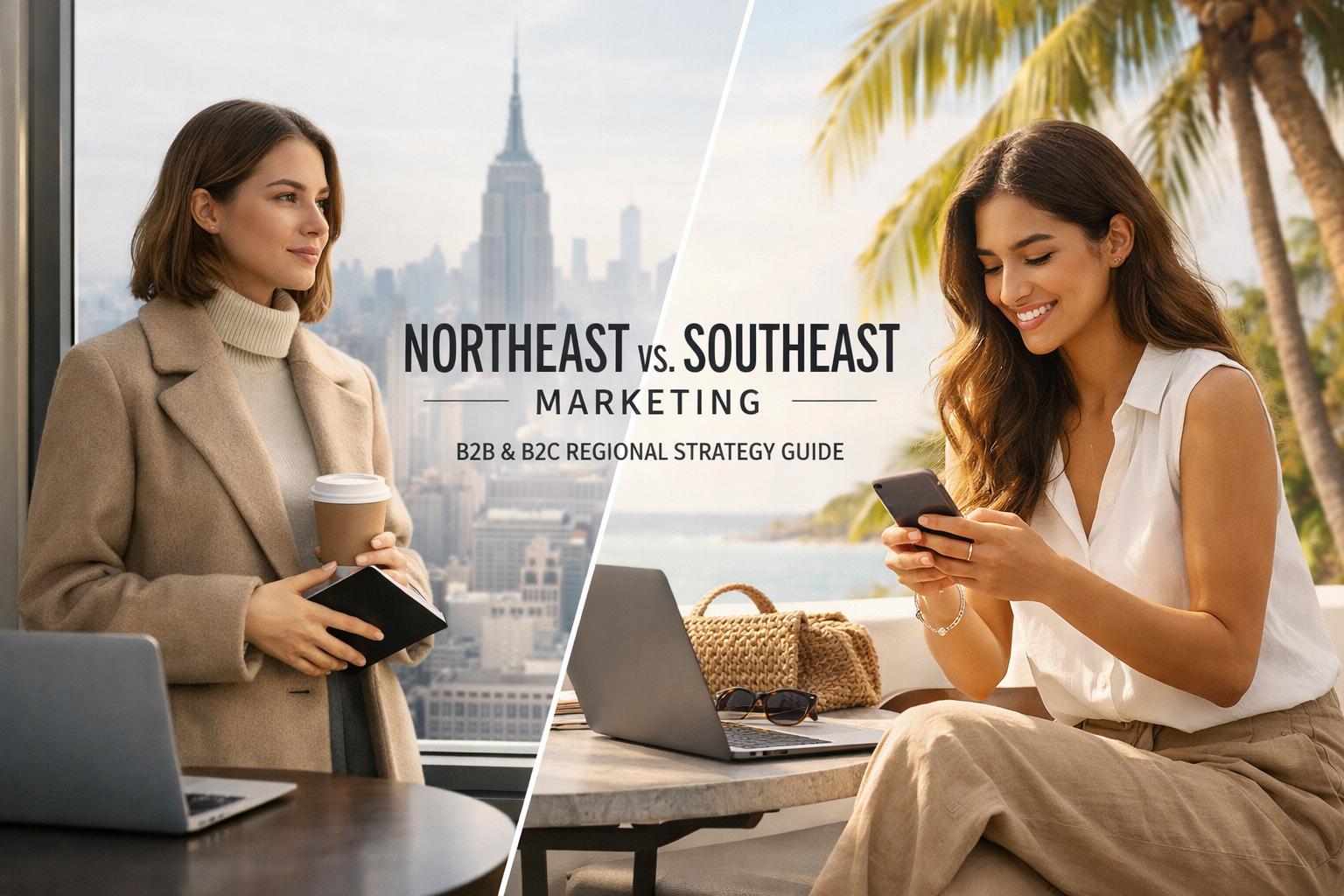
If you're running the same marketing campaign in Philadelphia and Atlanta, in Boston and Charlotte, in New York City and Nashville — you're leaving money on the table. Not because your product isn't good enough. Not because your team isn't talented enough. But because the people in those two regions are genuinely, demonstrably different in how they think, how they buy, and what earns their trust.
This isn't a gut feeling. It's backed by behavioral science, demographic data, and two centuries of distinct cultural development. And it applies whether you're marketing to everyday consumers (B2C) or to the decision-makers inside other businesses (B2B). The rules shift depending on your audience type — and they shift again depending on which region you're in.
At Ritner Digital, we work with clients who span both coasts, and we've seen firsthand how a campaign that performs brilliantly in the Mid-Atlantic can fall completely flat when dropped into the Southeast with no adaptation. This post is a deep dive into why — and what to do about it.
Part One: The Cultural Divide Is Real (and Scientifically Documented)
Before we get into tactics, let's establish the foundation. The differences between Northeast and Southeast consumers aren't just stereotypes — they're documented patterns that show up in psychological research, consumer behavior studies, and marketing performance data.
A landmark study published in APA's Journal of Personality and Social Psychology analyzed personality traits across more than a million participants in 48 states. The researchers, led by Dr. Peter J. Rentfrow of the University of Cambridge, identified three major regional personality clusters. People in the South tended to be characterized as "friendly and conventional," while residents of the Mid-Atlantic and Northeast were classified as "temperamental and uninhibited." APA
That's not an insult to either region — it's a personality profile, and it has profound implications for marketing. The "friendly and conventional" cluster reflects a culture rooted in community, tradition, and relationship. The "temperamental and uninhibited" cluster reflects a culture rooted in directness, ambition, and efficiency. Each of these orientations responds to very different messaging, very different channels, and very different brand voices.
In the South, there is a strong emphasis on politeness, indirectness, and community harmony — traits deeply embedded in Southern culture. In the North, communication tends to be more direct, with Northerners typically less concerned with pleasantries and more focused on getting to the point quickly. Loyaltytravelsagency
The Northeastern United States is known for its fast-paced lifestyle and ambitious spirit, with residents often prioritizing career success, education, and innovation. In the Southern states, hospitality and tradition reign supreme. Medium
These aren't just social observations. They translate directly into consumer expectations. A Northeast customer who lands on your website wants to see credentials, proof of results, and pricing transparency upfront. A Southeast customer may be equally sophisticated but more inclined to want to feel the brand before they buy into it — they want to sense that your company shares their values before they make a commitment.
Migration patterns continue to shift as well — the movement of people from the Northeast and Midwest to the Southeast continues to be a long-running trend, which is fragmenting the consumer base further as different age cohorts follow different migration patterns. Deloitte Insights This means Southeast markets are becoming more mixed, not less, and marketers can't assume monolithic audiences in either region.
Part Two: B2C Marketing — Consumer Differences That Change Everything
The Northeast B2C Consumer
Northeast consumers are fast-paced, tech-savvy, and prioritize efficiency and quality. Smart home technology, advanced appliances, and time-saving products tend to perform well in this region. Retailbound
What does this mean in practice? It means your B2C marketing in the Northeast needs to lead with value and speed. Long-form emotional brand storytelling may not land as a cold introduction. Your digital advertising needs to answer the question "What does this do for me, and why is it better?" before it tries to make someone feel good. Conversion-focused landing pages, strong calls to action, and immediate proof points (reviews, ratings, third-party endorsements) outperform aspirational brand content when the audience is skeptical and impatient.
The Northeast also skews toward higher levels of education and urban density. Demographically, the Northeast has relatively high levels of college graduates, more affluent populations, and high tolerance for cultural diversity. CR Research That creates an audience that is skeptical of marketing fluff, comfortable doing independent research, and highly influenced by peer reviews and expert opinion. In B2C contexts, this manifests in a population that reads before it buys — they'll compare three or four options before making a decision, and they'll make that decision based on data and social proof rather than brand personality alone.
Short-form content, punchy ad copy, transparent pricing, and review integration are all high-performers in this market. Social proof is critical. If your Northeast B2C campaign doesn't prominently feature reviews, case studies, or comparison data, you're missing what the audience is looking for.
The Southeast B2C Consumer
Southeast consumers operate differently. People from the South are often characterized by their politeness and friendliness, with Southern culture deeply intertwined with family and tradition. Family gatherings are a central part of Southern life, and community bonds are strong. Loyaltytravelsagency
That community orientation shows up in purchasing behavior. Southeast B2C consumers are more likely to buy from businesses they know, like, and trust — often through word-of-mouth, community referrals, and local brand reputation. They respond to authenticity. A brand that seems corporate and transactional may lose ground to a local alternative that feels more personal, even if the product is nearly identical.
From a digital standpoint, the Southeast has been experiencing explosive growth. Census data shows that nine of the top 10 fastest-growing counties in the country were in the South, and 45 of the top 50 fastest-growing counties were Southern, highlighting the Southeast as a hot spot for growth in the U.S. WilmingtonBiz This population growth is creating a consumer base that is both newer to the region (bringing Northern habits) and deeply embedded in Southern culture, which means Southeast campaigns need to appeal to both sensibilities.
Southeast and Texas markets showed stronger foot traffic growth than other regions, while West Coast markets had significantly higher e-commerce penetration. Deloitte Insights This suggests that physical presence, local visibility, and community-rooted marketing still have a competitive edge in the Southeast that they may not have elsewhere. For B2C brands, that means local SEO, Google Business profiles, community sponsorship, and brick-and-mortar events can drive outsized results in the Southeast compared to pure-digital approaches that dominate in the Northeast.
Influencer marketing also works differently in the Southeast. Community-based micro-influencers — local personalities, church leaders, sports coaches, neighborhood businesses — often carry more weight than national macro-influencers. Southern audiences value authenticity and shared values over polish and celebrity.
Key B2C Differences at a Glance
Northeast B2C: Lead with efficiency, proof, and credentials. Make it easy to compare, research, and buy quickly. Invest in reviews and third-party endorsements. Short-form, direct ad copy wins. Prioritize digital channels and fast UX.
Southeast B2C: Lead with warmth, community, and shared values. Build brand familiarity before pressing for the sale. Leverage local visibility, word-of-mouth, and community presence. Longer relationship-building pays off. Don't underestimate physical presence.
Part Three: B2B Marketing — Where the Regional Gap Gets Even Wider
The B2B marketing divide between Northeast and Southeast is arguably more pronounced than on the consumer side. That's because in B2B, the relationship and the sales cycle are longer — and the cultural lens through which your prospect evaluates your trustworthiness has more time to matter.
What B2B Marketing Is (and Isn't)
First, a quick baseline. The B2B sales cycle focuses primarily on building trust, authority, and price leadership. B2B purchases typically require alignment from multiple stakeholders, more complex negotiations, and involve more money — with an average sales cycle of approximately two months. US Chamber of Commerce
B2B purchasing is mostly rational and logic-driven. Business buyers need to justify decisions with metrics like ROI, efficiency gains, cost savings, and productivity improvements. Agencyjet
In complex B2B sales, buying groups now average 10 to 11 stakeholders, stretching to 15 or more in global deals, and decision cycles can last up to 16 months. By the time a prospect starts a conversation with a vendor, roughly 70% of the buyer journey has already happened independently. RTB House
Those fundamentals apply everywhere. But what changes by region is how trust is built, who the key stakeholders are, how quickly they expect to move, and what signals authority to them.
B2B Marketing in the Northeast
Northeast B2B buyers — think financial services in New York, biotech in Boston, insurance in Hartford, media in Philadelphia — come into the sales process fast, direct, and heavily researched. They've already read your case studies, looked up your leadership team on LinkedIn, and compared your pricing to competitors before they've agreed to a first meeting.
Regional buying preferences influence B2B strategy significantly — decision-making hierarchies, communication styles, and purchasing processes vary across regions. Amworldgroup In the Northeast, that hierarchy is often flatter in practice even when it appears formal on paper. Decision-makers will tell you quickly if the fit isn't there. They don't waste time on courtesy calls.
Your Northeast B2B marketing, therefore, needs to be built for speed and specificity. Thought leadership content that clearly differentiates your positioning, not generic "we help businesses grow" messaging. Case studies with specific, measurable outcomes. LinkedIn campaigns targeting named accounts. Email sequences that earn attention in the first sentence.
Thought leadership is particularly powerful in B2B — 58% of decision-makers award business based on thought leadership, and 61% are more willing to pay premium prices to companies that articulate a clear vision. AmworldgroupIn the Northeast, being the smartest voice in the room — demonstrably, not just reputationally — is a meaningful competitive advantage.
Directness is a feature, not a bug. Northeast B2B buyers don't need you to spend three paragraphs warming up before you make your point. Get to value fast.
B2B Marketing in the Southeast
Southeast B2B is a fundamentally different animal. The cultural emphasis on relationship, hospitality, and community that shapes B2C behavior here extends deep into business-to-business interactions.
The South has a strong sense of community and an honor-and-respect culture that shapes professional interactions. Loyaltytravelsagency In B2B contexts, that means deals are often made on trust that is built gradually — through multiple touchpoints, face-to-face interactions, and genuine relationship investment before a contract is ever discussed. It's not that Southeast B2B buyers are less analytical. They're often highly rigorous. But they want to know who they're doing business with, not just what the product does.
This has major implications for your B2B marketing strategy in markets like Atlanta, Nashville, Charlotte, Miami, Tampa, or Raleigh. Content marketing alone will not close deals. The human layer matters enormously. In-person events, trade shows, industry conferences, and local networking carry disproportionate weight in the Southeast B2B landscape.
In B2B marketing, trust is essential. Cultivating trust in the B2B space is about being consistent, transparent, and reliable — it's not about making grand promises. DirectiveGroup In the Southeast, that consistency needs to be demonstrated through relationships, not just through content. A vendor who shows up to the same industry event two years in a row, who follows up personally, who sends a handwritten note — that vendor has a meaningful advantage over a competitor who sends better emails but never shakes a hand.
According to research from LinkedIn and Ipsos, 94% of marketers believe that trust is the number-one KPI in B2B buyer relationships — and establishing trust with just one stakeholder in an account can, on average, help persuade 21 others. Theinsightcollective In the Southeast, that first trusted relationship often begins in a human interaction, not a digital one. Your digital marketing needs to support and reinforce those relationships, not substitute for them.
Account-based marketing (ABM) strategies work extremely well for Southeast B2B. If you can identify target accounts and build personalized campaigns that speak directly to their industry, their region, and their specific pain points — then back that up with a human follow-up — you'll outperform any competitor who is broadcasting generic B2B content.
Key B2B Differences at a Glance
Northeast B2B: Move fast, prove expertise quickly, lead with data and outcomes. Thought leadership and LinkedIn content are high-impact. Prioritize first-call clarity and ROI framing. Decision-makers are direct and decisive — match their energy.
Southeast B2B: Invest in the relationship before the pitch. Face-to-face matters. Build presence in regional industry events. Take a longer view of the pipeline. Personal follow-up and local credibility signals outperform cold digital outreach. ABM approaches that speak to their specific region and industry are highly effective.
Part Four: Channels — Where Each Region Actually Pays Attention
Social Media and Digital Advertising
It is estimated that 60% of marketing was digital by the end of 2024, with offline media spending declining in recent years. WordStream That's true across both regions — but the type of digital content and the platform distribution differ meaningfully.
In the Northeast, LinkedIn, targeted Google Ads, and industry-specific publications carry significant weight — especially for B2B. The audience is more skeptical of social media advertising and more likely to block or scroll past anything that feels promotional rather than informative. Native content, thought leadership, and search-intent-based advertising (where someone is actively looking for what you offer) tend to outperform interruption-based ads.
In the Southeast, Facebook and Instagram continue to be highly effective for both B2B and B2C campaigns — particularly at the local and regional level. Community engagement on social platforms is stronger, and the social graph (who recommends what to whom) remains a powerful purchase driver. People spend 50% more with businesses that regularly respond to reviews — and 93% of people read online reviews before making a purchase. WordStream In the Southeast, those reviews and community recommendations hold significant influence.
Video content works in both regions but serves different purposes. In the Northeast, video needs to deliver information fast — explainer content, product demos, and credibility-building interviews. In the Southeast, brand storytelling, community-focused content, and testimonials from relatable local figures perform well.
Search and SEO
Local SEO is universally important, but its relative value is higher in the Southeast where foot traffic and in-person discovery remain more dominant than in high e-commerce-penetration markets. Deloitte Insights A Southeast business with a strong Google Business Profile, consistent local citations, and positive recent reviews has a meaningful advantage. Northeast consumers, particularly in urban markets, are often making decisions faster and more transactionally, which means paid search and competitive keyword strategies matter more at the top of the funnel.
Email Marketing
Email remains one of the highest-ROI channels in both regions for B2B, but tone and pacing differ. Northeast B2B email sequences can be shorter, more direct, and less relational in the opening messages — because the audience will assess value quickly. Southeast B2B email should warm up more gradually, acknowledge the relationship, and demonstrate a genuine understanding of the recipient's specific business context before making any kind of ask.
For B2C, segmentation is critical in both markets, but the triggers that drive opens and clicks differ. Northeast B2C email campaigns benefit from urgency, limited-time offers, and efficiency-oriented subject lines. Southeast B2C email campaigns perform well when they feel personal, community-oriented, or value-aligned — a discount email framed as "something for our community" outperforms the same discount framed as "act now before it's gone."
Part Five: Voice, Tone, and Messaging — The Details That Win or Lose the Click
Beyond strategy and channel, the actual words you use matter — and they need to shift by region.
Northeast messaging can be punchy, credentialed, and ROI-forward. "We cut your customer acquisition costs by 40%" is a compelling Northeast headline. It's direct, specific, and delivers value before it asks for anything. Northeast buyers will respect this.
Southeast messaging needs warmth built in from the start. Not fake warmth — authentic warmth that reflects genuine familiarity with your audience's world. "Built for businesses like yours, because we've been in your market" speaks to a Southeast audience in a way that "industry-leading ROI" does not. This is especially true in B2B — Southeast buyers want to feel understood, not marketed to.
Southern states can have meaningfully different consumer habits than other regions, and recognizing and addressing these regional nuances is crucial for content that connects with audiences more personally. Profiletree
This extends to imagery as well. Stock photography showing a rushed city office environment signals "this brand is for New York." Imagery of community, outdoor spaces, family businesses, and regional landmarks signals "this brand understands us." These may seem like small details — but in a landscape where consumers are bombarded by hundreds of impressions daily, the visual language of your brand either earns familiarity or creates friction.
Part Six: What This Means for Your Marketing Budget
The strategic and creative differences between these two regions have direct budget implications. If you're deploying the same dollar amount in the Northeast and the Southeast but running identical campaigns, you're not getting optimal return in either market.
Here's a rough framework for thinking about budget allocation by region and audience type:
Northeast B2C: Heavy investment in paid search (capturing high-intent buyers who are actively comparing), review management and reputation tools, and conversion rate optimization on your website. Social advertising works but needs to be informative and snappy — not slow-burn emotional content.
Southeast B2C: Allocate more to local SEO, community-based social media, and local influencer partnerships. Don't neglect physical presence marketing — event sponsorships, geofenced advertising around community events, and locally-flavored content creation.
Northeast B2B: LinkedIn advertising, content marketing that establishes thought leadership, and ABM campaigns targeting named accounts are worth prioritizing. Outreach sequences can be shorter but must lead with strong differentiation. Industry-specific webinars and digital events perform well.
Southeast B2B: Invest in your event presence — both sponsorships and attendance. Budget for longer sales cycles and relationship-building content. Personalized video outreach outperforms mass email. Local case studies from regional clients carry tremendous credibility.
Part Seven: The Migration Effect — Why Both Markets Are Changing
One more layer of complexity worth acknowledging: neither region is static.
The migration of people from the Northeast and Midwest to the Southeast continues as a long-term demographic trend — with Baby Boomers moving primarily to Florida and Arizona, Gen X relocating to Texas, and Millennials migrating to Colorado and Florida. Deloitte Insights
What this means for marketers is that the Southeast is increasingly a hybrid market. You'll find communities — particularly in Charlotte, Nashville, Atlanta's suburbs, and the Research Triangle — where a significant portion of the population moved from the Northeast within the last decade. These buyers bring some of their Northern communication preferences with them, even as they adapt to Southern culture.
The smart play in these high-growth Southeast markets is a middle path: retain the relational warmth and community focus that defines the region, but don't assume the audience is unfamiliar with direct, data-driven marketing. A campaign that combines Southern authenticity with Northern clarity can outperform a campaign that goes fully in either direction.
Similarly, Northeast markets — particularly in mid-sized cities outside of major metros — often have more community-oriented buying behavior than the New York or Boston stereotypes would suggest. New Jersey, parts of Connecticut, upstate New York, and much of Pennsylvania sit closer to the cultural middle than the extremes of either archetype.
Know your specific city. Know your specific audience. Broad regional strategies are a starting framework — not a final answer.
Conclusion: Strategy Starts With Understanding
The Northeast and Southeast represent two genuinely distinct commercial cultures, shaped by history, migration, climate, and community values that have developed over generations. That doesn't mean one is better or easier to market in than the other — it means that the same message, delivered in the same way, to the same product, will land differently depending on where you are and who you're talking to.
Geographic segmentation is one of the four key types of B2C segmentation alongside demographic, behavioral, and psychographic — and smart marketers use local knowledge to adjust product positioning accordingly. ClickUp
For B2B, 44% of B2B decision-makers are highly relationship-oriented — willing to try new channels, but slow to shift from familiar patterns and existing supplier relationships, even when the status quo is less than ideal. McKinsey & Company Winning those buyers — wherever they are — requires patience, consistency, and genuine alignment with how they build trust.
The businesses that thrive across both regions aren't the ones with the biggest budgets. They're the ones that took the time to listen to each market before they started speaking to it.
Ready to Build a Regional Strategy That Actually Works?
At Ritner Digital, we specialize in marketing strategy and execution for businesses operating across the Northeast and Southeast — whether you're targeting consumers, businesses, or both. We don't believe in one-size-fits-all campaigns. We believe in understanding your market, building a strategy that fits it, and delivering results you can measure.
If you're ready to stop running the same campaign in two different worlds and start building something that actually connects — let's talk.
Schedule a Free Strategy Call with Ritner Digital →
Frequently Asked Questions
Is it really necessary to have separate marketing strategies for the Northeast and Southeast, or is this overkill for smaller businesses?
Even for smaller businesses, regional adaptation doesn't have to mean running two completely separate campaigns from scratch. It often means adjusting tone, imagery, channel mix, and messaging priorities — things that can be done without doubling your budget. A small B2B firm running LinkedIn ads can use the same case study but write different ad copy for each region. A B2C brand can run the same promotion with different creative that feels local. The investment is smaller than most people think, and the return on relevance is real.
What are the most common mistakes businesses make when marketing across both regions?
The most common mistake is assuming that a campaign which worked well in one region will translate automatically to the other. The second most common mistake is over-correcting — leaning so hard into regional stereotypes that the marketing feels patronizing or caricatured. "Southern charm" as a gimmick reads as fake. "Northeast hustle" as a brand personality can feel aggressive. The goal is genuine cultural alignment, not cosplay. Get to know your specific audience in each market before you lean on regional generalizations.
How does B2B marketing in a mixed market like Charlotte or Nashville work — where a lot of people have relocated from the Northeast?
These hybrid markets are genuinely tricky, and there's no single formula. A good starting point is segmenting your audience where possible — if you're running LinkedIn campaigns, you can often filter by years in current location or industry background. In practice, the safest approach in high-growth Southeast metros is to lead with Southern warmth and community while building in the data-driven proof points that relocated Northeasterners are looking for. You can satisfy both audiences with one well-constructed message if the content is layered correctly.
Does the Northeast vs. Southeast divide apply equally to both B2B and B2C, or is it more pronounced in one?
The divide matters in both, but it tends to be more pronounced and have higher stakes in B2B. Consumer purchasing decisions are often faster and more self-contained, so a message that's slightly misaligned can still convert. In B2B, where the sales cycle is longer and trust is built over multiple touchpoints, a message that doesn't match the regional culture can derail an entire pipeline. The relationship layer of B2B sales in the Southeast is particularly significant — if your outreach feels transactional in a market where relationship is the currency, you'll have a hard time recovering.
What industries see the biggest regional marketing differences between the Northeast and Southeast?
Financial services, professional services (legal, accounting, consulting), healthcare, and technology tend to show the most pronounced regional differences because they're relationship- and trust-dependent industries. In the Northeast, these buyers often want to see credentials, case studies, and ROI proof right away. In the Southeast, those same buyers want to know who you are, who you've worked with locally, and whether you understand their market before they'll engage deeply. Real estate, construction, and retail also show strong regional variation, particularly in how local presence and community reputation factor into buying decisions.
My business is based in New Jersey and I want to expand into Southeast markets. Where do I start?
Start by listening before you speak. Spend time studying your target Southeast market — who the key players are, what associations and events they participate in, what media they consume, and who the trusted voices in the space are. Before you launch any campaign, build at least one or two genuine local connections in the market, whether through a referral partner, a regional distributor, or attendance at an industry event. Then adapt your messaging to reflect that you understand the market — not just that you want to sell to it. Businesses that enter Southeast markets leading with community and credibility tend to build traction faster than those that lead with price or features.
How important is local SEO in each region?
Local SEO matters everywhere, but it carries extra weight in the Southeast where in-person discovery and community reputation still drive a meaningful share of purchasing decisions. A Southeast business with a well-maintained Google Business Profile, consistent local citations, and a steady stream of recent positive reviews has a tangible competitive advantage. In the Northeast — especially in major urban markets — consumers tend to be further along in independent online research before they ever look at local results, so combining local SEO with strong paid search and content strategy is more important than leaning on local SEO alone.
How do I measure whether my regional messaging is actually working?
Track performance separately by region from day one. That means separate campaign tagging, separate landing pages where possible, and separate conversion tracking for each geographic market. Look beyond top-line conversion rates — pay attention to engagement metrics (time on site, scroll depth, video completion), email open and click rates segmented by region, and qualitative feedback from your sales team about how leads in each market are responding. Over time, patterns will emerge that tell you which messages, channels, and offers are resonating where. If you're not segmenting your analytics by region, you're averaging out the signal you need to optimize.
Can a single brand voice work across both regions, or does Ritner Digital recommend having two distinct brand voices?
You shouldn't need two entirely different brands. What you need is a brand voice with enough range to flex toward directness and efficiency when speaking to Northeast audiences, and toward warmth and community when speaking to Southeast audiences — without ever losing its core identity. Think of it like register in music: the same song can be played at a different tempo and feel completely natural in a new context. The most successful brands operating across both regions have a clear set of core values and a consistent visual identity, but they give their copywriters and campaign managers the latitude to adapt tone and emphasis based on who they're talking to. That flexibility is a feature, not a inconsistency.
Where does Ritner Digital specialize geographically?
Ritner Digital works with clients across the Northeast and Southeast United States, with deep familiarity in the Mid-Atlantic and growing presence in Southeast growth markets. If you're operating in one region and looking to expand to the other — or trying to optimize performance in both simultaneously — we're built for exactly that challenge. Reach out to start a conversation about your specific markets and goals.
Sources
Rentfrow, P.J., et al. "Divided We Stand: Three Psychological Regions of the United States and Their Political, Economic, Social, and Health Correlates." Journal of Personality and Social Psychology, American Psychological Association, 2013. https://www.apa.org/news/press/releases/2013/10/regions-personalities
Retailbound. "Navigating Cultural Differences for Success with U.S. Retailers." November 2025. https://retailbound.com/navigating-cultural-differences-for-success-with-u-s-retailers/
LoyaltyTravelsAgency. "Understanding the Cultural Differences in the U.S.: North vs. South." February 2025. https://loyaltytravelsagency.com/2025/02/25/understanding-the-cultural-differences-in-the-u-s-north-vs-south/
Deloitte Insights. "The Consumer is Changing, But Perhaps Not How You Think." https://www.deloitte.com/us/en/insights/industry/retail-distribution/the-consumer-is-changing.html
U.S. Chamber of Commerce. "B2B vs B2C: What's the Difference?" January 2026. https://www.uschamber.com/co/start/strategy/b2b-vs-b2c
ClickUp. "B2B vs. B2C Marketing Differences: Key Strategies Explained." November 2025. https://clickup.com/blog/b2b-vs-b2c-marketing-differences/
McKinsey & Company. "Five Fundamental Truths: How B2B Winners Keep Growing." September 2024. https://www.mckinsey.com/capabilities/growth-marketing-and-sales/our-insights/five-fundamental-truths-how-b2b-winners-keep-growing
AMW Group. "Proven B2B Marketing Strategies That Drive Business Growth in 2025." December 2025. https://www.amworldgroup.com/blog/business-marketing-b2b
The Insight Collective. "How Trust by Association Builds B2B Credibility." March 2026. https://www.theinsightcollective.com/insights/trust-by-association-in-b2b-marketing
The Directive Group. "Trust-Based Marketing: Building Enduring B2B Relationships." December 2024. https://www.directivegroup.com/uncategorized/trust-based-marketing-building-enduring-b2b-relationships/
WordStream. "180+ Powerful Digital Marketing Statistics for 2026." January 2026. https://www.wordstream.com/blog/ws/2022/04/19/digital-marketing-statistics
WilmingtonBiz. "Wilmington Metro's Population Growth Ranks in Top 10 Nationwide." March 2026. https://www.wilmingtonbiz.com/more_news/2026/03/27/wilmington_metros_population_growth_ranks_in_top_10_nationwide/27332
ProfileTree. "Content Marketing in the USA: Regional Sensitivities." May 2024. https://profiletree.com/cultural-considerations-for-content-marketing-usa/
AgencyJet. "B2B vs B2C Marketing: What Sets Them Apart in 2026." June 2025. https://www.agencyjet.com/blog/b2b-vs-b2c-marketing-what-sets-them-apart
Discover Magazine. "How Regional Personality Differences Divide America." October 2020. https://www.discovermagazine.com/how-regional-personality-differences-divide-america-41889