What 3 Months of Industrial SEO Would Have Cost in Google Ads
Every time a prospect types "forklift charging station requirements" into Google and lands on your blog instead of a competitor's ad, something valuable just happened — and it didn't cost you a penny per click.
That's the core proposition of organic search. But "SEO has value" is a soft claim, the kind that gets nodded at in marketing meetings and quietly deprioritized when the CFO asks for hard numbers. So let's make it hard.
We recently analyzed three months of Google Search Console data from one of our industrial B2B clients — a distributor in the materials handling and motive power space, serving warehouses, distribution centers, and industrial facilities with batteries, charging equipment, watering systems, handling gear, and related products. We've anonymized the identifying details, but every keyword and every impression count is real.
The question we set out to answer: what would this organic search footprint have cost to replicate through Google Ads over the same 90-day window?
The answer will either validate your SEO investment or make you deeply uncomfortable about not having one.
The Baseline: What the Data Shows
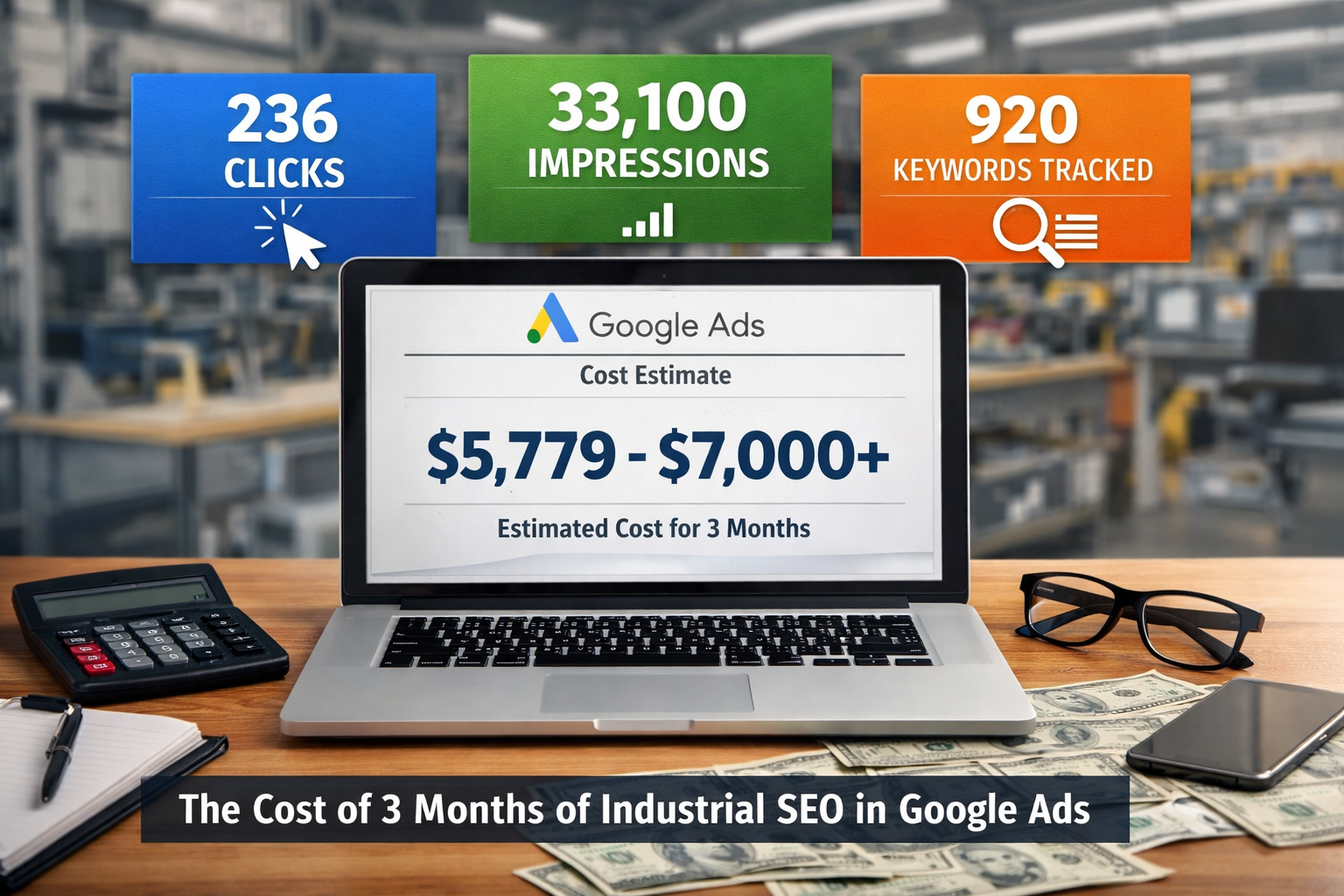
Over the three months from early January through early April 2026, this client's website generated 236 total clicks and 33,100 impressions across roughly 920 tracked queries, with an average CTR of 0.7% and an average position of 20.2. Their top pages included informational content on forklift charging station requirements, battery watering systems, pallet jack battery replacements, and battery handling equipment for industrial facilities — alongside core product category pages.
That average position of 20.2 is worth pausing on. It means the site is, on average, sitting at the bottom of page two — close enough to page one to matter, far enough away that significant click volume is still being left on the table. A 0.7% CTR is consistent with that positioning: research consistently shows CTR climbs dramatically as rankings move from positions 11–20 up into the top five. The impressions are there. The audience is searching. The opportunity gap is real.
On the surface, 236 clicks over 90 days doesn't sound like a lot. But before you dismiss that number, you need to understand two things: what these clicks are actually worth in this industry, and what 33,100 impressions tell you about organic positioning that hasn't fully converted yet.
What These Clicks Are Worth
The industrial materials handling sector is a niche B2B vertical. Buyers are warehouse managers, fleet supervisors, operations directors, and facility engineers. They're making purchasing decisions on equipment and supplies that carry average ticket values in the thousands to tens of thousands of dollars. The sales cycle is long. The intent behind a search like "electric pallet jack battery replacement" or "forklift charging station OSHA requirements" is high — these aren't casual browsers.
This matters enormously for CPC benchmarking. For B2B campaigns in low-to-mid competition industrial and niche verticals, you can expect to pay $2–$8 per click — these keywords are often specific part numbers or technical terms. Bootstrap Creative That's the floor. For transactional or high-intent queries with serious purchase signals, costs climb higher.
The broader B2B picture reinforces that. B2B Google Search Ads CPCs climbed roughly 29% over the past year, reaching an average of $5.34 for non-branded keywords. Dreamdata And that's the all-industry average, not a niche industrial number. Meanwhile, B2B cost per lead in manufacturing runs as high as $819 — one of the widest gaps between B2B and B2C costs of any industry. WebFX
For this analysis, we built a tiered CPC model based on the intent level of each keyword cluster in the data:
Informational and compliance queries (OSHA requirements, battery watering guides, charging ventilation rules): $2–$4 per click
Product research and comparison queries (pallet jack battery, forklift charger, battery handling equipment): $4–$7 per click
Transactional and commercial intent queries (battery replacement, battery rental, buy forklift batteries): $6–$12 per click
At a blended $5.00 CPC — a deliberately conservative number for this space — the 236 clicks this client received organically over 90 days would have cost approximately $1,180 in paid search spend. At $6.00, that's $1,416.
That sounds modest. We'll come back to why the click count alone is not the number that should concern you.
The Impression Inventory: The Number Nobody Talks About
Here's where the real story is.
Those 236 clicks came from 33,100 impressions. The site appeared in Google search results over thirty-three thousand times in 90 days — for everything from "industrial battery" (798 impressions) to "best electric pallet jack batteries" (233 impressions) to "forklift battery watering system" (234 impressions) to "battery handling systems" (294 impressions) to "industrial battery charger" (494 impressions).
Most of those impressions resulted in zero clicks. But in paid search, impressions are never free — you pay to be in the auction.
Display CPMs average around $2.54 broadly, while more competitive B2B verticals run significantly higher. Pixis Even using a modest $3.00 CPM for awareness-level impressions in this space, those 33,100 organic appearances carry roughly $99 in equivalent impression value on top of the click value. Not transformative on its own — but it's not the main story either.
The main story is what 33,100 impressions across 920 queries tells you about the size of the organic real estate this client has claimed. Every one of those impressions is a moment where the brand appeared in front of someone searching for exactly what this company sells. In paid search, you buy those moments one by one. In organic, they accumulate.
Breaking Down the High-Value Keyword Clusters
Let's look at the specific queries where this client is ranking and translate them into what paid coverage would actually cost.
The Compliance and Requirements Cluster
"Forklift charging station requirements" — the single highest-impression page in the data — generated 5,128 impressions at an average position of 12.4, with 34 clicks. This one query cluster expands to related terms like "OSHA forklift charging station requirements," "electric forklift charging station safety requirements," "forklift battery charging ventilation requirements," and "forklift charging station power requirements" — all representing searches from people who are actively preparing to build or upgrade a charging area, meaning they're close to a purchasing decision.
OSHA compliance and regulatory content like this is exceptionally valuable in paid search because the searcher intent is so clear. At even a conservative $4–$6 CPC for this type of query, those 34 clicks represent $136–$204 in equivalent ad spend for that page alone. The 5,128 impressions indicate this page is competing for one of the highest-volume informational queries in the entire industrial battery niche — and doing it without paying for each placement.
The Pallet Jack Battery Cluster
"Electric pallet jack battery replacement" (156 impressions), "best electric pallet jack batteries" (233 impressions), "electric pallet jack batteries" (214 impressions), "pallet jack battery replacement" (111 impressions), and "batteries for electric pallet jack" (184 impressions) together represent a cluster of roughly 900 impressions across queries with clear commercial intent — someone is evaluating or ready to buy.
CPCs for battery replacement and product queries in this category range from $5–$8 in a paid campaign. Buying coverage across this cluster with any meaningful frequency would run $100–$300 per month in paid spend, minimum — and that's before accounting for the ad quality and landing page optimization required to win those placements competitively.
The Battery Handling Equipment Cluster
"Battery handling equipment" (237 impressions), "battery handling systems" (294 impressions), "battery changing equipment" (204 impressions), "battery handling" (44 impressions), and "battery handling solutions" (73 impressions) form a cluster of roughly 850 impressions around one of the most purchase-intent-heavy topics in the catalog — facility managers actively evaluating equipment investments.
These are exactly the kinds of terms where B2B industrial and niche keywords carry $2–$8 per click at the low end Bootstrap Creative, with a single closed sale potentially representing a contract worth far more than a typical e-commerce transaction. Even at $5 CPC, maintaining visibility across this cluster represents meaningful ongoing paid spend.
The Industrial Battery Category Cluster
"Industrial battery" alone pulled 798 impressions. Add in "industrial batteries" (186 impressions), "industrial battery charger" (494 impressions), and "industrial battery chargers" (308 impressions), and you're looking at roughly 1,800 impressions across broad category terms where the site is indexed and building position without yet converting most of it to clicks.
In paid search, bidding on category-level industrial terms like "industrial battery charger" would be expensive and competitive. The average CPC across industries is $4.51, but costs vary dramatically by sector. WebFX Industrial equipment and B2B supply keywords routinely exceed that average when buyer intent is high.
The Battery Watering Systems Cluster
"Battery watering system" (366 impressions), "forklift battery watering system" (234 impressions), "battery watering systems" (43 impressions), "forklift battery watering" (81 impressions), and related terms generate nearly 800 impressions in aggregate. This is a niche product category with relatively low search volume nationally — but extremely high purchase intent when someone does search it. A watering system query almost always means an active fleet and an active buyer. These are not tire-kickers.
The 920-Query Moat
Here's the piece of this analysis that doesn't fit neatly into a CPC calculator, but matters most strategically.
This client is showing up for 920 distinct queries over 90 days. That's 920 individual search terms where Google has determined this site is relevant enough to surface. Many of them have very low individual impression counts — 3, 5, 10, 15 impressions per query. But they add up, and more importantly, they represent the long tail of industrial buying intent: specific model numbers, brand comparisons, OSHA regulation citations, equipment specifications, and category terms adjacent to their core products.
In paid search, you can't just "show up" for 920 queries passively. You either build and fund a campaign that covers those terms explicitly, or you miss them. The average cost per lead across Google Ads is $70.11, but this varies widely by industry — and in B2B manufacturing it climbs dramatically. TheeDigital Every long-tail query your organic content captures for free is one you'd otherwise need to bid on, monitor, optimize, and pay for.
The true cost of replicating a 920-query organic footprint in paid search isn't just about the 236 clicks you're already getting. It's about the infrastructure investment — the campaign architecture, the keyword research, the bid management, the ad copywriting, the landing page development, the ongoing optimization — required to even attempt that coverage. Non-branded Google search ads represent 39% of B2B ad budgets but deliver consistent lead volume Dreamdata — meaning companies are spending enormous portions of their marketing budget just to maintain the visibility that a solid organic foundation provides as a baseline.
The Real Paid-Ad Equivalent: A Conservative Model
Let's build a complete picture. If this client wanted to replicate their organic search presence through paid ads over the same 90-day window, here's what they'd actually be looking at:
Direct click replacement: 236 clicks at a blended $5.00 CPC = $1,180
Impression coverage: 33,100 impressions at $3.00 CPM = $99
Campaign infrastructure and management overhead: A campaign covering 920 keyword targets across multiple ad groups, with appropriate negative keyword lists, bid strategies, and ad copy variations requires significant agency or in-house time. At a modest $1,500/month management fee — on the low end for a B2B industrial campaign — that's $4,500 over 90 days.
Conservative 90-day paid equivalent: $5,779 – $7,000+
And that number still doesn't account for:
The compounding effect of organic rankings that improve over time versus paid traffic that stops the moment the budget runs out
The trust differential between organic results and ads — users are more likely to click organic results for research-phase queries
The reality that a paid campaign targeting 920 keywords across a niche B2B vertical would almost certainly require more than a modest management budget to run competitively
The cost of building the landing pages and content that paid campaigns require to convert
Survey data from 350 businesses shows that satisfied advertisers typically allocate 15–35% of their total marketing budget to PPC WebFX — meaning to maintain this kind of search presence through paid alone, you'd be looking at it as a significant, permanent line item with zero residual value the moment you pause it.
What This Means for Industrial B2B Companies
There's a version of this analysis that makes SEO look like a nice-to-have: 236 clicks over 90 days, a paid click equivalent under $1,500, a modest organic footprint in a niche vertical. If you read it that way, you might conclude that paid ads are perfectly fine — just spend a few thousand dollars a quarter and you're covered.
But that reading misses several compounding factors that change the math entirely.
The trajectory. The 920-query footprint this client has built didn't appear overnight. It represents months of indexed content, accumulated domain signals, and earned positions — positions that, once held, cost nothing to maintain beyond continued content investment. A paid campaign that matches this visibility needs to be funded indefinitely. The SEO asset appreciates. The ad spend disappears.
The intent quality. The queries driving the most impressions in this data — compliance requirements, equipment specifications, watering system questions — are research-phase queries. A $7 click that leads to a high-LTV B2B lead is far better than a $1 click from casual, low-intent traffic. Quimby Digital Industrial B2B organic traffic, particularly from informational queries, captures buyers during serious pre-purchase research. That means entering the consideration set before the prospect even knows who to call.
The CTR upside. The site's average CTR is 0.7% across all queries — consistent with an average position of 20.2. That's not a failure; that's an opportunity. The top-performing page already demonstrates what's possible: the forklift charging station requirements article earns a 0.7% CTR against 5,128 impressions at position 12. If that page moves from position 12 to position 5 — a realistic outcome with continued optimization — CTR typically increases 3–5x. That means 100+ clicks per 90 days from a single page, all organic, with no incremental cost per click.
The brand reinforcement. Branded search queries in the data — searches containing the company name or close variants — are already generating CTRs north of 10–30% in some cases. This tells you the organic presence is reinforcing brand recall. Visitors who encounter the brand organically during research are more likely to search by name later. That flywheel doesn't exist in a paid-only model.
The Bottom Line
Three months of organic search at this scale — 236 clicks, 33,100 impressions, 920 keyword targets — carries a conservative paid-ad replacement value of $5,779–$7,000+ when you account for clicks, impression coverage, and campaign management overhead. Use CPCs more representative of the B2B industrial market at full competition and that figure climbs further still.
More importantly, the organic asset this client has built is compounding. Every new piece of content, every improved ranking, every additional indexed page builds on the foundation already in place. The overall ad performance data for 2025 indicates a challenging ad platform marked by increased costs and declining efficiency Triple Whale — which means the gap between what paid search costs and what organic delivers keeps widening in favor of SEO over time.
For industrial distributors, manufacturers, and equipment suppliers who've been treating SEO as a line item to cut when margins tighten, this is the reframe: you're not paying for a marketing service. You're building an asset — one that's currently generating the equivalent of roughly $6,000 per quarter in search visibility, and growing.
The companies that figure this out early own their category online. The ones that don't spend twice as much, forever, to rent the same real estate.
Ritner Digital helps industrial and B2B companies build organic search programs that compound over time. If you want to run this analysis on your own Search Console data, get in touch.
Frequently Asked Questions
What is organic search traffic actually worth compared to paid ads?
The value of organic traffic depends heavily on your industry, the intent behind the keywords you're ranking for, and what a converted lead is worth to your business. In B2B industrial verticals, where a single sale can represent a five-figure contract, even a modest number of organic clicks carries significant dollar value. The framework we use is simple: take your click volume, apply a realistic blended CPC for your keyword mix, add impression value and campaign management overhead, and you have a defensible paid-ad equivalent. For the client analyzed in this piece, 236 organic clicks and 33,100 impressions over 90 days translated to a conservative paid equivalent of $5,779–$7,000+ when all costs are factored in.
Why do you include campaign management costs in the paid-ad equivalent calculation?
Because they're real. A paid search campaign covering 920 keyword targets across multiple ad groups — with negative keyword lists, bid strategies, ad copy variations, and ongoing optimization — doesn't run itself. Agency management fees for a B2B industrial paid search campaign typically start at $1,000–$1,500 per month on the low end and climb significantly from there depending on scope. If you're comparing the true cost of paid versus organic, you have to include the labor cost of running the campaign. Organic content, once it ranks, doesn't require a monthly management fee to maintain its position.
Our site gets low click volume. Does SEO still make sense for us?
Low click volume in isolation doesn't tell you much. The more important questions are: what's the average position of the pages generating those clicks, what's the impression volume, and what's the intent level of the queries? A site averaging position 20 across its keyword footprint — like the client in this analysis — has enormous upside. Most of those impressions are happening on page two, where CTRs are a fraction of what they'd be on page one. Moving even a handful of high-impression pages from position 15 to position 5 can multiply click volume several times over with no increase in ad spend. Low current performance, when combined with strong impression data, is often a sign that the foundation is there and the optimization work hasn't been done yet.
How long does it take for SEO to show results in industrial B2B?
Honestly, longer than most people want to hear. For a niche B2B industrial site targeting specific technical and compliance-related queries, you can typically expect to see meaningful ranking movement within 3–6 months of consistent content and on-page optimization work, with compounding growth over 12–18 months. The good news is that the competitive bar in many industrial verticals is still surprisingly low — a lot of distributors and manufacturers have minimal content presence, which means well-optimized informational content can rank relatively quickly compared to more crowded consumer categories.
What types of content work best for industrial B2B SEO?
The keyword data in an analysis like this one is essentially a content roadmap. The highest-impression queries in this client's data — OSHA compliance requirements, product comparison guides, battery type explainers, equipment selection guides — are all informational queries where a well-structured, accurate, detailed article can rank and earn clicks from buyers in research mode. Beyond informational content, product category pages and solution pages targeting commercial-intent terms ("forklift battery rental," "battery handling equipment," "industrial battery charger") need to be technically sound and optimized for the specific terms buyers use. The combination of informational content that captures early-stage research traffic and commercial pages that capture late-stage buying intent is what builds a durable organic footprint.
Should we run paid ads at all if we're investing in SEO?
For most industrial B2B companies, the answer is yes — but with a clear division of labor. Paid search is excellent for high-intent, transactional queries where you need immediate visibility while your organic rankings are still developing, for seasonal or promotional campaigns, and for capturing demand around new product lines that don't yet have organic traction. Organic SEO is better suited to building long-term visibility across the informational and research-phase queries that make up the majority of search volume in most B2B categories. The two strategies reinforce each other: organic content builds trust and awareness, paid ads capture conversion-ready buyers. The mistake is relying on paid alone and never building the organic asset — because the moment you stop spending, you disappear entirely.
How do we know which keywords to prioritize for SEO?
Your own Google Search Console data is the best starting point, and it's free. Sort your queries by impression volume, then look at which ones have high impressions but low CTR and weak average position — those are the keywords where you're visible but not yet competitive, and they represent the highest-leverage optimization opportunities. The queries where you already appear at position 10–20 with meaningful impression volume are usually quicker wins than trying to rank for brand-new topics from scratch. From there, a keyword gap analysis comparing your indexed terms against competitors in your space will surface additional opportunities your content strategy hasn't addressed yet.
What's the difference between branded and non-branded search in terms of SEO value?
Branded queries — searches containing your company name or close variants — indicate people who already know you exist and are looking specifically for you. High CTRs on branded terms (the data in this analysis showed branded CTRs of 10–30% in some cases) are healthy and expected, but they're not really a measure of SEO performance — they're a measure of brand awareness. Non-branded queries are where organic SEO creates new demand by putting you in front of buyers who don't yet know your name but are searching for exactly what you sell. The 920-query footprint in this analysis is almost entirely non-branded, which is why it's valuable — it represents reach beyond the existing customer base.
How do we get started with an SEO audit for our industrial business?
The simplest starting point is connecting Google Search Console to your website if you haven't already, letting it collect data for 60–90 days, and then pulling the queries and pages reports to see exactly what you're ranking for, what you're being seen for but not clicked on, and where your biggest impression-to-click gaps are. That data tells you where the opportunity lives before you spend a dollar on content or optimization. From there, a technical audit of your site's speed, crawlability, and on-page structure will reveal whether there are foundational issues suppressing rankings across the board. If you'd rather have someone run that analysis for you and translate it into a prioritized action plan, that's exactly what we do.
Have a question that isn't covered here? Get in touch with Ritner Digital and we'll point you in the right direction.