Prime Day Moved Up a Month — and AI Just Changed How Shoppers Find the Deals
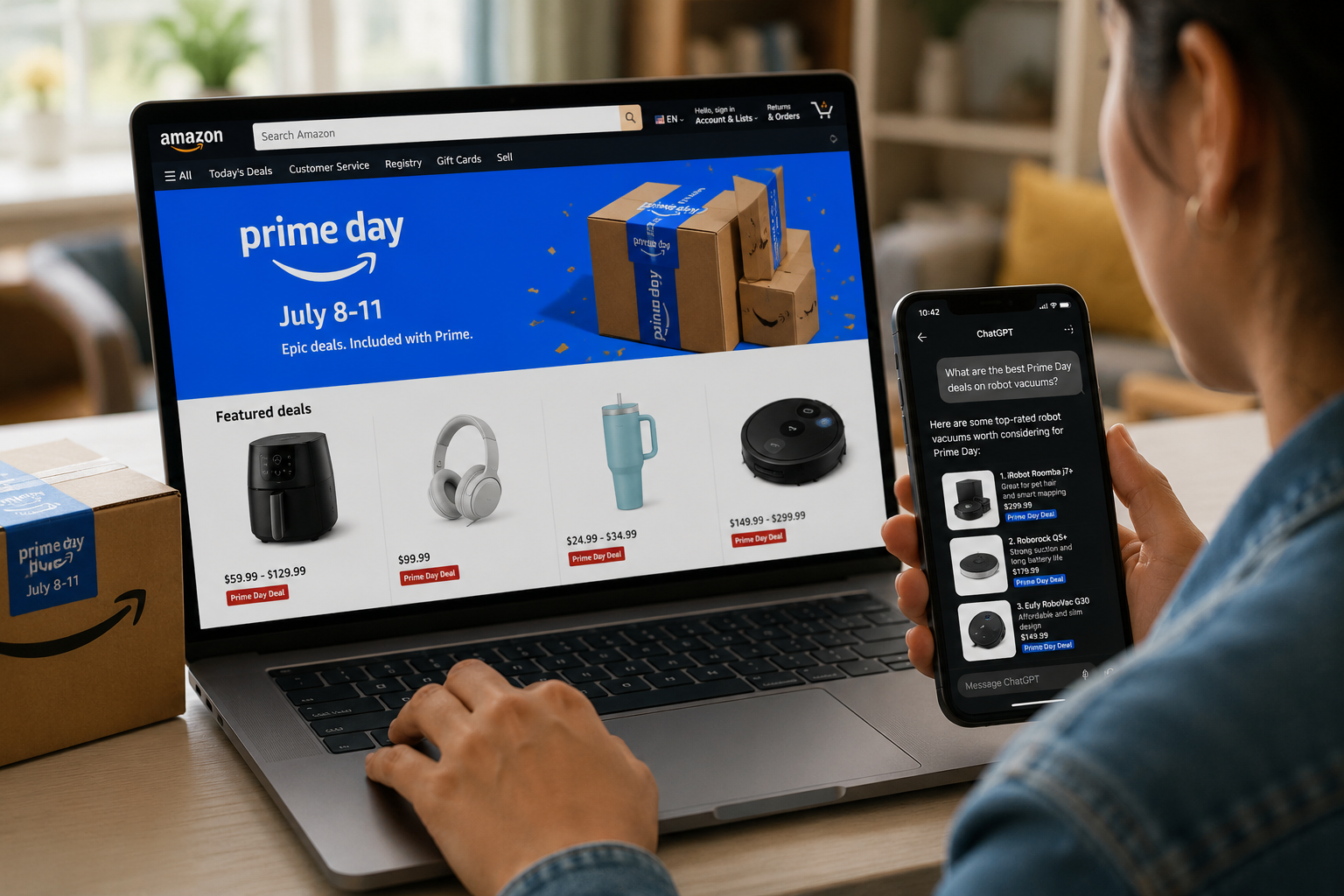
Amazon Prime Day is running early this year, Tuesday through Friday, pulled forward from its usual July slot to better line up with consumer spending around the World Cup and the 250th anniversary of American independence. The dogs of America have been warned: an influx of delivery drivers is coming. But beneath the familiar ritual of doorbuster deals and overflowing carts, something more fundamental has shifted in how people actually find what they buy during these big retail moments. They're increasingly not starting on Amazon's search bar, or Google's. They're asking an AI.
The signal from last year's event is impossible to ignore. On Prime Day 2025, Amazon's traffic from AI shopping assistants increased 3,300% year over year, and 34% of Amazon shoppers said they planned to use ChatGPT to navigate the event. That's not a fringe behavior anymore — it's a structural change in the buying journey, and it has enormous implications for any brand that sells products, whether you're on Amazon, running your own e-commerce site, or both.
This piece breaks down what's actually happening to product discovery, why AI search is rewriting the rules of a buying moment like Prime Day, and what brands need to do to be the product an AI recommends rather than the one it never mentions.
Shoppers are researching with AI before they buy
The adoption numbers across the broader market are genuinely striking. According to research from Exploding Topics (the trend platform owned by Semrush), more than three in four consumers have used AI to help with shopping or purchasing decisions in the past six months. A separate Capital One Shopping analysis found that 80% of consumers plan to use generative AI to shop in 2026, and that among shoppers already using AI, 72% use it as their primary tool to research products and brands.
Crucially, this isn't just top-of-funnel browsing. A Semrush study of over 1,000 U.S. shoppers found AI is used at every stage of the purchase decision: 51% use it during early discovery when they're still figuring out what category of product they want, 57% use it to narrow down a shortlist, and 53% use it to compare products they're already actively considering. Half of all consumers are consulting AI at the moment of decision — not just the moment of awareness. For a compressed, high-stakes window like Prime Day, where shoppers are making dozens of quick purchase calls in a few days, that decision-stage influence is exactly where deals are won or lost.
The reasons people reach for AI map perfectly onto deal-hunting. Consumers report trying AI shopping primarily to find the best price (55%), out of curiosity (46%), and for product discovery (39%). More than half say using AI makes shopping easier and reduces decision fatigue. When a shopper faces a wall of Prime Day discounts and limited time, "ChatGPT, what's the best robot vacuum under $300 on sale right now?" is a far more appealing entry point than scrolling endless listings. And it's working on behavior: AI has directly influenced roughly 69% of users to buy something they otherwise wouldn't have.
Why a buying moment like Prime Day supercharges the shift
Tentpole retail events concentrate an enormous amount of purchase intent into a short span, which makes them an accelerant for whatever discovery behavior is on the rise. That's why the AI numbers around these moments are so dramatic.
The Prime Day 2025 figure — a 3,300% jump in traffic from AI shopping assistants — is the clearest example, but the pattern repeats across every major shopping event. AI influenced just over $14 billion in online sales on Black Friday, and generative AI and AI agents together drove an estimated $262 billion in global retail revenue during the 2025 holiday season, roughly 20% of total sales. Traffic to U.S. retail sites from generative AI sources grew about 4,700% year over year per Adobe data. These aren't gentle upward trends; they're hockey-stick curves, and big buying moments are where the curve is steepest.
Amazon itself has leaned hard into this. Its in-app AI assistant, Rufus, surpassed 250 million users in 2025 — up 149% year over year — with Amazon projecting roughly $10 billion in incremental annual sales from it. So even within Amazon's own walls, a growing share of Prime Day shoppers are being guided to products by an AI rather than browsing categories the old way. The discovery layer has moved, and it's moved fastest precisely during the events that drive the most sales.
There's a competitive wrinkle here too. Amazon captured 54% of all ChatGPT-driven referral traffic in the most recent holiday period, up sharply from 40.5% the year before. For brands, that cuts two ways: if you sell on Amazon, AI discovery can funnel buyers toward your listings — but only if those listings are the ones the AI surfaces. If you sell direct, you're competing with Amazon's gravitational pull in AI answers, which makes your own AI-search visibility even more essential.
How AI decides which products to recommend
Here's the part that should reframe how brands think about all of this: in AI-mediated shopping, the primary "consumer" of your product information is increasingly a machine, not a human. An AI shopping assistant reads your product data, evaluates it, and decides whether to surface you — and it does that with zero tolerance for gaps or ambiguity. Retailers whose product feeds, schema, and pricing data aren't machine-readable simply become invisible to AI shopping agents, regardless of how good the product or the deal actually is.
Structured data has become the deciding factor. Pages with structured data are cited 3.1 times more frequently in Google AI Overviews, and analyses of AI citations found that 71% of pages cited by ChatGPT include structured data, as do 65% of pages cited by Google's AI Mode. JSON-LD Product schema — covering price, availability, attributes, and reviews — is the format AI crawlers parse most readily; researchers have observed AI search crawlers pulling structured JSON data more readily than crawling raw HTML. There's even a technical gotcha: AI systems generally don't wait for JavaScript to execute, so schema that loads dynamically via client-side JavaScript may never get parsed at all. Server-side rendering matters.
Access matters too, in a way many brands overlook. ChatGPT discovers products through its OAI-SearchBot crawler, and if your robots.txt blocks it, you're excluded from ChatGPT shopping recommendations entirely — no matter how strong your content is. (Notably, you can allow OAI-SearchBot for search visibility while still blocking GPTBot, which collects training data, so you gain discoverability without handing over free training material.) A single misconfigured line can make a brand invisible in the exact channel where a third of Prime Day shoppers are now starting.
Beyond the technical layer, description quality has overtaken keyword density as the thing that wins. The shift is from position-dependent SEO to description-quality optimization: your products and brand need to be described — on your own site and across third-party sources — in specific, contextual, needs-matching language that AI models draw on when constructing answers to precise queries. A shopper asking for "a quiet, lightweight cordless vacuum good for pet hair under $250" gets matched to products whose descriptions actually contain that specificity. Generic listings that just stack keywords give the AI nothing to match against.
Trust and verification still close the sale
One important nuance keeps the picture honest: shoppers use AI to research, but they verify before they commit, and most still want to control the actual purchase. Among consumers who discover products via AI, the overwhelming majority confirm before buying — many Google the brand immediately, others check review sites — because trust requires confirmation. And while shoppers are eager to use AI for research, they remain reluctant to hand it their wallet: the most common amount consumers would authorize an AI to spend autonomously is $0.
The practical takeaway is that AI recommendation and traditional trust signals work together, not in opposition. Getting named by an AI gets you into the consideration set; strong reviews, a credible brand presence, and consistent information across the web are what convert that mention into a sale when the shopper inevitably verifies. This is why review profiles and third-party mentions matter as much as your product schema — they're the confirmation layer that catches the shopper after the AI hands them your name. For Prime Day specifically, where buyers move fast but still want reassurance they're getting a genuine deal from a trustworthy seller, that verification infrastructure is the difference between a click and a conversion.
It's also why the payoff for getting this right is so large. AI-referred shoppers convert meaningfully higher than other traffic — some analyses put it at 31% higher, with these visitors spending 45% more time exploring products — because they arrive having already done their research and gotten a recommendation they trust. Lower volume, dramatically higher intent.
What brands should do — before the next buying moment
The work to become AI-visible is concrete, and the time to do it is ahead of a buying moment, not during one.
Get your structured data right first. Implement complete JSON-LD Product schema with price, availability, attributes, and reviews, and make sure it's server-side rendered so AI crawlers actually parse it. Confirm your product feed has high attribute completion, since a large share of AI shopping data pulls from existing retail feeds. Then check your crawler access: make sure OAI-SearchBot, PerplexityBot, and the other AI search crawlers can reach your pages, because blocking them is the fastest way to be invisible by default.
Rewrite product and brand descriptions for specificity and need-matching, not keyword stuffing — audit your product pages, your About section, your press coverage, and your review profiles for the kind of contextual language AI uses to match products to precise queries. Build and maintain the trust layer of reviews and third-party mentions that shoppers turn to when they verify an AI's recommendation. And start measuring AI as its own discovery channel: if you don't know how your brand appears in ChatGPT, Gemini, and Google's AI Overviews, you're operating blind in a channel where a large and growing share of consumers are discovering brands. Open those tools, run the queries your buyers would run for your category, and see whether your products come back.
None of this replaces your existing e-commerce SEO or your Amazon strategy — it extends them into the channel where discovery is increasingly happening. The brands that prepare their data, their descriptions, and their trust signals now are the ones AI will surface during the next Prime Day, the next Black Friday, and every ordinary Tuesday in between.
The bottom line
Prime Day moving up a month is a reminder that the calendar of retail keeps shifting — but the bigger shift is in how shoppers find what they buy when the deals go live. A third of Prime Day shoppers reached for ChatGPT last year, AI assistant traffic to Amazon jumped 3,300%, and the majority of consumers now research purchases with AI at every stage of the decision. The deals will sell themselves to the products an AI recommends; everything else competes for whatever attention is left. The question for your brand isn't whether shoppers are using AI to shop — they are. It's whether your products are built to be found when they ask.
Frequently Asked Questions
Are shoppers really using AI to find deals during events like Prime Day?
Yes, and the growth is dramatic. On Prime Day 2025, Amazon's traffic from AI shopping assistants increased 3,300% year over year, and 34% of Amazon shoppers said they planned to use ChatGPT for the event. More broadly, over three-quarters of consumers have used AI for shopping decisions in the past six months, and 80% plan to use generative AI to shop in 2026. Big buying moments concentrate purchase intent and tend to accelerate AI adoption even faster than everyday shopping.
At what point in the buying process do people use AI?
At every stage, not just early browsing. A Semrush study found 51% of consumers use AI during early discovery, 57% use it to narrow a shortlist, and 53% use it to compare products they're actively considering. Half of all surveyed shoppers consult AI at the moment of decision — which, during a time-compressed event like Prime Day, is exactly where the purchase gets made or lost.
How does an AI decide which products to recommend?
It reads and evaluates your product data, and it does so with no tolerance for gaps. The biggest factor is structured data: pages with structured data are cited 3.1x more often in Google AI Overviews, and most pages cited by ChatGPT and Google AI Mode include it. AI engines favor complete JSON-LD Product schema (price, availability, attributes, reviews), specific need-matching descriptions over keyword stuffing, and accessible pages its crawlers can actually reach. Products whose data isn't machine-readable become invisible to AI shopping assistants regardless of quality.
Could my products be invisible to AI shopping assistants without my knowing?
Easily. If your robots.txt blocks crawlers like OAI-SearchBot, you're excluded from ChatGPT shopping recommendations entirely, no matter how good your products are. If your schema loads via client-side JavaScript rather than being server-side rendered, AI crawlers may never parse it. And if your product descriptions are generic, the AI has nothing specific to match against a shopper's query. The only way to know is to test: open ChatGPT, Gemini, and Perplexity and ask for recommendations in your category.
Do people actually buy what AI recommends, or just research with it?
Both, with a verification step in between. AI has directly influenced roughly 69% of users to buy something they otherwise wouldn't have, but the overwhelming majority verify before purchasing — often Googling the brand or checking review sites — because trust requires confirmation. Most shoppers also still want to control checkout themselves; the most common amount consumers would let AI spend autonomously is $0. This is why an AI recommendation plus strong reviews and a credible brand presence convert far better than either alone.
Is optimizing for AI search different from my regular e-commerce SEO?
It builds on it rather than replacing it. Much of the foundation overlaps — clean product feeds, quality content, strong reviews — but AI search adds specific requirements: complete JSON-LD schema, server-side rendering, AI crawler access, description quality over keyword density, and a measurement framework that tracks how your brand appears in AI answers. Traditional SEO dashboards can't measure AI citations or recommendations, so AI visibility needs its own monitoring. The smartest approach runs both layers together.
When should I do this work — is it too late for this Prime Day?
The ideal time is ahead of a buying moment, because AI visibility depends on your data, descriptions, and trust signals being in place before shoppers start asking. The technical fixes (schema, crawler access, server-side rendering) can be implemented relatively quickly, while the content and trust layers compound over time. Even if you're up against a near-term event, getting the fundamentals right positions you for the next one — and there's always a next one.
When a shopper asks ChatGPT or Gemini for the best product in your category, does yours come up? Most brands have no idea — and no way to find out on their own. Ritner Digital builds the content, structured data, and domain authority that get brands found and cited across Google, ChatGPT, Perplexity, and Gemini — then we publish our own data to prove it works. Book a free strategy call → We'll run your category's real buyer queries through the AI engines, show you exactly where you stand, and give you a clear next step within one business day.