America's Lithium Boom Has a Visibility Problem — and It's a Lesson for Every B2B Brand
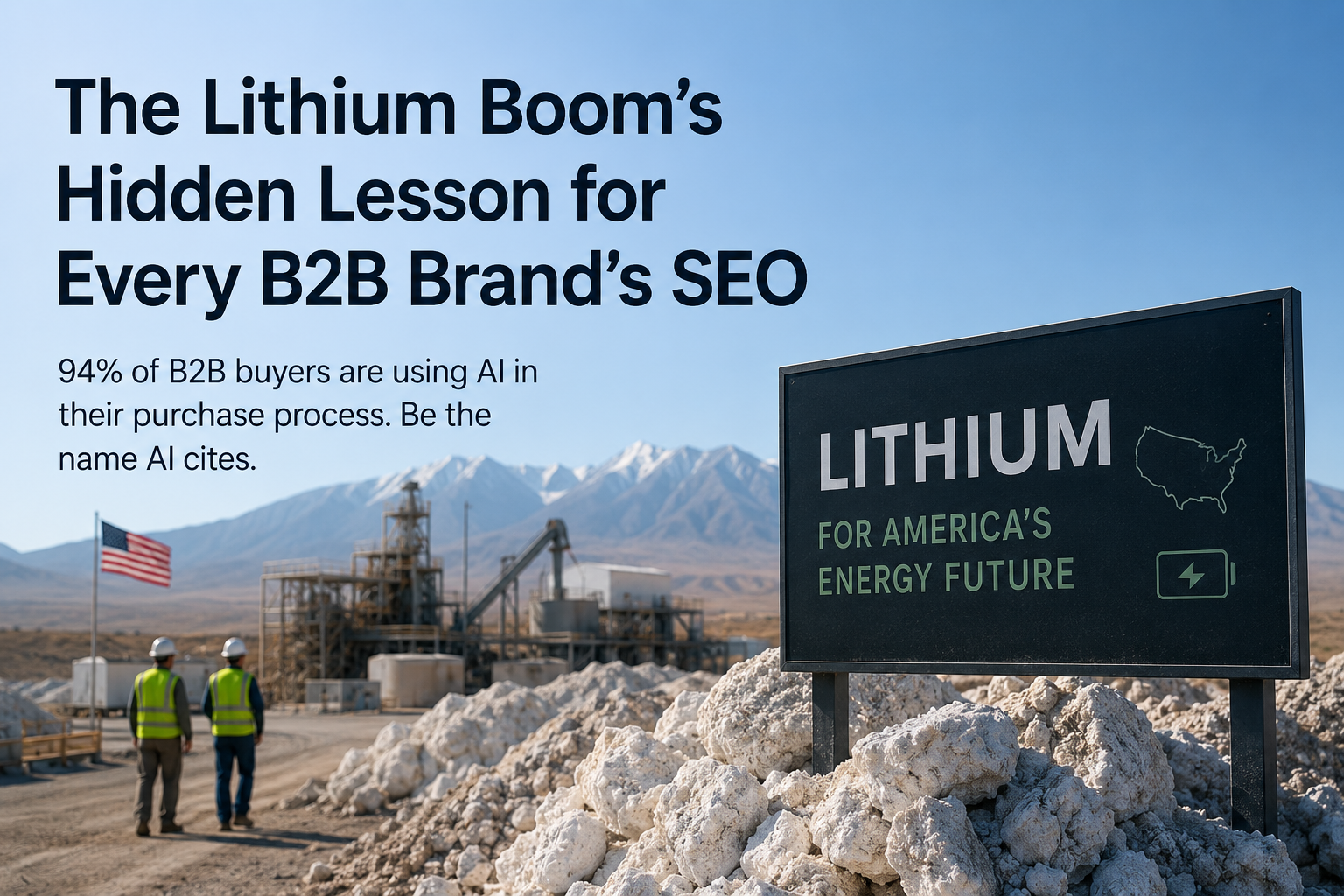
America's hottest land grab right now isn't for oil — it's for lithium. Energy giants and automakers are racing to lock up acreage in the U.S. "white gold" hotspots, new processing facilities are opening, and General Motors and other industrial heavyweights are pouring capital into domestic supply. The numbers behind the rush are real: the lithium spot price jumped roughly 180% between June 2025 and February 2026, J.P. Morgan forecasts global lithium demand growing 16% year over year in 2026, and the U.S. government has shifted from policy statements to active capital deployment, financing critical-minerals projects through the Department of Energy, Department of Defense, and a half-dozen other federal channels. As one industry analysis put it, critical minerals are becoming to the 21st century what oil was to the 20th.
That boom is minting a whole ecosystem of companies — lithium miners and processors, battery-materials firms, energy-storage and EV suppliers, cleantech and industrial players — all competing at once for capital, partnerships, talent, and customers. And here's the problem most of them haven't clocked yet: the people who decide whether these companies win business — procurement leads, design engineers, plant managers, OEM partners, institutional buyers — are increasingly doing their research not on Google or a vendor's website, but inside AI engines like ChatGPT, Perplexity, and Gemini. A surging industry is colliding with a fundamental change in how B2B discovery works, and the brands that aren't visible in AI answers are losing deals they never even knew they were in.
This piece isn't investment advice and it isn't about any single company. It's about the marketing reality underneath the boom: how B2B buying has shifted to AI-mediated research, why energy and cleantech brands are especially exposed, and what any B2B company in a fast-growing sector needs to do to be found, trusted, and cited when buyers go looking.
The B2B shortlist is now built inside AI engines
The single most important data point for any B2B marketer in 2026 comes from Forrester's Buyers' Journey Survey, which collected responses from nearly 18,000 global business buyers. It found that generative AI and conversational search are now the most meaningful source of vendor research — outranking vendor websites, product experts, and sales representatives. Twice as many buyers named AI or conversational search as their most meaningful research source compared to any other source in the study. The proportion of buyers using AI in their purchase process climbed from 89% in 2025 to 94% in 2026.
That isn't curiosity; it's the functional replacement of the search engine as the starting point of vendor due diligence. The specific use cases show how deep it runs: B2B buyers now use AI to research product information, to compare vendors against each other, and to build internal business cases before engaging any vendor at all. As Forrester's John Buten summarized the implication, the old model of driving traffic to your site to retarget and nurture prospects will be much less effective, because buyers now spend more of their journey with AI answer engines and less time engaging directly with vendors.
The software-buying data — which is the clearest public evidence and a useful leading indicator for industrial sectors — points the same way. A G2 study of more than 1,000 B2B buyers found that 71% now use AI chatbots in their vendor research, 69% said AI guidance led them to a different vendor than they'd originally planned, and roughly one in three purchased from a company they'd never heard of before a chatbot named it. Eighty-five percent of buyers think more highly of a vendor when an AI chatbot mentions it in a recommendation. The shortlist that used to be assembled through referrals, trade publications, and Google searches is now generated in a single AI prompt — and that shortlist is the new entry funnel.
Why the buying journey now starts before you see it
The structural shift here is that an entirely new phase has been inserted at the very front of the B2B buying journey. The traditional map ran Awareness → Consideration → Decision → Purchase. The 2026 map adds an AI Research Phase that precedes awareness entirely: the buyer formulates questions, asks an AI, gets a synthesized answer, and builds an initial mental model of the category and its players before they visit a single website, read a single blog post, or talk to a single salesperson.
For complex industrial and energy purchases, this is magnified by the structure of the buying group itself. Gartner pegs the typical complex B2B buying committee at six to ten stakeholders, each bringing four or five pieces of independently gathered research, and Forrester estimates that roughly 61% of the buying journey is complete before a vendor is ever contacted. So in a lithium-supply or battery-materials deal, it's not one buyer running one query — it's a design engineer, a plant lead, and a procurement contact each running their own AI searches, on their own time, building a case the vendor never sees. As one manufacturing-focused analysis put it bluntly: if you're not in those answers, you're not losing the deal — you were never in it.
This is also why website traffic has stopped being a reliable proxy for demand. Zero-click behavior, where the buyer gets their answer inside the AI interface without ever clicking through, is now a structural reality in enterprise software, consulting, and industrial sectors, and B2B companies optimizing purely around site traffic are reporting declines even as buyer activity grows. The buyers haven't disappeared; the research just moved somewhere your analytics can't fully see.
Why energy and cleantech brands are especially exposed
Several features of the energy-transition sector make AI-search visibility unusually high-stakes for the companies riding the boom.
The category is new, crowded, and confusing — which is exactly when buyers lean on AI to synthesize. A procurement team trying to understand domestic lithium processing, or a manufacturer evaluating battery-materials suppliers, faces a fast-moving landscape of unfamiliar names, competing technologies, and shifting policy. That's precisely the situation where buyers delegate the synthesis to an AI: "What are the leading domestic lithium processing companies?" or "Which U.S. battery-materials suppliers have DOE backing?" The AI returns a shortlist of a few names with pros and cons — and whoever isn't on it is invisible at the exact moment the category is being defined in the buyer's mind.
Capital and partnerships flow toward visible, credible entities. In a boom, it isn't only customers doing the research. Potential partners, OEMs evaluating supply agreements, talent weighing offers, and analysts shaping the narrative are all forming impressions through the same AI-mediated lens. Being the name an AI confidently surfaces — with a clear description of what you do and credible third-party validation behind it — functions as a form of pre-credentialing across every one of those relationships.
Specificity wins, and energy brands often hide behind vague language. AI engines reward specific, citable claims. A Princeton GEO study presented at ACM SIGKDD found that adding specific statistics, named source attribution, and direct quotes raised a page's visibility in AI answers by up to 40%. Energy and industrial companies that describe themselves in generic terms — "innovative solutions for a sustainable future" — give the AI nothing to extract. A company that states plainly what it produces, at what scale, with what cost position, backed by what partnerships and data, becomes something an AI can name with confidence for a specific query.
How AI engines decide who gets cited
Understanding the mechanism is what makes the work concrete. When a buyer types a category query into ChatGPT, Perplexity, or an enterprise AI tool, the answer is assembled largely from third-party sources the engine has indexed as authoritative — not primarily from the vendor's own homepage. A Moz analysis of 40,000 queries found that 88% of Google AI Mode citations don't appear in the organic top-10 search results, and a separate academic study found that 37% of AI-cited domains don't appear in traditional search results at all. The brands that earn placements in credible publications and industry sources are the brands the AI cites; the ones that have polished only their own owned content but earned no independent coverage are largely absent from the answers.
That points to a multi-layered reality. Earned media and third-party coverage carry enormous weight — a large share of AI brand signals come from editorial media, and community sources like Reddit and professional platforms like LinkedIn are among the most-cited. Reviews and validation on the platforms buyers trust matter, and recency matters more than volume — ten recent validations outweigh a flood of old ones. And critically, the buyer's journey through AI isn't a single step: they get a shortlist from the AI, then validate those names across Google, LinkedIn, industry forums, and analyst sources before gathering proof like case studies and ROI data. A brand needs to be present and consistent across all those surfaces, because a gap at the validation stage quietly drops you from the shortlist the AI handed the buyer moments earlier.
There's also a technical floor beneath all of this. AI engines need to be able to crawl and parse your content — accessible pages, machine-readable specs and data, structured schema, and ungated content all determine whether the engine can even consider you. For industrial companies that historically gated their most useful technical content behind forms, this is a meaningful shift: content an AI can't reach is content that can't earn a citation.
What B2B brands in any boom sector should do
The encouraging part is that none of this requires reinventing your marketing — it requires extending it deliberately into the channel where discovery now happens. A few priorities matter most.
Treat SEO and AI search as one unified program, not two competing workstreams. The signals that win AI recommendations overlap substantially with the fundamentals Google rewards — technical accessibility, genuine expertise, quality content, structured data — and running them together lets both compound. As even Google's own search advocates have noted, there's no meaningful AI-search optimization without solid SEO fundamentals underneath. But stopping at SEO leaves the larger share of AI-visibility drivers on the table.
Publish specific, data-rich content that answers the exact questions buyers ask their AI. Generic thought leadership ("trends shaping the energy transition in 2026") doesn't earn citations because it doesn't answer a concrete question. Specific content — real cost ranges, real timelines, real capacity figures, real comparisons backed by data — earns citations because it gives the AI something authoritative and extractable to quote. The test is simple: would a buyer read this and get an answer they couldn't easily find elsewhere?
Earn third-party coverage and build credible entity signals, because that's where most AI citations actually come from. Pair that with active management of reviews and validation on the platforms your buyers trust, keeping them recent. Clarify your brand as a defined entity — consistent name, description, and narrative everywhere the AI crawls — so the engine can confidently identify who you are and what you do.
And measure AI as its own channel. Run a fixed set of buyer-realistic prompts — category questions, comparison questions, requirement and compliance questions — across ChatGPT, Perplexity, and Google's AI Overviews on a regular schedule, and record which companies get named and which sources get cited versus your competitors. If you don't know how you appear in those answers, you're operating blind in the channel that now carries the majority of the upstream funnel.
The bottom line
The lithium rush is a vivid reminder that booms create crowds, and crowds create a visibility problem. Demand for domestic critical minerals, energy storage, and the whole transition supply chain is climbing fast — but rising demand doesn't automatically flow to your company. It flows to the brands that show up when a procurement lead, an engineer, or an OEM partner asks an AI to name the players worth considering. With 94% of B2B buyers now using AI in their purchase process and most of the decision made before a vendor is ever contacted, the question for any company riding a boom — in energy, cleantech, or anywhere else — isn't whether your buyers are researching with AI. It's whether your brand is one of the names that comes back when they do.
Frequently Asked Questions
Are B2B buyers really using AI to research vendors, or is that overstated?
It's well-documented across multiple large studies. Forrester's 2026 Buyers' Journey Survey of nearly 18,000 global business buyers found generative AI and conversational search are now the most meaningful source of vendor research — outranking vendor websites, product experts, and sales reps — with 94% of buyers using AI in their purchase process. A G2 study of over 1,000 buyers found 71% use AI chatbots in vendor research. The figures vary by sector and skew higher among technology buyers and younger committee members, but the direction is consistent and hard to argue with.
Why does this matter specifically for energy, lithium, and cleantech companies?
Because the category is new, crowded, and fast-moving — exactly the conditions under which buyers lean on AI to synthesize an unfamiliar landscape into a shortlist. Procurement teams, engineers, and OEM partners researching domestic lithium processing or battery-materials suppliers are asking AI to name the credible players. In a boom, partners, talent, and analysts form impressions the same way. A brand that isn't surfaced in those answers is invisible at the precise moment the category — and the buyer's mental shortlist — is being defined.
How is this different from regular SEO?
It overlaps but extends beyond it. Roughly 40% of what wins AI visibility is shared SEO fundamentals — technical accessibility, expertise, quality content, schema. The rest comes from things SEO alone doesn't fully cover: earned third-party coverage (where most AI citations originate), entity clarity in knowledge graphs, passage-level content structured for AI extraction, consistent brand presence across the platforms AI crawls, and active recent reviews. The smartest approach runs SEO and AI search as a single program so the signals compound in both channels.
How do AI engines decide which companies to cite?
Largely from authoritative third-party sources, not the vendor's own homepage. A Moz analysis found 88% of Google AI Mode citations don't appear in the organic top 10, and research shows a significant share of AI-cited domains don't appear in traditional search at all. Engines favor specific, data-backed claims (a Princeton study found stats, named sources, and quotes can lift visibility up to 40%), credible earned media, recent reviews, and content they can actually crawl and parse. Brands with polished owned content but no independent coverage tend to be invisible in the answers.
We get less website traffic now. Does that mean demand is falling?
Not necessarily — and this is a common trap. Zero-click behavior, where buyers get their answer inside the AI interface without clicking through, is now structural in industrial and enterprise sectors. Forrester estimates around 61% of the B2B buying journey is complete before a vendor is contacted. So buyers can be deep into researching and shortlisting you while your traffic dashboard shows a decline. The activity moved to a channel your analytics can't fully see, which is exactly why measuring AI visibility directly matters.
What's the first thing a B2B brand should do?
Find out where you actually stand. Run 10–15 buyer-realistic prompts — category, comparison, requirement, and compliance questions — across ChatGPT, Perplexity, and Google's AI Overviews, and record which companies get named and which sources get cited versus your competitors. That tells you whether you're present, partially visible, or absent, and which gaps to close first. Technical fixes like crawler access and machine-readability can land quickly; earning coverage and building entity and proof signals compound over months.
Is optimizing for AI search a quick fix or a long-term effort?
Both, in layers. The technical foundation — crawler access, structured data, machine-readable specs — can be fixed in days and removes the barriers that make you invisible by default. But the durable drivers of AI visibility — earned media, entity authority, a body of specific citable content, and recent validation — compound over months, much like SEO authority. The brands that start building now widen their lead as the boom matures and AI reinforces the names it already recognizes.
When a buyer asks ChatGPT or Perplexity to name the leading companies in your space, does yours come up?Most B2B brands have no idea — and no way to find out on their own. Ritner Digital builds the authority, content, and domain trust that get B2B and industrial brands found and cited across Google, ChatGPT, Perplexity, and Gemini — then we publish our own data to prove it works. Book a free strategy call → We'll run your category's real buyer prompts through the AI engines, show you exactly where you stand against competitors, and give you a clear next step within one business day.