Rebranding Without Losing Rankings
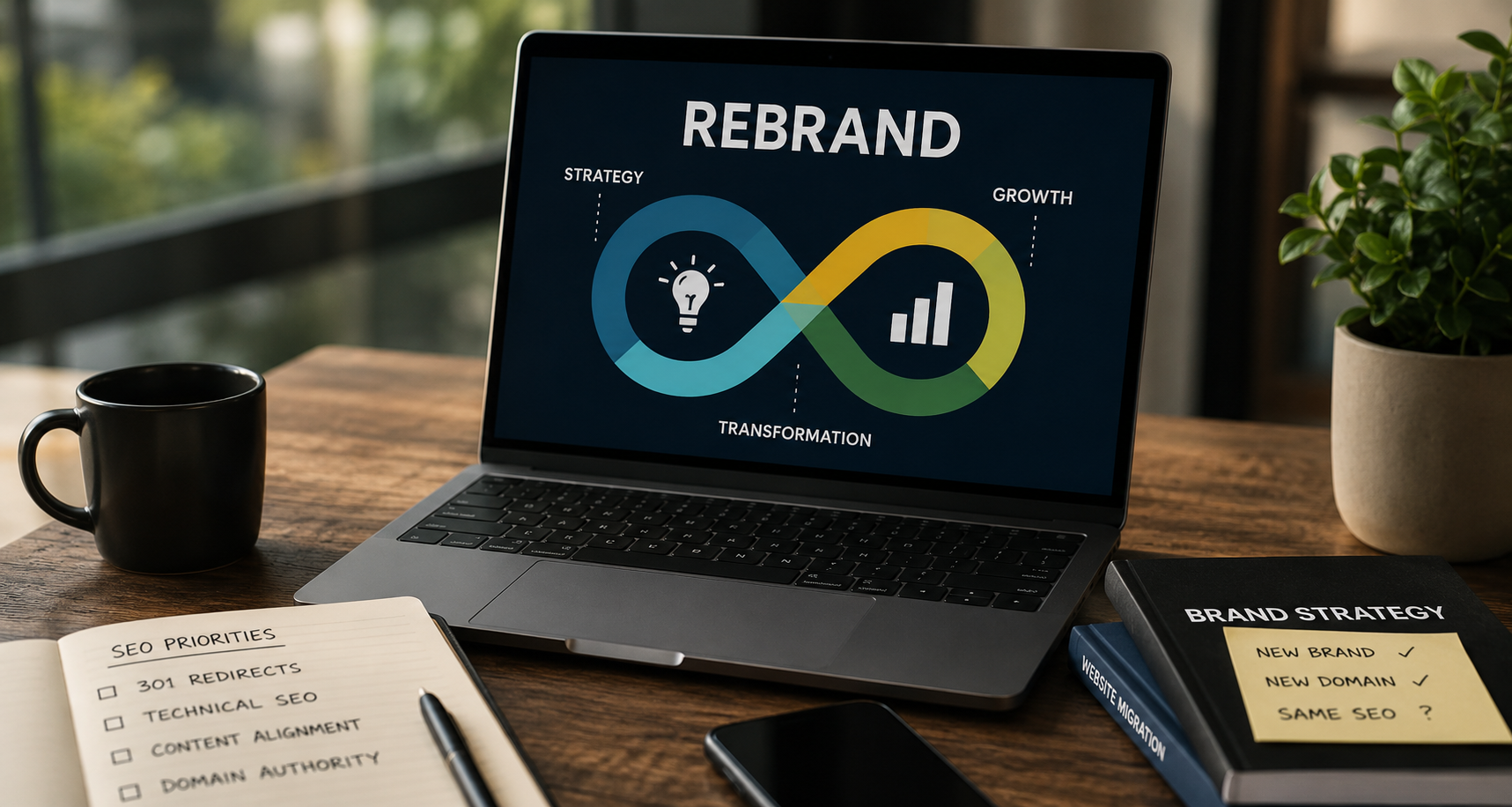
A rebrand is one of the highest-stakes events in a company's digital history. Done well, it's an opportunity — new positioning, new domain authority trajectory, new content strategy aligned with who the company actually is. Done poorly, it's a self-inflicted traffic wound that takes years to heal, compounding the difficulty of an already demanding business transition.
The SEO risk in a rebrand isn't theoretical. Domain changes, brand name changes, and URL restructuring all trigger the same fundamental search engine recalculation that platform migrations trigger — except rebrands often happen alongside content changes, positioning changes, and audience targeting changes that multiply the variables and make diagnosing post-rebrand ranking losses significantly more complex.
This piece covers every SEO consideration that matters when a brand name, domain, or both are changing — in the order they need to be addressed.
Understanding What's Actually Changing
Before any SEO work begins, the scope of what's changing needs to be precisely defined. Rebrands exist on a spectrum, and the SEO implications vary significantly depending on where on that spectrum the change falls.
Name change only, same domain. The company name changes but the domain stays the same. From an SEO perspective, this is the lowest-risk scenario. The domain's authority, backlink profile, and content rankings are preserved. The primary SEO work is updating brand mentions in on-site content, updating structured data that references the brand name, and managing the external brand mention transition so that the old name and new name are clearly connected in the web's understanding of the entity.
Domain change, same brand positioning. The company keeps its name or moves to a closely related name but changes the domain — typically moving from a less desirable TLD to .com, from a hyphenated domain to a clean one, or from a legacy domain that no longer fits the brand. This is a full domain migration — one of the most technically demanding SEO events — with the complexity that the new domain starts with zero authority and the old domain's authority needs to be transferred as completely as possible through redirects.
Full rebrand — name change and domain change. The highest-risk scenario. Everything is changing simultaneously — brand name, domain, potentially URL structure, potentially content positioning. The SEO challenge is preserving the authority built on the old domain while establishing the new domain as the successor entity as quickly as possible. This scenario requires the most comprehensive technical execution and the longest recovery timeline.
Partial rebrand — product line or subsidiary rename. A subset of the site changes while the rest remains. This is more surgical than a full rebrand but introduces its own complexity — ensuring the rebranded section is cleanly distinguished from the unchanged section while preserving the authority connections between them.
Defining the scope precisely before beginning any technical work determines which of these playbooks applies — and confusing them produces the wrong execution.
Phase One: Pre-Rebrand Audit
Current Authority Inventory
Before changing anything, document everything that has value.
Pull a complete backlink profile from Ahrefs or Semrush. Export every referring domain, every linking page URL, every anchor text. This is the authority inventory — the record of what's been built that needs to be preserved or transferred through the rebrand. The total referring domain count and the distribution of those domains across the site's URL structure tells you where the authority is concentrated and which URLs are most critical to handle correctly in the transition.
Pull organic keyword rankings for every page on the current domain. Export from Semrush, Ahrefs, or Search Console. This ranking inventory is the benchmark that post-rebrand performance will be measured against — and it identifies which pages are generating the most search value, which need the most careful handling in the transition, and which can be safely deprioritized.
Pull organic traffic data from Google Analytics by landing page for the past six and twelve months. This traffic inventory identifies which pages are actually converting organic visitors — which matters more than raw ranking data, because pages that rank but don't convert are lower priority to protect than pages that rank and drive meaningful business outcomes.
Brand Entity Documentation
Document how the current brand is understood as an entity across the web. Search for the current brand name in Google and note what appears in the knowledge panel, in the People Also Ask results, and in the top organic results. Check the brand's entity representation in Google's Knowledge Graph using the Knowledge Graph API or a third-party tool. Note what Wikipedia, Wikidata, Crunchbase, LinkedIn, and other structured databases say about the current brand.
This entity documentation matters because a rebrand doesn't just change URLs — it changes how AI systems and search engines understand the company as an entity. The transition from old entity to new entity needs to be managed explicitly, not just assumed to happen automatically when the domain changes.
Existing Structured Data Audit
Export and document all structured data currently implemented on the site. Organization schema referencing the current brand name, logo, and domain. Author schema connected to current employee profiles. Product schema if applicable. LocalBusiness schema for location-specific pages. All of this structured data needs to be updated to reflect the new brand identity — and failing to update it creates entity confusion that persists in AI systems and search engines long after the visual rebrand is complete.
Phase Two: New Domain and Brand Setup
Domain Selection and Authority Assessment
If the rebrand involves a domain change, the new domain's starting authority matters. A brandable new domain with zero history starts from scratch — whatever authority the old domain has built needs to be transferred through redirects. A domain with prior history — even one that hasn't been actively used — brings whatever authority or penalty baggage it accumulated previously.
Before registering or purchasing a new domain, check it in Ahrefs and Semrush for prior backlink history, prior organic rankings, and any penalty history in Search Console if the domain was previously registered. A domain with a toxic backlink profile from prior use is worse than starting from zero. A domain with a small amount of legitimate historical authority is a minor advantage.
Establish the New Domain's Infrastructure Before Going Live
Before any redirect or public announcement of the rebrand, the new domain needs its full technical infrastructure in place — hosting configured, SSL active, Shopify or CMS platform set up, Search Console property created, Analytics connected. Launching a rebrand to a domain that isn't technically ready creates a window where the old domain is redirecting traffic to a destination that isn't properly configured.
Verify the New Domain Is Not Pre-Indexed
If the new domain was set up in advance for development purposes, verify that staging or development content on the new domain hasn't been indexed by Google before launch. A pre-indexed staging version of the new site creates duplicate content issues at launch that complicate the clean establishment of the new domain as the canonical brand destination.
Phase Three: Redirect Strategy
The redirect strategy is the single most important technical decision in a rebrand involving a domain change. It determines how much of the old domain's authority transfers to the new domain — and how quickly that transfer happens.
Redirect Architecture
The correct redirect architecture for a full domain change is a 301 redirect from every URL on the old domain to the equivalent URL on the new domain. Not a redirect from every old URL to the new homepage. Not a redirect from every old URL to the closest category equivalent. A redirect from each old URL to the page on the new domain that contains the equivalent content.
Homepage to homepage. About to about. Product page to the same product page on the new domain. Blog post to the same blog post on the new domain.
The reason for URL-to-URL redirects rather than blanket redirects to the homepage is link equity specificity. A backlink to a specific blog post on the old domain represents a vote for that specific content. A 301 redirect from that blog post URL to the new domain homepage passes the link equity to the homepage rather than to the equivalent content page — diluting its impact on the content's rankings rather than transferring it cleanly.
Building the Redirect Map
Build the redirect map as a complete spreadsheet before implementing any redirects. Every URL on the old domain maps to its equivalent on the new domain. Where equivalent URLs don't exist — content that isn't being migrated, pages that are being consolidated or discontinued — map to the closest thematic equivalent rather than to a 404 or the homepage.
For rebrands involving URL structure changes in addition to domain changes — which is common when a new domain has a different CMS or content architecture — the redirect map needs to account for both the domain change and the URL structure change simultaneously.
Redirect Implementation Timing
Redirects should go live simultaneously with the new domain launch — not before, not after. Implementing redirects before the new domain is ready sends traffic and authority signals to a destination that isn't prepared to receive them. Implementing redirects after launch creates a window where old domain URLs are returning 404s on the new domain rather than redirecting correctly.
The redirect implementation should be tested in staging before going live — every redirect in the map should be verified for correct destination, correct redirect type (301 not 302), and absence of redirect chains or loops.
Phase Four: Brand Name and Entity Transition
On-Site Brand Reference Updates
Every reference to the old brand name in on-site content needs to be updated to the new brand name — not just in navigation and footers, but in body copy, image alt text, internal link anchor text, page titles, meta descriptions, and structured data. For large content libraries, this is a find-and-replace operation at scale — but it needs to be executed carefully because some references to the old brand name are intentional and should be preserved (history sections, "formerly known as" references that aid entity recognition during the transition period).
Structured Data Updates
Update every piece of structured data that references the old brand name or old domain. Organization schema on the homepage is the highest priority — update the name, url, logo, sameAs, and contactPoint properties to reflect the new brand. Author schema connected to employee profiles. LocalBusiness schema for any location pages. Product schema that references the brand as manufacturer or brand property.
The sameAs property in Organization schema is particularly important for rebrand entity transitions — using sameAs to link the new brand entity to the old brand's Wikipedia page, Wikidata entry, or other authoritative representations of the old entity helps AI systems and search engines understand that the new entity is the same organization under a new name.
Google Business Profile Update
Update the Google Business Profile to reflect the new brand name immediately when the rebrand goes public. GBP name changes require Google verification — the process can take days to weeks and should be initiated as early in the rebrand launch process as possible. Don't wait until after the website rebrand is live to initiate the GBP name change — the gap between a rebranded website and an unrebranded GBP creates entity inconsistency that confuses both search engines and potential customers.
Social Profile Updates
Update every social media profile to reflect the new brand name simultaneously with the website rebrand. LinkedIn company page, Twitter/X, Facebook, Instagram, YouTube — all should reflect the new brand at launch. Social profiles are part of the entity signal ecosystem that search engines and AI systems use to understand brand identity — inconsistent brand representation across platforms creates entity confusion that delays the search engine's recognition of the new brand as the authoritative successor to the old one.
Wikipedia and Wikidata Updates
If the old brand has a Wikipedia page or Wikidata entry — and any brand of meaningful scale should have at minimum a Wikidata entry — update these entries to reflect the new brand name, new domain, and the relationship between old and new brand. This is one of the highest-leverage entity transition actions available because Wikipedia and Wikidata are among the most authoritative sources that AI systems and search engines use to understand brand entities.
Phase Five: Authority Transfer and Link Building
Notify High-Value Linking Sites
The 301 redirect from the old domain to the new domain passes link equity — but imperfectly. Each redirect hop loses some fraction of the link value that direct links carry. The most valuable backlinks pointing to the old domain — those from the highest-authority referring domains — are worth the effort of direct outreach to update the link to point to the new domain rather than relying on the redirect.
Prioritize outreach to the top 20 to 50 referring domains by authority. Reach out to the editorial contact for each linking site, explain the rebrand, and request that they update the link to point to the new domain directly. This direct link update recovers the full link equity rather than the fraction that passes through the redirect — and it's the single highest-value link building activity available during a rebrand.
Press Coverage of the Rebrand
The rebrand announcement itself is an opportunity to earn new backlinks from authoritative sources. A well-executed PR program around the rebrand — with a compelling story about why the company is rebranding, what it means for customers, and what the new brand represents — generates press coverage that creates new backlinks to the new domain. These new links are not just authority signals — they're entity signals that explicitly connect the new brand name and new domain in authoritative external sources, which accelerates search engine recognition of the new entity.
Update Internal Brand Citations
Any content that references the company in the third person — case studies, press pages, about content — should be updated to use the new brand name consistently. Old brand name references that remain in on-site content after the rebrand create entity confusion and may trigger AI systems to associate some content with the old entity rather than the new one.
Phase Six: Search Console Property Management
Create a New Search Console Property for the New Domain
The new domain needs its own Search Console property — it doesn't inherit the old domain's property or its historical data. Create the property, verify ownership, and submit the new sitemap immediately at launch.
Use the Change of Address Tool for Domain Changes
Google Search Console provides a Change of Address tool specifically for domain migrations — it signals to Google that the old domain is being permanently replaced by the new domain and should accelerate the authority transfer process. The Change of Address tool is in the old domain's Search Console property and requires that the new domain's property is already created and verified before the tool can be used.
Use the Change of Address tool immediately after launch — not before, because it signals to Google that the migration is complete and Google should begin treating the new domain as the canonical brand destination.
Monitor Both Properties During Transition
For the six months following a domain rebrand, monitor both the old domain's Search Console property and the new domain's property in parallel. The old domain's property will show declining impressions and clicks as authority transfers — this is expected and healthy. The new domain's property should show increasing impressions and clicks on an accelerating trajectory. A new domain that isn't gaining impressions and clicks in Search Console within four to six weeks of launch indicates that the authority transfer isn't proceeding as expected and needs investigation.
Phase Seven: Post-Rebrand Monitoring
Ranking Recovery Timeline
A clean domain rebrand — complete redirects, Change of Address tool used, structured data updated, entity signals consistent across platforms — typically produces a recovery trajectory where the new domain returns to approximately pre-rebrand organic traffic levels within three to six months. The first month typically shows significant traffic decline as Google recrawls and reprocesses the old domain's content in its new location. The second and third months typically show traffic gradually recovering as the new domain accumulates authority. By month four to six, a well-executed rebrand should be approaching pre-rebrand traffic levels.
Rebrands that were executed poorly — incomplete redirects, entity inconsistency across platforms, Change of Address tool not used — can take twelve to eighteen months or longer to recover, and may never fully recover if high-value backlinks were orphaned by missing redirects.
AI Search Entity Recognition
AI search systems take longer to recognize and accurately represent a rebranded entity than traditional search engines. Parametric memory in AI models is built during training cycles — a new brand name and new domain may not be represented in AI model knowledge until the next training cycle incorporates the updated web content.
During the transition period, AI systems may continue to reference the old brand name or may be confused about the relationship between old and new entities. The mitigation is building as much explicit entity connection as possible in the sources AI systems draw from — Wikipedia, Wikidata, authoritative press coverage, structured database entries — so that the next training cycle incorporates a clear and consistent picture of the new brand as the successor entity.
Monitor AI search visibility for both the old brand name and the new brand name during the transition period. The old name should gradually decline in AI citation frequency while the new name increases — a healthy transition signal. If the new name isn't gaining AI citation frequency within six months of the rebrand, the entity signals connecting old and new brand aren't strong enough and need reinforcement.
The Mistakes That Cost Rankings
Blanket redirecting to the homepage. Every URL that had value — rankings, backlinks, organic traffic — should redirect to its URL-level equivalent on the new domain. Homepage blanket redirects destroy URL-level authority and produce ranking losses on every page except the homepage.
Not using the Search Console Change of Address tool. This tool exists specifically for domain migrations and meaningfully accelerates Google's recognition of the new domain as the authoritative successor. Not using it leaves the authority transfer to happen through organic recrawling alone — which takes longer and transfers less efficiently.
Updating the website before updating external profiles. Entity inconsistency between the new brand name on the website and the old brand name on GBP, LinkedIn, and social profiles creates a period of entity confusion that delays search engine recognition of the new brand. Update everything simultaneously.
Missing the structured data updates. Organization schema, author schema, and other structured data referencing the old brand name persist as entity signals that conflict with the new brand name. Update structured data on launch day, not as a post-launch cleanup task.
Forgetting to outreach to high-value linking sites. The redirect passes equity but not perfectly. Direct link updates from high-authority referring domains recover the full link value — and the rebrand announcement is the natural moment to make that outreach.
Not monitoring Search Console for both domains during transition. Missing the signals of an authority transfer that isn't proceeding as expected delays diagnosis and correction of problems that are much cheaper to fix early than late.
Ritner Digital manages rebranding SEO strategy for companies navigating name changes, domain migrations, and full brand identity transitions — with a technical execution framework built around protecting the authority that took years to build. If you're planning a rebrand and want to understand the SEO implications before you commit to the timeline, start here.
Frequently Asked Questions
How much organic traffic should we expect to lose during a rebrand?
A well-executed rebrand with complete redirects, correct structured data updates, Search Console Change of Address tool used, and consistent entity signals across platforms should produce a temporary traffic decline of 20 to 40 percent in the first four to eight weeks — followed by a recovery trajectory that returns to pre-rebrand levels within three to six months. The traffic decline is normal and reflects the time Google needs to recrawl the old domain's content in its new location and transfer authority signals to the new domain. Rebrands that lose more than 50 percent of organic traffic and don't begin recovering within eight weeks typically have specific technical problems — incomplete redirects, missing Change of Address tool submission, entity inconsistency — rather than normal migration volatility. The difference between a rebrand that recovers in three months and one that takes eighteen months is almost entirely in the technical execution quality.
Should we announce the rebrand publicly before or after the technical SEO work is done?
After — and simultaneously with the technical launch, not before it. A public rebrand announcement before the technical work is complete creates a window where press coverage, social sharing, and partner notifications are generating links and mentions for the new brand name and potentially the new domain before the redirect infrastructure is in place to capture the authority those links represent. The ideal sequence is: complete all technical work including redirects, structured data updates, new domain setup, and Search Console configuration; launch everything simultaneously; then announce the rebrand publicly. The press coverage and social momentum that follows the announcement then lands on a technically prepared destination that captures the full SEO value of that earned attention.
Can we keep the old domain active for a period after the rebrand to avoid losing traffic?
Keeping the old domain active while the new domain is also live creates a duplicate content problem — two domains with identical or near-identical content competing for the same rankings. The correct approach is to keep the old domain active only as a redirect source — serving 301 redirects to the new domain for every URL, with no original content being served at the old domain. The old domain should not have its own homepage, its own content, or its own navigation after the rebrand launch. It exists solely as a redirect infrastructure to transfer traffic and authority to the new domain. How long to maintain the old domain as a redirect source is a practical question — minimally one to two years to capture any residual direct traffic, inbound links, and bookmarks — but there's no SEO benefit to ever reverting it to serving original content.
How does a rebrand affect our Google Business Profile rankings?
GBP rankings are separate from organic website rankings and are governed by different signals — proximity, relevance, and prominence in the local ecosystem rather than domain authority and backlinks. A rebrand that changes the business name requires updating the GBP name, which triggers Google's verification process and can temporarily affect local pack visibility during the verification period. The GBP's accumulated review history, photo library, post history, and Q&A content are preserved through a name change — you don't lose the social proof infrastructure you've built. The primary risk is the verification delay and the entity inconsistency window between when the website rebrand goes live and when the GBP name change is verified. Initiating the GBP name change process simultaneously with the website launch minimizes this window.
Do we need to notify our backlink sources about the rebrand or will the redirects handle it?
Redirects handle the authority transfer automatically — you don't need to notify anyone for the basic SEO mechanics to work. The reason to proactively notify high-value backlink sources is that 301 redirects pass link equity imperfectly — each redirect hop loses some fraction of the link value that a direct link carries. For your top 20 to 50 referring domains by authority, the SEO value of updating the link to point directly to the new domain rather than passing through the redirect is worth the outreach effort. Beyond the SEO mechanics, the rebrand announcement is also a natural relationship touchpoint with media contacts, partners, and industry peers who link to your site — notifying them of the rebrand, explaining the story behind it, and asking them to update their link serves both relationship and SEO goals simultaneously.
How long should we keep the old domain's Search Console property active after the rebrand?
Keep the old domain's Search Console property active for at least twelve months after the rebrand launch — longer if the old domain was significant enough that monitoring its crawl and indexation status provides meaningful intelligence about the authority transfer. The old domain's property will show declining impressions and clicks over time as authority transfers to the new domain — this declining trend is the expected healthy signal and doesn't require intervention. What does require intervention is if the old domain's Search Console property shows crawl errors or indexation issues that indicate Google is having trouble processing the redirects — which needs to be diagnosed and corrected even months after the rebrand launch. The new domain's property is the primary focus, but the old domain's property remains a useful diagnostic tool throughout the transition period.
What happens to our AI search visibility during a rebrand?
AI search visibility during a rebrand is one of the most underappreciated risks of the transition. AI systems — particularly in their parametric memory mode — may continue referencing the old brand name for months after the rebrand because their training data hasn't yet incorporated the new entity information. Search-enabled AI responses are faster to update because they retrieve current web content, but they require the new domain and new brand name to have accumulated sufficient authority signals before AI systems will cite them confidently. The practical implication is that AI search visibility should be monitored for both the old and new brand names throughout the transition — and that building strong entity signals for the new brand as quickly as possible (Wikipedia updates, press coverage with the new brand name, Wikidata entry, Crunchbase update) accelerates AI recognition of the new entity. Expect a period of three to nine months where AI systems are transitioning between old and new entity representations, with the speed of that transition determined by how quickly authoritative external sources reflect the new brand identity.
Is a partial rebrand — changing only the product name or a subsidiary name — less risky than a full company rebrand?
Generally yes, but with specific risks that are unique to partial rebrands rather than just smaller versions of full rebrand risks. The primary risk in a partial rebrand is creating entity confusion within a single domain — where part of the site reflects the old naming and part reflects the new naming, creating inconsistent signals about what the company and its products are called. Search engines and AI systems building entity understanding from the site's content may receive conflicting signals if the transition isn't handled cleanly. The mitigation is treating the partial rebrand as a surgical content update — updating all references to the changed entity consistently across the relevant section of the site, updating structured data for the affected pages, and ensuring navigation and internal linking reflect the new naming — rather than a gradual transition that leaves the site in an inconsistent state for an extended period.
Ritner Digital manages rebranding SEO for companies navigating name changes, domain migrations, and brand identity transitions — with technical execution built around protecting what you've built while establishing the new brand as quickly as possible. If you're planning a rebrand and want to understand the SEO implications before you commit, start here.