Ritner Digital Just Hit 1,000 Facebook Followers — Here's the Full Breakdown
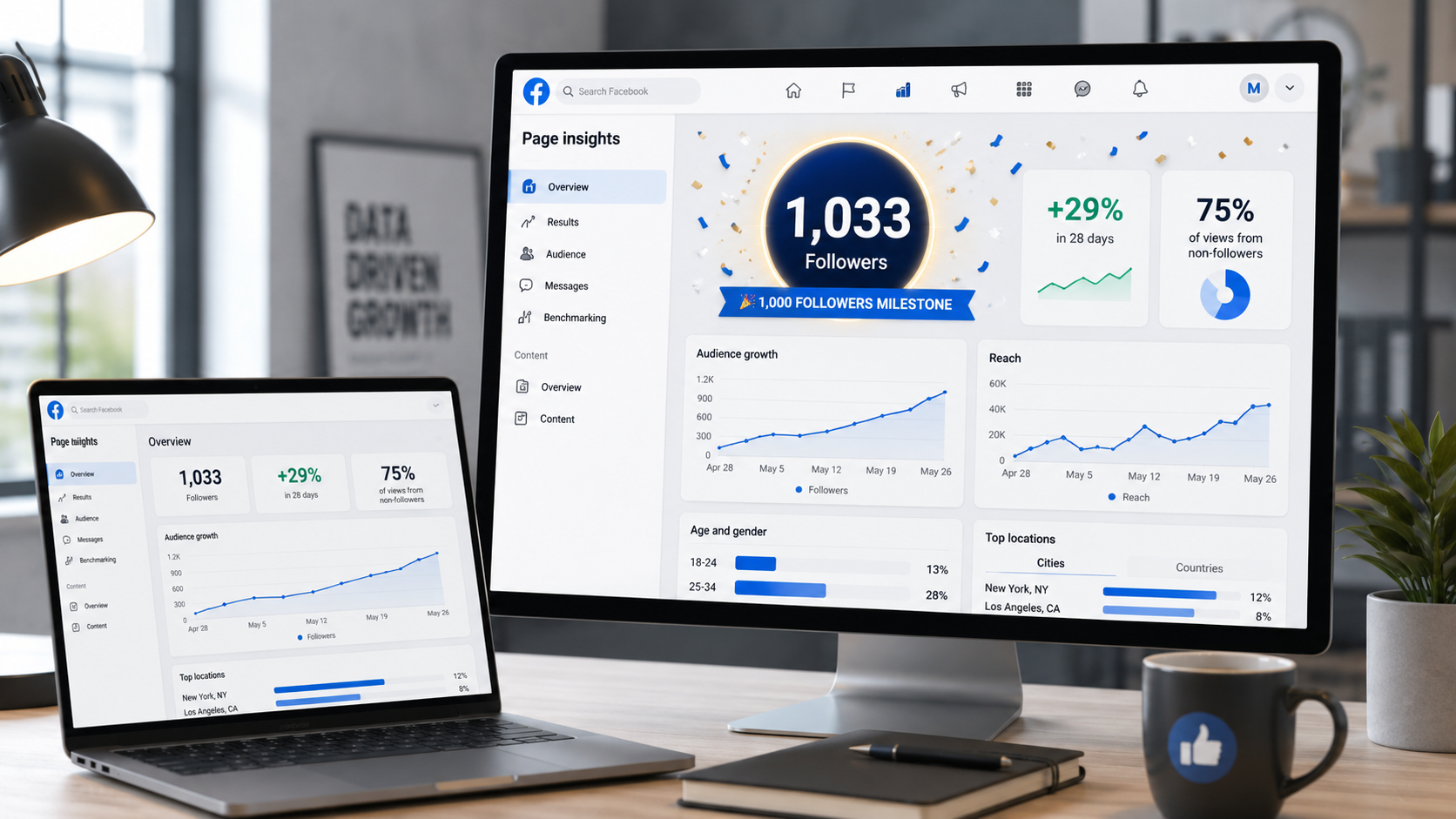
This week, Ritner Digital's Facebook page crossed 1,000 followers — 1,033 as of this writing, up 29.3% in the last 28 days alone.
For a solo South Jersey practice that treats Facebook as one spoke of the wheel rather than the whole vehicle, we'll take it. 🎉
But we're not going to write the standard milestone post — the one with the confetti graphic and the "thank you to our amazing community" and zero actual information. We're a marketing practice that has built its entire content brand on showing the receipts: we've published our real pricing, our diagnostic playbooks, and the questions that would expose us if we were bad at this. So the milestone post gets the same treatment.
Below is the full analytics breakdown of who this audience actually is, how they found us, what they engage with — and an honest read of what these numbers do and don't mean. Consider it half announcement, half media kit, and half free lesson in how to read your own page insights (yes, that's three halves; growth math is like that).
The Numbers at a Glance
Straight from the professional dashboard, last 28 days unless noted:
Total followers: 1,033 (+29.3% from the previous 28 days)
Page visits: 450 (+44.2%)
Engagement: 72 interactions (+53.2%)
Views from non-followers: 75.7% — three-quarters of our reach is people who haven't followed us yet
How people find our content:
Reels: 65.6%
Directly on our Page: 21.6%
Feed: 10.1%
Other: 2.7%
What content earns the engagement:
Link posts: 66.6% of engagement
Reels: 22.2%
Photos: 11.1%
Who the audience is (lifetime):
Core age band: 35–44 years old — 65.5% of the audience, with 25–34 next at 12.1%
Geography: United States 62.8%, United Kingdom 6%, with the remainder international
In other words: the demographic heart of this page is the exact person we build for — the 35-to-44-year-old owner-operator making the marketing decisions at a small business
Some Context Before You Shrug at Those Numbers: Organic Facebook in 2026 Is Brutal
A thousand followers and double-digit weekly engagement might sound modest if your mental benchmark was set in 2014. So before the honest read, here's what the playing field actually looks like now, per published industry data:
Organic reach has collapsed across the platform. Per Deep Marketing's 2026 platform-by-platform analysis, average organic engagement on Facebook business pages sits around 2.2% — down from 5.2% in 2020 and roughly 16% in the early 2010s, an 86% decline over twelve years. This is deliberate platform design, not anyone's failing: free commercial reach is being steadily converted into ad inventory.
The median post barely reaches anyone. Apaya's 2026 Facebook benchmark analysis puts the median post reach at 365 people across all pages — and just 21 people for small pages. Twenty-one. That's the honest baseline for a page our size.
The only format still growing is Reels — industry tracking has organic post reach falling double digits year over year while Reels reach grew — which is why our discovery mix (65.6% Reels) isn't a quirk, it's survival.
Now re-read our numbers against that baseline: our median post reaches 60–90 people — roughly 3–4x the published small-page median — and our breakout Reel's 339 views essentially matched the median for pages of every size, from a page one-hundredth the following of the accounts dragging that average up. Growth of +29% in a month, on a platform where reach is structurally rigged against unpaid pages, is the context in which 1,033 followers means something.
We're not claiming to have cracked Facebook. We're claiming something more useful: that a small local page, run on consistency and substance with zero ad spend, can meaningfully outperform the published baselines — and that the same is available to any South Jersey business willing to run the two-gear machine described below.
The Honest Read (This Is the Media-Kit-With-Integrity Section)
Any agency can screenshot a follower count. Here's what we actually see when we read our own dashboard the way we'd read a client's — including the caveats a less transparent shop would crop out of the picture.
The growth is real and accelerating. +29% followers, +44% visits, +53% engagement in the same 28-day window is the good kind of chart — every layer of the funnel growing, with engagement growing faster than followers. That ordering matters: it means the new audience isn't dead weight.
Reels are the discovery engine; links are the relationship engine. Two-thirds of our discovery comes from Reels, but two-thirds of our engagement comes from link posts — the articles like this one. That split is the whole modern Facebook playbook in one insight: short video casts the net, substantive content closes the loop. If your business page posts only one of the two, you're running half a machine.
Three-quarters of our views come from non-followers. 75.7% non-follower reach means the content is traveling well beyond the existing audience — that's the discovery flywheel working, and it's why the follower curve bends upward instead of plateauing.
And the caveat we'd flag on any client's report, so we'll flag it on our own: Reels reach is global by nature, and our audience geography reflects that — about 63% United States, with a meaningful international tail. For a practice that serves South Jersey businesses, the international slice of a Reels-driven audience is reach, not pipeline, and we don't pretend otherwise. The numbers that matter for the business are the US core, the 35–44 decision-maker concentration, and — above everything on this page — the fact that our clients don't come from follower counts at all. They come from the work: the organic search engine that's quadrupled our own clicks in a quarter, the referrals, and increasingly, people who found us through ChatGPT.
That's the difference between a milestone and a metric. We wrote about this exact distinction when our LinkedIn presence crossed its own thresholds — what hitting 5,000 LinkedIn followers actually signals and why 10,000 is a big deal precisely because most established businesses never get there — and the thesis holds on every platform: follower counts are a trust signal and a distribution asset, not a scoreboard. A thousand followers doesn't pay an invoice. A thousand followers who include your next three clients, and who make every future post land on more screens in your service area? That's an asset with compounding interest.
What Actually Got Us Here (The Replicable Part)
Because this page doubles as free advice, here's the honest attribution — no growth hacks, no follower campaigns, no giveaway loops:
Consistency over intensity. Posting kept happening on ordinary weeks. That's the entire secret and nobody wants it to be.
Reels for reach, articles for substance. The discovery/engagement split above isn't an accident; it's the design. Short video gets us in front of strangers; published work like our pricing guide and diagnostic playbooks gives them a reason to stick.
Radical transparency as the content strategy. The posts that outperform everything are the ones that share what agencies usually gate: real pricing, real audits, real numbers — including this post, which is itself the strategy demonstrating itself. (Meta, we know.)
Local specificity. Content built for Cherry Hill, the Route 42 corridor, and Gloucester County businesses — not "5 marketing tips" content built for nobody in particular.
If you run a small business page and take one thing from this section: your insights dashboard is already telling you which half of your machine is missing. Ours told us. We just listened.
What 50 Posts Actually Look Like at 1,000 Followers (The Part Nobody Shows You)
Since we're doing full transparency, here's the layer below the pretty summary numbers — the post-by-post reality from our last 50 posts, because this is the data that sets honest expectations for any small business page:
The typical post reaches 60–90 views. That's the median reality at a thousand followers. Not hundreds, not thousands. Sixty to ninety real humans.
The best performer did 339 views — a Reel that reached 264 unique viewers, pulled 17 engagements, earned nearly 15 minutes of cumulative watch time, and got a distribution boost from the algorithm for outperforming. That's roughly 4–5x our median post, from the same page, same week, same audience.
One post got 12 views. Another got zero. Literally zero. We're showing you anyway, because every page has these and every agency crops them out of the screenshots.
Three lessons hiding in that spread:
Distribution is lumpy, and you can't predict the breakout. The 339-view Reel wasn't obviously better than the 70-view posts when we hit publish. Nobody knows which one travels — which is precisely why consistency beats intensity. You post through the 60-view weeks because the 4x post is somewhere in the queue, and the only way to find it is volume.
The breakout was a Reel; the engagement lives on links. Same split as the page-level data, confirmed at the post level. The machine has two gears and they do different jobs.
Small reach compounds anyway. Sixty to ninety views per post sounds humble until you multiply it by fifty posts and add a 29% monthly follower curve underneath it. That's thousands of impressions of your name in front of a local, decision-maker-aged audience, on a channel that costs nothing but consistency. Page growth isn't one viral moment — it's the boring math of showing up, punctuated by the occasional 339.
How to Read Your Own Page Insights in 15 Minutes (Steal This)
Since this post is half media kit and half free lesson, here's the lesson part: the exact five numbers we'd check on yourpage, in order, from Meta's Professional Dashboard — and the ones we'd ignore.
1. Views from non-followers (%). This is your discovery health. High (ours is 75.7%) means the algorithm is introducing you to strangers and growth will continue; low means you're preaching to the existing choir and the follower curve will flatten. If this number is under ~30%, your content isn't traveling — usually a format problem (no Reels) more than a quality problem.
2. How people find your content, by surface. Reels vs. Page vs. Feed. This tells you which gear of the machine is working. Most stalled local business pages we audit have 0–10% Reels discovery — they're posting into a format Facebook stopped distributing years ago and concluding "Facebook doesn't work."
3. Engagement by content type — compared against discovery by content type. The split is the insight. If (like ours) video discovers and links engage, you need both, in rhythm. If one type is doing all of both, you're one algorithm shift from zero.
4. The direction of the three growth numbers, not their size. Followers, visits, engagement — all three trending up together, with engagement growing fastest, is a healthy page at any size. Any of the three flat while follower count climbs is a warning: you may be minting passive followers off a viral push who will never see or touch your content again.
5. Age band and geography vs. your actual customer. Our 65.5% concentration in the 35–44 band is worth more than another five hundred followers, because that's the buyer. A page whose audience demographics don't resemble its customer base is a vanity project with a like button.
And the numbers to stop staring at: raw follower count in isolation (see everything above), reactions on any single post (one post is noise; fifty posts are data), and anyone else's page (their audience, niche, and ad spend are invisible to you — benchmark against published medians and your own last quarter, nothing else).
Fifteen minutes, once a month. That's the entire discipline, and it's more analysis than most agencies do on the pages they're paid to run.
The Road to 2,000: What We're Testing Next
A media kit should tell you where the numbers are headed, so here's the actual plan — written down publicly, where it can embarrass us later:
More Reels, same substance. Discovery data says the ceiling on short video is nowhere in sight; the challenge is keeping the transparency-and-receipts brand intact at 45 seconds. Expect more of Cara explaining Search Console at unreasonable speed.
A link in every post, no exceptions. Our own engagement data says links are where the relationship happens — and it's the exact advice we give clients (a vehicle post without an inventory link is a billboard; a post with one is a lead source). Practicing it, visibly.
Local gravity. More Cherry Hill, Gloucester County, and Route 42 specificity, less anything that could have been posted by an agency in Anywhere, USA. The international Reels tail is fine; the US decision-maker core is the asset, and content specificity is how you feed it.
The benchmark to beat: hold 25%+ monthly follower growth, push median post views from the 60–90 band toward triple digits, and keep engagement growing faster than followers. We'll report back at 2,000 with the same level of detail — including whatever flopped.
For the Businesses and Partners Reading This as an Actual Media Kit
The quick version for anyone evaluating a collaboration, a referral partnership, or whether the person they're about to hire practices what she publishes:
Audience core: US-based small business owners and operators, dominantly aged 35–44
Momentum: ~30% monthly follower growth, ~50% engagement growth, 3-in-4 views reaching new people
Content engine: Facebook is one channel of several — alongside a blog whose Google clicks have roughly 4x'd in three months, a LinkedIn presence, and measurable referral traffic arriving from ChatGPT, Gemini, and Claude (the AI search visibility we sell, demonstrated on ourselves)
What we do: SEO and AI search optimization for dealerships, law firms, contractors, and local service businesses across South Jersey
Frequently Asked Questions
Is 1,000 followers a lot for a local business page?
More than it sounds. Most local business pages stall in the low hundreds — created at launch, posted to sporadically, and quietly abandoned once the owner concludes "Facebook doesn't work." Against published 2026 benchmarks, where the median small-page post reaches just 21 people, a thousand-follower page whose typical post reaches 60–90 and whose audience matches its customer demographic is performing well above baseline. The count matters less than the composition and the trend.
How long does it take to grow a business page to 1,000 followers organically?
At our current pace (+29% per month), the last few hundred came fast — but the honest answer is that the early hundreds are the slow part everywhere, because you're growing without the non-follower distribution that Reels unlock later. Plan in quarters, not weeks, and judge yourself on the trend of your discovery percentage, not the follower count.
Do Facebook followers actually turn into customers?
Indirectly, and that's fine — as long as you understand the mechanism. For a local business, the page mostly does three jobs: it passes the credibility check when someone looks you up, it keeps your name resurfacing in front of local buyers between purchase cycles, and it feeds discovery for the content that does the persuading. Our clients don't arrive saying "I follow your page"; they arrive saying "I keep seeing your stuff." Different sentence, same funnel. (And if you're a dealership wondering how page activity relates to actual inquiries, we wrote a whole diagnostic on that.)
Why is my page's reach so low even though I post regularly?
Because reach on Facebook is structurally scarce now — organic engagement for business pages averages around 2.2%, down 86% from the early 2010s — and because most business pages post exclusively in the formats Facebook distributes least (photos and text). Check your "how people find your content" breakdown: if Reels are near zero, that's the fix, not posting harder into the dead formats.
Should I just buy followers to get the count up?
No, and not for ethics reasons — for math reasons. Purchased followers are engagement-dead weight that lowers your engagement rate, which tells the algorithm your content isn't worth distributing, which suppresses your reach to the real audience you actually want. It's paying money to make your page perform worse. If a marketing provider ever suggests it, that's a walk-away red flag.
How often should a small business post on Facebook?
Consistency beats volume. Two to four substantive posts a week, sustained through your busy season, outperforms a daily sprint that dies in month two — the same hours-math that governs every DIY marketing decision. Mix the two gears: Reels for discovery, link/substance posts for engagement, and put your median-post expectations where the benchmarks actually are so a 70-view post reads as normal, not as failure.
Thank You — and What's Next
To the thousand of you (and the strangers the algorithm keeps introducing us to): thank you, sincerely. Every follow, share, and "saw your post about the SEO pricing thing" at a local business counter is noticed.
What's next is more of what got us here — real numbers, real playbooks, and the occasional Reel of Cara explaining Google Search Console faster than should be legal. If you're not following yet, the page is right here. On to 2,000.
And if you're a South Jersey business that would rather be the subject of a growth chart than a spectator of one — that's the actual job.
Let's talk about your numbers → Contact Ritner Digital
Ritner Digital is a South Jersey digital marketing practice specializing in SEO and AI search optimization for small and midsize businesses across Gloucester, Camden, and Burlington counties.