SEO Purists vs. Experimenters: Both Camps Are Partially Right and Partially Getting Left Behind
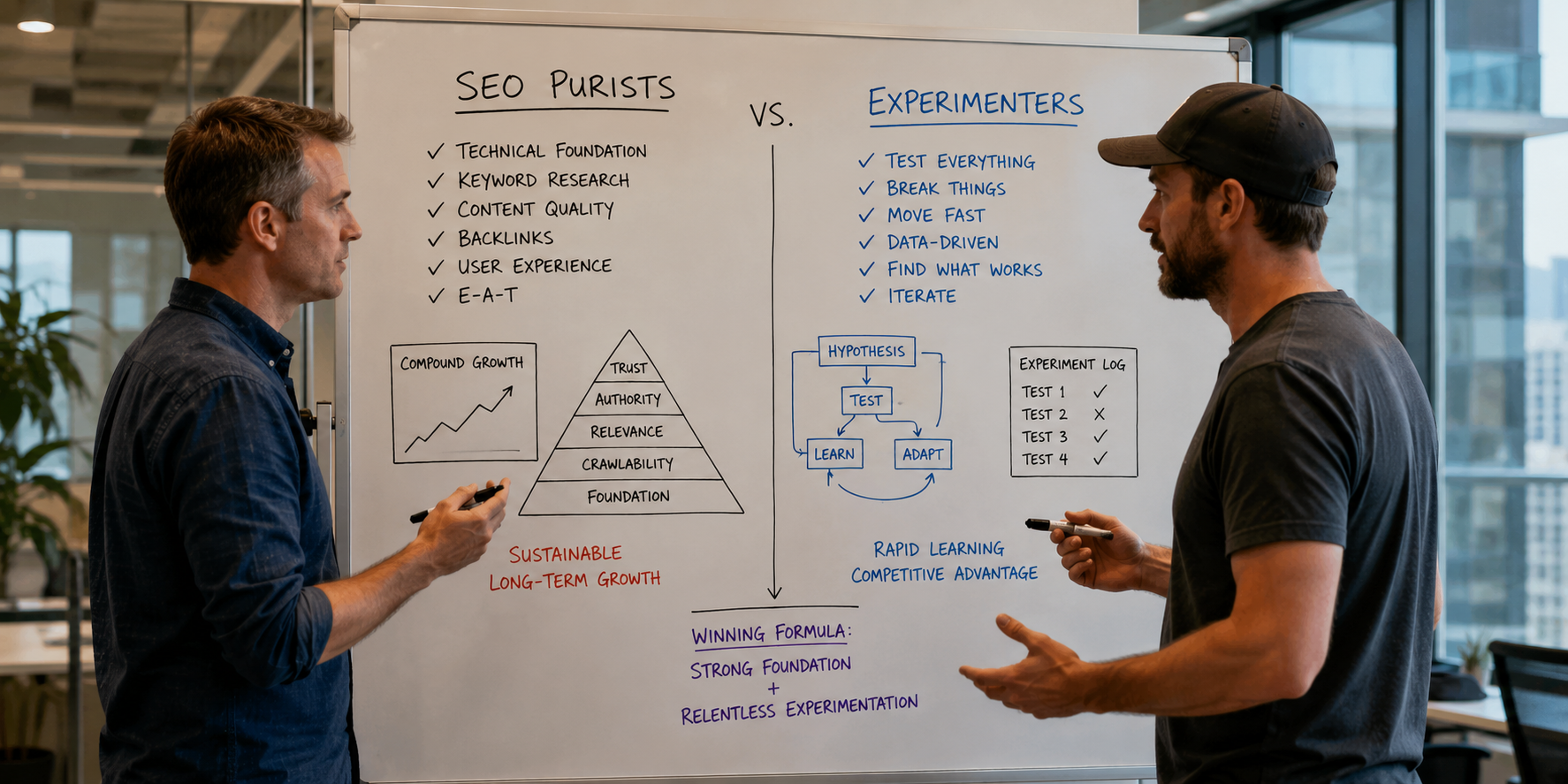
There are two distinct schools of thought that have been arguing in the SEO industry for years, and the argument has gotten louder as AI search has rewritten the rules underneath both of them.
The purists believe that SEO is fundamentally a discipline of principles — that the fundamentals work, that they have always worked, that practitioners who chase tactics and run experiments without building on a solid foundation are building on sand. Get the basics right and the results follow.
The experimenters believe that SEO is fundamentally a discipline of data — that best practices are just educated guesses until they're tested against your specific site, your specific audience, and the current state of an algorithm nobody fully understands. Follow the rules and you're following someone else's data. Run your own tests and you know.
Both camps make legitimate arguments. Both camps have blind spots that cost the organizations following them real money. And the environment both camps are operating in has changed enough in 2025 and 2026 that neither can afford to stay where they are.
The Purists' Case — And Why It's Stronger Than Experimenters Admit
The purist position rests on something real. The fundamentals of SEO — high-quality content, technical site health, authoritative backlinks, demonstrated expertise, clear site structure — have been the core of what Google rewards since the algorithm was sophisticated enough to reward anything. They haven't changed in the ways that matter most, even as the tactics around them have evolved continuously.
97% of AI Overview citations come from pages already ranking in the top 20 organic results — meaning traditional SEO is the prerequisite for AI visibility. That is not a small finding. The brands winning in the new AI search environment are, overwhelmingly, the brands that built and maintained strong fundamentals in the old one. Experimentation on top of a weak foundation produces experiments that are hard to interpret and results that don't compound. Whitehat SEO
Every single respondent in Goodfirms' 2026 survey agreed that trust and credibility signals are becoming more important as AI systems take on the work of deciding which sources to surface. Trust has stopped being just a ranking factor and is now the primary filter for AI inclusion. Trust, in the SEO sense, is not something you A/B test your way into. It is built through consistency, demonstrated expertise, and a track record that accumulates over time — exactly the things the purist framework prioritizes. GoodFirms
The fundamentals — intent-based SEO, content quality, topical authority, technical SEO, UX and SEO integration, and brand signals — still work. The purists are right about this. The practitioners who abandoned fundamentals to chase short-term tactics during every algorithm cycle are the ones who got hit hardest by the Helpful Content updates, the core updates, and the AI Overview rollout. Their sites recovered slowly or not at all. Medium
Where the purists go wrong is in treating the fundamentals as sufficient on their own — and in assuming that best practices derived from broad industry data automatically apply to every site in every context. They often don't.
The Experimenters' Case — And Why It's Stronger Than Purists Admit
The experimenter position also rests on something real. Best practices in SEO are, at their core, generalizations derived from observed patterns across many sites. They represent what tends to work across a population. They do not represent what will work for your site, your audience, your competitive landscape, and the current state of the algorithm — which is an important distinction.
While competitors guess, the companies that test consistently know. While others follow best practices, they follow their data. This isn't bravado — it's a description of a real competitive advantage that structured experimentation produces. An organization that tests title tag formats across a large page set and measures the impact on click-through rate has information that no best practices guide can give them. They know what works on their site, with their audience, right now. Statsig
In 2025, organic search is no longer a game of broad optimizations and reactive adjustments. The brands that lead are those that embrace precision-driven SEO. SEO A/B testing transforms SEO from guesswork into a disciplined, data-backed growth engine. This is not a fringe position. The largest, most sophisticated SEO programs at enterprise organizations are built around continuous experimentation — not because they've abandoned the fundamentals, but because they've layered testing on top of them to find the marginal gains that separate their performance from their competitors'. ConvertMate
Where the experimenters go wrong is in two predictable places. First, they frequently test without sufficient traffic volume to reach statistical validity, producing results that feel meaningful but are actually noise. Only 23% of organizations rate their testing programs as mature, with the remaining 77% reporting challenges with test velocity, statistical validity, or translating test results into business impact. Running tests is not the same as running tests that generate valid insights. The gap between those two things represents a significant waste of time and resources for organizations that have adopted experimentation as a philosophy without the infrastructure to support it. SEO Agency USA
Second, experimenters sometimes develop a kind of allergy to the fundamentals — treating established principles as things to be overturned rather than things to be built on. The result is an experimental program that is generating data on top of a site that doesn't deserve to rank well to begin with.
What the Current Environment Demands From Both Camps
The SEO environment in 2026 has changed in ways that make both the purist and experimenter frameworks incomplete on their own — and more compatible with each other than either camp typically acknowledges.
Generative AI platforms are rapidly becoming influential across stages of the customer journey. Adobe research shows that from July 2024 to February 2025, web traffic from generative-AI-driven referrals increased more than tenfold in the United States. AI-referred visitors now browse 12% more pages per visit and show a 23% lower bounce rate than non-AI referrals. This is a structural shift in where traffic comes from and how it behaves — and it demands a response that neither pure fundamentalism nor pure experimentation is well-positioned to provide on its own. Adobe
Traditional SEO measures clicks and rankings. AI SEO measures citation frequency and share of model — the proportion of AI-generated responses in which your brand appears. Most organizations lack reliable tools to measure this. This is exactly the kind of new terrain where experimenters should be leading — developing methodologies for measuring AI visibility and testing what content structures earn citations. But the foundation for those citations, as the data shows, is traditional authority built through exactly the kind of consistent, fundamental work the purists have been advocating all along. Adobe
SEO has always been a discipline that chases the algorithm — but the fundamentals remained stable. What's required now isn't a new set of tactics. It's a fundamental change in mindset. That change in mindset is not toward either camp as they currently exist. It's toward something that takes the purist's long view on authority and trust and combines it with the experimenter's rigor around measurement and iteration. Search Engine Land
Where the Real Synthesis Lives
The organizations winning in SEO in 2026 are not the ones that have chosen a camp. They're the ones that have built a foundation strong enough to experiment on top of — and an experimental practice rigorous enough to generate insights worth acting on.
That means a few specific things in practice.
Fundamentals first, experiments second. If your site has limited traffic, start by applying proven SEO best practices first. SEO A/B testing is most effective once you have enough consistent data volume to run statistically sound experiments. The sequencing matters. Experimenting on a technically broken site with thin content and no backlinks produces data that reflects the weakness of the foundation, not the effectiveness of the test variable. ConvertMate
Treat best practices as hypotheses, not conclusions. The purist's mistake is holding best practices as settled law. Every best practice was derived from data at a particular moment in a particular context. Some of them have been stable for a decade. Others have been invalidated by algorithm changes and nobody sent a memo. Treating each principle as a hypothesis — something to be applied and measured rather than followed and trusted — is the experimental mindset applied in service of the fundamentals rather than in opposition to them.
Measure what you can't see, not just what's easy. 51.4% of marketers cite measuring and proving ROI as a top challenge in SEO. The experimenter's instinct to measure everything is correct — but the measurement framework needs to expand to match the environment. Ranking positions and organic sessions are no longer sufficient proxies for the full value of an SEO program in a world where AI Overviews resolve more than 80% of triggered queries without a click. Organizations need to build measurement frameworks that capture brand search volume, AI citation frequency, and direct traffic alongside traditional metrics. GoodFirms
Build authority you can't A/B test. The things that earn AI citations and sustain rankings through algorithm volatility — original research, genuine expertise, demonstrated authoritativeness, consistent brand signals — cannot be A/B tested in any meaningful sense. They are built over time through decisions that compound rather than decisions that can be reversed after a two-week test. The experimenter's framework, taken too literally, creates a bias toward things that can be tested on short timescales. Some of the highest-value SEO investments are invisible to that framework.
The Bottom Line
The purist is right that the fundamentals work, that trust compounds over time, and that tactical experimentation without a solid foundation is largely wasted effort. The experimenter is right that best practices are generalizations, that site-specific data beats industry consensus, and that organizations that test consistently outperform those that follow rules without questioning them.
The argument between these two camps has always been less productive than the synthesis of them. In 2026, with AI reshaping how search works and traditional metrics becoming less reliable proxies for business impact, neither framework is complete on its own. The organizations that will lead are the ones disciplined enough to build the fundamentals and rigorous enough to test everything on top of them.
If you're trying to figure out where your SEO program sits between these two frameworks — and what the right balance looks like for your specific situation — Ritner Digital can help you build a strategy that doesn't have to choose.
Talk to the Ritner Digital team →
Sources: Adobe "SEO in 2026: How AI Is Reshaping the Fundamentals of Search"; Goodfirms AI SEO Statistics 2026; Search Engine Land "SEO's New Goal in 2026: Recognition, Not Rankings"; Whitehat SEO Best Practices 2026; ConvertMate "SEO A/B Testing: Best Practices 2025"; Statsig "A/B Testing Technical SEO Best Practices"; VWO 2024 State of Experimentation Report; SEO Agency USA A/B Testing Best Practices; Medium "SEO in 2026: What Changed, What Still Works."
Frequently Asked Questions
What is the difference between an SEO purist and an SEO experimenter?
An SEO purist prioritizes established fundamentals — high-quality content, technical site health, authoritative backlinks, topical authority, and demonstrated expertise — and believes these principles compound over time into durable rankings. An SEO experimenter prioritizes data derived from their own site and audience, using controlled testing to validate or invalidate assumptions rather than following industry best practices on faith. In practice, most effective SEO programs contain elements of both — the disagreement is usually about which deserves more emphasis and resources.
Are SEO best practices still reliable in 2026?
Largely yes, with an important caveat. The core fundamentals — content quality, technical health, authority signals, user experience — remain the foundation of what earns rankings and AI citations. 97% of AI Overview citations come from pages already ranking in the top 20 organic results, meaning traditional SEO is the prerequisite for AI visibility. However, best practices are generalizations derived from broad data, and they don't automatically apply to every site in every context. Treating them as starting hypotheses rather than settled conclusions — and measuring whether they're actually working on your specific site — is a more defensible approach than following them on faith. Whitehat SEO
Is SEO A/B testing worth doing for smaller websites?
Not until the fundamentals are in place and traffic volume is sufficient to produce statistically valid results. If your site has limited traffic, start by applying proven SEO best practices first. SEO A/B testing is most effective once you have enough consistent data volume to run statistically sound experiments. Running experiments on a site with insufficient traffic produces results that look meaningful but are actually noise — and acting on that noise can cause more harm than the test was designed to prevent. ConvertMate
What does AI search mean for the purist vs. experimenter debate?
It complicates both positions. The purists are validated by the fact that AI Overview citations overwhelmingly come from pages already ranking in the top 20 organic results — meaning the traditional authority-building work they've always advocated is the prerequisite for AI visibility. But the experimenters are right that the new measurement environment — where traditional SEO measures clicks and rankings while AI SEO measures citation frequency and share of model — demands new methodologies that most organizations haven't built yet. Neither camp's existing framework is fully equipped for the current environment on its own. Whitehat SEOAdobe
How do I know if my SEO program is too rigid or too experimental?
A program that is too rigid tends to follow best practices without measuring whether they're actually working, rarely questions assumptions, and struggles to adapt when algorithm changes invalidate previously reliable tactics. A program that is too experimental tends to generate a lot of data without the statistical validity to act on it confidently, underinvests in the fundamentals that compound over time, and creates a bias toward decisions that can be tested on short timescales — which excludes some of the highest-value SEO investments. Only 23% of organizations rate their testing programs as mature, with 77% reporting challenges with test velocity, statistical validity, or translating results into business impact. If your experimentation program fits that description, it may be doing more to consume resources than generate insight. SEO Agency USA
What SEO signals actually can't be A/B tested?
The most durable and high-value SEO signals — original research, genuine demonstrated expertise, brand authority, and consistent trust signals — cannot be meaningfully tested on short timescales. Trust has stopped being just a ranking factor and is now the primary filter for AI inclusion. Trust accumulates through decisions that compound over months and years, not variables that can be reversed after a two-week test. An experimental framework taken too literally creates a systematic bias against exactly these kinds of investments, because they don't fit the testing model. GoodFirms
What's the right way to treat SEO best practices if not as settled rules?
As hypotheses. A best practice is a generalization derived from data collected across many sites at a particular point in time. Some are remarkably stable. Others have been quietly invalidated by algorithm changes with no announcement. Applying a best practice and measuring whether it's actually producing the expected outcome on your specific site — rather than assuming it will because it worked somewhere else — is the experimental mindset applied in service of the fundamentals rather than in opposition to them. The two approaches are more complementary than either camp typically acknowledges.
How has the measurement challenge changed for SEO in 2026?
Significantly. 51.4% of marketers cite measuring and proving ROI as a top SEO challenge. The traditional metrics — ranking positions and organic sessions — are becoming less reliable proxies for the full value of an SEO program as AI Overviews resolve more queries without generating a click. A complete measurement framework in 2026 needs to capture brand search volume, direct traffic trends, AI citation frequency, and share of model alongside traditional metrics. Organizations still measuring SEO exclusively through rankings and sessions are increasingly flying blind about a significant portion of what their program is actually doing. GoodFirms
Can a small or mid-sized business realistically run SEO experiments?
Yes, with appropriate scope. The most accessible SEO experiments for smaller sites involve testing title tag formats across similar page types, measuring the impact of structured data implementation, or comparing content depth across pages targeting similar queries. These don't require the sophisticated infrastructure of an enterprise experimentation program — they require a clear hypothesis, a defined measurement window, and enough traffic volume to produce interpretable results. Starting with one well-designed test on a high-traffic page cluster is more valuable than a sprawling experimental program that produces data too noisy to act on.
How does Ritner Digital approach the balance between fundamentals and experimentation?
We build strategies that treat the fundamentals as the foundation and experimentation as the layer that compounds on top of them — not as competing philosophies. That means starting with an honest audit of where the fundamentals are strong and where they aren't, building a content and technical strategy that earns authority over time, and then layering in measurement frameworks and testing methodologies that generate site-specific insights rather than just confirming what the industry already believes. Talk to us about your SEO strategy here.