SEO vs. SEM: What’s the Difference, and Which One Should Your Business Use?
If you have ever researched digital marketing, you have probably encountered two acronyms almost immediately:
SEO and SEM.
They sound similar.
They both involve search engines.
They can both put your business in front of people who are actively looking for products or services.
And they can both generate leads and sales.
But they work very differently.
For a business owner, the easiest way to understand the difference is this:
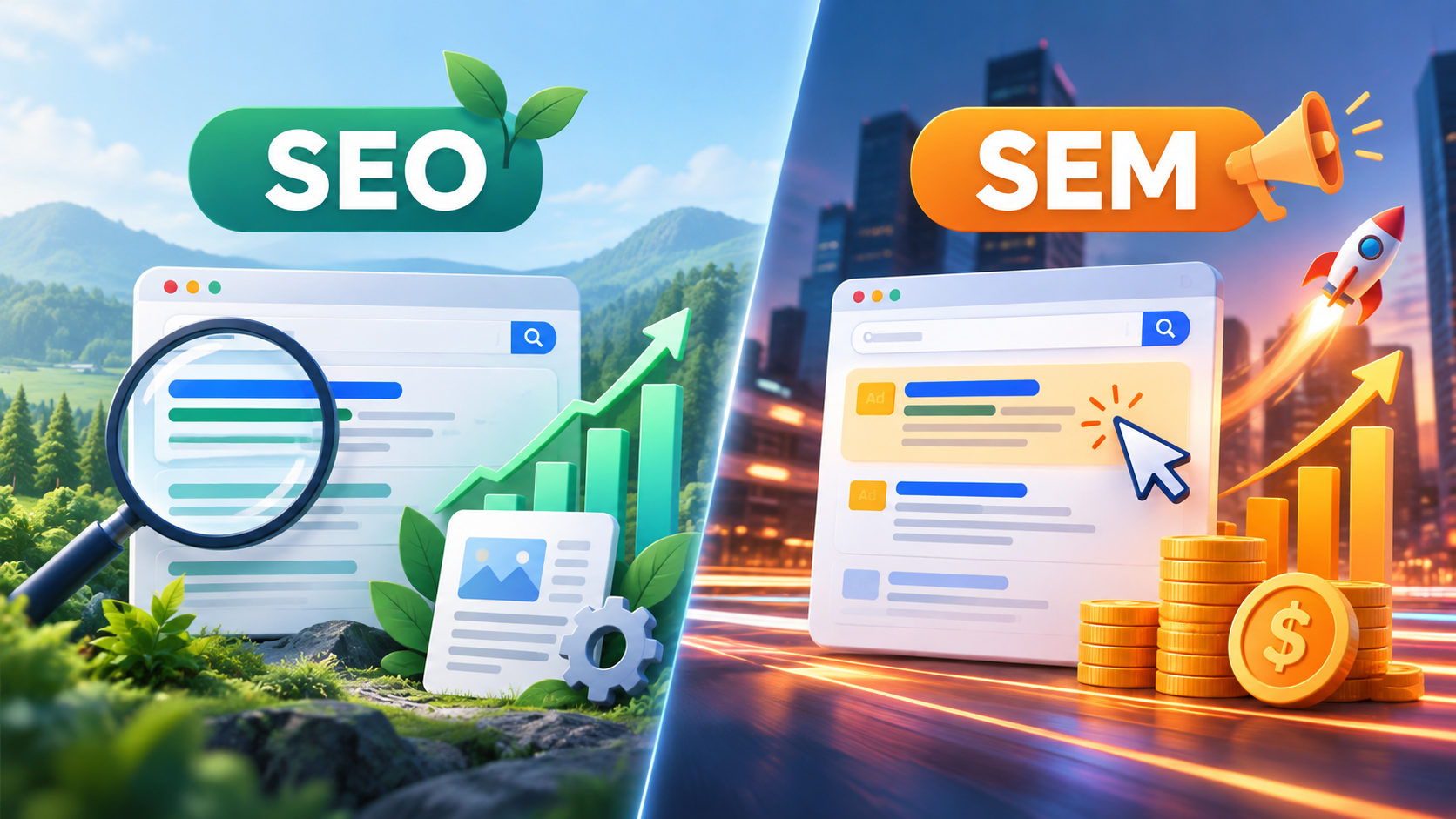
SEO helps you earn visibility in search results. Paid search lets you buy visibility in search results.
SEO is about building a website, content and digital authority that can appear organically when customers search.
Paid search advertising lets you bid for prominent placement when customers search.
And that distinction affects almost everything: how quickly results can happen, how long those results can last, how much you pay for traffic and how the strategy should fit into your larger marketing plan.
There is also one terminology problem worth clearing up immediately.
Technically, SEM stands for Search Engine Marketing, and some industry definitions use SEM as an umbrella term covering both SEO and paid search. Search Engine Land, for example, defines search marketing as encompassing SEO and PPC. At the same time, many marketers and businesses now use “SEM” conversationally to mean paid search advertising, such as Google Ads. Search Engine Land
So when somebody asks:
“Should I invest in SEO or SEM?”
What they usually mean is:
“Should I invest in organic search or paid search advertising?”
That is the comparison we are going to make here.
And the answer is rarely that one is universally better.
SEO and paid search solve different problems.
One can help you generate visibility relatively quickly.
The other can help you build search visibility that becomes a long-term business asset.
Understanding where each fits can keep you from wasting money—and help you build a search strategy that produces customers both now and later.
What Is SEO?
SEO stands for Search Engine Optimization.
At its core, SEO is the process of improving your website and broader digital presence so your business can become more visible in organic, or unpaid, search results.
Modern SEO can involve:
Technical website optimization
Keyword and search-intent research
Website architecture
Service-page optimization
Blog and content strategy
Internal linking
Local SEO
Google Business Profile optimization
Link building and digital PR
Structured data
User experience
Conversion optimization
Brand authority
Increasing visibility in traditional and AI-powered search
Search Engine Land's current definition describes SEO as optimizing websites and digital content to increase visibility, traffic and brand authority across search engines and AI search. Search Engine Land
The important word is organic.
With SEO, you are not paying Google a fee every time somebody clicks your organic result.
You are investing in the things that may help your website deserve greater visibility.
That investment can include paying an SEO firm, hiring writers, improving your website, producing research, earning links or creating better landing pages.
So organic traffic is not necessarily “free.”
But the economics are fundamentally different from advertising.
You are investing in the asset rather than purchasing each individual click.
What Is SEM?
SEM stands for Search Engine Marketing.
As mentioned earlier, the terminology can get confusing.
Historically and technically, search engine marketing can include both organic SEO and paid search. Search Engine Land currently explains SEM as the broader category in which SEO drives organic results and PPC drives paid results. Search Engine Land
But in day-to-day business conversations, SEM is frequently used to mean paid search marketing.
That usually means platforms such as Google Ads or Microsoft Advertising.
A business chooses keywords, audiences, geography and other targeting criteria, creates advertisements and bids to have those ads appear when relevant searches occur.
If someone clicks a cost-per-click ad, the advertiser pays.
Google defines CPC bidding as a model in which advertisers pay for clicks on their advertisements. Google Help
So for the remainder of this article, when we compare SEO vs. SEM, we are using the common business distinction:
SEO = organic search
SEM = paid search advertising
SEO vs. SEM in One Simple Example
Imagine you own a roofing company.
Someone searches Google for:
roof replacement company near me
Your business could potentially appear in several ways.
You might have an advertisement toward the top of the search results because you are running a Google Ads campaign.
That is paid search.
You could appear in the local map results because your local SEO and Google Business Profile are strong.
That is organic visibility.
Your roofing service page could appear in the traditional organic search results.
That is SEO.
A useful article from your website could appear because the person searched something more informational, such as:
How much does a roof replacement cost?
That is SEO too.
With the paid advertisement, you essentially purchased an opportunity to appear.
With the organic results, you earned an opportunity to appear through your website, content, relevance and authority.
Both can send the same person to your website.
But the mechanism is very different.
The Biggest Difference: Paying for the Click vs. Building the Asset
Suppose you launch a paid search campaign tomorrow.
You set a budget.
You build advertisements.
You choose your targeting.
Google begins showing your ads.
When somebody clicks, you may pay for that click.
That can be extremely valuable.
But what happens when your advertising budget reaches zero?
The campaign stops delivering paid traffic.
Now imagine that you spend money improving a service page so it becomes one of the best resources in your market.
You improve the content.
Fix technical problems.
Add internal links.
Add proof.
Earn backlinks.
Strengthen your local signals.
Eventually the page begins performing well in organic search.
There is no guarantee that the ranking will remain forever, and SEO still requires maintenance.
But you do not receive a bill from Google every time somebody clicks the organic listing.
That is the fundamental economic difference.
SEM rents visibility.
SEO builds visibility.
Neither model is automatically better.
Renting can be extremely useful when you need immediate access.
Owning becomes incredibly valuable over time.
The smartest businesses often understand how to do both.
SEO Is More Like Building a House
Imagine purchasing land and building a house.
At first, the expense is significant.
You need a foundation.
Framing.
Electrical work.
Plumbing.
Roofing.
Finishing.
For months, it may feel like you are putting money into something that is not producing much immediate value.
Then the house exists.
You own an asset.
You still have maintenance.
Things eventually need to be repaired.
Taxes do not disappear.
But the initial investment created something that continues providing value.
SEO behaves similarly.
You might spend the first few months fixing technical issues, rewriting service pages, developing content, improving local listings and building authority.
Growth may initially feel slow.
Then those assets begin working together.
A blog ranks.
A service page moves higher.
The Google Business Profile generates calls.
An article earns links.
Brand searches increase.
Customers start finding the company from searches you were not even targeting when the project began.
SEO can compound.
That is why evaluating it only by what happened during the first 30 days can be misleading.
SEM Is More Like Renting Prime Retail Space
Paid search is different.
Imagine renting a store at the busiest intersection in town.
You can potentially get visibility immediately.
There is already traffic.
People are already passing by.
You are simply paying for access to that audience.
As long as you can afford the rent and the location generates enough business, that can be a fantastic strategy.
But stop paying the rent and you lose the space.
That is essentially how paid search works.
The traffic exists.
Google has people searching.
You bid for an opportunity to appear in front of them.
And unlike SEO, where ranking improvements can take time, paid ads can often begin generating impressions soon after a campaign is properly configured and approved.
That speed is one of SEM's greatest advantages.
SEO vs. SEM: How Fast Can You Get Results?
This may be the most significant practical difference for businesses.
SEM Can Be Fast
Paid search advertising can put your business in front of potential customers relatively quickly.
If you have:
A functioning website.
A good landing page.
A properly configured advertising account.
A sufficient budget.
Relevant keywords.
Compelling ad copy.
You can begin testing demand without waiting months for organic rankings.
This can make SEM especially useful when:
You are launching a new company.
You are entering a new market.
You have a seasonal promotion.
You need leads immediately.
You want to test a new product.
You want to validate keyword demand.
You need visibility while the SEO strategy develops.
But speed does not mean guaranteed profitability.
An advertisement can generate traffic tomorrow and still lose money tomorrow.
The campaign has to convert.
SEO Usually Takes Longer
SEO is generally a longer-term strategy.
Search engines need to discover pages.
Evaluate them.
Understand the website.
Compare your content against competitors.
Assess external signals.
Observe changes.
Determine which results deserve visibility.
A brand-new website competing against companies that have spent ten years building authority will usually not outrank them simply because someone optimized the title tag last Tuesday.
SEO requires patience.
But that patience can create a meaningful advantage.
If competitors rely almost entirely on paid search while you steadily build useful content, links, rankings and brand authority, you are creating an asset they cannot instantly duplicate simply by increasing tomorrow's advertising budget.
What Happens When You Stop Spending?
This is one of the easiest ways to understand SEO vs. SEM.
Stop paying for paid search:
Your ads generally stop appearing.
Your paid traffic stops.
Your paid leads stop.
Pause SEO:
Your rankings do not instantly disappear simply because you did not publish a blog this week.
Your existing pages still exist.
Your backlinks still exist.
Your previous optimizations still exist.
Your authority does not reset to zero.
That does not mean SEO should be abandoned once rankings improve.
Competitors keep working.
Search behavior changes.
Websites develop technical problems.
Content becomes outdated.
Google's systems evolve.
AI search changes how people discover information.
Ongoing optimization remains important.
But SEO creates something that can carry momentum forward.
Paid search usually requires continued media spend to maintain paid visibility.
Another Major Difference: How Google Decides Who Appears
Organic search and paid search use completely different systems.
With SEO, Google's organic systems evaluate webpages based on many signals designed to determine which results are most useful and relevant for a search.
You cannot simply offer Google another $20 to move your organic result from number six to number one.
Organic rankings are earned through relevance, quality, authority and many other signals.
Paid advertising operates through an auction.
Google says its ad auctions evaluate factors including an advertiser's bid, the quality of the ad and landing page, competition, the context of the search and the expected impact of ad assets. Google Help
That means SEM is not merely:
“Whoever pays the most wins.”
Quality matters too.
Google evaluates the relevance and usefulness of both the advertisement and the landing page. Google Help
That creates an interesting connection between SEO and SEM:
A better website can help both.
SEO Can Make SEM Better
Businesses sometimes treat their SEO company and advertising company as if they operate on different planets.
They should not.
SEO can improve the same landing pages your advertisements send people to.
That means SEO work can improve:
Page speed.
Content quality.
Mobile usability.
Navigation.
Message clarity.
Search-intent alignment.
Conversion experience.
Trust signals.
Service information.
Google says landing-page experience and ad relevance are components used in its Quality Score diagnostic. Google Help
So improving the website for organic search can also produce a stronger destination for paid traffic.
That is one of many reasons integrated search strategies tend to make sense.
SEO and SEM are not enemies.
They are two ways of capturing search demand.
SEM Can Also Make SEO Smarter
The relationship works in the opposite direction too.
One of the advantages of paid search is speed of testing.
Suppose you are considering building an entire SEO strategy around a particular service.
You could spend months developing organic visibility before discovering that the keyword generates plenty of traffic but very few qualified customers.
Paid search may allow you to test that market sooner.
You can learn:
Which terms generate clicks.
Which searches produce leads.
Which offers resonate.
Which landing-page headlines convert.
Which geographic markets respond.
Which service generates profitable customers.
That information can influence your organic strategy.
Instead of deciding SEO priorities based only on search volume, you can sometimes use paid campaign data to see what actually creates business.
SEO informs SEM.
SEM informs SEO.
That is when search marketing becomes significantly smarter.
SEO Is Usually Better for Long-Term Compounding Value
One of SEO's largest advantages is cumulative growth.
Suppose your company publishes one excellent article each week.
After one year, you may have roughly 50 new search assets.
After two years, around 100.
Those articles can address dozens or hundreds of problems your customers search for.
Some may rank well.
Some may earn backlinks.
Some may appear in AI-generated answers.
Some may send prospects to service pages.
Some may help salespeople answer common customer questions.
Some may generate traffic for years.
You are building an increasingly large search footprint.
SEM does not compound in quite the same way.
Running 100 ads last year does not mean Google gives you 100 free ads this year.
Advertising data can become more valuable.
Campaigns can become more efficient.
Brand awareness can increase.
But the media placement itself generally still needs funding.
SEO accumulates digital assets.
That is a powerful long-term distinction.
SEM Is Usually Better When You Need Immediate Visibility
Imagine you open a new dental practice.
Your website is three weeks old.
Your competitors have been online for 15 years.
Waiting for SEO alone to build visibility may not be practical.
You need appointments.
Paid search can bridge that gap.
The same applies when launching:
A new service.
A new location.
A limited-time promotion.
An event.
A seasonal product.
A new market.
SEM can get your offer in front of relevant searchers while your organic presence develops.
That does not make paid search a replacement for SEO.
It makes paid search a speed layer.
SEO creates the foundation.
SEM can create immediate reach.
SEO vs. SEM Costs
This comparison is more complicated than:
SEO is free and SEM costs money.
SEO is not free.
Professional SEO can involve investments in:
Strategy.
Technical optimization.
Content.
Design.
Development.
Research.
Digital PR.
Link acquisition.
Analytics.
Local optimization.
Conversion improvements.
And professional expertise.
The difference is where the money goes.
With SEM, a significant portion of the budget typically goes toward buying media exposure.
With SEO, the investment goes largely toward improving digital assets and earning visibility.
That creates different economics.
Suppose you spend $5,000 per month on PPC.
A portion of that goes directly toward advertising clicks.
Spend $5,000 on SEO and that money could fund technical improvements, content, research, digital PR or other assets that remain associated with the website.
Neither automatically provides better ROI.
The answer depends on your industry, conversion rate, customer value, competitive environment and execution.
Cost Per Click Matters More in SEM
Paid search involves an auction, which means different keywords can have dramatically different costs.
Some searches are inexpensive.
Others are extremely competitive.
Businesses selling high-value services may face much higher costs per click because competitors know that one new customer could generate substantial revenue.
Google defines cost-per-click as the amount advertisers pay when someone clicks an ad under CPC bidding. Google Help
That means SEM requires careful economics.
If you pay $30 per click and your website needs 40 clicks to generate one lead, you have spent $1,200 to produce that lead.
If only one out of four leads becomes a customer, your advertising click cost alone could effectively equal $4,800 per customer before agency fees and other expenses.
That might be fantastic if the customer is worth $50,000.
It might be disastrous if the customer is worth $500.
SEM makes customer-acquisition economics impossible to ignore.
SEO Has Costs Too, but Not Usually Per Visit
SEO economics are different.
Suppose a company spends $4,000 creating, promoting and optimizing a major resource.
In year one, that page generates 1,000 qualified organic visits.
In year two, another 2,000.
In year three, another 2,500.
The original content cost did not increase every time somebody clicked.
The business may have spent money updating and promoting the page, but traffic was not purchased visitor by visitor.
That is where SEO can become incredibly powerful.
Successful content can lower its effective cost per acquisition over time.
The initial investment gets distributed across an increasingly large number of visitors and conversions.
That is the compounding effect businesses are usually seeking from organic search.
Which Generates Better Leads: SEO or SEM?
There is no universal winner.
Both can produce exceptional leads because both are capable of reaching someone at the exact moment they are searching.
That is what makes search marketing unique.
Compare search to a billboard.
A billboard interrupts whoever happens to drive past.
Search begins with the customer expressing intent.
They typed:
“emergency plumber near me.”
“business attorney Philadelphia.”
“commercial HVAC repair.”
“SEO company New Jersey.”
“best accounting software for contractors.”
The customer has already raised their hand.
Both SEO and SEM can capture that intent.
Lead quality then depends on:
The keyword.
Search intent.
Offer.
Landing page.
Targeting.
Price.
Reputation.
Sales process.
And how well the service matches what the customer actually wants.
Trust Can Feel Different Between Paid and Organic Results
Customers know advertisements are advertisements.
Paid listings are labeled.
Organic visibility can create a different psychological response because the company appears to have earned its position rather than purchased the placement.
That does not automatically make an organic result more trustworthy.
A terrible company can rank.
An excellent company can advertise.
But appearing organically for numerous topics over time can contribute to perceived authority.
Imagine a potential customer searches five different questions over several weeks.
Your company appears every time.
They see:
Your blog.
Your service page.
Your Google Business Profile.
Your reviews.
Your research.
Eventually, your company starts to feel familiar.
That is where SEO begins functioning not merely as traffic generation but as brand building.
SEO Can Reach Customers Earlier in the Buying Journey
Paid search campaigns often focus heavily on commercially valuable queries.
That makes sense.
If you are paying for clicks, you want people with a reasonable probability of becoming customers.
SEO gives businesses more freedom to reach people earlier.
Suppose you sell commercial solar installations.
A paid campaign may target:
“commercial solar installation company.”
SEO can also target:
“Are commercial solar panels worth it?”
“How much can a warehouse save with solar?”
“What tax incentives exist for commercial solar?”
“How long is the payback period for commercial solar?”
“Solar vs. traditional electricity costs for warehouses.”
Those searchers may be months away from contacting a provider.
But by answering their questions early, your company can enter the buying process before competitors focusing only on bottom-of-funnel advertising.
That can be tremendously valuable.
SEM Is Excellent for Bottom-of-Funnel Searches
Paid search becomes especially powerful when the customer is ready to act.
Searches such as:
“book dentist appointment.”
“emergency water damage repair near me.”
“divorce attorney consultation.”
“buy commercial generator.”
“24-hour plumber.”
indicate significant commercial intent.
A company may reasonably decide that appearing prominently for those searches is worth paying for.
This is where SEM shines.
The customer has a problem.
They want a solution now.
The advertiser purchases an opportunity to be present during that moment.
SEO and SEM therefore often complement different stages of the same journey.
SEO Goes Beyond Traditional Google Rankings
The meaning of SEO has also expanded.
Search is no longer just ten blue Google links.
Businesses can be discovered through:
Traditional Google results.
Google Maps.
Featured snippets.
Images.
Videos.
Shopping results.
AI-powered search experiences.
Bing.
Other search engines.
And increasingly conversational AI platforms.
Modern SEO is partly about helping the web understand what your business is, what it knows and when its content might be useful.
Search Engine Land's 2026 SEO definition explicitly incorporates both traditional search engines and AI search into modern organic visibility. Search Engine Land
That gives SEO another long-term role.
You are not merely trying to win one ranking.
You are increasing the amount of useful, authoritative information associated with your business across the search ecosystem.
SEM Is More Controllable Day to Day
Paid search has an advantage many marketers love:
Control.
You can usually make rapid changes to:
Budget.
Keywords.
Geography.
Schedule.
Ad copy.
Landing pages.
Bids.
Audience targeting.
Campaign structure.
If a campaign is underperforming, you can adjust it.
If one service suddenly becomes a priority, you can allocate more spend there.
If you only want leads between 8 a.m. and 5 p.m., advertising can often accommodate that kind of targeting.
SEO is not nearly as controllable.
You can make excellent improvements and Google still ultimately decides when and where organic pages appear.
That lack of direct control can frustrate businesses accustomed to paid media.
But again, it is the tradeoff for earned visibility.
SEO Gives You More Owned Assets
Here is another important difference.
A Google Ad lives inside Google's advertising ecosystem.
Your optimized service page lives on your website.
Your blog belongs to your business.
Your research belongs to your business.
Your case studies belong to your business.
Your internal-link architecture belongs to your business.
Your email list generated from organic visitors belongs to your business.
Your brand authority belongs to your business.
That ownership matters.
Every dollar invested in organic content has the potential to improve an asset under your control.
Paid media is extremely useful.
But businesses should be careful about building a customer-acquisition strategy in which nearly all visibility disappears the moment an external platform stops receiving money.
SEO vs. SEM for a New Business
A new business often benefits from both.
If your domain has little authority and few rankings, SEO can take time.
Paid search can help generate early leads.
At the same time, the business can begin building the organic infrastructure it will wish it had two years from now.
That means:
Creating excellent service pages.
Building local visibility.
Publishing useful content.
Collecting legitimate reviews.
Fixing technical issues.
Developing authority.
Tracking conversions.
Learning which searches generate actual customers.
This creates a strong combination.
SEM generates opportunity today.
SEO builds opportunity for tomorrow.
SEO vs. SEM for an Established Business
An established business may have a completely different situation.
Perhaps the company already has:
A strong domain.
Hundreds of pages.
Years of backlinks.
A known brand.
Existing rankings.
A large Google Business Profile.
Significant historical traffic.
In that case, SEO improvements may unlock enormous value relatively quickly because the foundation already exists.
An established website might have pages sitting at positions four through ten for valuable searches.
Moving those pages upward can create meaningful traffic growth without starting from zero.
Paid search can then fill gaps where organic rankings are weak or where the company wants additional visibility.
Should You Run Ads for Keywords Where You Already Rank?
Sometimes.
It can feel redundant.
Why pay for clicks when you already appear organically?
Because occupying both paid and organic visibility can increase your overall presence on the results page.
It can also prevent competitors from owning the paid space above you.
Paid advertising may provide more control over messaging for high-value searches.
And organic rankings fluctuate.
There is no rule saying businesses must choose one appearance.
Search Engine Land notes that paid and organic search are complementary parts of search marketing rather than mutually exclusive strategies. Search Engine Land
For your most important queries, the real goal may be:
Own as much relevant search visibility as makes economic sense.
When SEO Is Probably the Better Priority
SEO often deserves greater attention when:
You want sustainable long-term visibility.
Your customers conduct significant research before buying.
Your industry contains many informational searches.
You have valuable expertise worth publishing.
Paid search clicks are extremely expensive.
You want to build brand authority.
Your website already has authority that is being underutilized.
You rely too heavily on paid advertising.
You want organic local visibility.
You want greater visibility in AI search.
You are building a business intended to compound over many years.
That does not mean you should avoid advertising.
It means organic search is part of the infrastructure your business should probably own.
When SEM Is Probably the Better Immediate Priority
Paid search may deserve greater attention when:
You need leads now.
You are launching a new business.
You need to validate an offer.
You are promoting a limited-time service.
You have predictable conversion economics.
Your customer has extremely high commercial intent.
Your SEO strategy has not matured yet.
Your organic competitors are currently too strong to displace quickly.
You need precise geographic or audience targeting.
You want fast testing data.
Again, this does not mean abandoning SEO.
It means the business has a problem paid search can solve faster.
The Biggest Mistake: Treating SEO and SEM Like Competitors
This might be the most important takeaway from the entire SEO vs. SEM debate.
They are not opposing strategies.
They are complementary acquisition channels.
SEO can provide:
Long-term visibility.
Content.
Authority.
Trust.
Brand awareness.
Lower marginal traffic costs over time.
AI-search visibility.
Paid search can provide:
Speed.
Control.
Testing.
Immediate demand capture.
Precise targeting.
Measurable campaign economics.
One builds.
The other accelerates.
A business that understands both has more options.
And marketing becomes much healthier when no single channel controls the entire pipeline.
A Better Search Strategy Looks at the Entire Customer Journey
Imagine someone needs a new commercial HVAC system.
Six months before purchasing, they search:
How long do commercial HVAC systems last?
They find your blog.
Three months later:
Repair or replace commercial HVAC system?
They find another article from you.
One month later:
Commercial HVAC replacement cost.
Your organic guide appears.
Then:
Commercial HVAC contractor near me.
Your company appears organically and in a paid advertisement.
They recognize the name.
They click.
That is not SEO or SEM.
That is SEO and SEM supporting the same buying journey.
Your organic content built familiarity.
Your advertisement captured immediate commercial intent.
Your website converted the visit.
That is search marketing functioning as a system.
SEO vs. SEM in the Age of AI Search
AI makes this comparison even more interesting.
Paid search is fundamentally a media channel.
SEO increasingly encompasses information visibility.
As search engines and AI platforms synthesize answers instead of simply displaying links, businesses need useful content that clearly communicates their expertise.
That may include:
Original research.
Detailed educational content.
Case studies.
FAQs.
Product information.
Service expertise.
Local information.
First-party data.
Expert commentary.
Clear company information.
Those are organic assets.
Paid advertising can still put a promotional message in front of an audience.
But advertising alone does not create the same library of information search engines and AI systems can potentially reference.
That makes SEO increasingly important as part of brand discoverability, not simply traditional ranking.
Think of SEO as Infrastructure and SEM as Fuel
Here is perhaps the simplest analogy.
SEO is the infrastructure.
SEM is fuel.
A business with strong infrastructure can put fuel into the machine and move faster.
A business with weak infrastructure can buy all the fuel it wants and still struggle.
A great advertising campaign sending visitors to a confusing, slow, unconvincing website wastes money.
Good SEO forces businesses to improve the asset underneath the traffic.
Better pages.
Better information.
Better architecture.
Better content.
Better customer experience.
Those improvements can help organic performance while also making paid marketing more effective.
That is why the question should often change from:
“Should we do SEO or SEM?”
to:
“What combination of organic and paid search gives us the strongest customer-acquisition system?”
That is a much better business question.
Frequently Asked Questions
What is the main difference between SEO and SEM?
In common business usage, SEO refers to earning organic visibility in search engines while SEM typically refers to purchasing paid search visibility through platforms such as Google Ads.
Technically, however, SEM can also be used as an umbrella term encompassing both SEO and paid search. Search Engine Land uses that broader definition. Search Engine Land
For practical marketing conversations, many businesses use SEO to mean organic and SEM to mean paid.
Is SEO free?
No.
Organic clicks generally do not require paying Google for each click, but SEO itself requires resources.
Businesses may invest in SEO professionals, content creation, website development, research, analytics, digital PR, link acquisition and technical improvements.
A more accurate description is:
SEO earns traffic rather than purchasing each visit directly.
Is SEM the same as PPC?
Not technically.
PPC means pay-per-click, which is a pricing model where advertisers pay when people click their ads. Google describes CPC bidding this way. Google Help
SEM can refer more broadly to paid search strategies, and under some definitions it refers to all search marketing—including both SEO and PPC.
In everyday business terminology, however, SEM and paid search are often used almost interchangeably.
Which is faster, SEO or SEM?
SEM is generally faster.
Properly configured paid campaigns can begin creating impressions and clicks soon after launch.
SEO usually takes longer because organic search performance depends on factors including site quality, competition, authority, technical health and content.
SEO's advantage is that the assets created can continue generating value beyond the initial work.
Which costs more, SEO or SEM?
It depends on the business.
Highly competitive Google Ads campaigns can become expensive because advertisers continuously purchase traffic.
Professional SEO also requires meaningful investment.
The major difference is economic structure.
SEM typically includes ongoing media spend.
SEO primarily invests in improving owned digital assets and earning organic visibility.
Does SEO stop working when I stop paying an SEO agency?
Not immediately.
Pages, content, backlinks and technical improvements generally remain in place.
However, SEO performance can decline over time if competitors improve, content becomes outdated or technical issues develop.
Ongoing SEO protects and expands the investment rather than simply keeping an advertisement turned on.
Do Google Ads improve organic SEO rankings?
Paying for Google Ads does not buy better organic rankings.
Paid and organic search use separate systems.
However, the strategies can support each other indirectly.
Paid campaigns can provide keyword and conversion insights, while SEO improvements can produce stronger landing pages for advertising.
Can you pay Google to rank #1 organically?
No.
Advertising can purchase paid placement opportunities, but organic search rankings cannot simply be purchased through Google Ads.
That separation is one of the fundamental differences between SEO and paid search.
What determines whether a Google Ad appears?
Google uses an ad auction.
Its documentation says Ad Rank considers factors including bid amount, ad and landing-page quality, competitiveness, search context and the expected impact of ad assets. Google Help
Paying the highest amount therefore does not automatically guarantee the highest position.
Should a small business invest in SEO or Google Ads first?
That depends on the company's immediate needs.
A business that needs leads quickly may benefit from paid search while SEO develops.
A company with steady demand but excessive dependence on advertising might prioritize organic search.
In many cases, a blended approach works well:
Use SEM to capture immediate demand while building SEO assets that reduce long-term dependence on paid traffic.
Is SEO better for AI search?
SEO increasingly contributes to AI-search visibility because useful website content gives search and answer systems information they can discover and potentially surface.
Modern SEO therefore involves more than traditional Google rankings. It can include technical accessibility, content quality, authority, structured information and strong brand signals across the web.
Can SEO and SEM use the same keywords?
Absolutely.
In fact, paid search data can help businesses identify commercially valuable search terms that deserve organic investment.
SEO can also reveal profitable topics that companies decide to reinforce with advertising.
The best keyword strategy often considers both channels.
Should I stop Google Ads once my SEO improves?
Not necessarily.
Paid advertising may still be valuable for:
High-value keywords.
Seasonal campaigns.
New services.
Competitor-heavy searches.
Market testing.
Additional search visibility.
The decision should be based on profitability rather than the assumption that organic visibility makes advertising unnecessary.
SEO vs. SEM: The Final Answer
SEO and SEM are not really fighting for the same job.
They operate on different timelines.
They have different economics.
And they solve different business problems.
SEM helps you purchase visibility.
You can launch quickly, target precisely, test offers and capture immediate search demand.
SEO helps you build visibility.
You improve your website, publish useful information, build authority and create search assets capable of generating discovery over time.
If SEM is the switch you can turn on today, SEO is the electrical system you are installing for the future.
Successful companies often need both.
Use paid search when speed, targeting and immediate demand matter.
Use SEO to build an increasingly valuable digital presence that can attract customers without requiring you to purchase every visit.
And when the two strategies work together, your business has the opportunity to occupy more of the customer journey—from the first question they research to the final search they make before contacting someone.
That is the real goal.
Not SEO versus SEM.
Search visibility that turns into business.
Build a Search Strategy That Works Now—and Keeps Working Later
Ritner Digital helps businesses build stronger search visibility through SEO, content strategy, local search, technical optimization and modern search strategies designed for both traditional and AI-driven discovery.
If your business is spending money chasing clicks but has not built the organic foundation that can attract customers over time, it may be time to rethink the balance.
Use paid search when buying attention makes sense. Build SEO so buying every click is not your only option.
Talk to Ritner Digital about your search strategy →
Sources
Google Ads explains how its advertising auctions evaluate bids, ad quality, landing-page quality, competition and the context of an individual search. Google Help
Google's advertising documentation explains cost-per-click bidding and how advertisers may pay when people click their advertisements. Google Help
Google also explains that ad relevance, expected click-through performance and landing-page experience contribute to its Quality Score diagnostic. Google Help
Search Engine Land's updated SEO guide defines modern SEO as improving organic visibility across traditional search engines and AI search, while also explaining the relationship among SEO, SEM and PPC. Search Engine Land
Search Engine Land's SEM guide discusses the terminology issue surrounding “SEM” and explains why the term is used both as an umbrella for search marketing and, colloquially, as another name for paid search.