Should You Add Your Agency to Your Website's Footer? The Honest SEO Answer
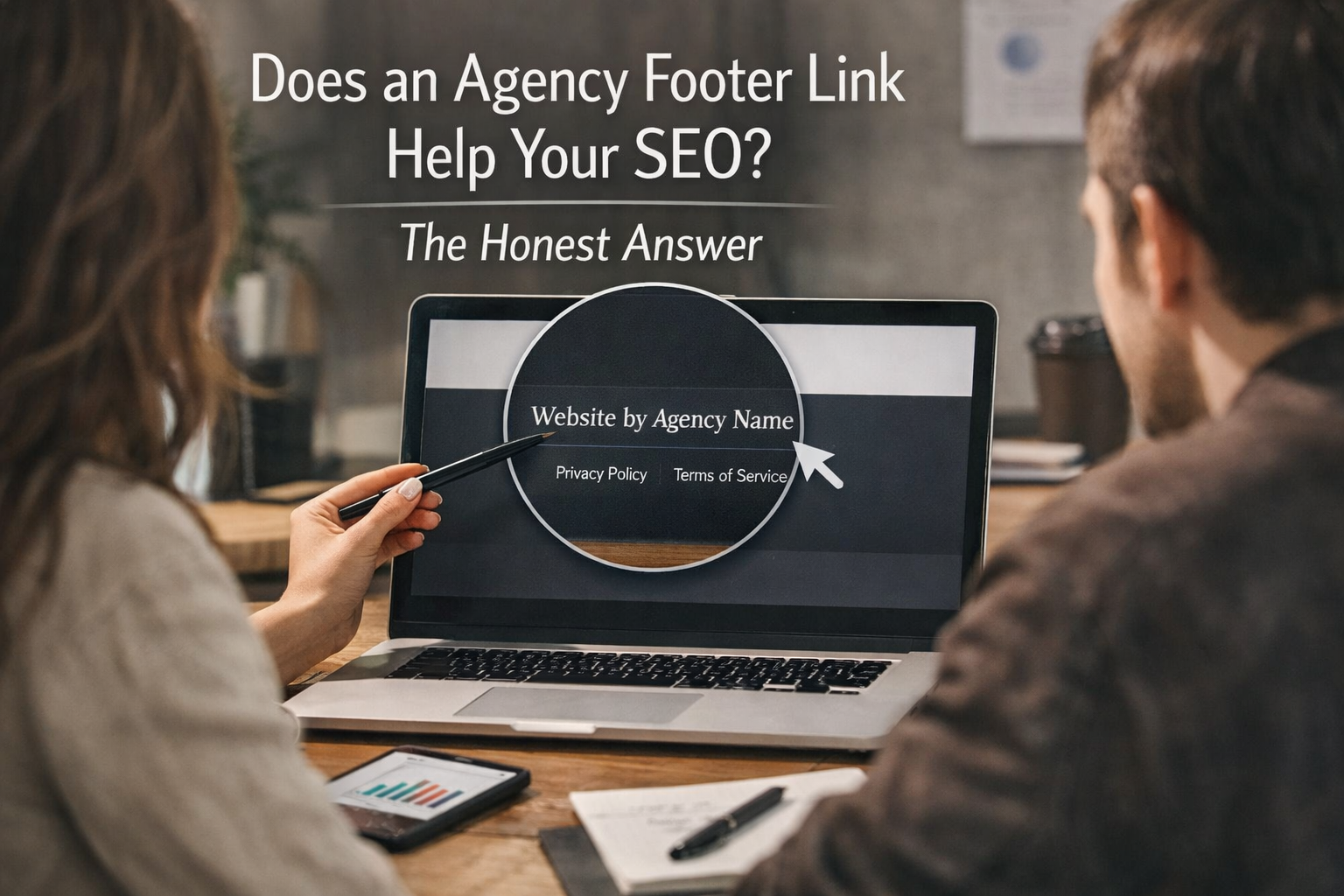
Walk through the footer of almost any small business website and you'll see it: "Website by [Agency Name]" with a link back to whoever built the site. It's been standard practice for two decades. Agencies ask for it. Clients agree to it without thinking. And somewhere along the way, both sides started quietly believing it was helping the client's SEO too.
Here's the uncomfortable truth: in most cases, a dofollow footer link pointing from your site to your agency doesn't help your SEO at all. It helps the agency's SEO — sometimes a lot — and depending on how it's implemented, it can actively hurt yours.
But there's a more interesting conversation buried under that. Because there are legitimate, non-SEO reasons to credit the agency that built your site, and there are specific ways to structure that relationship so it benefits you instead of draining you. Let's walk through the whole thing honestly.
The myth: "A footer link to my agency helps my site rank"
This one comes up a lot, and it's almost always wrong. Backlinks are a one-way street — they pass authority from the linking site to the linked site. If your site links out to your agency, your agency gets the SEO benefit. You don't.
The only way an outbound link helps your ranking is indirectly: Google's systems reward sites that link out to relevant, high-quality sources because it signals you're part of a genuine information ecosystem. But that benefit applies to any quality outbound link, not specifically to your agency. Linking to a credible industry resource would do the same thing.
So if someone has told you "keep that footer link — it's helping your SEO," they've either misunderstood how links work or they're selling you something.
The bigger problem: sitewide dofollow agency links can actually hurt you
This is where the conversation gets serious. The SEO community has been warning about sitewide footer links to agencies for over a decade, and the concern is real.
Here's why. When an agency drops a dofollow "Designed by Agency Name" link into your footer, that link appears on every single page of your site. If you have 500 pages, that's 500 sitewide backlinks pointing at your agency. That pattern — thousands of dofollow links with identical anchor text, sitewide, pointing to the same commercial site — is exactly the pattern Google's Penguin algorithm was built to catch back in 2013. It still gets flagged today.
The risk falls on both sides:
The agency can get penalized. When Google detects an unnatural link pattern from dozens or hundreds of client sites all linking to the same agency with commercial anchor text like "SEO agency" or "Philadelphia web design," that's a textbook manipulative link scheme.
The client can get penalized too. Google's spam systems don't just penalize the destination — they can devalue the source. If your site is part of what looks like a coordinated link scheme, your own rankings can suffer, even if you had no idea it was happening.
And here's the part most business owners never hear: you're paying for this. If your agency is also running SEO for you, they're billing you to build authority for your domain while simultaneously siphoning some of that authority back to their own. It's a conflict of interest that usually goes unspoken.
What Google actually says about this
Google's own guidance on agency footer links is unambiguous, and it's been consistent for years. Google's John Mueller has publicly advised that "designed by" credit links should always use the rel="nofollow" attribute.
A nofollow link still works like any other link from a user's perspective — they can click it, land on your agency's site, and become a lead. But the nofollow attribute tells Google, "this link is for attribution and advertising, not for passing ranking signals." That's the honest framing of what the link actually is. It removes the manipulation risk entirely.
If your agency has a dofollow footer link on your site, that's a signal worth noting. It doesn't necessarily mean they're acting in bad faith — some agencies genuinely haven't updated their practice since 2015. But it does mean the current setup is working against your interests.
The legitimate reasons to credit your agency in the footer
Okay, so dofollow SEO juice isn't the reason. That doesn't mean footer credits are worthless. There are real, defensible reasons to include your agency in your footer — they're just not the reasons you've been told.
1. Social proof and trust. If your agency has built sites for recognizable brands, seeing "Website by [Respected Agency]" in the footer is a quiet trust signal to informed visitors. B2B buyers, in particular, look at things like this.
2. A functional support channel. Many business owners genuinely want a click-to-reach line back to whoever built their site when something breaks. A visible footer credit is a practical shortcut.
3. Referral traffic. Other business owners who like your site will sometimes click through to find out who built it. That's real referral traffic for the agency, and legitimately earned — it came from someone admiring the work.
4. Local market association. If you're a Philadelphia business and your site is credited to a Philadelphia agency, that's a subtle local signal to visitors (though not a ranking factor). It reinforces that you work with local vendors, which matters in some markets.
All of these work perfectly fine with a nofollow link. None of them require you to pass ranking signals to your agency.
What actually does help your site SEO-wise (and isn't a footer link)
If you want to build real authority for your site, the footer isn't where it happens. The things that actually move the needle:
Earned backlinks from relevant industry sites. A link from a trade publication, supplier, partner, or local chamber of commerce — placed because your content or business genuinely deserved the mention — is worth more than thousands of sitewide footer links.
Strategic internal linking. How your own pages link to each other is one of the most underused levers in SEO. Your footer is prime internal linking real estate — use it for your most important service pages, locations, or resource hubs, not for an outbound agency link.
Citations in local directories and industry listings. For local businesses especially, consistent name-address-phone mentions across credible directories matter more than most business owners realize.
Content that earns links naturally. Case studies, original research, practical guides, data-driven pieces — these earn links because they deserve them. No footer swap required.
None of these require you to give away link equity to your agency. And none of them rely on a tactic Google has been actively discouraging for over a decade.
What to ask your current agency
If you're reading this and wondering about your own setup, here are the questions worth asking:
Is there a link to the agency in my footer right now?
If yes, is it dofollow or nofollow? (Anyone can check this by right-clicking the link, choosing "Inspect," and looking for rel="nofollow" in the HTML.)
What anchor text does it use? (Generic attribution like "Website by Agency Name" is far safer than keyword-stuffed anchors like "Philadelphia SEO services.")
Is it on every page, or just the homepage?
Is this footer credit covered in our contract, and can it be removed on request?
A good agency will answer all of these openly. A good agency will also already have the link set to nofollow by default, because that's the actual best practice.
If you ask and the answer is evasive — or if the agency pushes back hard on removing or nofollowing the link — that's telling you something about whose interests are actually being served.
The honest summary
A footer link from your site to your agency does not help your SEO. It helps your agency's SEO. Done wrong (sitewide, dofollow, keyword-rich anchor text), it can actively hurt both sides. Done right (single placement, nofollow, attribution-style anchor like a small "Website by" credit), it's a fine marketing arrangement that serves legitimate purposes — just not the ones most people assume.
The framing that matters is this: your website's footer is an asset you paid for. Decide deliberately what goes there. Credit your agency if you want to — most business owners are happy to. Just know what you're giving up and what you're getting back, and make sure the link is structured so it doesn't put either of you at risk.
Frequently Asked Questions
Does having my agency in the footer help my Google ranking?
No. Outbound links transfer ranking signals from your site to the destination, not the other way around. A link from your site to your agency helps your agency's SEO, not yours. Anyone telling you otherwise has the relationship backward.
Is it bad to have a "Designed by" link in my footer?
Not automatically. It depends entirely on how the link is implemented. A single, nofollow "Designed by [Agency]" credit with generic anchor text is fine and carries no risk. A dofollow sitewide link with commercial anchor text like "Philadelphia SEO agency" is a known spam pattern that can hurt both sites.
What's the difference between a dofollow and nofollow link?
A dofollow link passes ranking authority ("link juice") from the source site to the destination. A nofollow link — identified by rel="nofollow" in the HTML — still works normally for clicks and referral traffic, but tells Google not to pass ranking signals. For agency footer credits, Google's John Mueller has explicitly recommended using nofollow.
How do I check whether my footer link is dofollow or nofollow?
Right-click the footer link and choose "Inspect" in your browser. Look at the HTML for the link. If you see rel="nofollow"in the anchor tag, it's nofollow. If there's no rel attribute or it says rel="dofollow" (which isn't technically a real attribute but is sometimes used), it's passing authority. You can also use free browser extensions that highlight link types automatically.
Can I ask my agency to remove the footer link?
Yes. Unless your contract explicitly requires the credit — which is rare and should raise questions — the footer of your site is yours to control. A reasonable agency will remove it on request or agree to nofollow it. If they refuse, that's a meaningful signal about the relationship.
Should I link to my agency anywhere else on my site?
If you want to — a single link on a "credits" page or a case study where they're genuinely part of the story is fine and natural. What Google flags is the pattern of sitewide identical links across many client sites. A one-off contextual mention doesn't trigger that pattern.
Is a footer link to my agency worth anything to them?
Yes, which is exactly why so many agencies quietly insist on them. Each client site with a dofollow footer link is effectively a backlink on every page of that site, and across dozens of clients, that adds up to significant domain authority at zero acquisition cost. That's the dynamic you're participating in when you agree to one.
What should be in my footer instead?
Your footer is prime real estate for internal linking. Put your core service pages, location pages, contact information, primary calls to action, social media links, and any legal or trust pages (privacy policy, terms, accreditations). That's footer space working for your business, not siphoning authority out of it.
Do nofollow links pass any SEO value at all?
Google has said nofollow links are used as a "hint" rather than a strict directive since 2019, meaning they may still carry some signal in specific cases. But for practical purposes, treat nofollow as passing zero ranking authority. The primary value of a nofollow link is referral traffic and brand exposure, not SEO.
My agency says the footer link helps both of us — are they lying?
Not necessarily lying, but likely either out of date or reframing a tactic that benefits them as a mutual win. The "it helps both of us" framing hasn't been defensible since around 2013. Ask them to put the claim in writing and explain the mechanism. A straight answer should tell you what you need to know.
Work with an agency that puts your SEO first
At Ritner Digital, we build websites, SEO, and ad systems that work for your business — not for ours. Our footer credits (when we include them at all) are nofollow by default, because that's the honest best practice and because we don't need to borrow authority from our clients to build our own.
If you're working with an agency right now and you're not sure whether they're quietly benefiting at your site's expense, we'll do a free audit and show you exactly what's in your footer, what it means, and what a cleaner setup would look like. No pressure, no lock-in — just a clear look at what you're actually paying for.