Impressions Up and Position Down — Or Position Up and Impressions Down? What Your Search Console Data Actually Says About Your SEO Maturity
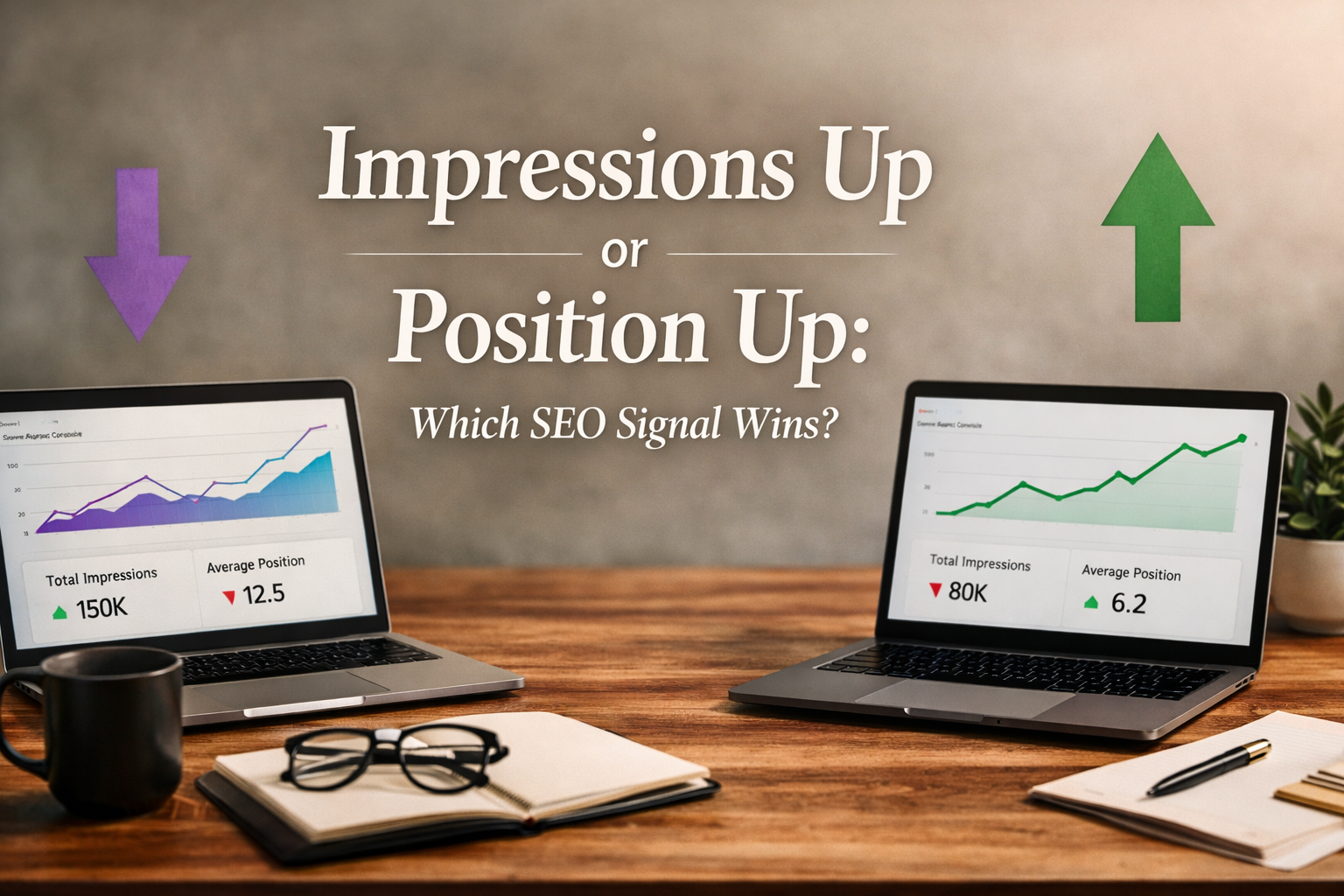
If you've spent any real time inside Google Search Console, you've heard both sides of this argument — usually from different SEOs, usually within the same week:
Version 1: "Impressions are up, average position went down. That's great — it means you're expanding into more keywords."
Version 2: "Impressions are down, average position went up. That's great — it means the keywords you do rank for are getting stronger."
Both are technically defensible. Both are also how agencies quietly reframe flat or declining performance as a "win." So which one is actually better? And more importantly — what does each pattern tell you about where your SEO program actually sits on the maturity curve?
This is the guide we wish someone had handed our clients before their last quarterly review.
First, a quick refresher on what these two metrics actually are
Before we get into interpretation, let's make sure we're talking about the same thing — because these metrics are subtler than they look.
Impressions are how often a link to your site appears on a Google search results page. For a standard blue link, the impression counts even if the user never scrolls down to see it. For carousels, the result has to actually be scrolled into view. A result has to get an impression for a position to be recorded at all — no impression, no data point.
Average position is the impression-weighted average rank of your URLs across every query they appeared for. If your page shows up at position 3 for one query and position 7 for another, your average position is 5. Remember that "lower is better" here — position 1 is the top of the page, position 40 is deep on page 4. When people say "average position went down," they almost always mean the number got bigger, which means your average rank got worse.
One non-obvious thing: average position is an aggregate, not a single real-world rank. Your "average position" of 12 might mean you rank 3 for your main keyword and 25 for a bunch of long-tail stuff — not that you rank 12th for anything specific. That distinction matters a lot once we start interpreting movement.
A critical note for anyone comparing year-over-year data right now: Google made major changes to how impressions are reported in late 2025 after deprecating the &num=100 parameter, which third-party scrapers had been using. As Search Engine Land explained, many sites saw impression drops that weren't real performance changes — they were reporting corrections. Google also confirmed a separate logging bug that over-reported impressions from May 2025 onward, which was corrected in late 2025. If your data took a step-change around either period, factor that in before drawing conclusions.
Scenario A: Impressions up, average position worsens (the number gets bigger)
This is the pattern most agencies point to when they want to tell you things are going well despite a lower-looking rank.
What it usually means: You're showing up for more queries than you used to, and many of those new queries rank lower than your established keywords. When everything averages together, the aggregate position gets pulled down by the new entrants.
Why this is often a good sign: It means Google is indexing more of your content and starting to associate your site with a broader set of topics. For a site that's been building out content — publishing new pages, expanding into new service areas, going deeper into topical clusters — this is exactly what you'd expect to see. You're casting a wider net. The net isn't tight yet, but it's in the water.
When this is actually a bad sign: Impressions can go up for reasons that have nothing to do with you winning. A few things to watch:
You rank for irrelevant queries. If your impression growth comes from queries that don't match your business, that's not authority — that's noise. A plumber ranking on page 4 for "plumbing memes" has more impressions. It doesn't mean more leads.
The SERP itself changed. Google adds and removes features (AI Overviews, People Also Ask, image packs) that can expose or bury listings without any ranking change on your side.
Seasonality or a news cycle lifted you temporarily. Holiday searches, a viral event, a trending topic — impressions spike, but don't sustain.
CTR is cratering. More impressions with fewer clicks means you're showing up but nobody's choosing you. That's a visibility problem, not a win.
The real test for Scenario A: Are the right queries growing? Segment your GSC data by query type. If branded queries, commercial-intent queries, and queries that match your service offering are all trending up — even at mediocre positions — you're genuinely expanding. If the growth is all long-tail informational fluff that will never convert, you're inflating a vanity metric.
Scenario B: Impressions down, average position improves (the number gets smaller)
This one sounds cleaner because rank is the metric everyone intuitively cares about. "We rank higher" feels like winning. And sometimes it is.
What it usually means: You've either lost visibility on a bunch of lower-ranking queries (which used to drag your average down), or you've pruned/consolidated content, or you've gotten more selective about what you target. The remaining queries you rank for are higher-quality, higher-positioned ones — so the average looks better.
Why this is often a good sign: This is what healthy focus looks like. You've killed the thin, off-target content. You've consolidated overlapping pages. You've stopped chasing every keyword and started winning the ones that matter. Your cannibalization issues have resolved. Your strongest pages are getting rewarded because the weaker pages aren't competing with them anymore.
When this is actually a bad sign: Impressions falling is only a good thing if you intended it. A few scenarios where it's not:
You got hit by an algorithm update or a reporting change and lost visibility you wanted.
A competitor is outranking you on queries you used to show up for, so you've dropped off page 2 entirely (which removes those impressions from your data and mechanically improves your average).
You de-indexed or broke pages without realizing it. Technical issues can quietly tank impressions.
You stopped publishing. New content drives fresh impressions. If you quietly pulled back on content velocity, your impression base shrinks.
The AI Overview ate your click. Zero-click searches are increasingly common. You might still be ranking — you just aren't being seen.
The real test for Scenario B: Did clicks hold or grow while impressions dropped? If clicks are steady or up while impressions are down, you've genuinely traded quantity for quality — the stuff you're still ranking for is working harder. If clicks fell alongside impressions, you didn't refine anything. You just lost ground.
So which is actually better?
Here's the honest answer: neither pattern is inherently better. They just signal different things about where you are.
What actually matters is whether clicks, qualified traffic, and conversions are moving in the right direction. Impressions and position are leading indicators. They hint at what's going to happen. They're not the thing that pays the bills.
If you're forced to pick a tiebreaker, it's this: a pattern where clicks are growing faster than impressions (meaning your CTR is improving) almost always beats one where impressions grow but CTR dilutes — regardless of which way position moved.
The maturity framework: what each pattern actually tells you about your SEO stage
Here's where most analysis stops and where the useful conversation actually begins. The same movement in impressions and position means wildly different things depending on what stage your SEO program is in.
Stage 1: New or low-maturity site (under a year of serious SEO investment)
You want to see: Impressions up, average position down (Scenario A).
At this stage, you're not trying to rank #1 for anything yet — you're trying to get Google to notice you at all. You're building the foundation. You want to see your content hitting more and more SERPs, even at page 3 or page 4 positions. That's Google saying, "Okay, I know what you're about, I'll start testing you on relevant queries."
If you're at Stage 1 and your impressions are flat, you don't have an SEO problem — you have a content and indexing problem. Nothing is compounding because nothing is being published, linked to, or considered.
Stage 2: Building momentum (growing, ranking on page 2–3 for target terms)
You want to see: Impressions growing AND average position holding or slightly improving.
This is the inflection point. You have enough content in the index. Now you need the right content to start climbing. At this stage, you should start splitting your analysis — look at impressions and position for your priority keyword set separately from everything else. Your priority list should show position improvement. Everything else can stay messy.
Most businesses get stuck here for years because they keep doing Stage 1 tactics (publishing more content) when what they need is Stage 2 work (improving the pages that are stuck on page 2).
Stage 3: Established authority (ranking on page 1 for core terms, building topical dominance)
You want to see: Position improving on commercial-intent keywords. Impressions can do whatever — the question is whether they're the right impressions.
At this stage, Scenario B (impressions down, position up) is often a deliberate and healthy outcome. You're pruning. You're consolidating. You're killing cannibalization. You're focusing the site around the queries that actually produce revenue. If your overall impression volume drops 15% but your impressions on money keywords grow, that's a win.
Warning sign at Stage 3: impressions growing but position and clicks flat. That usually means you're publishing content that expands surface area without expanding authority — busywork disguised as strategy.
Stage 4: Market leader (dominating the topic)
You want to see: Stability, with incremental position gains on new, adjacent topics.
If you're the leader in your space, dramatic movement in either direction is usually bad news. You want steady top-3 rankings for your core terms, and you want to see new clusters of queries entering your impression data as you expand into adjacent topics. Leaders grow through controlled topical expansion — covering one topic completely before expanding to the next related one.
At this stage, the question is never "impressions or position?" — it's "are we defending our core while we expand our edges?"
The segmentation that actually makes this useful
Here's the practical move most SEOs skip: stop looking at your aggregate numbers. The site-wide view is the one that causes the "is this good or bad?" confusion in the first place.
Break your GSC data into at least three segments:
Branded queries — searches that include your company name. These should be rock-solid position 1, with impressions growing in line with your brand marketing. If branded impressions drop, you have a brand awareness problem, not an SEO problem.
Commercial-intent queries — searches from people who want to buy, book, or hire. These are the queries that matter most. Track position and CTR on these obsessively. Ignore what your "average" site-wide position does if this subset is improving.
Informational/top-of-funnel queries — searches from people researching. Impressions here can grow wildly and should; position can be mid-pack and still be fine. These queries are how you build the trust layer that makes the commercial queries convert later.
Once you're segmenting like this, the "impressions up, position down" versus "impressions down, position up" debate mostly disappears. You stop looking at a single blended number and start answering the real question: is each part of the funnel doing what it's supposed to be doing?
The signals to actually watch
Instead of arguing about which direction the arrows are pointing, watch for these patterns:
Clicks growing faster than impressions → your CTR is improving, which usually means better rankings on better queries. Strong signal.
Impressions growing faster than clicks → you're getting exposure but losing the click. Check titles, meta descriptions, SERP features eating your clicks.
Impressions and clicks both dropping on commercial queries → real performance decline. Don't let anyone tell you otherwise.
Impressions flat but position improving on a specific page cluster → that cluster is maturing. Reinvest there.
Position improving site-wide after content pruning → healthy refinement. Keep going.
Position "improving" because long-tail impressions fell off a cliff → probably a reporting change or lost visibility, not a win. Verify against clicks.
The one-line takeaway
Impressions and position are useful as a paired signal, not a scoreboard. The right question isn't "which direction is better?" — it's "does the movement in these metrics match the stage my SEO program is actually in, and is it showing up in clicks and conversions yet?"
If you can answer yes, you're on track. If you can't, the aggregate numbers are telling you a story that isn't real.
Work with an SEO team that reads the data honestly
Most of the confusion around impressions and position happens because someone wants the numbers to tell a flattering story. At Ritner Digital, we don't sell impressions. We build search programs that compound — technical cleanup, content planning rooted in intent, and reporting that connects SEO activity to leads and revenue instead of vanity metrics.
If you've been getting reports full of arrows and percentages but can't tell whether your SEO is actually working, we'll give it to you straight. Get a free 200+ point SEO audit from our Philadelphia team — we'll show you exactly where you are on the maturity curve, what's actually moving the needle, and what to fix next.
Sources
Google Search Console Help: What are impressions, position, and clicks?
Search Engine Land: Why Google Search Console impressions fell (and why that's good)
ALM Corp: Google Search Console Inflated Impression Counts — What Changed and What to Do Now
Incremys: Google Search Console Position Analysis Guide (2026)
Incremys: Google Search Console Impressions Analysis Guide (2026)
Search Engine Land: How SEO maturity unlocked a 133x ROAS in medical device marketing
Jen Ruhman: The SEO Maturity Model — What Stage Is Your Business In?
Frequently Asked Questions
Is it better for impressions to go up or average position to improve?
Neither is inherently better — they signal different things depending on your SEO maturity stage. For new or low-maturity sites, rising impressions (even with a worsening average position) is usually the healthier signal because it shows Google is starting to recognize and index your content. For established sites, improving position on commercial-intent keywords matters more, even if overall impressions drop due to pruning or consolidation. The metric that actually matters in both cases is whether clicks and conversions are moving in the right direction.
Why did my average position get worse when I published more content?
This is almost always Scenario A in action. When you publish new pages, they typically enter the index at lower positions than your established, stronger pages. Those new lower-ranked queries pull down the impression-weighted average. The aggregate number looks worse, but your site is actually expanding its reach. Segment your data by page or query cluster to see what's really happening — your core pages are probably holding or improving while the new content drags the average.
My impressions dropped but my average position improved. Did my SEO get better?
Maybe, maybe not. Check clicks. If clicks held steady or grew while impressions fell, you likely pruned weak content or consolidated overlapping pages successfully — that's a healthy refinement. If clicks fell alongside impressions, you lost real visibility and the "better" position is just a mathematical artifact of losing your lower-ranked queries. Also verify that the drop isn't tied to the September 2025 &num=100 reporting change or the May 2025 logging bug Google later corrected.
What's a "good" average position in Google Search Console?
It depends entirely on what you're measuring. For your target commercial keywords, you want to be in the top 3 — that's where the vast majority of clicks go. For informational or long-tail content, ranking in the top 10 is solid, and even positions 11–20 can produce meaningful traffic on high-volume queries. The site-wide aggregate average position is mostly a vanity number because it blends your best and worst pages together. Always segment before judging.
Why does Google Search Console show a different position than where I actually rank?
Because average position is an impression-weighted aggregate across every query, device, and location where you appeared — not a single fixed rank. You might rank #3 for your main keyword but show an "average position" of 15 because you also appear at position 40 for dozens of long-tail queries. Segment by specific query, device, and country to get closer to your actual rank for any given search.
Should I focus on getting more impressions or improving my position first?
Depends on your stage. If you're new or have thin content coverage, focus on impressions — you need Google to recognize you across more queries before position gains matter. Once you're consistently getting impressions on your target terms (typically ranking page 2 or better), shift focus to position improvement on the keywords that drive revenue. Trying to optimize position before you have impression coverage is like polishing a car you haven't built yet.
Are impressions a vanity metric?
They can be, yes. Impressions only matter if they're on queries that match your business and eventually convert into clicks and customers. A site with 1 million monthly impressions on irrelevant long-tail queries is worse off than a site with 10,000 impressions on high-intent commercial keywords. Always pair impression data with query relevance and CTR before treating it as a sign of health.
Why did my impressions suddenly drop in late 2025?
Most likely one of two Google changes. In September 2025, Google stopped supporting the &num=100 URL parameter that third-party SEO tools had been using to scrape rankings, which removed a lot of crawler-generated impressions from Search Console data. Separately, Google confirmed a logging bug that over-reported impressions from May 2025 onward, and that was corrected in late 2025. If your drop aligns with either period and your clicks stayed stable, it's probably a reporting correction rather than a performance problem.
What should I actually report to my boss or client each month?
Report clicks, qualified traffic, and conversions as your headline numbers. Use impressions and position as supporting context that explains why clicks moved. Segment by branded queries, commercial-intent queries, and informational queries so you can show which part of the funnel is working. Skip the blended site-wide average position entirely — it creates more confusion than insight and almost always invites a bad-faith interpretation in either direction.
How often should I check these metrics?
Weekly for anomaly detection — big swings usually signal a technical issue, an algorithm update, or a SERP feature change that needs investigation. Monthly for trend analysis and prioritization. Anything more frequent than weekly is noise, and anything less frequent than monthly means you'll miss problems until they've already cost you.