Stop Chasing Leads. Start Attracting Them: How the Right SEO Strategy Turns Your Business Into the One Customers Find
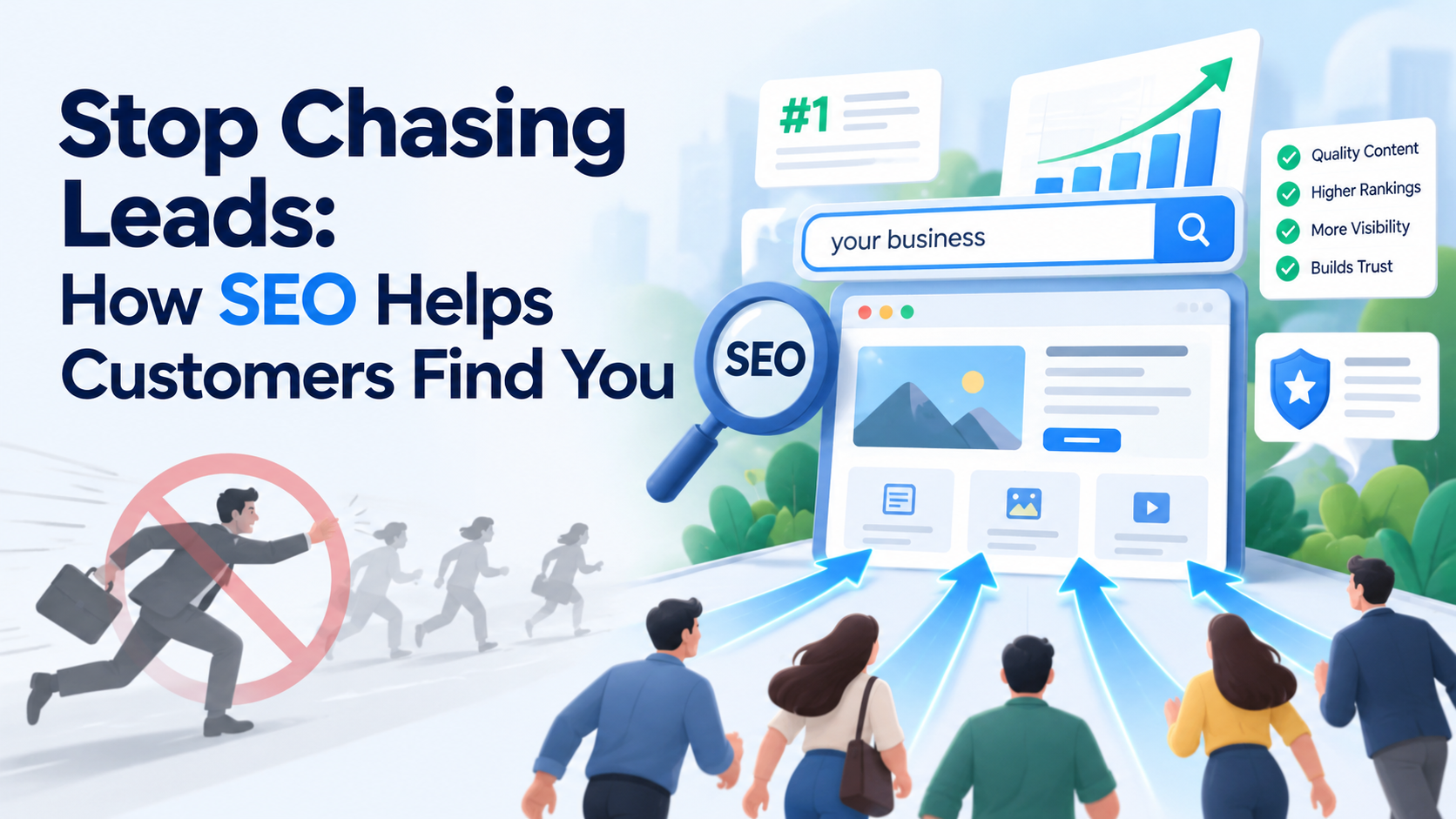
There is a quote that perfectly captures what good search engine optimization is supposed to do for a business:
“Don’t chase what you want. Keep upgrading yourself until what you want starts chasing you.”

Most people read that as advice about personal growth.
But it might be one of the best descriptions of SEO we have ever seen.
Because a lot of businesses spend their marketing lives chasing.
They chase leads.
They chase clicks.
They chase prospects who stopped answering emails.
They chase people on social media.
They chase yesterday’s algorithm.
They chase referrals.
They chase the latest marketing tactic someone promised would transform their pipeline in thirty days.
And when the chasing stops, so does the business.
Pause the advertising campaign and the traffic disappears. Stop posting constantly and engagement falls. Stop cold emailing and the conversations dry up. Stop prospecting and the pipeline suddenly looks uncomfortable.
There is nothing inherently wrong with outbound marketing or paid advertising. Both can be valuable components of a larger marketing strategy.
The problem is dependence.
A business should not have to run faster every month simply to remain in the same place.
SEO offers a different model.
Instead of repeatedly interrupting people and asking them to pay attention to you, you improve the digital presence of your business until people who already need what you sell can discover you.
You stop trying to manufacture attention.
You start becoming easier to find.
That distinction is at the heart of what an experienced SEO firm such as Ritner Digital helps businesses accomplish.
SEO is not about sitting back and hoping customers magically appear. In fact, strong SEO requires substantial work. The difference is that the work goes into building an asset that can continue creating visibility after the work is published.
You upgrade the website.
You upgrade the content.
You upgrade the information Google has about your business.
You upgrade your authority.
You upgrade your reputation.
You upgrade the way your products and services match the language customers actually use when they search.
Eventually, something interesting begins to happen.
You are not searching for every customer.
More customers begin searching for you.
The Expensive Habit of Chasing Attention
Consider how traditional prospecting often works.
A business needs more revenue, so someone decides it needs more leads.
The company launches an advertising campaign, sends more emails, makes more calls, attends more networking events, buys another lead list, posts more frequently or increases its paid media budget.
Some of those things work.
Then the campaign ends.
The lead source slows down.
So the company starts again.
This is the marketing equivalent of filling a bucket that has a hole in the bottom.
As long as you keep pouring, everything looks fine.
The moment you stop, you discover how little you actually own.
This problem becomes particularly obvious with paid traffic. Advertising can put a company in front of prospective customers quickly, which is why paid search remains useful. But visibility is generally tied directly to continued spending. Ritner Digital describes the problem plainly on its own website: when businesses are overly dependent on advertising, they can end up “renting traffic instead of owning it.” Ritner Digital | AI Search & SEO Agency
Organic search creates a different kind of asset.
A useful service page you publish today may continue appearing in search months from now.
A detailed guide can generate traffic long after the initial writing cost has been absorbed.
A strong Google Business Profile can repeatedly introduce your company to nearby searchers.
A piece of original research can earn links, mentions and citations from other websites.
A technically sound website can allow dozens or hundreds of existing pages to perform better without requiring you to pay every time somebody visits.
That does not make SEO free.
It makes SEO cumulative.
The work you do this month can become part of the foundation supporting the work you do next month.
That is the difference between chasing attention and building an ecosystem that attracts it.
Search Changes the Conversation Because the Customer Has Already Raised Their Hand
One of the most important advantages of SEO is intent.
When someone searches Google for “commercial roofing company near me,” “estate planning attorney Philadelphia,” “best CRM for small business,” “SEO company New Jersey,” or “how much does HVAC replacement cost,” that person has already expressed a need.
You did not have to convince them to become interested in the topic.
They told the search engine what they wanted.
Your job is to become a credible answer.
That matters because modern consumers still rely heavily on search when researching businesses. BrightLocal's 2025 consumer search research found that Google remained the starting point for a large share of online searches and that nearly three in five consumers search for something online multiple times per day. It also found that local intent represents a meaningful percentage of consumer search behavior. BrightLocal
By July 2026, BrightLocal's follow-up research found that 84% of consumers had searched for a local business online within the previous three months, while three-quarters used more than one channel during their most recent local-business search. Mobile devices dominated much of that activity, and even people who used AI tools often returned to Google or other channels to verify what they found. BrightLocal
That is what makes modern SEO larger than simply trying to rank a webpage.
Customers may encounter your business through Google Search, Maps, reviews, a directory, an article, a recommendation from an AI answer engine or another website that cites your expertise.
The goal is no longer merely:
“How do we rank for this keyword?”
The better question is:
“How do we become the business search engines, AI systems and customers repeatedly recognize as a credible answer?”
That is an attraction strategy.
What “Upgrading Yourself” Looks Like for a Business
The quote says to keep upgrading yourself until what you want begins chasing you.
For a business, those upgrades are remarkably concrete.
Your website either makes it easy for search engines to understand your company or it does not.
Your service pages either clearly answer what customers want to know or they do not.
Your company either has convincing proof and authority across the web or it does not.
Your local profiles either provide accurate information or they do not.
Your content either demonstrates genuine expertise or it sounds like another generic page written because somebody heard blogging was good for SEO.
Google itself makes the objective fairly clear.
Its Search Central guidance says its ranking systems are designed to prioritize helpful, reliable information created primarily to benefit people, rather than content created principally to manipulate rankings. Google recommends producing substantial, useful material that demonstrates knowledge, serves a real audience and leaves readers feeling that they learned enough to accomplish their goal. Google for Developers
That is why sustainable SEO is not about sprinkling keywords around a mediocre website.
It is about making the business's digital presence genuinely better.
And that usually begins underneath the surface.
Upgrade #1: Fix the Foundation Before Asking Google for More Traffic
A beautiful website can still be an SEO mess.
Pages can be accidentally blocked from indexing.
Important content can sit several clicks deep in the site architecture.
Multiple pages can compete against one another for the same search query.
URLs can redirect unnecessarily.
Mobile performance can be poor.
Internal links can fail to communicate which pages matter most.
Search engines can encounter duplicate or incomplete information.
Structured data can be missing.
A company may have dozens of excellent pages that Google simply does not understand as well as it could.
This is why serious SEO engagements often begin with an audit instead of immediately publishing twenty blog posts.
Ritner Digital's current SEO process starts with a technical and on-page audit, followed by keyword research, competitor analysis and a prioritized roadmap. Its listed SEO work includes technical cleanup, indexation, site architecture, internal linking, local SEO and Google Business Profile optimization. Ritner Digital | AI Search & SEO Agency
Think of this as renovating the storefront before increasing foot traffic.
You would not spend heavily promoting a physical store if the sign was missing, the door was difficult to open, the aisles were confusing and half the inventory had no labels.
Yet businesses do the digital equivalent constantly.
They invest in content or advertising without fixing the website that is supposed to convert the attention.
SEO firms identify and prioritize those foundational problems so subsequent marketing has somewhere productive to land.
Upgrade #2: Stop Guessing What Customers Want
Business owners know their industries.
That expertise is invaluable.
But expertise can also create a language problem.
Businesses often describe their services using terminology their customers never search.
They create pages around internal department names.
They write about what they want to promote rather than what their customers are trying to solve.
They assume the most obvious keyword is the most valuable keyword.
SEO research corrects this.
Keyword and search-intent research reveal how people describe their problems, what questions they ask, which services they compare, what geographic terms they use and how their search behavior changes as they move closer to making a decision.
Someone searching “what causes water under my furnace” is in a different stage of the journey than someone searching “emergency HVAC repair near me.”
Someone searching “what does an SEO company do” has different needs than someone searching “SEO agency Philadelphia pricing.”
Both may eventually become customers.
But they should not be greeted by identical content.
A good SEO strategy maps different questions to different pages and stages of the buyer journey.
This is where SEO stops being a collection of keywords and becomes an information system.
Ritner Digital has described this philosophy directly in its own content: businesses can build content across services, industries, locations, platforms and case studies so prospective customers can encounter the company from multiple search paths instead of relying on a single page or keyword. Ritner Digital | AI Search & SEO Agency
Instead of chasing one supposedly perfect keyword, you build a searchable ecosystem around the problems your company is qualified to solve.
Upgrade #3: Turn Your Website Into Your Best Salesperson
A ranking is not the ultimate goal.
A lead is not even the ultimate goal.
Revenue is.
That means an SEO firm should care about what happens after somebody reaches your website.
Does the page quickly explain the service?
Does it demonstrate why the company is credible?
Does it answer the questions preventing the visitor from contacting you?
Does it include real examples, data, expertise or proof?
Does it explain what happens next?
Does the call to action make sense for someone at that stage of the buying process?
Does the website work properly on mobile?
Can someone find a phone number, location, business hours or contact method without hunting for it?
BrightLocal found in its consumer search research that 85% of consumers considered contact information and opening hours important when researching local businesses. BrightLocal
That sounds basic.
It is.
And businesses still get it wrong.
Attracting customers requires reducing friction after they arrive.
Good SEO therefore overlaps with good user experience, good messaging and good sales enablement.
The page that ranks should also deserve the lead.
Upgrade #4: Build Content That Makes Customers Trust You Before They Contact You
Content marketing often gets reduced to “we need a blog.”
That is not a strategy.
Publishing random articles twice a month because somebody sold you a content package does not automatically build authority.
Useful content answers the questions sitting between a prospect and a purchasing decision.
How much will this cost?
How long will it take?
What are the alternatives?
What can go wrong?
What should I expect?
How do I compare providers?
When do I need professional help?
What does your process look like?
What should I ask before signing a contract?
These are sales conversations happening inside Google every day.
Content allows your business to participate in those conversations before the customer knows your company exists.
That is powerful because useful content can perform several jobs simultaneously.
It can rank for long-tail searches.
It can support your service pages through internal links.
It can provide salespeople with educational resources to send prospects.
It can establish expertise.
It can attract backlinks.
It can supply clear information that AI systems may use when generating answers.
It can reduce repetitive questions during the sales process.
And it can bring prospects back to your brand multiple times before they make a decision.
Google's own documentation encourages content creators to demonstrate first-hand expertise, provide meaningful depth and focus primarily on helping an intended audience. It also recommends being clear about who created content and why it exists. Google for Developers
The goal should not be to publish the most content.
It should be to become the most useful answer your business is qualified to give.
Upgrade #5: Become More Visible Where Local Customers Are Looking
For local businesses, SEO becomes even more tangible.
When somebody searches for a dentist, contractor, lawyer, restaurant, accountant, auto dealer, home service company or other nearby provider, Google's local results can become the front door to the business.
Google says its local ranking systems primarily consider relevance, distance and prominence.
Relevance reflects how well a Business Profile matches the search.
Distance reflects proximity to the searcher.
Prominence reflects how well-known a business appears, incorporating signals that can include links, reviews and other information about the company. Google specifically notes that complete business information and positive reviews can contribute to local performance. Google Help
You cannot optimize away geography.
But you can improve how clearly Google understands everything else.
That includes accurate business information, appropriate categories, service descriptions, location pages, reviews, citations, website content, links and the relationship between your website and your Business Profile.
Structured data can reinforce that understanding as well. Google's LocalBusiness documentation explains that structured data can communicate information including business hours and other organizational details to search engines. Google for Developers
This is another example of attraction through improvement.
You are not begging the person three towns away to consider your company.
You are becoming a stronger, clearer candidate when someone in your actual market searches for precisely what you provide.
Upgrade #6: Build a Reputation That Sells Before You Speak
Ranking is one battle.
Trust is another.
Imagine that two competing companies appear next to each other in local search.
One has an incomplete profile, inconsistent information, twelve reviews and no responses.
The other has detailed business information, current photos, thoughtful review responses and customers discussing specific positive experiences.
Which company feels safer?
Reviews are not merely an SEO tactic. They are part of the sales experience.
BrightLocal's 2025 review research found that only 4% of consumers said they never read online business reviews. Its research also found that consumers increasingly examine the substance of reviews rather than relying exclusively on a headline star rating. BrightLocal
That matters.
People want evidence.
They want to know whether you solved a problem similar to theirs.
They want to see how you treat customers.
They want to know whether negative feedback is ignored or handled professionally.
The SEO firm that understands reputation management therefore does more than “get reviews.”
It helps businesses build a repeatable system for requesting legitimate feedback, responding appropriately, showcasing proof and ensuring reputation signals support the rest of the search strategy.
You are upgrading trust.
And trust attracts.
Upgrade #7: Give the Rest of the Internet a Reason to Vouch for You
A business saying it is excellent is advertising.
Someone else saying it is excellent is evidence.
Search engines have long used links and references around the web as signals of authority and discovery.
But this principle has become even more important as search expands beyond a traditional list of blue links.
AI systems need information from somewhere.
Journalists need sources.
Industry publications need statistics.
Bloggers need examples.
Customers need independent proof.
The businesses creating original research, useful guides, expert commentary, case studies, tools and genuinely distinctive information give other websites a reason to mention them.
That is why modern link building should not mean buying hundreds of questionable links from websites nobody visits.
Authority should increasingly be treated as digital public relations.
Ritner Digital describes its approach as earning backlinks and brand citations through content worth referencing, media mentions, directories and other credible third-party signals. Its website also publicly displays examples of sites that have cited Ritner Digital's research and analysis. Ritner Digital | AI Search & SEO Agency
That creates a useful mental model:
Do something worth citing. Say something worth quoting. Publish something worth referencing.
Then make sure the right people can discover it.
That is far more durable than trying to manufacture authority through shortcuts.
Upgrade #8: Optimize for a World Where Search Does Not Always Look Like Google
Search behavior is changing.
A prospective customer may still type a query into Google.
But they may also ask ChatGPT which companies they should consider.
They may ask an AI-powered search experience to compare providers.
They may conduct discovery through Maps, YouTube, Reddit, Instagram or another platform.
Then they may move between several of those channels before making a decision.
BrightLocal's 2026 local-search research found that three-quarters of consumers used multiple channels during their most recent local-business search and that people using AI frequently verified information through other search channels. BrightLocal
This means businesses should not interpret “SEO” too narrowly.
The broader objective is search visibility.
Does the internet clearly understand who your company is?
What does it do?
Where does it operate?
What is it known for?
What evidence supports its expertise?
Which credible sources mention it?
Is information about the organization consistent across platforms?
Does the website contain content that answers specific questions clearly enough to be useful in both search results and generated answers?
Ritner Digital explicitly includes AI search visibility, entity SEO, schema markup, citation-worthy content and AI citation tracking within its current service model. Ritner Digital | AI Search & SEO Agency
Traditional SEO fundamentals still matter enormously.
But the destination is getting larger.
Businesses are no longer optimizing merely to be one of ten links.
They are building enough digital authority to be recognized as an answer.
Why Hiring an SEO Firm Changes the Equation
Business owners can absolutely learn SEO.
Some do it very well.
The challenge is rarely whether the information exists.
The challenge is time, prioritization and execution.
SEO crosses multiple disciplines at once.
It touches technical website architecture, analytics, copywriting, user experience, local search, competitive research, content planning, reputation, digital PR, link acquisition, structured data, conversion and increasingly AI visibility.
Most businesses do not struggle because there is literally nothing they could do.
They struggle because there are one hundred things they could do and no clear agreement about which five should happen first.
That is one of the most valuable functions of an experienced SEO partner.
Prioritization.
A capable SEO firm should be able to look at your business and say:
This technical problem is preventing important pages from being indexed.
These service pages need improvement before we create additional content.
This keyword looks exciting but does not match commercial intent.
This location deserves its own page.
These twenty articles are cannibalizing each other.
These reviews should be incorporated into the customer journey.
This competitor is winning because of authority, not keyword density.
This page is receiving impressions but its click-through performance needs work.
This traffic is growing, but it is not turning into leads, so something downstream is broken.
That is the difference between SEO activity and SEO strategy.
What the Right SEO Relationship Should Feel Like
Businesses should be careful when hiring an SEO agency because the industry has historically made it easy to hide mediocre work behind complicated terminology.
A monthly report containing thousands of impressions is not meaningful if nobody can explain whether those impressions contribute to the business.
Neither is a list of one hundred keywords if none of them has anything to do with profitable customer behavior.
SEO should become increasingly understandable as the engagement progresses.
You should know what is being changed.
You should know why it matters.
You should know what is improving.
You should know what has not worked yet.
You should know what happens next.
And you should be able to connect search performance to actual business outcomes as closely as the available data allows.
That transparency is central to Ritner Digital's positioning. The agency publishes its own Search Console performance—including declines as well as gains—and describes its client reporting as plain-English reporting tied to Search Console, Google Analytics, leads, calls and pipeline rather than vanity metrics alone. Ritner Digital | AI Search & SEO Agency
That is an important distinction.
SEO is probabilistic.
No legitimate firm controls Google's algorithm.
No agency can purchase an organic #1 ranking from Google. Google itself explicitly says there is no way to request or pay for a better local ranking. Google Help
What a good agency can control is the quality and consistency of the work.
The Attraction Flywheel
The real value of SEO appears when the individual improvements begin reinforcing one another.
Your technical foundation improves.
That helps search engines crawl and understand the site.
You create stronger service pages.
Those pages begin ranking for commercially relevant searches.
You publish useful supporting content.
That content attracts informational traffic and strengthens your topical authority.
Some content earns backlinks and mentions.
Those authority signals strengthen the domain.
Customers find the business and leave reviews.
The reviews increase confidence among future searchers.
Your brand receives more searches.
Your business becomes more recognizable.
Third-party websites cite your expertise.
Search engines and AI systems encounter more consistent evidence about who you are and what you do.
More prospective customers discover the company.
More first-party data becomes available.
That data tells you which content and searches actually generate opportunities.
Then you reinvest in the areas that work.
That is the flywheel.
None of these things eliminates the need for sales.
None eliminates advertising.
None means a business never has to prospect again.
What changes is the balance.
Instead of your sales team being solely responsible for creating awareness from zero, more prospects arrive having already encountered the company.
Instead of introducing yourself for the first time on a cold call, the prospect may say:
“I keep seeing your company.”
“I found your article.”
“You came up when I searched.”
“I read your reviews.”
“Someone referenced your research.”
“Google recommended you.”
“An AI search mentioned you.”
That is what attracting demand looks like.
SEO Is Not About Doing Nothing. It Is About Doing Work That Keeps Working
“Stop chasing” can sound passive.
SEO is anything but passive.
You are still competing.
You are still publishing.
You are still analyzing.
You are still improving.
You are still earning attention.
But instead of spending all your effort pursuing individual prospects one at a time, you are improving the machinery that brings prospects toward the business.
A salesperson can have one conversation at a time.
A strong page can answer the same important question for thousands of people.
A cold email can disappear in seconds.
A useful guide can remain discoverable for years.
An advertisement stops when its budget stops.
A ranking or citation you earn can continue producing exposure after the initial investment, although maintaining performance still requires ongoing work as competitors, content and search systems evolve.
This is what makes the quote such an effective philosophy for search marketing.
Do not spend your entire marketing budget chasing what you want.
Upgrade the business people discover when they search.
Upgrade your website.
Upgrade your information.
Upgrade your authority.
Upgrade your content.
Upgrade your reputation.
Upgrade your measurement.
Become a better answer.
Then make sure search engines can see it.
Frequently Asked Questions
How does SEO help a business attract customers instead of chasing leads?
SEO increases the chances that your business appears when prospective customers are already searching for your products, services or expertise. Rather than initiating every interaction through cold outreach or advertising, you build visibility around existing demand. The prospect begins the conversation by searching, and your optimized website, content, local presence and authority give your company an opportunity to become the answer.
Is SEO better than paid advertising?
They solve different problems.
Paid advertising can create visibility quickly and is often valuable for promotions, testing and highly targeted customer acquisition. SEO typically takes longer but builds organic visibility that does not require paying for every click.
Many businesses benefit from using both. Paid campaigns can capture immediate demand while SEO builds a longer-term source of visibility and inbound opportunity.
The bigger strategic problem is relying entirely on a channel that stops producing the moment you stop spending.
How long does SEO take to work?
There is no universal timeline because results depend on the website's current condition, competition, industry, market, domain history, technical issues, content and authority.
Ritner Digital currently describes three to six months as an average time-to-results benchmark for its SEO work, while also emphasizing ongoing content, technical improvements and tracking. Ritner Digital | AI Search & SEO Agency
Some improvements can surface sooner. More competitive searches may take considerably longer.
A trustworthy SEO company should set expectations based on your actual starting point rather than promising a guaranteed ranking by a specific date.
Can anyone guarantee a #1 Google ranking?
No legitimate SEO company can guarantee control over Google's organic rankings.
Google determines rankings using its own systems, and Google states explicitly that businesses cannot request or pay for better local organic rankings. Google Help
An SEO firm can improve your website, strategy, content, authority and visibility. It cannot sell ownership of Google's algorithm.
Be skeptical of anyone who claims otherwise.
Do small businesses really need SEO?
For businesses whose customers search online before buying, SEO can be particularly valuable.
This is especially true for local companies, professional services, contractors, healthcare organizations, law firms, financial firms, dealerships, B2B providers and businesses selling services people actively research.
BrightLocal's 2026 research found that 84% of consumers had searched online for a local business during the previous three months, illustrating how deeply digital discovery is embedded in customer behavior. BrightLocal
Is blogging still useful for SEO?
Yes, when the content serves a legitimate strategic purpose.
Publishing generic articles simply to increase your page count is not a strong strategy.
Useful blog content should answer questions your audience genuinely asks, demonstrate expertise, support important service pages, cover meaningful topics in depth and give customers a reason to trust your organization.
That approach aligns with Google's guidance around helpful, reliable, people-first content. Google for Developers
Does SEO include Google Business Profile optimization?
Local SEO commonly includes Google Business Profile optimization because the profile is an important component of how local businesses appear across Google Search and Maps.
Google says complete and accurate business information can help it understand a company's relevance, while reviews and broader prominence signals can influence local visibility. Google Help
Ritner Digital includes local SEO, Google Business Profile work and review strategy within its search services. Ritner Digital | AI Search & SEO Agency
Do reviews really affect whether customers choose a company?
Yes.
Reviews give prospective customers independent evidence about previous customer experiences, and review platforms remain a major component of local-business research.
BrightLocal's 2025 study found that only 4% of consumers said they never read online business reviews. The research also suggests people pay attention to the substance and authenticity of reviews rather than evaluating businesses solely by star ratings. BrightLocal
What is AI search optimization, and how is it related to SEO?
AI search optimization focuses on improving the likelihood that a business, brand or piece of content can be understood, retrieved, referenced or cited by AI-driven search and answer systems.
It overlaps heavily with traditional SEO because both benefit from clear site architecture, authoritative content, accurate entity information, structured data, third-party mentions and credible citations.
The difference is that businesses increasingly need to think beyond ranking a webpage and consider whether their brand is recognized as a trusted source across a broader information ecosystem.
How do I know whether an SEO company is actually working?
Look beyond isolated keyword rankings.
An effective SEO reporting system should help you understand changes in organic visibility, qualified traffic, conversions, leads, calls and other business outcomes. It should also explain what work was completed, what changed, where progress has stalled and what will happen next.
SEO reporting should make the strategy easier to understand, not hide it behind jargon.
Why hire Ritner Digital for SEO?
Ritner Digital combines traditional search strategy with technical SEO, local optimization, content systems, authority building, digital PR, analytics and AI search visibility. The company also publicly shares its own search performance and describes a reporting approach built around explaining the real numbers—including the periods where performance does not move perfectly upward. Ritner Digital | AI Search & SEO Agency
That transparency fits the larger philosophy behind this article.
You do not attract more business by pretending everything is perfect.
You attract it by becoming better, becoming more useful, becoming more visible and proving the work.
Sources
This article draws on guidance and research from Google Search Central, Google Business Profile Help, BrightLocal and Ritner Digital's published SEO methodology and performance information.
Google Search Central: Creating Helpful, Reliable, People-First Content
Google Business Profile: Tips to Improve Your Local Ranking
Google Search Central: LocalBusiness Structured Data
BrightLocal: Consumer Search Behavior Research
BrightLocal: Local Consumer Review Survey 2025
BrightLocal: Where Are Your Customers Really Searching? 2026 Research
Stop Chasing. Start Building Something Customers Can Find.
Your next customer may already be searching for exactly what your business does.
The question is whether they find you or the competitor who invested in becoming easier to discover.
Ritner Digital helps businesses improve the technical foundation, content, local visibility, authority and search presence that turn Google and AI search into long-term customer acquisition channels.
Stop spending all your energy chasing attention.
Build the kind of digital presence that attracts it.
Contact Ritner Digital and start building your search visibility →