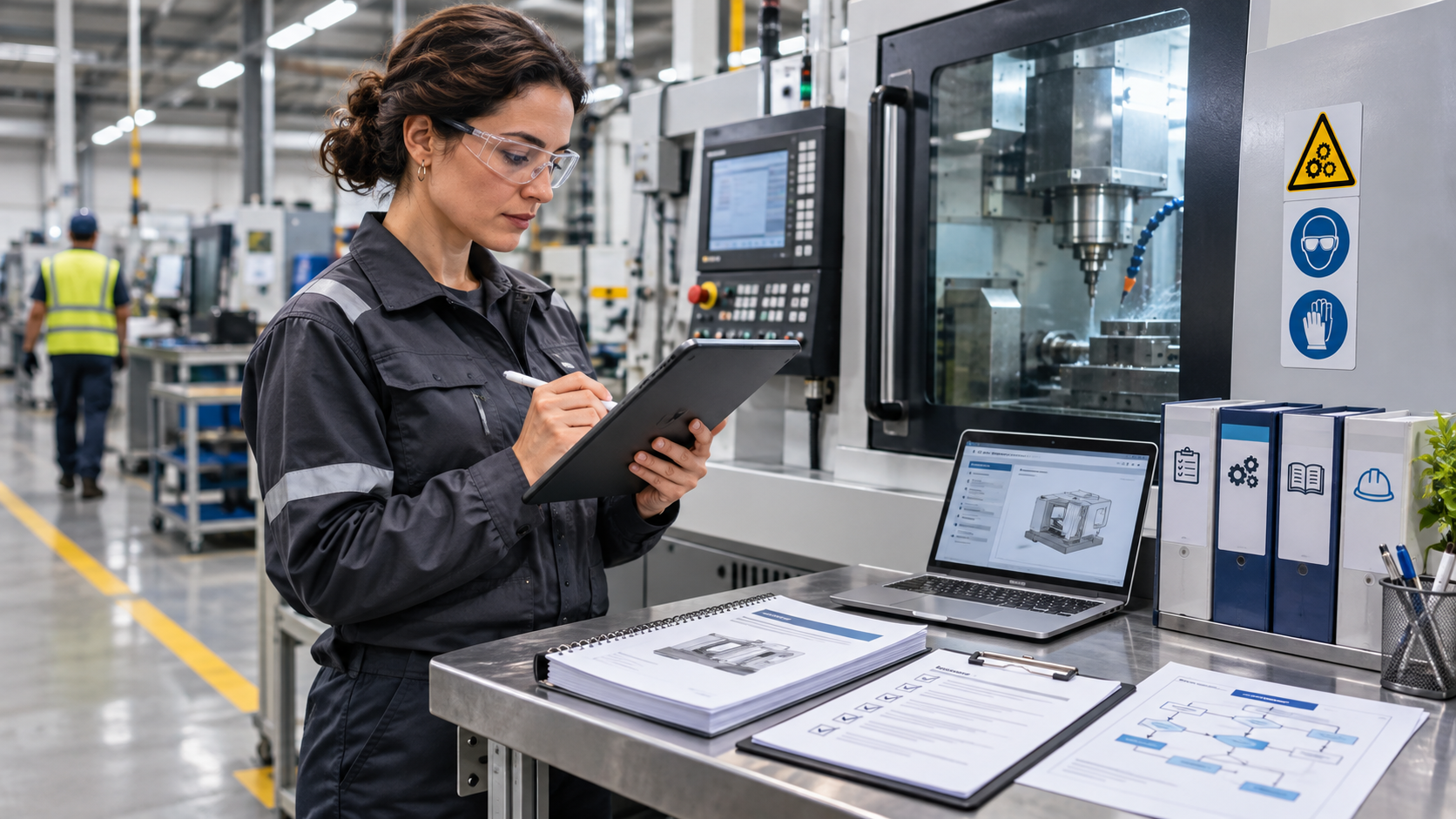
From standard operating procedures and equipment manuals to safety instructions and industrial B2B content, technical writing helps manufacturers communicate complex information accurately, improve consistency, and make specialized knowledge more accessible.
Manufacturing runs on precision.
Production equipment must operate within defined parameters. Employees need to understand established procedures. Maintenance teams depend on accurate instructions. Quality departments need consistent records. Customers require reliable information about the equipment, materials, and systems they purchase.
Yet even sophisticated manufacturing organizations can struggle with a surprisingly fundamental problem: communicating what people need to know.
An engineer may understand every component of a machine but struggle to explain its operation to someone unfamiliar with the system.
A maintenance technician may know how to diagnose recurring equipment problems but have never documented that knowledge.
A production supervisor may rely on years of experience to guide employees through complicated processes.
And a marketing team may have difficulty explaining a manufacturer's technical capabilities to prospective customers.
These situations share a common challenge.
Specialized knowledge is only useful when the people who need it can understand and apply it.
That is where technical writing becomes valuable.
Technical writing in manufacturing involves developing accurate, organized, and usable information about equipment, processes, systems, and products.
It includes standard operating procedures, equipment manuals, maintenance documentation, safety instructions, work instructions, technical specifications, training resources, and industrial content intended for customers.
These documents serve different audiences, but they share a common purpose: transforming complex information into communication that supports informed action.
For manufacturers, effective documentation can contribute to more consistent operations, clearer training, better knowledge transfer, and improved customer experiences.
It can also help industrial businesses explain their expertise through technically accurate website content, product guides, white papers, and educational articles.
As manufacturing systems become more connected and organizations face continuing pressure to improve efficiency, the ability to communicate technical knowledge is increasingly important.
This guide examines how technical writing works in manufacturing, why different types of documentation matter, how technical writers collaborate with engineers and operators, and how industrial companies can connect accurate technical communication with their broader business and marketing strategies.
What Is Technical Writing in Manufacturing?
Technical writing in manufacturing is the practice of creating and maintaining information that explains industrial equipment, production processes, operating requirements, and related technical subjects.
Unlike general marketing writing, manufacturing documentation frequently needs to support specific tasks or decisions.
A machine operator may need to follow an approved procedure.
A maintenance technician may need to identify a component or consult troubleshooting instructions.
A quality specialist may need to verify that a process meets documented requirements.
A purchasing manager may need to compare equipment specifications.
A prospective customer may need to understand how a manufacturing technology fits a particular application.
Each audience requires a different level of detail.
The U.S. Bureau of Labor Statistics describes technical writers as professionals who prepare instruction manuals, how-to guides, and other supporting documents to communicate complex technical information. Technical writers frequently work with engineers and other technical specialists to understand products and processes.
In manufacturing, this collaboration is especially important.
A writer may be responsible for organizing and communicating information, but technical authority typically comes from engineers, equipment manufacturers, process owners, safety professionals, and other qualified specialists.
The writer's job is to make that information understandable without changing its meaning.
Technical Writing Is More Than Creating Manuals
Equipment manuals are a familiar example, but manufacturing documentation extends throughout the organization.
It can include production procedures, work instructions, inspection criteria, equipment setup guides, maintenance documentation, training materials, troubleshooting resources, technical product descriptions, and customer-facing educational content.
Some documents are intended exclusively for internal use.
Others are distributed to customers, suppliers, service technicians, or regulatory authorities.
Some require formal approval and revision control.
Others may be updated through a less formal editorial process.
The appropriate documentation approach depends on the information's purpose, the audience, and the consequences of errors.
A general article explaining industrial automation does not require the same approval process as a safety-critical maintenance procedure.
Both may involve technical writing, but they should not be treated as equivalent.
Why Clear Documentation Matters in Manufacturing
Manufacturing organizations depend on repeatability.
A process that produces consistent results under controlled conditions is generally more useful than one that depends entirely on individual experience.
Documentation supports that consistency by establishing a shared reference.
Without clear written procedures, employees may develop different interpretations of the same task.
Training may vary between shifts.
Equipment knowledge may remain concentrated among a few experienced workers.
Maintenance activities may be documented inconsistently.
And new employees may struggle to understand processes that experienced personnel consider routine.
Technical writing cannot solve every operational problem, but it can make critical information easier to access and use.
Supporting Operational Consistency
Consider a manufacturer operating several production lines.
If each line uses slightly different terminology for the same procedure, employees moving between departments may become confused.
A standardized document can establish consistent names, sequence, responsibilities, and references.
However, standardization must reflect the actual process.
A writer should not assume that two machines have identical operating requirements simply because they perform similar functions.
Equipment-specific differences must be verified and documented.
Preserving Institutional Knowledge
Manufacturing businesses often rely on employees with extensive practical experience.
These individuals may understand unusual equipment behaviors, recurring production issues, or important process details that are not formally recorded.
When employees retire, change roles, or leave the organization, undocumented knowledge may be difficult to recover.
Technical documentation can help preserve approved procedures and relevant operational knowledge.
The process often involves interviewing experienced employees, observing work, reviewing existing materials, and validating the resulting instructions.
This is sometimes described as knowledge capture.
The objective is not to document every informal habit.
It is to identify useful information, verify that it reflects approved practices, and make it available to appropriate personnel.
Improving Training and Onboarding
New manufacturing employees need to learn terminology, equipment functions, operational expectations, and approved procedures.
Clear documentation can support structured training.
For example, a work instruction may identify the equipment involved, required qualifications, prerequisites, process steps, and relevant checks.
A training guide may explain the purpose of a process before introducing detailed instructions.
These resources can help trainers deliver consistent information.
They do not replace supervised training, competency assessment, or any training required by applicable regulations.
Supporting Quality Management
Many manufacturing quality systems depend on documented processes and controlled information.
The ISO 9001 quality management systems standard includes requirements concerning documented information.
The exact documentation needed depends on an organization's processes, risks, and applicable requirements.
A well-managed documentation process can help ensure employees have access to current instructions and that changes are reviewed appropriately.
Technical writers may contribute by improving clarity, consistency, organization, and document usability.
They should work within the manufacturer's established quality management and approval procedures.
Standard Operating Procedures: Creating a Consistent Reference for Work
Standard operating procedures, commonly called SOPs, are among the most important types of manufacturing documentation.
An SOP describes how an organization expects a defined activity or process to be performed.
It may establish responsibilities, prerequisites, required records, decision points, and references to more detailed instructions.
The purpose is to support consistent execution of an approved process.
What Should a Manufacturing SOP Include?
The content depends on the task and the organization's documentation system.
A typical SOP may include:
Document title, identifier, version, and approval information.
Purpose and scope.
Roles and responsibilities.
Required qualifications, tools, or materials.
Safety precautions and references to approved controls.
Process steps or references to detailed work instructions.
Required checks, records, and escalation procedures.
Related documents and revision history.
Not every SOP requires every element.
The structure should reflect the process's complexity and the organization's requirements.
SOPs vs. Work Instructions
These terms are sometimes used interchangeably, but many organizations distinguish them.
An SOP often describes a process at a broader level.
A work instruction may explain a specific task within that process in greater detail.
For example, an SOP might govern how a facility manages incoming material inspections.
A related work instruction might explain how qualified personnel perform a particular approved inspection using a specified measuring instrument.
The SOP defines the overall workflow.
The work instruction explains the task.
This distinction can help prevent large procedures from becoming difficult to navigate.
Example: A Poorly Written SOP Statement
Consider this hypothetical instruction:
"Inspect the material properly and record any problems."
The statement leaves important questions unanswered.
What material is being inspected? Which inspection method is approved? What constitutes a problem? Where should results be recorded? Who determines whether the material is acceptable?
A clearer high-level SOP statement might be:
"Perform the incoming material inspection using the current approved inspection work instruction for the material category. Record the results in the designated quality system. Refer any nonconforming results to the authorized quality representative before the material is released."
This version identifies the approved reference, required record, and escalation path.
It does not invent inspection criteria or imply that a writer can determine technical acceptance limits.
Those requirements must come from the organization's validated process.
Why SOP Writing Requires Collaboration
A technical writer should not create manufacturing procedures solely from general knowledge or online examples.
An effective process may require interviews with operators, review by process engineers, quality assurance approval, and input from environmental health and safety personnel.
The writer can improve organization and clarity.
The responsible technical specialists must verify that the documented process is correct.
This distinction becomes especially important when an SOP affects machinery operation, hazardous materials, product quality, or worker safety.
Equipment Manuals: Making Complex Machinery Understandable
Equipment manuals are among the most visible examples of technical writing in manufacturing.
They may accompany industrial machinery, automation systems, production equipment, measuring instruments, or other specialized products.
A well-developed manual provides information appropriate to the equipment and intended users.
Depending on its scope, that may include product identification, technical specifications, installation requirements, operating information, maintenance requirements, troubleshooting guidance, and safety information.
The difficulty is that manufacturing equipment can involve several interconnected systems.
An automated production machine may contain mechanical assemblies, electrical controls, sensors, pneumatic components, and software interfaces.
The documentation must explain these elements without creating ambiguity about how they interact.
Different Users Need Different Information
An equipment manual may serve several audiences.
An operator needs information about approved operating functions and normal system behavior.
A maintenance technician needs equipment-specific service information, subject to appropriate qualifications and safety controls.
An installation specialist may require verified site requirements and setup documentation.
An engineering team may need detailed specifications and technical references.
Trying to satisfy every audience in one uninterrupted document can make information difficult to find.
Technical writers can help organize manuals into clearly defined sections or separate documents according to user needs.
The Problem With Vague Equipment Instructions
Consider this fictional instruction for a packaging machine:
"Check the system and adjust the settings as needed before operation."
It sounds reasonable but communicates very little.
Which system should be checked? What settings are relevant? What values are acceptable? Who is authorized to make adjustments?
A stronger documentation approach would identify the approved pre-operation checklist, specify which user role may perform it, and refer to the verified configuration requirements for that equipment model.
The writer should not invent operating values to make the instruction appear complete.
Instead, missing requirements should be flagged for engineering review.
This is one of the most important distinctions between technical writing and general content creation: a technical writer must know when the available information is insufficient to produce a reliable instruction.
Manuals Need Maintenance, Too
Documentation becomes less useful when the product changes but the manual does not.
Manufacturers may introduce new equipment revisions, replace components, modify control interfaces, or update software.
Those changes can affect existing instructions.
A controlled documentation process should establish how product changes trigger reviews of affected manuals.
Depending on the organization, this may involve engineering change notices, document owners, approval workflows, and revision histories.
Clear writing is only one part of an effective equipment manual.
Keeping the information current is equally important.
Process Documentation: Explaining How Manufacturing Systems Work
Process documentation describes how work moves through an organization or production system.
It can explain the relationships between materials, equipment, personnel, inspection points, decisions, and records.
Unlike a narrow work instruction, process documentation may address a broader workflow.
Consider a manufacturer producing custom metal components.
Its production process might involve order review, material verification, scheduling, machining, inspection, finishing, and shipment.
Each stage may involve different departments and documentation requirements.
A process document helps explain how these activities connect.
Why Process Documentation Is Different From an SOP
An SOP often establishes how a defined activity should be performed.
Process documentation may describe the larger system in which multiple activities occur.
For example, a manufacturer might maintain a process description explaining how customer orders move from sales to production.
Separate SOPs could govern order approval, material handling, quality inspection, and shipping.
The process description provides context.
The SOPs and work instructions provide more specific operational requirements.
This layered approach can make complex documentation easier to manage.
Documenting Process Inputs and Outputs
A useful process description may identify what starts an activity, what information or materials it requires, who is responsible, and what result should be produced.
It may also identify dependencies.
For example, production scheduling may depend on an approved order and confirmed material availability.
A process description can clarify that relationship without attempting to document every detail of the scheduling software.
The objective is to help readers understand the process at the appropriate level.
Avoiding Unnecessary Complexity
Manufacturing processes can be complicated, but the documentation should not be more complicated than necessary.
A writer may encounter internal terminology, abbreviations, legacy process names, and department-specific language.
Part of the work involves determining which terms are essential and which require clarification.
A document should not assume that every reader has worked at the facility for ten years.
At the same time, it should not oversimplify information that experienced technical personnel need.
The right level of detail depends on the audience and intended use.
Safety Instructions: Where Precision Becomes Critical
Safety-related documentation deserves particular attention because unclear or incorrect information can contribute to serious consequences.
Manufacturing environments may involve moving machinery, electrical systems, stored energy, hazardous substances, elevated temperatures, pressure systems, and other workplace hazards.
Safety instructions must accurately reflect the equipment, workplace conditions, applicable requirements, and employer-approved controls.
Technical writers can help organize and clarify these instructions, but they should not independently design safety procedures or determine compliance requirements.
Those responsibilities belong to qualified and authorized personnel.
OSHA Requirements and Documented Procedures
In the United States, the Occupational Safety and Health Administration establishes workplace safety requirements relevant to many manufacturing activities.
One important example is OSHA's hazardous energy control standard, 29 CFR 1910.147, commonly associated with lockout/tagout.
The standard requires covered employers to establish energy control programs and, subject to a narrowly defined exception, develop and use documented energy control procedures for covered servicing and maintenance activities.
It specifies requirements concerning the scope and content of those procedures, training, inspections, and employee responsibilities.
See OSHA's Control of Hazardous Energy Standard.
A generic instruction such as "turn off the machine before maintenance" does not adequately represent the requirements of a hazardous energy control program.
Equipment can contain multiple energy sources, and turning off a control switch may not eliminate hazardous energy.
This is why safety documentation must be developed around actual equipment and approved procedures.
The Technical Writer's Role in Safety Documentation
A technical writer can contribute by identifying unclear wording, organizing information consistently, checking terminology, and ensuring approved warnings are presented where readers need them.
For example, the writer might identify that a maintenance document refers to a component by three different names.
That inconsistency should be reviewed with the responsible technical personnel.
The writer may also notice that a procedure references an inspection form that employees cannot locate.
Resolving such documentation issues can improve usability.
However, the writer should not independently decide which protective equipment is required, how hazardous energy should be isolated, or whether a particular procedure is safe.
Those decisions require appropriate technical and safety authority.
Why Copying Safety Procedures Is Dangerous
Manufacturers sometimes encounter generic templates that appear to simplify documentation development.
Templates can be useful for structure, but they are not substitutes for equipment-specific analysis.
A procedure written for one machine may be unsuitable for another, even when the machines look similar.
Different equipment may involve different energy sources, configurations, hazards, or operating requirements.
For safety-critical materials, technical writers should treat templates as organizational aids, not as verified operating instructions.
The finished documentation must be validated through the manufacturer's established process.
Quality Documentation and ISO 9001
Quality management is another area where documentation plays a significant role.
Manufacturers use quality systems to establish processes, define responsibilities, manage records, and support consistent outcomes.
The ISO 9001 family provides an internationally recognized framework for quality management systems.
Manufacturers should verify the edition of ISO 9001 applicable to their quality management system, certification, and any transition requirements.
Technical writing can support quality management by making approved procedures and related information clear and consistent.
Document Control
Document control helps organizations manage information throughout its lifecycle.
Depending on the system, this can include document identifiers, ownership, approval, revision status, access permissions, and retention requirements.
A manufacturer may have several versions of an operating instruction.
If employees cannot identify the current approved version, the documentation system can create confusion.
A technical writer can help establish consistent document formatting and support revision workflows.
However, document approval and quality-system compliance remain the responsibility of the organization's authorized personnel.
Controlled Documents vs. General Reference Content
Not every document should be managed identically.
An approved inspection procedure may require formal control.
An internal educational article explaining a manufacturing concept may not require the same level of oversight.
A public marketing blog may use a conventional editorial review process.
The appropriate governance should reflect the document's purpose, risks, and organizational requirements.
Applying excessive controls to low-risk material can slow communication unnecessarily.
Applying insufficient controls to consequential instructions can create more serious problems.
Industrial B2B Content: Where Technical Writing Meets Marketing
Manufacturers need more than internal documentation.
They also need to communicate with customers, distributors, purchasing departments, engineers, and other business decision-makers.
Industrial purchasing decisions can involve substantial research.
A buyer may need to understand equipment compatibility, operating requirements, material characteristics, performance limitations, installation considerations, or long-term service needs.
Generic promotional language often fails to answer these questions.
That creates an opportunity for technically informed B2B content.
Technical Product Pages
An industrial product page should explain what the product does, who it is intended for, and which verified characteristics matter to prospective customers.
Depending on the product, this may include specifications, available configurations, applications, compatibility information, and references to supporting documentation.
Marketing language can explain benefits, but technical claims should remain accurate.
For example, a manufacturer should not claim that a component works in every environment if its performance depends on temperature, pressure, material compatibility, or other conditions.
Clear product writing helps customers understand both capabilities and limitations.
Educational Industry Articles
Manufacturers can publish articles that explain complex subjects relevant to their customers.
A precision machining company might explain differences between machining processes.
An industrial filtration supplier might discuss factors that influence filtration system selection.
An automation integrator might explain how manufacturers evaluate production monitoring technologies.
These articles can support customer education while demonstrating the company's knowledge.
They may also attract people researching specialized problems through search engines.
Google's guidance on helpful, people-first content encourages original information, reliable sourcing, and material that satisfies the intended audience's needs.
For industrial businesses, that makes technical accuracy a valuable part of content quality.
Technical White Papers
White papers can provide deeper analysis of a technology, problem, methodology, or application.
They may include research, engineering context, technical comparisons, or detailed explanations of a proposed approach.
A manufacturer might publish a white paper about a particular material technology or production method.
Unlike a general blog article, a white paper may serve readers who already understand the industry and need more detailed evidence.
A strong white paper should distinguish verified results from assumptions, estimates, and promotional claims.
If the document discusses testing, the methodology and limitations should be clear.
Industrial Case Studies
Case studies explain how a product or service was applied to a specific business challenge.
For manufacturers, they can be particularly useful because prospective buyers often want to understand real applications.
A case study might describe a customer's production challenge, the solution implemented, and the outcomes observed.
However, claims about productivity, cost savings, defect reduction, or other improvements should be supported by appropriate evidence.
If results are based on customer-reported information, that should be identified.
If a percentage improvement is cited, readers should be able to understand what was measured and over which period.
A credible case study is more useful than an exaggerated success story.
One Manufacturing Subject, Four Different Writing Approaches
Consider a fictional manufacturer called Meridian Industrial Systems.
The company produces automated inspection equipment for production facilities.
The following examples are illustrative and do not describe actual equipment or validated procedures.
Example 1: Technical Work Instruction
Audience: Authorized equipment operators.
Purpose: Direct users to the approved inspection setup procedure.
Inspection System Setup
Before beginning, confirm that you are authorized to operate the equipment and have access to the current approved setup instructions for the installed model.
Use the model-specific work instruction to verify the required inspection configuration.
If the displayed configuration does not match the approved production requirements, stop the setup process and contact the designated supervisor.
This example emphasizes authorization, approved references, and escalation.
It intentionally does not invent machine-specific operating steps.
Example 2: General Business Communication
Audience: Operations management.
Purpose: Explain a proposed equipment evaluation.
Automated Inspection Equipment Evaluation
The quality and operations departments propose evaluating automated inspection technology for selected production activities.
The assessment will consider inspection requirements, equipment compatibility, implementation costs, employee training, and potential changes to existing workflows.
The findings will support a recommendation on whether the proposed technology is appropriate for the facility.
This version supports a management decision.
It does not provide technical operating instructions.
Example 3: Marketing Copy
Audience: Manufacturing decision-makers.
Purpose: Encourage product interest.
Bring Greater Visibility to Your Inspection Process.
Explore automated inspection technology designed to help manufacturing teams monitor production quality and access consistent inspection information.
Discover whether Meridian Industrial Systems has a solution suited to your facility.
Request a Product Consultation.
This version emphasizes potential customer value.
It avoids unsupported guarantees about defect reduction or productivity.
Example 4: Technical SEO Article
Audience: Manufacturing engineers and quality managers researching inspection technology.
Purpose: Explain a technical concept.
How Does Automated Inspection Technology Work in Manufacturing?
Automated inspection systems use technologies such as cameras, sensors, measurement devices, and software to evaluate defined characteristics of products or components.
The appropriate system depends on the inspection requirements, production environment, product characteristics, and accuracy needs.
Some systems compare measurements with established acceptance criteria, while others use image analysis to identify specified visual characteristics.
Manufacturers evaluating these systems should consider validation requirements, integration needs, maintenance, and the limitations of the selected technology.
This version provides educational information without pretending to be an equipment manual.
It can help potential customers understand the technology before discussing a particular solution.
What These Examples Demonstrate
The same subject can support multiple business needs.
The work instruction addresses an operational task.
The business communication supports an investment decision.
The marketing copy introduces potential value.
The educational article explains the technology.
The most effective manufacturing communication strategies recognize these distinctions rather than attempting to make one document serve every audience.
How to Develop Effective Manufacturing Documentation
Manufacturing technical writing works best as a collaborative process.
The exact workflow varies by organization, but several stages are particularly important.
1. Define the Document's Purpose
Before drafting, identify what the document is supposed to accomplish.
Is it intended to support equipment operation, employee training, maintenance, quality management, customer education, or sales?
A document without a clear purpose can become unnecessarily long or omit essential information.
The intended outcome should guide the structure.
2. Identify the Audience
Determine who will use the document and what knowledge they can reasonably be expected to possess.
An experienced maintenance technician may need a different explanation from a newly hired production employee.
An industrial purchasing manager may need different information from an engineer reviewing specifications.
Audience analysis helps determine terminology, detail, and organization.
3. Gather Authoritative Source Material
Manufacturing documents should be based on verified information.
Sources may include approved specifications, engineering documents, manufacturer manuals, established procedures, product data, and interviews with qualified personnel.
If information is missing or contradictory, the writer should request clarification.
Assumptions should not be silently converted into instructions.
4. Develop a Usable Structure
Organize the information around the reader's needs.
For procedural documents, that may involve prerequisites, responsibilities, approved steps, verification requirements, and escalation information.
For technical articles, it may involve defining the subject, explaining relevant concepts, describing applications, and addressing common questions.
The structure should make information easy to locate.
5. Draft With Consistent Terminology
Use direct language and maintain consistent names for components, processes, and roles.
Avoid unnecessary jargon, but do not replace essential technical terms with imprecise substitutes.
When a specialized term is necessary, define it appropriately for the audience.
6. Conduct Technical Review
The responsible subject-matter experts should verify the information.
Depending on the document, reviewers may include engineers, process owners, quality specialists, safety professionals, product managers, or other authorized personnel.
Technical review is especially important when documents contain operational requirements, specifications, safety information, or regulated claims.
7. Test Usability Where Appropriate
A document can be technically accurate but difficult to follow.
Usability testing may reveal unclear navigation, missing prerequisites, ambiguous language, or information that readers struggle to locate.
Testing should occur within an approved and appropriately controlled environment.
For safety-critical procedures, any validation must be directed by qualified personnel.
8. Establish Maintenance Responsibilities
Documentation should have an identified owner and an appropriate update process.
Manufacturing systems change.
New equipment versions, process improvements, revised requirements, and organizational changes may affect existing information.
Without maintenance, even well-written documentation can become unreliable.
Common Manufacturing Documentation Mistakes
Several recurring problems can reduce the usefulness of technical documents.
Writing for everyone instead of a defined audience. A document intended for operators may become confusing if it mixes routine tasks with advanced engineering details.
Using inconsistent terminology. Different names for the same component or process can create unnecessary ambiguity.
Leaving important information undocumented. Experienced employees may assume that everyone knows steps or requirements that new personnel have never encountered.
Copying procedures without validation. Instructions from another machine, facility, or organization may not apply to the current environment.
Failing to control revisions. Employees may continue using outdated documents if approved versions are difficult to identify.
Treating marketing claims as technical evidence. A promotional statement about equipment performance is not a substitute for verified specifications or testing.
Relying on AI-generated instructions without expert review. Plausible language does not establish technical correctness.
Addressing these problems requires more than proofreading.
It requires an appropriate documentation process, clear responsibilities, and collaboration between writers and technical specialists.
Can AI Help With Manufacturing Technical Writing?
Artificial intelligence can assist with some aspects of technical communication.
It may help writers organize approved information, identify repetitive language, suggest clearer wording, or create preliminary outlines.
It can also support terminology reviews and the preparation of noncritical drafts.
However, manufacturing documentation presents risks that make unsupervised AI-generated instructions inappropriate.
An AI system may invent a specification, omit a prerequisite, confuse equipment models, or describe an unsafe procedure.
These errors may be difficult to recognize when the language sounds confident.
For this reason, AI-generated technical content should be checked against authoritative information and reviewed by qualified personnel before use.
Confidentiality also matters.
Manufacturers should evaluate whether proposed AI tools are appropriate for proprietary engineering data, customer information, and sensitive operational documents.
The value of AI in technical writing is not that it eliminates verification.
It is that it may assist the writing process while the organization maintains responsibility for accuracy and approval.
Technical Writing as Part of a Manufacturing SEO Strategy
Industrial manufacturers often possess valuable expertise that is not reflected clearly on their websites.
Engineers understand their products.
Production teams understand their processes.
Sales personnel understand recurring customer questions.
But that knowledge may remain scattered across internal documents and individual employees.
Technical content development can help turn appropriately approved information into useful public resources.
Answer the Questions Industrial Buyers Actually Ask
Potential customers may search for product specifications, material compatibility, manufacturing methods, technical terminology, or application requirements.
An industrial website that provides accurate answers can become more useful during the research process.
For example, a manufacturer might publish an educational article explaining the differences between two production technologies.
The article could discuss applications, limitations, selection factors, and questions buyers should consider.
That content may help attract relevant readers while demonstrating subject-matter knowledge.
Connect Educational Content to Product Information
A technical article can explain a general concept and direct readers toward relevant product pages, specification documents, or service information.
This helps visitors move from education to evaluation.
The connections should be genuinely useful.
A reader researching a technical process should not be forced through unrelated promotional material to find the information they need.
Maintain Technical Credibility
SEO should not encourage manufacturers to publish unsupported claims or oversimplified explanations.
Google Search Essentials recommends creating helpful, reliable content and using language that reflects how people search.
For industrial businesses, combining those principles with qualified technical review can produce content that is both accessible and accurate.
Search visibility is never guaranteed.
However, useful technical resources can support a website's broader content strategy and provide information that prospective customers may value.
How Ritner Digital Can Support Manufacturing Technical Content
Manufacturers often need help translating specialized expertise into clear customer-facing communication.
That may include technical website content, industry-specific articles, product and service explainers, educational guides, white papers, and SEO-focused B2B content.
Ritner Digital's technical writing and digital content positioning is particularly relevant to these public-facing communication needs.
The objective is to help industrial businesses explain what they do, communicate complex information clearly, and make useful content easier for prospective customers to discover.
Technical Research and Content Development
Manufacturing content should begin with reliable information.
That may include approved product specifications, technical references, industry research, and materials supplied by the client.
When necessary, knowledgeable client personnel can clarify terminology, applications, and technical limitations.
The resulting content should be understandable without introducing unsupported claims.
Industrial SEO Content
Manufacturers may benefit from articles addressing specialized customer questions.
These can include explanations of manufacturing processes, comparisons of technologies, product applications, and purchasing considerations.
SEO research can help identify how potential customers describe their problems and search for solutions.
The content should answer those questions accurately rather than simply repeat keywords.
Product and Service Explanations
Industrial companies sometimes struggle to explain complex capabilities to nontechnical buyers.
Clear website content can help bridge that gap.
The goal is to communicate what a product or service does, where it may be appropriate, and which verified characteristics matter.
Technical details should be preserved when they are important to the purchasing decision.
Documentation Support and Expert Collaboration
Manufacturing projects involving formal operating procedures, safety instructions, equipment manuals, or regulated documentation require clearly defined responsibilities.
Ritner Digital can discuss writing, organization, editing, and content-development needs, but safety-critical or controlled documentation must be based on manufacturer-approved information and reviewed by qualified personnel.
A marketing or technical writing provider should never be treated as a substitute for the manufacturer's engineering, safety, or compliance authority.
The Future of Manufacturing Technical Documentation
Manufacturing documentation is evolving alongside the systems it describes.
Digital production technologies, connected equipment, and more complex software interfaces can increase the amount of information organizations need to manage.
Manufacturers may also face growing pressure to preserve institutional knowledge as experienced employees change roles or retire.
These conditions make information management an important operational consideration.
Future documentation practices may involve more structured digital content, improved version control, searchable knowledge systems, and closer connections between product development and technical communication.
AI-assisted tools may help teams organize and maintain information, provided that appropriate validation and governance remain in place.
However, the fundamental requirement will not change.
Manufacturers need accurate information that the intended audience can understand and use.
Technology can improve how that information is produced and distributed.
It cannot eliminate the responsibility to verify what the documentation says.
Conclusion: Clear Documentation Turns Manufacturing Knowledge Into a Usable Resource
Manufacturing organizations depend on specialized knowledge.
Engineers design systems.
Operators perform production activities.
Maintenance teams support equipment reliability.
Quality professionals establish and verify requirements.
Sales and marketing teams communicate capabilities to customers.
Technical writing helps make the information connecting these activities clearer and more accessible.
Standard operating procedures support consistent processes.
Equipment manuals explain complex products.
Process documentation clarifies how work moves through an organization.
Safety instructions communicate approved requirements that must be developed and validated by qualified personnel.
Industrial B2B content helps prospective customers understand specialized products and services.
Each type of writing has a different purpose.
But all benefit from accuracy, clear organization, appropriate terminology, and a strong understanding of the audience.
For manufacturers, the objective should not simply be to produce more documentation.
It should be to create information that people can trust, locate, understand, and use.
That principle applies whether the reader is a machine operator, an engineer, a purchasing manager, or a prospective customer researching an industrial solution.
Make Your Manufacturing Expertise Easier to Understand
Your business may have sophisticated equipment, specialized capabilities, and years of industry knowledge.
But if prospective customers struggle to understand what you offer, valuable expertise can remain difficult to discover.
Ritner Digital helps businesses communicate complex products and services through technical writing, industry-specific content, and SEO-focused digital communication.
Whether you need manufacturing website content, technical product explainers, educational industry articles, or B2B content that speaks to knowledgeable buyers, the goal is to make your expertise clearer and more accessible.
Turn complex manufacturing knowledge into content your customers can understand.
Contact Ritner Digital about technical writing and manufacturing content
Frequently Asked Questions
1. What is technical writing in manufacturing?
Technical writing in manufacturing involves creating accurate, organized information about industrial equipment, processes, systems, and products. Examples include operating procedures, equipment manuals, maintenance documentation, technical specifications, and educational content.
2. Why is technical writing important in manufacturing?
It helps organizations communicate specialized knowledge consistently. Clear documentation can support training, process understanding, knowledge transfer, equipment use, and customer education.
3. What is the difference between an SOP and a work instruction?
An SOP generally describes how an organizational activity or process should be performed. A work instruction often provides more detailed guidance for a particular task. Organizations may define these terms differently within their documentation systems.
4. Who writes manufacturing SOPs?
SOPs may be drafted by process owners, engineers, quality personnel, technical writers, or other authorized employees. The appropriate technical specialists should verify and approve the procedures according to the organization's requirements.
5. What should an equipment manual include?
Depending on the equipment, a manual may include product identification, specifications, installation requirements, operating information, maintenance guidance, troubleshooting resources, and safety information. The exact content must reflect the product and applicable requirements.
6. Can technical writers create safety instructions?
Technical writers can help organize, draft, and clarify safety documentation using approved source information. However, qualified personnel must establish and validate safety requirements and procedures. Writing expertise alone does not confer engineering or safety authority.
7. How does technical writing support ISO 9001?
Technical writing can support the clarity, consistency, and usability of documented information within a quality management system. It does not independently establish compliance or certification.
8. What is process documentation in manufacturing?
Process documentation explains how activities, responsibilities, inputs, outputs, and decisions connect within a manufacturing workflow. It may provide context for more detailed SOPs and work instructions.
9. What is industrial B2B technical content?
Industrial B2B technical content includes product explainers, industry articles, technical white papers, case studies, and other materials that help business customers understand specialized technologies, products, and services.
10. Can manufacturing technical writing improve SEO?
Public technical content can help manufacturers answer specialized customer questions and make relevant information easier to discover through search engines. Results depend on many factors, and rankings are not guaranteed.
11. Can AI write manufacturing equipment manuals?
AI can assist with drafting and organization, but it may generate incorrect specifications or instructions. Equipment documentation requires verification against authoritative sources and appropriate technical approval.
12. How often should manufacturing documentation be updated?
Documents should be reviewed and updated according to the organization's control procedures and whenever relevant changes affect their accuracy. Triggers may include equipment modifications, process changes, revised requirements, or identified errors.
13. What is the difference between technical writing and manufacturing copywriting?
Technical writing focuses on accurate explanations of products, systems, and processes. Manufacturing copywriting focuses on communicating benefits and encouraging prospective customers to take action. Both require factual accuracy.
14. Do small manufacturers need technical writing?
Small manufacturers may need operating procedures, equipment documentation, training resources, technical product descriptions, or industry-specific website content. The appropriate scope depends on their products, operations, and customer requirements.
15. Does Ritner Digital offer manufacturing technical writing?
Ritner Digital can discuss manufacturing-focused technical content projects, including industrial articles, product explainers, B2B website content, and related writing support. Formal safety-critical and controlled documentation requires qualified client review and approval.
Sources and References
1. Occupational Safety and Health Administration — 29 CFR 1910.147, Control of Hazardous Energy
Federal requirements concerning covered energy control programs, procedures, employee training, and inspections.
https://www.osha.gov/laws-regs/regulations/standardnumber/1910/1910.147
2. International Organization for Standardization — ISO 9001
Official overview of the quality management systems standard.
https://www.iso.org/standard/9001
3. U.S. Bureau of Labor Statistics — Technical Writers
Occupational information about technical writing responsibilities, collaboration, and employment.
https://www.bls.gov/ooh/media-and-communication/technical-writers.htm
4. Google Search Central — Creating Helpful, Reliable, People-First Content
Guidance on original information, accuracy, reliability, and audience usefulness.
https://developers.google.com/search/docs/fundamentals/creating-helpful-content
5. Google Search Central — Search Essentials
Foundational recommendations for creating useful, discoverable web content.
https://developers.google.com/search/docs/essentials
6. Google for Developers — Developer Documentation Style Guide
Guidance on organizing technical information and writing clear instructions.
https://developers.google.com/style
Editorial note: Illustrative examples in this article are not approved equipment procedures. Manufacturing instructions, safety information, and controlled documents must be validated against actual equipment, workplace conditions, and applicable requirements before use.