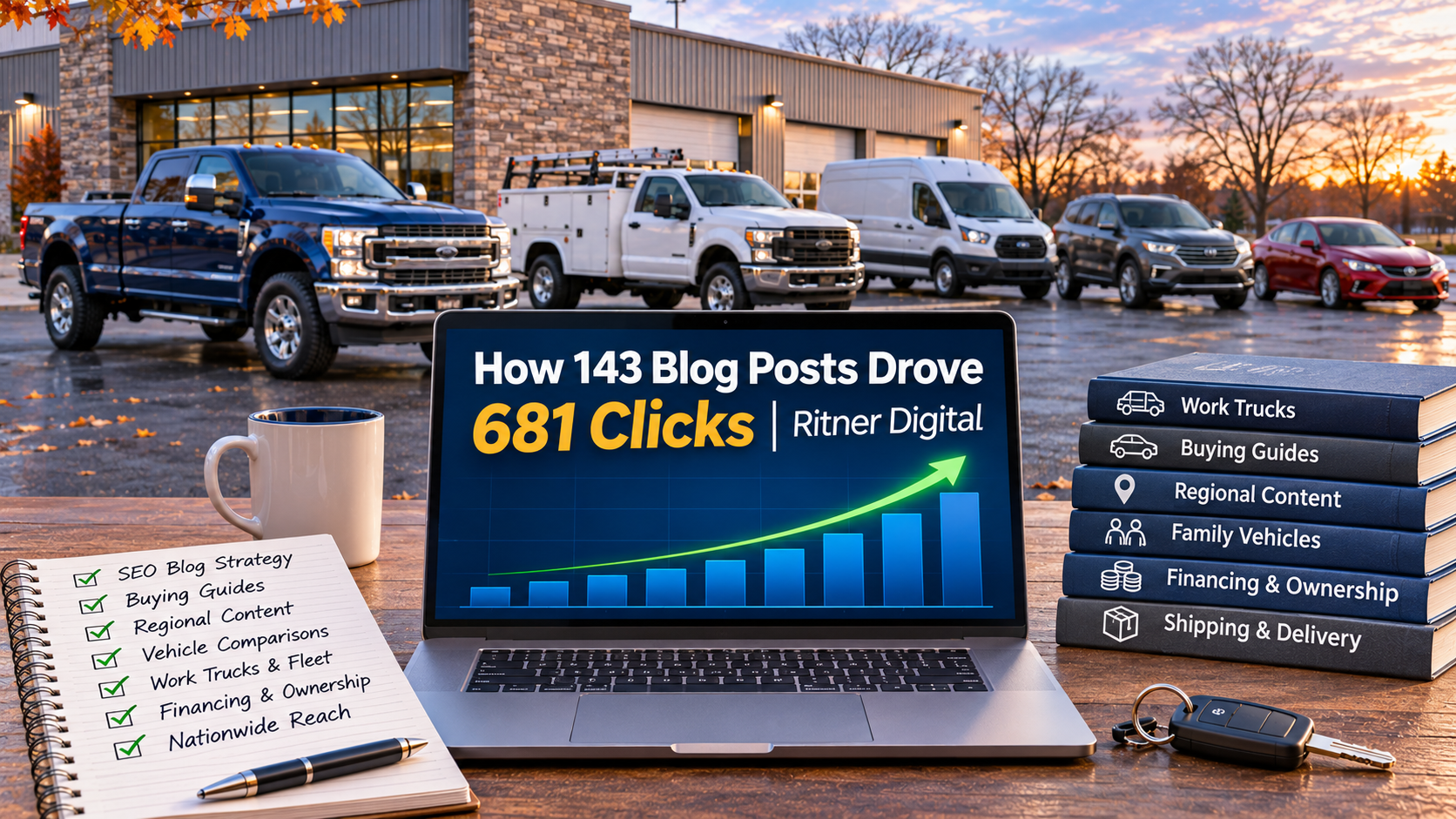
An automotive SEO case study featuring True Blue Autos in Greensburg, Indiana, and the educational content strategy developed by Ritner Digital.
Imagine someone searching Google for the difference between a Ford F-550 and an F-750.
They're not searching for your dealership. They might not know your business exists. They're simply trying to figure out which truck can handle the work they need to do.
Now imagine that your dealership has the article that answers their question.
Instead of discovering another automotive marketplace, an anonymous comparison website, or a competing dealership's listing, that shopper lands directly on your website.
They learn something useful. They discover your business. And when they're ready to explore vehicles, they're already somewhere they can take the next step.
That's the opportunity we've been building with True Blue Autos.
True Blue Autos is a family-owned vehicle dealership in Greensburg, Indiana, with deep experience in commercial work trucks and an expanding selection of used cars, SUVs, and minivans. The dealership serves local buyers and offers vehicle delivery arrangements across all 50 states.
Since July 2026, Ritner Digital has worked with the True Blue Autos team to develop something beyond a traditional dealership blog: a connected library of educational vehicle buying resources designed to help real customers make better decisions.
By November, that library contained 143 educational articles, including 50 regional buying guides across five states.
And we have some exciting numbers to share.
The Results: What Google Search Console Shows
Between June 22 and November 19, 2026, the dealership's Google Search Console data recorded:
The most important number for our content work is 681.
These were recorded Google Search clicks to educational blog pages developed through the Ritner Digital content program.
Those pages also accumulated more than 153,000 search impressions in the page-level report.
The broader website recorded 2,498 Google Search clicks during the same reporting window. That includes the dealership's existing homepage, inventory, business pages, and educational content.
In other words, we can distinguish traffic landing on the blog content we helped create from overall website performance.
The figures are encouraging, but we want to present them accurately: the 681 clicks are measured clicks to those blog URLs, not proof that all 681 were incremental visitors who would never have discovered the dealership otherwise. Page-level and property-level Search Console reports also use different aggregation rules.
What we can say confidently is that the educational blog library was being discovered and clicked through Google Search.
And that's exactly what we wanted to build.
This is the story of the strategy, the partnership, the work behind the content, and why creating your own source of automotive search visibility matters.
The Automotive Industry Is Competitive. Your Website Needs to Do More Than Display Inventory.
Car dealerships operate in one of the most competitive digital environments imaginable.
A potential buyer can search hundreds of listings in minutes. Large automotive marketplaces aggregate inventory from businesses across the country. Search results feature paid advertisements, map listings, vehicle listing pages, national review sites, editorial articles, videos, and increasingly AI-powered features.
For a smaller dealership, earning attention isn't easy.
And there's an important difference between having inventory available online and building an online presence that people can discover before they start comparing individual listings.
Inventory is essential. Customers need to see what's available, compare vehicles, and contact the dealership.
But inventory pages tend to serve shoppers who already know what they're looking for.
What about the people who aren't quite ready?
Maybe they're wondering:
Is a Ford F-350 enough for my landscaping business, or do I need an F-450?
What's the difference between an F-550 and an F-750?
What should I inspect before buying a used diesel truck?
Is it safe to buy a commercial truck from another state?
How much does it cost to ship a vehicle across the country?
Should I replace my aging work truck or keep repairing it?
Is a minivan or SUV the better option for my family?
These questions happen before someone selects a specific vehicle.
They also represent opportunities for a dealership to demonstrate what it knows.
At Ritner Digital, we believe businesses should have the opportunity to participate in these conversations directly, through useful content on their own websites.
Not every person who reads an article will become a customer.
But every relevant article creates another opportunity for someone to discover the dealership, learn something helpful, and continue their research.
That's a different long-term approach from relying entirely on vehicle listings.
Why Dealerships Should Build Their Own Search Traffic
Third-party automotive marketplaces can be useful.
They help customers compare vehicles and give dealerships access to shoppers beyond their immediate markets.
We're not suggesting dealerships should abandon them.
The challenge arises when nearly every new customer discovers the business through a platform controlled by another company.
Those platforms determine much of the browsing experience.
A shopper may encounter your vehicle beside numerous competing listings. The marketplace controls the surrounding interface and much of the customer journey. It may offer limited space for explaining your dealership's expertise or answering specialized buying questions.
And after browsing several vehicles, the customer may remember the marketplace more clearly than any individual dealer.
Your own website gives you a different opportunity.
You can publish detailed information about the vehicles and services you know best.
You can explain how to evaluate a used truck, why different configurations matter, and what buyers should understand before purchasing.
You can link related resources together and give visitors a reason to stay.
You can also update, expand, and maintain that information over time.
The goal isn't to eliminate third-party marketing. It's to build a stronger first-party presence so your business has more than one way to be found.
Educational content requires investment in planning, research, writing, maintenance, and optimization. Organic search traffic isn't automatically free.
But the published resource becomes part of a library on the dealership's own website, rather than content that exists only within someone else's marketplace.
For a business looking to build a more sustainable digital presence, that distinction matters.
Meet True Blue Autos: A Family-Owned Indiana Dealership With Nationwide Reach
One of the most rewarding parts of this project has been getting to work with the True Blue Autos team.
True Blue Autos is based in Greensburg, Indiana, where the dealership has built its business around helping people find vehicles suited to their needs.
The company has a strong background in commercial trucks, including heavy-duty pickups, service bodies, flatbeds, and specialized work vehicles.
More recently, the dealership has expanded its offerings to include additional used cars, SUVs, and minivans.
That variety creates an interesting opportunity for content.
A contractor researching a heavy-duty diesel pickup needs different information from a parent looking for a safe first car for a teenager.
A delivery business comparing box trucks has different concerns from a family preparing for winter travel.
And a buyer living several states away needs to understand the purchasing and delivery process before committing to a vehicle.
Each type of customer deserves useful answers.
The True Blue Autos team has been wonderful to work with throughout this project.
Alex, Ted, and the team have been supportive of new ideas, open to expanding the dealership's educational resources, and enthusiastic about reaching more customers beyond their immediate market.
We have a lot of appreciation for family-owned businesses that invest in building something lasting.
We're proud to help True Blue Autos grow its national visibility while preserving the approachable, customer-focused identity that makes it distinctive.
You can explore the dealership at True Blue Autos or browse its complete vehicle buying library.
Where Ritner Digital Came In
True Blue Autos already had its dealership website, inventory platform, business pages, and sales operations before our work began.
Ritner Digital did not build the dealership's original website or existing inventory system.
Our work has focused on the blog and educational SEO content system.
That includes researching topics, identifying customer questions, planning the editorial calendar, developing articles, connecting related resources, and organizing the growing library.
The distinction matters because the strategy wasn't to replace what the dealership already had.
It was to create a new way for potential customers to discover that existing business.
We wanted people researching vehicles to find True Blue Autos even when they weren't searching for the dealership's name.
We also wanted those visitors to encounter helpful information rather than a generic sales pitch.
That meant developing a structured collection of articles, not publishing occasional posts simply to fill a calendar.
The Blog's Measurable Contribution: 681 Google Search Clicks
Let's look more closely at the results specifically associated with the blog-content program.
We reviewed the Google Search Console Pages export and matched its URLs against the published article catalog.
This distinction is important because many True Blue Autos blog posts have URLs directly under trueblueautos.com/instead of containing /blog/ in their paths.
Simply filtering for URLs containing the word blog would miss the individual articles.
Instead, we matched the report's URLs against the actual published blog directory.
Blog Content Performance, June 22–November 19, 2026
Those 681 clicks are associated with specific educational articles created through our content program.
The 153,623 impressions reflect their appearances in the page-level Search Console report.
The report contained 80 matching article URLs. The other catalog pages were not represented in that export, which can reflect publication timing, search visibility, or reporting limits. We shouldn't assume that every missing URL received exactly zero impressions over its lifetime.
The data also ends on November 19.
Many of the later November articles were published after that cutoff, so their future performance is not reflected here.
Why This Matters
The significance of 681 clicks isn't simply the number.
It's where those clicks went.
They went to educational articles that addressed specific vehicle-related questions.
Someone searching for an F-550 comparison could discover a helpful True Blue Autos guide.
Someone researching truck shipping costs could land on the dealership's explanation of the process.
Someone comparing service-body configurations could encounter a resource written around their actual buying decision.
Those are opportunities to introduce the dealership to people who may not have searched for it by name.
For us, this is the central value of the content program.
The blog isn't just filling space on a website. It is producing measurable search activity of its own.
Which Blog Articles Attracted the Most Search Traffic?
The most-clicked educational pages reveal something useful about the people discovering True Blue Autos.
They weren't all searching for general car-shopping advice.
Many were looking for detailed information about commercial vehicles.
Here are the strongest-performing educational articles from the supplied Search Console export:
These results are exciting because they show how targeted educational topics can earn attention.
A person comparing an F-550 with an F-750 may be investigating payload, towing requirements, or commercial operating needs.
Someone researching truck shipping costs may be considering a long-distance purchase.
A person looking for the best service truck for an electrician may be evaluating vehicle configurations for a business.
Not every search necessarily leads to a sale. But the questions are closely connected to the types of vehicles and services True Blue Autos offers.
What the Popular Blog Posts Tell Us
Three lessons stand out.
Specific buying questions create opportunities. Detailed model comparisons can address a distinct need that a generic dealership homepage may not satisfy.
Technical information matters to commercial buyers. Truck classes, work bodies, engines, payload, and delivery logistics influence real business decisions.
Useful content can attract attention before a buyer chooses a dealership. By answering the question first, a business earns an opportunity to become part of the shopper's research journey.
This is exactly why we developed a content strategy around real customer questions rather than promotional messages alone.
The Bigger Picture: Sitewide Search Visibility Also Grew
The blog-specific data tells us what happened on our educational pages.
The overall website data provides another perspective.
Between June 22 and November 19, 2026, True Blue Autos recorded:
These figures include the homepage, inventory, existing website pages, and blog posts.
They should not be described as traffic exclusively generated by Ritner Digital.
However, the trend across the observation period is noteworthy.
Monthly Search Performance
June and November are partial reporting months and should not be compared directly with full months.
The website's monthly search impressions increased considerably between July and October.
But we wanted to avoid overstating that trend by comparing periods of unequal length.
So we examined the first and last 30 days of the report.
First 30 Days Versus Last 30 Days
The later period recorded approximately 2.2 times as many clicks and 10.2 times as many search impressions.
That's a meaningful difference in sitewide visibility.
It doesn't prove that every increase was caused by the content program. Search demand, brand activity, existing pages, inventory, indexing, and other factors can influence results.
But the combination of growing sitewide visibility and measurable blog traffic provides a useful picture of how the dealership's online presence was developing.
For more information about these metrics, see Google's official Search Console Performance Report and its explanation of clicks, impressions, and average position.
From Individual Blog Posts to 143 Connected Buying Guides
The next question is how we created such a substantial educational library.
The answer is structure.
We didn't begin by writing 143 unrelated articles.
We developed topic groups connected to the dealership's vehicles, services, customers, and growth plans.
July: Nationwide Buying and Shipping
True Blue Autos offers delivery arrangements across all 50 U.S. states.
That capability creates buying opportunities beyond the dealership's immediate geographic market.
But shoppers considering a vehicle from another state have legitimate concerns.
How should they evaluate a truck they haven't seen in person?
What documents are needed?
How does transport work?
What happens when the vehicle arrives?
Our July content helped answer those questions through practical guides on remote purchasing, transport costs, carrier arrangements, paperwork, inspections, and delivery.
This created an educational foundation for buyers who might otherwise be hesitant about purchasing from an Indiana dealership.
August: Ford Super Duty and Commercial Vehicle Expertise
August expanded into Ford Super Duty comparisons and trade-specific work vehicles.
We covered F-250, F-350, F-450, F-550, and F-750 models.
We also developed resources addressing gas versus diesel powertrains, service bodies, flatbeds, and truck configurations for HVAC companies, plumbers, electricians, mobile mechanics, and utility crews.
These were highly relevant to the dealership's commercial vehicle audience.
Several eventually became the strongest-performing educational articles in the Google Search Console data.
September: Indiana and Ohio
September introduced regional buying guides for ten Indiana markets and ten Ohio markets.
Rather than presenting True Blue Autos as having physical dealerships in every city, we wrote about the real commercial vehicle needs buyers in those areas might have.
Each guide connected local work requirements with practical buying advice.
October: Ownership, Financing, and Family Vehicles
October broadened the library.
We covered ownership costs, trade-ins, maintenance, winter preparation, financing questions, and replacing aging work trucks.
As True Blue Autos expanded its vehicle offerings, we also developed content for used cars, SUVs, and minivans.
The goal was to make the blog useful to a wider range of shoppers while retaining the detailed commercial vehicle resources that were already attracting interest.
November: Three New States and More Seasonal Content
November added 50 individual articles plus a monthly roundup.
The content included 30 regional guides for Kentucky, Illinois, and Michigan, ten additional vehicle comparisons, and ten seasonal resources.
These articles addressed winter maintenance, holiday travel, deer collisions, vehicle gifting, small-business fleet budgeting, and starting a snow removal business.
The collection continued building the library's relevance to both business and personal vehicle buyers.
The Full Publication Breakdown
The 143 articles include four earlier roundup and resource-hub posts. They do not include the newer master directory created afterward.
A Geographic Content Strategy Across Five States
One of the most ambitious parts of the project was expanding the geographic reach of the content.
True Blue Autos operates from Greensburg, Indiana, but its nationwide delivery offering means buyers don't necessarily have to live nearby.
We wanted to help potential customers understand that option.
So we developed 50 regional buying guides across five states:
The strategy was to create genuinely useful local context rather than simply swapping city names into a generic article.
Kentucky guides addressed topics such as horse farms, manufacturing suppliers, construction, and river-corridor businesses.
Illinois guides discussed commercial contractors, agricultural operations, warehouses, and distribution.
Michigan content examined winter driving, road salt, plow-ready pickups, agricultural trucks, and specialized trade vehicles.
Indiana and Ohio received their own regional coverage earlier in the program.
Each guide helps readers think about the types of vehicles that may serve their work.
Each also creates an opportunity to explain how an out-of-state purchase might work.
We wanted to help True Blue Autos become more discoverable nationwide without pretending the dealership had physical locations where it doesn't.
That's an important part of responsible geographic SEO.
Why Internal Linking Makes the Library More Valuable
Publishing useful articles is only part of the work.
Visitors need to be able to navigate between them.
A person reading about Ford F-550 flatbeds may also want to understand the difference between an F-550 and F-750.
Someone researching service-body configurations may need guidance on used-truck inspections.
A buyer comparing two trucks might want to understand financing or nationwide delivery.
Those questions naturally connect.
Our content system links related articles so readers can continue researching without repeatedly starting over.
Google's official SEO link best practices explain why crawlable links and descriptive anchor text matter for discovery and understanding page relationships.
Internal links don't automatically guarantee rankings, but they can improve navigation and help related information become easier to find.
The approach also creates opportunities to keep older articles useful by connecting them to newer resources.
The Master Buying Library
By late November, we had developed enough content to create a comprehensive directory.
That led to The Complete True Blue Autos Vehicle Buying Library: 143 Guides for Indiana & Nationwide Shoppers.
Instead of forcing visitors to browse months of blog archives, the library organizes the articles by state, vehicle category, and buying question.
It includes the commercial truck guides, regional resources, brand comparisons, ownership advice, shipping information, family vehicle content, and earlier roundups.
This is what turns a series of articles into a knowledge hub.
It's not simply a publication count.
It's an organized resource people can actually use.
And as the library grows, the structure makes it easier to add new information without losing connections to earlier topics.
What About AI Search and ChatGPT?
Dealership owners are increasingly asking how their businesses can appear in AI-generated search answers.
It's a fair question.
People use AI tools to compare products, understand technical specifications, and research buying decisions.
Businesses with useful, accessible information have more relevant material available for search systems to discover and evaluate.
But publishing a large volume of content does not guarantee recommendations in ChatGPT, Google AI Overviews, or Perplexity.
Google's people-first content guidance emphasizes providing information that benefits readers rather than producing material primarily to manipulate search visibility.
That aligns with the approach we want to take.
For True Blue Autos, we focus on helpful vehicle explanations, clear titles, accurate information, related reading, and resources that address practical buying decisions.
The Google Search Console numbers in this case study measure traditional Google Web Search activity.
They do not separately establish how often AI assistants cited or recommended the dealership.
We want to be excited about the possibilities of AI-powered discovery without making promises that the available reporting cannot support.
What Other Dealerships Can Learn From True Blue Autos
Every dealership is different.
Inventory, location, brand recognition, competition, and customer needs all affect what a content strategy should look like.
There's no universal formula guaranteeing that another business will reproduce the same search results.
But this project illustrates some principles that other automotive businesses can apply.
Start With Actual Customer Questions
Look at the questions customers ask before buying.
What do they misunderstand?
What do they repeatedly ask sales staff to explain?
Which vehicle features or purchasing decisions confuse them?
These questions can become useful educational resources.
The goal is to provide information that helps the reader, not simply add another promotional page.
Build Around Your Business's Strengths
True Blue Autos' commercial truck experience gave us a natural place to begin.
We developed technical comparisons and trade-specific resources that fit the business's vehicle focus.
As the dealership broadened its inventory, the content expanded into personal vehicles and family buying decisions.
The strategy followed the business rather than forcing unrelated topics onto the website.
Use Content to Support the Full Buying Journey
Early-stage research matters.
But so do inspections, financing, ownership costs, trade-ins, and delivery.
A helpful content library can address several stages of the decision-making process.
Those different articles should connect naturally.
Keep Geographic Claims Accurate
If your dealership serves buyers in several states, explain that capability honestly.
You don't need to invent extra dealership locations.
You can discuss the practical needs of customers in those markets while making your actual location and delivery service clear.
Measure Blog Performance Separately
This is one of the most important takeaways from our reporting.
Sitewide traffic figures help show the overall website trend.
But when you're investing in blog content, you should also measure the specific pages that belong to that program.
That's how we identified 681 Google Search clicks and 153,623 impressions associated with Ritner Digital's educational article URLs.
Without separating the blog pages, those results would have remained hidden inside the broader website totals.
This gives us a clearer way to evaluate the content investment over time.
Connect Search Performance to Business Results
Search visibility is an important starting point, but it isn't the same as sales.
Dealerships should also monitor what visitors do after landing on the site.
Do they explore available vehicles?
Do they call the dealership?
Do they complete an inquiry form?
Do they ask about a specific truck?
Do they request a shipping quote?
Connecting these interactions to content performance can help a business understand which subjects attract valuable interest.
What Comes Next?
The True Blue Autos educational library is substantial, but it isn't finished simply because the master directory is published.
A long-term content program requires ongoing attention.
Some articles will continue attracting interest. Others may need improvement.
Newer resources need time to appear in search results and accumulate meaningful data.
Older posts may need updates when vehicle specifications, regulations, or dealership service information change.
And as True Blue Autos continues serving both commercial and personal vehicle buyers, the content can evolve with the business.
The next phase is about learning from the results and making the library more useful.
We can examine pages that earn impressions but few clicks.
We can improve navigation between related topics.
We can refine the next generation of buying guides based on what people are actually searching for.
We can also continue separating educational-page performance from other site activity so the reporting remains transparent.
The goal is not endless content production. It's a growing resource that helps customers and contributes to the dealership's long-term visibility.
A Personal Note About the True Blue Autos Team
There's one part of this project that doesn't fit into a search performance table.
It's the people.
We have genuinely enjoyed working with Alex, Ted, and the True Blue Autos team.
They're a family-owned business with ambitious plans, and they've been supportive of creating something more useful than a conventional promotional blog.
They've embraced the idea that helping customers understand their options is valuable in its own right.
We're especially proud to support their growth beyond Indiana as the dealership continues making vehicles available to buyers nationwide.
And we're grateful for the trust they've placed in Cara Bunda and Ritner Digital to develop the educational content and SEO strategy.
The dealership's vehicles, website infrastructure, inventory, and customer relationships are its own.
Our contribution is the research, planning, writing, and organization behind its growing blog library.
Seeing that work earn hundreds of Google Search clicks to the articles themselves has been particularly rewarding.
We believe independent and family-owned businesses deserve the chance to share what they know and be discovered by people who could genuinely benefit from their services.
That's what makes this project meaningful to us.
Frequently Asked Questions
1. How many Google Search clicks did Ritner Digital's blog content receive?
The matched True Blue Autos blog URLs recorded 681 clicks in the Google Search Console Pages export covering June 22–November 19, 2026.
These are measured clicks to the articles developed through the content program. They should not be interpreted as 681 independently verified incremental visits or vehicle buyers.
2. How many Google Search impressions did the blog articles receive?
The matched article URLs accumulated 153,623 impressions in the Pages report during the observed reporting window. These are page-level impressions associated with educational articles, not sitewide impressions.
3. How many total Google Search clicks did True Blue Autos receive?
The entire website recorded 2,498 clicks during the same observed period. That total includes the homepage, inventory pages, business information, and blog articles.
4. Why not attribute all 2,498 clicks to Ritner Digital?
Because True Blue Autos had an existing website and online presence before the content partnership began. Sitewide clicks include activity from those pre-existing pages.
We can identify the recorded clicks to the blog URLs separately, providing a more direct view of the educational content's search performance.
5. Why doesn't every blog URL contain /blog/?
True Blue Autos uses individual article URLs directly under its main website domain. The blog archive and individual posts don't necessarily share the same path structure.
For accurate reporting, we matched the published article catalog to the Search Console Pages export rather than filtering only for paths containing /blog/.
6. How many blog articles did Ritner Digital create?
The July–November 2026 library includes 143 educational articles, including four earlier roundup and resource-hub posts. An additional master library was published afterward to connect the collection.
7. Why were only 80 blog URLs represented in the Search Console Pages export?
The supplied Pages report contained 80 URLs matching the 143-article catalog. Articles published later, pages not represented in the export, and other reporting factors can affect which URLs appear. The absence of a URL from the export should not automatically be interpreted as a permanent lack of search visibility.
8. Which articles received the most Google Search clicks?
The strongest educational performers included the Ford F-550 versus F-750 comparison, the F-350 versus F-450 comparison, the F-550 flatbed buying guide, and the article about truck shipping costs.
9. Can a dealership attract traffic without relying entirely on third-party marketplaces?
Yes. A dealership can create additional opportunities for discovery through useful content on its own website, alongside technical SEO, local search optimization, accurate business information, and relevant internal links.
Third-party marketplaces can still complement that strategy.
10. Do car dealerships need blog content if they already have inventory pages?
Inventory pages serve people shopping for available vehicles. Educational articles can serve earlier questions about vehicle selection, ownership, financing, inspections, and other buying decisions.
The two types of content can support different stages of the customer journey.
11. Can automotive SEO help dealerships reach out-of-state customers?
Relevant educational content can help a dealership explain the vehicle needs and buying considerations of customers in other areas. True Blue Autos developed 50 regional guides across Indiana, Ohio, Kentucky, Illinois, and Michigan.
Geographic content should accurately represent where the dealership operates and where it can provide services.
12. What is an automotive SEO knowledge hub?
A knowledge hub is an organized collection of related resources that helps visitors find information by topic, vehicle type, location, or buying question.
True Blue Autos' master library connects its commercial truck, family vehicle, shipping, and regional buying guides into one navigable resource.
13. Does publishing more blog posts guarantee better Google rankings?
No. Quality, relevance, technical accessibility, competition, search intent, website history, and other factors influence search performance.
Publishing volume alone does not guarantee traffic, rankings, or sales.
14. Can blog content help a dealership appear in AI-powered search tools?
Helpful, accessible content may provide relevant information for AI-powered search features, but specific AI recommendations or citations are not guaranteed.
The Search Console data used here does not separately report ChatGPT or Perplexity mentions.
15. What should dealerships measure beyond blog clicks?
Useful measurements include qualified leads, inventory visits, phone calls, contact forms, vehicle inquiries, and completed sales where attribution is available.
Clicks and impressions help evaluate discovery, while customer interactions help measure commercial value.
16. How can a dealership start developing an SEO content strategy?
Begin with customer questions, the dealership's vehicle specialties, existing search performance, and realistic business goals. Then prioritize useful articles, connect related resources, and measure results over time.
A clear strategy is more important than an arbitrary publication quota.
Ready to Build More Traffic to Your Own Dealership Website?
What if more potential customers could discover your dealership while researching the vehicles they need—before they ever searched for your business by name?
That's the opportunity we're working to create through automotive SEO.
The True Blue Autos project demonstrates how a family-owned dealership can invest in a connected educational library, expand the topics and geographic markets it addresses, and begin earning measurable search attention through its own blog content.
681 Google Search clicks to educational articles. More than 153,000 blog-page impressions. A library of 143 buying guides. Fifty regional guides across five states.
At Ritner Digital, we help businesses develop practical SEO strategies and educational content systems designed to build long-term visibility.
If your dealership is looking for ways to strengthen its own website, reach more potential customers, or rely less exclusively on third-party marketplaces, we'd love to hear about your goals.
Contact Ritner Digital to start a conversation about your website, your customers, and where you'd like to grow.
We'd love to help you build something useful.
Sources and Reporting Methodology
Primary performance data: True Blue Autos Google Search Console exports, June 22–November 19, 2026. The analysis used the daily Chart export for sitewide results and the Pages export matched against the published July–November article catalog for blog-level results. Blog figures represent 80 matched article URLs within the available Pages report. The figures are historical observations, not verified sales, causal lift estimates, or AI citation counts. Page-level and property-level totals may use different aggregation rules.
Client content and published resources:
The Complete True Blue Autos Vehicle Buying Library: 143 Guides for Indiana & Nationwide Shoppers
True Blue Autos November 2026 Roundup
True Blue Autos October 2026 Roundup
Work Truck Buying Guides for Indiana & Ohio
Official Google Search documentation:
Google Search Console — Performance Report
Google Search Console — Clicks, Impressions, and Average Position
Google Search Central — Creating Helpful, Reliable, People-First Content
Google Search Central — SEO Link Best Practices
Reporting note: The Search Console Filters export displays a date selection extending back to January 1, but the supplied daily Chart data begins June 22 and ends November 19, 2026. The reporting in this case study uses only those observed dates. Sitewide and article-level performance are reported separately, and results are not presented as guaranteed outcomes for other dealerships.