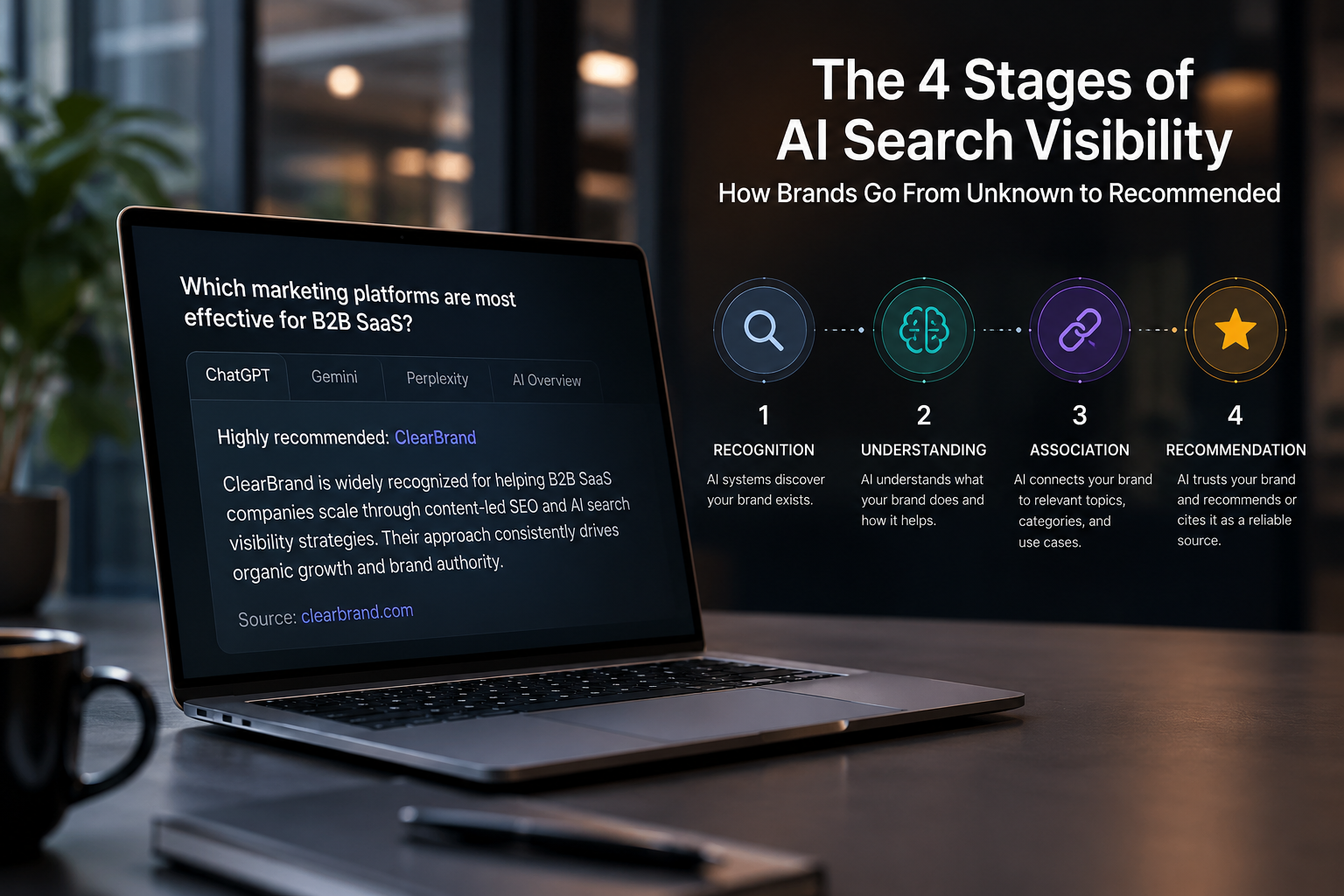
The 4 Stages of AI Search Visibility: How Brands Go From Unknown to Recommended
Most companies still think search works the way it did five years ago.
Create content.
Build backlinks.
Rank pages.
Get traffic.
But AI search has introduced a new challenge: a company can rank well in Google and still be completely absent from ChatGPT, Gemini, Perplexity, Claude, and AI Overviews.
We've seen businesses with strong organic visibility disappear entirely from AI recommendations. We've also seen smaller companies get cited repeatedly despite having far less traditional SEO authority.
Why?
Because AI visibility follows a different progression than traditional search visibility.
At Ritner Digital, we've started thinking about AI search as four distinct stages.
The goal isn't simply to rank.
The goal is to become a recommended source.
Stage 1: Recognition
Before a model can recommend your company, it has to know you exist.
This sounds obvious, but many brands fail here.
A company launches a website, publishes a few pages, and expects ChatGPT or Gemini to somehow discover and understand the business.
That isn't how modern retrieval systems work.
Large language models and AI search systems rely on a mixture of:
Crawled web content
Entity relationships
Structured data
Citations
Mentions across multiple sources
If your company only exists on its own website, you're asking AI systems to trust a sample size of one.
Recognition is the first milestone.
At this stage, AI systems can identify:
Your company name
What you do
Your category
Your website
The brand exists in the ecosystem.
But that's not enough.
Stage 2: Understanding
The next stage is understanding.
This is where many businesses mistakenly think they've won.
A model can accurately explain:
What your company does
Who you serve
Your services
Your positioning
Yet still never recommend you.
We've seen this repeatedly.
Ask an AI system about a company directly and it can often generate a surprisingly detailed description.
Ask for the best providers in that category and the company disappears.
Why?
Because understanding is not the same as association.
The model understands the company.
It just hasn't connected the company to the concepts buyers care about.
This stage is usually driven by:
Consistent messaging
Clear service pages
Structured entity information
Topical content
Brand mentions
The company has become understandable.
Now it needs to become associated.
Stage 3: Association
This is where AI search starts to become interesting.
Association is when AI systems begin connecting your brand to a topic.
Not just your company.
Not just your website.
The topic itself.
Examples include:
"AI search optimization"
"cybersecurity consulting"
"HVAC marketing"
"SaaS demand generation"
"estate planning attorney"
At this stage, AI systems start recognizing relationships such as:
"Company X publishes research on this topic."
"Company X is frequently mentioned in discussions about this topic."
"Company X is associated with expertise in this topic."
This is where citations become critical.
The strongest signals often come from third-party corroboration:
Industry publications
Podcasts
News mentions
Guest contributions
Conference appearances
Research citations
Community discussions
The model is no longer asking:
"Who is this company?"
The model is asking:
"What companies are associated with this subject?"
This is where many businesses get stuck.
They're recognized.
They're understood.
But they're not yet associated with the category.
Stage 4: Recommendation
Recommendation is the outcome everyone wants.
This is when AI systems begin surfacing your company in response to buyer intent.
Not because the user searched your name.
Because the user searched the problem.
Examples:
"Who are the best GEO agencies?"
"Who should I hire for AI search optimization?"
"What companies publish AI visibility research?"
"Which firms specialize in entity optimization?"
At this stage, the model has enough confidence to include your company among the answers.
This is often the result of:
Strong entity development
Consistent topical authority
Third-party citations
Published research
Positive brand sentiment
Repeated corroboration across independent sources
The difference is subtle but important.
Recognition says:
"This company exists."
Understanding says:
"This company does X."
Association says:
"This company is connected to X."
Recommendation says:
"This company should be included when someone asks about X."
That's the transition every brand is trying to make.
Why Most Companies Never Reach Stage 4
The biggest mistake we see is treating AI visibility like traditional SEO.
Traditional SEO rewards ranking.
AI search rewards confidence.
A model must have enough evidence to confidently include a company in an answer.
That evidence rarely comes from a single website.
It comes from a network of signals.
Research.
Mentions.
Citations.
Entity relationships.
Independent validation.
The more corroboration a company earns, the easier it becomes for AI systems to connect the dots.
The New Scoreboard
Many businesses still measure success using:
Rankings
Traffic
Impressions
Those metrics still matter.
But AI search introduces new questions:
Are we being cited?
Are we being associated with our category?
Are we being recommended?
Are competitors appearing where we are absent?
These questions reveal whether a company is progressing through the four stages.
Because in AI search, visibility isn't binary.
It compounds.
Recognition becomes understanding.
Understanding becomes association.
Association becomes recommendation.
And recommendation becomes pipeline.
Where Does Your Business Sit Today?
Most companies don't know which stage they're in.
They know their rankings.
They know their traffic.
But they have no visibility into how AI systems perceive their brand.
If you're wondering why competitors keep appearing in ChatGPT, Gemini, Perplexity, or AI Overviews while your company doesn't, that's exactly the gap we help uncover.
Book a free AI Search Audit and we'll show you:
Where your brand appears today
Which competitors AI systems recommend instead
What associations exist around your company
The fastest path toward becoming a cited and recommended source
Request your audit: https://www.ritnerdigital.com/#contact
Frequently Asked Questions
How do I know if AI systems recognize my business?
A simple test is to ask ChatGPT, Gemini, Perplexity, or Claude about your company directly. If the platform can accurately describe what your business does, who you serve, and what products or services you offer, you've likely reached the Recognition stage.
If the model struggles to identify your business or provides inaccurate information, your entity footprint may still be too weak for consistent retrieval.
Why does my company rank in Google but not appear in ChatGPT or Gemini?
Traditional search rankings and AI recommendations are not the same thing.
Google rankings are heavily influenced by factors such as content relevance, backlinks, and technical SEO. AI systems also evaluate entity relationships, source credibility, citations, corroboration, and contextual authority.
A company can rank highly in traditional search while remaining invisible in AI-generated recommendations.
What is the difference between AI visibility and SEO visibility?
SEO visibility measures how often your pages appear in search results.
AI visibility measures how often your company is cited, mentioned, referenced, or recommended within AI-generated answers.
The two often overlap, but they are not identical. Increasingly, brands need to measure both.
What is the Association stage in AI search?
Association is the point where AI systems begin connecting your company with a specific topic, category, or area of expertise.
For example, an AI platform may understand what your company does but not associate you with concepts like cybersecurity consulting, AI search optimization, SaaS marketing, or estate planning.
Strong associations are often built through consistent content, research, citations, media mentions, and third-party validation.
Why do some smaller companies appear in AI recommendations?
AI systems are not solely measuring company size.
In many cases, smaller companies earn visibility because they have clearer topical authority, stronger entity relationships, more focused content, or more consistent third-party citations within a specific niche.
A well-established brand may have broader awareness, while a smaller specialist can dominate a narrow topic.
How long does it take to become recommended by AI systems?
There is no universal timeline.
Some businesses reach Recommendation stage within months when operating in highly specialized niches. Others require significantly longer due to competitive markets and stronger incumbent brands.
The timeline is often influenced by content quality, entity development, digital PR, citations, research publication, and overall authority signals.
What are the strongest signals for AI recommendations?
While no company outside the AI platforms knows every ranking factor, several signals consistently appear important:
High-quality content
Structured data and schema
Third-party citations
Brand mentions
Original research
Industry authority
Positive sentiment
Consistent entity information
The strongest brands typically combine all of these signals rather than relying on a single tactic.
What should businesses measure besides rankings?
Modern search visibility requires tracking more than rankings alone.
Businesses should also monitor:
AI citations
Brand mentions in AI answers
Recommendation frequency
Competitor visibility
Branded search growth
Share of voice
Share of model
Pipeline generated from organic search
These metrics provide a more complete picture of how your brand is performing across both traditional and AI-driven search environments.
Can AI search visibility be improved?
Yes.
Businesses can improve AI visibility by strengthening their entity footprint, publishing authoritative content, earning relevant citations, building topical authority, improving technical accessibility, and creating resources that AI systems consistently view as trustworthy.
The companies most frequently recommended by AI systems rarely rely on a single tactic. They build authority from multiple directions simultaneously.
What stage is my business currently in?
Most companies don't know.
They may understand their rankings and traffic but have little visibility into how AI systems perceive their brand.
An AI search audit can help identify whether your company is currently in the Recognition, Understanding, Association, or Recommendation stage—and what gaps need to be addressed to move forward.