The Death of the "10 Blue Links": Why a Page-One Ranking No Longer Guarantees Traffic
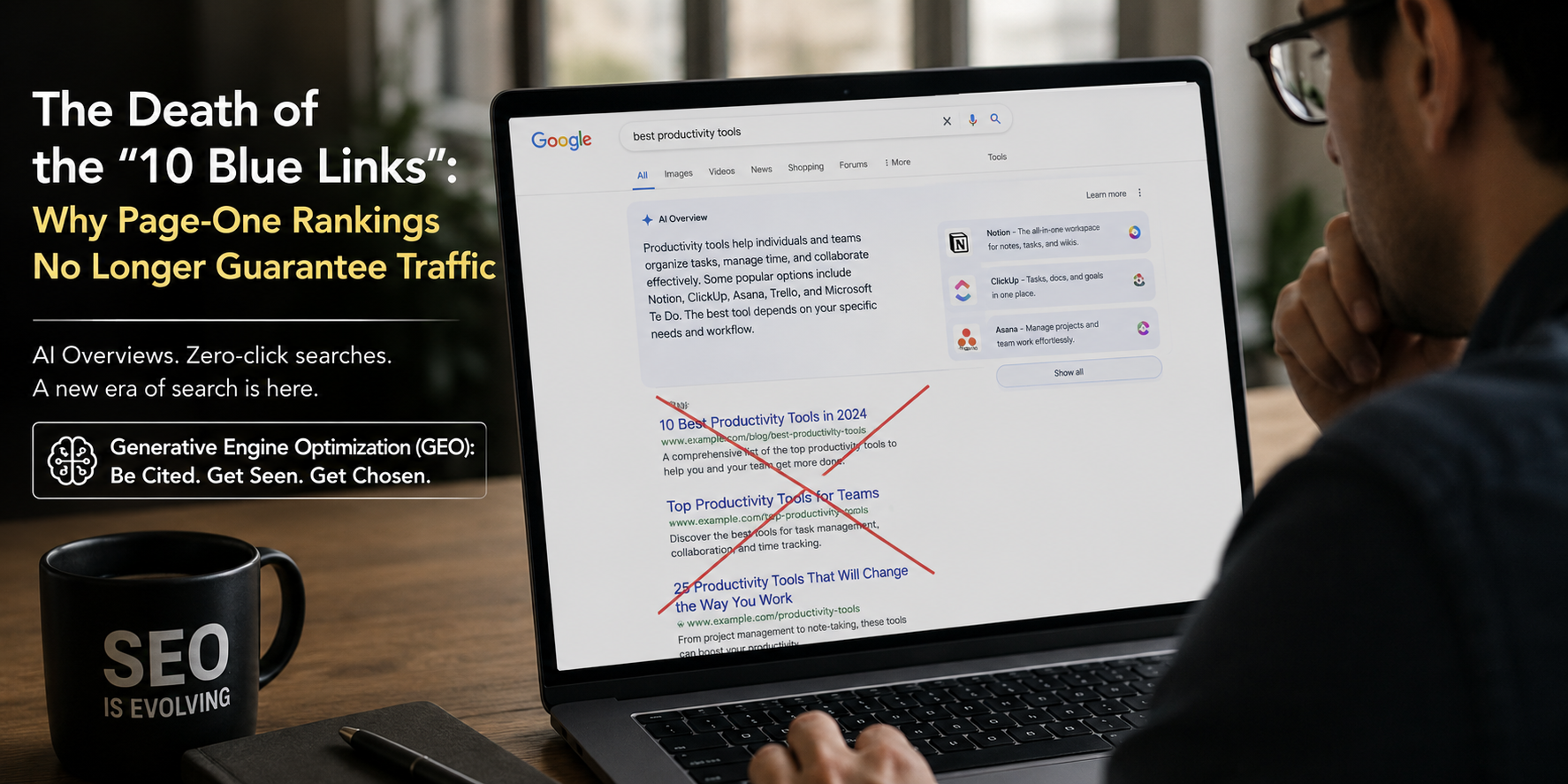
For twenty-five years, the goal of search engine optimization was simple to explain to any business owner: get your website onto the first page of Google. Land in the top few "blue links," and the clicks would follow. That model was the bedrock of digital marketing. It was predictable, measurable, and — for those who invested in it — reliable.
That model is now collapsing in real time. The shift isn't subtle, and it isn't coming someday. It's already here, it's measurable across dozens of independent studies, and it's quietly rewriting the relationship between a ranking and a result. If you're still measuring SEO success purely by where you rank, you're tracking a metric that no longer means what it used to.
Here's the uncomfortable truth that the data now makes impossible to ignore: a number-one organic ranking can produce a fraction of the traffic it did two years ago — and in many cases, the gap between "ranked first" and "got the click" has become a chasm. Below, we'll walk through exactly what's happening, why it's happening, and what businesses can actually do about it.
What "Zero-Click" Actually Means for Your Business
Start with the headline behavior change. According to research compiled from industry reports, publisher data, and academic studies, roughly 60% of Google searches now end without any click to a website, up from 58% in 2024. Think about that for a moment. The majority of searches are now resolved entirely on the results page itself. The user gets their answer and never leaves Google.
This is the phenomenon known as the "zero-click search," and it isn't new in concept — Google has spent years adding features like featured snippets, knowledge panels, and weather boxes that answer questions without requiring a click. But the arrival of AI Overviews has accelerated this trend from a slow drift into a structural rupture.
AI Overviews are the AI-generated summaries Google now places at the very top of many search results pages. Rather than presenting a list of links and letting you choose, Google's systems read across multiple sources, synthesize an answer, and hand it to the user directly — often before a single traditional result is visible without scrolling. The reach is expanding fast. Semrush's analysis of more than 10 million keywords found that queries triggering AI Overviews grew rapidly through early 2025 before settling at around 16% of all queries, with another analysis putting the figure at 13.14% of queries — more than double the 6.49% recorded in January 2025.
When the answer is already on the page, the incentive to click evaporates. And the data on what happens to clicks is, frankly, brutal.
The Numbers: How Far Clicks Have Actually Fallen
This is where the abstract becomes concrete. Let's look at what multiple independent research bodies have measured, because no single study tells the whole story — but together they paint an unmistakable picture.
The most rigorous independent analysis comes from the Pew Research Center, which tracked 68,000 real search queries rather than relying on estimates or keyword tools. Pew found that users clicked on a result just 8% of the time when an AI summary appeared, compared to 15% of the time when no summary was present — a 47% relative reduction in clicks. Because Pew tracked actual user behavior rather than modeled projections, this finding carries particular weight and validates what publishers had been reporting anecdotally for months.
The trend has also worsened over time. An Ahrefs study found that in April 2025, AI Overviews were associated with a 34.5% drop in click-through rate for the top result. By December 2025, that same analysis showed the presence of an AI Overview had driven a 58% reduction in CTR for the top-ranking result. To translate that into plain terms: for every 100 clicks that the first-ranked page would have earned in the past, only about 42 remain — the other 58 are absorbed into the AI answer and never reach the website.
The pattern holds beyond the top spot. That same research found CTR dropped by 50.8% for second-ranked links and 46.4% for third-place links when AI Overviews were present. The decline isn't isolated to one position; it's pulling the entire results page downward.
Seer Interactive's longitudinal study, spanning 3,119 informational queries across 42 organizations and more than 25 million organic impressions between June 2024 and September 2025, reached an equally sobering conclusion: organic click-through rates for informational queries featuring AI Overviews fell 61% since mid-2024, while paid CTRs on those same queries dropped 68%. When IDEAVA compiled twelve separate studies measuring CTR impact, the magnitude of decline varied from 15% to 89% depending on methodology and query type — but every single study found a decline. The direction was unanimous.
The Most Important Detail Most People Miss
Here is the finding that should reshape how every business thinks about search — and it's the one that gets buried under the headline numbers.
Even when AI Overviews are not present, clicks are still falling. Seer's data showed that on queries without AI Overviews, organic CTRs still fell 41%. Similarly, the broader research found that traditional organic results are struggling to maintain click-through rates for informational queries even when AI summaries don't dominate the page.
Why does this matter so much? Because it tells us the problem isn't only Google's AI Overviews. User behavior itself has shifted. People are increasingly seeking answers in other places before they ever reach Google — in ChatGPT, in Perplexity, on social platforms like Reddit and TikTok, or by going directly to brands they already trust. As one analysis put it, that lost traffic isn't coming back.
This reframes the entire challenge. You can no longer "fix" your traffic problem simply by ranking higher on Google, because a growing share of your potential audience is forming opinions and making decisions inside AI tools long before a traditional search ever happens. ChatGPT alone now processes an estimated 1.6 billion search-style queries daily and ranks among the most-visited websites in the world. The behavior has moved. The question is whether your business has moved with it.
Being Cited Is the New Being Ranked
If clicks from traditional rankings are drying up, where does visibility come from now? The answer is citation — being the source that an AI engine selects, extracts, and references when it builds its answer.
When someone asks ChatGPT or Perplexity a question, they don't get ten blue links. They get one synthesized answer, and that answer typically cites somewhere between two and seven sources. If your brand isn't one of them, you are effectively invisible at one of the most decisive moments in your customer's research journey — the moment they're deciding who to consider.
And here's the strategic upside that makes this worth fighting for. Although clicks from AI answers are rarer, the visitors who do arrive are dramatically more valuable. One analysis found that AI search traffic converts at 14.2% compared to Google organic's 2.8% — meaning a single AI citation can be worth roughly five times as much as a traditional organic click. Other analyses put the conversion gap even higher. The logic is intuitive: someone who clicks a cited source after reading a synthesized answer is deeper into their decision process and more qualified than a casual searcher skimming a results page.
There's also a first-mover advantage that won't last forever. Research suggests the top 20% of cited domains capture roughly 80% of all AI references, and that authority compounds over time through what's been called "source preference bias" — AI systems repeatedly returning to sources they've learned to trust. The brands establishing citation share now, while competition is still relatively low, are building an advantage that gets harder for latecomers to dislodge.
This Is What Generative Engine Optimization Solves
The discipline built to address this shift is called Generative Engine Optimization, or GEO. Where traditional SEO optimizes for rankings and clicks, GEO optimizes for mentions, citations, and recommendations inside AI-generated answers. The two aren't in opposition — GEO builds on SEO fundamentals. Strong technical accessibility, quality content, and credibility signals form the foundation that AI systems rely on when deciding which brands to reference. But the goal, and the way you measure success, fundamentally change.
The encouraging news for anyone worried that AI answers are too unpredictable to optimize for: while individual responses fluctuate, the underlying inputs are stable. AI systems consistently rely on durable signals — authority, clarity, structure, and trust. Brands with strong entity clarity and credible, well-structured sources appear repeatedly, even as the surface-level wording of answers shifts. The patterns are stable enough to act on.
So what actually moves the needle? The foundational peer-reviewed GEO research, which tested optimization strategies across 10,000 queries in 25 domains, found measurable visibility lifts from specific tactics: adding relevant quotations lifted visibility by 41%, incorporating statistics by 32%, adding citations by 30%, and improving fluency by 28%. Beyond that study, practitioners have identified a consistent set of effective principles:
Lead with the answer. Structure content so a direct, extractable answer appears in the first 40 to 60 words of a section. AI systems pull clean, self-contained statements — make yours easy to lift.
Build fact density. Include statistics, data points, and verifiable claims regularly throughout your content. Fact-dense writing is more citable than vague prose.
Use tables for comparisons. Listicles and comparison tables account for an estimated 32% of all AI citations — the single highest-performing content format. Comparisons, rankings, and feature lists structured as HTML tables are scannable and extractable.
Keep content fresh. Perplexity shows a strong recency bias, with around half its citations referencing content from the current year. Update statistics, refresh examples, and signal freshness visibly.
Earn third-party validation. AI systems weigh earned mentions heavily — reviews on platforms like G2 and Trustpilot, industry coverage, and authentic community discussion on sites like Reddit all strengthen the signals AI uses to judge your credibility.
It's worth noting where Google itself has landed on all this. In 2026, Google released official documentation stating that "optimizing for generative AI search is optimizing for the search experience, and thus still SEO." In other words: this isn't a separate, exotic discipline disconnected from everything you know. It's the natural evolution of search optimization for a world where the search experience has fundamentally changed.
Where This Leaves Your Business
Let's bring it back to the question every business owner is really asking: what does this mean for me?
It means the comfortable assumption that a good ranking equals good traffic is no longer safe. It means that measuring SEO success by position alone will increasingly mislead you, because the relationship between position and clicks has been severed. And it means there's a narrowing window to establish your brand as a trusted, citable source inside AI answers — before your competitors lock up the citation share in your category.
The businesses that thrive through this transition won't be the ones that panic or the ones that pretend nothing has changed. They'll be the ones that adapt their measurement, restructure their content for extractability, and deliberately pursue citation rather than just ranking. The "10 blue links" era is ending. What replaces it rewards a different kind of preparation — and the brands getting ready now are the ones who'll own the answers tomorrow.
Find Out Where You Stand in AI Search
The hardest part of this shift is that most businesses have no visibility into it. You can't see how often ChatGPT, Perplexity, or Google's AI Overviews are citing — or ignoring — your brand. You can't tell whether your hard-won rankings are still producing clicks, or quietly bleeding traffic into AI answers that never mention you.
That's exactly what a GEO audit reveals. At Ritner Digital, we run Generative Engine Optimization audits that map where your brand currently appears in AI-generated answers, identify the citation slots you're missing, and build a concrete plan to secure them — turning your content into the source AI engines choose to cite when your customers are deciding who to trust.
The brands that move first will own the answers. Get your GEO audit started today →
Sources: Pew Research Center; Ahrefs (December 2025); Seer Interactive AIO CTR Study (September 2025 update); Semrush AI Overviews Study; Search Engine Journal; Search Engine Land; IDEAVA (12-study analysis); Frase.io GEO Guide; the foundational Princeton/Georgia Tech/Allen AI GEO research; and Google's 2026 generative AI search documentation.
Frequently Asked Questions
What are AI Overviews?
AI Overviews are AI-generated summaries that Google places at the top of many search results pages. Instead of returning only a list of links, Google's systems read across multiple sources, synthesize an answer, and present it directly to the user — often before any traditional result is visible without scrolling. They've expanded rapidly, appearing on somewhere between 13% and 16% of all queries by late 2025, up from roughly 6.5% in January 2025.
Does ranking number one on Google still matter?
It matters, but it no longer guarantees traffic the way it once did. Ahrefs found that by December 2025, the presence of an AI Overview drove a 58% reduction in click-through rate for the top-ranking result — meaning the first-ranked page now earns roughly 42 of every 100 clicks it would have captured in the past. A top ranking is still valuable, but position alone is no longer a reliable predictor of clicks.
How much have click-through rates actually dropped because of AI Overviews?
Estimates vary by methodology, but every credible study found a decline. The Pew Research Center, tracking 68,000 real searches, found clicks fell from 15% to 8% when an AI summary appeared — a 47% relative drop. Seer Interactive measured a 61% decline in organic CTR for informational queries with AI Overviews. An IDEAVA review of twelve studies found declines ranging from 15% to 89%, with the direction unanimous across all of them.
What is a zero-click search?
A zero-click search is one that ends without the user clicking through to any website — they get their answer directly on the results page. Roughly 60% of Google searches now end this way, up from 58% in 2024. AI Overviews, featured snippets, and knowledge panels all contribute to this behavior by resolving queries before a click is ever needed.
What is Generative Engine Optimization (GEO)?
GEO is the practice of optimizing your content to be cited, quoted, or referenced inside AI-generated answers from platforms like ChatGPT, Perplexity, Google AI Overviews, and Claude. Where traditional SEO optimizes for rankings and clicks, GEO optimizes for citations and mentions. The two work together — GEO builds on solid SEO fundamentals like technical accessibility, quality content, and credibility signals.
Is GEO different from SEO, or a replacement for it?
It's an evolution, not a replacement. In 2026, Google released official documentation stating that "optimizing for generative AI search is optimizing for the search experience, and thus still SEO." GEO builds on SEO fundamentals rather than discarding them — but it changes what you measure, shifting the goal from ranking position to citation share inside AI answers.
Is AI search traffic actually worth pursuing if clicks are so rare?
Yes — arguably more than ever. Although clicks from AI answers are rarer, the visitors who do arrive convert dramatically better. One analysis found AI search traffic converts at 14.2% versus Google organic's 2.8%, making a single AI citation worth roughly five times as much as a traditional organic click. Fewer, higher-quality visitors can outperform a larger volume of casual ones.
How do I get my brand cited by AI engines?
The foundational GEO research found measurable visibility lifts from specific tactics: adding quotations (+41%), statistics (+32%), citations (+30%), and improving fluency (+28%). Practitioners also recommend leading with a direct answer in the first 40–60 words of a section, building fact density throughout, using comparison tables, keeping content fresh, and earning third-party validation through reviews and authentic community discussion. A GEO audit is the fastest way to see which of these your content is missing.