Why "Search Everywhere" Is Now Dominating Discovery — And Why Your Brand Might Be Invisible to It
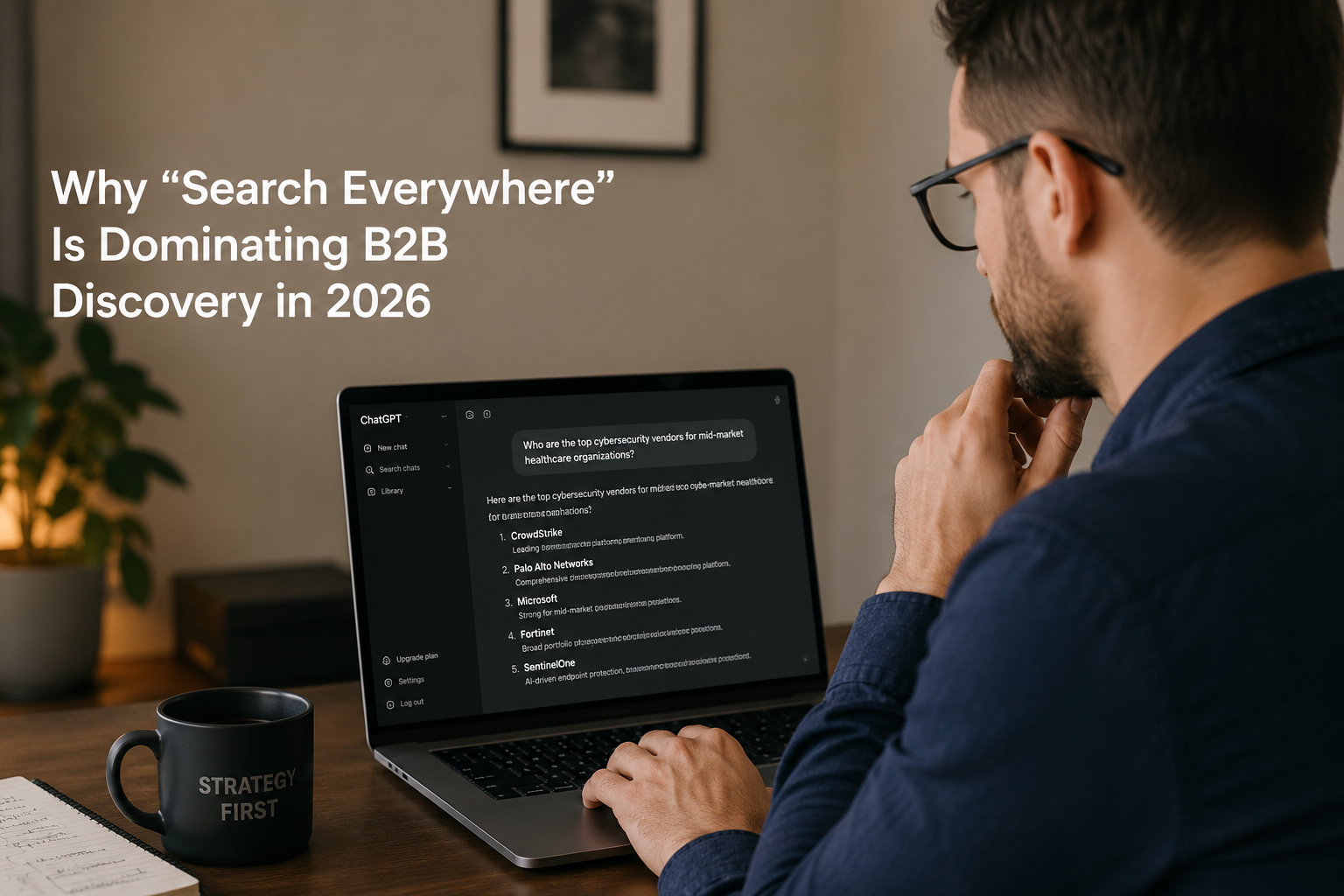
There's a conversation happening about your company right now that you will never see. A managing director three states away opens Perplexity, types "Who are the top B2B digital PR firms in Philadelphia?" and within seconds receives a clean, confident shortlist of four or five vendors with their strengths neatly summarized. By the time anyone at those firms knows a buyer exists, the decision is already half made. And if your name wasn't in that list, you were never in the running.
This is the quiet pipeline bleed reshaping B2B discovery in 2026. It isn't a future trend to prepare for — it's the present reality, and most companies have no idea it's happening to them. The buyer journey hasn't just moved; it's inverted. The shortlist now forms before a salesperson is ever involved, assembled by an AI engine reading across the entire web. The question every business needs to answer is uncomfortable but simple: when the AI builds that list, does your brand exist as something it can recognize and recommend?
For a growing number of companies, the honest answer is no. Not because their product is weak or their reputation is poor — but because their digital footprint isn't structured in a way that AI engines can understand. Let's unpack what's actually happening, why it's happening at the level of entities rather than keywords, and what it takes to stop being invisible.
The Funnel Didn't Shift — It Inverted
Start with the behavior change, because the scale of it is genuinely hard to overstate.
According to Forrester's B2B Predictions for 2026, 94% of B2B decision-makers used at least one large language model during their purchase process in 2025. A separate March 2026 analysis combining six independent studies — covering 680 million AI citations and nearly two million browsing sessions — found that 73% of B2B buyers now use AI tools like ChatGPT and Perplexity in their research process. A Wynter survey of CMOs put the vendor-discovery figure at 84%, a number that sat at just 24% a year earlier and barely registered in 2024. However you slice the data, the direction is unanimous and the velocity is staggering.
But adoption alone doesn't capture the structural change. The more important finding is when in the journey this happens. Research consistently shows that B2B buyers complete roughly 70% of their decision journey before ever filling out a form or replying to outreach. One 2026 analysis found that for every hour a buyer spends with a vendor's sales team, they've already spent approximately five hours researching independently — and the majority of that research now happens inside AI tools, not on Google.
Think about what that means for the traditional marketing funnel. For decades, the model was: awareness at the top, consideration in the middle, decision at the bottom, with sales and marketing guiding the prospect down through each stage. That funnel has effectively flipped on its head. The shortlist — the single most consequential moment in the entire journey — now happens at the very beginning, in a conversation you're not part of, before you even know the buyer exists. As one report bluntly put it: buyers are choosing brands before they ever open Google, and most companies have no idea it's happening.
The competitive stakes are brutal. Studies of B2B buying behavior find that around 80% of deals are won by the vendor who was the buyer's pre-contact favorite. If the AI shortlist shapes who that favorite becomes, then visibility inside AI answers isn't a marketing nicety. It's the difference between being considered and being invisible.
Why This Is About Entities, Not Keywords
Here's where most businesses misunderstand the problem — and why the old SEO playbook won't save them.
When that managing director asks Perplexity for the top digital PR firms in Philadelphia, the engine is not scanning the web for pages that repeat the phrase "Philadelphia digital PR firm" the most times. That's not how generative engines work. Instead, the system uses retrieval-augmented generation: it cross-references multiple sources, identifies real-world entities — companies, people, places, products — and maps the relationships and attributes associated with each one. It then assembles an answer from the sources it has indexed as authoritative on that topic.
This is a fundamental shift in how discovery operates. As industry analysis has noted, traditional SEO optimizes for keyword matching and backlink authority, while AI search evaluates entity clarity, factual consistency, and structured signal density. The engine isn't asking "which page mentions these words most?" It's asking "which entities are genuinely associated with this category, and which sources can I trust to define them?"
This distinction is why a company can rank respectably on Google and still be completely absent from AI answers. Keyword optimization makes you findable in a list of links. Entity clarity makes you recognizable as a thing that an AI can confidently name and recommend. They are not the same capability, and the second one is now the one that decides whether you make the shortlist.
It gets more pointed. An academic study published in late 2025 found that 37% of AI-cited domains do not appear in traditional search results at all. Read that again: more than a third of the sources AI engines cite when answering buyer questions are sources that wouldn't show up on page one of a Google search for the same query. The AI is drawing from a different, broader map of authority — one built on entity associations and third-party validation across the web, not classic search rankings. If your strategy is built entirely around Google rankings, you're optimizing for a map the buyer is no longer using.
The Fragmentation Problem: "Search Everywhere" Is Literal
Compounding all of this is the fact that "search everywhere" isn't a slogan — it's a literal description of how discovery now fragments across platforms, each with its own rules.
The same brand can receive wildly different visibility depending on which engine the buyer happens to use. A March 2026 cross-platform analysis found that citation volumes for the same brand can differ by up to 615 times between platforms. The engines source information differently, too: one analysis found ChatGPT leans on business listings for roughly 49% of local citations, while Gemini favors websites at around 52%, and Perplexity diversifies heavily across review platforms and community sources like Reddit. A brand that's perfectly visible on one platform can be effectively nonexistent on another.
This fragmentation makes the underlying problem more dangerous, not less. You can't simply optimize for "the AI" as if it were a single destination, the way you once optimized for Google. The buyer might be in ChatGPT, Perplexity, Gemini, Claude, Copilot, or Google's own AI Overviews — and your presence in each is governed by different signals. The only durable way to perform across all of them is to make your brand legible at the most fundamental level: as a clearly defined entity with consistent, machine-readable attributes that every engine can ingest, no matter how it sources its answers.
And the volume of these conversations is enormous. Estimates of daily B2B-related prompts run to more than 20 million per day on ChatGPT alone, ballooning to somewhere between 80 and 100 million across all major assistants when you factor in Claude, Copilot, Perplexity, and Gemini. Every one of those is a discovery moment. Every one is a chance to be on the list or off it.
Schema and Structured Data: The Baseline Requirement
So how do you make your brand legible as an entity? This is where schema markup and structured data move from "technical nice-to-have" to baseline infrastructure for modern discovery.
Schema is structured data markup — a standardized vocabulary, most reliably implemented in JSON-LD, that acts like a map telling engines exactly what your content means: this is the organization, this is what it does, these are its services, this is where it operates, these are the people behind it, here are the relationships between them. Rather than forcing an AI to infer what your business is from prose, you hand it an unambiguous, machine-readable definition.
This isn't speculative. Two major platforms have explicitly confirmed that schema helps their AI systems understand content: Google's Search team stated in 2025 that structured data provides an advantage in search results, and Microsoft confirmed that schema markup helps its models understand content for Bing Copilot. Industry analysis is now blunt about it — JSON-LD structured data is described as no longer optional for AI search in 2026, but rather the standard that major engines rely on to extract structured signals from your pages.
The mechanism matters. When a query arrives, AI engines parse schema markup, map the entities they find to knowledge-graph nodes, and rank sources by confidence. Schema markup is, in effect, the primary method for getting your entities recognized in a knowledge graph in the first place — particularly when you connect your organization, people, and products with strong "sameAs" links to authoritative references like Wikidata and Wikipedia. That's what builds the entity associations the AI relies on. Get it right, and you're feeding the engine clean, confident signals about who you are. Get it wrong — or skip it entirely — and you're asking the AI to guess, which it will often do by simply citing a competitor whose signals were clearer.
One critical caveat that trips up most do-it-yourself attempts: your schema must match what's actually visible on the page. AI engines check for this consistency, and mismatches between your structured data and your real content can get you ignored or penalized. Entity optimization isn't about gaming the system with hidden markup — it's about making your genuine, verifiable identity perfectly clear to a machine that's trying to understand it.
The Window Is Open — But It's Closing
Here's the part that should move this from your "someday" list to your "now" list.
Despite 94% of buyers using these tools, the marketing world has been remarkably slow to respond. Only about 22% of marketers currently track AI visibility at all, and barely a quarter plan to develop content specifically for AI citations. Roughly 64% admit they're unsure how to even measure success in AI search. This gap between buyer behavior and marketer response is the entire opportunity. Your competitors, by and large, are not yet doing this well.
That won't last. The authority that AI engines assign to entities tends to compound — sources the models learn to trust get cited again and again, and that advantage becomes harder for latecomers to dislodge over time. The brands that establish clear entity definitions and strong structured-data foundations now, while the field is still wide open, are building a position that will be progressively more expensive and difficult for others to catch.
There's also a quality dividend that makes the investment unusually attractive. The traffic that does arrive from AI search converts dramatically better than traditional organic — multiple studies put AI search conversion rates at roughly four to five times that of standard Google organic traffic. These are buyers deep in a genuine evaluation, not casual searchers. Being the cited, recommended entity in that moment isn't just about volume; it's about reaching the most qualified prospects at the exact instant they're deciding who to trust.
The Bottom Line
The discovery landscape has fundamentally changed. Buyers now assemble their vendor shortlists inside AI engines, before sales is ever involved, and those engines build their answers by recognizing entities — not counting keywords. If your digital footprint isn't structured so an AI can identify your brand as a clear, trustworthy entity associated with your category, you are simply not in the conversation. Not losing the conversation. Not in it at all.
The good news is that this is a solvable problem with known tools: comprehensive schema markup, consistent structured data, and deliberate entity optimization that makes your brand machine-legible across every platform a buyer might use. The companies that treat this as core infrastructure rather than an afterthought are the ones who'll keep showing up on the shortlist as the rest of the market scrambles to catch up.
Is Your Brand Visible to the AI Engines Your Buyers Already Use?
Most companies have never checked whether ChatGPT, Perplexity, or Google's AI Overviews can actually recognize and recommend them — and many discover, too late, that they're invisible at the exact moment buyers are building their shortlists.
At Ritner Digital, we make sure your brand exists as a clearly defined entity that AI engines can find, understand, and cite. Our Schema, Structured Data, and Entity Optimization services build the machine-readable foundation modern discovery depends on — turning your business into a source the AI confidently names when your next customer asks who the best option is.
Don't find out you were left off the list after the deal is gone. Get your entity visibility assessment started today →
Sources: Forrester B2B Predictions 2026; Averi 680-million-citation analysis (March 2026, via PR Newswire); Wynter CMO survey (2026, via Fast Company); 5W First-Stop Study 2026; G2 (March 2026); Superlines cross-platform analysis (March 2026); Zhang et al. (arXiv, December 2025); Search Engine Land; Search Engine Journal; Stackmatix; and Google and Microsoft official structured-data statements.
Frequently Asked Questions
How are B2B buyers actually using AI tools to find vendors?
Buyers now use tools like ChatGPT, Perplexity, Claude, and Gemini to build their vendor shortlists before contacting any company. They ask open category questions — like "What are the best cloud ERP providers for mid-sized manufacturers?" — and the AI returns a shortlist of three to five vendors with pros and cons. Forrester found 94% of B2B decision-makers used at least one large language model during their 2025 purchase process, and research shows roughly 70% of the buying journey is now complete before a buyer ever contacts sales.
What's the difference between keyword SEO and entity optimization?
Keyword SEO optimizes for pages that match specific search terms and earn rankings and clicks. Entity optimization makes your brand recognizable as a defined "thing" — a company, with specific services, locations, people, and relationships — that AI engines can confidently identify and recommend. Traditional SEO is about keyword matching and backlinks; AI search evaluates entity clarity, factual consistency, and structured signals. A brand can rank on Google yet still be invisible in AI answers because its entity isn't clearly defined.
What is schema markup and why does it matter for AI search?
Schema markup is structured data — most reliably written in JSON-LD — that acts as a machine-readable map of your content, telling engines exactly what your business is, what it does, and where it operates. Both Google and Microsoft have confirmed that schema helps their AI systems understand content. When a query arrives, AI engines parse schema, map the entities to knowledge-graph nodes, and rank sources by confidence — making structured data a baseline requirement for AI visibility in 2026 rather than an optional extra.
Can my brand rank well on Google but still be invisible in AI answers?
Yes — and it's common. An academic study in late 2025 found that 37% of AI-cited domains don't appear in traditional search results at all. AI engines draw from a broader map of authority built on entity associations and third-party validation, not just classic search rankings. If your strategy is built entirely around Google rankings, you may be optimizing for a map your buyers are no longer using.
Why do I need to optimize for multiple AI platforms instead of just one?
Because discovery has fragmented, and each engine sources information differently. Citation volumes for the same brand can differ by up to 615 times between platforms. ChatGPT leans heavily on business listings, Gemini favors websites, and Perplexity diversifies across reviews and community sources. A brand visible on one platform can be absent from another. The only durable approach is making your brand legible as a clear entity that every engine can ingest, regardless of how it builds its answers.
Is AI search traffic actually worth optimizing for?
Yes — it's both high-intent and high-converting. Multiple studies put AI search conversion rates at roughly four to five times that of traditional Google organic traffic. These visitors arrive deep in a genuine evaluation rather than casually browsing. Combined with the fact that around 80% of deals go to the buyer's pre-contact favorite, being the cited, recommended entity at the shortlist stage is one of the highest-leverage positions a brand can hold.
How quickly do I need to act on this?
The window is open now but narrowing. Despite 94% buyer adoption, only about 22% of marketers track AI visibility and barely a quarter plan to create content for AI citations — meaning competition is still low. But the authority AI engines assign to entities compounds over time, so brands that establish strong structured-data foundations now build a position that gets progressively harder for latecomers to displace.