Code Got Cheap. Content Got Priceless: Why Your Digital Knowledge Now Matters More Than Your Software
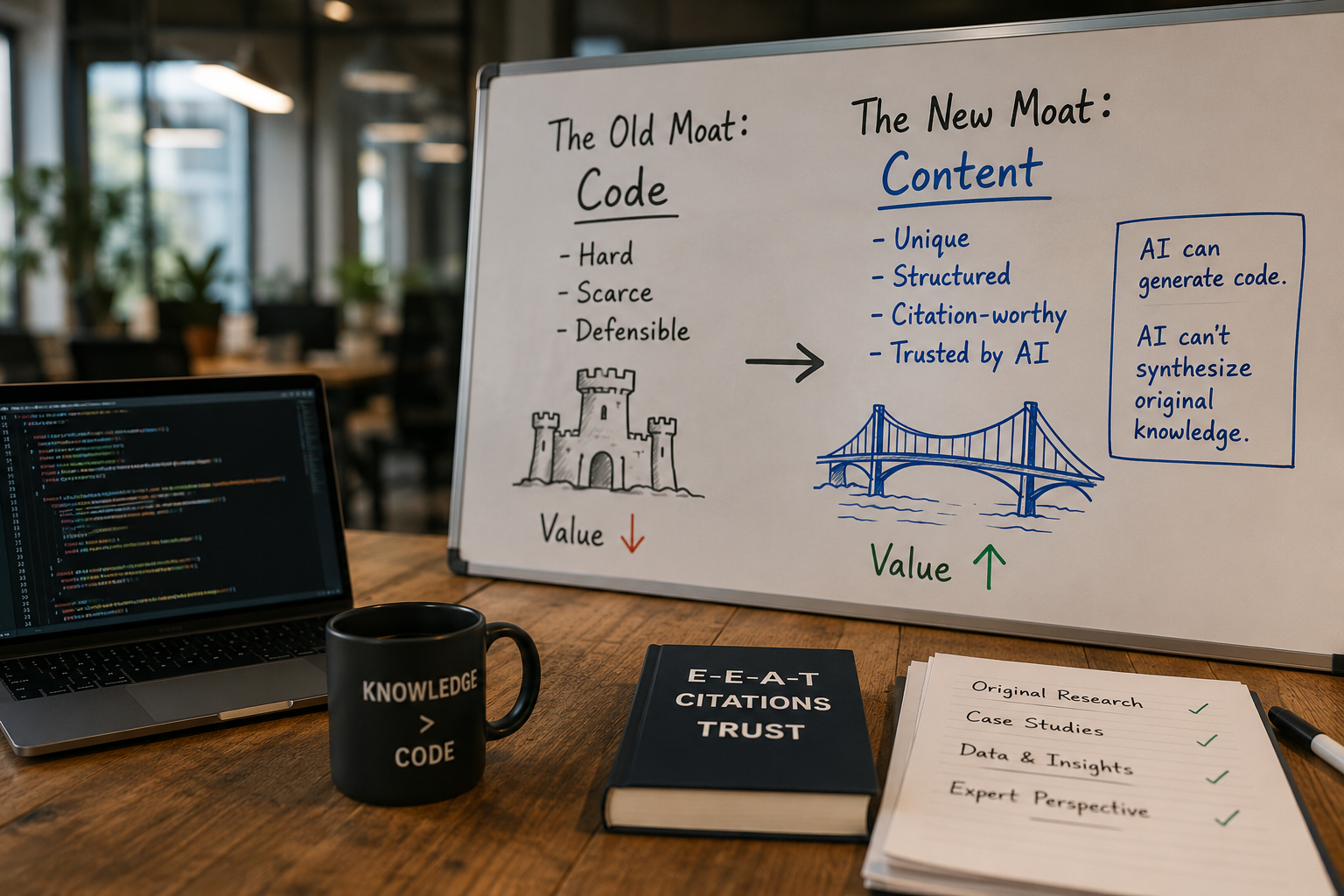
For thirty years, the hard part of building a digital business was building the thing. Software was the moat. If you could write the code — the app, the platform, the front end, the clever back-end logic — you had something most people couldn't replicate, and that difficulty was your protection. Engineering talent was scarce, development was slow, and shipping working software was a genuine competitive advantage in its own right.
That world is ending faster than most companies have noticed. AI has quietly commoditized the act of programming. It can write, refactor, debug, and review code at a pace and cost that would have seemed impossible a few years ago. Building a functional app or a polished front end is no longer the bottleneck — in many cases it's the easy part. And when the hard thing becomes easy, its value collapses. The scarcity moves somewhere else.
Here's where it moved: to high-quality, structured, citation-worthy digital content and data. The unique knowledge your business holds — your expertise, your customer stories, your localized insight, your original research — is now the genuinely scarce asset. Not because content suddenly got more important in the abstract, but because everything around it got cheap, and scarcity is always relative. This piece is about why that shift happened, why it's more durable than it looks, and what it means for where you should actually be investing.
The Commoditization of Code
Start with the uncomfortable truth for anyone who built their advantage on engineering: the ability to code is no longer the main barrier to entry.
The venture capitalist Tomasz Tunguz framed the structural version of this well. Think of a software application as a three-layer cake: a workflow layer the user interacts with, a middle connectivity layer, and a data layer underneath. AI makes writing the front end and the workflow layer trivial, which means the part that used to take a team of engineers months now takes far less. When the workflow layer gets commoditized, the value doesn't disappear — it redistributes downward, toward the data.
You can see this everywhere right now. A solo founder can stand up a working product in a weekend that would have required a funded team a few years ago. Internal tools that once sat in a six-month backlog get built in an afternoon. The line between "software user" and "software builder" is blurring, because the act of building no longer requires the specialized, scarce skill it once did.
This is genuinely good news in a lot of ways. But it has a brutal implication for competitive strategy: if anyone can build the software, the software is no longer your advantage. When the barrier to entry collapses, everyone rushes through the gap, and the market fills with functional, capable, near-identical products. The thing that was supposed to set you apart becomes table stakes. And the moment that happens, the question every business has to answer changes from "can you build it?" to "why should anyone choose you — and how will they even find you?"
That question is not answered by code. It's answered by everything code can't produce.
What AI Cannot Synthesize
The reason content and data have become the new constraint is specific and worth being precise about. It comes down to a single distinction: there's a category of things AI can generate effortlessly, and a category it fundamentally cannot — and the value has migrated entirely into the second category.
AI can write code because code is, in a sense, a solved problem with a vast public corpus to learn from. It can also generate generic content — the bland, listicle-grade, "10 tips for X" filler that now floods the internet — for the same reason. If the information already exists in a thousand similar forms, AI can synthesize a thousand-and-first instantly, and that synthesized version is worth almost nothing precisely because anyone can produce it on demand.
But there is a whole class of assets AI cannot conjure from its training data, because they don't exist anywhere until youcreate them:
Your brand's authentic history and point of view. The actual story of why your company exists, what you believe, the hard-won opinions you've formed from real experience. AI can fake a generic version; it cannot author your genuine one.
Real customer stories and outcomes. The specific results you delivered for a specific client in a specific situation — with real numbers, real context, real before-and-after. This is first-party knowledge that lives only in your business.
Localized and domain-specific expertise. The deep, particular knowledge of your market, your geography, your niche — the kind of insight that only comes from doing the work for years in one place. A model trained on the whole internet is, almost by definition, generic; your value is in being specific.
Original data and research. Numbers nobody else has. Surveys you ran, results you measured, patterns you observed across your own client base. Proprietary data is the one input AI cannot manufacture, because it has to be collected, not generated.
Notice what these have in common: they're all original, all first-party, and all impossible to synthesize from public information. That's exactly why they've become valuable. In a world drowning in AI-generated sameness, the only content that stands out is the content that couldn't have been generated by a machine — because it encodes something real that only your business possesses.
The Trust Layer: Why This Determines Whether AI Recommends You
Here's where the argument moves from interesting to urgent, and it's the part most companies haven't connected yet.
The way customers discover businesses has shifted. A growing share of buyers no longer browse ten search results — they ask an AI engine a question and act on its recommendation. "Who's the best [your category] for [my situation]?" And the engine answers by deciding which businesses to name.
That decision is a trust decision. AI models recommend the entities they understand clearly and can corroborate confidently. And what builds that understanding and corroboration? Not your code. Not your app. Your content — the body of clear, structured, credible information that establishes your business as a real, distinct, authoritative entity in your space.
This is the through-line that connects the whole argument. The same content that AI can't synthesize is the content that makes AI trust you. Your authentic history, your real case studies, your domain expertise, your original data — these don't just differentiate you to human buyers. They're the raw material the engines use to decide whether you're a credible answer worth recommending. A business with a thin, generic, or purely software-driven presence gives the AI nothing to grab onto, so it gets passed over in favor of competitors the model can actually understand and vouch for.
So the stakes are doubled. High-quality first-party content is simultaneously the thing that differentiates you from the flood of look-alike products and the thing that gets you surfaced in the AI-driven discovery layer where buyers increasingly live. Code does neither.
The New Technical Paradigm: Even Inside the Software, Data Wins
It's worth pausing on a deeper version of this, because it shows the shift isn't only about marketing — it's structural, reaching into how software itself now works.
In the old SaaS model, the intelligence of an application lived in its code. Hard-coded business rules determined each step— if a lead does this, the system does that; every path explicitly programmed by a developer. The logic was the product, and the data was just something the logic operated on.
In AI-native applications, that inverts. A non-deterministic model decides what to do based on context — the relevant information it can pull from your systems. The quality of the output depends overwhelmingly on the quality of that context. Tunguz's example is apt: a support email asking "was I double charged?" gets handled well only if the AI can query well-structured billing, contract, and customer data to compose an accurate, personalized response. The better the data, the better the workflow. The model is largely interchangeable; the context is the differentiator.
The implication is striking. Even inside the software, the source of advantage has moved from the code to the data. Rich, well-structured information assets now change what the software can do, more than the business logic does. Companies are beginning to realize this and treat their data architecture as a competitive moat — something to be deliberately structured, owned, and protected, because whoever has the better context builds the better AI systems. Hard-coded rules are commoditizing right alongside the front end. Structured knowledge is what's left standing.
Whether you're thinking about how customers find you or how your own AI tools function, the same principle holds: the value lives in the content and data, not the code.
What "Valuable Content" Actually Means Now
If content and data are the new constraint, it's worth being exact about what kind, because most of what gets called "content" is exactly the commoditized filler that's losing value. As search engines and AI agents like AI Overviews get better at synthesizing generic information instantly, copied listicles and rehashed explainers are racing toward zero. The content that holds value now has three properties.
Entity optimization. Your business has to be legible to the models as a distinct, credible entity — not a vague name, but a clearly defined organization with a known specialty, a consistent identity, and corroboration across the web. This is what lets an AI engine confidently recognize and recommend you. Without it, you're not a trusted answer; you're noise the model routes around.
First-party data and originality. The content that earns attention and citations is the content only you could have made: visual portfolios of your actual work, local case studies with real outcomes, expert buying guides that reflect genuine domain experience, original research and data. This is the material AI can't synthesize, which is precisely why it's the material worth investing in. Generic content competes with infinite generic content; original content competes with nothing.
Structured knowledge. Even great information is wasted if the machines can't read it. Your expertise has to be formatted, marked up, and organized so that AI agents and algorithms can easily retrieve, parse, and cite it. The difference between knowledge trapped in a PDF or a salesperson's head and knowledge published in a structured, machine-legible form is the difference between an asset that works for you in AI search and one that's invisible to it.
These three together are what separate content that compounds into durable competitive advantage from content that's already obsolete the moment it's published.
The Strategic Reallocation
Step back and the practical conclusion is hard to avoid. For decades, the default instinct was to pour resources into building — into development, into engineering, into the software itself — because that was the scarce, defensible thing. That instinct is now miscalibrated for the world we're actually in.
When code is cheap and content is scarce, continuing to over-invest in the commoditized layer while under-investing in the differentiated one is a strategic error. The marginal dollar spent making your software incrementally better buys less and less advantage, because your competitors can match it cheaply and quickly. The marginal dollar spent building genuine, original, structured content — the kind that differentiates you to buyers and makes you trustworthy to AI engines — buys an asset that compounds and can't be easily copied.
This doesn't mean software stops mattering. It means software has become the price of entry rather than the source of advantage — necessary but no longer sufficient. The advantage has moved to the layer above it: distribution, brand trust, and getting your unique knowledge discovered amid an ocean of AI-generated noise. That's the real challenge now, and it's not a coding problem. It's a content and authority problem.
The companies that internalize this early will look, in a few years, like they had foresight. In reality they'll just have noticed something that was true the whole time but easy to miss while everyone was still mesmerized by how fast AI could write code. The fact that a machine can now build your software cheaply isn't the headline. The headline is what that makes valuable instead: the things the machine can't build, which are the things only your business holds.
The Bottom Line
AI commodified code. In doing so, it didn't lower the value of building a digital business — it relocated that value. The scarce, defensible, advantage-generating asset is no longer the software you can write. It's the clear, unique, domain-specific content and data you can create: the knowledge that differentiates you from a sea of look-alikes, builds the trust that AI engines rely on to recommend you, and powers the AI systems you'll increasingly run yourself.
Code got cheap. Your knowledge got priceless. The only question left is whether you're investing like that's true — building the original, structured, citation-worthy content that becomes a compounding asset — or whether you're still pouring resources into the layer that AI already commoditized while competitors quietly build the authority that wins the recommendation.
That second layer — turning your unique knowledge into structured, trusted, discoverable content that both humans and AI engines recognize and cite — is exactly the work we do.
This article references publicly available analysis for informational purposes; ideas on the relative value of data and code draw on work by Tomasz Tunguz and others writing on AI's impact on software.
Frequently Asked Questions
Why is digital content considered more valuable than code now?
Because AI has commoditized programming. Writing, refactoring, and reviewing code is now fast and cheap, so the ability to build software is no longer a meaningful competitive advantage — everyone can do it. Value always concentrates in what's scarce, and what's now scarce is original, domain-specific content and data that AI can't synthesize: your brand's real history, authentic customer stories, localized expertise, and proprietary data.
Doesn't software still matter for a digital business?
Yes, but its role has changed. Software has become the price of entry rather than the source of advantage — necessary but no longer sufficient to stand out, because competitors can build comparable products cheaply and quickly. The differentiating advantage has moved to the layer above the code: brand trust, distribution, and getting your unique knowledge discovered and cited, which are content and authority problems, not coding problems.
What kinds of content can't AI replace?
Anything that's genuinely first-party and original: your authentic brand story and point of view, real customer case studies with specific outcomes, deep localized or domain-specific expertise, and proprietary data or research. AI can generate a generic version of almost anything that already exists publicly, but it cannot manufacture knowledge that lives only inside your business and has never been published before.
How does content affect whether AI engines recommend my business?
AI engines recommend businesses they can understand clearly and corroborate as credible entities. That understanding is built from your content — your structured, authoritative information that establishes you as a distinct, trustworthy organization. A thin or generic presence gives the model nothing to evaluate, so it recommends competitors it understands better. Strong first-party content is both your differentiator to buyers and the trust signal AI relies on.
What makes content "valuable" in the age of AI search?
Three things: entity optimization (the models clearly recognize your business as a distinct, credible entity), first-party data and originality (real portfolios, case studies, buying guides, and research only you could produce), and structured knowledge (information formatted so AI agents can easily retrieve and cite it). Generic, copied listicle content is losing value fast because AI can synthesize it instantly.
Should I shift budget from development to content and marketing?
That's a decision for your team, but the underlying logic is clear: when code is cheap and original content is scarce, the marginal dollar tends to buy more durable advantage in content and authority than in incremental software improvements competitors can easily match. The goal isn't to stop building software — it's to stop treating software as your moat and start building the content and trust that actually differentiate you. An AI search audit is a good way to see where you stand. Book one here.
Turn Your Knowledge Into an Asset AI Recognizes
At Ritner Digital, we help businesses build the one thing AI can't commoditize: clear, original, structured content that establishes your brand as a credible entity and gets you found and cited across Google, ChatGPT, Perplexity, and Gemini. We turn the unique knowledge inside your business into a compounding asset — then we publish our own data to prove it works.
Code got cheap. Your knowledge is the advantage now. Let's make sure it's working for you where your buyers are actually looking.
Book a free AI search audit — a real read on how the engines see your brand, and a clear next step. Let's talk →