
An advertisement for LinkedIn Premium claims the average career lasts 42 years. But what does that number actually mean? And what can it teach us about professional growth, career changes, burnout, artificial intelligence, and the future of work?
A LinkedIn Ad Made Me Think Differently About My Career
I was scrolling through LinkedIn when a small advertisement caught my attention.
It wasn't a job posting.
It wasn't an announcement about layoffs, artificial intelligence, or another major company restructuring.
It was an advertisement for LinkedIn Premium.
The message was simple:
"The average career is 42 years."
Underneath, the advertisement encouraged users to invest in their long-term growth with Premium.
I kept thinking about that number.
Forty-two years.
That's more than four decades of working, learning, making decisions, navigating professional relationships, changing industries, and adapting to circumstances that may be completely different from the ones we expected when we started.
It is an enormous amount of time.
And yet, so much career advice focuses on what we should accomplish within the next six months, year, or five years.
We're encouraged to get promoted faster, develop new skills, build professional networks, increase our salaries, and stay competitive.
But if a career potentially stretches across four decades, perhaps the more important question isn't how quickly we can advance.
Perhaps it's how we build a professional life that can evolve.
The LinkedIn advertisement was designed to sell a subscription.
But the message raises a much larger question:
Are we thinking about career growth on the wrong timescale?
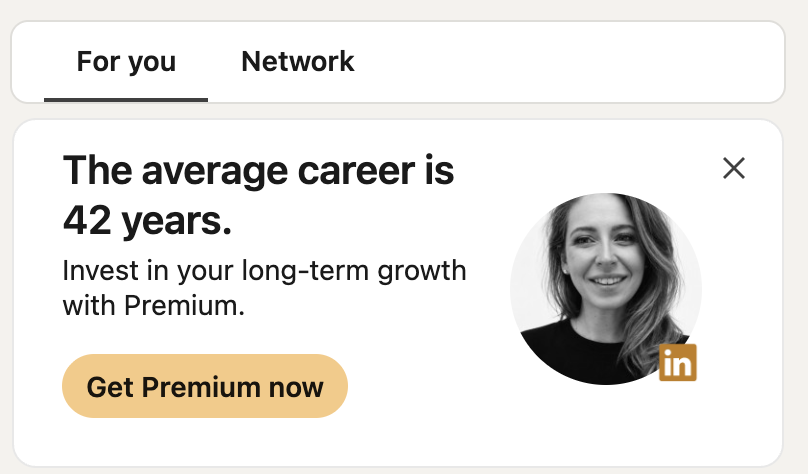
A LinkedIn Premium advertisement displayed in November 2026 stated, "The average career is 42 years." Screenshot captured by the author.
Is the Average Career Really 42 Years?
Before building an argument around the number, it's important to examine what it actually represents.
The LinkedIn advertisement states that the average career lasts 42 years.
However, the screenshot does not identify the research source, population, methodology, or definition used to calculate that figure.
That matters because there are several ways to measure a career.
A career might be defined as the number of years between entering and leaving the workforce.
It might represent years spent actively employed.
Or it might describe the duration of a person's working life, including periods of unemployment, education, caregiving, or career transitions.
Those definitions can produce different results.
A 42-Year Career Is Plausible, but That Doesn't Verify the Average
Someone who begins working at age 23 and retires at age 65 would have a 42-year span between those milestones.
Someone who begins at 20 and retires at 67 would have a 47-year span.
These are simple illustrations, not verified population averages.
Actual working lives vary substantially.
Some people begin working during their teenage years.
Others pursue extended education.
Some retire early.
Others continue working well beyond traditional retirement ages.
Health, finances, caregiving responsibilities, employment opportunities, and personal circumstances all influence career length.
Without LinkedIn's underlying methodology, we should treat 42 years as an advertising claim rather than a universally established statistic.
But the broader idea remains worth exploring.
A career can last decades.
And decades create room for far more change than most short-term career plans acknowledge.
A Career Is Not the Same Thing as a Job
One of the most useful distinctions in career planning is the difference between a career and an individual job.
A job is a particular position.
A career is the broader collection of work, experience, skills, and professional development that unfolds over time.
A person may have one career that includes several employers.
They may also move between occupations or industries.
The U.S. Bureau of Labor Statistics reported that median employee tenure was 4.1 years in January 2026.
That means half of the wage and salary workers measured had been with their current employer for more than 4.1 years, while half had been there for less.
It does not mean the average career lasts 4.1 years.
Employee tenure measures time with a current employer, not the length of an entire working life.
The distinction is important.
A person could spend four decades working while changing employers many times.
They could also spend a substantial portion of their career with one organization.
Neither pattern automatically determines whether the career is successful.
Source: U.S. Bureau of Labor Statistics, Employee Tenure in 2026.
What 42 Years Looks Like in Real Life
A four-decade career is difficult to visualize when we're focused on immediate deadlines.
Consider a hypothetical professional who begins working at age 23.
Their working life might include several distinct stages.
Years 1–7: Learning the Professional World
The early years may involve developing foundational skills, understanding workplace expectations, and discovering personal strengths.
A person might begin in an entry-level role and gradually assume greater responsibilities.
They may also discover that their original career choice doesn't suit them.
Years 8–15: Developing Expertise
The next stage might involve specialization, management responsibilities, or a move into a different industry.
A professional may begin developing a reputation for a particular skill.
They may also change employers to pursue opportunities.
Years 16–25: Reassessment and Reinvention
By this point, the person may have substantial experience.
But their priorities could be different.
They might pursue leadership, start a business, return to school, change careers, or seek greater flexibility.
Years 26–35: Applying Experience Differently
An experienced professional may shift toward consulting, mentoring, entrepreneurship, or specialized work.
They might continue advancing within an organization.
Or they might decide that a less demanding role better suits their circumstances.
Years 36–42: Redefining the Final Chapter
Later career stages can involve continued professional development, reduced hours, leadership, teaching, or preparation for retirement.
Not everyone follows this sequence.
Some people experience major career changes much earlier.
Others face involuntary transitions, unemployment, disability, or financial pressures that shape their options.
The point is not that careers follow predictable stages.
It's that a long working life can contain multiple versions of professional success.
Why Do We Feel So Much Pressure to Succeed Quickly?
If careers can last decades, why do so many professionals feel behind after only a few years?
Part of the answer may involve how we evaluate progress.
Professional networking platforms frequently highlight achievements.
Promotions.
New jobs.
Business launches.
Certifications.
Awards.
Major client wins.
These accomplishments can be genuinely meaningful.
But they represent selected moments rather than the complete experience of a career.
Social Comparison Changes How We Evaluate Ourselves
People naturally compare their circumstances with those of others.
In psychology, social comparison theory describes how individuals evaluate themselves partly through comparisons with other people.
Professional platforms create frequent opportunities for this.
Someone might see a former classmate become a director.
A colleague announces a business acquisition.
Another person shares that they doubled their income.
Without context, those milestones can make ordinary professional progress feel inadequate.
But we rarely see every setback, rejected application, financial challenge, or difficult decision behind the announcement.
The Visibility Problem
Career achievements are easy to post.
Periods of uncertainty are less visible.
Someone may spend years learning a new field before becoming successful.
Another person may experience several unsuccessful business attempts before finding a sustainable model.
A third may choose a stable position because it provides flexibility for family responsibilities.
These paths are difficult to compare meaningfully.
Yet professional platforms encourage us to place them side by side.
A Better Question
Instead of asking whether we're progressing as quickly as someone else, we might ask whether our current decisions are building a career that aligns with our circumstances and long-term goals.
That doesn't eliminate the importance of financial stability or professional ambition.
It simply changes the comparison.
The Psychology Behind LinkedIn's 42-Year Message
The advertisement is interesting not only because of the number, but because of how the message is constructed.
It presents a long timeframe.
Then it encourages the viewer to invest in professional growth.
The logic is straightforward.
If your career lasts decades, ongoing development matters.
And if ongoing development matters, a professional development product may seem more valuable.
The Power of a Specific Number
"The average career is 42 years" is more memorable than saying "Careers last a long time."
Specific numbers can make messages feel concrete.
They can also create an impression of precision.
However, precision in wording does not establish the quality of the underlying evidence.
A statistic still needs a reliable source and clear definition.
Long-Term Framing
The advertisement encourages viewers to consider a much longer period than the immediate future.
That framing can make a subscription feel like part of a larger investment in career development.
Instead of evaluating the product only in terms of what it provides this month, the viewer may begin thinking about decades of professional opportunity.
The Investment Message
The phrase "Invest in your long-term growth" connects the product to self-improvement.
It presents professional development as something worth supporting consistently.
That message may resonate with people who feel uncertain about the future of their careers.
What the Ad Does Not Establish
The advertisement does not demonstrate that purchasing LinkedIn Premium will improve someone's career outcomes.
It also does not establish that the subscription is necessary for long-term professional development.
Those are separate questions.
The ad is persuasive marketing.
Its effectiveness as a message should not be confused with evidence of product effectiveness.
What the Ad Reveals About Modern Career Marketing
Professional development has become a substantial commercial category.
People encounter products and services offering help with networking, learning, job searching, personal branding, and career advancement.
Many of these services address real needs.
But their marketing frequently draws on the uncertainty surrounding professional success.
The underlying message may be that people should keep investing in themselves to remain competitive.
That can be motivating.
It can also create pressure.
Career Development as a Continuous Project
In earlier generations, career advice often emphasized finding a stable employer and advancing within an organization.
Today, professional development messaging frequently emphasizes adaptability, personal branding, networking, and continuous learning.
These ideas can be useful.
But they can also make career development feel like an endless obligation.
When Growth Becomes Pressure
A person might begin to feel that every free hour should be spent improving professional skills.
Every networking opportunity becomes a potential advantage.
Every new technology becomes something they must master immediately.
That approach may be difficult to sustain over decades.
A long career requires more than ambition.
It also requires realistic expectations about time, energy, health, and personal responsibilities.
The 2026 Tech Layoffs Make the 42-Year Question More Relevant
The advertisement appeared during a period of substantial change in technology employment.
Throughout 2026, major technology companies and smaller businesses continued restructuring their workforces.
Workers across software engineering, product management, marketing, design, recruiting, and other functions faced uncertainty.
For someone experiencing a layoff, the idea of a 42-year career may feel very different from how it feels to someone celebrating a promotion.
It may raise difficult questions.
What happens when the industry you trained for changes?
What if the job you expected to keep disappears?
What if you need to develop new skills midway through your career?
What if your next professional chapter looks nothing like your previous one?
Career Longevity Doesn't Guarantee Job Security
A long working life may include periods of unemployment or underemployment.
It may require changes in occupation or location.
And some transitions are not voluntary.
That's why career resilience should not be presented as a simple matter of having the right attitude.
Workers operate within labor markets shaped by employer decisions, economic conditions, technological change, and personal circumstances.
Experience Can Still Be Transferable
A professional who loses a position may retain valuable knowledge.
A software engineer may understand complex systems.
A marketer may understand customer behavior and communication.
A technical writer may know how to organize specialized information.
A project manager may have experience coordinating people and resources.
These skills may apply in other environments.
However, transitioning into a new industry can require additional qualifications or domain knowledge.
A long career may offer time for reinvention, but reinvention is not always easy or inexpensive.
Artificial Intelligence Could Change Several Chapters of a Career
AI is changing how people work.
Software developers use AI-assisted coding tools.
Marketing teams experiment with automated research and content workflows.
Businesses apply AI to customer support, data analysis, and administrative processes.
These technologies can change job responsibilities.
They may also affect staffing decisions.
The Skills You Start With May Not Be the Skills You Finish With
Imagine someone beginning a career in digital marketing today.
Over the next 20 or 30 years, the tools they use may change substantially.
Search engines may evolve.
AI assistants may become more integrated into business workflows.
New platforms may emerge.
Some existing responsibilities may become automated.
A person cannot reasonably expect to learn every future tool before it exists.
But they can develop habits that support continued learning.
Foundational Skills Matter
Technical tools change.
Certain underlying capabilities remain relevant across many environments.
These include problem solving, research, communication, analytical thinking, and the ability to evaluate information.
That doesn't mean these skills make anyone immune to technological disruption.
It means they can support adaptation when tools and workflows change.
AI Literacy Is More Than Prompt Writing
Understanding AI involves recognizing both capabilities and limitations.
Professionals may need to evaluate outputs, verify claims, protect sensitive information, and understand where human judgment remains necessary.
For technical and content-related work, accuracy becomes especially important.
AI-generated material can sound convincing while containing errors.
The ability to evaluate information may become as important as the ability to produce it.
A 42-Year Career Could Include Several Different Careers
One of the most limiting assumptions about professional life is that people must choose one career path and remain on it indefinitely.
Some do.
Others don't.
A person might begin in retail, move into marketing, specialize in analytics, and eventually start a consulting business.
Someone might work in engineering, transition into technical writing, and later become a product manager.
A teacher might move into instructional design.
A journalist might become a communications strategist.
These transitions can involve real challenges.
But they demonstrate that professional experience does not always fit neatly into one job title.
Career Changes Aren't Necessarily Starting Over
When someone changes industries, they may feel that their previous experience no longer counts.
But skills can transfer.
A former teacher may bring instructional and communication abilities into corporate training.
A former engineer may bring technical knowledge into documentation or consulting.
A marketing professional may bring audience research and strategy skills into entrepreneurship.
The challenge is identifying which skills are relevant and communicating that value to new employers or customers.
Reinvention Doesn't Require a Complete Reset
Sometimes career change involves learning an entirely new profession.
Other times, it means applying familiar skills in a different context.
A technical writer who begins working with manufacturing companies may use the same core communication abilities they developed elsewhere while learning a new industry's terminology and processes.
Professional growth can involve building on existing expertise rather than discarding it.
The Problem With Treating Every Career as a Race
Career development is often described using competitive language.
Getting ahead.
Climbing the ladder.
Beating the competition.
Reaching the next level.
That language can motivate some people.
But it can also encourage a narrow definition of success.
Not Everyone Wants the Same Destination
Some professionals want executive leadership.
Others want to become highly specialized experts.
Some want to build businesses.
Others prioritize predictable schedules, flexibility, or meaningful work.
A person may also change priorities over time.
The career goal that makes sense at 25 may not be the goal that makes sense at 45.
Growth Isn't Always Vertical
Professional growth can involve more responsibility or higher compensation.
It can also involve developing new skills, gaining autonomy, changing industries, or improving work-life compatibility.
Not every meaningful career decision results in a more impressive title.
A Long Career Needs Room for Different Priorities
Over several decades, people may experience changes in family responsibilities, health, finances, and personal interests.
A sustainable career plan should allow for those realities.
Success is not always about maximizing advancement at every stage.
Sometimes it involves making choices that allow a person to continue working effectively over time.
What Does Long-Term Career Growth Actually Look Like?
The phrase "career growth" is often associated with promotions and salary increases.
Those outcomes can matter.
But long-term growth can be evaluated through several dimensions.
Skills
Are you developing abilities that remain useful across different roles or industries?
Knowledge
Are you building a deeper understanding of your work and the problems you solve?
Relationships
Are you developing professional connections based on trust and mutual respect?
Financial Stability
Are your career decisions helping you meet your financial needs and obligations?
Autonomy
Are you gaining more influence over the work you perform and the decisions you make?
Sustainability
Can you continue working in a way that is compatible with your health and personal circumstances?
A career does not need to improve in every category simultaneously.
Different priorities may become more important at different stages.
The Hidden Value of Professional Experience
In industries focused on emerging technology, there can be a tendency to emphasize the newest tools and skills.
But experience can provide forms of knowledge that are difficult to capture in a course or certification.
An experienced professional may recognize recurring problems.
They may understand why a particular strategy failed previously.
They may know how to communicate with different stakeholders.
They may be better equipped to identify risks.
These abilities can develop through repeated exposure to real situations.
Experience Is Not Automatically Expertise
Years of employment alone do not guarantee strong performance.
A person can repeat ineffective habits for decades.
Experience becomes more valuable when it is combined with reflection, learning, and feedback.
The Value of Combining Old and New Skills
An experienced technical professional who learns new AI tools may combine established subject knowledge with emerging capabilities.
A marketer who understands consumer psychology may apply that understanding across changing digital platforms.
A technical writer who understands documentation principles may adapt those skills to new software and publishing systems.
The combination can be useful because technology changes faster than many underlying business problems.
Why Career Longevity Matters for Entrepreneurs
The 42-year framing also raises questions for people who want to start businesses.
Entrepreneurship is often presented as something people should pursue as early as possible.
But business ownership can begin at different stages of life.
Some founders start companies after years of industry experience.
Others begin with limited professional experience and learn through building their businesses.
Neither path guarantees success.
Experience Can Help Identify Problems
Someone who has spent years working in an industry may recognize inefficiencies or customer needs.
They may understand specialized terminology, purchasing processes, or operational challenges.
That knowledge can inform a business idea.
Starting a Business Is a Career Transition
A professional moving from employment into entrepreneurship may need to learn sales, marketing, finance, and client management.
Technical expertise alone may not be sufficient.
Professional Identity Can Change
Someone who spent years identifying as an employee may begin thinking of themselves as a founder.
That transition can change how they evaluate success.
Instead of focusing on promotions, they may focus on customer relationships, revenue, profitability, and sustainable operations.
A long career can accommodate different professional identities.
Why This Matters for Marketing and Personal Branding
The LinkedIn advertisement also highlights the relationship between career development and marketing.
Professional platforms encourage users to communicate their experience, skills, and accomplishments.
In effect, people are asked to explain their professional value.
That resembles the challenge businesses face when communicating their expertise.
A Résumé Is a Form of Positioning
A résumé organizes experience for a particular audience.
It emphasizes information relevant to an employer.
A LinkedIn Profile Communicates Professional Identity
A profile helps other people understand a person's background, skills, and interests.
But a profile is not a complete record of someone's career.
A Business Website Serves a Similar Function
A business must explain what it offers, who it serves, and why its expertise is relevant.
A company may have years of experience.
But if its website doesn't communicate that experience clearly, potential customers may struggle to understand its capabilities.
The Connection to Content Strategy
Good content helps turn knowledge into useful explanations.
A manufacturer can explain technical products.
A consultant can demonstrate expertise.
A software company can publish educational resources.
A professional can share insights from their work.
In each case, communication helps an audience understand specialized knowledge.
Why Technical Writing and Content Strategy Matter Over a Long Career
The longer someone works in a specialized field, the more knowledge they may accumulate.
But knowledge is not always easy to communicate.
An engineer may understand complicated systems.
A manufacturer may know how to solve difficult production problems.
A consultant may recognize patterns that newer professionals haven't encountered.
Technical writing helps organize that expertise.
Content strategy helps determine which information should be communicated to which audiences.
Technical Writing Preserves Knowledge
Documentation can help organizations capture procedures, specifications, and operational information.
This is particularly important when experienced employees retire or change roles.
Educational Content Makes Expertise Accessible
Businesses can publish articles and guides that explain specialized subjects.
These resources may help prospective customers understand products and services.
SEO Helps People Discover Information
Search engine optimization can improve how useful content is organized and found through search engines.
It does not guarantee rankings, but it can support discoverability.
AI Search Creates Additional Considerations
As people use AI assistants to research subjects, businesses need to consider how clearly their information is presented online.
Accurate, accessible content may help search and AI systems interpret information.
However, no content strategy can guarantee inclusion in AI-generated recommendations.
How Ritner Digital Approaches This Work
Ritner Digital helps specialized businesses communicate their expertise through technical writing, SEO content strategy, educational articles, and AI search visibility.
The objective is to make complicated information easier for relevant audiences to understand.
For companies with decades of experience, this can be particularly useful.
Their knowledge may be substantial.
The challenge is making it accessible.
What Employers Should Learn From the 42-Year Career Idea
Career longevity isn't only an individual concern.
It also has implications for employers.
If people may work for several decades, organizations need to consider how employees develop and adapt over time.
Training Shouldn't Stop After Onboarding
Employees may need to learn new systems, tools, and procedures throughout their careers.
Ongoing training can support those transitions.
Experience Should Be Used Effectively
Long-tenured employees may hold important institutional knowledge.
Organizations can benefit from documenting that knowledge and creating opportunities for knowledge transfer.
Career Development Should Include Different Paths
Not every employee wants to become a manager.
Some may prefer technical specialization, project leadership, or other forms of professional growth.
Workforce Changes Require Clear Communication
When companies restructure, employees need accurate information about their roles, responsibilities, and available resources.
Clear communication does not eliminate the consequences of layoffs or organizational change.
But it can help people understand what is happening.
How to Think About Your Next Five Years Within a 42-Year Career
A long-term perspective does not mean abandoning short-term goals.
It means placing those goals within a larger context.
A useful exercise is to consider several questions.
What skills are you developing that could remain relevant beyond your current job?
What kinds of problems do you enjoy solving?
Which parts of your experience might transfer into another industry?
What professional relationships are worth maintaining?
What financial responsibilities shape your decisions?
And what would make your working life more sustainable?
The answers may change over time.
That's normal.
A career plan should be flexible enough to accommodate new information and changing circumstances.
Don't Confuse Urgency With Importance
A new platform or professional trend may feel urgent.
But not every development requires immediate action.
Some skills have short lifecycles.
Others remain useful for years.
The challenge is deciding where to invest limited time and resources.
Don't Treat Every Transition as Failure
Changing jobs, industries, or professional goals does not automatically mean a previous decision was wrong.
Circumstances change.
People learn.
Priorities evolve.
A career is a sequence of decisions made with the information available at the time.
Don't Assume You Must Optimize Every Year
Professional development matters.
But rest, relationships, health, and financial stability matter too.
A long career requires room for life outside work.
What LinkedIn's Advertisement Gets Right—and What It Leaves Out
The advertisement's central message is that professional growth deserves long-term attention.
That is a reasonable idea.
Careers can last decades, and people may benefit from continued learning and professional relationships.
But the message also simplifies a complicated reality.
Not everyone has equal access to training, employment opportunities, or career flexibility.
Some workers face layoffs.
Others experience health problems or caregiving responsibilities.
Some industries offer limited advancement.
And not everyone can afford paid professional development services.
Career Growth Isn't Just a Personal Purchase
A subscription may provide tools that some users find useful.
But long-term career development also depends on experience, opportunity, relationships, employer decisions, economic conditions, and personal circumstances.
No single platform controls those outcomes.
The Number Is Less Important Than the Perspective
Whether the average career is exactly 42 years is less important to the article's central argument than the idea of planning for a working life that spans decades.
The number creates a memorable starting point.
The deeper question is what we do with that perspective.
Conclusion: A Career Is a Long Story, Not a Single Achievement
I didn't expect a small LinkedIn Premium advertisement to make me think about four decades of professional life.
But that's what happened.
"The average career is 42 years."
It's a simple marketing message.
And without the underlying source, the statistic should not be treated as independently verified.
Still, it raises a worthwhile question.
If our working lives may stretch across decades, why do we measure so much of our success through immediate achievements?
A career can include different jobs, industries, employers, responsibilities, and goals.
It can involve promotions and setbacks.
It can involve periods of stability and uncertainty.
It can include entrepreneurship, education, reinvention, and unexpected opportunities.
And it can change as we change.
Perhaps the goal isn't to build a career that looks impressive at every moment.
Perhaps it's to build one that remains meaningful, financially workable, and adaptable over time.
Forty-two years is a long time to spend chasing someone else's definition of success.
The more useful question might be:
What kind of career do you want to build over the long run—and what are you doing today that supports it?
Helping Businesses Communicate the Expertise They've Built
Years of professional experience can create valuable knowledge.
But that knowledge doesn't always translate into clear website content, useful documentation, or an effective digital presence.
Ritner Digital helps businesses explain specialized products, services, and ideas through technical writing, SEO content strategy, and AI search visibility.
Whether your company has decades of industry experience or you're building something new, clear communication can help potential customers understand what you offer.
Ready to make your expertise easier to find and understand?
Frequently Asked Questions
1. Is the average career really 42 years?
A LinkedIn Premium advertisement displayed in November 2026 claimed that the average career is 42 years. The screenshot did not provide the source or methodology behind the number, so it should not be treated as a verified universal average.
2. How long does the average person work before retirement?
Working life varies according to the age someone begins working, retirement timing, employment interruptions, health, finances, and other circumstances. There is no single duration that applies to everyone.
3. What is the difference between career length and employee tenure?
Career length describes the broader duration of someone's working life. Employee tenure measures how long someone has worked for a particular employer.
4. How long do employees stay with one employer?
According to the U.S. Bureau of Labor Statistics, median employee tenure was 4.1 years in January 2026. This measures time with the current employer, not total career length.
5. Is changing careers in your 30s or 40s too late?
Not necessarily. People change occupations at different ages. The feasibility of a transition depends on qualifications, finances, available opportunities, and personal circumstances.
6. How many careers can a person have in a lifetime?
There is no fixed number. Some people remain in one occupation, while others move between several fields. The answer also depends on how a career change is defined.
7. Why do people feel behind in their careers?
Social comparison, financial expectations, workplace pressures, and exposure to other people's achievements may contribute to that feeling. Individual circumstances vary.
8. Does LinkedIn Premium guarantee career growth?
No. A paid subscription does not guarantee promotions, employment, salary increases, or professional success.
9. Why is lifelong learning important?
Tools, industries, and job requirements change over time. Continuing to develop relevant skills can help professionals adapt, although training does not guarantee employment.
10. How is AI changing career development?
AI is changing some workplace tasks and creating demand for certain skills. Its effects differ by industry, occupation, and employer.
11. Can someone start a business later in their career?
Yes. People start businesses at different ages and experience levels. Business success depends on many factors, including demand, resources, execution, and market conditions.
12. What are transferable career skills?
Transferable skills are capabilities that can be useful across different roles or industries, such as communication, research, problem solving, project management, and technical knowledge.
13. How can professionals avoid career burnout?
Strategies may include setting realistic expectations, managing workload, maintaining boundaries, seeking appropriate support, and evaluating whether working conditions are sustainable. The appropriate approach depends on the individual's circumstances.
14. Why does personal branding matter for career development?
Clear professional communication can help others understand someone's experience, skills, and areas of expertise. However, personal branding alone does not guarantee career opportunities.
15. How can businesses preserve decades of employee knowledge?
Businesses can use technical documentation, training resources, knowledge bases, standard operating procedures, and structured knowledge transfer to help preserve important information.
Sources and References
1. LinkedIn Premium Advertisement — Screenshot Captured November 21, 2026
Original screenshot supplied by the author. The advertisement states, "The average career is 42 years," and encourages investment in long-term growth through Premium.
The screenshot does not identify the underlying research methodology.
2. U.S. Bureau of Labor Statistics — Employee Tenure in 2026
https://www.bls.gov/news.release/tenure.htm
Reports median employee tenure of 4.1 years in January 2026, with additional breakdowns by age, occupation, and industry.
3. U.S. Bureau of Labor Statistics — Occupational Outlook Handbook
Provides information about occupations, qualifications, work environments, and employment projections.
4. U.S. Bureau of Labor Statistics — Employment Projections
Provides projections of employment and labor force trends.
5. American Psychological Association — Psychology Topics
A starting point for information about psychological topics, including work-related stress and behavior.
6. Ritner Digital — Official Website
Editorial note: This article analyzes a LinkedIn Premium advertisement observed in November 2026. It is independent commentary and is not sponsored by or affiliated with LinkedIn. The 42-year figure is attributed to the advertisement, not independently established as a population statistic. The career stages and examples are illustrative, not predictions of individual career outcomes.