
I came across a simple message about appreciation that made me think about how often we notice something wonderful about another person—and never actually tell them. Psychology suggests those unspoken compliments may matter more than we realize.
A Simple Picture Made Me Think About Everything We Don't Say
I came across an image recently that made me stop scrolling.
It wasn't an advertisement.
It wasn't a motivational post about productivity, success, or getting ahead.
It was a message about something much simpler.
Telling people when we appreciate them.
The image, attributed to Vex King, describes an idea called the Tell Them Theory.
If someone is kind, acknowledge it.
If a friend looks great, say so.
If someone's work inspires you, let them know.
The message ends with a reminder that criticism often receives more attention than appreciation.
And I kept thinking about that.
Because how many times have we noticed something positive about someone and never said anything?
Maybe a coworker handled a difficult situation with patience.
Maybe a stranger was unexpectedly thoughtful.
Maybe someone created something that genuinely inspired us.
Maybe a friend was having a good day, and we noticed how happy they looked.
We think something nice.
We appreciate it privately.
And then we move on.
The other person never knows.
It seems like such a small thing.
But what if those small, unspoken thoughts are opportunities to make everyday interactions a little better?
What if appreciation doesn't have to be extraordinary to be meaningful?
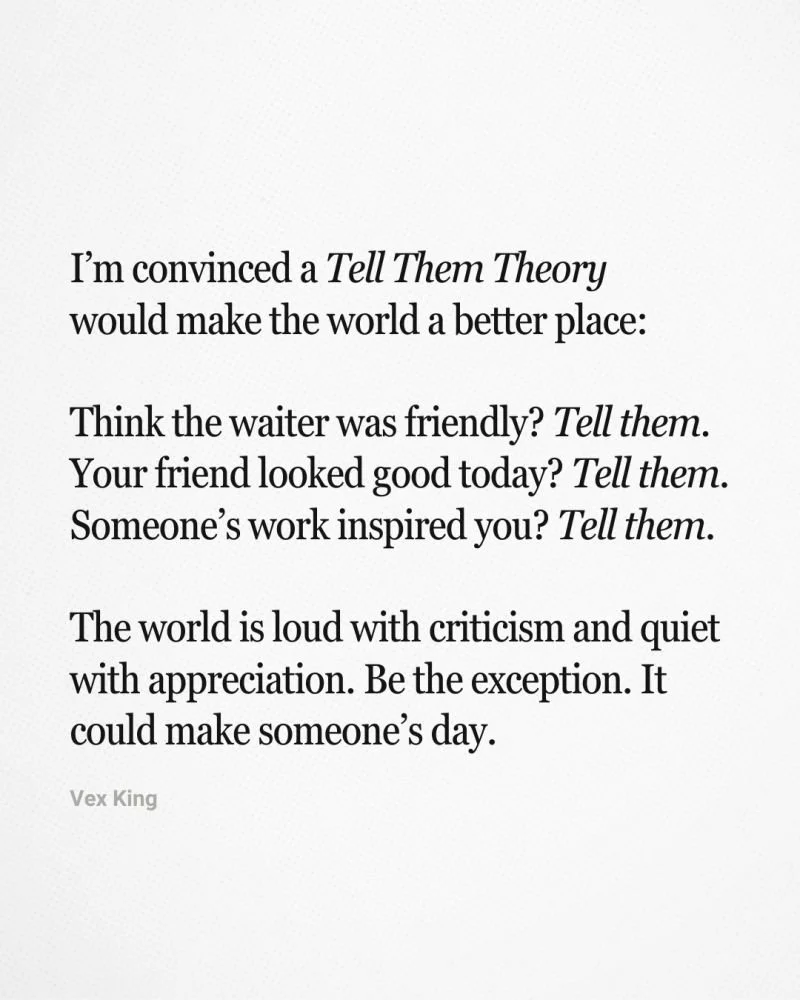
A message attributed to Vex King encourages people to express genuine appreciation instead of keeping positive thoughts to themselves. Image supplied by the author.
What Is the Tell Them Theory?
The Tell Them Theory, as described in the image, is a simple approach to expressing appreciation.
When you notice something genuinely positive about another person, consider telling them.
It doesn't require an elaborate speech.
It doesn't require a special occasion.
And it doesn't have to involve someone you know particularly well.
The idea is that appreciation becomes more meaningful when it is communicated.
Thinking that someone did an excellent job is different from telling them their work made an impression on you.
Feeling grateful for someone's kindness is different from letting them know you noticed.
The image presents the theory as a personal philosophy rather than a formally established psychological theory.
That's an important distinction.
There is no need to treat the phrase as a scientifically validated framework to find value in its message.
But the underlying behavior—expressing compliments, gratitude, and appreciation—has been studied by psychologists.
And the research raises an interesting possibility.
We may be holding back positive feedback because we misunderstand how other people will receive it.
Why Do We Notice the Good but Keep It to Ourselves?
This was the question that interested me most.
Why is it sometimes easier to recognize something positive internally than to express it?
We might think a compliment would be awkward.
We might worry about sounding insincere.
We might assume the other person already knows.
Or we might decide the moment isn't important enough to mention.
Sometimes we're simply distracted.
We have places to be, messages to answer, and responsibilities demanding our attention.
A positive thought passes through our minds.
But we don't act on it.
We Don't Always Know How Our Words Will Be Received
Complimenting someone involves a small amount of social uncertainty.
Will they appreciate it?
Will they feel uncomfortable?
Will the interaction seem strange?
These questions can discourage us from speaking.
But psychological research suggests we may be overestimating some of those concerns.
We Assume the Compliment Is Obvious
If someone is exceptionally talented, we might assume they hear positive feedback all the time.
If someone is consistently kind, we may take their kindness for granted.
If a coworker always delivers excellent work, their reliability can become something we simply expect.
But being good at something doesn't mean a person never needs acknowledgment.
We Treat Appreciation as Optional
Many of us are quick to speak when something goes wrong.
We report mistakes.
We ask for corrections.
We explain what needs improvement.
Positive observations don't always receive the same urgency.
They can feel optional.
But perhaps that is precisely why they deserve more attention.
The Psychology of Saying It Out Loud
One of the most interesting findings in the psychology of compliments is that people may underestimate how positively their words will be received.
In a 2021 study published in the Journal of Personality and Social Psychology, researchers Xuan Zhao and Nicholas Epley examined why people hesitate to give genuine compliments.
Across a series of experiments, people who gave compliments tended to underestimate how good recipients would feel and overestimate how awkward the interaction would be.
In other words, the compliment often felt riskier to the giver than it actually was for the recipient.
That finding stayed with me.
Because it suggests something surprisingly ordinary.
We may be talking ourselves out of making someone feel appreciated.
The research doesn't mean every compliment is welcome in every situation.
Context, sincerity, relationships, and boundaries still matter.
But it challenges the assumption that expressing appreciation will necessarily make an interaction uncomfortable.
Research: Zhao and Epley, 2021
We Might Be Underestimating How Much Kindness Matters
Another study, published in Personality and Social Psychology Bulletin, explored how people predict the effects of compliments.
Researchers Erica Boothby and Vanessa Bohns found that compliment givers tended to underestimate recipients' positive feelings.
They also overestimated how uncomfortable the recipients would feel.
The research examined several everyday interactions, not an entire lifetime of relationships.
Still, it offers a useful insight.
Sometimes the emotional value of a compliment is greater than the person giving it expects.
Think about that for a moment.
You might tell someone that you admire their work and assume it's a minor interaction.
But the other person might remember it.
You might thank someone for being patient and move on with your day.
But they might have been dealing with a particularly difficult morning.
You can't know exactly how another person will respond.
And that's part of the point.
We don't always recognize the significance of our own kindness.
Research: Boothby and Bohns, 2021
Why a Small Compliment Can Feel So Significant
Not every positive comment changes someone's day.
And not every compliment is memorable.
But some are.
A sincere observation can communicate that a person has been noticed.
That their effort mattered.
That something they did had an effect.
I think that's an important distinction.
A compliment isn't necessarily valuable because it makes someone feel impressive.
Sometimes it's valuable because it makes them feel seen.
Being Seen Is Different From Being Praised
Consider a person who regularly helps coworkers solve problems.
They may not be looking for public recognition.
But hearing someone say that their help made a difficult task easier can communicate something specific.
Their contribution was noticed.
Specificity Makes Appreciation More Meaningful
Compare these two statements:
"Great job."
And:
"The way you explained that complicated issue made it much easier for everyone to understand."
Both are positive.
But the second explains what the person did and why it mattered.
It provides information.
It demonstrates attention.
And it can help the recipient understand which part of their contribution was valuable.
Appreciation Doesn't Need to Be Dramatic
Sometimes a simple thank-you is enough.
Sometimes a brief comment is more appropriate than a long message.
The goal isn't to turn every interaction into an emotional event.
It's to stop assuming that positive thoughts are always better left unspoken.
The Difference Between Compliments, Gratitude, and Recognition
These words are related, but they aren't identical.
A compliment expresses admiration or approval.
Gratitude acknowledges something for which we feel thankful.
Recognition identifies a person's effort, contribution, or achievement.
A friend might receive a compliment about their creativity.
A neighbor might receive gratitude for helping with a task.
A coworker might receive recognition for solving a difficult problem.
All three can communicate appreciation.
But they serve slightly different purposes.
Why the Difference Matters
If someone helped you during a difficult time, telling them they are talented may be pleasant.
But explaining that their support mattered to you may be more meaningful.
If an employee completed a challenging project, generic praise may be less informative than recognition of the specific work involved.
The most useful expression of appreciation often reflects what actually happened.
We May Also Underestimate the Value of Gratitude
Compliments aren't the only form of appreciation people hesitate to express.
Researchers Amit Kumar and Nicholas Epley examined gratitude letters in a 2018 study published in Psychological Science.
Participants wrote letters expressing gratitude and predicted how recipients would feel.
The researchers found that writers underestimated how positive recipients would feel and overestimated potential awkwardness.
Again, the pattern was revealing.
People were not necessarily accurate judges of how their appreciation would be received.
That doesn't mean everyone should write lengthy gratitude letters to every acquaintance.
But it suggests that expressing sincere thanks may be more worthwhile than we sometimes assume.
Research: Kumar and Epley, 2018
The World Can Feel Louder About What Goes Wrong
One part of the image particularly resonated with me.
It contrasts the visibility of criticism with the relative quietness of appreciation.
I don't think criticism is always bad.
Constructive feedback can be necessary.
People need to identify problems, address mistakes, and hold one another accountable.
But criticism and appreciation often serve different functions.
Criticism draws attention to something that needs to change.
Appreciation draws attention to something worth recognizing.
Both can be useful.
Why Negative Experiences Demand Attention
When something goes wrong, there may be an immediate problem to solve.
A customer receives the wrong order.
A project misses a deadline.
A product doesn't work as expected.
These situations naturally create reasons to speak up.
Positive experiences may not create the same urgency.
If a service is excellent, we might simply enjoy it and leave.
If a colleague is helpful, we may thank them quickly without explaining what their help meant.
If a friend consistently shows up for us, their reliability can become part of the background of our lives.
What Would Change if We Noticed Both?
Imagine approaching daily interactions with a little more balance.
Not ignoring problems.
Not pretending everything is wonderful.
Just making room to acknowledge what is going right.
That feels like a small adjustment.
But small adjustments can change how people experience ordinary moments.
What the Tell Them Theory Can Teach Us About Friendship
Friendships often depend on things we don't formally measure.
Reliability.
Attention.
Shared experiences.
Trust.
Humor.
The feeling that someone genuinely cares.
Yet we don't always communicate what we appreciate about our friends.
We might assume they know.
We've been friends for years.
We spend time together.
We help each other.
Surely that communicates enough.
Sometimes it does.
But words can add clarity.
Tell People What You Appreciate About Them
A friend may not realize how much you value their ability to listen.
They may not know that a conversation helped you through a difficult week.
They may have forgotten something kind they did months ago.
You might remember it clearly.
And you can tell them.
Don't Wait for a Special Occasion
Birthdays, weddings, and major milestones naturally invite appreciation.
But ordinary days matter too.
There is something meaningful about receiving a thoughtful message when nothing extraordinary has happened.
It suggests that the appreciation wasn't prompted by an occasion.
It was prompted by genuine observation.
Keep It Natural
Not every friendship involves openly emotional conversations.
People communicate differently.
A brief message, a casual remark, or a specific thank-you may feel more comfortable than a dramatic declaration.
The point is sincerity, not performance.
Why Appreciation Matters in Romantic Relationships
The same principle applies to romantic relationships.
When people become familiar with one another, everyday contributions can become easy to overlook.
Someone prepares dinner.
Someone remembers an appointment.
Someone offers reassurance.
Someone handles a responsibility without being asked.
Over time, these actions may become expected.
But expected doesn't have to mean unappreciated.
Familiarity Can Make Appreciation Less Visible
The longer we know someone, the more we may assume they understand how we feel.
Yet appreciation can be communicated in different ways.
Some people value verbal acknowledgment.
Others place greater importance on practical support, time together, or other expressions of care.
There isn't one universal method.
Specific Appreciation Can Be More Personal
Instead of offering only broad praise, we can acknowledge particular actions.
Thanking someone for listening patiently.
Recognizing the effort they made.
Explaining why something they did was meaningful.
These comments communicate attention.
Appreciation Doesn't Replace Difficult Conversations
Expressing gratitude doesn't mean ignoring problems.
Healthy relationships still require boundaries, honesty, and the ability to address conflict.
The Tell Them Theory is most useful as an encouragement to communicate genuine appreciation—not as an instruction to remain positive regardless of circumstances.
What the Tell Them Theory Can Teach Businesses About Communication
This is where the idea becomes especially interesting from a workplace perspective.
Businesses spend substantial time communicating expectations.
Deadlines.
Responsibilities.
Performance standards.
Customer requirements.
Project updates.
These are important.
But organizations also depend on people feeling that their work is understood and valued.
Appreciation is one part of that experience.
Employees Want to Know Their Contributions Matter
An employee may spend hours solving a problem that few people notice.
A customer service representative may calmly resolve a difficult situation.
A technical writer may turn confusing documentation into something customers can actually use.
A project manager may prevent delays through careful coordination.
These contributions don't always generate dramatic announcements.
But they can be important to how a business operates.
Recognition Can Be Specific
A manager might acknowledge the way an employee handled a customer concern.
A colleague might thank someone for reviewing a complicated document.
A team leader might explain how a particular contribution helped the project.
Specific recognition helps people understand what was valuable about their work.
Recognition Shouldn't Be a Substitute for Fair Treatment
This distinction matters.
Appreciation cannot replace appropriate compensation, reasonable working conditions, clear expectations, or respectful management.
A workplace that relies on compliments while ignoring serious problems is not necessarily supportive.
Recognition works best when it reflects genuine contributions within a broader culture of fairness and respect.
What Workplace Research Says About Recognition
Gallup and Workhuman examined the relationship between employee recognition and retention in research reported in 2024.
Their analysis followed nearly 3,500 employees from 2022 to 2024.
Gallup reported that employees who received high-quality recognition were 45% less likely to have changed organizations two years later.
That is an observed association, not proof that recognition alone caused the difference.
Employee retention is influenced by many factors, including compensation, management, opportunities, and working conditions.
Still, the findings support the idea that recognition deserves attention as part of workplace culture.
The research also emphasizes the quality of recognition rather than treating every positive comment as equally meaningful.
Gallup: Employee Retention Depends on Getting Recognition Right
Why Leaders Shouldn't Assume Their Teams Know They're Appreciated
I think this is one of the most practical lessons in the entire idea.
A manager may privately believe an employee is doing excellent work.
They may trust that employee with important responsibilities.
They may consider them essential to the team.
But if that appreciation is never communicated, the employee may not know.
Silence Can Be Ambiguous
When someone receives little feedback, they may wonder whether their work is meeting expectations.
Silence doesn't always communicate confidence.
Sometimes it simply creates uncertainty.
Recognition Can Provide Useful Information
Specific feedback helps employees understand which actions were effective.
It can reinforce good practices without requiring exaggerated praise.
Public and Private Recognition Are Different
Some people appreciate public acknowledgment.
Others prefer a private conversation.
Managers should consider individual preferences and the nature of the contribution.
The purpose is to recognize the person—not to create an uncomfortable performance.
The Tell Them Theory in Customer Service
Think about the last time someone provided genuinely excellent service.
Maybe a restaurant employee was especially patient.
Maybe a customer service representative solved a problem efficiently.
Maybe someone at a local business went out of their way to explain something.
Did you tell them?
Sometimes we do.
Other times we leave satisfied without saying much.
Positive Feedback Can Be Useful
A sincere compliment can let an employee know that their effort was noticed.
When appropriate, positive feedback shared with a manager can also identify work worth recognizing.
Reviews Can Communicate Appreciation
Businesses often encourage customers to leave reviews.
A thoughtful review can describe a positive experience and help other potential customers understand what to expect.
But reviews should reflect genuine experiences.
Appreciation shouldn't become a transaction.
The Human Element Matters
Behind many customer experiences is someone doing their job.
Acknowledging that person can make the interaction feel more human.
And that matters even when the exchange lasts only a few minutes.
The Connection Between Appreciation and Marketing
At first, the Tell Them Theory might seem unrelated to marketing.
But both involve communication.
Marketing asks businesses to explain what they offer and why it matters.
Appreciation asks people to communicate what they notice and value.
The similarity is not that every compliment should become a marketing message.
It is that important information can lose its impact when it remains unexpressed.
Businesses Often Struggle to Communicate Their Strengths
A company may have excellent employees.
It may provide highly specialized services.
It may have years of technical expertise.
But customers cannot automatically understand that expertise.
The business has to communicate it.
Clear Communication Makes Value Visible
A manufacturer may need to explain what differentiates its products.
A software company may need to describe a complicated feature in accessible language.
A service provider may need to show how its experience relates to customer needs.
Good writing can make those details understandable.
Authenticity Matters
Just as an insincere compliment can feel uncomfortable, unsupported marketing claims can weaken credibility.
Businesses should communicate real strengths.
They should explain them clearly.
And they should avoid exaggerating what they can deliver.
The lesson is similar.
Say what is meaningful, but make sure it is true.
Why Appreciation Is Not the Same as Flattery
There is an important difference between sincere appreciation and saying something positive to influence someone.
Appreciation is grounded in genuine observation.
Flattery may involve exaggerated praise intended to gain approval or advantage.
The distinction can be subtle.
Genuine Appreciation Is Specific
It identifies something real.
A thoughtful action.
A useful contribution.
An impressive effort.
Flattery Can Feel Transactional
When praise seems disconnected from reality, people may question the motive behind it.
This is especially relevant in professional settings.
A compliment delivered immediately before asking for a favor may be interpreted differently from one offered without an obvious expectation.
Intent Isn't the Only Consideration
Even sincere compliments can be inappropriate in certain contexts.
Comments about appearance, for example, may be welcome between close friends but uncomfortable in some professional situations.
Boundaries and relationships matter.
The Tell Them Theory should encourage thoughtful appreciation, not indiscriminate commentary about other people.
Why We Shouldn't Turn Kindness Into Another Productivity Habit
I also think there is a risk in how we interpret messages like this.
We live in a culture that often turns good ideas into systems.
Track your habits.
Set goals.
Measure progress.
Optimize your routine.
And while structure can be useful, not every positive behavior needs to become another performance metric.
We don't need to count how many compliments we give each day.
We don't need to force conversations.
We don't need to turn appreciation into a personal branding strategy.
Sometimes the most meaningful thing is simply noticing something and responding naturally.
Kindness Doesn't Need a Return on Investment
We don't have to express appreciation because it might improve our network.
Or because it could increase employee productivity.
Or because it might strengthen a business relationship.
Those outcomes may sometimes follow.
But they don't need to be the reason.
Sometimes it's enough that another person did something worth acknowledging.
The People Who Rarely Hear That They're Doing a Good Job
The image also made me think about people whose work is easy to overlook.
People performing routine tasks.
People whose contributions happen behind the scenes.
People who consistently solve problems before anyone else notices them.
People who support others without drawing attention to themselves.
Their work may be important precisely because it prevents problems.
But when everything goes smoothly, their effort can become invisible.
The Invisible Work Problem
Consider an employee who carefully checks information before a document is published.
If they do their job well, readers may never see the errors they prevented.
Or consider someone who maintains equipment.
When maintenance is effective, operations may continue without interruption.
The absence of problems doesn't mean the absence of effort.
Recognition Can Make Contributions Visible
Acknowledging this kind of work can help people understand that their contributions matter.
It doesn't require a formal award.
Sometimes it begins with a specific observation.
What If We Applied the Tell Them Theory Online?
Social media gives us countless opportunities to encounter other people's work.
We see articles.
Photographs.
Designs.
Business announcements.
Educational videos.
Personal reflections.
Sometimes something genuinely impresses us.
But we keep scrolling.
A Meaningful Comment Can Be More Valuable Than a Generic Reaction
If someone's article helped you understand a subject, you can tell them which part was useful.
If a creator explained something clearly, you can acknowledge the effort.
If a professional shared an insightful perspective, you can respond thoughtfully.
Online Appreciation Should Still Be Genuine
There is no need to manufacture enthusiasm.
And there is no obligation to comment on everything.
But when something genuinely resonates, communicating that reaction can create a more meaningful interaction.
Not Every Interaction Needs to Become Networking
This is especially important on professional platforms.
Sometimes a compliment is just a compliment.
It doesn't have to lead to a connection request, sales conversation, or business opportunity.
Why the Smallest Interactions Sometimes Stay With Us
Most days are made up of ordinary moments.
A conversation at a coffee shop.
A message from a friend.
A brief interaction with a coworker.
A helpful stranger.
We don't know in advance which moments someone will remember.
A person might be having a difficult day.
They might be questioning their work.
They might be feeling overlooked.
Or they might simply appreciate hearing something kind.
We can't predict the emotional impact of every interaction.
But research on compliments and gratitude suggests that people sometimes underestimate the positive responses their words can produce.
That doesn't make kindness magical.
It makes it worth considering.
How to Practice the Tell Them Theory Without Making It Awkward
The idea doesn't need to be complicated.
Start by noticing genuine positive observations.
When appropriate, communicate them.
Be specific when possible.
Respect the other person's boundaries.
And don't expect a particular reaction.
Tell Someone What Their Work Meant to You
Instead of offering generic praise, explain what you found useful or impressive.
Thank Someone for a Specific Action
If someone helped you, tell them what their assistance made easier.
Acknowledge Effort, Not Just Outcomes
People may put significant work into projects that don't receive much attention.
Recognizing thoughtful effort can still be meaningful.
Keep the Moment Appropriate
A quick comment may be enough.
A private message may be better than public praise.
The context should guide the approach.
Don't Demand a Response
Appreciation is not a contract.
The recipient doesn't owe an equally enthusiastic reaction.
The purpose is to express something sincere.
A Small Experiment Worth Trying
After seeing the image, I kept returning to one simple idea.
What if, for a little while, we paid more attention to the positive things we normally leave unsaid?
Not as a challenge to complete.
Not as a social media trend.
Just as a way of noticing.
The next time someone helps you, consider explaining why you appreciated it.
The next time a friend's work impresses you, consider telling them.
The next time someone makes an ordinary interaction better, consider acknowledging it.
You don't need to make a grand statement.
You don't need to wait for the perfect words.
And you don't need to assume the interaction will be life-changing.
Just give the other person the opportunity to know that something they did mattered.
What the Tell Them Theory Doesn't Mean
It's worth being clear about the limitations.
The Tell Them Theory is not a substitute for honest feedback.
It doesn't require people to compliment others when they don't mean it.
It doesn't mean every thought about another person's appearance or behavior should be spoken aloud.
And it doesn't guarantee that a positive comment will always be welcomed.
Relationships, power dynamics, cultural expectations, and personal boundaries influence how messages are received.
The strongest version of the idea is thoughtful rather than automatic.
Notice something genuinely positive.
Consider whether expressing it is appropriate.
Then communicate it with sincerity.
That's enough.
Why This Message Feels Especially Relevant Today
We have more ways to communicate than ever.
Messages.
Emails.
Video calls.
Social media.
Professional networks.
Yet the availability of communication tools doesn't guarantee meaningful communication.
We can exchange information all day without expressing much appreciation.
We can react to posts without explaining why they matter.
We can work alongside people for years without telling them which contributions we value most.
And we can assume that the people closest to us already know how we feel.
Maybe they do.
But maybe they would still appreciate hearing it.
That's what makes the message so interesting.
It doesn't ask us to become different people.
It asks us to communicate something we already feel.
Conclusion: Don't Let Every Good Thought Go Unspoken
I didn't expect a simple image about appreciation to make me think so much about psychology, communication, and everyday relationships.
But the more I considered it, the more I realized how often positive observations remain private.
We notice someone's kindness.
We admire someone's work.
We appreciate a thoughtful gesture.
We feel grateful for someone's support.
And then we continue with our day.
Sometimes that's perfectly fine.
But sometimes there is an opportunity to say something meaningful.
The research on compliments and gratitude suggests we may underestimate how positively our words will be received.
And the image's central message offers a practical response.
When you notice something good, consider expressing it.
Not because every compliment will transform someone's life.
Not because kindness guarantees anything in return.
But because appreciation is more useful when the other person knows it exists.
We spend so much time thinking about what we wish people would do differently. Maybe we should spend a little more time telling them what they're already doing right.
And perhaps the next time a kind thought crosses our minds, we shouldn't be so quick to let it disappear.
Clear Communication Matters in Business, Too
Whether we're expressing appreciation to another person or explaining specialized knowledge to a customer, communication matters.
Ritner Digital helps businesses turn their expertise into clear, useful content through technical writing, educational SEO, content strategy, and AI search visibility.
The goal is to help people understand what a business does, why its expertise matters, and where to find reliable information.
Learn more about Ritner Digital
Frequently Asked Questions
1. What is the Tell Them Theory?
The Tell Them Theory, as presented in the image attributed to Vex King, encourages people to express genuine appreciation when they notice something positive about another person.
2. Who created the Tell Them Theory?
The supplied image attributes the message to Vex King. The image alone does not establish whether he originated the phrase or concept.
3. Is the Tell Them Theory scientifically proven?
The phrase is presented as a personal philosophy, not a formally validated scientific theory. However, psychological research supports the broader idea that people sometimes underestimate the positive effects of compliments and gratitude.
4. Why do people hesitate to give compliments?
People may worry about awkwardness, insincerity, or how their words will be received. Research suggests some people overestimate potential discomfort and underestimate recipients' positive reactions.
5. Do compliments actually make people feel better?
Research has found positive effects of genuine compliments in studied interactions. The outcome depends on context, sincerity, and the relationship between the people involved.
6. What is the psychology behind expressing appreciation?
Expressing appreciation involves social perception, expectations about others' reactions, and interpersonal communication. Research suggests people may misjudge how positively their appreciation will be received.
7. What is the difference between appreciation and gratitude?
Appreciation involves recognizing something valuable or positive. Gratitude typically involves feeling thankful for something received or experienced.
8. Why is employee recognition important?
Recognition can help employees understand that their contributions are noticed. Workplace research has also found associations between high-quality recognition and employee retention.
9. How can managers show genuine appreciation?
Managers can acknowledge specific contributions, explain why the work mattered, and consider whether employees prefer public or private recognition.
10. Can compliments improve relationships?
Sincere, appropriate compliments may support positive interactions. However, healthy relationships also depend on trust, respect, communication, and other factors.
11. How can I compliment someone without making it awkward?
Keep the compliment genuine, specific, and appropriate to the relationship. Avoid comments that cross personal or professional boundaries.
12. Is appreciation the same as flattery?
No. Appreciation is grounded in genuine recognition. Flattery may involve exaggerated praise intended to influence someone.
13. Should businesses encourage employees to give more compliments?
Businesses can encourage specific, sincere recognition, but it should not be forced or used as a substitute for fair treatment, appropriate compensation, and effective management.
14. How does appreciation relate to communication skills?
Appreciation involves noticing relevant information and expressing it clearly. It is one part of effective interpersonal communication.
15. What is the simplest way to practice the Tell Them Theory?
When you notice something genuinely positive about another person, consider telling them in a respectful, natural way without expecting anything in return.
Sources and Further Reading
1. Original Tell Them Theory Image — Attributed to Vex King
Image supplied by the author. Used as the editorial inspiration for this article. The attribution shown in the image has not been independently authenticated.
2. Zhao, X., & Epley, N. (2021). Insufficiently Complimentary?
Journal of Personality and Social Psychology.
https://pubmed.ncbi.nlm.nih.gov/34636586/
Research examining why people underestimate the positive impact of compliments.
3. Boothby, E. J., & Bohns, V. K. (2021). Why a Simple Act of Kindness Is Not as Simple as It Seems
Personality and Social Psychology Bulletin.
https://pubmed.ncbi.nlm.nih.gov/32856538/
Research examining how compliment givers predict recipients' emotional reactions.
4. Kumar, A., & Epley, N. (2018). Undervaluing Gratitude
Psychological Science.
https://pubmed.ncbi.nlm.nih.gov/29949445/
Research on how people misjudge the effects of expressing gratitude.
5. Kumar, A., & Epley, N. (2023). A Little Good Goes an Unexpectedly Long Way
Journal of Experimental Psychology: General.
https://pubmed.ncbi.nlm.nih.gov/35980709/
Research examining how people underestimate the positive impact of acts of kindness.
6. Gallup (2024). Employee Retention Depends on Getting Recognition Right
https://www.gallup.com/workplace/650174/employee-recognition-boosts-retention.aspx
Research on employee recognition and subsequent retention.
7. Ritner Digital — Official Website
Editorial note: This article is independent commentary inspired by a user-supplied image attributed to Vex King. The phrase "Tell Them Theory" is used descriptively, not as the name of an established psychological treatment or validated scientific framework. The psychological studies cited examine specific populations and settings; their findings should not be interpreted as guarantees about every interpersonal interaction.