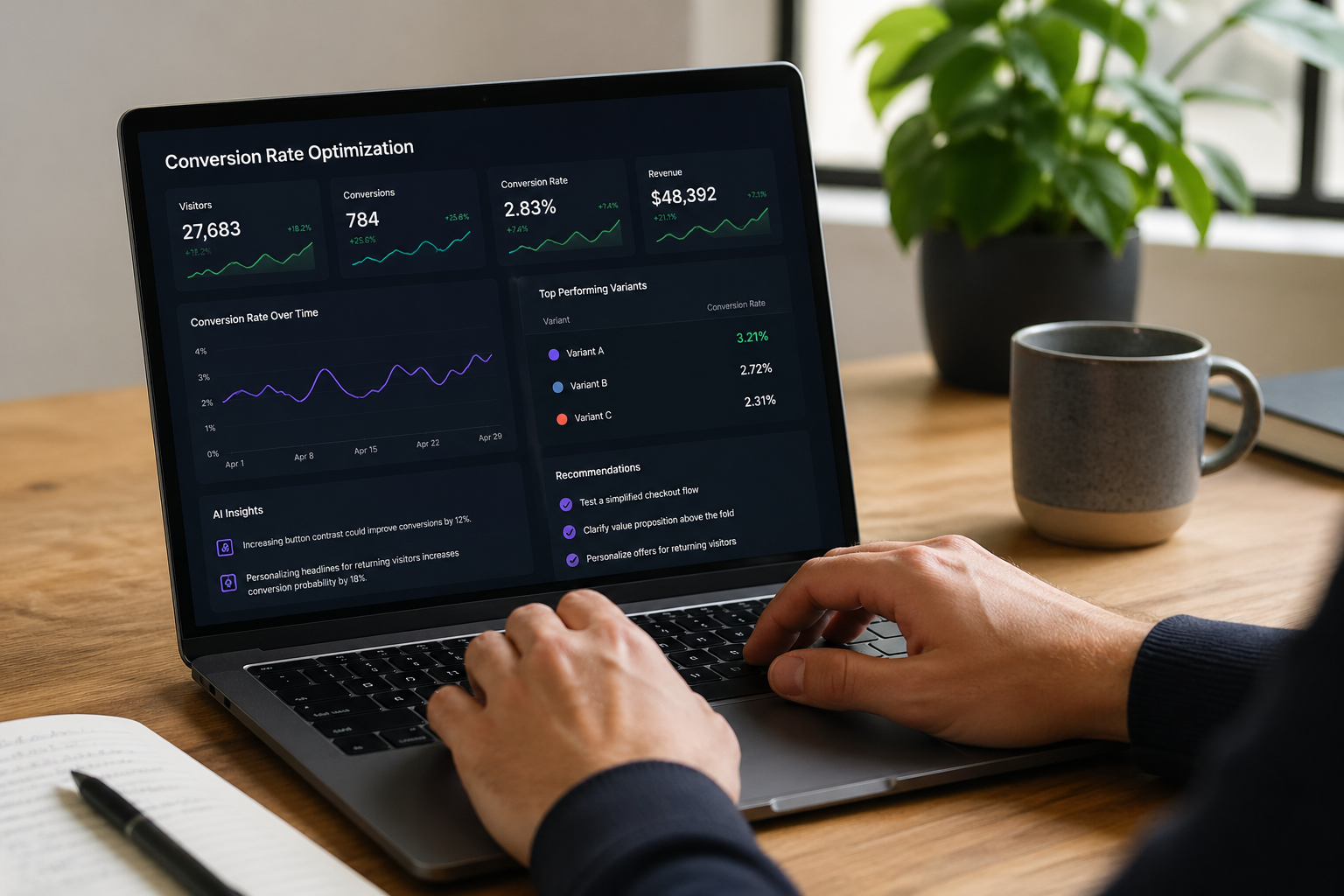
You're already paying to get people to your website. You're paying for ads, investing in SEO, creating content, building your social presence. Traffic is coming. But how much of it is actually converting into leads, customers, and revenue?
For most businesses, the honest answer is: not enough. The average conversion rate across all industries is approximately 2.9%. The top 25% of landing pages convert at 5.31% or higher. SQ Magazine That gap between average and top-quartile performance is not primarily a traffic problem. It's a conversion problem — and AI is rapidly changing what's possible when it comes to closing it.
This guide is for business owners, marketers, and anyone who wants to understand what AI-powered conversion rate optimization actually is, how it works in practice, and how to start using it to get more value from the traffic you're already paying for.
What Is Conversion Rate Optimization?
Before getting into what AI changes, it helps to understand what conversion rate optimization is at its core.
Conversion rate optimization — CRO — is the practice of improving the percentage of website visitors who take a desired action. That action depends on your business: making a purchase, submitting a contact form, booking a call, downloading a resource, signing up for an email list. Whatever the goal, CRO is the discipline of making it more likely to happen.
The basic math is straightforward. If your website gets 10,000 visitors per month and 2% of them fill out your contact form, that's 200 leads. If CRO improves that to 4%, you have 400 leads — from the same traffic, with zero increase in ad spend. Revenue impact analysis connects conversion improvements directly to revenue changes. A 25% improvement in conversion rate on a page generating $100,000 monthly means $25,000 in additional monthly revenue. Atechnocrat
This is why CRO is often described as the highest-leverage marketing investment available. You're not spending more to acquire visitors. You're making what you already have work harder.
How Traditional CRO Has Been Done — And Why It's Not Enough
Traditional CRO has always meant testing. You form a hypothesis — "our headline isn't clear enough," "our form is too long," "our CTA button should be more prominent" — and you run an A/B test to find out if you're right.
The process is valuable but slow. You pick one element, create two versions, split your traffic, wait for enough data to be statistically significant, and then declare a winner. A meaningful test can take weeks. Running multiple tests simultaneously creates complexity. And the scope of what you can test is limited by the time and resources your team has to manage the process.
Traditional CRO is reactive. It makes changes based on an analysis of what has already happened. AI CRO is predictive and proactive, anticipating what visitors will do and adjusting the experience on the fly to guide them toward a conversion. Linear
The other limitation of traditional CRO is that it treats all visitors the same. You run a test, one version wins, and that version becomes the default for everyone. But a version that converts well for a first-time visitor from a paid search ad might perform very differently for a returning visitor who found you through organic search. Serving the same experience to everyone is itself a form of lost conversion opportunity.
What AI Changes About CRO
AI doesn't replace the discipline of conversion rate optimization. It transforms the speed, scale, and precision at which it operates.
AI has quietly changed how this whole process works. Instead of testing one idea at a time, systems now look at huge volumes of behavior all at once. They pick up patterns you would never spot manually. EzRankings
Advanced tracking now captures mouse movement velocity and hesitation patterns. AI systems process hundreds of behavioral signals per second and build predictive profiles for each visitor. This shift from reactive analytics to predictive behavioral modeling is the foundation of every successful AI conversion optimization strategy. Atechnocrat
The three fundamental shifts AI brings to CRO are speed, scale, and personalization.
Speed: AI can identify patterns and act on them in real time — within the same session a visitor is on your site. Rather than waiting weeks for a test to conclude, AI can detect which elements are working and for whom, and begin optimizing immediately.
Scale: Rather than testing one variable at a time, AI can run multivariate tests across dozens of elements simultaneously. AI-assisted multivariate testing programs now deliver an average 27% performance improvement over standalone A/B testing, with companies running 50 or more concurrent multivariate experiments per month achieving a compounded annual conversion rate improvement of 38%. Amra & Elma
Personalization: Instead of finding one winning version for all visitors, AI serves different versions to different visitors based on their individual behavioral profile — so each person sees the experience most likely to convert them specifically.
The Key Applications of AI in CRO
Dynamic Website Personalization
This is the most immediately impactful application of AI in CRO for most businesses. Rather than showing every visitor the same homepage, landing page, or product page, AI dynamically adjusts content — headlines, images, offers, CTAs, testimonials — based on who the visitor is and what their behavior signals about their intent.
Through real-time behavioral analysis, AI watches how each visitor interacts with your site — every click, pause, scroll, and search query — to understand their unique intent and mindset. This allows for dynamic content optimization where headlines, images, testimonials, and offers change instantly based on user behavior. A visitor who repeatedly views security-related pages might see trust badges and data-privacy reassurances prominently displayed, while a price-conscious visitor might be shown a limited-time discount or a comparison chart. Linear
Personalized CTAs versus generic ones yield approximately 42% higher conversion. AI Personalization is the leading CRO technique, used by 28.2% of marketers. SQ Magazine
Automated and Multivariate Testing
AI removes most of the manual overhead from conversion testing. Rather than a human team deciding what to test, setting it up, monitoring it, and analyzing results, AI tools can generate test variations, run experiments continuously, identify winners, and implement changes — all with minimal human intervention required for each individual test.
AI runs tests automatically — no more manual setup, tracking, or result analysis. It analyzes performance data in real time, learns what works, and suggests improvements. It also generates content, images, or layout variants to test faster. This makes optimization continuous, data-driven, and far more efficient. Landingi
Behavioral Heatmaps and Predictive Analytics
AI-powered behavioral analytics goes far beyond traditional heatmaps. Instead of just showing where visitors clicked, modern AI tools analyze the full behavioral fingerprint of each session — where visitors hesitated, where they accelerated, where they abandoned, and what combinations of behaviors precede conversion versus exit.
There was a time when teams waited for results to show up in reports before making changes. By then, the user was already gone. Now you can see patterns forming while people are still on the site. AI picks up signals that hint at what might happen next — who looks ready to convert, who seems unsure, where people tend to lose interest and leave. Not in a vague way, but with enough clarity to act on it. EzRankings
AI Chatbots and Conversational Conversion
One of the most tangible and immediate applications of AI for CRO is the chatbot — not the rigid, scripted chatbot of five years ago, but conversational AI tools that understand context, answer questions in natural language, qualify leads, and guide visitors toward conversion around the clock.
When a visitor lands on your site, they have questions. They have doubts. They are probably looking at your competitors at the same time. A great AI chatbot answers their questions right now, in plain language, without making them hunt through a help page. That instant response removes doubt. Removing doubt creates conversions. Businesses using AI chatbots for lead engagement saw 67% more qualified leads compared to businesses using forms alone. Conversion Xperts
The speed dimension of chatbot conversion is significant. If your team does not respond to a lead within five minutes, your chance of converting that lead drops by 80%. Conversion Xperts An AI chatbot eliminates that latency entirely — responding to every inquiry immediately, at any hour, without requiring a human to be available.
Predictive Lead Scoring for Landing Pages
For B2B businesses and service providers, AI can score incoming visitors on their likelihood to convert based on their behavioral signals and whatever firmographic or demographic data is available — and then adjust the experience accordingly. High-intent visitors get served content that moves them toward a decision faster. Lower-intent visitors get served content that builds awareness and nurtures them toward a future conversion.
Dynamic website personalization powered by AI produces an average 29% lift in demo request conversion rates, but only when personalization logic is built around buyer role and use-case signals rather than company size or industry alone. Arete
Cart and Form Abandonment Recovery
About 70.22% of shopping carts are abandoned, and Baymard's 2025 data confirms the upside clearly sits in faster, clearer, lower-risk flows that recover value from each visit. Aidigital AI-powered abandonment recovery goes beyond sending a generic reminder email. It identifies the specific point of abandonment, infers what the barrier might have been based on behavioral patterns, and delivers a targeted recovery experience — whether that's an email with a relevant offer, a retargeting ad that addresses the likely objection, or a follow-up that arrives at the optimal moment based on predicted re-engagement timing.
What Good Results Look Like
The performance data on AI-powered CRO is consistent across different business types and scales.
Brands using AI-driven funnel personalization have pushed average conversion rates to 6.8%, with the top 10% of performers now exceeding 14.3%. Amra & Elma
According to McKinsey, companies using AI in their marketing see 10 to 20% more revenue. And most of that growth comes from converting the traffic they already have. Conversion Xperts
Companies using CRO tools report an average ROI of 223%. SQ Magazine
These aren't results from unusually large companies with unlimited technology budgets. They're the outcome of building a systematic approach to understanding why visitors aren't converting and using AI to fix it continuously, at scale, with personalization that manual testing cannot match.
How to Get Started: A Practical Framework
If you're new to AI-powered CRO, the path forward is sequential rather than simultaneous. Trying to implement everything at once is one of the most common reasons CRO programs fail to produce meaningful results.
Step 1 — Establish your baseline. Before optimizing anything, know your current conversion rate at every meaningful stage of the funnel. Where are visitors arriving? Where are they dropping off? What pages precede conversion most often? You can't improve what you can't measure.
Step 2 — Identify the biggest gap. Too many teams optimize for activity instead of outcomes. Pick a North Star for the next two to three quarters — qualified demos, paid subscriber adds, contact form submissions — and define guardrails: CAC/CPA limits and a quality threshold for what counts as a conversion worth optimizing for. Aidigital Focus first on the funnel stage where improving the conversion rate would have the biggest business impact.
Step 3 — Implement behavioral tracking. AI tools need behavioral data to work with. Install heatmapping and session recording tools — Hotjar, Microsoft Clarity, and similar platforms — to understand how visitors are actually behaving on your highest-priority pages. Look for hesitation points, rage clicks, scroll depth patterns, and exit triggers.
Step 4 — Start with your highest-traffic conversion point. The page or funnel stage with the most traffic and a conversion problem is where AI optimization produces the fastest visible results. Start there rather than trying to optimize everything simultaneously.
Step 5 — Layer in personalization. Once behavioral tracking is in place and you have a baseline understanding of where conversion is breaking down, begin personalizing experiences based on visitor segments. Even basic personalization — showing different headlines to first-time versus returning visitors, or adjusting CTAs based on the source of the visit — produces meaningful lift.
Step 6 — Automate and scale. As you build confidence in your personalization logic and testing infrastructure, expand to multivariate testing across more pages, more elements, and more audience segments. AI CRO drives more sales, sign-ups, and actions by constantly refining what works. It targets the right users, delivers personalized content, and optimizes every step of the funnel. The result is a smarter, faster path to growth without guesswork. Landingi
The Bottom Line
Conversion rate optimization has always been about getting more value from existing traffic. AI doesn't change that goal — it transforms how rapidly and accurately you can achieve it. The businesses converting at 6, 8, 10 percent or more are not doing so because they have better products or bigger ad budgets. They're doing so because they've built systems that understand individual visitor behavior and respond to it in real time, continuously learning and improving with every session.
You already have the traffic. The question is what percentage of it you're willing to let leave without converting.
Want to build a CRO strategy that turns more of your existing traffic into customers?
Let's talk at ritnerdigital.com/#contact
Ritner Digital is a digital marketing agency helping businesses build, grow, and optimize their online presence with strategy-first thinking and data-backed execution.
Frequently Asked Questions
What is a conversion rate and how do I calculate mine?
Your conversion rate is the percentage of website visitors who complete a desired action — a purchase, a form submission, a phone call, a demo request, whatever constitutes a meaningful outcome for your business. To calculate it, divide the number of conversions by the total number of visitors, then multiply by 100. If your website had 5,000 visitors last month and 150 of them filled out your contact form, your conversion rate is 3%. The important thing to note is that you can have different conversion rates for different goals on different pages — and tracking them separately gives you a much clearer picture of where optimization effort will produce the most return.
What's a good conversion rate to aim for?
It depends heavily on your industry, your traffic source, and what type of conversion you're measuring. The average conversion rate across industries is approximately 2.9%, but that number is almost meaningless without context. Paid search traffic typically converts at a higher rate than organic traffic because it's higher intent. A contact form on a services page should convert at a different rate than a purchase button on a product page. A more useful benchmark is your own historical rate — because a 50% improvement from your current baseline is always a better goal than hitting an industry average that may not apply to your specific situation. Generally, landing pages that convert above 5% are considered strong performers, and top-quartile pages exceed 10%.
How is AI-powered CRO different from just running A/B tests?
Traditional A/B testing compares two versions of a page or element to find a winner, then applies that winner universally to all visitors. It's valuable but slow — tests take weeks to reach statistical significance, you can only test a limited number of things at once, and the winner is still a one-size-fits-all solution. AI-powered CRO is fundamentally different in three ways. It can run multivariate tests across dozens of elements simultaneously rather than one at a time. It can identify which version performs best for different types of visitors rather than finding one universal winner. And it can act on behavioral signals in real time — within the current session — rather than waiting for a test to conclude before making changes. The combination of speed, scale, and individual-level personalization is what makes AI CRO significantly more powerful than manual testing alone.
Does my website need to have a lot of traffic for AI CRO to work?
More traffic means more behavioral data, which means AI models can identify patterns and reach statistical confidence faster. That said, AI CRO tools are useful at lower traffic levels too — particularly for behavioral analytics, session recordings, heatmapping, and chatbot applications, which don't require large data sets to generate useful insights. For multivariate testing at scale, you generally need enough monthly visitors to run meaningful experiments without waiting months for results. If your traffic is limited, the highest-impact starting point is usually qualitative behavioral analysis — understanding what visitors are actually doing on your site through session recordings and heatmaps — before layering in more sophisticated AI testing tools.
What is dynamic website personalization and how does it improve conversions?
Dynamic personalization means different visitors see different versions of your website based on who they are and how they're behaving. A returning visitor who previously looked at your pricing page might see a CTA that invites them to book a call. A first-time visitor from a paid ad about a specific service sees a headline that speaks directly to that service. A visitor whose behavior suggests price sensitivity sees a comparison chart and a money-back guarantee highlighted prominently. None of this requires manually creating different versions of pages for every possible visitor type — AI handles the personalization logic automatically based on behavioral signals. Personalized CTAs convert approximately 42% better than generic ones, and the more accurately the personalization reflects the individual visitor's intent, the more significant the lift.
What is cart abandonment and how does AI help recover lost revenue from it?
Cart abandonment happens when a shopper adds items to their cart but leaves before completing the purchase. Approximately 70% of all shopping carts are abandoned, representing an enormous pool of warm, nearly-converted customers. AI helps recover that revenue in several ways. First, by identifying at what point in the checkout process abandonment is happening and why — whether it's unexpected shipping costs, a form that's too long, a confusing payment step, or something else entirely. Second, by triggering personalized recovery sequences — emails, retargeting ads, or on-site messages — that arrive at the optimal moment and address the likely reason for abandonment based on behavioral patterns. An abandoned cart email sent within minutes of abandonment, with a subject line and content personalized to what the visitor was looking at, dramatically outperforms a generic reminder sent the following morning.
How does an AI chatbot actually increase conversions?
A well-implemented AI chatbot increases conversions primarily by eliminating the friction that comes from unanswered questions. When a visitor has a question about pricing, availability, compatibility, or process and can't find the answer immediately, they leave — often to a competitor who makes the answer easier to find. An AI chatbot answers those questions instantly, in natural language, at any hour. It also qualifies leads by gathering information about the visitor's needs and timeline, which both improves the quality of leads that reach your sales team and helps route visitors toward the most relevant next step. The lead response time dimension is particularly important for service businesses: research shows that responding to a lead within five minutes makes conversion dramatically more likely than responding hours or a day later. An AI chatbot eliminates that latency entirely for every inquiry.
Where should I start with CRO if I've never done it before?
Start with measurement before you start with optimization. Install Google Analytics or equivalent, set up conversion tracking for the goals that matter to your business, and spend a few weeks simply understanding your current baseline — your overall conversion rate, where visitors are dropping off in your funnel, which pages precede conversion most frequently, and which traffic sources convert at the highest rate. Layer in heatmapping and session recording tools to understand the behavioral picture. From there, identify the single highest-impact opportunity — the page with the most traffic and a clear conversion problem — and focus your first optimization effort there. Starting narrow and measuring carefully produces better results than trying to optimize everything at once. Once you have a working system and visible results, expanding to more pages and more sophisticated AI tools becomes a much clearer decision.
How does Ritner Digital help businesses with conversion rate optimization?
We audit your current conversion performance from the ground up — baseline rates, funnel drop-off points, behavioral patterns on key pages, and the gap between your current performance and what's achievable. From there we build the strategy and implementation roadmap: behavioral tracking setup, personalization logic, testing infrastructure, and the specific optimizations most likely to move your conversion rate meaningfully. Whether you're starting from scratch or looking to take an existing CRO program to the next level with AI-powered personalization and testing, we build the system that makes it continuous rather than a one-time project.
Start converting more of your existing traffic at ritnerdigital.com/#contact