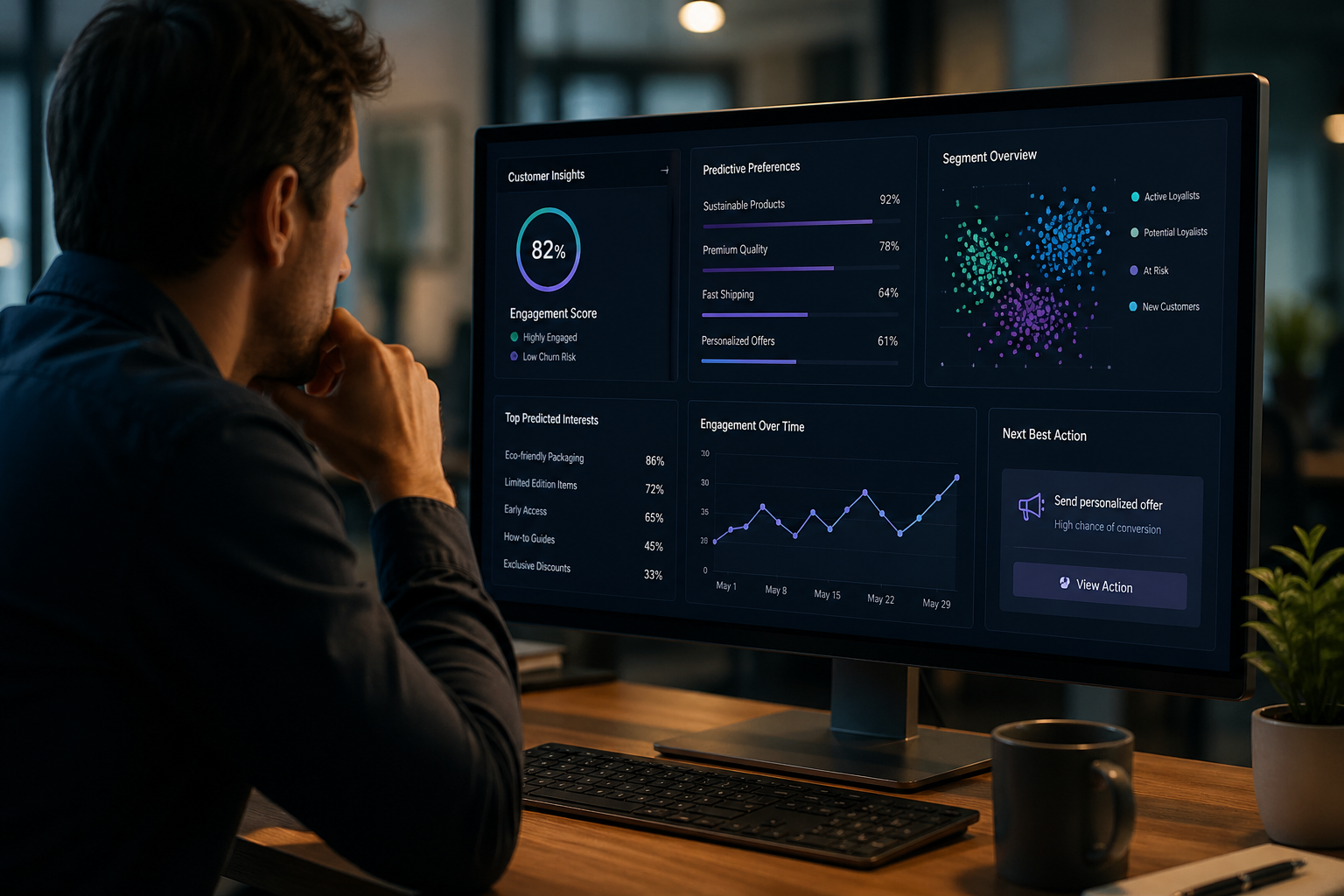
Every marketing decision involves a bet. When you choose a message, a channel, an offer, or a timing — you are betting that you know what your customers want, what will resonate with them, and what will move them toward a decision.
Most of those bets are based on a combination of experience, instinct, past campaigns, and whatever data happened to be available when the decision was made. Some of them pay off. A significant portion of them don't. And the ones that don't represent not just wasted budget, but missed opportunities with customers who were genuinely interested and never got the right message at the right moment.
Nearly 85% of marketing efforts fail to meet their goals, often due to poor planning and execution, with audience mismatch remaining the leading issue. As much as 68% of businesses lose money by advertising in the wrong places, leading to an estimated $37 billion in wasted ad spend in the US every year. Cropink
That's not a technology problem. That's a knowledge problem. And AI is solving it — not by guessing better, but by replacing guesswork with a continuously updating, data-driven picture of what your specific customers actually want.
The Honest Cost of Guessing
Before getting to what AI does, it's worth being clear about what guessing costs — because most businesses dramatically underestimate it.
Marketers estimate they waste 21% of their budget. This waste manifests in various forms: inefficient spending, inaccurate targeting, customer loss, reduced productivity, and flawed performance reporting. These factors not only drain marketing budgets but also contribute to a reported revenue loss of up to 20%. CaliberMind
26% of marketing budgets are wasted on ineffective channels and strategies. At the core of this inefficiency lies a simple but critical issue: buyer personas that are outdated or disconnected from actual customer behavior. Without accurate customer profiles guiding your go-to-market strategy, campaigns risk becoming noise. Smartscaled
The hidden cost goes beyond direct budget waste. When your messaging misses the mark, customers who were genuinely interested in what you offer disengage — not because they didn't want it, but because they didn't feel like you understood them. Companies with weak brand alignment see 27% higher customer acquisition costs. Misaligned messaging increases bounce rates, decreases trust, and creates a conversion drag. Medium
And there's the churn problem that most businesses don't see coming until it's already happened. 55% of sales and marketing professionals cannot identify customers at the risk of leaving, with 71% suspecting customers are leaving due to poor customer service or experience. SugarCRM Those customers weren't lost because the product failed. They were lost because the business never understood what they needed and failed to deliver it.
What "Guessing" Actually Looks Like in Practice
It helps to name what we're actually talking about when we say guessing. Most marketing teams are doing a version of some combination of these things:
Building buyer personas from customer interviews and sales team anecdotes, then treating those personas as accurate representations of their entire audience. Deciding what content to create based on what performed well last quarter, without understanding why it performed well or whether the same signals apply to new campaigns. Choosing ad messaging by debating internally which value proposition sounds most compelling, rather than testing what actually resonates with different segments. Sending the same email sequence to everyone on the list because personalizing at scale feels operationally impossible. Making budget allocation decisions based on last-click attribution that credits the final touchpoint and ignores everything that built the purchase intent.
Each of these is a form of guessing. And each of them has a measurable cost that shows up in conversion rates, customer acquisition costs, churn rates, and lifetime value — metrics that look like campaign performance problems but are actually customer understanding problems.
How AI Moves From Guessing to Knowing
AI is no longer just tracking clicks. It's analyzing behavior patterns, predicting intent, understanding emotion, and shaping digital journeys in real time. In reality, AI studies aggregated behavior patterns across thousands or millions of users. Modern machine learning systems analyze signals such as browsing behavior, purchase patterns, and engagement history. Individually, these signals mean little. Together, they reveal intent. AI models continuously learn from this data. The more interactions they process, the more accurate their predictions become. It is not guesswork — it is statistical probability powered by pattern recognition. Engage Coders
The shift from guessing to knowing is not about having more data. Most businesses already have more data than they know what to do with. The shift is about having systems that can find the patterns in that data that are invisible to human analysts — and then act on those patterns automatically, at scale, in real time.
Here's what that looks like across the specific business problems where guessing currently costs the most.
AI Knows Who Is About to Buy Before They Tell You
The most financially impactful thing AI can do with customer data is identify purchase intent before it becomes an explicit signal. By the time someone fills out a contact form or adds something to their cart, they've already made most of their decision. The opportunity to influence that decision happens earlier — when behavioral patterns are already suggesting where they're heading.
Predictive personalization flips the reactive model. It uses AI to anticipate what each customer will do next and intervenes before they act. Instead of waiting for explicit signals like cart abandonment or a support ticket, you score intent in real time and deliver the right message, offer, or experience while the customer is still deciding. Insider
A prospect researching your category across multiple websites represents much stronger buying intent than someone who only visited your site once. Combining first-party behavioral data with third-party intent signals dramatically improves lead scoring accuracy. ALM Corp
In practice, this means a prospect who visits your pricing page three times in a week, downloads a case study, and spends an average of four minutes per visit gets scored differently than one who opened your email once and moved on — and the marketing response they each receive is different accordingly. Not because a human analyst noticed the pattern, but because the AI identified it and triggered the appropriate response automatically.
AI Knows Which Customers You're About to Lose
Churn is one of the most expensive problems in marketing and one of the most preventable — because customers almost never leave without warning. The signals are in the behavioral data weeks or months before the cancellation or the lapse in purchase. They just aren't visible without the right systems.
Predictive personalization protects margin by suppressing discounts for high-intent users, reduces churn by flagging disengagement before customers cancel, and optimizes lifetime value by balancing short-term conversion against long-term customer quality. Insider
Advanced NLP models interpret intent, emotional intensity, and underlying drivers, enabling brands to detect early dissatisfaction, unmet expectations, or emerging demand patterns. Customer behavior changes over time, and time-series AI models help predict when shifts will occur, not just what those shifts are. Blog
The at-risk customer profile looks different in every business. It might be declining email open rates combined with reduced purchase frequency. It might be a pattern of customer service contacts that predicts dissatisfaction. It might be competitive research behavior detected through intent data. AI identifies the specific combination of signals that precedes churn in your customer base — not a generic model, but a model trained on your actual data — and flags those customers for intervention before they've made the decision to leave.
AI Knows What Messaging Will Actually Resonate
One of the most common and expensive forms of marketing guesswork is messaging. Teams debate which value proposition to lead with, which objection to address, which emotional appeal to make — and usually land on a consensus answer that represents the best guess of the people in the room, not what the data would actually show.
Deep learning opens the door to hyper-personalization of marketing messages and the customer experience because it takes a customer's intent into account, and not just their transactional or interaction history. The ability to predict a customer's needs, and get it right, is pure gold for marketers. With the help of well-trained AI, marketers can rely less on assumptions and guesswork and more on data-driven insights to predict customer behavior more accurately. Invoca
AI-driven messaging optimization works by testing variations at a scale that human-managed A/B testing cannot match, identifying the patterns that connect specific messages to specific audience segments, and dynamically serving the version most likely to resonate for each individual visitor based on their behavioral profile. The result is not one winning message but a personalized message for each customer — which is the actual answer to what works.
AI Knows Which Customers Are Worth Acquiring
Not all customers are equally valuable, and most businesses know this in theory while ignoring it in practice. Customer acquisition campaigns typically optimize for volume — getting as many leads as possible — rather than value — getting the customers most likely to become high-lifetime-value, low-churn, high-margin accounts.
Predictive marketing lets you target users with the highest intent so you can promote products at their regular price to these customers, instead of wasting discounts since they'll likely buy anyway. On the flip side, predictive segmentation lets you also target customers with a high discount affinity. Both of these tactics protect profit margins and help make smart marketing decisions. Insider
The commercial impact is well documented. Pierre Cardin used AI-backed predictive audience segmentation, focusing on user behaviors and predictive data to target customers who showed real intent to purchase. The results were a 445% uplift in conversion rates, a 164.83% increase in return on ad spend, and a 67.95% reduction in cost per acquisition. Insider
Those aren't incremental improvements. Those are the results of replacing broad audience targeting based on demographic assumptions with behavioral and predictive data that identifies which specific individuals are actually likely to buy.
AI Knows What Products and Content to Show Each Person
The recommendation problem — deciding what to show each customer based on what they're most likely to want — is one of the clearest demonstrations of what AI does that guessing cannot. The math is simply impossible to do manually. Even for a catalog of a few hundred products and a few thousand customers, the number of possible combinations of "who should see what" is beyond any human's ability to calculate and act on in real time.
Netflix has an AI-driven focus on personalization, and its recommendation system influences about 80 percent of the content that its subscribers watch. The company estimates that its algorithms help it save $1 billion annually in value from customer retention. Invoca
Philips used AI-powered product recommendations to improve mobile conversion rates by 40.1% and generate over €20,000 of incremental revenue. Insider The same logic applies whether you're recommending products in an e-commerce catalog, blog posts in a content library, service offerings in a B2B context, or follow-up resources in an onboarding sequence. The customer who gets the most relevant next thing to engage with is more likely to stay engaged, convert, and retain. AI is the only system that can deliver "the most relevant next thing" at the individual level, for every customer, in real time.
What Stops Most Businesses From Getting Here
The barriers to AI-driven customer intelligence are real, but they're not what most businesses assume. The technology is no longer the constraint. A local retailer can now deploy AI-powered personalization for under $200, while autonomous advertising platforms optimize campaigns with the same sophistication as global brands. This technological democratization means competitive advantage no longer depends on company size or marketing budget — it depends on strategic implementation and execution speed. Brandsatplayllc
The actual constraints are data quality and organizational discipline. AI models produce outputs that are only as reliable as the data feeding them. Fragmented customer data spread across systems that don't communicate, inconsistent tracking that creates gaps in the behavioral record, and poorly maintained CRM data all undermine the AI's ability to build an accurate picture of what customers want.
Behavioral data is the strongest indicator of intent and continuously updates, allowing models to detect shifting interests in near real-time. A customer who suddenly starts researching competitor products represents an actionable churn signal that demographic data alone would never reveal. ALM Corp
Getting to a state where AI can reliably tell you what your customers want requires the same data foundation that makes every other advanced marketing capability possible: connected data sources, unified customer profiles, and a commitment to data quality as a strategic asset rather than a technical afterthought.
The Compounding Advantage of Stopping the Guesswork
The businesses that have built AI-powered customer intelligence aren't just making better individual campaign decisions. They're building a system that gets progressively more accurate over time — and the gap between their understanding of their customers and their competitors' understanding is widening every month.
AI models continuously learn from data. The more interactions they process, the more accurate their predictions become. The brands dominating in 2026 are those that remove friction before it appears, anticipate needs before they are expressed, and respond before competitors react. Engage Coders
According to recent data, 88% of marketers say AI helps personalize customer experience, proving that AI-driven personalization is no longer optional — it is becoming the norm in modern marketing. Netwrix
The businesses still operating primarily on guesswork aren't just leaving performance on the table today. They're falling behind a curve that is accelerating. Every campaign cycle, the businesses running on data-driven customer intelligence are making better decisions, converting more efficiently, retaining customers longer, and building audience models that compound in accuracy and advantage.
Stopping the guesswork isn't a technical project. It's a strategic decision to build the kind of customer understanding that makes every marketing dollar work harder — not because you're spending more, but because you finally know who you're spending it on and what they actually want.
Ready to stop making marketing decisions based on assumptions and start making them based on what your customers are actually telling you through their behavior?
Let's talk at ritnerdigital.com/#contact
Ritner Digital is a digital marketing agency helping businesses build, grow, and optimize their online presence with strategy-first thinking and data-backed execution.
Frequently Asked Questions
What does "guessing" actually mean in marketing and why is it so common?
Guessing in marketing means making decisions about messaging, targeting, offers, timing, and channels based on assumptions, intuition, or limited data rather than on what customer behavior actually shows. It's common because building genuinely data-driven marketing requires infrastructure most businesses haven't invested in — unified data, behavioral tracking, and AI models that can find patterns in that data at scale. In the absence of that infrastructure, marketers default to what they can observe: past campaign performance, customer interviews, sales team feedback, and their own experience. These inputs aren't worthless, but they're filtered through organizational bias and represent a tiny fraction of the behavioral signal that already exists in the data. The gap between what teams assume about customers and what customers actually do is almost always significant — and closing that gap is where the performance gains live.
How does AI predict what customers want — isn't that just sophisticated guessing?
It's the opposite of guessing. AI identifies statistically significant patterns across large volumes of behavioral data — patterns that no human analyst could detect manually. When thousands of customers who exhibit a specific combination of behaviors — visiting a pricing page multiple times, engaging with certain content types, returning within a short window — consistently convert at a higher rate, the AI learns that combination as a signal of purchase intent. It doesn't guess that someone is likely to buy. It calculates the probability based on how customers with similar behavioral profiles have acted historically. The prediction gets more accurate over time as more data flows through the model. The distinction matters because the AI isn't expressing an opinion about what customers want — it's reading the behavioral evidence they've already generated.
What kinds of customer behaviors does AI actually analyze to make predictions?
The most predictive signals are behavioral rather than demographic. Page visits and return visit frequency, time spent on specific content types, scroll depth and click patterns, email opens and click behavior, purchase history including recency, frequency, and order value, content download patterns, product comparison behavior, support interactions, and app usage all contribute to the behavioral picture. When these signals are combined and analyzed together, patterns emerge that are invisible when looking at any single signal in isolation. A customer who visited your pricing page once means something different from a customer who visited it four times in two weeks and also downloaded a case study. AI identifies those compound patterns and scores each customer's intent and likely next action accordingly. Demographic data — industry, company size, job title — adds useful context but is far less predictive than behavioral data on its own.
Can AI really predict churn before it happens, and how reliable is it?
Yes, and it's one of the highest-ROI applications of AI in marketing precisely because the behavioral signals that precede churn are almost always present in the data weeks or months before a customer actually cancels or stops buying. Reduced engagement frequency, declining email open rates, changed purchase patterns, increased support contacts, and competitive research behavior are all signals that, in combination, indicate a customer moving toward disengagement. AI models trained on your historical data learn which specific combinations of signals preceded churn in your actual customer base — not a generic model, but one calibrated to your business. The reliability improves over time as the model processes more of your own data. The practical question isn't whether AI can predict churn — it clearly can — but whether your data infrastructure gives it enough behavioral signal to work with.
What is predictive personalization and how is it different from regular personalization?
Regular personalization is reactive — a customer abandons a cart, so you send them a reminder. They browse a category, so you show them related products. The response follows the explicit signal. Predictive personalization is proactive — it anticipates what a customer is likely to do next before they do it and delivers the relevant experience while they're still in the decision window. Instead of waiting for a customer to show an obvious signal of intent, predictive personalization scores their likelihood to take a specific action based on their behavioral profile and intervenes at the optimal moment. The practical difference is that reactive personalization catches customers after a moment has already passed, while predictive personalization reaches them while the moment is still open. That timing difference consistently drives meaningfully higher conversion rates.
My business is small — is AI-driven customer intelligence realistic at my scale?
The tools have become significantly more accessible. AI-powered behavioral segmentation, predictive lead scoring, and personalized recommendation capabilities are now embedded in platforms that small businesses already use — HubSpot, Klaviyo, Shopify, and similar tools have incorporated AI features that were enterprise-only capabilities a few years ago. The starting point at any scale is the same: connect the behavioral data you're already generating — website analytics, email engagement, CRM records, purchase history — into a coherent view of individual customer behavior. Even basic connections between these systems unlock patterns that are invisible when they're siloed. You don't need a data science team or a custom AI platform to start making meaningfully better decisions about who wants what. You need clean, connected data and a clear goal for what you want to predict.
What's the difference between knowing what customers want and knowing what they'll do next?
They're related but distinct. Knowing what customers want is about understanding preferences, pain points, and motivations — the underlying drivers of their decisions. Knowing what they'll do next is about predicting the specific action they're likely to take given their current behavioral context. AI is particularly strong on the second. By analyzing what customers with similar behavioral profiles have done historically, it can predict with statistical confidence what a specific customer is likely to do in the next days or weeks — whether that's making a purchase, upgrading a subscription, contacting support, or going quiet. The first — understanding deeper motivations — still benefits from human judgment, customer conversations, and qualitative research. The most effective approach combines AI's behavioral pattern recognition with the kind of qualitative customer understanding that only comes from direct human engagement.
How does AI-driven customer intelligence improve marketing ROI specifically?
It improves ROI through multiple compounding mechanisms. It reduces wasted spend by identifying which customers are actually likely to convert, so budget concentrates on the right audiences rather than broad targeting. It improves conversion rates by delivering the right message to the right person at the right moment rather than sending uniform campaigns to everyone. It extends customer lifetime value by identifying at-risk customers before they churn and triggering retention interventions while there's still time. It protects margin by distinguishing between high-intent customers who will buy at full price and discount-sensitive customers who need an offer, so you're not giving away margin to customers who didn't need the incentive. Each of these is a separate performance lever, and they compound — higher conversion rates plus lower churn plus better margin protection adds up to significantly higher return on every marketing dollar.
How does Ritner Digital help businesses stop guessing and start using AI to understand their customers?
We start by auditing the gap between what your current marketing is based on — personas, intuition, basic analytics — and what your actual behavioral data shows. Most businesses are surprised by how much misalignment exists between their assumptions and the evidence. From there we build the data connections and AI-powered systems that transform raw customer behavior into actionable intelligence — predictive segmentation, intent scoring, churn identification, and personalization infrastructure that responds to what customers are actually doing rather than what the team assumed they were doing. The goal is marketing that gets measurably smarter every month because it's learning from reality instead of repeating the same assumptions.
Stop guessing and start knowing at ritnerdigital.com/#contact