The Case Against Push-Button Content: Why "AI at Scale" Is the Riskiest Bet in Marketing Right Now
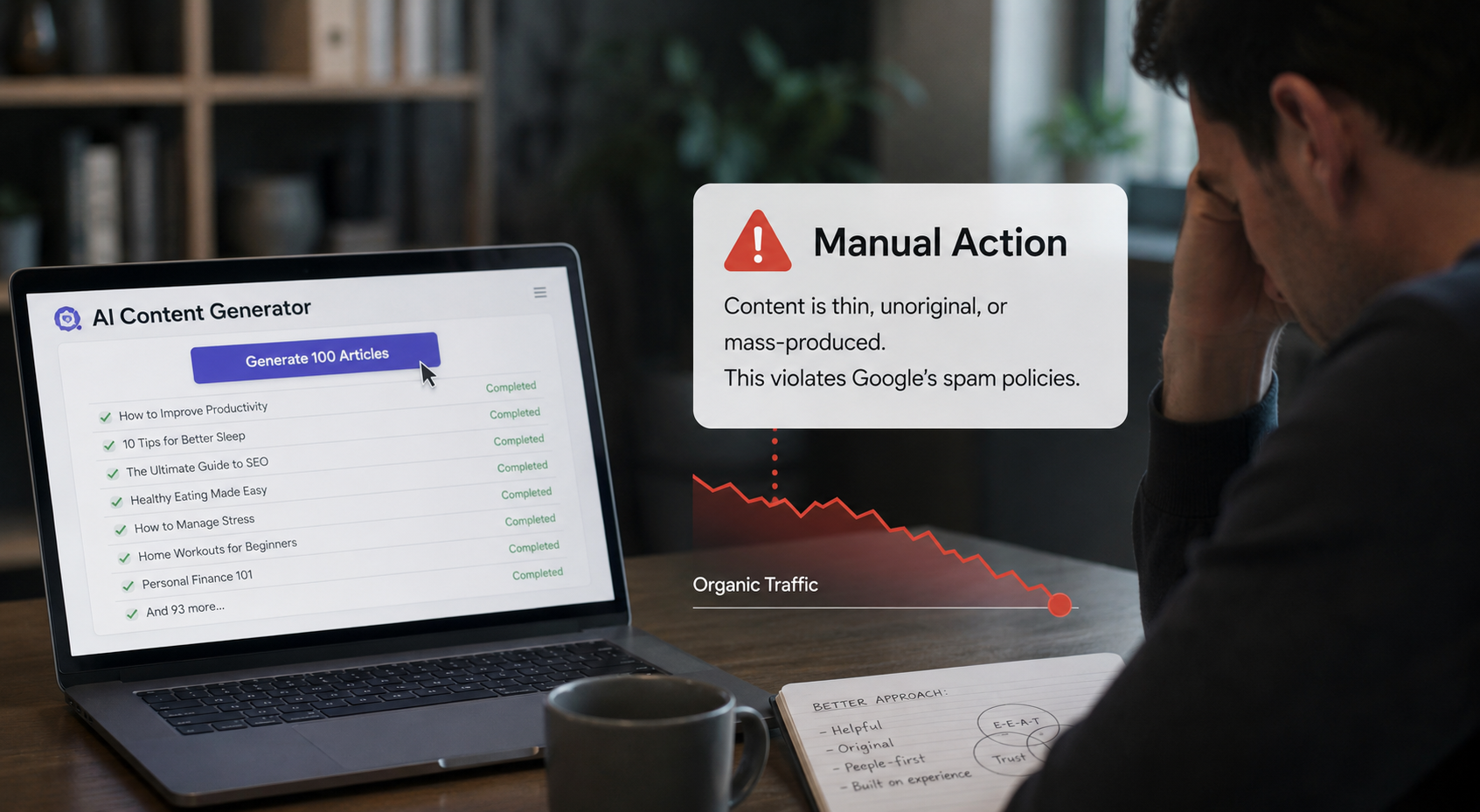
There's a seductive pitch making the rounds in marketing software right now. Drop in your URL. Hit a button. Watch a fleet of "AI-optimized" articles, hero images, and structured data generate themselves and auto-publish across Reddit, Medium, LinkedIn, and Quora — all engineered to make ChatGPT, Claude, and Gemini recommend your brand. Stop briefing writers. Just approve and ship.
It sounds like leverage. In practice, it's one of the fastest ways to torch your search visibility, your brand credibility, and your budget all at once.
We're not anti-AI. AI is woven into how good marketing teams work in 2026, and we use it ourselves. The problem isn't the technology — it's the specific bet that volume and prompt-matching are a substitute for value. That bet is colliding head-on with how search engines and answer engines actually reward content, and the brands making it are about to learn an expensive lesson.
Google has spent two years building a machine to catch exactly this
The "generate hundreds of pages at the push of a button" model isn't a clever loophole. It's the precise behavior Google has been systematically penalizing.
Google formally defined "scaled content abuse" in its March 2024 spam policy update as "generating many pages primarily to manipulate search rankings, with little or no value added for users." The critical detail: the policy targets intent and outcome, not the production method — meaning thin content that happens to be human-written is covered too, and AI content isn't inherently the problem. Digital Applied TeamDigital Applied Team
This stopped being theoretical. Google's enforcement moved from policy language to documented manual actions in June 2025, with affected sites receiving Search Console notifications citing "aggressive spam techniques, such as large-scale content abuse." The August 2025 Spam Update, which concluded September 22, specifically targeted mass-produced, low-quality AI text created solely for ranking purposes, powered by Google's SpamBrain detection engine. LexiconlegalcontentSEO-Kreativ
The mechanics of detection are pointed directly at the push-button model. A leaked internal system reportedly analyzes the ratio of URLs generated in a given period against the number of substantive articles actually produced — a massive spike in pages without a matching increase in real substance flags as poor quality. In other words: publishing a flood of articles in a short window is itself the signal. Breakline
The results for sites that ignored this have been brutal. One UK e-commerce site that AI-spun product descriptions across thousands of pages drew a manual action for scaled content abuse and lost 80% of its traffic overnight. Medium
"Matching the prompt models" is built on a misunderstanding
The newer version of this pitch leans on Answer Engine Optimization — engineering content so ChatGPT, Claude, and Gemini cite your brand. The logic seems sound: if AI models are the new discovery layer, optimize for them.
But here's what the push-button approach gets wrong. The qualities that earn citations from AI systems are the same ones that have always earned rankings: clear structure, genuine topical depth, original information, and direct answers to real questions. As one content platform puts it, the content qualities that rank well in Google — clear structure, comprehensive coverage, direct answers — are the same qualities that get cited by ChatGPT, Perplexity, and Google AI Overviews. Metamonster
Mass-generated content fails this test by definition. Google's Danny Sullivan described the 2026 ranking shift as a move toward "non-commodity content" — content a reader cannot find in equivalent form elsewhere — and noted that pages built on templated workflows, whether the template is human- or AI-generated, are commodity content by that standard. An LLM trained to surface the most useful, authoritative answer has no reason to cite the tenth interchangeable summary of a topic. Prompt-matching produces exactly that: interchangeable summaries. Lexiconlegalcontent
You can't shortcut your way to authority. The tools promising to do so are optimizing for a target that doesn't exist.
What it actually costs when it goes wrong
The push-button pitch is framed around what you save: no writers, no briefs, no hours. The real accounting looks different once you include the downside.
When a scaled-content penalty hits, the damage compounds — traffic and impressions drop, conversions and revenue fall with them, user trust erodes as quality visibly declines, and then you pay again to clean it up: removing low-value pages, rewriting content, and restructuring site architecture all take budget, time, and resources. You don't just lose the upside. You pay to undo the work, and you rebuild credibility from a deficit. Rsacreativestudio
There's a quieter cost too. When a tool auto-distributes generated articles to Reddit, Medium, LinkedIn, and Quora under your brand, every thin, generic piece is a public signal about how much you actually care about the people reading it. In a market where audiences are increasingly skeptical of synthetic content, that's a brand liability you're scaling, not an asset. Rank Monster
The honest version of the counterargument
To be fair: the appeal is real, and the tools aren't worthless. AI genuinely collapses the time it takes to research, outline, and draft. Google's own position is that it isn't trying to ban AI — it's trying to reduce unoriginal, low-value content at scale, and AI paired with real expertise and editorial standards is a powerful way to produce great content. For a solo operator who'll never afford a content team, a tool that gets a rough draft on the page has a place. Google-penalty
The distinction that matters is AI-assisted versus AI-abdicated. In one 2025 analysis of 487 search results, 83% of top spots were human-generated, and the AI pages that did rank had heavy human edits — added case studies, original visuals, real insight. The winning use of AI is as a drafting and research accelerator underneath human judgment. The losing use is removing the human entirely and letting volume do the work. The push-button model is the second thing wearing the costume of the first. Medium
What we actually believe
The brands that win the next few years won't be the ones who published the most. They'll be the ones who published the things only they could have written — backed by real expertise, original data, a genuine point of view, and the human editorial judgment to know what's worth saying.
That's slower. It's also the only approach that survives a spam update, earns an AI citation, and builds a brand people trust. AI belongs in that process. It just belongs in the seat next to a person who knows what good looks like — not in the driver's seat with a button that says "publish 200 articles."
Thinking about content that actually compounds instead of content that gets penalized? Ritner Digital builds AI-accelerated, human-led content strategies designed to earn rankings, citations, and trust — the kind that lasts. Let's talk about doing it right →
Frequently Asked Questions
Does Google penalize AI-generated content?
Not for being AI-generated. Google's "scaled content abuse" policy targets intent and outcome — generating many pages primarily to manipulate rankings with little value for users — not the production method, which means thin human-written content is covered too. Google's own stance is that it isn't trying to ban AI; it's trying to reduce unoriginal, low-value content at scale. The penalty is for the abuse pattern, not the tool. Digital Applied TeamGoogle-penalty
What exactly is "scaled content abuse"?
It's Google's term for mass-producing pages to game search rankings. It's essentially a rebranding of "spammy automatically generated content," and the definition centers on volume combined with manipulative intent. The August 2025 Spam Update specifically targeted mass-produced, low-quality AI text created solely for ranking purposes. BreaklineSEO-Kreativ
Can publishing a lot of articles quickly actually hurt my rankings?
Yes — high content velocity itself can be a red flag. A reported internal Google system analyzes the ratio of URLs generated in a period against the number of substantive articles produced, treating a spike in pages without matching substance as a poor-quality signal. Sudden floods of content are exactly the pattern these systems are built to catch. Breakline
Will AI tools help me get cited by ChatGPT, Claude, and Gemini?
Only if the content is genuinely good. The qualities that earn AI citations are the same ones that rank in Google — clear structure, comprehensive topic coverage, and direct answers. Google's Danny Sullivan has described the ranking shift as favoring "non-commodity content" a reader can't find in equivalent form elsewhere. Generic, prompt-matched output is commodity content by definition, so it gives answer engines little reason to surface it. MetamonsterLexiconlegalcontent
What happens if my site gets hit with a content penalty?
The damage compounds. Traffic and impressions drop, conversions and revenue fall with them, user trust erodes, and then you pay again to clean it up — removing low-value pages, rewriting content, and restructuring your site all take budget and time. One e-commerce site that AI-spun thousands of product pages lost 80% of its traffic overnight. RsacreativestudioMedium
So should I avoid AI for content entirely?
No. The line is between AI-assisted and AI-abdicated. AI paired with real expertise and editorial standards is a powerful way to produce great content. In one analysis of 487 search results, 83% of top spots were human-generated, and the AI pages that did rank had heavy human edits — added case studies, visuals, and real insight. Use AI to accelerate research and drafting; keep a human in charge of judgment, originality, and quality. Google-penaltyMedium
What's the safer alternative to push-button content tools?
An AI-accelerated, human-led approach: original research, a genuine point of view, and editorial oversight that ensures every piece adds something only your brand could say. It's slower than hitting "publish 200 articles," but it's the only model that survives spam updates, earns AI citations, and builds lasting trust. That's exactly what Ritner Digital builds. Let's talk about doing it right →