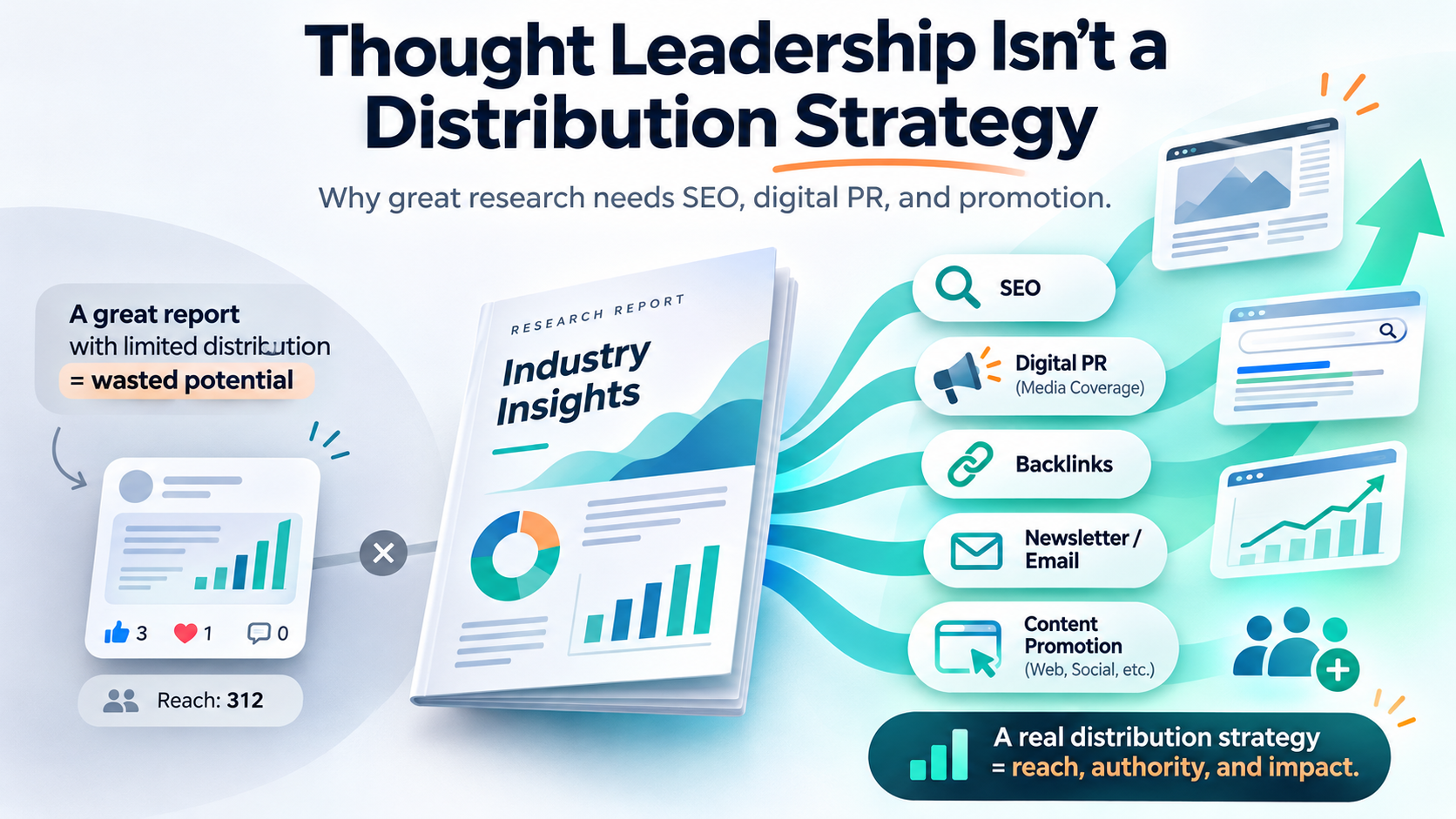
An investigation into why companies spend $80,000 producing groundbreaking research, post it on LinkedIn once, and then act personally betrayed when the internet fails to assemble a welcoming committee.
Somewhere in America, a B2B research firm has just completed the most important study in its history.
The research took eight months.
It involved 1,200 survey respondents, six analysts, three senior researchers, and a project manager who has developed a noticeable eye twitch whenever someone says "just one more revision."
The findings are extraordinary.
They challenge conventional industry assumptions.
They reveal emerging patterns in customer behavior.
They contain information that could change how major companies approach purchasing, investment, hiring, or strategic planning.
The leadership team is ecstatic.
"This is going to establish us as true thought leaders," announces the managing director.
Everyone agrees.
The marketing team creates a landing page.
The design team finishes the PDF.
Someone writes an enthusiastic LinkedIn caption.
The CEO approves it.
At 9:03 on a Tuesday morning, the company publishes its announcement:
"We're thrilled to share our latest groundbreaking research report, delivering actionable insights into the evolving landscape of strategic business transformation."
Fourteen employees like the post.
One comments, "Great work, team!"
Another writes, "Excited to see this!"
A former intern shares it with the caption, "Proud!"
By Thursday, the report has disappeared into the infinite digital sediment of LinkedIn.
Nobody contacts the company.
No journalists reference the findings.
No industry association requests a presentation.
No prospective clients appear, trembling with appreciation for the firm's statistical rigor.
At the next leadership meeting, someone asks why the research hasn't generated more business.
The marketing director clears her throat.
"We've distributed it on social media."
Ah.
Of course.
The distribution strategy.
One LinkedIn post, several employee likes, and a deeply held belief that the quality of the research would somehow notify the appropriate purchasing committees.
And this is where we encounter one of the most expensive misunderstandings in B2B marketing.
Thought leadership is not a distribution strategy.
It's the thing you're trying to distribute.
Producing genuinely valuable research is an achievement.
Getting that research in front of the right people is a separate discipline.
And if your company consistently funds the first while neglecting the second, you may be operating a remarkably sophisticated information production facility with no functioning delivery department.
Let's investigate.
First, We Need to Discuss What Thought Leadership Actually Is
The term "thought leadership" has been through a lot.
It began as a useful description of people and organizations contributing meaningful expertise to professional conversations.
Then corporate marketing departments discovered it.
Soon, everyone was a thought leader.
The CEO was a thought leader.
The chief operating officer was a thought leader.
The regional sales director was a thought leader.
Someone who had recently attended a webinar about customer experience was preparing a thought leadership series.
LinkedIn became a vast digital symposium of executives announcing that trust matters, change is inevitable, and leadership begins with listening.
All important observations.
Also available on decorative wooden signs at HomeGoods.
But serious thought leadership has a legitimate purpose.
It can introduce original evidence.
Offer a distinctive interpretation.
Challenge an accepted assumption.
Explain an emerging industry problem.
Or help buyers understand complicated decisions.
For research firms, consultancies, advisory businesses, and other expertise-driven organizations, this can be particularly valuable.
Their intellectual capabilities are central to what clients purchase.
A firm demonstrating how it thinks may provide stronger evidence of expertise than a brochure announcing that its approach is innovative.
However, there is an important distinction between having something worth saying and making sure the right people encounter it.
Those are not the same business activity.
And the difference is beginning to show up in industry research.
The 2026 Research Is Essentially Telling B2B Marketers to Stop Admiring Their PDFs
In January 2026, Hinge Research Institute published findings from its 2026 High Growth Study.
The study examined professional services firms and found that high-growth organizations invested substantially more in marketing than their no-growth counterparts.
High-growth firms allocated 12% of revenue to marketing, compared with 5% among no-growth firms.
That is a meaningful difference.
But the more interesting finding concerns priorities.
According to Hinge, the leading marketing emphasis for 2026 shifted toward promoting content through social media and developing individual thought leaders, rather than concentrating primarily on content creation.
Read that again.
An industry already overflowing with white papers, research reports, expert articles, and strategic insights is beginning to recognize that producing more material is not necessarily the missing ingredient.
The missing ingredient may be getting people to encounter what already exists.
Hinge's 2026 executive summary also reports that high-growth professional services firms are 2.5 times more likely to activate subject-matter experts in their marketing.
This doesn't prove that content promotion causes higher growth.
The study identifies relationships between marketing practices and business performance, not a guaranteed formula.
But it does challenge a familiar assumption.
That if you simply publish enough expert content, customers will eventually recognize your brilliance.
They might.
They might also continue reading whatever your competitors are putting in front of them.
The internet is under no obligation to reward your organization for completing a comprehensive research project.
Which is a shame, because some companies have already ordered commemorative mugs.
The Content Production Industrial Complex Has Become Extremely Efficient at Producing Content
There is another reason the distribution problem deserves attention.
Companies are becoming better at making content faster.
Much faster.
The Content Marketing Institute's B2B Content and Marketing Trends: Insights for 2027, published November 4, 2026, examined responses from 861 B2B marketers.
The findings are revealing.
Among respondents, 88% reported that their organizations used AI-powered content creation tools.
When asked what generative AI was contributing to content creation, 78% selected speed, 59% selected efficiency, and 44% selected volume.
Only 17% selected quality.
And just 12% selected performance improvement.
These numbers do not prove AI is incapable of improving content quality.
They reflect what the surveyed marketers reported about its contributions.
But they illustrate something important.
The industry has invested heavily in making content production easier.
Production is no longer necessarily the bottleneck.
A company that once struggled to publish two articles per month can now produce an astonishing quantity of material.
Unfortunately, the audience has not agreed to read an astonishing quantity of material.
Especially when every article begins:
"In today's rapidly evolving business landscape..."
We need to discuss this relationship.
Because the modern marketing department has become increasingly capable of manufacturing content without developing an equally effective system for ensuring anyone encounters it.
We have built factories.
We have not necessarily built roads.
And management keeps asking whether the factory could produce another 20 articles before Friday.
Publishing Is an Event. Distribution Is a Process.
This is the distinction that should probably be printed on a large sign and installed in every B2B marketing department.
Publishing means making something available.
Distribution means deliberately connecting that thing with relevant audiences through appropriate channels.
A research firm can publish a report on its website.
That makes the report available.
It can post a link on LinkedIn.
That creates one potential point of discovery.
But neither action, by itself, establishes a sustainable distribution process.
A meaningful distribution strategy requires decisions.
Who needs this information?
Where do those people look for it?
Who do they already trust?
What questions does the research answer?
Which findings are relevant to different audiences?
What formats make those findings easiest to understand?
How will the organization introduce the material?
How will it continue doing so after launch day?
And how will it know whether the effort is working?
These questions are not glamorous.
They generally don't require a ceremonial brand video.
But they matter.
The Corporate Research Launch Ceremony
Let's examine the typical research publishing workflow.
First comes the research.
Then analysis.
Then writing.
Then editing.
Then design.
Then legal review.
Then another round of design because someone in legal would like the limitation statement to appear in 14-point type.
Then leadership review.
Then a final approval meeting.
Then publication.
Then an enthusiastic announcement.
Then silence.
Nobody has established who owns promotion after publication.
Nobody has identified relevant journalists.
Nobody has connected the report with the firm's sales materials.
Nobody has developed articles around specific findings.
Nobody has planned a newsletter sequence.
Nobody has evaluated whether the research addresses questions people are searching for.
But the PDF is beautifully designed.
The gradient on page seven is magnificent.
And for approximately 36 hours, everyone feels tremendous professional accomplishment.
That is a production process.
It is not a distribution strategy.
One LinkedIn Post Is Not a Campaign. It Is a Digital Post-it Note.
LinkedIn can be an important channel for B2B marketing.
It contains executives, professionals, researchers, consultants, and industry specialists.
People can encounter ideas, share information, and discover organizations they didn't previously know.
There are genuine opportunities.
But relying on a single company-page announcement is an unusually optimistic strategy.
A social post has a limited opportunity to be seen.
Your target audience might be busy when it appears.
They might not follow your company.
They might scroll past.
They might not recognize the report's relevance from the headline.
They might encounter the announcement but have no immediate reason to click.
None of these outcomes necessarily reflects poorly on the research.
They reflect the limitations of treating a single piece of social content as an entire distribution program.
The Problem Isn't LinkedIn. It's Asking LinkedIn to Perform Miracles.
Imagine your firm publishes original research about how private equity-backed companies approach operational transformation.
There may be several worthwhile ways to discuss the findings.
One executive could explain a surprising pattern.
A researcher could describe the methodology and its implications.
A partner could discuss what the findings mean for portfolio company leadership.
A separate post might focus on one particularly relevant industry.
A newsletter could summarize the most useful results.
A related article could explore a practical question raised by the evidence.
These pieces can introduce different aspects of the research to appropriate audiences.
That is not the same as copying the original announcement seven times and scheduling it for consecutive Wednesdays.
Please don't do that.
The goal isn't repetition for its own sake.
It's giving people multiple legitimate opportunities to encounter a useful idea.
And those opportunities should provide value even when someone doesn't immediately click through to the complete report.
Your Research Doesn't Have One Audience. It Has Several.
One of the most expensive content distribution mistakes is assuming that everyone who might benefit from a report will respond to the same message.
Consider a fictional research company that studies AI adoption among regional healthcare organizations.
The findings might interest several audiences.
A hospital executive might care about costs and operational risk.
An IT director might care about implementation barriers.
A compliance professional might focus on governance and privacy concerns.
A healthcare journalist might look for a surprising, well-supported statistic.
A technology vendor might be interested in how buyers evaluate solutions.
An industry association might want practical findings for its members.
These audiences could all benefit from the same research.
But they do not necessarily approach it with the same questions.
A generic announcement saying "New Healthcare AI Report Released" doesn't explain why any particular person should care.
Distribution Begins With Audience Mapping
Before publishing, identify the specific groups most likely to benefit from your findings.
Then consider the information each group would find valuable.
A useful audience map examines the audience's role, its pressing questions, the research findings most relevant to those questions, and the channels through which that audience may encounter credible information.
Some groups might discover the study through search engines.
Others through industry newsletters.
Others through professional associations.
Others through expert commentary.
And some through a colleague forwarding a relevant excerpt.
Not every report needs 14 audience segments.
Please do not create a 68-slide segmentation presentation explaining how to distribute a 12-page study.
But a few thoughtful audience decisions can make the difference between speaking to a specific group and announcing something to the entire internet.
Which, in practical terms, often means announcing it to nobody in particular.
The 2026 Edelman–LinkedIn Research Explains Why Distribution Matters Beyond Visibility
The 2026 Edelman–LinkedIn B2B Thought Leadership Impact Report surveyed more than 1,100 management-level professionals.
Its findings emphasize that thought leadership can influence how buyers discover companies, evaluate providers, establish confidence, and maintain relationships.
The report also highlights how useful ideas move through private conversations among buyers.
That last point is particularly important.
Your research may reach one person.
That person may share it with a colleague.
A colleague may introduce the findings during a meeting.
An executive may use the information to question an assumption.
A purchasing committee may revisit the issue months later.
Your company may never see every step in that process.
But the research can still become part of how buyers understand a market or evaluate potential providers.
This is one reason content distribution should not be reduced to generating clicks.
The objective may also involve making useful information available to the people who influence future decisions.
The Work Chat Is a Distribution Channel You Don't Control
One of the more interesting findings in Edelman and LinkedIn's research is the role of private sharing.
Professional ideas don't travel exclusively through public social posts.
They also move through internal conversations.
Group messages.
Email threads.
Presentations.
Meetings.
Someone reads a useful article and sends it to a colleague with the message:
"This is exactly what we've been seeing."
That interaction may be more commercially meaningful than several hundred superficial social reactions.
And it can be difficult to measure.
Which brings us to an important distinction.
Content should be easy to discover, but it should also be worth sharing once discovered.
A proprietary study with clear evidence, useful explanations, and a compelling conclusion has more potential to become part of a substantive conversation than a report whose main finding is that organizations face challenges.
They certainly do.
Thank you for the update.
Search Engine Optimization Is Distribution. Just on a Different Timeline.
B2B research distribution frequently concentrates on launch-day promotion.
But some of the most valuable discovery opportunities happen long after the report is published.
Someone searches Google for an industry statistic.
A manager investigates a market trend.
An executive looks for evidence supporting a business decision.
A researcher seeks recent data on a particular subject.
A journalist searches for credible sources.
Those people may be looking for information your organization has already produced.
But they won't necessarily search for the official name of your report.
They may search for the question the research answers.
Google's Search Essentials recommends using the language people employ when searching and placing those terms in meaningful locations such as titles, headings, and links.
Its SEO Starter Guide also explicitly discusses promoting content to help interested audiences and search engines discover it.
That makes SEO an important part of a research distribution strategy.
Not because every report will rank highly.
There are no guarantees.
But because a research asset with a useful public webpage, descriptive headings, meaningful explanations, and relevant internal links creates more opportunities for discovery.
Your Research Report Needs More Than a Download Button
A research page should help someone understand the findings before deciding to download the full report.
That means presenting original evidence in accessible text.
Explaining the study's scope.
Identifying important results.
Providing methodology and relevant limitations.
And connecting the material to related questions.
The PDF can remain available.
It can still be beautifully designed.
The gradient can stay.
But the public webpage should be useful on its own.
Otherwise, the company may be expecting Google to understand the significance of a document while providing very little context around it.
Google can index PDFs, but that doesn't automatically mean a PDF-only approach best serves your audience or your business goals.
And it definitely doesn't mean naming the file final-report-v7-APPROVED-really-final.pdf is an SEO strategy.
AI Search Is Another Reason to Make Original Research Publicly Understandable
Search behavior is also changing.
People increasingly encounter AI-generated summaries and answers when researching complex topics.
In July 2025, Pew Research Center published an analysis of Google user behavior.
The study examined browsing activity from 900 U.S. adults during March 2025.
When a Google search produced an AI summary, users clicked a traditional search result in 8% of visits.
When no AI summary appeared, the corresponding figure was 15%.
Links cited within AI summaries were clicked in only 1% of visits with a summary.
These findings describe the observed behavior in that study, not a universal prediction for every industry or search query.
But they illustrate why publishers should not assume that visibility always produces a website visit.
A person may encounter information through an AI-generated response without clicking through to the original source.
This makes original, identifiable, credible information especially important.
You Want Your Research to Be a Source, Not Merely Another Generic Summary
Google's guidance on AI features in Search explains that foundational SEO practices remain relevant.
It recommends making important content accessible, ensuring pages can be crawled, and providing useful information in text.
It does not promise inclusion in AI Overviews or AI Mode.
No responsible agency should promise that either.
But the strategic opportunity is straightforward.
If your firm has conducted original research, publish it in a way that makes its findings clear and verifiable.
Attribute the research.
Explain the methodology.
Use accurate terminology.
Provide meaningful context.
Make important conclusions accessible.
And connect those findings to relevant topics.
Original research can contribute information that other sources lack.
That's worth preserving.
Especially in a world where generic explanations can be produced more easily than ever.
The research doesn't need to pretend to be written for robots.
It needs to make sense to people.
A concept that remains surprisingly controversial in modern digital marketing.
Digital PR: Your Research Might Be Newsworthy, but Journalists Don't Receive Telepathic Notifications
Now we must discuss earned media.
Research firms can have a substantial advantage when it comes to public relations.
They produce information.
Sometimes that information is new.
Sometimes it challenges established beliefs.
Sometimes it reveals patterns relevant to an industry.
And sometimes the findings are genuinely newsworthy.
But publishing a report does not automatically notify journalists, newsletter writers, editors, or trade publications that something important has happened.
A journalist is not required to monitor your website's Resources page.
They have work.
They have deadlines.
They have inboxes that resemble overcrowded municipal landfills.
If your research provides credible evidence relevant to their reporting, you may need to bring it to their attention.
A Press Release Is Not a Substitute for a Story
Consider a fictional report showing that mid-sized industrial companies are changing how they evaluate cybersecurity investments.
A generic announcement might say:
"Leading Research Firm Announces Groundbreaking Cybersecurity Study."
This is primarily news about the company.
Now consider a more substantive angle:
"New Survey of 650 Industrial Executives Finds Cybersecurity Budgets Increasing While Implementation Confidence Remains Low."
If the hypothetical study actually supports that conclusion, the second headline gives a journalist a reason to investigate.
It offers a specific finding.
It identifies the population.
It suggests a potentially interesting industry issue.
And it provides a starting point for further reporting.
That is the difference between announcing that research exists and explaining why the research may matter to an audience.
Effective digital PR requires editorial relevance, credible evidence, accurate sourcing, and thoughtful outreach.
It should not involve sending the same pitch to 3,000 journalists who cover entirely unrelated subjects.
Nothing establishes your firm's expertise quite like emailing a sports reporter about enterprise procurement optimization.
Make the Findings Easy to Verify
If you want credible third-party coverage, provide useful supporting information.
Explain who conducted the research.
Identify the sample.
State when the study took place.
Describe relevant methodology and limitations.
Make qualified researchers available for questions.
Provide the underlying findings in a format that journalists can examine.
And avoid exaggerating the conclusions.
A survey of 400 executives should not become "All Business Leaders Agree" simply because the marketing team enjoys certainty.
Research credibility is an asset.
Don't sacrifice it to manufacture a more dramatic headline.
Your Subject-Matter Experts Should Not Be Invisible Until the Webinar Begins
Research firms and advisory businesses often have exceptionally knowledgeable people on staff.
They understand the findings.
They can explain why particular results matter.
They can identify limitations.
They can discuss how the evidence relates to real business decisions.
Those people can play an important role in distribution.
Yet some companies treat expert involvement as something that ends when the final report is approved.
The researcher returns to other projects.
The analyst begins another survey.
The senior partner resumes client work.
And the marketing team is left trying to promote highly technical material it may not have helped develop.
This is an organizational design problem.
Not simply a social media problem.
Experts Can Help Translate Research Into Conversations
A subject-matter expert might contribute a short explanation of a surprising result.
They might discuss the findings during an industry event.
They might answer questions in a professional community.
They might participate in a relevant podcast or interview.
They might help marketing develop an article addressing an important practical implication.
They don't need to become influencers.
They don't need to post motivational observations at 6:00 every morning.
They don't need to begin photographing their coffee beside a notebook labeled "Innovation."
They need opportunities to communicate the expertise that makes the organization valuable.
The 2026 Hinge High Growth Study identifies visible subject-matter experts as a notable characteristic of faster-growing professional services firms.
And the 2026 Edelman–LinkedIn report emphasizes how trusted outside voices and credible expertise can strengthen thought leadership.
The implication is not that every researcher must maintain a personal brand.
It is that organizations may benefit from making their real expertise easier to encounter.
An idea becomes more compelling when someone qualified can explain why it matters.
Your Existing Customers Are an Audience. A Rather Important One.
Companies often treat distribution as a strategy for reaching entirely new people.
New prospects.
New markets.
New followers.
New audiences.
All reasonable objectives.
But what about the people who already know the business?
Existing customers may be highly interested in relevant research.
Especially if it helps them understand changes affecting their industries.
A company that has already hired your firm has demonstrated some level of confidence in your expertise.
Relevant new findings may reinforce that confidence or introduce additional capabilities they were not aware of.
The 2026 Edelman–LinkedIn report also identifies an important role for thought leadership after the initial sale.
It reports that high-quality thought leadership can help maintain relevance and strengthen existing vendor relationships.
That doesn't mean emailing every client every time someone publishes a new article.
Nobody wants to receive a daily message announcing another revolutionary insight into organizational resilience.
But relevant findings can be shared thoughtfully.
An account manager might send a customer an article that directly addresses a current challenge.
A newsletter could feature new research for subscribers who have chosen to receive it.
An industry-specific update could explain how a recent study relates to developments in that market.
The objective is to remain useful.
Not to establish an elaborate new category of inbox harassment.
Your Sales Team Should Know the Research Exists Before a Prospect Mentions It
This seems obvious.
Unfortunately, obvious things are not always operational things.
A research report gets published.
Marketing celebrates.
The sales team continues using a presentation from 2024.
Three months later, a prospect references a statistic from the new report.
The account executive responds:
"Interesting. I'll have to look into that."
The statistic came from their own company.
An inspiring demonstration of organizational alignment.
Research distribution should include internal enablement.
What did the study find?
Which findings matter to which customer segments?
What can the sales team responsibly say about them?
Where can the research be accessed?
Which claims require context or qualification?
How does the material relate to the firm's services?
These questions help transform a report from a marketing asset into something commercially useful.
That doesn't mean every research finding should become a sales pitch.
It means the people speaking with potential clients should understand the evidence their own organization has produced.
A Useful Sales Resource Is More Than a PDF Attachment
Sometimes a salesperson needs a concise summary.
Sometimes a relevant finding deserves a slide.
Sometimes the most effective resource is an article answering a customer's question.
Sometimes the full study is appropriate.
The format depends on the conversation.
The goal is to make it easy for someone to use the material without losing its meaning.
Because forwarding a 94-page report with the message "Thought you might find this interesting" is technically distribution.
It is also a substantial request for someone else's afternoon.
Paid Distribution Isn't Cheating. It's Buying Access to a Relevant Audience.
Some research organizations are oddly uncomfortable with paid content promotion.
They consider their material intellectually valuable.
They believe it should earn attention organically.
Paying to promote it can feel undignified.
As though sponsoring a relevant industry newsletter somehow compromises the integrity of the survey methodology.
It doesn't.
Paid distribution is simply one possible way to reach an audience.
It might involve sponsored placements in professional publications.
Targeted LinkedIn advertising.
Promotion through relevant industry newsletters.
Search advertising for appropriate topics.
Or paid partnerships with credible industry events.
The right option depends on audience fit, cost, the offer, and the firm's objectives.
But paid distribution should not be treated as a rescue operation for weak content.
Promoting uninteresting research to a larger audience does not make the research interesting.
It merely allows more people to discover that it is uninteresting.
A significant achievement in reach.
A limited achievement in marketing.
Don't Promote the Whole Report When One Finding Makes a Better Invitation
Suppose your study contains a particularly surprising statistic about customer behavior.
That finding may offer a more compelling reason to investigate than the report's formal title.
A paid campaign can introduce a specific insight and provide a clear path to the supporting research.
The audience has a reason to care.
The evidence has a credible destination.
And the company can evaluate whether the channel reaches people who might benefit from the information.
This is a much more sensible approach than targeting every executive in North America with a sponsored post announcing that your firm is delighted to release its latest insights.
The audience is not obligated to share your delight.
Give them a reason.
The Distribution Budget Problem: $75,000 for Research, $0 for Anyone to Read It
Now we arrive at the uncomfortable economic question.
Why do companies underinvest in distribution?
Often because research creation feels tangible.
A proposal specifies the deliverables.
The project has a scope.
The work requires analysts, designers, and subject-matter experts.
Management can point to the completed report.
Distribution is less concrete.
It involves ongoing decisions, outreach, coordination, testing, content adaptation, and measurement.
It may take months for certain results to become visible.
It can be difficult to attribute influence to a single activity.
And sometimes it requires people from different departments to cooperate.
Which is, historically speaking, a considerable organizational challenge.
So the creation budget gets approved.
The distribution budget is reduced.
And leadership assumes marketing can simply "get it out there."
The Hypothetical Research Investment Nobody Thought Through
Imagine a company spends $75,000 producing a flagship research report.
The work is excellent.
The findings are distinctive.
The finished publication is genuinely useful.
Now imagine it allocates no specific budget or staff time to promotion beyond one launch announcement.
The organization has invested substantially in producing something valuable without creating a realistic plan for connecting it with its intended audience.
This does not automatically make the research a bad investment.
It may have internal strategic value.
It may help existing clients.
It may support proprietary decision-making.
But if external visibility is a major objective, the investment model is incomplete.
Distribution should be planned when the research is commissioned.
Not introduced as an emergency request after the report receives fewer downloads than expected.
How Much of the Budget Should Go Toward Distribution?
There is no universal percentage that works for every research project.
A niche study serving 50 highly specialized executives may require a different approach from a broad public survey intended to attract national media coverage.
An established firm with a large subscriber base has different distribution capabilities from a new company with very little existing visibility.
The right investment depends on the audience, channels, desired outcomes, and internal resources.
But distribution should have an explicit allocation of money, time, or both.
It should not exist exclusively as a sentence in the marketing plan reading:
"Promote through appropriate channels."
That sentence is the business equivalent of instructing an event planner to "ensure everyone has a wonderful time."
It describes the desired outcome.
It does not establish a plan.
The 2027 Budget Shift Is Worth Watching
The Content Marketing Institute's 2027 B2B research found that 42% of respondents identified owned media among the top three areas where their organizations expected the most investment or increased investment for 2027.
That was 10 percentage points higher than the comparable 2026 figure.
Other leading areas included events and experiential marketing at 35%, paid media at 30%, and social or earned media at 25%.
These are reported investment priorities, not proof that every channel delivers the same return.
But they reflect renewed attention to the places where organizations build and maintain audience relationships.
The lesson isn't to spend indiscriminately.
It's to recognize that content needs a functioning path to market.
The Most Useful Research Can Be Distributed More Than Once Without Becoming Repetitive
One reason research is attractive as a content investment is that a single study may contain multiple meaningful findings.
But this doesn't mean organizations should produce 40 nearly identical posts from every report.
That is not repurposing.
That is a document having a nervous breakdown across multiple platforms.
Effective repurposing creates distinct ways to understand or apply the original evidence.
A full report serves readers who need comprehensive information.
An executive summary helps decision-makers understand the major conclusions.
An expert article explores one important implication.
A newsletter offers subscribers a concise, relevant update.
An industry presentation supports discussion.
A relevant social post introduces a single finding.
A sales resource connects the evidence to a specific business question.
These formats serve different purposes.
They can support each other without simply repeating the same introduction.
One Study, Multiple Useful Conversations
Imagine an original study about procurement challenges in mid-sized manufacturing companies.
A CFO may care about costs.
An operations leader may care about supply continuity.
A procurement director may focus on supplier data and process reliability.
A technology provider may want to understand purchasing requirements.
Each perspective creates an opportunity for genuinely different analysis.
The research is the foundation.
The surrounding content helps explain its relevance.
And the distribution strategy helps those explanations reach appropriate audiences.
This is what a content system is supposed to accomplish.
Not merely increase the number of items listed under "Published This Quarter."
Owned, Earned, Shared, and Paid: The Channels Have Different Jobs
A practical research distribution strategy can use several kinds of channels.
Owned channels include the company's website, email list, and other spaces it directly manages.
Earned channels include relevant editorial coverage and references from independent publications.
Shared channels involve professional conversations and distribution through social networks or communities.
Paid channels provide purchased access to audiences through advertising or sponsorships.
The categories can overlap.
And not every business needs to use all of them.
The important point is that each serves a different purpose.
Your website provides a stable home for the research.
Search can support ongoing discovery.
Email can reconnect with people who have chosen to hear from you.
Relevant publications can introduce the findings to new audiences.
Subject-matter experts can provide credible interpretation.
Paid distribution may help reach a specific group that the firm would otherwise struggle to access.
None of these approaches should be treated as a magic solution.
They work best when connected to an actual audience and a clear objective.
The goal is not to appear everywhere.
It is to be present where the information is useful.
The Research Launch Should Be the Beginning, Not the Funeral
One particularly unfortunate habit is treating publication as the final stage of a research project.
The report launches.
The team celebrates.
The project closes.
The material gradually disappears.
But research can remain valuable well beyond launch week.
A study may continue answering relevant questions for months or years, depending on the subject and how quickly the underlying conditions change.
It might become useful during a later industry development.
A journalist may need a historical benchmark.
A client may want to compare newer findings with earlier results.
A conference organizer may seek relevant evidence for an upcoming event.
A potential buyer may encounter the study long after publication.
That creates an argument for ongoing distribution.
Not endless repetition.
Ongoing relevance.
A Research Asset Should Have a Useful Shelf Life
A good distribution plan can revisit the research when there is a legitimate reason.
Perhaps a new industry development makes one finding more relevant.
Perhaps the organization publishes a follow-up study.
Perhaps a subject-matter expert develops a new interpretation.
Perhaps a professional association is discussing a related problem.
Perhaps search data reveals an audience asking questions the study can answer.
These are reasons to resurface existing evidence.
But dates and limitations matter.
An older study should not be presented as newly conducted research.
A finding from 2023 should not become a current 2027 statistic through the simple act of changing the webpage's publication date.
Google's people-first content guidance specifically discourages changing dates without substantive updates merely to make content appear fresh.
Research organizations should be particularly careful here.
If you are going to market your analytical rigor, please do not falsify the freshness of your own evidence.
A Practical 90-Day Research Distribution Plan
Let's make the argument operational.
Suppose your company has completed a strong industry report and wants to ensure it reaches relevant audiences.
A sensible distribution plan could begin before publication and continue well afterward.
Days 1–15: Define the Audience and Prepare the Research
Identify the primary audience.
Determine which business questions the report answers.
Select the most useful and defensible findings.
Create a public research landing page with meaningful information, methodology, and a clear path to the complete report.
Prepare an executive summary.
Develop accurate descriptions of the study for different audiences.
Identify relevant internal experts.
Decide who owns distribution after the launch.
Yes, someone needs to own it.
A shared spreadsheet titled "Marketing Ideas" is not an employee.
Days 16–30: Launch Through Relevant Owned Channels
Publish the research.
Check that the page is technically accessible.
Connect it to relevant pages across the website.
Introduce the findings through appropriate company and expert channels.
Share it with relevant subscribers who have consented to receive updates.
Provide the sales and client service teams with a concise explanation and usable resources.
Begin tracking relevant traffic, search performance, and engagement.
This is the initial launch.
Not the completion of the entire project.
Days 31–60: Extend the Conversation
Develop a few substantive articles around distinct findings.
Identify relevant industry publications and journalists.
Consider appropriate expert interviews or speaking opportunities.
Share findings with professional communities where they are directly relevant and permitted.
Evaluate whether targeted paid distribution is appropriate.
Monitor which topics generate meaningful attention.
Adjust the emphasis based on what the audience responds to.
Do not assume that the first social post's performance determines the entire study's commercial potential.
Days 61–90: Build Continued Discovery and Evaluate Impact
Review search performance.
Identify useful incoming references and relevant citations.
Examine newsletter and campaign engagement.
Gather feedback from sales and customer-facing teams.
Consider additional applications of the findings.
Update the research page when substantive changes are warranted.
Document what worked and what didn't.
Create a longer-term plan for maintaining the asset where appropriate.
Ninety days is not a guaranteed path to national recognition.
It is a reasonable starting framework for distributing research deliberately rather than hoping somebody influential eventually stumbles upon it.
Which is currently the distribution model at an alarming number of otherwise impressive companies.
Stop Measuring Thought Leadership Like a Popularity Contest
We should discuss metrics.
Because sooner or later, someone in leadership will ask how many impressions the report generated.
This is a reasonable question.
It is not the only important one.
Research can create several kinds of value.
It can attract relevant readers.
Generate citations.
Support qualified inquiries.
Help sales conversations.
Strengthen existing customer relationships.
Build recognition among specialists.
Or influence professional discussions that don't immediately produce a measurable conversion.
These effects may occur over different periods.
And not all of them can be attributed neatly to one marketing interaction.
A report could receive 10,000 views from an irrelevant audience and contribute little to business development.
Another study could reach a smaller group of highly relevant industry decision-makers and prove significantly more useful.
The point isn't to dismiss reach.
It's to connect reach with relevance and commercial objectives.
What Should You Actually Measure?
Start with the purpose of the research.
If the objective is awareness, examine reach among relevant audiences, search visibility, earned coverage, and meaningful engagement.
If the objective is lead generation, evaluate qualified inquiries and how the research contributes to the buying journey.
If the objective is client education, examine whether the material reaches existing customers and supports useful conversations.
If the objective is industry credibility, look for legitimate citations, expert invitations, and references from relevant professional sources.
Google Search Console can help assess how the public research page performs in search. Its official documentationexplains impressions, clicks, and query-level performance.
Analytics platforms can provide additional information.
Campaign parameters can help identify traffic from specific links.
Customer relationship management systems can support opportunity tracking.
But no single dashboard will capture every private conversation influenced by your research.
A colleague forwarding your study in an internal chat may be commercially important without generating a beautifully labeled marketing attribution event.
You may have to accept some uncertainty.
Research firms, of all businesses, should be emotionally prepared for that possibility.
The Research Distribution Strategy Nobody Wants to Fund: Actual Human Coordination
Here is the operational problem hiding behind many distribution failures.
The research team produces research.
The marketing team publishes content.
The sales team manages opportunities.
The leadership team provides approvals.
The PR function, if it exists, handles media relations.
And the customer-facing team knows which questions clients are actually asking.
These groups possess different pieces of the distribution puzzle.
But they may not have a process for working together.
The result is predictable.
Researchers assume marketing knows the findings.
Marketing assumes sales knows the report exists.
Sales assumes the researchers have created a usable summary.
Leadership assumes everyone is coordinating.
Everyone is extremely busy.
And the report is sitting peacefully on the website, experiencing almost no human interaction.
A distribution system requires coordination.
Someone needs to turn findings into appropriate messages.
Someone needs to identify audiences.
Someone needs to manage channels.
Someone needs to involve experts.
Someone needs to review performance.
These responsibilities can be shared.
They cannot simply be imagined into existence.
The Most Important Role May Be the Person Who Connects Everything
A strong research distribution program often needs an editorial or marketing owner who understands the audience, the evidence, and the intended business outcome.
That person doesn't need to personally conduct every task.
But someone must ensure the work moves from research completion to public visibility.
Without that ownership, distribution becomes an assortment of optional activities conducted whenever someone has spare time.
Unfortunately, spare time has proven to be a remarkably scarce resource in professional services.
It ranks somewhere between free airport parking and a 30-minute meeting that actually lasts 30 minutes.
Your Next Research Project Should Start With a Distribution Plan
This may be the most important practical recommendation.
Don't wait until the report is finished to decide how people will find it.
When planning the study, consider how the findings might be communicated.
Which audiences matter?
What kinds of questions will the research answer?
Are there timely industry conversations it could contribute to?
Will the findings be publicly shareable?
What are the permissions and confidentiality requirements?
Could the methodology support meaningful comparisons?
Who will explain the conclusions?
Where should the complete study live?
Which resources will help people understand it?
How much time and budget can the organization realistically devote to promotion?
These decisions can inform the research design without compromising its independence.
The study should still follow appropriate methodological standards.
You should not manipulate research questions to produce more sensational headlines.
But understanding the intended audience before commissioning the work can help ensure the results are communicated effectively.
Research Value and Distribution Value Should Reinforce Each Other
The most useful arrangement is a collaboration.
Researchers protect the quality of the evidence.
Marketers help identify the questions and audiences the evidence can serve.
Subject-matter experts provide interpretation.
Commercial teams explain where the research connects to real client problems.
And distribution specialists help ensure the information reaches the appropriate channels.
Everyone contributes something.
Nobody has to pretend to be an expert in everyone else's discipline.
And the report has a better chance of becoming a useful business asset rather than an expensive downloadable ornament.
The Internet Doesn't Owe Your Research an Audience
This may sound harsh.
But it's liberating.
Your company can produce excellent research.
You can spend months on the methodology.
You can hire talented analysts.
You can invest in thoughtful design.
You can publish something that genuinely improves professional understanding.
And the world may not notice.
Not because the work is worthless.
Because attention is limited.
Because your intended audience is busy.
Because other organizations are competing for visibility.
Because search discovery takes effort.
Because people need context.
Because journalists need relevant stories.
Because a strong reputation doesn't automatically reach everyone who might benefit from it.
Because no document, however magnificent, can distribute itself.
There is nothing embarrassing about acknowledging that.
The mistake is treating distribution as beneath the intellectual dignity of the research.
If the findings are worth producing, they're worth making accessible to the people who can use them.
That is not cheapening the work.
It is completing the work.
In Conclusion: Your Research Cannot Change the Conversation if Nobody Hears It
Let's return to our original research firm.
The study was excellent.
The analysts did their jobs.
The methodology was sound.
The findings were genuinely useful.
The report looked beautiful.
And the launch consisted primarily of publishing a PDF and asking several employees to like a LinkedIn announcement.
The research wasn't necessarily the problem.
The distribution strategy was.
Thought leadership can be an important business asset.
But it needs a path to its intended audience.
That path may involve search visibility, expert commentary, earned media, newsletters, professional communities, paid promotion, sales enablement, and other appropriate channels.
Not every firm needs every tactic.
Not every report deserves an enormous campaign.
But a meaningful content investment should have a realistic plan for reaching relevant people.
That plan should begin before publication.
It should reflect the audience.
It should provide enough resources for execution.
It should make the research easy to understand and share.
And it should continue beyond the initial launch announcement when the information remains valuable.
The goal is not to manufacture artificial hype.
It's to connect useful knowledge with people who can benefit from it.
Because a thought leader nobody encounters is still capable of having excellent thoughts.
Those thoughts just aren't leading very much.
And your $80,000 research report deserves a better future than living quietly beside the 2023 webinar recordings.
Great research deserves great distribution.
Preferably something more ambitious than asking the CEO to repost it one more time.
Ritner Digital: Because Publishing Brilliant Content Is Only Half the Job
At Ritner Digital, we believe the quality of your expertise should be reflected in how easily people can discover it.
Research-driven businesses, consultancies, advisory firms, and other B2B organizations often have valuable knowledge that deserves a larger, more relevant audience.
But excellent content needs a system connecting it to the people who can use it.
Through content systems, SEO, AI search visibility, digital PR, and broader digital marketing strategy, Ritner Digital helps businesses make their expertise easier to find, understand, and remember.
We can't promise that your next research report will become an international sensation.
And we won't pretend one LinkedIn post is a comprehensive distribution campaign.
But we can help you build a more thoughtful approach to getting valuable content in front of the people who matter.
If your business is producing excellent research but struggling to turn it into visibility, recognition, and qualified opportunities, contact Ritner Digital.
Let's make sure the work you're proud of doesn't become another beautiful PDF that only your employees have read.
Frequently Asked Questions About Thought Leadership and Content Distribution
1. What is a thought leadership distribution strategy?
A thought leadership distribution strategy is a plan for getting expert content, research, and original ideas in front of relevant audiences.
It identifies who should encounter the material, which channels are appropriate, how the content will be presented, who is responsible for promotion, and how results will be measured.
Common channels include organic search, email, social media, digital PR, industry publications, professional communities, and relevant paid promotion.
The objective is to make expertise discoverable and useful rather than simply publishing it.
2. Why isn't publishing thought leadership enough to generate leads?
Publishing makes content available, but it doesn't guarantee that potential clients will encounter it.
Your audience may not know the content exists.
The material may not appear for relevant searches.
The company may have limited social reach.
Or the research may not be packaged around questions buyers actually care about.
Generating qualified opportunities requires more than visibility alone, but distribution is an important part of ensuring useful content reaches appropriate audiences.
3. How should research firms distribute original research?
Research firms should begin by identifying the intended audiences and the findings most relevant to them.
A practical approach may include a substantive HTML research page, relevant SEO content, expert commentary, newsletters, industry outreach, professional communities, sales enablement, and appropriately targeted promotion.
The best combination depends on the research topic, audience size, available resources, and business objectives.
The full study should also be accurately attributed and supported by clear methodology.
4. What is the difference between content creation and content distribution?
Content creation involves developing the original material, such as research reports, articles, presentations, or expert analysis.
Content distribution involves bringing that material to the attention of the appropriate audience.
Creation establishes the value of the asset.
Distribution creates opportunities for people to encounter and use it.
A successful content program generally needs both capabilities.
5. How much should a B2B company spend on content distribution?
There is no universal distribution budget that works for every organization.
Spending should reflect the audience, business objectives, content value, channel costs, and available internal resources.
Research intended for a narrow group of specialists may require a different strategy from a broad industry report.
The important principle is to include distribution resources in the original project plan rather than treating promotion as a free activity after publication.
6. Is LinkedIn enough for B2B thought leadership distribution?
LinkedIn can be valuable for sharing expert perspectives and reaching relevant professional audiences.
However, relying exclusively on LinkedIn can limit discovery through other channels, including Google, email, publications, and industry communities.
A diversified strategy may help research remain discoverable beyond the lifespan of individual social posts.
The right channel mix depends on where the intended audience seeks information.
7. How does SEO support research content distribution?
SEO helps make research discoverable when people search for relevant questions, statistics, trends, or business problems.
Useful practices include descriptive page titles, accessible HTML summaries, logical headings, internal links, and original explanatory content.
Google's SEO Starter Guide explains how helpful content and promotion can support discovery.
SEO is typically an ongoing effort rather than a guarantee of immediate traffic.
8. Can digital PR help promote B2B research?
Yes. Original research may be relevant to industry journalists, editors, newsletter writers, professional associations, and other organizations.
Effective digital PR identifies findings that are genuinely newsworthy and connects them with appropriate publications.
The research should be credible, accurately presented, and supported by sufficient methodological information.
Coverage is earned through editorial relevance, not guaranteed by sending a press release.
9. Should research reports be gated behind an email form?
That depends on the objective.
A gated report can support lead generation when the material offers sufficient value to justify the exchange.
However, hiding all findings behind a form can restrict public discovery and make it more difficult for readers to evaluate the research.
One approach is to publish meaningful findings and methodology on a publicly accessible page while offering the complete report or supplementary materials as an optional download.
10. What role should subject-matter experts play in content distribution?
Experts can help explain findings, contribute original interpretation, participate in industry discussions, and strengthen the credibility of published material.
They might write articles, give interviews, speak at events, or provide commentary on particular conclusions.
The goal is not to require every specialist to become a social media personality.
It's to create opportunities for audiences to encounter genuine expertise.
11. Can AI search tools discover and cite original research?
Potentially.
Search experiences incorporating AI may surface relevant sources when answering users' questions.
Google explains that eligibility for its AI search features relies on standard search requirements, including indexing and technical accessibility.
Clear, original, well-supported research can provide useful information, but appearance or citation is not guaranteed.
Google's AI features guidance describes the relevant principles.
12. How many times should a company promote the same research report?
There is no universal ideal number.
The important consideration is whether each promotional activity provides a useful reason for the intended audience to engage.
Different findings, applications, expert perspectives, or industry developments may justify revisiting the same study.
Repeatedly posting identical announcements without new context is less likely to create meaningful value.
Promotion should reflect relevance rather than a fixed repetition quota.
13. How can companies measure the ROI of thought leadership distribution?
Start by identifying the business objective.
Relevant measures may include search visibility, qualified website visits, earned citations, newsletter engagement, relevant inquiries, sales opportunities, and content use during the buying journey.
Some effects, including private sharing and long-term familiarity, can be difficult to attribute directly.
A reasonable measurement system combines available performance data with qualitative feedback and commercial outcomes rather than relying on a single metric.
14. What are the most common content distribution mistakes?
Common mistakes include waiting until launch day to plan promotion, assuming one social post is sufficient, failing to identify the intended audience, underfunding distribution, overlooking existing customers, and failing to involve subject-matter experts.
Other problems include weak SEO, vague research headlines, poorly documented methodology, and treating publication as the end of the project.
A stronger approach connects creation, promotion, and measurement from the beginning.
15. How long should a B2B research distribution campaign last?
It depends on the subject, relevance, and business objective.
A timely industry study may require concentrated promotion around release.
An evergreen research resource may remain useful for months or longer.
A phased 90-day plan can help organize launch, outreach, supporting content, and measurement, but it is not a fixed requirement.
Research should continue to be distributed when it remains accurate, relevant, and useful to the intended audience.
16. What does the latest research say about thought leadership marketing?
The 2026 Hinge High Growth Study identifies greater emphasis on content promotion and visible experts among professional services firms.
The 2026 Edelman–LinkedIn Thought Leadership Impact Report highlights the importance of original evidence, trusted voices, and private sharing among B2B buyers.
And the 2027 Content Marketing Institute B2B Trends Report, published in November 2026, shows that marketers are increasingly focused on production speed while also placing renewed emphasis on owned media and meaningful audience relationships.
These studies cover different populations and measure different outcomes, but together they reinforce the importance of connecting content quality with deliberate promotion.
17. How can Ritner Digital help distribute B2B research and thought leadership?
Ritner Digital provides services including SEO, AI search visibility, content systems, digital PR, social media, and digital marketing strategy.
For research-driven organizations, these services can support the work of turning valuable expertise into discoverable, understandable content that reaches appropriate audiences.
The right approach depends on the organization's current visibility, intended customers, research assets, and business objectives.
To discuss your needs, contact Ritner Digital.
Because the purpose of thought leadership isn't simply to prove that you've been thinking. It's to make those thoughts useful to the people who need them.