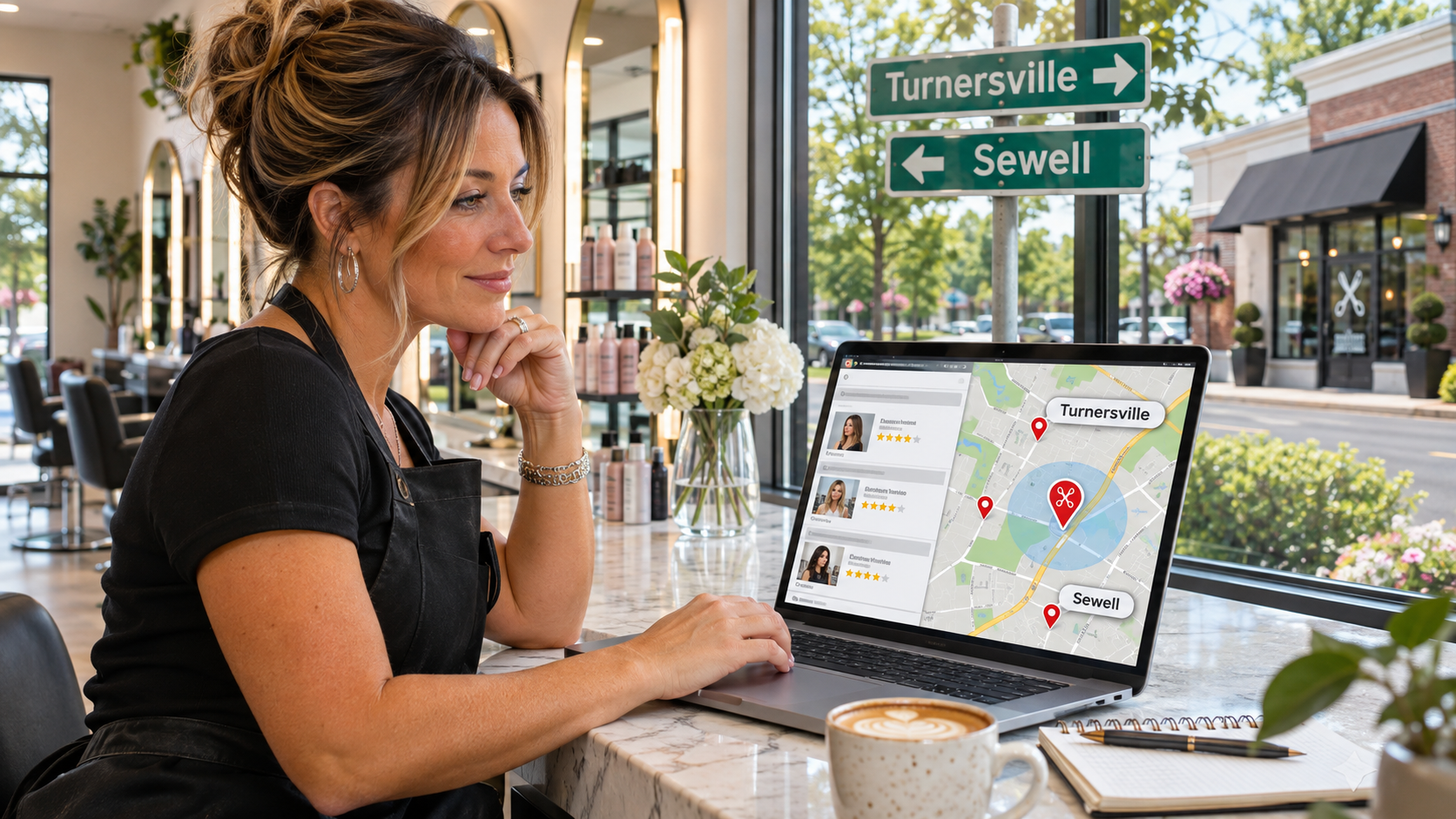
Imagine owning a hair salon in Washington Township, New Jersey.
Your stylists have loyal clients. Your color appointments are consistently popular. Your Instagram account features genuine examples of balayage, highlights, and transformations.
Your Google Business Profile is verified.
Your website looks professional.
But there's something you can't explain.
When someone searches for "hair salon Turnersville NJ," your business doesn't always appear prominently.
Yet when another person searches for "hair salon Sewell NJ," you seem to be more visible.
Or perhaps the opposite happens.
Your salon has a Turnersville address, but potential clients searching from neighborhoods associated with Sewell aren't consistently finding you.
And then there's another complication.
Some of your strongest local competitors use Sewell mailing addresses even though their salons operate within Washington Township.
You begin to wonder:
Does Google prefer salons with a Turnersville address over salons with a Sewell address?
Should you change the city name on your Google Business Profile?
Should your website say Turnersville even if your official mailing address says Sewell?
Do you need separate location pages for both communities?
And is the city name in your address the reason another salon appears above yours?
These are reasonable questions.
But the answers are more complicated than many local SEO sales pitches suggest.
Your salon's actual physical location can influence where you appear in Google Maps. However, changing a legitimate Sewell postal address to Turnersville does not automatically improve your rankings.
Google's published local ranking guidance identifies three main factors: relevance, distance, and prominence.
That means your location matters, but so does how clearly Google understands your services and how your business is represented across the web.
For salons in Turnersville, Sewell, and Washington Township, the distinction between mailing addresses, community names, and actual geographic locations is especially important.
A property can be physically located in Washington Township while using a Sewell mailing address.
Turnersville is a recognized community within Washington Township.
And a customer's idea of what counts as "nearby" may extend across several familiar South Jersey place names.
The right SEO strategy should reflect those realities.
This guide explains how Google evaluates salon locations, why rankings vary between neighborhoods, when address corrections are appropriate, and how a single salon can reach customers searching for both Turnersville and Sewell without creating misleading listings.
We'll also explore salon-specific issues involving Google Business Profile categories, independent stylists, salon suites, location pages, balayage services, online booking, customer reviews, and performance tracking.
The goal isn't simply to appear for more town names.
It's to make your salon easy to find, correctly located on the map, and worth booking for the customers who can realistically visit.
The Short Answer: Your Physical Location Matters More Than Your Preferred City Label
Google doesn't publish a ranking formula showing that the word "Turnersville" is worth more than "Sewell" in a business address.
Its public guidance focuses on broader local ranking considerations.
According to Google's local ranking documentation, local results primarily depend on relevance, distance, and prominence.
For a salon, that translates into three practical questions.
Relevance: Does Google have enough accurate information to understand that your business offers the haircut, balayage, hair extension, or other service the customer wants?
Distance: How far is your actual salon from the customer's search location or the geographic area specified in the query?
Prominence: How well established is your business, based on information such as genuine reviews, relevant links, and its broader public presence?
These factors interact.
A salon that is physically closer to someone searching may have a geographic advantage.
But the nearest salon doesn't automatically rank first.
A more distant business may be more relevant to the particular service, or it may have stronger overall prominence.
What doesn't follow from Google's guidance is the idea that changing a correct postal city creates a new physical location.
If your salon is on Ganttown Road in Washington Township, changing its displayed city name doesn't relocate the building.
If your salon is on Hurffville–Cross Keys Road in Turnersville, changing the wording on your website doesn't move your stylists closer to a customer searching from another neighborhood.
Address accuracy is something you can improve. Physical proximity is a real geographic factor you need to understand.
1. Why Turnersville and Sewell Confuse Salon Owners
The geography is the starting point.
Many South Jersey business owners use familiar community names when describing their locations.
But the municipality, postal designation, and locally recognized community name may not match exactly.
Turnersville is part of Washington Township
Turnersville is an unincorporated community within Washington Township in Gloucester County, New Jersey.
It is a recognized local place name, not a separate incorporated municipality.
Businesses along Route 42, Hurffville–Cross Keys Road, and other nearby roads may describe themselves as being in Turnersville or Washington Township, depending on their actual location and how customers recognize the area.
Sewell is both a community name and a postal designation
Sewell is a recognized community associated with Mantua Township.
But the name also appears in legitimate mailing addresses for properties in neighboring municipalities, including Washington Township.
For example, the Washington Township municipal government has an official address at 523 Egg Harbor Road, Sewell, NJ 08080.
The mailing name doesn't mean the municipal building is located in a different township.
The same distinction can apply to local businesses.
ZIP codes don't simply follow township boundaries
Turnersville-area businesses may use addresses associated with ZIP code 08012, while Sewell addresses commonly use 08080.
However, neither number should be treated as a universal identifier of the municipality in which every property is located.
Postal geography and municipal geography serve different purposes.
Why this matters for salon marketing
A salon owner might see another Washington Township salon using Sewell and conclude that Google views it as being in a completely different market.
That isn't a sound conclusion.
The better question is where the business actually sits on the map and how that location relates to the customer searching.
Ritner Digital explores the broader business issue in Turnersville vs. Sewell: Does Your Business Address Affect How You Rank on Google?.
For salons, that same geographic distinction becomes particularly important because most clients must travel to the actual storefront for their appointments.
2. Two Real Salon Examples Show Why Address Labels Aren't Enough
You can see this geographic complexity in actual Washington Township salon websites.
These examples demonstrate how businesses publicly describe their locations.
They are not a ranking comparison or an assessment of which salon provides better services.
Rizzieri Salon & Spa: Washington Township with a Sewell address
Rizzieri Salon & Spa's Washington Township location page identifies its salon at:
389 Ganttown Road, Sewell, NJ 08080.
The company describes that location as its Washington Township salon.
Its website also includes pages addressing customers researching hair and spa services from both Sewell and Turnersville.
The important point is that the actual salon remains at the same Ganttown Road location.
It doesn't need to pretend that the business operates from a second building merely to describe its relevance to nearby customers.
Rizzieri's public information also provides location-specific services, hours, directions, and appointment instructions.
Lillian James Salon & Spa: A Turnersville address
Lillian James Salon & Spa identifies its location at:
460 Hurffville–Cross Keys Road, Turnersville, NJ 08012.
Its website provides information about hair services, the salon team, color specialties, and appointment options.
The address identifies a different real salon location within the broader Washington Township market.
What these examples actually tell us
One salon publicly uses a Sewell address.
Another uses a Turnersville address.
Both identify real operating locations.
Both serve salon customers in the broader area.
And both give customers online information about their services.
What we cannot conclude from their addresses alone is which salon ranks higher for every search.
That would require a separate, standardized search visibility study across multiple locations, search phrases, and observation periods.
A correct mailing address is not evidence of an SEO problem simply because another salon uses a different local place name.
3. Google Maps Rankings Are Not Assigned Equally Across Washington Township
One of the biggest misconceptions about local SEO is that a business has one permanent ranking for an entire town.
It doesn't work that simply.
A salon might appear prominently when someone searches from near its storefront.
But a customer searching from another part of Washington Township may see different salons.
The result can also change when the searcher uses a different service term.
Consider a hypothetical salon on Egg Harbor Road
Imagine a salon on Egg Harbor Road with an accurate Google Business Profile.
Someone searching nearby for "hair salon near me" may see the business among relevant local options.
Another customer searches for the same phrase from farther away, closer to a different concentration of salons.
The available competitors and distances change.
The first salon may appear less prominently.
That isn't necessarily a sign that its address is wrong.
Google evaluates the location of the search
Google states that distance reflects how far a business is from the customer searching.
When the customer doesn't share their exact location, Google may estimate location using other available information.
This means two customers can enter the same words and see different local results.
Google doesn't publish a guaranteed ranking radius
There is no official rule saying that a hair salon ranks within a certain number of miles if its Business Profile is complete.
Similarly, there is no public Google rule stating that every salon in ZIP code 08080 receives a particular advantage for Sewell searches.
The ranking process is more complex.
What salon owners should do
Instead of asking whether your salon ranks first in Turnersville, ask:
Where is the salon visible?
For which services?
From which search locations?
Against which competing businesses?
And does that visibility result in appropriate appointment inquiries?
Those are much more useful questions.
4. “Hair Salon Turnersville” and “Hair Salon Sewell” Are Different Searches
The city name in a query can influence how Google interprets what the person wants.
Consider these phrases:
"Hair salon Turnersville NJ."
"Hair salon Sewell NJ."
"Hair salon Washington Township NJ."
"Hair salon near me."
"Balayage near me."
"Hair extensions Sewell NJ."
They all relate to salon services.
But they are not identical requests.
A town-modified search
Someone explicitly searching for a salon in Turnersville may be trying to find a business associated with that place.
Google has to interpret the geographic reference alongside the services and businesses available.
A near-me search
Someone typing "hair salon near me" may not mention a community at all.
Their actual or estimated search location becomes especially important.
A service-specific search
A person searching for "balayage Sewell NJ" has a more specific service need than someone searching for a general salon.
A business with clearly described balayage services may be more relevant to that request than one that primarily advertises unrelated treatments.
A branded search
Someone searching for a particular salon's name may already know which business they want.
That is different from trying to discover a new provider.
Why this matters
You shouldn't judge your salon's performance using only one keyword.
A salon can be easy to find for its own name while having limited visibility for new-client service searches.
Or it may rank for a particular color service in ordinary organic search while appearing less often in the Google Maps local pack.
Each situation deserves a different diagnosis.
5. Should You Change Your Google Business Profile From Sewell to Turnersville?
Not merely because you want better rankings.
If your salon has a valid Sewell mailing address, you shouldn't replace it with Turnersville simply because that keyword appears more attractive.
Google's business address documentation requires complete, accurate address information.
The business must represent its real location.
First, verify the address
Check the salon's actual street address and suite information.
Use reliable business records and USPS address lookup where appropriate.
Confirm that the postal information is valid for the specific property.
Second, inspect the map pin
Open the salon's Google Business Profile and examine the displayed location.
Does the pin accurately identify the business?
Will customers following directions arrive at the correct building?
If the salon is inside a shopping center or suite building, is the destination understandable?
Third, correct only genuine errors
If Google has the wrong street number or unit, use the official editing process.
If the pin has been placed incorrectly, Google provides tools to adjust it to the actual business location.
But don't move the pin closer to the center of Turnersville simply because you hope to increase Maps visibility.
Fourth, explain local geography on the website
If your salon has a Sewell mailing address within Washington Township, you can explain that naturally.
For example, a hypothetical business might state:
"Our salon is located on Egg Harbor Road in Washington Township, with a Sewell mailing address. We welcome clients from Turnersville and surrounding Gloucester County communities."
This is useful context.
It doesn't misrepresent the actual location.
Fifth, review what customers experience
If customers are reaching the right building and the address is valid, the problem may not be the postal city.
It could involve service relevance, local competition, website content, or ordinary proximity differences.
Don't change accurate data before investigating those possibilities.
6. Your Map Pin Matters More Than a Cosmetic Address Change
For a salon, the map pin has an obvious practical purpose.
Customers need to arrive at the right place.
If your business occupies a salon suite, they may need to know the building and suite number.
If you operate inside a larger commercial center, visitors may need information about the entrance or parking.
A bad pin can cause real confusion
Imagine a first-time client arriving for a lengthy color appointment.
Google directions lead to the opposite side of the shopping center.
The customer can't find the salon.
They call for help.
Their appointment begins late.
That is a customer experience problem worth correcting.
Google provides an address and pin editing process
Through the Business Profile, owners can review their location information and use the supported pin adjustment tools where necessary.
Google may review changes before publishing them.
Certain edits may require further verification.
Correcting a pin isn't a guaranteed ranking improvement
An accurate pin helps communicate the actual location.
But there is no reason to promise that adjusting a misplaced pin will automatically move the salon into the top three results for "balayage Turnersville NJ."
The purpose of the correction is truthfulness and navigation.
Any effect on visibility should be evaluated separately.
7. Salon Suites Create Additional Local SEO Questions
Washington Township has beauty professionals operating in traditional salons, smaller studios, and shared suite environments.
These arrangements can create legitimate questions about Google Business Profile eligibility.
Suppose several independent stylists operate inside one suite building.
Should each have a separate Google listing?
What if two stylists share a room?
What if someone rents a chair inside an established salon?
There isn't one universal answer.
Google distinguishes real businesses from duplicate listings
Its business representation guidelines include requirements for actual business locations and separate guidance for individual practitioners.
A business must be eligible.
Simply renting space does not automatically mean every stylist qualifies for a separate listing.
Consider the real operating structure
Does the stylist operate a genuinely distinct business?
How is that business represented publicly?
Is the location appropriately staffed and identifiable?
Does it meet the relevant signage and customer-facing requirements?
Is the listing likely to duplicate an existing operation?
These details matter.
A suite number should be accurate
Where appropriate, include the legitimate unit information in the address.
Don't invent a different street address or move the map pin to another part of the property.
Don't create multiple listings just to target services
A salon shouldn't create a separate fake business for balayage, extensions, blonding, and haircuts.
Those are services, not automatically separate business entities.
The practical lesson
Salon-suite SEO should begin with eligibility and accurate business representation.
It shouldn't begin with how many additional Google Maps listings can be created.
8. Does Your Salon Need a Separate Profile for Turnersville and Sewell?
For one ordinary salon operating from one eligible storefront, generally not.
The same business should not create duplicate Google Business Profiles simply because clients use different town names.
For example, a hypothetical hair salon located on one Washington Township street shouldn't create:
"Example Salon Turnersville"
and
"Example Salon Sewell"
as two separate profiles representing the same operation.
Google's rules restrict duplicate profiles.
What if the business genuinely has two salons?
A company with two distinct eligible locations may qualify for a separate Business Profile for each.
Those profiles should contain their own correct addresses, hours, contact details, and relevant information.
What if the salon serves customers from several towns?
A salon can welcome customers from multiple communities without maintaining an office in each one.
The website can describe that reach accurately.
What if the owner provides mobile bridal styling?
That may introduce a service-area or hybrid business question depending on the operating model.
Google's requirements distinguish storefront businesses, service-area businesses, and eligible hybrid operations.
The right setup should reflect where the business actually serves customers.
Don't use service areas as a ranking trick
Adding extra geographic areas to a profile doesn't create new physical locations.
Google does not promise that every service-area entry becomes a new Maps ranking center.
For a salon where customers visit the storefront, the real address remains central.
9. Can a Sewell Salon Rank for Turnersville Searches Without Moving?
Potentially, yes.
A salon with a Sewell mailing address can still be relevant to customers searching for services in the broader Washington Township market.
But visibility isn't guaranteed.
The business must compete with other eligible salons, and its actual location still matters.
Start with clear services
Make sure the Google Business Profile accurately identifies what your salon offers.
Google's Services editor documentation explains how eligible businesses can list their offerings.
A salon may want to describe genuine services such as:
Haircuts.
Balayage.
Hair highlights.
Custom hair color.
Hair extensions.
Blowouts.
Bridal styling.
Color consultations.
Only include services actually provided.
Improve the website
A page explaining balayage at your Washington Township salon may be useful to someone searching from Turnersville.
The content should describe the service and booking process rather than repeat the town name.
Communicate the location clearly
A contact page can explain that the salon is in Washington Township, has a Sewell mailing address, and welcomes customers from nearby communities.
All those statements must be accurate for the specific business.
Develop a genuine reputation
Customer reviews, appropriate local mentions, and a professional online presence can help customers evaluate the salon.
Google also identifies reviews and relevant links among the information contributing to local prominence.
Understand the limitation
The physical distance between a salon and a searcher isn't something an SEO agency can simply erase.
Improving relevance and prominence can be worthwhile, but it doesn't guarantee visibility in every neighborhood.
10. Can a Turnersville Salon Rank for Sewell Searches?
The same principle applies in reverse.
A salon with a legitimate Turnersville address may attract customers from areas that use Sewell addresses.
A visitor may be willing to travel for a specific stylist, service, or consultation.
But the company should not falsely claim that it operates a Sewell storefront.
Focus on the real customer need
Someone searching for a routine haircut may prioritize convenience.
Someone researching a specialty color service may compare portfolios and expertise across a broader area.
These are possibilities, not universal rules about salon customer behavior.
Create useful service content
A salon offering extensions can explain the available methods, consultations, and appointment requirements.
A salon offering balayage can provide genuine portfolio examples and relevant pricing information.
Explain where customers visit
The website should provide the real location and useful directions.
Monitor demand
Look at where actual appointment inquiries originate when reliable business records are available.
If customers from Sewell regularly travel to your Turnersville salon, that is useful information for marketing decisions.
If they don't, investigate why before investing heavily in geographic content or advertising.
11. Google Maps Rankings and Organic Website Rankings Are Different Opportunities
A salon owner may be disappointed because their Google Business Profile isn't in the local pack for a particular search.
But that doesn't necessarily mean the salon website has no opportunity to reach those customers.
Google Search can display traditional organic results alongside local businesses.
Google Maps results emphasize local businesses
The actual location is an important factor.
A salon physically farther from the searcher may face stronger competition from closer salons.
Organic results feature individual website pages
A relevant, accessible service page may appear for a search even when the corresponding salon doesn't dominate nearby Maps results.
For example, someone might find an informative balayage page while researching color services in Washington Township.
The website still needs to be competitive
A relevant page doesn't automatically rank because it includes a town name.
Google's SEO Starter Guide emphasizes useful content, logical site structure, and accessibility.
Measure the channels separately
Google Business Profile performance and Search Console answer different questions.
A website click isn't the same as a completed booking.
A Maps appearance isn't the same as an organic website ranking.
And a branded search isn't the same as a new customer discovering a salon for the first time.
The strategic takeaway
Don't make every salon SEO decision based on one map-pack screenshot.
Evaluate where customers discover the business and what happens after they find it.
12. Should Your Website Have a Turnersville Page and a Sewell Page?
Sometimes separate geographic pages are appropriate.
Sometimes they're unnecessary.
The decision should be based on customer value, not keyword volume alone.
For a single-location salon
A clear location page may be sufficient.
It can include:
The actual address.
Directions.
Parking information.
Services available.
Stylist information.
Hours.
Online booking or consultation instructions.
And natural references to nearby communities.
When a nearby-town page may provide value
Suppose your salon has a genuine reason to explain how customers from Turnersville can reach its Sewell-addressed location.
A dedicated directions or local service page might provide helpful context.
Rizzieri, for example, publishes publicly accessible pages relating to its Washington Township salon's accessibility from both Sewell and Turnersville.
The underlying salon location remains the same.
This demonstrates one way to organize information for customers who use different place names.
It does not prove that every salon needs equivalent pages.
Avoid copying the same page twice
If your Turnersville page and Sewell page contain identical information except for the town name, ask whether both pages are genuinely useful.
Google's search spam policies address doorway abuse, including substantially similar geographic pages that funnel visitors toward the same destination.
A better starting point
For many salons, strengthen one primary location page and the main service pages first.
Publish additional geographic content only when it adds distinct, accurate information for customers.
13. Build Salon Service Pages Around What Customers Actually Search For
A salon's address is only one part of its local relevance.
The services it offers are just as important.
Consider someone searching for "balayage near me."
They aren't necessarily looking for the nearest business offering any beauty treatment.
They want information about a particular color service.
Explain important specialties
If your salon offers balayage, develop useful information about the actual process.
Explain consultation requirements.
Identify relevant stylist expertise.
Share authentic portfolio examples with permission.
Make the booking process understandable.
Don't treat every search variation as a new location
"Balayage Turnersville."
"Balayage Sewell."
"Balayage Washington Township."
These might relate to the same salon and service.
You usually don't need three nearly identical pages for them.
Use natural geographic context
Your primary service page may identify the actual salon location and mention nearby communities where appropriate.
But the content's main purpose should remain explaining the service.
Connect services to appropriate stylists
A customer may want to know who performs color corrections, extensions, or other specialized work.
Provide accurate information about the professionals and their actual services.
Keep the next step clear
For a complex color service, the salon may require a consultation.
That's appropriate if it reflects the actual booking process.
Don't force every visitor through a generic appointment menu that doesn't explain what to choose.
14. Online Booking Can Matter More Than a Minor Ranking Difference
Imagine two salons that are both relevant to a customer's search.
The customer visits the first website.
They like the work but can't determine how to book a first-time color consultation.
Then they visit the second salon's site.
It clearly explains the service, identifies the location, and provides the correct appointment instructions.
The second experience may be more convenient.
That doesn't prove the customer will book there.
But it highlights a point salon owners sometimes overlook.
Search visibility is useful only when people can take an appropriate next step.
Check the Google appointment link
Google supports appointment links for eligible businesses.
Its local business links guidance explains how supported links work.
Review the destination
A multi-location salon shouldn't accidentally direct every customer to the wrong branch.
A single-location salon should make the correct location obvious.
Explain consultation rules
Some hair color services may need a telephone consultation or assessment before an appointment is confirmed.
State that clearly.
Test the full journey
A person who clicks a booking link hasn't necessarily completed an appointment.
Confirm that requests reach the appropriate system and that customers receive correct confirmations.
Track actual appointments
Where the software permits, review confirmed and completed bookings rather than treating all booking-link clicks as new clients.
15. Reviews Can Strengthen Trust, but They Don't Relocate Your Salon
Customer reviews can be valuable.
A potential client may want to hear about the consultation experience, service quality, staff communication, or overall atmosphere.
Google also identifies reviews among the information contributing to local prominence.
But reviews aren't a guaranteed way to overcome distance.
There is no public review-count formula
Google doesn't publish a rule stating that a salon with a particular number of reviews will outrank another salon a certain distance away.
Ranking involves multiple considerations.
Ask for genuine feedback
Use Google's official review request link or QR code where appropriate.
Invite clients to share their actual experiences.
Don't manipulate the content
Google's review policies prohibit incentives, fake engagement, selective positive solicitation, and pressuring customers to include specific wording.
Don't tell clients to mention "best balayage in Sewell" because you hope it will improve rankings.
Respond professionally
Acknowledge customer feedback where appropriate.
Avoid disclosing private appointment information in public responses.
Think of reviews as reputation, not a shortcut
A strong reputation may help a customer feel comfortable traveling farther for a salon.
But that's a customer decision.
It isn't proof that Google will treat the salon as physically closer.
16. What About Salon Photos, Local Citations, and Backlinks?
These elements can support a salon's broader digital presence.
But they should be handled realistically.
Authentic salon photographs
Photographs can help potential clients understand the atmosphere and the work.
They should represent the actual salon and services.
Obtain appropriate permission before featuring identifiable clients.
Accurate third-party listings
A salon may appear on appointment platforms, directories, social networks, and local business websites.
Check important sources for accurate business identity and contact information.
Minor formatting differences aren't automatically an SEO crisis
An abbreviated street designation isn't necessarily proof of a serious ranking problem.
Focus on discrepancies that could misidentify the business, misdirect customers, or create genuine confusion.
Legitimate backlinks
A relevant publication or local organization may link to the salon.
Those links may help customers discover the company.
But buying links intended to manipulate search rankings can violate Google's spam policies.
Community involvement
Genuine partnerships and local participation can create awareness.
They don't guarantee backlinks or higher rankings.
Don't buy directory volume
Submitting the salon to hundreds of unrelated websites isn't necessarily useful.
Prioritize relevant places where customers actually look for businesses.
17. Could LocalBusiness Schema Help Google Understand the Address?
Structured data is a standardized way to provide information about a web page and business.
Google publishes LocalBusiness structured data guidance.
For a legitimate salon location, appropriate markup can describe information such as the actual business name, address, telephone number, and hours.
Schema should describe reality
Don't mark up a fictional Sewell branch for a salon that only operates in Turnersville.
Don't create multiple fake business entities because you want to rank for additional place names.
Match the visible address
The structured data should be consistent with the legitimate information customers see.
Don't expect schema to override proximity
Adding a geographic term to structured data doesn't physically move the business.
Google doesn't promise improved Maps placement from inserting more town names into markup.
Validate the implementation
Use suitable testing tools to check whether the data is implemented correctly.
Focus on customer value
Structured data can support clearer machine-readable information.
But useful service pages, accurate addresses, and working booking systems remain essential.
18. How to Test Whether Geography Is Really the Problem
A reliable local SEO diagnosis should compare several search contexts.
A single search from your salon reception desk isn't enough.
Start with branded searches
Search for the salon's exact name.
Does the correct Google Business Profile appear?
Is the address accurate?
Do the phone number and directions work?
If the business is difficult to find by its exact name, investigate that separately from competitive service keywords.
Check the actual location
Confirm the official address and map pin.
Verify that the physical operation matches what the profile represents.
Choose a small set of relevant queries
For example, a hypothetical salon might investigate:
"Hair salon Turnersville NJ."
"Hair salon Sewell NJ."
"Balayage near me."
"Hair extensions Washington Township."
"Hair color specialist Sewell."
Only test services the salon actually provides.
Observe multiple real search locations
Evaluate representative points near the salon and in nearby customer markets.
Document the query, location, date, search surface, and results.
If a third-party geo-grid tool is used, treat the data as a series of local search observations.
It is not an official Google ranking score.
Separate Google Maps from organic results
Record the map-pack observations independently from the website's organic visibility.
Use Search Console for website performance
Review relevant search queries, page impressions, and clicks.
Don't assume that someone searching for "Sewell" is necessarily physically located in Sewell.
Review booking outcomes
Check actual appointment records where available.
A salon may gain visibility without attracting additional bookings.
That is a reason to investigate the customer journey, not automatically spend more on ranking reports.
19. How to Interpret a Local SEO Geo-Grid
Some marketing agencies use a geo-grid to visualize rankings from multiple locations.
The report may show a series of points around the salon.
Different points may indicate different observed positions for a particular query.
This can be useful.
But it is also easy to overinterpret.
A grid measures selected locations
It doesn't establish how every person in Washington Township sees Google.
Rankings can vary over time
Google results may change with the search context, business information, and competition.
A colored square isn't a customer
A favorable ranking observation doesn't automatically represent a person who wants to book.
Not every keyword is equally valuable
Ranking for a general salon term may be useful.
But a specific service query may better match a salon's most important offerings.
Avoid unsupported scoring systems
An agency may create a proprietary visibility score.
That can help organize observations, but it should not be confused with an official Google metric.
Ask for transparent measurement
A useful geo-grid report identifies the queries, observation points, date, and method.
It should also explain the limitations.
The purpose of geographic ranking analysis is to guide decisions, not to produce an impressive-looking map of colored boxes.
20. How to Decide Whether to Target More Sewell or Turnersville Clients
The best geographic strategy depends on actual business goals.
A salon shouldn't automatically divide its marketing budget evenly between the two place names.
Review where current clients come from
If appropriate, examine available booking records.
Where do new clients live or work?
How often do people travel from nearby communities?
Are they booking high-value color services or shorter appointments?
Consider stylist availability
A salon with limited color appointment capacity may not benefit from aggressively expanding demand for that service.
Review actual service economics
A lengthy color appointment has different costs and scheduling requirements from a basic haircut.
The most valuable inquiry isn't necessarily the one closest to the salon.
Evaluate the search opportunity
Use legitimate keyword research and current performance data.
Avoid inventing local monthly search volumes or assuming one town has greater demand without evidence.
Measure appointment quality
How many new clients book?
How many attend?
How many return?
Don't let one ranking decide the budget
A salon may have weaker visibility for one geographic keyword but already receive substantial qualified bookings through referrals, brand searches, and other services.
The objective is sustainable salon business, not winning every keyword comparison.
21. A 30-Day Turnersville–Sewell Salon Visibility Audit
If your salon's geographic rankings seem inconsistent, begin with a focused diagnostic process.
Week One: Verify location information
Confirm the real street address, valid postal details, and actual municipal location.
Inspect the Google Business Profile.
Check the map pin and suite information.
Verify directions from relevant approaches.
Resolve genuine errors through Google's official tools.
Goal: Establish an accurate geographic foundation.
Week Two: Review services and local relevance
Check the primary business category.
Review the Services editor.
Confirm that important color, styling, and treatment offerings are represented accurately.
Examine the website's main service pages.
Identify where local information could help customers without becoming repetitive.
Goal: Make the salon's offerings clear.
Week Three: Test customer discovery and booking
Compare representative searches from several relevant locations.
Record Google Maps and organic results separately.
Test the website on mobile.
Check appointment and telephone links.
Review the actual consultation process for complex services.
Goal: Understand the journey from search to appointment request.
Week Four: Evaluate and prioritize
Review Search Console and available Business Profile performance information.
Compare those findings with booking records.
Identify the most meaningful obstacles.
Create a prioritized list of improvements.
Goal: Make decisions based on evidence rather than address-name assumptions.
Thirty days can be enough to identify and correct important problems.
It doesn't guarantee a new Maps ranking or a particular number of appointments.
22. What Should a Salon SEO Agency Actually Do?
If you hire an SEO agency, the work should go beyond telling you to replace one town name with another.
A credible local SEO engagement should explain the actual problem.
Review the business's real location
Confirm eligibility, address accuracy, and map pin placement.
Evaluate Google Business Profile information
Review appropriate categories, services, contact details, hours, photographs, and booking links.
Analyze geographic visibility
Compare relevant search queries from locations that reflect the salon's real customer market.
Examine the website
Look at service pages, technical accessibility, navigation, and location information.
Test booking
Identify unnecessary obstacles between a customer discovering a service and booking it.
Review reputation practices
Ensure that review requests comply with Google policy.
Define meaningful metrics
A salon should understand search visibility, relevant inquiries, confirmed appointments, and completed services where the systems permit.
Explain the limitations
No agency controls Google's exact ranking algorithm.
And no agency can guarantee that a salon will appear first for every "near me" search in both Turnersville and Sewell.
Keep ownership clear
The salon should retain appropriate ownership or control of its Business Profile, domain, website, and customer data.
A marketing provider should use authorized access rather than claiming control of business assets.
How Ritner Digital Can Help Turnersville and Sewell Salons Understand Their Geographic Visibility
Ritner Digital is an independent SEO and AI search marketing practice based in Philadelphia.
Its services include local SEO, website optimization, content strategy, Google visibility research, and conversion-related improvements.
For a salon in Washington Township, the appropriate strategy depends on the real location and customer journey.
A salon might have perfectly accurate address information but weak service pages.
Another may have clear services but an incorrectly placed map pin.
Another may rank well near its storefront but less prominently from a neighboring area.
And a salon with useful search visibility may still lose interested customers because its booking process is confusing.
These are different problems.
They shouldn't all receive the same solution.
Related Ritner Digital resources
Turnersville vs. Sewell: Does Your Business Address Affect How You Rank on Google?
A broader guide to postal geography, physical business location, and address accuracy.
Why Your Turnersville Business Shows Up on Google in One Neighborhood but Disappears in Another
Explains how proximity, relevance, and prominence can produce different Maps results within a small geographic area.
Covers real salon locations, local SEO, service content, online booking, reviews, and marketing measurement.
The Website Audit We'd Run on Every Washington Township, NJ Small Business
Provides a framework for evaluating technical SEO, Business Profiles, content, and customer inquiry pathways.
These resources illustrate Ritner Digital's published approach.
They are not verified claims that a particular salon received a guaranteed ranking or booking increase.
What a salon-specific review could produce
Depending on the business, an appropriate engagement may identify:
An inaccurate Business Profile address.
A map pin that needs correction.
Weak or missing service descriptions.
Limited organic visibility for important treatments.
Unclear geographic information.
A difficult appointment process.
Or misleading reporting that focuses only on rankings.
The objective should be to identify which factors are reasonably within the business's control and prioritize improvements that help real customers.
Contact Ritner Digital to discuss your Turnersville or Sewell salon's local search visibility.
Frequently Asked Questions
1. Does a Sewell address hurt my salon's rankings in Turnersville?
Not automatically.
A legitimate Sewell mailing address can belong to a salon physically located within Washington Township.
Google's local ranking guidance emphasizes relevance, distance, and prominence.
The city label alone doesn't establish that the salon is at a geographic disadvantage.
2. Is Turnersville the same as Washington Township?
Turnersville is a recognized community within Washington Township in Gloucester County.
Washington Township is the municipality.
The names can overlap in everyday local usage, but they aren't identical administrative or postal designations.
3. Is Sewell part of Washington Township?
Sewell is a community associated with Mantua Township, but Sewell mailing addresses are also used by properties in Washington Township.
The actual municipal location of a salon should be confirmed using its specific street address.
4. Should I change Sewell to Turnersville on my Google Business Profile?
Not simply to improve SEO.
Use the legitimate address for the salon's actual location.
If the information is genuinely incorrect, follow Google's official correction process.
Don't substitute a preferred marketing location for the real address.
5. Does Google rank salons based on ZIP codes?
Google hasn't published a simple ZIP-code ranking formula.
Its stated local factors include relevance, distance, and prominence.
Postal codes are part of address information, but a ZIP code doesn't guarantee ranking throughout its entire area.
6. Can a Turnersville salon rank for Sewell hair salon searches?
Potentially.
A salon may be relevant to customers in neighboring communities.
However, its physical location, the searcher's location, service relevance, and competition can influence visibility.
7. Can a Sewell salon rank for balayage searches in Turnersville?
Potentially.
Accurate balayage service information and useful website content may support relevance.
But geographic distance and other ranking factors still apply.
There is no guaranteed placement.
8. Should I create two Google Business Profiles for one salon?
Generally not.
A single eligible salon location ordinarily should not be represented by duplicate profiles solely to target different town names.
Separate profiles require genuine eligibility and distinct business operations where applicable.
9. What if my salon is inside a suite building?
Use the real location and appropriate suite information.
Whether an individual stylist or suite-based business qualifies for a separate profile depends on Google's eligibility requirements and the actual operating arrangement.
10. Does changing my Google Maps pin improve rankings?
Correcting an inaccurate pin is important for business accuracy and customer directions.
But deliberately moving the pin away from the real location is misleading.
A ranking improvement isn't guaranteed simply because the pin is corrected.
11. Should I create separate Turnersville and Sewell pages on my website?
Only if both pages provide meaningful distinct value.
For many single-location salons, a clear location page and useful service pages may be sufficient.
Avoid near-identical geographic pages created primarily to capture keywords.
12. Does adding nearby towns as service areas make my salon rank there?
Not automatically.
Google's service-area settings communicate where eligible businesses operate.
They don't guarantee local pack visibility in every selected town.
An ordinary storefront salon should use the profile configuration that accurately reflects its operations.
13. Why does my Maps ranking change when I drive a few miles?
Google's local results depend partly on the location used for the search.
As that location changes, the distance to your salon and the nearby competitors may change.
The search phrase and other context also matter.
14. Can better Google reviews overcome distance?
Genuine reviews can support customer trust and may contribute to local prominence.
But Google doesn't publish a formula proving that reviews consistently outweigh proximity.
Don't treat review collection as a substitute for geographic reality.
15. Are organic website rankings different from Google Maps rankings?
Yes.
Google Maps emphasizes local business discovery and geographic context.
Organic results feature individual web pages.
A salon may have opportunities through both, but performance should be evaluated separately.
16. How do I check whether my salon ranks in both areas?
Use representative searches from relevant locations and record the exact query, observation point, date, and search surface.
Where appropriate, a local rank-tracking tool can help identify patterns.
One manual search isn't a complete regional visibility test.
17. How much should I spend trying to rank in both Turnersville and Sewell?
There is no universal amount.
The appropriate budget depends on the salon's existing visibility, service profitability, appointment capacity, geographic customer demand, and required work.
Fix genuine address and booking problems before investing heavily in broader campaigns.
18. Can Ritner Digital help with geographic SEO for my salon?
Ritner Digital offers local SEO, website, content, and digital visibility services.
A salon-specific project could investigate Google Business Profile accuracy, geographic visibility, service pages, technical issues, and booking pathways.
The results and scope would depend on the business's actual circumstances.
Final Thoughts: Your Salon's Location Is Real. Your SEO Strategy Should Be Too.
Turnersville and Sewell may appear to be competing address labels.
But for salon owners in Washington Township, the important question isn't which place name sounds better in a Google listing.
It's where the salon actually operates.
How Google understands that real location.
Which services the business genuinely offers.
Where interested customers are searching from.
And whether those customers have a convenient way to book.
A Sewell mailing address doesn't automatically prevent a Washington Township salon from reaching Turnersville customers.
A Turnersville address doesn't guarantee that the salon will dominate every Sewell search.
And changing an accurate postal city doesn't relocate a salon closer to the people searching.
What business owners can do is maintain accurate address information, review the map pin, explain local geography clearly, improve service relevance, develop a genuine reputation, and make booking convenient.
They can also use proper search and appointment data to determine whether geographic visibility is creating real business opportunities.
Your goal shouldn't be to convince Google that your salon is located somewhere else. It should be to help the right clients find the salon where you actually do your best work.
Want to Know Why Your Salon Ranks Differently in Turnersville and Sewell?
Maybe your salon has a Sewell address but you want to attract more Turnersville clients.
Maybe your Google Business Profile appears prominently near your storefront but disappears in other parts of Washington Township.
Or perhaps your salon has excellent colorists and strong customer relationships, but your local search visibility doesn't reflect your service offerings.
Those situations deserve an evidence-based assessment.
Ritner Digital helps businesses improve local SEO, Google Business Profile information, website content, search visibility, and customer conversion pathways.
For a salon, a useful review can begin with the real address, actual map pin, relevant search terms, service pages, and online booking experience.
No fabricated locations.
No manipulative review strategies.
And no guaranteed top-three Google Maps placement.
Just a practical approach to understanding where your salon is visible and what can reasonably be improved.