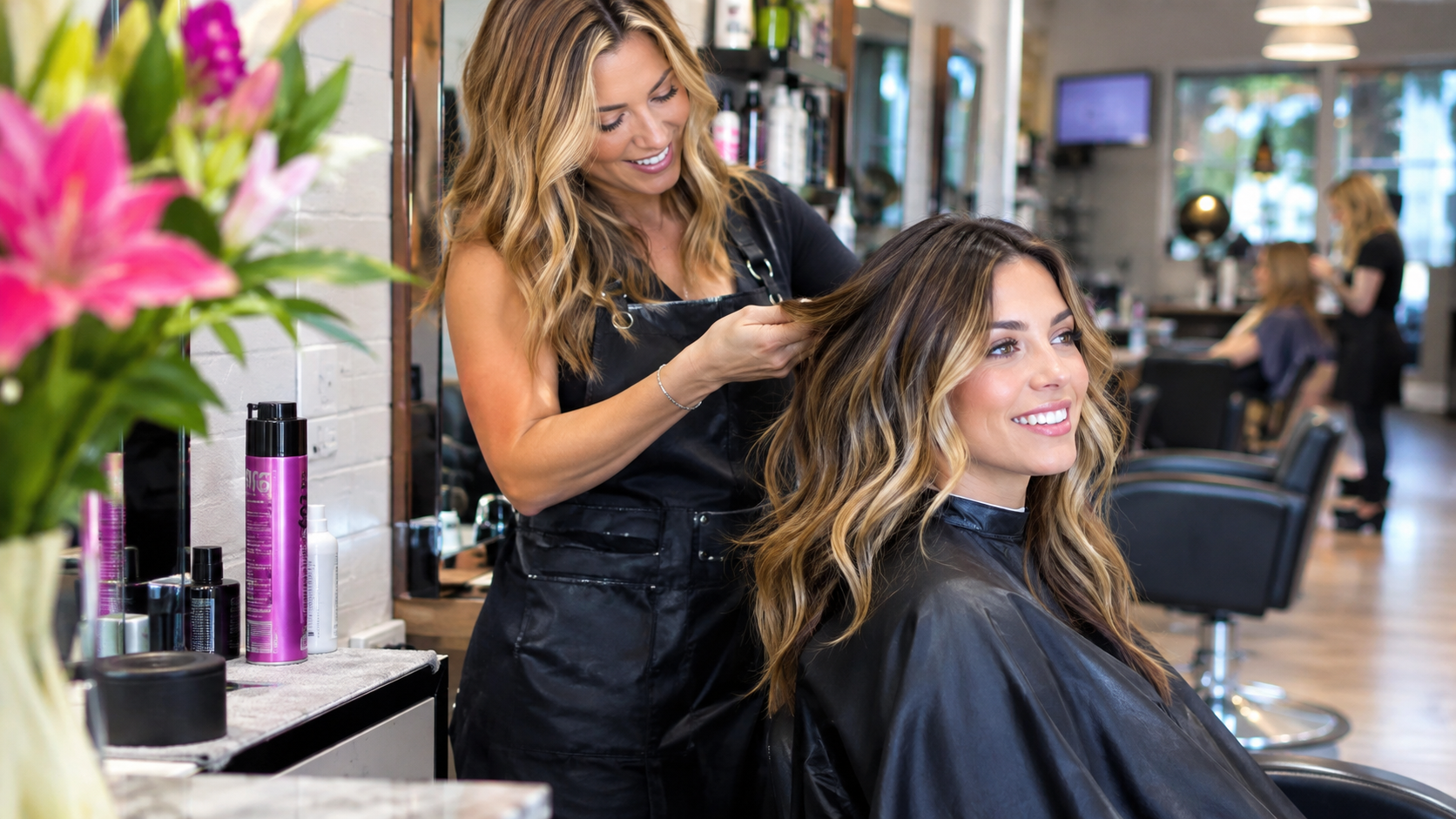
Your salon could have talented stylists, beautiful color work, excellent client relationships, and a loyal customer base.
But when someone in Washington Township searches Google for "hair salon near me," your business might not be one of the first options they see.
The same thing can happen with more specific searches.
"Balayage Turnersville NJ."
"Hair color specialist Sewell."
"Women's haircut Washington Township."
"Hair extensions near me."
"Blowout salon Gloucester County."
You may offer exactly what the customer wants.
But if your Google Business Profile doesn't communicate that clearly, potential clients may discover another salon first.
And even if someone does find your business, an outdated appointment link, incorrect hours, or incomplete service information can make it harder for them to book.
For salons in Turnersville, Sewell, and Washington Township, New Jersey, Google Business Profile is more than a digital business listing.
It's a place where prospective clients may first encounter your salon, evaluate your reputation, see your work, check your location, and decide whether to contact you.
A properly maintained Google Business Profile helps customers understand what your salon offers and makes it easier for interested people to take the next step.
That doesn't mean every optimization will improve your rankings.
Google's local search results depend on multiple factors, including relevance, distance, and prominence.
No salon can guarantee the first Maps position simply by completing a checklist.
But business owners can control the accuracy and usefulness of much of the information they publish.
And that's where a practical local SEO plan should begin.
This guide provides a comprehensive 2027 Google Business Profile checklist for Washington Township hair salons.
We'll cover everything from ownership verification and business categories to services, photographs, booking links, customer reviews, business hours, website connections, and performance measurement.
We'll also explain how salons can improve visibility for individual services such as balayage without keyword-stuffing their business names or creating fake locations in neighboring towns.
Finally, we'll outline a 30-day optimization plan and a maintenance schedule for the rest of 2027.
This article was prepared in November 2026 for businesses planning the coming year. Platform features and interface labels can change, so salon owners should check Google's linked documentation when making updates.
The objective is straightforward.
Make your real salon easier to discover, easier to evaluate, and easier to book.
Why Google Business Profile Matters for Washington Township Salons
A salon customer's decision doesn't always begin on Instagram or a booking app.
Sometimes it starts with Google.
A person may be new to the area.
They may be dissatisfied with their current salon.
They may need a particular color service.
Or they may have received a recommendation and want to verify the business before scheduling.
Google can display a salon's Business Profile directly within Search and Maps.
Depending on the profile and available features, customers may see its location, business hours, telephone number, website, photographs, services, reviews, and appointment links.
That creates several opportunities to help a customer.
Discovery
A person searching for a local hair salon may encounter a business they didn't previously know.
Verification
Someone who received a referral may use Google to confirm the salon's address, hours, and identity.
Evaluation
Customer reviews, service information, photographs, and the website may help a potential client determine whether the salon fits their needs.
Action
A visitor may call, open the website, request directions, or use an available appointment link.
These are different stages of the customer journey.
A profile that makes the salon visible but provides a confusing booking path may not be achieving its full practical value.
Before the Checklist: Understand How Google Ranks Local Salons
Google identifies three primary considerations in local search:
Relevance: How well the business matches what someone searches for.
Distance: How far the business is from the searcher's location or the place involved in the search.
Prominence: How established or well-known the business is based on available information, including relevant links and reviews.
These factors are described in Google's official local ranking guidance.
For salon owners, this means two things.
First, accurate service and business information can help Google understand what your salon provides.
Second, a complete profile doesn't remove the effect of physical location.
A salon on Hurffville–Cross Keys Road may appear differently from another salon on Ganttown Road depending on where the person searches.
A customer in Glassboro may see different results from someone searching in Turnersville.
And a customer using "balayage near me" may encounter a different competitive mix from someone searching for a general haircut.
Google Business Profile optimization improves the quality and accuracy of your local presence. It does not purchase, force, or guarantee specific rankings.
With that distinction established, here's the checklist.
Part One: Get Your Salon's Business Identity Right
Checklist Item 1: Claim and Verify Your Google Business Profile
Before optimizing the profile, confirm that the business controls it.
Google permits eligible business owners and authorized representatives to claim and verify their profiles.
Start by searching for your salon's actual name on Google.
Check whether a Business Profile already exists.
If the profile is unclaimed, follow Google's process to request management access.
If another person already controls it, use the appropriate ownership request process rather than creating a duplicate.
Google's verification guidance explains the supported methods.
The verification options offered to each business can differ.
Google may require video verification or other evidence, depending on the situation.
Why this matters
A profile that hasn't been properly verified may limit your ability to manage its information and respond to customer needs.
It can also create problems when an agency or former employee controls the only account with access.
Your action steps
Confirm that the correct salon profile exists.
Check whether it is verified.
Confirm that the current business owner has appropriate access.
Resolve duplicate or ownership problems through Google's official process.
Checklist Item 2: Review Profile Ownership and Manager Access
A salon's Google Business Profile is an important business asset.
It shouldn't depend on a former employee's personal account.
It also shouldn't be controlled exclusively by a marketing agency.
Google allows profile owners to assign appropriate manager access.
Its owner and manager documentation explains the different permissions.
The salon should retain control of its primary ownership.
Agencies and employees can receive the access needed to perform approved work without sharing passwords.
Why this matters
If the salon changes marketing providers, ownership shouldn't become a dispute.
A business should be able to continue updating its profile, handling reviews, and managing appointments.
Your action steps
Confirm the primary owner is appropriate.
Review current owners and managers.
Remove access that is no longer authorized.
Give external marketing partners appropriate permissions instead of passwords.
Checklist Item 3: Use Your Salon's Real Business Name
Google requires a Business Profile name to reflect the company's real-world name.
That means the name should match how the business is identified through its signage, website, and legitimate branding.
Suppose a hypothetical salon is named "Willow Hair Studio."
Its Google listing shouldn't become:
"Willow Hair Studio Best Balayage Hair Salon Turnersville Sewell NJ"
just because those are desirable search phrases.
Google's business representation guidelines prohibit unnecessary keyword additions to business names.
What to do instead
Use the real salon name.
Communicate services through the Services section.
Explain location and offerings in the relevant profile fields and website content.
Your action steps
Match the salon's legitimate real-world name.
Remove unsupported keywords or service phrases from the name.
Ensure the name is consistent across important business information sources.
Checklist Item 4: Confirm the Actual Address and Map Pin
Washington Township has a geographic detail that can confuse both customers and salon owners.
Turnersville is a community within Washington Township in Gloucester County.
Many businesses in the township use Sewell mailing addresses.
Other local postal designations may also differ from the municipality.
That doesn't mean a business should choose whichever town name seems most attractive for SEO.
The correct approach is to use the real business address.
If you operate a storefront, make sure the address and map pin lead customers to the correct entrance or location.
If your salon moved, review the updated information carefully.
Google may require re-verification after certain changes.
Ritner Digital discusses this geographic issue in:
Turnersville vs. Sewell: Does Your Business Address Affect How You Rank on Google?
Your action steps
Confirm the actual street address and appropriate suite information.
Check the map pin.
Verify that directions lead customers to the right place.
Use the correct legitimate postal information.
Never substitute an invented location to target a different town.
Checklist Item 5: Don't Create Duplicate Profiles for Nearby Towns
A salon may attract clients from Turnersville, Sewell, Sicklerville, Glassboro, Deptford, and Williamstown.
That doesn't mean it should create a different Google Business Profile for each area.
Google generally permits one Business Profile per eligible business location.
Separate legitimate businesses or qualifying locations may have their own profiles under applicable rules.
But a single storefront shouldn't manufacture additional branches.
What about salon suites or independent stylists?
The answer depends on whether a person or operation is a genuinely distinct, eligible business.
Google has specific policies for businesses sharing an address and for qualifying individual practitioners.
A stylist working inside another salon doesn't automatically become eligible for a separate listing simply because they accept appointments.
Where independent businesses share a location, eligibility, distinct identity, signage, and operational arrangements need to be considered carefully.
Your action steps
Check for accidental duplicate listings.
Review whether each claimed location represents a real eligible business.
Avoid virtual offices, rented mailing addresses, or fictional branches.
Use appropriate guidance before creating separate profiles for salon suites or independent practitioners.
Part Two: Make Your Services Clear to Google and Customers
Checklist Item 6: Choose the Correct Primary Business Category
Your primary category should describe the business itself.
For a traditional hair salon, "Hair salon" may be the most appropriate category.
For a different type of beauty business, another category may fit better.
Google's guidance emphasizes categories that complete the idea:
"This business is a..."
Rather than:
"This business has a..."
That distinction matters.
A hair salon that offers several color services doesn't need an unrelated category for every treatment.
Avoid category stuffing
Adding unnecessary categories doesn't guarantee additional visibility.
And selecting categories for services the business doesn't actually provide can misrepresent the company.
Your action steps
Confirm the primary category accurately describes the business.
Review whether relevant secondary categories are available and appropriate.
Remove categories that misrepresent the operation.
Recheck categories when the salon's actual business model changes.
Checklist Item 7: Add Your Actual Hair and Beauty Services
Google provides a Business Profile Services editor for eligible businesses.
It allows certain businesses to add suggested or custom services.
For a salon, the available services may include haircuts, coloring, styling, treatments, and other offerings.
The exact interface and available choices can vary.
Services worth reviewing
If your salon genuinely provides them, consider whether your profile clearly identifies:
Women's haircuts.
Men's haircuts.
Children's haircuts.
Balayage.
Full and partial highlights.
Hair coloring.
Color correction.
Hair glossing.
Blowouts.
Hair extensions.
Conditioning or restorative treatments.
Bridal or special-event styling.
Only include the services your salon actually offers.
If your business has separate pricing or consultation requirements, communicate them accurately.
Why this matters
Someone searching for balayage may be evaluating a much more specific service than a basic haircut.
Google says relevant services may be highlighted when customers search for an offering the business provides.
But service listings are not a guarantee of ranking for every related keyword.
Your action steps
Open the Services editor.
Add genuine services from the available options.
Use custom service entries only when appropriate.
Remove outdated offerings.
Review service descriptions and price information where supported.
Checklist Item 8: Make Balayage and Color Specialties Easy to Identify
For salons with experienced colorists, this deserves special attention.
A generic listing that says "Hair services" may not communicate the breadth of your color work.
If you offer balayage, lived-in color, brunette dimension, blonding, or other specialized services, explain them accurately.
But don't treat every color phrase as an entirely separate service if your salon doesn't distinguish them operationally.
What local examples show
Rizzieri Salon's balayage page explains full, half, and partial balayage and provides a specific process for arranging color appointments at its Washington Township location.
Lillian James Salon & Spa publishes information about its team, stylist matching, and salon experience.
These examples demonstrate different ways to help customers understand services and choose an appropriate appointment process.
They are not evidence that either salon holds a particular Google Maps ranking.
Connect the profile to your website
If balayage is an important service, your website should provide information beyond a short list entry.
Explain consultations, service options, pricing considerations, and how clients can book.
Ritner Digital's Multi-Location Salon Marketing Playbook explores this relationship in greater detail.
Your action steps
Make important color services identifiable in the profile.
Confirm that the website explains them accurately.
Link relevant service content to appropriate appointment paths.
Avoid exaggerated or guaranteed color-result claims.
Checklist Item 9: Write a Useful Business Description
Google permits a Business Profile description of up to 750 characters.
The description should explain what the business offers and what makes it distinctive.
According to Google's profile editing guidance, it shouldn't include links, HTML, or a string of promotions and sales offers.
Example description for a hypothetical salon
Willow Hair Studio is a hair salon serving clients in Washington Township, New Jersey. Our team offers haircuts, customized color, balayage, highlights, blowouts, and special-event styling. We focus on thoughtful consultations and helping guests choose services that suit their preferences and hair goals. Visit our salon in Turnersville to learn more about our stylists and appointment options.
This is illustrative copy for a fictional business.
It should only be adapted to services and policies a real salon actually offers.
What to avoid
Don't write a description filled with repetitive keywords.
Don't claim to be the highest-rated salon without substantiation.
Don't add a website link to the description.
And don't turn the description into a temporary gift card promotion.
Your action steps
Write an accurate description of the salon.
Include genuine specialties and geographic context.
Keep it within Google's character limit.
Remove sales pitches, promotional prices, and URLs.
Review the description when the salon's services change.
Part Three: Improve the Information That Helps People Visit and Book
Checklist Item 10: Confirm Your Phone Number and Website Link
A person who wants to book an appointment should not have to search several websites to find the correct telephone number.
Check the main number published on your Google Business Profile.
Make sure it reaches the actual salon or appropriate booking team.
Google's policies require telephone numbers and links to represent the business accurately.
Your website link should be useful
For a single-location salon, the primary website may be the homepage or another appropriate official business page.
For a multi-location salon, the link should help the customer identify the correct location.
Avoid unnecessary redirects
Don't send prospective customers through unrelated websites that make the real business difficult to identify.
Your action steps
Test the primary phone number.
Confirm the website URL is correct.
Review redirects and broken links.
Ensure the destination represents the actual salon location.
Checklist Item 11: Connect the Correct Appointment Booking Link
This is one of the most commercially important items on the checklist.
Google supports appointment links for eligible businesses.
Its local business links documentation explains how appointment links can be added and managed.
If your salon supports online booking, the link should take people to a useful destination.
Test the entire experience
Click the booking link from Google.
Confirm that it opens the right location.
Check whether a first-time client can identify the service they need.
Verify that the appropriate stylists and appointments appear.
Complete an authorized test where the system permits.
Complex color services may need consultations
Not every balayage appointment should be booked through an instant calendar.
Some salons require clients to speak with staff or complete a consultation first.
That's a legitimate process.
The important thing is to explain it clearly.
Don't confuse opening the booking system with a booking
A person may click the appointment link but never confirm a time.
Your reporting should distinguish those actions.
Your action steps
Add or review the supported appointment link.
Direct customers to the correct location and booking experience.
Confirm stylist and service information is accurate.
Check whether consultation requirements are clearly explained.
Test booking completion and confirmation.
Checklist Item 12: Update Regular and Holiday Hours
Google allows businesses to publish normal operating hours and special hours for temporary changes.
Its special hours guidance explains how to communicate holidays and other exceptional schedules.
For salons, this matters during busy periods such as Thanksgiving week, Christmas, and New Year's.
Customers may want to purchase gift cards, schedule a color appointment, or visit for an existing reservation.
An outdated "Open" status can create frustration.
Plan for the 2026–2027 holiday transition
Before January 2027, confirm your actual New Year's schedule.
If you extend hours for a seasonal period, make sure the information reflects what your salon can actually accommodate.
If appointments aren't available on a holiday, don't leave misleading hours simply because the online booking system remains accessible.
Your action steps
Verify normal operating hours.
Add confirmed holiday and special hours.
Update temporary closures appropriately.
Recheck hours whenever staffing or business operations change.
Ensure the website and booking software communicate compatible information.
Checklist Item 13: Review Business Attributes
Google allows eligible businesses to display certain attributes.
These may concern accessibility, amenities, payment methods, and other business characteristics.
Availability varies by category and location.
Google's business attributes guidance explains how to edit supported attributes.
Why customers care
A client may want to know whether accessible parking is available.
Another may need to confirm accessibility features.
Someone else might be looking for information about payment options.
These details can influence whether the salon is convenient and suitable.
Be accurate
Only select attributes that reflect the actual business.
Don't claim an accessible entrance or facility feature without verifying that it meets the applicable description.
Your action steps
Review available attributes.
Confirm accessibility details accurately.
Check applicable amenities and payment information.
Remove incorrect attributes.
Revisit the section after significant facility changes.
Part Four: Make Your Salon's Work Visible
Checklist Item 14: Add a Recognizable Logo and Cover Photo
A salon's visual identity should be consistent across its website, storefront, and Google profile.
Google allows eligible verified businesses to add a logo and cover photo.
However, selecting a cover photo doesn't guarantee that Google will always display it first.
Google may choose other imagery.
A useful cover image
The image should represent the actual business.
A photograph of the salon interior, genuine work, or another relevant subject may be appropriate.
Avoid misleading stock imagery that creates a false impression of the location or services.
Your action steps
Upload a current logo.
Choose a relevant, authentic cover photo.
Check how the profile appears to customers.
Replace outdated branding when necessary.
Checklist Item 15: Build a Genuine Salon Photo Library
Hair salons have an obvious reason to use photography.
Clients may want to see the environment, stylists, and examples of actual services.
Google's photo and video documentation recommends clear, well-lit, authentic images without significant alterations.
Its published guidelines include JPG or PNG photos, a recommended resolution of 720 by 720 pixels, and file sizes from 10 KB to 5 MB.
The documentation also provides requirements for supported short video uploads.
Useful image types
A salon might share genuine photographs of:
The salon exterior and entrance.
The reception area.
Styling stations.
The team, with appropriate permissions.
Completed balayage or highlighting work.
Haircuts and styling examples.
Authorized special-event looks.
The actual products or amenities customers encounter.
Don't create a fake portfolio
Avoid using photographs from other salons as though they represent your team.
Don't use heavily altered images that misrepresent the results clients can expect.
Respect client privacy
Obtain appropriate permissions before using identifiable photographs commercially.
This is especially important for minors and paid advertising.
Your action steps
Add authentic photos of the salon and its work.
Use images consistent with Google's published requirements.
Obtain permissions for identifiable clients.
Review the profile for outdated or misleading photos.
Add useful new images when genuine material is available.
Checklist Item 16: Use Business Profile Posts for Relevant Updates
Google allows eligible businesses to publish updates, offers, and event information through Business Profile posts.
These posts may appear in relevant areas of Search and Maps.
See Google's posts documentation.
For salons, the feature can be useful for communicating real business updates.
Examples
A salon might introduce a new stylist.
Announce an approved event.
Share updated service information.
Highlight a genuine seasonal offer with accurate terms.
Or explain how clients can schedule a consultation for a new service.
Don't confuse posting with ranking
Google doesn't promise that publishing a certain number of posts each week will improve Maps rankings.
Post because the information is useful to customers.
Not because an agency claims there is a secret posting frequency that guarantees visibility.
Your action steps
Review whether the posting feature is available.
Publish useful, accurate updates when appropriate.
Remove outdated offers or correct misleading information.
Use real images and appropriate links.
Avoid spam, repetitive content, and unsupported promotional claims.
Checklist Item 17: Connect Your Actual Social Media Profiles
Some Google Business Profiles support social media links.
Google's social media link documentation describes the available options and notes that features may vary.
A salon may want visitors to find its official Instagram, Facebook, or other supported profiles.
That can help customers examine additional work and learn more about the team.
Keep accounts consistent
Use the real business name and branding.
Ensure the social profiles represent the same salon.
Avoid linking to unrelated pages or an individual account that doesn't appropriately represent the business.
Remember the difference in purpose
Instagram may be useful for showing your portfolio.
Your website may be better for detailed service information.
Google may help customers discover and verify the salon.
These channels should support one another.
Your action steps
Review available social link fields.
Add supported official profiles.
Check links for accuracy.
Keep branding and contact information consistent.
Don't rely on social media as the only route to booking.
Part Five: Build a Review Strategy That Follows Google's Rules
Checklist Item 18: Create an Ethical Review Request Process
Google reviews can help prospective clients evaluate a salon.
They may provide information about consultations, service experiences, scheduling, and staff communication.
Google also identifies review information as part of local prominence.
But a salon should not attempt to manipulate its rating.
Google permits businesses to create an official review link or QR code.
Its review request instructions explain how to access those options.
When to request feedback
A salon may invite customers to leave a review after an actual appointment.
The request should be neutral.
Customers should feel free to describe their genuine experiences.
Example request
"Thank you for visiting our salon. If you'd like to share an honest review of your experience, you can use our Google review link."
What not to do
Don't offer a discount in exchange for a review.
Don't give clients a free hair treatment for posting feedback.
Don't ask them to write particular keywords.
Don't request five-star ratings.
Don't use employees, fake accounts, or unrelated people to manufacture reviews.
Your action steps
Create the official Google review link or QR code.
Establish a neutral request process.
Invite genuine feedback without incentives.
Avoid selectively requesting only positive reviews.
Train employees on the applicable policies.
Checklist Item 19: Respond to Reviews Professionally
A salon's public review responses can help potential customers understand how it communicates.
A simple acknowledgment may be appropriate for positive feedback.
A thoughtful response to criticism can show that the business takes concerns seriously.
But public responses should be careful.
Avoid revealing private information
Don't publish someone's appointment history, contact details, payment information, or other sensitive records without appropriate authorization.
Don't argue publicly
If a customer raises a concern, a professional response may offer an appropriate private contact process.
Don't offer compensation to change a review
Google prohibits incentives for editing or removing negative reviews.
Review the process regularly
The person responding should know the salon's policies and when a matter should be escalated to management.
Your action steps
Review new feedback regularly.
Respond when appropriate.
Avoid scripted or defensive arguments.
Protect private client information.
Don't pressure clients to modify or delete reviews.
Checklist Item 20: Understand Review Policy Violations
Google's Maps user-contributed content policy explicitly prohibits fake engagement and rating manipulation.
This includes paid reviews, incentives, selective positive review requests, and pressuring customers to include specific information.
For salons, that means avoiding several tempting tactics.
A free conditioning treatment for a Google review is not an appropriate strategy.
A competition among stylists to generate the most five-star reviews can create policy problems.
An agency promising to deliver fifty five-star reviews should raise serious concerns.
Why the risks matter
Google can remove reviews that violate its policies.
It may also impose restrictions on business profiles in connection with fake engagement.
Those restrictions can affect the salon's ability to receive or display reviews.
A trustworthy reputation is more valuable than a manipulated rating.
Part Six: Connect Your Profile With Your Website and Local SEO
Checklist Item 21: Make Your Website Support the Same Service Information
Google Business Profile isn't a replacement for your salon website.
The two should tell a consistent story.
If your profile lists balayage, the website should help visitors understand the salon's actual balayage offering.
If the profile advertises hair extensions, customers should be able to find useful information about how that service works.
If booking is handled by telephone for certain treatments, the website should explain that.
Build content around real client questions
What is included in the service?
How are appointments scheduled?
Does a new client need a consultation?
Which stylists provide the treatment?
What affects pricing?
Where is the salon located?
These are useful questions independent of whether someone types them into Google.
Prioritize important services
You may not need a separate website page for every minor menu item.
But major offerings such as balayage, extensions, color correction, and bridal styling may justify dedicated information when the salon genuinely specializes in them.
Your action steps
Match profile services with real website offerings.
Create useful pages for important specialties.
Check internal links and navigation.
Make the booking process obvious.
Avoid generic or repetitive location content.
Checklist Item 22: Keep Local Business Information Consistent
Your Google listing is one place customers can encounter your business.
They may also find information through your website, salon booking platform, social media, professional directories, or relevant local organizations.
If those sources display different telephone numbers or outdated addresses, customers may be confused.
Review important listings
Check the information sources that actual clients use.
Prioritize legitimate business directories and booking platforms.
Correct outdated details
If the salon moved, changed its telephone number, or rebranded, update the relevant profiles.
Don't create false locations
A salon physically based in Washington Township shouldn't manufacture additional addresses in Glassboro, Deptford, or Williamstown.
Focus on quality
Buying hundreds of unrelated directory entries is not a substitute for accurate business information.
For a deeper explanation of local listing problems, see:
The Google Business Profile Mistakes We See at Almost Every Gloucester County Business
Checklist Item 23: Understand the Limits of Service-Area Targeting
A hair salon usually operates as a storefront business.
Clients travel to the actual location for appointments.
That is different from a mobile hairstyling business that genuinely travels to customers.
Google's service-area settings are intended for businesses that serve customers at their locations and, where eligible, hybrid businesses.
A storefront salon shouldn't assume that selecting nearby towns as service areas will improve Maps rankings there.
What about clients traveling from other towns?
It's entirely reasonable for a Washington Township salon to welcome customers from Glassboro, Sicklerville, Deptford, or Williamstown.
The website can explain that naturally.
But the salon's physical location remains its actual location.
What about a mobile bridal stylist?
A professional who genuinely travels to clients may need to consider Google's rules for service-area businesses and whether their operation qualifies.
The correct setup depends on how the business actually operates.
Your action steps
Confirm whether the business is a storefront, service-area, or eligible hybrid operation.
Use truthful location and service coverage information.
Don't add unsupported service areas merely to chase rankings.
Avoid fake offices and duplicate profiles.
Checklist Item 24: Check Your Website's Mobile Experience
Many potential clients may investigate a salon from their phones.
A mobile visitor should be able to find:
The services offered.
The salon's location.
Relevant portfolio examples.
The telephone number.
The appointment process.
And important policies.
Test real interactions
Open the website on a phone.
Try to locate the color menu.
Open the booking link.
Find a stylist's profile.
Check whether the contact button works.
Review technical fundamentals
A website may need improvements to speed, indexing, navigation, or mobile usability.
Google's SEO Starter Guide explains the importance of clear organization and helpful content.
Your action steps
Test the salon website on mobile.
Confirm important services are easy to find.
Test appointment and phone links.
Review important technical problems.
Fix issues that prevent clients from taking action.
Part Seven: Measure Whether the Profile Supports Actual Appointments
Checklist Item 25: Review Google Business Profile Performance
Google provides performance reporting for verified Business Profiles.
Depending on eligibility and available features, reports may include searches, profile views, and customer interactions.
Google's performance documentation explains that not every metric applies to every business.
It also notes that Business Profile performance can include activity associated with both organic search and Google Ads.
What to review
Relevant searches and profile views may help you understand how customers encounter your listing.
Website clicks can indicate interest.
Call-button clicks can show an attempted action.
Booking-related metrics may be available in certain configurations.
But none of those measures automatically proves a completed appointment.
Keep a consistent reporting period
Review month-over-month trends with the appropriate seasonal context.
Salon demand may vary around holidays, weddings, back-to-school periods, and other events.
Don't automatically attribute every change to a profile edit.
Your action steps
Open the Performance section.
Record the metrics actually available to the business.
Use consistent comparison periods.
Note important promotions or operational changes.
Distinguish interactions from completed appointments.
Checklist Item 26: Connect Search Activity to Booking Records
If the salon wants more customers, the ultimate question isn't simply whether Google displays the profile more often.
It's whether relevant people book and complete services.
Review the booking platform
How many first-time consultations were scheduled?
How many color appointments were completed?
How many bookings were canceled?
How many customers returned for another appointment?
Consider appointment economics
A high-value color appointment may require more time, products, and staff capacity than a basic haircut.
More appointment requests aren't necessarily better if the business cannot serve them profitably.
Recognize attribution limits
Someone may discover a stylist on Instagram, search Google for the salon, read reviews, and finally book through the website.
The channels worked together.
Your reporting shouldn't assume one interaction deserves all the credit.
Your action steps
Define which appointments matter most.
Review confirmed and completed bookings.
Distinguish first-time clients from returning clients.
Evaluate actual service capacity.
Connect marketing metrics with business outcomes where reliable data permits.
Checklist Item 27: Review Visibility From Different Nearby Locations
A salon owner may search "hair salon near me" from the reception desk and see their listing prominently.
That doesn't mean the salon holds the same position across Washington Township.
Google's distance considerations can influence results.
A search from Turnersville may differ from one originating in Glassboro or Deptford.
Don't use one screenshot as proof
A local search result is a snapshot.
It doesn't establish permanent rankings throughout the county.
Evaluate relevant locations
If you use legitimate local rank observation tools, review representative search points rather than relying on a single office-based search.
Distinguish Maps and organic results
Your salon website may appear in ordinary search results even when your Google Business Profile doesn't appear in the local map pack.
These are different opportunities.
Ritner Digital explores this in:
Why Your Turnersville Business Shows Up on Google in One Neighborhood but Disappears in Another
Your action steps
Review the salon's branded search presence.
Examine representative local service searches.
Note geographic differences.
Avoid treating one ranking position as universal.
Evaluate whether changes lead to relevant customer activity.
Part Eight: Your 30-Day Salon Google Business Profile Optimization Plan
Completing every item in one afternoon may not be practical.
A better approach is to address the important foundations first.
Week One: Fix Identity, Access, and Contact Information
Start by confirming ownership and verification.
Review the salon's official name.
Check the actual address, telephone number, website link, and map pin.
Review access permissions.
Make sure the business categories represent the salon accurately.
If important information is incorrect, prioritize resolving it.
Week-one objective: A verified, accurately represented business profile that the salon can control.
Week Two: Clarify Services and Booking
Review the Services section.
Add actual color, haircut, styling, and treatment offerings.
Update service information and descriptions.
Improve the business description.
Check appointment links.
Test the customer journey from profile to booking.
Week-two objective: Customers can understand what you offer and how to schedule it.
Week Three: Improve Visuals and Reputation Processes
Review the logo and cover photo.
Add genuine photographs where appropriate.
Confirm photo permissions.
Create an official review link.
Establish a policy-compliant review request process.
Review unanswered feedback and respond professionally where appropriate.
Week-three objective: The profile provides authentic evidence of the salon experience and a trustworthy way for customers to share feedback.
Week Four: Evaluate Results and Establish Maintenance
Review the profile's performance reports.
Check the website and booking platform.
Document the changes completed.
Record a baseline for relevant searches, interactions, and bookings.
Set responsibilities for future updates.
Week-four objective: The salon has a clear maintenance plan and a more reliable way to evaluate customer activity.
Thirty days is enough to make many foundational changes.
It is not a guarantee that the salon will move into the top three Google Maps results or generate a particular number of appointments.
Part Nine: Your 2027 Salon Google Business Profile Maintenance Calendar
A Google Business Profile shouldn't be treated as a one-time setup project.
The salon's services, employees, business hours, promotions, and appointment availability may change throughout the year.
The right maintenance schedule should reflect those changes.
January: Audit the Full Profile
Review all essential information.
Confirm current stylist services and the appropriate booking process.
Check whether seasonal hours have returned to the normal schedule.
February: Review Color and Styling Services
Evaluate whether the profile accurately describes the services your team genuinely provides.
Update service information when appropriate.
March: Refresh Authentic Photographs
Add new portfolio material where available and permitted.
Review whether older photographs still represent the salon accurately.
April: Check Booking and Contact Links
Test the booking system from a mobile device.
Confirm that important appointment actions function correctly.
May: Prepare for Seasonal Styling Demand
If the salon offers relevant wedding, prom, graduation, or special-event styling, make sure its actual services and booking policies are clear.
June: Review Local Search Performance
Compare relevant search and profile activity with actual appointment records.
Investigate meaningful changes without assuming a single cause.
July: Recheck Profile Ownership and Security
Confirm that appropriate staff and authorized partners retain access.
Remove permissions that are no longer needed.
August: Review Services and Team Information
Update the website and profile if the salon has added or discontinued services.
Ensure that booking availability is accurate.
September: Evaluate the Review Process
Check that review requests remain neutral and policy-compliant.
Review how public feedback is handled.
October: Prepare Holiday Information
Check upcoming business hours and relevant seasonal booking information.
Confirm that gift card and appointment processes work as advertised.
November: Finalize Holiday Schedules
Publish confirmed special hours.
Use relevant business updates where appropriate.
Don't advertise appointments or offers that aren't available.
December: Review the Year and Plan for 2028
Evaluate the work completed.
Review meaningful search and booking patterns.
Identify what should be maintained, improved, or tested next year.
The purpose of this calendar isn't to create activity for its own sake.
It's to keep the profile useful as the business evolves.
Part Ten: Common Google Business Profile Mistakes Salon Owners Should Avoid
Mistake 1: Using a keyword-stuffed business name
Keep the name consistent with the salon's real-world identity.
Mistake 2: Adding services the salon doesn't offer
Don't advertise treatments simply because customers search for them.
Mistake 3: Using fake or duplicate locations
Additional Google listings require genuine eligibility.
Mistake 4: Ignoring booking links
An outdated or confusing appointment link can waste genuine customer interest.
Mistake 5: Relying on generic stock photographs
Use authentic images that represent the actual salon and work.
Mistake 6: Paying for Google reviews
Incentivized reviews violate Google's policies.
Mistake 7: Asking clients to write particular keywords
Don't pressure customers to include stylist names, service terms, or location phrases in reviews.
Mistake 8: Forgetting holiday hours
Customers need accurate information, especially during busy periods.
Mistake 9: Posting constantly without a useful purpose
Posts can communicate updates, but Google doesn't guarantee ranking improvements based on posting frequency.
Mistake 10: Giving an agency complete ownership
Retain appropriate business control and assign manager permissions responsibly.
Mistake 11: Treating Google views as appointments
Profile interactions and completed bookings are not equivalent.
Mistake 12: Ignoring the website
A Google profile can introduce your salon, but the linked site still needs to explain services and support bookings.
Mistake 13: Making unsupported medical or professional claims
Salon and beauty marketing should accurately represent the services the business is legally authorized to provide.
New Jersey's State Board of Cosmetology and Hairstyling publishes licensing requirements for relevant professionals.
Medical aesthetics and other regulated treatments may involve different requirements.
Mistake 14: Assuming an optimization score guarantees rankings
A checklist helps identify important work.
It isn't a Google-issued ranking formula.
The strongest Google Business Profile strategy is accurate, useful, policy-compliant, and connected with a real customer experience.
Part Eleven: When Should a Washington Township Salon Hire an SEO Agency?
Not every salon needs an ongoing marketing agency retainer.
Some owners may be able to handle basic profile maintenance internally.
Others may need specialized help.
The distinction depends on the scope of the problems.
A focused project may be enough when:
The profile is unclaimed or incomplete.
Business information needs correction.
Booking links are outdated.
The salon needs help organizing its core services.
The owner wants a professional audit and implementation plan.
Ongoing support may be useful when:
The salon serves several legitimate locations.
The website requires substantial technical improvements.
Search visibility is inconsistent across important services.
The business runs multiple advertising channels.
The owner needs help connecting marketing activity with actual appointment data.
Questions to ask an agency
Who will own the Google Business Profile?
Which fields and services will be reviewed?
Will the website and booking journey be evaluated?
How will policy-compliant reviews be handled?
Which metrics will appear in reports?
How will completed work be documented?
And what happens if rankings do not improve immediately?
A credible agency should explain what it can do and what remains outside its control.
Avoid promises of guaranteed top-three Maps placement.
How Ritner Digital Helps Washington Township Salons Improve Local SEO
Ritner Digital is an independent, Philadelphia-based marketing practice focused on SEO, AI search visibility, local search, technical website improvements, and conversion-related content.
Its published salon and South Jersey research addresses many of the problems that can prevent a good business from being easy to discover online.
For a salon, a practical engagement might begin with the Google Business Profile.
But it shouldn't end there.
A company could have an accurate profile and still struggle because its color service information is weak.
Or the website may be clear while the booking system creates unnecessary friction.
Or the profile may produce significant search interactions without a reliable process for measuring actual appointments.
The right approach examines how the pieces work together.
Related Ritner Digital resources
Explores how salon and beauty businesses can coordinate their Google Business Profiles, websites, review policies, advertising, and booking systems.
Empty Chairs Cost More Than You Think: The Digital Playbook Every Multi-Location Salon Needs in 2026
Discusses the relationship between salon visibility, customer trust, and appointment opportunities.
The Google Business Profile Mistakes We See at Almost Every Gloucester County Business
Examines common mistakes involving business identity, reviews, categories, location information, and profile ownership.
The Website Audit We'd Run on Every Washington Township, NJ Small Business
Provides a wider framework for reviewing technical SEO, content, local business information, authority, and customer inquiry pathways.
Turnersville vs. Sewell: Does Your Business Address Affect How You Rank on Google?
Explains the relationship between genuine business locations, postal names, and Google Maps visibility.
These resources are educational articles describing Ritner Digital's approach.
They should not be interpreted as proof that any particular salon client achieved a specified ranking or booking increase.
What a salon-focused local SEO review could include
A practical assessment might examine:
The salon's actual location and Google Business Profile eligibility.
Its primary and secondary categories.
The completeness of its service information.
Public photos and reviews.
Appointment links.
Important color and styling pages.
Technical website problems.
The relationship between online inquiries and actual booking records.
The goal is to prioritize improvements that address the salon's real challenges.
Not to manufacture extra profiles, manipulate reviews, or guarantee search results.
Discuss your salon's Google Business Profile and local SEO strategy with Ritner Digital.
The 2027 Washington Township Salon Google Business Profile Master Checklist
Use this checklist when reviewing the profile at the start of 2027 and throughout the year.
Business Identity and Access
The correct Google Business Profile is claimed and verified.
The business owner retains appropriate primary access.
Former employees and unauthorized partners no longer have access.
The business name matches real-world signage and branding.
The primary business category accurately describes the salon.
Secondary categories are relevant and limited to real business activities.
The street address and map pin are correct.
No false or duplicate business locations are being used.
Services and Business Information
The main telephone number works.
The official website link is accurate.
The description explains genuine services and specialties.
Balayage, highlights, cuts, and other actual services are listed where supported.
Important service descriptions and prices are accurate.
Regular business hours reflect actual customer-facing operations.
Holiday and exceptional hours are maintained.
Available accessibility and amenity attributes are truthful.
Photos, Posts, and Social Media
The logo and cover photo represent the current salon.
Portfolio photos show genuine work with appropriate permission.
Images are clear and comply with Google's policies.
Relevant updates and offers are accurate.
Official social media links work where supported.
Reviews and Reputation
Review requests invite honest, voluntary customer feedback.
No incentives are offered for Google reviews.
Staff do not request specific star ratings or keyword wording.
Negative reviews are not selectively discouraged.
Responses are professional and protect customer privacy.
Booking and Website Experience
Appointment links lead to the appropriate booking destination.
Important services have useful website information.
Color consultation requirements are explained accurately.
Booking and telephone links work on mobile.
First-time clients can identify the appropriate next step.
The salon's actual address and location information are consistent.
Reporting and Maintenance
Google Business Profile performance is reviewed periodically.
Website activity is distinguished from completed bookings.
Qualified new-client inquiries are measured where practical.
Seasonal changes and new services are reflected accurately.
Profile access and information are reviewed regularly.
A completed checklist doesn't guarantee higher rankings.
It does establish a more reliable foundation for customers researching the salon.
Frequently Asked Questions
1. Is Google Business Profile free for salons?
Yes. Eligible businesses can create and manage a Google Business Profile without paying Google for the listing itself.
Optional advertising, professional marketing services, and third-party booking software may involve separate costs.
2. How can a Turnersville salon improve Google Maps visibility in 2027?
Start with accurate business information, relevant categories, clear services, genuine reviews, a useful website, and appropriate appointment links.
Google's local ranking system also considers distance and prominence, so no optimization guarantees a particular position.
3. What primary category should a hair salon use?
A conventional hair salon will often use the "Hair salon" category.
However, the correct category depends on the real business.
Choose the most specific option that accurately describes the overall operation.
4. Can adding balayage to my Google Business Profile help?
If your salon genuinely offers balayage and the Services editor supports the appropriate entry, adding accurate service information can help clarify what you provide.
Google may highlight relevant services when customers search.
This doesn't guarantee a top ranking for "balayage near me."
5. Should I add every hair service as a separate category?
No.
Business categories describe the type of business.
Individual treatments and offerings belong in the Services section when supported.
Don't use unrelated categories solely to capture keywords.
6. Can my salon rank in Sewell if it's located in Turnersville?
Potentially.
Customers use different local and postal place names in the Washington Township area.
Google considers the salon's real geographic location and other ranking factors.
Use accurate address information rather than manipulating the city name.
7. Should I add Glassboro and Deptford as service areas?
Only if your business model qualifies for and genuinely uses service-area settings.
An ordinary storefront salon shouldn't assume selecting nearby towns will improve rankings there.
You can accurately describe customers traveling from nearby communities without inventing additional business locations.
8. Do salon photos improve Google rankings?
Authentic photos can help customers evaluate your services and understand the business.
Google recommends useful photos as part of maintaining a complete profile.
But it doesn't guarantee a specific ranking improvement from uploading a certain number of images.
9. How often should a salon post Google Business Profile updates?
There is no universal posting frequency that guarantees better rankings.
Publish timely, accurate updates when they provide value to customers.
A realistic schedule is better than repetitive posts created only for SEO.
10. Can a salon offer a discount in exchange for Google reviews?
No.
Google prohibits payments, discounts, free treatments, and other incentives in exchange for reviews or changes to reviews.
A review request should invite genuine feedback without rewards or pressure.
11. Can I ask clients to mention their stylist's name in a review?
Businesses should not pressure customers to include specific wording, including staff-member names.
Let clients describe their experiences voluntarily.
12. Should every stylist have their own Google Business Profile?
Not automatically.
Google has specific eligibility requirements for separate businesses and qualifying individual practitioners.
A stylist working for an existing salon doesn't necessarily qualify for a separate listing.
Review the relevant business structure and Google's rules before creating additional profiles.
13. How do I add a booking link to my salon's Google profile?
Eligible businesses can manage appointment links through the Business Profile's supported booking controls.
Use Google's official local business links documentation and test the destination.
Availability and interface details can vary by business.
14. Can a salon with several locations have separate profiles?
Yes, when each location is a legitimate eligible business operation.
Each profile should accurately identify its real address, hours, and relevant contact information.
Multi-location salons should also coordinate their website and booking links accordingly.
15. How do I know whether my Google Business Profile is generating appointments?
Review available profile performance data alongside the actual booking system.
Profile views, website clicks, and call-button clicks don't automatically equal completed appointments.
Reliable attribution may require additional analytics or operational records.
16. Does a salon need a website if it already has a Google Business Profile?
A dedicated website isn't always a prerequisite for an eligible Business Profile.
However, a useful website can provide more complete service information, stylist biographies, booking policies, portfolio examples, and other details that help customers make decisions.
17. How long does Google Business Profile optimization take to work?
Some changes may be completed quickly, while Google's review and publication of edits can take additional time.
Ranking changes depend on multiple factors and may not follow a predictable schedule.
A completed profile is not a guarantee of immediate ranking improvement.
18. Can Ritner Digital help optimize a Washington Township salon's Google Business Profile?
Ritner Digital offers local SEO, website, content, and search visibility services.
A relevant project may include reviewing the profile, its eligibility and accuracy, services, reviews, website connections, and booking experience.
The appropriate scope and expected outcomes should be discussed based on the salon's actual needs.
Final Thoughts: Make It Easier for Local Clients to Choose Your Salon
Washington Township has a diverse group of hair salons and beauty businesses.
Some focus on cuts and everyday styling.
Others offer specialized color services, extensions, bridal looks, and additional beauty treatments.
And many have built loyal client relationships through years of excellent work.
But strong service doesn't automatically create strong online visibility.
Potential clients still need to find the business.
They need to understand what it offers.
They may want to see authentic examples, read genuine feedback, and learn about the stylists.
Then they need a convenient way to schedule the appropriate service.
Google Business Profile can help connect those steps.
But only when the business information is accurate, useful, and maintained.
For 2027, the right approach is not to chase every possible keyword or invent new locations.
It's to represent the salon clearly.
Keep the services current.
Use genuine imagery.
Respect Google's review policies.
Make booking convenient.
And evaluate the results against actual customer activity.
A stronger Google Business Profile won't replace talented stylists or a great salon experience. It helps more people discover the experience your team is already capable of providing.
Want Your Washington Township Salon to Be Easier to Find and Book?
Your salon may already have beautiful work, talented professionals, and a loyal customer base.
But is Google clearly communicating what makes your business relevant?
Can someone searching for balayage, highlights, haircuts, or another specialty find the correct information?
Does the Business Profile show accurate hours, services, and contact details?
And can prospective clients move from Google Search to a real appointment without unnecessary frustration?
Ritner Digital helps small businesses improve local SEO, Google Business Profile accuracy, service-focused content, technical websites, and conversion pathways.
For a salon in Turnersville, Sewell, or Washington Township, a practical review can begin with the Business Profile and continue through the website and booking system.
No guaranteed first-place Google rankings.
No fake reviews.
No invented locations.
And no confusing profile views with actual appointments.
Just a focused approach to making your salon easier to discover, understand, and contact.