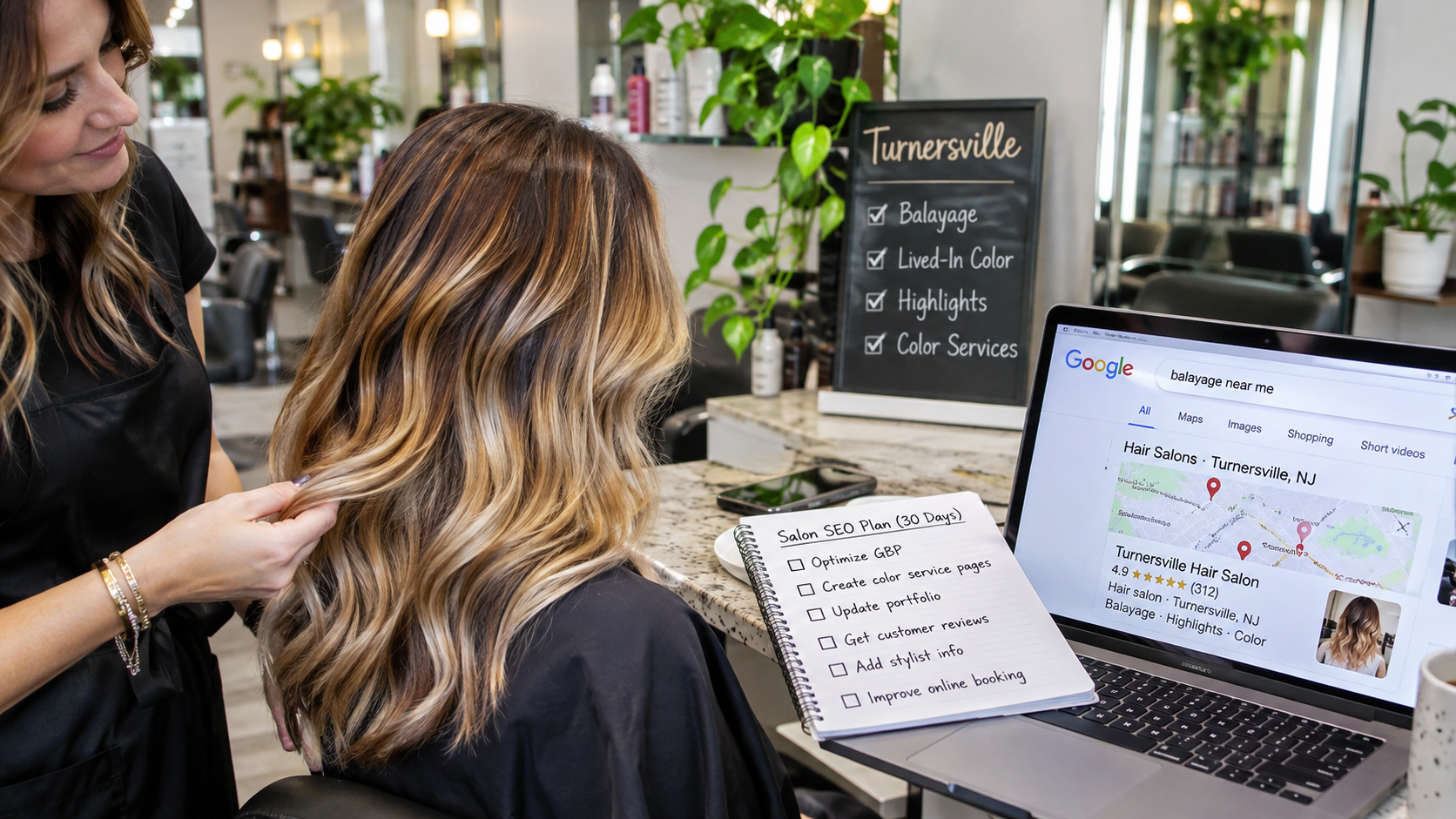
Your salon could have an incredibly talented colorist.
Your team may create beautiful dimensional blondes, soft brunette balayage, lived-in color, and carefully customized highlights.
Your existing clients may love the results.
You might have a strong Instagram presence filled with before-and-after photographs.
And your appointment calendar may already include regular customers who have trusted your stylists for years.
But when someone in Turnersville searches Google for “balayage near me,” your salon might be nowhere near the top of the results.
Instead, Google displays other businesses.
Some may be closer to the person searching.
Some may have more developed websites.
Others may clearly identify balayage as one of their main services.
And some may simply have a stronger overall local search presence.
For a salon owner, that can be frustrating.
You know your team performs the service.
You know there are potential customers looking for it.
But your business isn't consistently appearing when those customers are researching where to book.
Here's the important distinction: being excellent at balayage and being discoverable for balayage searches are two different things.
Google can't personally evaluate your stylists' artistic ability.
Its systems use available business information, websites, geographic context, reviews, and other signals to determine which results may be useful to someone searching.
If your salon's website simply says "hair services," Google may have less clearly organized information about the specific color services you provide.
If your Google Business Profile is incomplete, potential clients may not immediately understand your specialties.
If your salon is several miles from the person searching, location can affect which businesses appear in Google Maps.
And even when your salon does appear, an unclear service menu or difficult booking process can prevent that visibility from becoming an appointment.
For beauty businesses in Turnersville, Sewell, and Washington Township in Gloucester County, the solution requires more than adding "balayage near me" to a homepage.
You need a practical local SEO strategy that connects what your salon genuinely offers with the questions potential clients ask.
That includes your Google Business Profile, service pages, photographs, stylist information, online booking, customer reviews, and the way you evaluate actual appointment inquiries.
This guide explains the most common reasons a Turnersville salon may be missing from balayage searches, how to investigate the problem, and what to improve.
We'll also show how to approach related searches such as "balayage Turnersville NJ," "lived-in blonde Sewell NJ," and "hair color specialist Washington Township" without creating repetitive pages or misleading location claims.
The goal isn't to guarantee the first Google Maps position.
It's to help more suitable customers understand your salon's color expertise, discover the right service, and take the next step toward an actual appointment.
The Short Answer: Google Needs Clear Evidence That Your Salon Offers Balayage
If your salon isn't appearing for "balayage near me," several explanations are possible.
Your Google Business Profile might not clearly describe the services you provide.
Your website may lack a useful balayage service page.
Your photographs might not be connected with descriptive service information.
Your location may put you farther from the person searching than other eligible salons.
Your competitors may have stronger local prominence or more relevant public information.
Your website may have technical indexing problems.
Or your salon may already be appearing in some results, but not from the location or device where you're checking.
You cannot determine the cause from a single Google search.
A useful diagnosis separates three questions.
First, can Google identify your business and its services?
Second, how competitive is your salon's location and overall search presence for the query?
Third, when someone discovers your salon, can they find enough information to decide whether to book?
Fixing only one of those areas may leave the larger problem unresolved.
1. Understand What “Balayage Near Me” Actually Means
"Balayage near me" isn't the same search as "what is balayage?"
The second query is mainly informational.
The first usually has a stronger local-service component.
Someone may be looking for a salon, comparing stylists, researching prices, or preparing to schedule a consultation.
However, you shouldn't assume every searcher is ready to book immediately.
Some people are still deciding what kind of color service they need.
Others want to compare portfolios.
A first-time color client may be unsure whether balayage is appropriate for their hair.
And someone with previously colored hair may need an individualized consultation before receiving an accurate quote.
The role of location
The phrase "near me" introduces geographic context.
Google may consider the searcher's location or other information about the place involved in the search.
That means a salon in Washington Township may appear differently to people searching from Turnersville, Sewell, Glassboro, Sicklerville, or Deptford.
The role of service relevance
Google also needs to identify businesses relevant to the specific service.
A general hair salon might provide balayage.
But if its public information only emphasizes basic cuts and styling, its specialization may be less obvious.
The role of reputation and prominence
Google's official local ranking guidance explains that local results primarily depend on relevance, distance, and prominence.
Complete business information, genuine reviews, and relevant information from across the web can contribute to how a business is understood.
None of these signals guarantees a particular placement.
The key lesson is that service relevance and local visibility work together.
2. Your Google Business Profile May Not Describe Balayage Clearly Enough
A Google Business Profile is often one of the first public resources customers encounter when researching a local salon.
It may display the business name, location, hours, reviews, website, photographs, and services.
But some salons create a profile, enter the basic address and phone number, and rarely revisit the service information.
That can leave important details incomplete.
Start with the correct primary category
If your business operates as a hair salon, its main category should accurately represent that business.
Google advises choosing the category that describes what the business is, not using categories simply as keywords for everything it offers.
A salon shouldn't select unrelated categories merely because they seem to have more search demand.
Add actual services
Google's Business Profile services editor allows eligible businesses to add predefined or custom services.
Depending on the available options, a salon may be able to describe services such as:
Balayage.
Full balayage.
Partial balayage.
Hair highlights.
Hair coloring.
Glossing or glazing.
Color correction.
Other genuine color services the salon actually provides.
The available service choices may differ by business category.
Don't add services your salon doesn't perform.
Include useful descriptions
Google permits eligible businesses to provide descriptions and prices for services.
That information should be accurate.
A useful balayage description might explain that the salon offers customized, hand-painted color and that first-time clients may require a consultation.
It should not guarantee a particular result for every client.
Don't stuff keywords into the business name
A salon called "Example Hair Studio" shouldn't rename its profile:
"Example Hair Studio — Best Balayage Near Me Turnersville NJ"
unless that wording actually represents the company's legitimate real-world business name.
Google's business representation guidelines prohibit unnecessary keyword additions to profile names.
The correct approach is to communicate services through the appropriate service fields and website content.
3. Your Website May Not Have a Real Balayage Service Page
One of the biggest content opportunities for salons is explaining individual services clearly.
Many salon websites group every color-related option under one broad menu heading.
The page might list "Color," "Highlights," and "Balayage" without explaining what the customer is booking.
That may be enough for existing clients who already understand the services.
But new clients often need more information.
Why a dedicated page can help
A page focused on balayage can address questions that wouldn't fit naturally on a general salon homepage.
What does the service involve?
Who might be a suitable candidate?
Does the salon offer full and partial balayage?
How does the consultation work?
How are prices determined?
Can a client choose a particular stylist?
How do they book?
Those questions make the page useful.
The page also gives search engines more explicit, relevant information about the service.
An example of useful local content
A genuine Washington Township salon could create a page titled:
"Balayage Hair Color in Turnersville, NJ"
The page might describe its actual balayage services, link to stylist biographies, show original portfolio photographs, explain the consultation process, and provide an appointment action.
That is more useful than publishing a paragraph that repeats "best balayage Turnersville NJ" several times.
An important limitation
A dedicated service page doesn't automatically earn a ranking.
The page still needs to be accessible, informative, accurate, and competitive.
But it can provide a stronger foundation than leaving the service almost entirely unexplained.
4. Look at How Local Salons Explain Their Color Services
You don't need to speculate about whether businesses in this market publish specific balayage information.
There are publicly available local examples.
Rizzieri Salon
Rizzieri Salon's dedicated balayage page explains that balayage is available at its Moorestown and Washington Township locations.
Its Washington Township salon is listed at 389 Ganttown Road, Sewell.
The page distinguishes full, half, and partial balayage services and directs guests to call the appropriate location to book with a colorist.
This is a practical example of a page designed around a specific service.
The service is identified.
The genuine locations are clear.
And the customer receives booking instructions.
Lillian James Salon & Spa
Lillian James Salon & Spa's public salon information identifies balayage and lived-in color among its hair color specialties.
The salon's published address is 460 Hurffville–Cross Keys Road, Turnersville.
Its site also explains related color services and provides a stylist-matching process.
That creates a different but equally relevant example of communicating specialization.
What these examples demonstrate
The takeaway isn't that one salon ranks better or creates more appointments than another.
We haven't audited their private analytics or verified a specific ranking outcome for the query.
The useful observation is narrower.
Both businesses publicly connect their real salon identity with specific balayage-related services and a customer next step.
If your website barely mentions balayage, examining how to make your service information equally clear is a reasonable starting point.
5. Google Maps May Be Favoring Salons Closer to the Searcher
A salon owner may search "balayage near me" from their workplace and see disappointing results.
Then another person runs the same search from a nearby neighborhood and sees a different set of businesses.
This is normal in local search.
Google considers distance as part of its local ranking system.
A salon may be relevant to the query but geographically less convenient to a particular searcher.
Turnersville and Sewell create an additional naming complication
Turnersville is a community within Washington Township in Gloucester County.
Businesses in the township may use Turnersville or Sewell in their postal addresses.
These names are familiar locally, but they don't provide a special mechanism for overriding Google's distance considerations.
Don't change your address for a keyword
A salon should use its real address and accurate map pin.
A Sewell mailing address isn't inherently an SEO disadvantage that should be "fixed" by inventing a Turnersville address.
Likewise, a salon shouldn't claim a Glassboro or Deptford location unless it operates a qualifying business location there.
Look beyond one search position
A salon might appear in local results near its actual location but less prominently in another part of Gloucester County.
That's different from being completely absent for its own business name or having a broken profile.
Ritner Digital explains this in Why Your Turnersville Business Shows Up on Google in One Neighborhood but Disappears in Another.
The practical response is to diagnose the geography rather than assume every missing result represents a technical failure.
6. Your Salon's Photos May Show Great Work Without Explaining It
Balayage is highly visual.
Customers often want to see examples before deciding whether a stylist's work matches their preferences.
But a collection of beautiful photographs doesn't automatically explain the underlying service.
A gallery might contain dozens of transformations without describing which techniques were used.
An image may be uploaded as a generic filename.
Or it may appear without a relevant caption or surrounding information.
Use authentic work examples
Photographs should represent actual services performed by your team.
Obtain appropriate permission before using identifiable customer images commercially.
Don't publish another salon's portfolio photographs as if your stylists created them.
Add meaningful context
If a photograph shows a brunette balayage service, explain that in a relevant caption where appropriate.
If the example required a consultation, multiple appointments, or other individualized work, avoid presenting it as a guaranteed one-session outcome for everyone.
Use descriptive image filenames
Google's image SEO best practices recommend useful filenames and descriptive alternative text.
For example, a file named brunette-balayage-salon-portfolio.jpg is more informative than IMG_4827.jpg.
But filenames are not a substitute for good page content.
Write alt text for accessibility
Alt text should describe the image helpfully for people using assistive technology.
It shouldn't be a long chain of geographic keywords.
A suitable description might be:
"Shoulder-length brunette hair with soft caramel balayage highlights."
That is more useful than repeating "Turnersville NJ best balayage hair salon near me."
Optimize images for performance
Large, unoptimized photographs may slow down a website.
Use appropriate formats and image sizes without unnecessarily sacrificing portfolio quality.
A gallery should help customers evaluate your work without making the website difficult to use.
7. Your Stylist Pages May Not Communicate Individual Expertise
Many salon customers choose a stylist, not just a salon.
They may want someone experienced with blonding, lived-in color, brunette dimension, or color correction.
A website that provides no information about the team may leave new visitors with unanswered questions.
Create useful stylist biographies
A biography might identify a stylist's genuine specialties, professional background, and services available for booking.
It can include portfolio examples and the correct booking path.
Don't invent expertise
Avoid claiming that a stylist is certified in a particular method unless that credential is legitimate.
Similarly, don't claim award recognition or advanced qualifications that cannot be supported.
Connect profiles with services
A balayage service page may link to the stylists who actually offer that work.
The stylist's page can link back to the relevant service description.
This gives visitors a logical way to move from researching the technique to choosing an appointment.
Respect staff availability
Don't advertise a stylist as currently accepting new appointments if the business knows that is inaccurate.
A useful site should reflect how the salon actually operates.
8. Your Booking System Could Be Losing Interested Balayage Clients
A salon may become more visible in search without increasing its completed appointments.
This can happen when visitors reach the website but struggle to book.
Imagine someone finds your balayage page.
They like the portfolio.
They want to make an appointment.
They click "Book Now."
But the booking software opens a generic list of dozens of services.
They don't know whether to choose highlights, partial balayage, full balayage, or a color consultation.
They may abandon the process.
Match the booking path to the service
If your salon requires a consultation before balayage, make that clear.
If existing clients may book directly while new guests need an assessment, explain the distinction.
Don't promise instant booking if it isn't supported
Some salons prefer to schedule complex color work by telephone.
That can be appropriate.
For example, Rizzieri's public balayage page explicitly states that color bookings are handled by phone.
The important point is clarity.
Review appointment durations
Make sure the scheduler reflects realistic service times and stylist availability.
Explain pricing appropriately
Balayage prices may vary according to hair length, history, desired outcome, complexity, and associated services.
If the salon uses starting prices or consultations, communicate that accurately.
Test the customer experience
Have an authorized team member follow the complete journey from the service page to the booking system.
Check whether the requested appointment arrives correctly and whether the client receives the expected confirmation.
A booking button click isn't the same as a completed appointment.
9. Put the Right Appointment Link on Your Google Business Profile
Many salons have a booking system but fail to make it easy to access from their Google listing.
Google's local business links guidance explains how eligible businesses can add appointment links to their Business Profiles.
Google also permits certain third-party scheduling integrations.
Verify the correct destination
If a salon operates several locations, the booking link should direct customers to the appropriate location or a clear location selection process.
Check unexpected third-party links
Google may display certain booking links from participating third-party providers.
Review which options appear on your profile and use the platform's available controls when appropriate.
Don't assume that clicking means booking
A customer might open the scheduler and leave before confirming an appointment.
Where supported, compare booking-related profile metrics with records from the actual appointment system.
Preserve customer choice
Someone may want to call before booking a complex color service.
Provide a clear phone option when that is how your business handles consultations.
The most useful booking path is the one that matches the service and the customer's real decision process.
10. Your Reviews May Be Strong but Not Particularly Helpful to New Color Clients
A salon might have many positive Google reviews.
That's valuable.
But prospective balayage clients often have specific questions.
They may want to know whether people were comfortable during consultations.
They may be interested in communication, timing, service expectations, or the overall salon experience.
Reviews can provide some of that context.
However, a business should never try to manipulate what customers say.
Invite genuine feedback
Google allows businesses to request honest reviews from customers.
Use a neutral request without prescribing a star rating.
Don't ask customers to insert SEO keywords
Avoid scripts such as:
"Please mention balayage, Turnersville, Sewell, and our stylist's name so we rank higher."
That turns customer feedback into an artificial keyword exercise.
Don't offer incentives
Google's review policies prohibit discounts, free services, payments, or other benefits offered in exchange for reviews.
The restriction includes incentives tied to posting, editing, or removing reviews.
Don't selectively request reviews
Businesses should not invite only satisfied clients to review while discouraging others.
Respond professionally
A salon can acknowledge feedback and answer concerns appropriately.
Avoid disclosing a client's private appointment details or discussing sensitive information publicly.
What about negative feedback?
A thoughtful response may show future customers how the business communicates.
It doesn't require the salon to argue with the reviewer or disclose confidential information.
A sustainable reputation strategy makes genuine experiences visible. It doesn't manufacture a particular rating or set of keywords.
11. Your Website May Be Competing With Its Own Service Pages
Some salons create several pages targeting similar phrases without a clear content strategy.
The site may contain:
"Balayage Turnersville."
"Best balayage Sewell."
"Blonde balayage Washington Township."
"Balayage hair salon near me."
If every page says essentially the same thing and leads to the same booking menu, the collection may be more confusing than helpful.
Start with one strong primary service page
For a single-location salon, a comprehensive balayage page may be the best foundation.
Use natural language to explain the service and identify the salon's real location.
Add separate content when the subject genuinely differs
A useful article about the difference between balayage and traditional highlights may deserve its own page.
A guide about caring for color-treated hair could answer another genuine question.
A stylist's biography has a different purpose from a service page.
Avoid doorway pages
Google's search spam policies warn against pages created primarily to capture similar geographic searches and funnel visitors to the same destination.
A salon should not generate dozens of near-identical pages merely to mention every nearby community.
Think about how customers navigate
Your primary balayage page should be easy to find from the service menu.
Relevant supporting content can link to it.
The booking process should remain clear.
This approach gives both visitors and search engines a more logical website structure.
12. You May Be Targeting Only One Version of the Customer's Search
Not everyone describes hair color in the same way.
One person searches for balayage.
Another searches for lived-in blonde.
Someone else wants dimensional brunette color.
Another may ask about highlights, glossing, gray blending, or color correction.
These services and techniques aren't identical.
But they may be related within a salon's genuine color offering.
Research language your clients actually use
Listen to the questions new clients ask.
Review how customers describe their desired results during consultations.
Examine available Search Console queries.
Look at the terminology on your actual service menu.
Avoid assuming every phrase has meaningful search volume
Without reliable local keyword research, you shouldn't claim that one service phrase receives a certain number of searches every month in Turnersville.
Search demand can vary.
Use language naturally
A balayage page might explain how the service relates to customized color or lived-in looks without claiming every technique is interchangeable.
Don't advertise services you don't provide
A salon specializing in traditional highlights should not add balayage solely to capture more traffic if that isn't a service it offers.
Relevance is valuable only when the underlying information is true.
13. Your Salon's Local Competition May Extend Beyond Turnersville
Potential balayage clients may compare salons in Turnersville, Sewell, Glassboro, Deptford, Williamstown, Cherry Hill, or other South Jersey communities.
Some people prioritize convenience.
Others may travel farther for a particular stylist or service.
That means your competitive market may be broader than the municipality where your salon operates.
However, not every salon needs to target every town.
Start with actual customer geography
Where do your existing color clients come from?
Do people regularly travel from nearby communities?
Does the salon have capacity to welcome more customers from those areas?
Distinguish storefront location from customer reach
A salon located in Turnersville can truthfully explain that it welcomes clients from nearby towns.
That doesn't mean it should claim a physical salon in each location.
Don't create extra Google Business Profiles
Google generally expects one profile for each eligible business location.
A salon shouldn't create fictional branches to rank in neighboring markets.
Consider travel-based decisions
Someone booking a high-value color appointment may be willing to travel farther than someone seeking a quick trim.
But this depends on the customer and service.
The right targeting decision should be informed by actual appointments and inquiries, not assumptions about every client's willingness to travel.
14. Technical SEO Could Be Preventing Your Balayage Page From Appearing
Sometimes the content isn't the primary problem.
The page may have technical issues.
It could be blocked from indexing.
The website may use a template that prevents important content from appearing properly.
A page may redirect unexpectedly.
Or several competing URLs may create confusion about which page should represent the service.
Check Google Search Console
Google's Search Console documentation explains how to evaluate search clicks, impressions, queries, and pages.
Use URL Inspection to examine important service pages.
Confirm that your page is eligible for indexing
A page accidentally marked noindex may not appear in ordinary organic results.
Other indexing issues can also affect visibility.
Review the canonical URL
If several pages display substantially similar content, check whether the canonical configuration reflects the intended page.
Check mobile rendering
Google needs to access important content and resources.
A visually attractive page that hides essential service information behind inaccessible elements may create problems.
Investigate real performance issues
Large salon photographs and heavy booking integrations may slow page loading.
Appropriate technical testing can identify what needs improvement.
Don't assume one technical fix guarantees a ranking
Resolving an indexing or loading issue can remove an obstacle.
But the page still needs to compete on relevance and other factors.
15. Your Balayage Portfolio Should Work With Instagram, Not Depend Entirely on It
Instagram can be valuable for salons.
It's a natural platform for showing color transformations, stylists, customer experiences, and salon personality.
But an Instagram profile and a search-optimized salon website serve different purposes.
Social media can demonstrate your work
A potential client may discover a stylist through a reel or before-and-after photograph.
Your website can answer the next questions
The visitor may want to know which service to select, how prices work, and where the salon is located.
Connect the channels
Link relevant social content to useful service information where appropriate.
Make the booking link easy to find from both the website and social profiles.
Avoid posting the portfolio only on social media
If the salon's own website contains no genuine balayage examples, people arriving from Google may struggle to understand the team's work.
Maintain image permissions
Get appropriate authorization before using client photographs or videos in marketing.
That includes reuse in paid promotions.
Social media and search work best when they support the same accurate service story.
16. A Good Balayage Page Needs More Than a Booking Button
If a salon owner asks what a useful balayage service page should include, the answer depends on the service and the salon's actual policies.
But several elements are often worth considering.
Clear service identity
Explain that the salon offers balayage at its real location.
Appropriate service explanation
Describe what customers can expect without promising identical results.
Genuine portfolio examples
Include original, authorized photographs that accurately show the work.
Stylist information
Help visitors identify which professionals offer the service.
Pricing context
Explain starting prices, consultation requirements, and factors affecting the final cost where appropriate.
Appointment information
Provide realistic timing and preparation guidance if useful.
Related services
If the salon offers glosses, treatments, or other relevant options, explain their role accurately.
Real location details
Include the actual address, hours, and contact information or link to the appropriate location page.
A suitable next step
That might be booking, calling, or requesting a color consultation.
A useful service page is designed for a person considering an appointment.
Search optimization should support that purpose.
17. What About Structured Data for Hair Salons?
Structured data can help search engines understand certain information about a business and its pages.
Google's LocalBusiness structured data documentation describes how businesses can provide structured information such as addresses, hours, and other relevant details.
For a genuine salon location, appropriate markup may help clarify business identity.
But structured data is not a magic ranking shortcut.
Represent the real salon
Use accurate business information.
Don't invent additional locations or unsupported ratings.
Keep markup consistent with visible content
The structured information should reflect what the website actually communicates.
Validate the implementation
Use appropriate testing tools to check the structured data.
Don't expect automatic rich results
Google doesn't guarantee that every valid markup implementation produces a special search feature.
Prioritize the fundamentals
A useful balayage page, accurate business information, working booking experience, and strong customer service deserve attention before adding unnecessary technical complexity.
18. How to Measure Whether Balayage SEO Is Generating Appointments
This is where salon owners should be especially careful.
SEO reports often show impressions, clicks, and keyword positions.
Those can be useful metrics.
But they're not the same as completed appointments.
Start with search visibility
Use Google Search Console to evaluate relevant queries and pages.
Look for terms connected to balayage and other genuine color services.
Remember that the report has data limitations and may not display every individual query.
Review Google Business Profile performance
Google's Business Profile performance documentation explains its available search, view, call, website, and booking-related measurements.
Only supported metrics appear for a given business.
A call-button click is not automatically a completed call.
Measure website inquiries
Where supported, track successful form submissions and relevant booking actions.
Review the appointment platform
A booking-system record may tell you whether an appointment was actually created.
It may also show cancellations, rescheduling, and completed services.
Distinguish first-time and returning clients
A first-time balayage client may have different acquisition value from a long-standing regular.
Both matter, but they're not the same outcome.
Review service profitability
A complex color service may require substantial stylist time and product costs.
More bookings aren't necessarily better if the salon lacks capacity or the campaign isn't financially sustainable.
Be cautious with attribution
A customer may find a stylist on Instagram, read reviews on Google, and eventually book through the salon website.
No single channel necessarily explains the entire journey.
The purpose of reporting is to make decisions, not manufacture certainty.
19. How Much Could Missing Balayage Searches Be Costing Your Salon?
There's no responsible way to assign a universal monthly revenue loss to a salon that isn't appearing for a particular query.
The answer depends on actual local search demand, where the salon appears, how many suitable people click, which visitors book, appointment value, costs, and stylist availability.
A useful evaluation can still be performed.
Start with capacity
How many additional color appointments can your team realistically handle?
If every suitable stylist is fully booked, generating more leads may not be the immediate priority.
Examine appointment economics
Understand the revenue and direct costs associated with actual color services.
Review the current inquiry process
How many interested clients request consultations?
How many book?
How many complete their appointments?
Find the biggest bottleneck
If the salon receives little relevant search traffic, discovery may be the problem.
If it receives many visitors but few inquiries, the page or booking process may require attention.
If consultations are plentiful but customers don't schedule, there may be operational or service-fit issues.
Don't use invented industry averages
A marketing plan shouldn't claim that every lost Maps position costs a Turnersville salon thousands of dollars per month without local evidence.
The more useful question is whether targeted improvements can attract profitable appointments that the business is ready to serve.
20. A 30-Day Turnersville Balayage SEO Improvement Plan
You don't need to rebuild the entire salon website at once.
Start with the most important information and customer experience issues.
Week 1: Diagnose the search visibility problem
Search for the salon's exact name.
Review its Google Business Profile.
Check its real address, map pin, primary category, and services.
Use Search Console to investigate whether the relevant color page receives impressions or is indexed.
Examine a small set of representative searches from different relevant locations.
Don't rely on a single manual search from one device.
Week 2: Improve the balayage content
Develop or improve the main balayage service page.
Explain the actual service.
Add useful questions and answers.
Include authorized portfolio images and links to relevant stylists.
Use descriptive titles, headings, and image information.
Week 3: Improve the booking experience
Check whether customers can find and understand the correct appointment path.
Clarify consultation requirements.
Test the online scheduler or phone booking process.
Make sure the Google Business Profile booking link leads to an appropriate destination.
Week 4: Establish measurement and review
Confirm that booking activity can be evaluated through appropriate systems.
Review the profile's public information.
Establish a policy-compliant process for inviting genuine reviews.
Record the changes made and establish a reporting baseline.
Thirty days may be enough to make important improvements.
It isn't a guarantee that your salon will appear first for "balayage near me."
21. What the First 90 Days With a Salon SEO Agency Should Look Like
If you hire outside marketing help, the first ninety days should produce clear work and useful information.
Days 1–30: Discovery and technical assessment
The agency should understand your services, stylists, location, booking process, and goals.
It should examine the website, Google Business Profile, search performance, and relevant competition.
The agency should not assume that every salon needs the same number of new pages or the same advertising budget.
Days 31–60: Implementation
Work may include improving color service pages, technical SEO, local business information, image presentation, stylist profiles, or booking paths.
The exact priorities should follow the initial assessment.
Days 61–90: Measurement and refinement
Review completed deliverables, early visibility changes, relevant inquiries, and actual booking data where available.
If results aren't yet clear, the agency should explain what remains uncertain.
Ask who owns the accounts
Your salon should understand who controls its domain, website, Google Business Profile, Search Console, analytics, and booking-platform relationships.
Avoid vague reporting
A report saying "we optimized your SEO" isn't enough.
You should know what changed and why.
Ritner Digital's Multi-Location Salon Marketing Playbook goes deeper into how beauty businesses can coordinate SEO, advertising, reviews, bookings, and agency responsibilities.
22. Common Balayage SEO Mistakes Turnersville Salons Should Avoid
Mistake 1: Assuming great styling work guarantees Google visibility
Technical skill and public search visibility are different.
Mistake 2: Hiding balayage in a generic service menu
A customer may need more explanation before deciding what to book.
Mistake 3: Keyword-stuffing the Google Business Profile name
Use your real business name and proper service fields.
Mistake 4: Creating fake salon locations
Don't invent branches in Sewell, Glassboro, or Deptford for rankings.
Mistake 5: Posting portfolio photos without context
Use genuine photographs with appropriate descriptions and permissions.
Mistake 6: Asking customers to mention keywords in reviews
Review requests should invite authentic, unbiased feedback.
Mistake 7: Offering free treatments or discounts for Google reviews
Google prohibits review incentives.
Mistake 8: Sending every color visitor to an unrelated booking menu
Make the service selection understandable.
Mistake 9: Publishing near-identical town pages
Create distinct content only when it serves a real customer need.
Mistake 10: Counting every click as a new client
Track inquiries, confirmed appointments, completed services, and business outcomes separately.
Mistake 11: Promising identical color results to every guest
Service suitability and results depend on the individual's hair and professional assessment.
Mistake 12: Hiring an agency that guarantees the top Maps position
Google says businesses cannot request or purchase better organic local rankings.
A credible agency should explain its work and limitations.
How Ritner Digital Can Help Turnersville Salons Improve Local Search Visibility
Ritner Digital is an independent, Philadelphia-based SEO and AI search marketing practice serving businesses beyond its home city.
Its services include local SEO, technical website improvements, content strategy, digital visibility research, and conversion-related marketing.
For a salon, that work may involve examining the relationship between service searches and actual appointment inquiries.
Relevant Ritner Digital salon resources
Empty Chairs Cost More Than You Think: The Digital Playbook Every Multi-Location Salon Needs in 2026
This article examines salon search visibility, reviews, mobile websites, and the importance of connecting digital discovery with bookings.
This guide covers service and location pages, Google Business Profiles, review practices, paid marketing, booking measurement, and agency accountability.
Turnersville vs. Sewell: Does Your Business Address Affect How You Rank on Google?
This article explains why postal names and actual business locations should be represented accurately.
The Website Audit We'd Run on Every Washington Township, NJ Small Business
This guide outlines a practical framework for reviewing local visibility, technical SEO, content, and customer contact paths.
These articles demonstrate Ritner Digital's published approach to salon and South Jersey marketing.
They should not be treated as evidence that every salon engagement will produce a particular booking increase.
What a focused balayage SEO engagement might include
A salon-focused project could examine whether the business is visible for relevant color services, whether its public information is accurate, whether its content demonstrates genuine expertise, and whether its booking experience works.
Some salons may need a better service page.
Others may need technical improvements.
Another may have good visibility but an unnecessarily confusing consultation process.
The right recommendations should follow the evidence.
The objective is not to make a salon look more qualified than it is. It's to make its real expertise easier to discover and book.
Frequently Asked Questions
1. Why isn't my Turnersville salon showing up for "balayage near me"?
Possible reasons include distance, incomplete Business Profile information, limited service-specific website content, technical indexing issues, or stronger competing results.
A single manual search isn't enough to identify the cause.
2. Does adding balayage to my Google Business Profile help?
If your salon genuinely provides balayage and is eligible to edit its services, adding accurate service information can help clarify what you offer.
Google says relevant service information may be highlighted when customers search for that service.
It doesn't guarantee a particular ranking.
3. Should balayage be my salon's primary Google Business Profile category?
The primary category should describe the overall business accurately.
For a hair salon, the appropriate salon category generally matters more than trying to represent each treatment as a separate business.
Services belong in the relevant service fields.
4. Do I need a dedicated balayage website page?
It may be useful if balayage is a significant service.
A strong page can explain the process, consultation requirements, styling expertise, pricing considerations, and booking options.
However, the page must be useful and accurate rather than created solely to repeat keywords.
5. Can a salon in Sewell rank for Turnersville balayage searches?
Potentially.
Many local customers use Turnersville, Sewell, and Washington Township when describing nearby businesses.
Google still considers actual location and relevance.
Use the correct business address and natural local descriptions.
6. Should I create separate balayage pages for Glassboro, Deptford, and Sicklerville?
Not automatically.
Separate town pages are more appropriate when they provide genuinely different, useful information.
A single-location salon should not imply that it operates physical locations in those towns when it doesn't.
7. Do before-and-after photographs help salon SEO?
Authentic portfolio photographs can help customers evaluate the work and provide useful page content.
Descriptive filenames, relevant captions, and accessible alt text may help search engines understand the images.
Photographs don't guarantee rankings.
8. Should I put "balayage near me" in every page heading?
No.
Use natural language that accurately describes the service.
Keyword repetition isn't a substitute for useful content, and excessive repetition may reduce the page's quality.
9. Can Google reviews help my salon appear in local results?
Google identifies reviews among the information contributing to local prominence.
But reviews are one part of the overall ranking system.
Relevance and distance also matter.
10. Can I ask customers to mention balayage in their reviews?
Businesses should avoid scripting or pressuring customers to use particular SEO keywords.
Invite genuine, unbiased feedback about their actual experiences.
11. Can I offer a discount for a five-star Google review?
No.
Google prohibits incentives for reviews, including discounts, free services, and payments.
It also prohibits other forms of review manipulation.
12. Does Instagram replace the need for a salon website?
No.
Instagram may help display your team's work and reach interested audiences.
A website can provide more structured information about services, location, stylists, and booking.
The two channels can support each other.
13. Should balayage clients book online or by phone?
That depends on the salon's real consultation and scheduling process.
Complex color work may require an assessment before the appointment is confirmed.
The most important thing is to explain the correct process and make it convenient.
14. Can I track how many balayage appointments come from Google?
Potentially, depending on your website analytics, booking platform, and tracking configuration.
Search Console reports search visibility and clicks, while appointment systems may show actual bookings.
Attribution may be incomplete when customers interact with several channels.
15. How long does balayage SEO take to work?
Timelines vary.
Technical fixes or profile updates may be implemented relatively quickly.
Changes in organic visibility can take longer and depend on competition, indexing, content, and other factors.
No agency can guarantee a fixed ranking within a set period.
16. Is Google Ads better than SEO for balayage appointments?
Neither is universally better.
Ads can help reach people through paid placements.
SEO can support unpaid discovery.
The appropriate mix depends on budget, customer demand, booking capacity, and performance.
17. How much should a Turnersville salon spend on local SEO?
There's no universal price.
A salon with a good website may need a focused service-page or Business Profile project.
Another may require extensive technical work and ongoing support.
Compare actual deliverables, full costs, and business goals.
18. Can Ritner Digital help my salon rank for balayage searches?
Ritner Digital offers SEO, local search, content, website, and visibility-related services.
A relevant engagement could investigate the salon's Google presence, service pages, technical issues, and booking process.
It cannot guarantee a first-place ranking or a particular number of appointments.
Final Thoughts: Your Balayage Expertise Should Be Easier to Find
A Turnersville salon can have exceptional stylists and still struggle to appear in the searches that introduce new clients to the business.
That doesn't automatically mean the salon needs more advertising.
It may need clearer service information.
A more complete Google Business Profile.
A useful balayage page.
Better portfolio organization.
Accurate location details.
Or a less confusing appointment process.
In other cases, the salon's visibility may be limited partly by geographic distance or stronger competing results.
Those factors deserve honest analysis.
For salon owners in Turnersville, Sewell, and Washington Township, the objective should be to connect the quality of the work performed inside the salon with the information prospective customers can find online.
Explain your actual color specialties.
Show genuine work.
Help clients understand which service to select.
Make booking convenient.
Maintain a trustworthy reputation.
And measure real appointments rather than treating every website click as a new customer.
Your salon doesn't need to promise that it has the best balayage in South Jersey. It needs to help the people looking for the services you genuinely offer find enough information to choose you confidently.
Want More Local Clients to Find Your Salon's Color Services?
If your salon offers balayage, lived-in color, blonding, highlights, or other specialty services but struggles to appear in relevant searches, it's worth investigating why.
Perhaps Google doesn't have clear service information about your business.
Maybe your balayage page needs more useful detail.
Maybe your booking system makes first-time consultations confusing.
Or perhaps your salon appears in search results, but interested visitors aren't becoming actual appointments.
Ritner Digital helps businesses improve local search visibility through SEO, service-focused content, website optimization, and clearer customer inquiry pathways.
A practical salon SEO engagement can begin by reviewing your Google Business Profile, website, actual service offerings, local search presence, and booking process.
No guaranteed Maps rankings.
No fake reviews.
No invented salon locations.
And no treating search traffic as confirmed appointments.
Just a focused approach to making your real expertise easier to find, understand, and book.