The Website Audit We'd Run on Every Washington Township, NJ Small Business
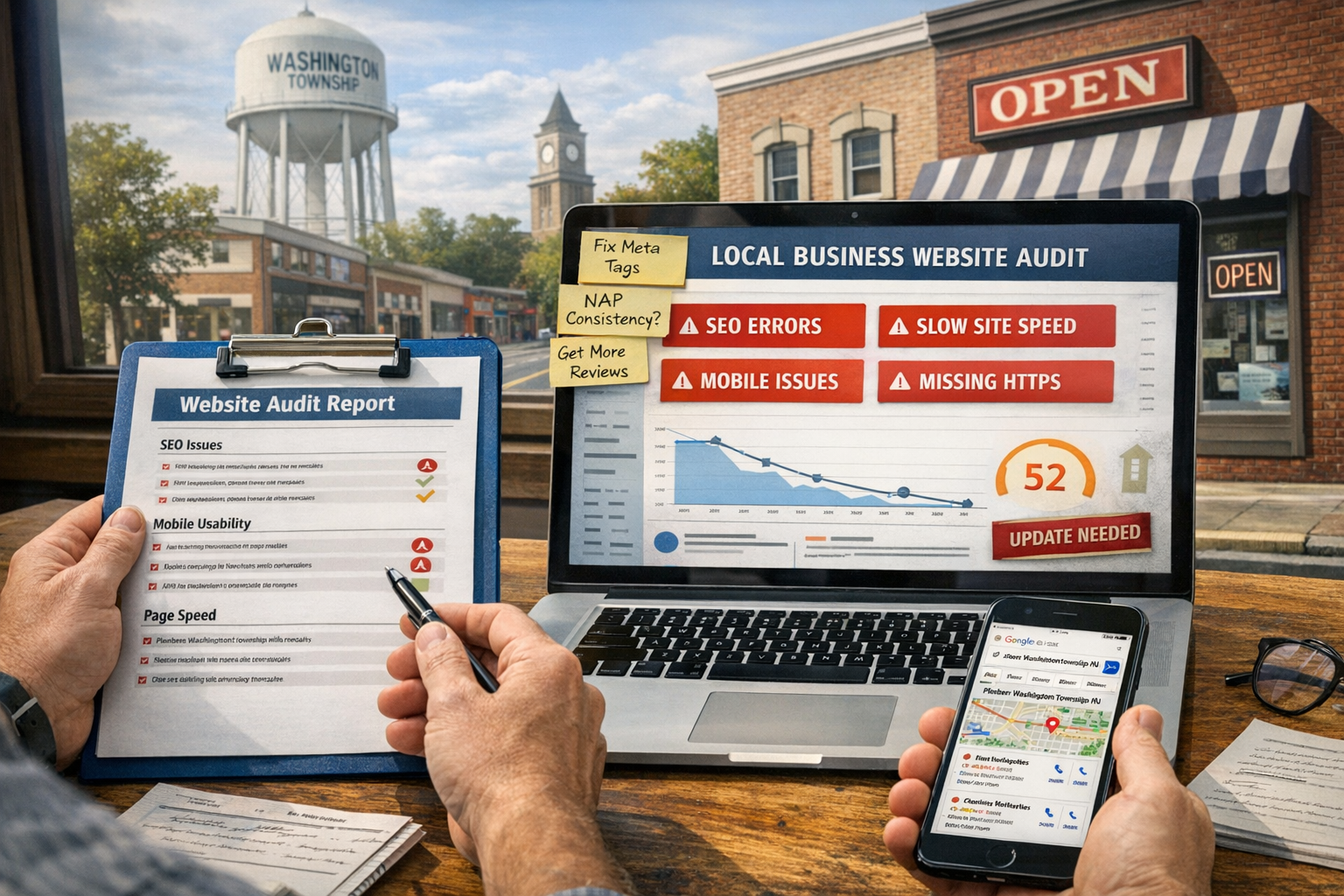
If you run a small business in Washington Township and you've ever wondered why your website isn't generating the leads you think it should — this is for you.
Not a generic "10 tips to improve your website" post. A real walkthrough of the specific audit we'd run on a local business in this market. The exact things we'd look at, why they matter for competing in Washington Township search results specifically, and what we'd expect to find on the average local business site we look at for the first time.
Fair warning: the findings are almost always humbling. Not because local business owners have done something wrong, but because most small business websites were built once and then left alone — while the standards Google uses to evaluate and rank them have kept moving.
Here's the full audit, section by section.
Section One: Google Business Profile Health Check
Before we look at the website at all, we start here. For a Washington Township small business, the Google Business Profile is often the single highest-leverage asset for local search visibility — and it's almost always the most neglected.
What we check:
Is the profile claimed and verified. You'd be surprised how many businesses in the area are either unclaimed or sitting in a verification limbo that's been there for months.
Is every field complete and accurate. Business name, address, phone number, website URL, hours — including holiday hours — service categories, service area, business description, and attributes. Most profiles we look at are missing at least three of these. Some are missing most of them.
Is the primary category correct. This is the most important category signal Google has for your business, and it's frequently set to something slightly off — close enough that nobody noticed, wrong enough that it's suppressing visibility for the most important searches.
Are photos present and recent. Not just a logo. Real photos of the business, the team, the work, the location. Profiles with recent, genuine photo activity consistently outperform those without. We look at how many photos there are, when the last one was added, and whether they reflect the actual business.
Is there an active posting cadence. Google Posts — short updates published directly to the GBP — are an underused local signal that most Washington Township businesses have either never touched or abandoned after a few initial attempts.
What does the review profile look like. Volume, recency, star rating, and — critically — whether the business is responding to reviews. A business that responds to every review signals active, accountable management. One that hasn't responded to anything in six months signals the opposite.
Are there unanswered questions in the Q&A section. This is one of the most overlooked parts of the GBP. Questions from potential customers sitting unanswered for weeks are both a missed opportunity and a trust signal in the wrong direction.
What we typically find:
The average Washington Township small business GBP is maybe 60% optimized. The basics are there — name, address, phone, hours. The high-impact stuff — recent photos, active posts, a systematic review strategy, complete service listings, a well-written description with local relevance — is usually missing or thin.
The gap between a 60% optimized GBP and a fully optimized one is often the difference between showing up in the local map pack and not. And for local searches — "HVAC repair Washington Township," "accountant Sewell NJ," "landscaping company near me" — the map pack is where the majority of clicks and calls go.
Section Two: Website Technical Health
Once we've assessed the GBP, we move to the website. And the first thing we look at isn't the design or the content — it's the technical foundation. Because a website with technical problems is like a store with a broken front door. It doesn't matter how good the inventory is if people can't get in.
What we check:
Page speed on mobile. Google has been explicit about mobile page speed as a ranking factor for years. We run the site through Google's PageSpeed Insights and look at both the score and the specific issues flagging. Scores below 50 on mobile are common and are actively suppressing search visibility.
Core Web Vitals. These are Google's specific measurements of loading performance, interactivity, and visual stability. We look at Largest Contentful Paint, Interaction to Next Paint, and Cumulative Layout Shift — and flag any that are in the "needs improvement" or "poor" range.
Mobile responsiveness. We look at the actual mobile experience — not just whether the site technically resizes, but whether it's genuinely usable on a phone. Navigation that requires zooming, text that's too small to read, buttons too close together to tap accurately — these are all signals of a site that wasn't built with mobile users in mind.
HTTPS and security. Is the site running on a secure connection. An http site in 2026 is a trust and ranking liability.
Crawlability and indexation. We check whether Google can actually access and index the pages that matter. Crawl errors, blocked resources, and pages accidentally set to noindex are all problems we find regularly on small business sites — often on pages that the business owner has no idea are invisible to Google.
Broken links. Internal links pointing to pages that no longer exist, external links going to dead URLs — these create poor user experiences and waste crawl budget.
URL structure. Are URLs clean, descriptive, and consistent. A URL like yoursite.com/services/landscaping-washington-township-nj is significantly better for local SEO than yoursite.com/page?id=47.
Schema markup. Is there structured data on the site that explicitly tells Google what the business is, where it's located, what it does, and how to contact it. Local business schema, service schema, and review schema are all frequently missing on small business sites.
What we typically find:
Technical issues are almost universal on small business sites in Washington Township — not because the sites are badly built, but because technical SEO standards evolve and sites built two or three years ago without ongoing maintenance fall behind. The most common findings are poor mobile page speed driven by unoptimized images and too many third-party scripts, missing or incomplete schema markup, and at least a handful of crawl errors or broken links that have accumulated over time.
Section Three: On-Page SEO Fundamentals
Technical health tells us whether Google can access the site. On-page SEO tells us whether Google understands what the site is about and what searches it should rank for. These are different things, and both matter.
What we check:
Title tags. Is every page — especially the homepage and key service pages — optimized with a descriptive, keyword-relevant title tag that includes the business's primary service and location? A title tag like "Washington Township Plumber | [Business Name] | Licensed & Insured" is doing SEO work. "Home | [Business Name]" is not.
Meta descriptions. Are meta descriptions written for every page, do they accurately describe the page content, and do they include a compelling reason to click? Missing meta descriptions mean Google writes them automatically — which is almost always worse than a well-crafted one.
Header structure. Is each page organized with a logical H1, H2, and H3 structure that reflects the content hierarchy and includes relevant keywords naturally. A page without a clear H1 is leaving a significant on-page signal on the table.
Keyword relevance and placement. Are the primary keywords — the searches the page is trying to rank for — present in the title, the headers, the opening paragraph, and naturally throughout the content? This is basic, but it's frequently not done.
Local relevance signals. Does the content explicitly reference Washington Township, Gloucester County, and the specific communities the business serves? Generic service descriptions without geographic context are consistently outperformed by locally specific content.
Image optimization. Are images compressed for fast loading, named descriptively rather than with generic file names like IMG_4521.jpg, and tagged with descriptive alt text that includes relevant keywords?
Internal linking. Are key service pages linked to from other relevant pages on the site, distributing authority and helping Google understand the site's content hierarchy?
What we typically find:
Most Washington Township small business sites have inconsistent on-page optimization. Some pages — usually the homepage — have had some thought put into SEO. Others — service pages, location pages, blog posts — are largely unoptimized. Title tags are often generic. Local relevance signals are frequently absent or thin. Image optimization is almost never done thoroughly. The result is a site where Google understands the general category of the business but not the specific local relevance and service depth that would push it to the top of local results.
Section Four: Content Depth and Local Relevance
This is the section where most Washington Township small business sites have the biggest gap — and the biggest opportunity.
What we check:
Homepage content. Does the homepage clearly and specifically describe what the business does, who it serves, and where it operates — with enough content depth that Google can confidently match it to relevant searches? A homepage with one paragraph of generic service description is not competitive.
Service pages. Does each core service have its own dedicated page with substantive, specific content? A landscaping company with one page that lists all its services in a bullet list is significantly less competitive than one with individual pages for lawn maintenance, landscape design, hardscaping, irrigation, and seasonal cleanup — each with locally relevant, substantive content.
Location and service area content. Does the site explicitly address the communities it serves — Washington Township, Sewell, Turnersville, Grenloch, Bells, Hurffville, and the surrounding areas — with content that reflects genuine local relevance rather than just mentioning the name of a town in passing?
Blog and educational content. Does the site have any content that addresses the questions Washington Township homeowners, business owners, or customers are actually asking? Or is the blog either nonexistent or abandoned after three posts from 2021?
Content quality and specificity. Is the content on the site specific, genuine, and reflective of real expertise — or is it generic, could-be-anyone content that sounds like it was written without any particular knowledge of the local market?
What we typically find:
Thin content is the most common finding on Washington Township small business sites. Homepages with a few hundred words of generic service description. Service pages that don't exist as individual pages. No blog, or a blog that was started with good intentions and abandoned. Zero location-specific content beyond the address in the footer. The businesses showing up at the top of Washington Township local search results have addressed all of this — they have content depth that small competitors simply don't.
Section Five: Backlink Profile and Domain Authority
This section looks at the external signals pointing back to the website — the votes of credibility from other parts of the web that tell Google this is a business worth trusting and ranking.
What we check:
Total backlink profile. How many other websites link to this site, and what's the quality of those links? A handful of high-quality, locally relevant links is worth more than hundreds of low-quality directory links.
Local link opportunities. Is the business listed on the Gloucester County Chamber of Commerce website? The Washington Township business community sites? Local news outlets? Neighborhood and community organizations? Industry associations? These are the locally relevant link sources that signal genuine community embeddedness to Google.
Competitor comparison. How does the link profile of this business compare to the businesses currently outranking it in Washington Township search results? This tells us how big the authority gap is and roughly how much link building investment is needed to close it.
Toxic links. Are there any spammy or low-quality links pointing to the site that could be dragging down its authority? This is less common for local small businesses but worth checking.
What we typically find:
Most Washington Township small businesses have thin backlink profiles — a few directory listings, maybe a Chamber of Commerce mention, and not much else. The businesses outranking them locally often don't have dramatically more links, but they have better ones — more relevant, more locally rooted, more authoritative sources pointing back to their site. Closing this gap is a medium-term investment that pays compounding dividends over time.
Section Six: Review Profile and Reputation Signals
We've already looked at reviews as part of the GBP audit. Here we go deeper — because reviews are one of the most impactful local SEO signals available and most businesses are leaving significant ranking potential on the table.
What we check:
Total review volume across platforms. Google reviews are most important for local search, but we also look at Yelp, Facebook, industry-specific platforms, and any other relevant review sources. How many total reviews does this business have across all platforms combined?
Review recency. When was the last review received? A business with 50 reviews but the most recent one from fourteen months ago is signaling to Google that something may have changed. Recency matters.
Review response rate and quality. Is the business responding to reviews — both positive and negative? The quality of responses matters too. Genuine, personalized responses signal a business that cares. Copy-pasted generic responses signal a business going through the motions.
Review content and specificity. Are reviews mentioning specific services, specific team members, specific locations? Detailed, specific reviews are more valuable as local ranking signals than generic "great company" feedback.
Negative review handling. How has the business responded to negative reviews? This is often the most revealing part of the review profile audit — it tells you a lot about how the business handles accountability.
What we typically find:
Review profiles for Washington Township small businesses are almost always underdeveloped relative to their potential. Businesses with genuinely satisfied customers who have simply never systematically asked for reviews. Businesses with 15 reviews when they should have 150. Businesses that haven't responded to a review in six months. The gap between the review profile these businesses have and the one they could have with a systematic approach is one of the most addressable gaps in the entire audit.
Section Seven: Citation Consistency
Citations — mentions of the business name, address, and phone number across the web — are a foundational local SEO signal. And citation messes are extraordinarily common.
What we check:
NAP consistency across major directories. Is the business name, address, and phone number appearing consistently on Google, Yelp, Facebook, Bing Places, Apple Maps, and the dozens of other directories where local businesses get listed? Even small inconsistencies — a suite number included on some listings but not others, an old phone number still appearing somewhere, slight variations in the business name — introduce doubt that suppresses local ranking.
Duplicate listings. Are there multiple listings for the same business on the same platform? Duplicates are surprisingly common and consistently cause ranking confusion.
Missing directory listings. Are there major directories where the business simply doesn't have a listing at all — losing both the citation signal and the potential referral traffic?
Industry-specific citation sources. Beyond the general directories, are there industry-specific platforms where the business should be listed and isn't?
What we typically find:
Citation messes are universal. Every local business we audit in Washington Township has some version of this problem — old addresses from a previous location, phone number variations, business name inconsistencies accumulated over years of being listed on platforms the owner forgot existed. The cleanup is unglamorous work but it consistently produces meaningful local ranking improvements.
Section Eight: Conversion and User Experience
The last section of the audit shifts from "can Google find and rank you" to "when people do find you, does the site do its job."
What we check:
Clear calls to action. Is it immediately obvious what the visitor should do next on every key page? A phone number that's hard to find, a contact form buried three scrolls down, no clear next step — these are conversion killers.
Phone number prominence. For most Washington Township service businesses, the phone call is the primary conversion event. Is the phone number in the header, visible on every page, clickable on mobile?
Contact form functionality. Is the contact form actually working and submitting correctly? We test it. You'd be surprised how often forms are broken and the business owner has no idea.
Trust signals. Are there elements on the site that build confidence — licenses and certifications, insurance information, years in business, local recognitions, before and after photos, specific case studies? Or does the site ask visitors to trust a business they know nothing about?
Clear service area communication. Is it immediately clear that this business serves Washington Township and the surrounding South Jersey communities? Or does a visitor have to dig to figure out whether the business operates in their area?
Mobile conversion experience. On a phone — which is where most local searches happen — is the conversion path frictionless? Can someone find the number, tap to call, and reach the business in under ten seconds?
Page-level clarity. Does each page have one clear purpose and one clear next step? Or are pages trying to do too many things at once, leaving visitors unsure where to focus?
What we typically find:
Conversion friction is extremely common on small business sites. Phone numbers that aren't clickable on mobile. Contact forms that haven't been tested in months. No visible trust signals beyond a generic tagline. Service areas that are implied but never explicitly stated. The visitor who has found the site — potentially through significant SEO effort — encounters an experience that doesn't make it easy enough to take the next step.
What Happens After the Audit
The audit isn't the destination. It's the starting point for a prioritized plan.
Every finding gets assessed for impact and effort — what's going to move the needle most significantly for this specific business in this specific market, and what can be addressed quickly versus what's a longer-term investment. We don't try to fix everything at once. We fix the highest-impact things first and build from there.
For most Washington Township small businesses, the first priorities coming out of an audit look something like this. Fully optimize the Google Business Profile — it's the fastest path to improved local visibility. Fix the technical issues that are actively suppressing rankings. Address the most glaring on-page SEO gaps on the highest-priority pages. Put a systematic review generation process in place. Clean up the citation profile. Then build — content, links, authority — over time.
It's not a quick fix. But it's a clear, prioritized path from where most Washington Township small businesses are to where they need to be to compete effectively in local search.
Want us to run this audit on your Washington Township business?
Ritner Digital works with small businesses across South Jersey to identify exactly what's holding their digital presence back and build the strategies that close those gaps. If you want a real audit — not a generic report, but a specific, actionable assessment of your actual site and your actual competitive position in Washington Township search — let's have that conversation.
👉🏼 Get in Touch at ritnerdigital.com
Frequently Asked Questions
How long does a website audit take and what does the process look like?
A thorough website audit covering all eight sections — Google Business Profile, technical health, on-page SEO, content depth, backlink profile, review profile, citation consistency, and conversion experience — typically takes several hours of focused analysis to do properly. The process involves running the site through multiple technical tools, manually reviewing content and on-page elements, analyzing the GBP and review profiles, auditing citation consistency across directories, and benchmarking the findings against the competitors currently outranking the business in Washington Township search results. What you receive at the end isn't a generic automated report — it's a specific, prioritized assessment of your actual site and your actual competitive position in the local market.
My website looks professional and modern. Why would it still have SEO problems?
Because visual design and search performance are almost completely separate things. A website can look excellent and still have slow page load times, missing schema markup, thin content, unoptimized title tags, and a citation profile full of inconsistencies — none of which are visible to the human eye but all of which affect how Google evaluates and ranks the site. Some of the most beautifully designed small business websites we've audited have had significant technical and content SEO problems underneath the surface. The design is what visitors see. The SEO foundation is what Google sees. Both matter, but they require different kinds of attention.
What is the single most impactful thing most Washington Township small businesses could fix right now?
For most local businesses in this market, fully optimizing the Google Business Profile is the fastest path to improved local visibility — and it's the most consistently underutilized opportunity we find in audits. A complete, accurate, actively managed GBP with recent photos, a systematic review strategy, active posting, and fully populated service listings can produce meaningful local pack visibility improvements relatively quickly compared to the longer timelines involved in content and link building. It's not the only thing that matters, but for businesses that haven't given their GBP serious attention, it's almost always where the highest near-term ROI is.
How does Washington Township's local search landscape compare to other South Jersey markets?
Washington Township is a competitive local search market — it's a large, populous Gloucester County municipality with a significant concentration of small businesses competing for visibility across a wide range of service categories. The businesses showing up at the top of Washington Township local search results have generally built solid digital foundations — optimized GBPs, reasonable content depth, consistent citation profiles, and healthy review volumes. The gap between those businesses and the average small business site we audit isn't insurmountable, but it's real and it requires deliberate investment to close. The good news is that most Washington Township markets still have meaningful opportunity for well-optimized local businesses to compete effectively — this isn't a market so saturated that the opportunity is gone.
How important are reviews for local search ranking in Washington Township specifically?
Extremely important — and consistently underdeveloped among local businesses in this market. Google weights review volume, recency, and response rate as meaningful local ranking signals, and the businesses ranking at the top of Washington Township local results for most service categories have meaningfully stronger review profiles than their competitors further down the page. The most actionable insight from almost every review profile audit we run in this market is that businesses have far fewer reviews than they should given their actual customer volume — not because customers are unsatisfied, but because nobody is systematically asking. A consistent review generation process is one of the highest-ROI investments a Washington Township small business can make in its local search presence.
What does citation consistency mean and why does it keep coming up in local SEO conversations?
Citations are mentions of your business name, address, and phone number across the web — on directories, on social platforms, on industry listings, and anywhere else your business information appears. Consistency means that information appears the same way everywhere. Google uses citation data to build confidence in the identity and location of local businesses, and inconsistencies — an old address still listed somewhere, slight variations in how the business name is formatted, an outdated phone number on a directory you forgot you signed up for — introduce doubt that suppresses local ranking. Citation cleanup is unglamorous work but it consistently produces meaningful local visibility improvements and is one of the most commonly overlooked elements in local SEO.
How long does it take to see results after fixing the issues an audit identifies?
It depends on what's being fixed and how significant the changes are. Google Business Profile optimization and citation cleanup tend to produce the fastest visible improvements — sometimes within a few weeks to a couple of months. Technical fixes and on-page SEO improvements typically show results within two to four months as Google recrawls and reindexes the updated pages. Content depth improvements and backlink building are longer-term investments with compounding returns — meaningful impact typically takes six to twelve months of consistent effort. The important framing is that local SEO is not a single fix but an ongoing investment, and the improvements compound on each other over time. Businesses that address the audit findings systematically and consistently are in meaningfully stronger positions six months and twelve months later.
Should I be worried that my competitors have already done all of this and I can't catch up?
Not necessarily — and this concern is usually more paralyzing than it is accurate. Most Washington Township small businesses, even the ones ranking reasonably well right now, have meaningful gaps in their local digital presence. Very few small business websites in this market have addressed all eight areas of a thorough audit comprehensively. The businesses at the top of local results have usually done a few things well — often GBP optimization and reviews — without necessarily having excellent content depth, strong backlink profiles, and clean technical foundations simultaneously. There are almost always specific competitive gaps worth targeting, and a well-executed local SEO strategy that addresses those gaps systematically can produce meaningful ranking improvements even in competitive categories.
What is schema markup and do I really need it for a small business website?
Schema markup is structured data added to your website's code that tells Google explicitly and precisely who you are, where you are, what you do, and how to contact you — in a format Google can read directly rather than having to infer from your page content. Local business schema, service schema, and review schema are all particularly relevant for small business websites. For a Washington Township business competing in local search, properly implemented schema helps Google understand your business category, service area, hours, and specific offerings clearly — which contributes to local ranking and can enhance how your business appears in search results. It's a technical element that's frequently missing on small business sites and consistently worth implementing.
Can I do this audit myself or do I need an agency?
Parts of the audit are genuinely accessible to a motivated business owner — you can check your own GBP completeness, run your site through Google's PageSpeed Insights, look at your review profile, and get a general sense of your content depth without specialized tools or expertise. The more technical elements — crawl analysis, schema validation, backlink profile assessment, detailed Core Web Vitals diagnosis, citation audit across dozens of directories — require either specialized SEO tools or enough experience to know what you're looking at and what it means. More importantly, the value of a professional audit isn't just identifying problems — it's prioritizing them correctly and connecting them to a strategy that addresses the highest-impact issues first in the context of your specific competitive position in the Washington Township market.
How can Ritner Digital help my Washington Township business specifically?
Ritner Digital works with small businesses across South Jersey — including Washington Township and the surrounding Gloucester County communities — to identify exactly what's holding their local search presence back and build the strategies that close those gaps. We know the South Jersey market, we understand the competitive landscape across different business categories in Washington Township, and we build strategies designed to produce real improvements in local visibility and lead flow — not just better-looking reports. If you want a real audit of your specific site and a clear, prioritized plan for improving your local search performance, the best starting point is a conversation.