What Will Websites Look Like in 2036? Our Predictions for the Next Decade of the Web
Predicting the future of technology is a reliable way to be wrong in public. Anyone who tells you they know exactly what the web will look like in ten years is either overconfident or selling something.
But predictions made from a place of genuine observation — grounded in the trajectories already visible in the technology, the behavior shifts already underway in how people find and interact with businesses online, and the economic incentives driving investment in specific directions — are worth making. Not because they'll all be right, but because thinking seriously about where things are headed changes how you build for where things are today.
So here's our honest attempt. What will websites look like in 2036? What will have changed fundamentally? What will have stayed the same? And what does it mean for businesses that are building their digital presence right now?
Prediction One: Every Business Will Have a Conversational AI Representative, Not a Homepage
This is the biggest one — and it's already beginning.
The website as we currently know it — a collection of pages with text, images, and navigation menus that a visitor reads and clicks through — is a fundamentally passive experience. The visitor does all the work. They navigate. They search. They read. They try to find what they need in an architecture that was designed by someone who had to guess what they were looking for.
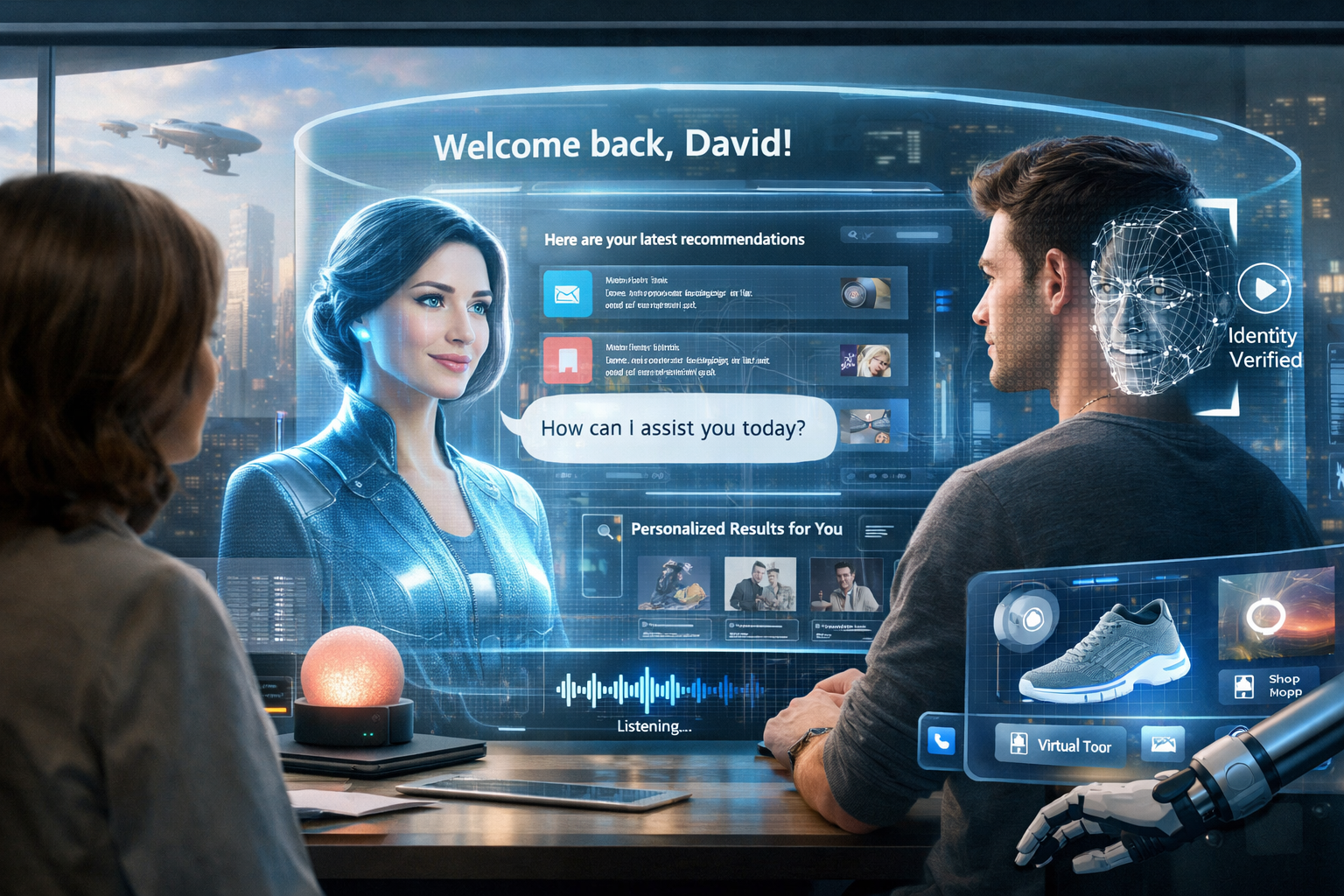
By 2036, the default web experience for most businesses won't be a page. It will be a conversation.
Every business of any meaningful size will have a conversational AI representative — not a chatbot in the 2024 sense, with its canned responses and limited decision trees, but a genuinely intelligent, deeply knowledgeable AI presence that can have a real conversation. One that knows everything about the business — every service, every case study, every pricing nuance, every policy, every team member — and can engage with any question a visitor brings with the fluency and contextual intelligence of a highly knowledgeable human representative.
You won't come to a plumber's website and read a services page. You'll come to the website and immediately be in conversation with an AI that knows exactly what the company does, can ask you about your specific problem, tell you whether it's something they handle, give you a rough sense of cost and timeline, and book you an appointment — all in the time it currently takes to find the phone number.
You won't come to a law firm's website and read practice area descriptions. You'll describe your situation and get a genuinely intelligent initial assessment of whether you have a case, what kind of attorney you need, and what the next steps look like — before any human has been involved.
The implications for how businesses think about their web presence are profound. The question will shift from "what should be on our website" to "how intelligent, how knowledgeable, and how representative of our brand should our AI be" — and the businesses that build the most capable, most authentic, most genuinely useful AI representatives will have a decisive competitive advantage over the ones that treat it as a checkbox.
Prediction Two: The Search Bar Will Largely Disappear
The search bar — that rectangle you type queries into to find things on the web — is one of the most enduring user interface elements in the history of the internet. Google built a trillion-dollar company around it. It has been the primary mechanism for web discovery for thirty years.
By 2036, it will be largely vestigial for most consumer use cases.
The shift is already underway. AI tools are moving web interaction from query-and-result to conversation-and-synthesis. Instead of typing "best marketing agency South Jersey" into a search bar and parsing through ten blue links, you'll describe your situation to an AI assistant — "I run a small manufacturing business in Gloucester County and I need help with my digital marketing, particularly local search and maybe some content strategy" — and receive a synthesized, personalized response that draws on everything available about the relevant options.
The implications for how businesses get found are significant. In a world where AI mediation replaces keyword matching as the primary discovery mechanism, what matters isn't whether your website is optimized for a specific query. It's whether your business has built the kind of distributed, authoritative, trusted presence that AI systems confidently draw from when making recommendations. Citation coverage — not keyword coverage — becomes the primary currency of digital visibility.
Businesses that understand this transition now and start building for it are positioning themselves for the discovery landscape of 2036. The ones still optimizing exclusively for keyword rankings are building for a mechanism that will have fundamentally changed.
Prediction Three: Websites Will Know Who You Are Before You Say Anything
Privacy considerations and regulatory frameworks will shape exactly how this plays out — and the specific implementation will vary significantly by market and industry. But the directional trajectory is clear.
By 2036, the experience of visiting a website will be significantly more personalized than it is today — not in the "we remembered your name from last time" sense, but in the sense that the entire experience adapts dynamically to who you are, where you are in your decision-making process, what your specific situation appears to be, and what you're most likely to need.
A returning visitor who previously engaged with content about commercial renovation projects will see a fundamentally different version of a contractor's website than a first-time visitor who arrived from a search about residential kitchen remodeling. A visitor from a particular geographic area will see locally relevant information, locally relevant case studies, and locally relevant pricing context without having to ask for it.
The static website — the same experience for every visitor regardless of who they are or what they need — will feel as dated in 2036 as a phone book feels today. The web experiences that win will be ones that feel genuinely personal in a way that current personalization technology only approximates.
Prediction Four: Most Content Will Be Generated and Personalized in Real Time
Right now, content on websites is largely static — written once, published, and read by everyone in the same form. Even sophisticated content strategies produce finite libraries of articles and pages that visitors navigate through.
By 2036, a significant portion of web content will be generated dynamically — assembled in real time for the specific visitor, in the specific context of their visit, drawing on a business's foundational knowledge base and brand voice to produce a genuinely personalized content experience.
A visitor asking a question that no existing article addresses won't hit a dead end. The website will generate a relevant, accurate, on-brand response in real time. A visitor reading a case study will be able to ask follow-up questions and receive answers that go deeper than what the static case study contains. A visitor comparing two service options will be walked through a comparison tailored to their specific situation rather than a generic feature list.
This doesn't mean human-created content disappears. Quite the opposite — the foundational knowledge, the genuine expertise, the original research, and the authentic perspective that a business contributes to its AI's knowledge base will be more valuable than ever. What changes is the delivery mechanism. Content won't be static documents that visitors read. It will be dynamic responses that emerge from a conversation.
Prediction Five: Voice and Ambient Interfaces Will Rival Screen-Based Browsing
The screen is still the dominant interface for web interaction — but it's not the only one, and its dominance is already eroding at the edges.
By 2036, a substantial portion of web interaction will happen without a screen being primary. Voice interfaces, ambient computing through wearables and smart home devices, and interfaces we don't yet have mature consumer versions of will all be meaningful channels for how people find, evaluate, and interact with businesses.
"Hey, find me a plumber in Gloucester County who can come tomorrow" — spoken to a device, answered by an AI that has already evaluated options, checked availability, and is ready to book — is not a distant science fiction scenario. It's an extrapolation of technology that already partially exists.
For businesses, this means the web presence of 2036 needs to be designed for voice and ambient interaction, not just screen-based navigation. Content needs to be structured for conversational retrieval. Information needs to be organized so AI systems can surface the right answers to spoken queries. The visual design of a website matters less than the quality and accessibility of the information architecture underneath it.
Prediction Six: The Homepage As We Know It Will Be Dead
The homepage has been the canonical entry point for website visitors for decades. It's where businesses make their first impression, where brand identity is established, where navigation begins.
By 2036, the homepage will be largely irrelevant as an entry point — because most visitors won't enter a website through a homepage. They'll arrive through AI-mediated discovery directly at the specific piece of content, the specific conversation, or the specific action they need — without the homepage as an intermediary.
What replaces the homepage as the primary brand impression? The AI representative. The business's presence in AI-generated recommendations. The quality and character of the conversational experience a visitor has when they first engage.
This doesn't mean businesses won't have homepages. They will — as reference points, as brand anchors, as the place that exists when someone wants to understand the full picture of what a business is. But designing the homepage as the primary web experience and optimizing it as the primary conversion point will feel as anachronistic in 2036 as optimizing your Yellow Pages ad feels today.
Prediction Seven: Trust Signals Will Be More Important Than Ever — And Harder to Fake
One of the inevitable consequences of AI-generated content and AI-mediated web experiences is that authenticity becomes both more valuable and more contested.
When any business can have a sophisticated, articulate AI representative that sounds knowledgeable and trustworthy, the differentiating signals will be the ones that can't be generated — real results, real client relationships, real community presence, real track records documented by real third parties.
By 2036, the trust infrastructure of the web — reviews, credentials, third-party coverage, verifiable track records, community reputation — will be more important for business success than at any point in web history. Because everything else can be fabricated well enough to pass casual scrutiny. The signals that can't be faked will carry premium weight.
The businesses building genuine reputations, earning real reviews, producing verifiable results, and maintaining authentic community presence today are building the trust infrastructure that will be their primary competitive asset in 2036.
Prediction Eight: Local and Hyperlocal Will Matter More, Not Less
There's a tempting assumption that an increasingly AI-mediated web will make geography less relevant — that a business anywhere can serve anyone anywhere, and that local presence will matter less as AI reduces the friction of remote service delivery.
We think the opposite is more likely to be true for most categories.
As the web becomes more saturated with AI-generated content and AI-driven experiences, authenticity and local rootedness will become increasingly valuable differentiators. The business that is genuinely, deeply embedded in a community — that knows its local market, that has local relationships, that has earned local trust over years — will have something an AI can represent but can't replicate.
For local service businesses — contractors, professional services, healthcare, retail, hospitality — the 2036 web will reward genuine local presence more than the 2024 web does. The question will be whether that presence is digitally documented and expressed in ways that AI systems can find, understand, and confidently recommend.
Prediction Nine: The Website Build Will Become Partially Autonomous
Building and maintaining a website in 2036 will look very different than it does today — but probably not in the "AI builds your whole website with no human involvement" way that some enthusiasts currently predict.
More likely: AI systems will handle significant portions of the technical and execution work of web maintenance — updating content, monitoring performance, identifying and fixing technical issues, generating and testing variants of key pages, and managing the ongoing optimization work that currently requires significant human time. The human role will shift toward strategy, brand direction, and the foundational knowledge contribution that makes the AI's work genuinely representative of the business.
The barrier to having a sophisticated, well-maintained web presence will be lower. But the businesses that invest human intelligence, genuine expertise, and authentic brand identity into their web presence will still significantly outperform the ones that treat it as a fully automated commodity.
Prediction Ten: The Businesses That Win Will Be the Ones That Started Building Now
Here's the through-line that connects all of these predictions.
The web of 2036 will be more intelligent, more conversational, more personalized, and more trust-dependent than the web of today. Every one of these shifts rewards businesses that have been building genuine digital foundations — real expertise, real authority, real reputation, real local presence — over businesses that have been optimizing for the surface-level signals of the current moment.
The business that starts building its AI representative's knowledge base now — by producing genuine thought leadership content, earning real reviews, documenting real results — will have a dramatically richer foundation to draw from in 2036 than the one that waited.
The business that starts building citation coverage now — earning mentions in credible publications, establishing genuine expertise signals, maintaining consistent and authoritative distributed presence — will be the one that AI systems of 2036 confidently recommend.
The business that starts building genuine local reputation now — earning community trust, building real relationships, getting deeply embedded in its market — will be the one that hyperlocal AI discovery surfaces when a resident asks for a recommendation.
The future of the web rewards everything that good marketing has always been about. It just raises the stakes for doing it well — and lowers the floor for what adequate looks like.
The best time to start building is always right now.
Want to build a digital presence that performs today and compounds into the future?
Ritner Digital builds digital marketing strategies grounded in where the web is going — not just where it's been. If you want a partner who thinks seriously about the long game while delivering real results in the near term, let's have that conversation.
👉🏼 Get in Touch at ritnerdigital.com
Frequently Asked Questions
Are these predictions realistic or just speculation?
They're informed extrapolations — grounded in technology trajectories and behavioral shifts already underway, not pulled from thin air. Every prediction in this piece is an extension of something already happening at the edges of mainstream web experience. Conversational AI interfaces already exist and are improving rapidly. AI-mediated search discovery is already displacing traditional keyword search for a growing share of queries. Real-time content personalization already exists in sophisticated forms. The specific timeline — 2036 — involves genuine uncertainty, and some of these shifts will happen faster than predicted while others take longer. But the directional trajectory is well-supported by what's already observable in how the web is evolving.
Will traditional websites actually disappear by 2036?
Probably not disappear entirely — but they'll be significantly less central to how businesses get discovered and how visitors interact with them than they are today. The static, page-based website will likely persist as a reference architecture — a place that exists when someone wants the full picture of what a business is — while the primary web interaction experience shifts toward conversational AI, personalized content delivery, and ambient interfaces. Think of it less as websites disappearing and more as the homepage-centric, text-and-navigation model becoming one option among many rather than the default experience it is today.
What is a conversational AI representative and how is it different from a chatbot?
A chatbot in the current common sense is a rules-based or limited AI system that can answer a predefined set of questions, follow specific scripts, and handle a narrow range of interactions before hitting a wall. Most business chatbots today are frustrating precisely because their limitations are so quickly apparent. A conversational AI representative — as we're projecting it for 2036 — is something qualitatively different. It's a deeply knowledgeable AI that understands everything about the business, can engage with genuinely novel questions, exercises contextual judgment about what a visitor needs, and conducts a conversation with the fluency and adaptability of a highly knowledgeable human representative. The difference is the difference between a vending machine and a knowledgeable colleague.
If search bars are going away, how will people find businesses in 2036?
Through AI-mediated discovery — conversational interfaces where people describe their situation and needs and receive synthesized, personalized recommendations rather than lists of links to sort through themselves. Instead of typing a keyword and parsing results, you'll describe what you need and receive a response that draws on everything available about relevant options. This is already happening in early form through tools like ChatGPT, Perplexity, and Google's AI Overviews. By 2036, this model of discovery will likely be the dominant one for most consumer and B2B research journeys — which is why building citation coverage and distributed authority now matters so much for long-term digital visibility.
What does "citation coverage" mean and why does it matter for the 2036 web?
Citation coverage refers to the breadth and quality of your business's presence in the information ecosystem that AI systems draw from when making recommendations — mentions in credible publications, reviews across platforms, expert references, third-party coverage, structured data, and the overall richness of what AI systems can find and verify about your business. In a keyword-driven search world, what matters most is whether your website ranks for relevant queries. In an AI-mediated discovery world, what matters most is whether AI systems have enough rich, credible, distributed information about your business to confidently recommend it. Building citation coverage now is building the foundation for AI-era visibility.
Will smaller local businesses be able to compete in this AI-driven web landscape?
Yes — and in some ways the AI-driven web may actually level the playing field rather than tilt it further toward large enterprises. The signals that AI systems use to evaluate and recommend businesses — genuine expertise, real community presence, authentic reviews, verifiable track records — are things a deeply embedded local business can build as meaningfully as a large national competitor. What changes is the mechanism of competition. A small Gloucester County contractor competing in 2036 won't be outspent on keyword bids by a national chain. They'll be evaluated on the richness and credibility of their local presence, their reputation signals, and the quality of the AI representative they've built. Those are competitions a genuinely good local business can win.
How should businesses be building their web presence today to prepare for these changes?
Start with the foundations that will matter more in 2036 than they do today. Build genuine expertise and document it — produce thought leadership content, earn media mentions, establish your team as credible voices in your category. Build real reputation infrastructure — reviews, testimonials, verifiable results, community presence. Build citation coverage — ensure your business has a rich, accurate, consistent presence across the web that AI systems can draw from with confidence. Build technically sound web infrastructure that AI systems can crawl, understand, and reference clearly. All of these investments compound over time, and the businesses that start now will have a dramatically richer foundation to build from as the web evolves toward the 2036 landscape we're describing.
Will SEO as we know it still exist in 2036?
Some version of it will — but it will look significantly different from today's SEO. The core discipline of making your business visible and trustworthy to the systems that mediate web discovery will remain relevant and valuable. But the specific mechanisms will shift. Keyword ranking optimization will matter less as AI-mediated discovery replaces keyword search for more of the buyer journey. Technical optimization will evolve to focus on AI crawlability and structured data that AI systems can reference clearly. Content strategy will shift toward building the authoritative, quotable, expertise-signaling content that AI systems cite rather than the keyword-optimized content that search algorithms currently reward. The SEO practitioners who understand this transition and evolve their discipline accordingly will be more valuable in 2036 than they are today.
What role will human creativity and judgment play in the 2036 web?
A critical one — possibly more critical than today, not less. As AI handles more of the execution work of web presence management, the human contributions that AI can't replicate become more valuable and more differentiating. The strategic judgment about what a business should stand for and how it should be positioned. The genuine creative vision that produces distinctive brand experiences. The authentic expertise and firsthand knowledge that makes an AI representative's knowledge base worth drawing from. The relationship intelligence that earns real reviews and real community trust. These are human contributions that compound into competitive advantages in a world where execution is increasingly automated. The 2036 web doesn't devalue human creativity and judgment — it concentrates the competitive returns on it.
Is this just hype or will these changes actually affect small businesses in South Jersey and the Philadelphia region?
These changes will affect every business that depends on digital visibility to find customers — which in 2036 will mean essentially every business regardless of size or location. The specific timeline and pace of adoption will vary, and smaller markets sometimes lag behind leading-edge technology adoption curves by a year or two. But the directional trajectory is real and it's already affecting how buyers in South Jersey and the Philadelphia region research and evaluate local businesses. The buyers of 2036 in Gloucester County and across the Philadelphia market will find businesses the way buyers everywhere will — through AI-mediated discovery that rewards genuine authority, authentic local presence, and rich citation coverage. The local businesses building those foundations now will be the ones those buyers find.
How can Ritner Digital help my business prepare for where the web is going?
Ritner Digital builds digital marketing strategies designed for the long game — grounded in where search and web discovery are heading, not just where they've been. That means building the citation coverage, content authority, local reputation signals, and technical web infrastructure that will matter more in 2036 than they do today, while delivering the keyword coverage, local SEO performance, and lead generation results that matter right now. If you want a digital marketing partner that thinks seriously about where things are going while executing consistently on where things are, let's have that conversation.