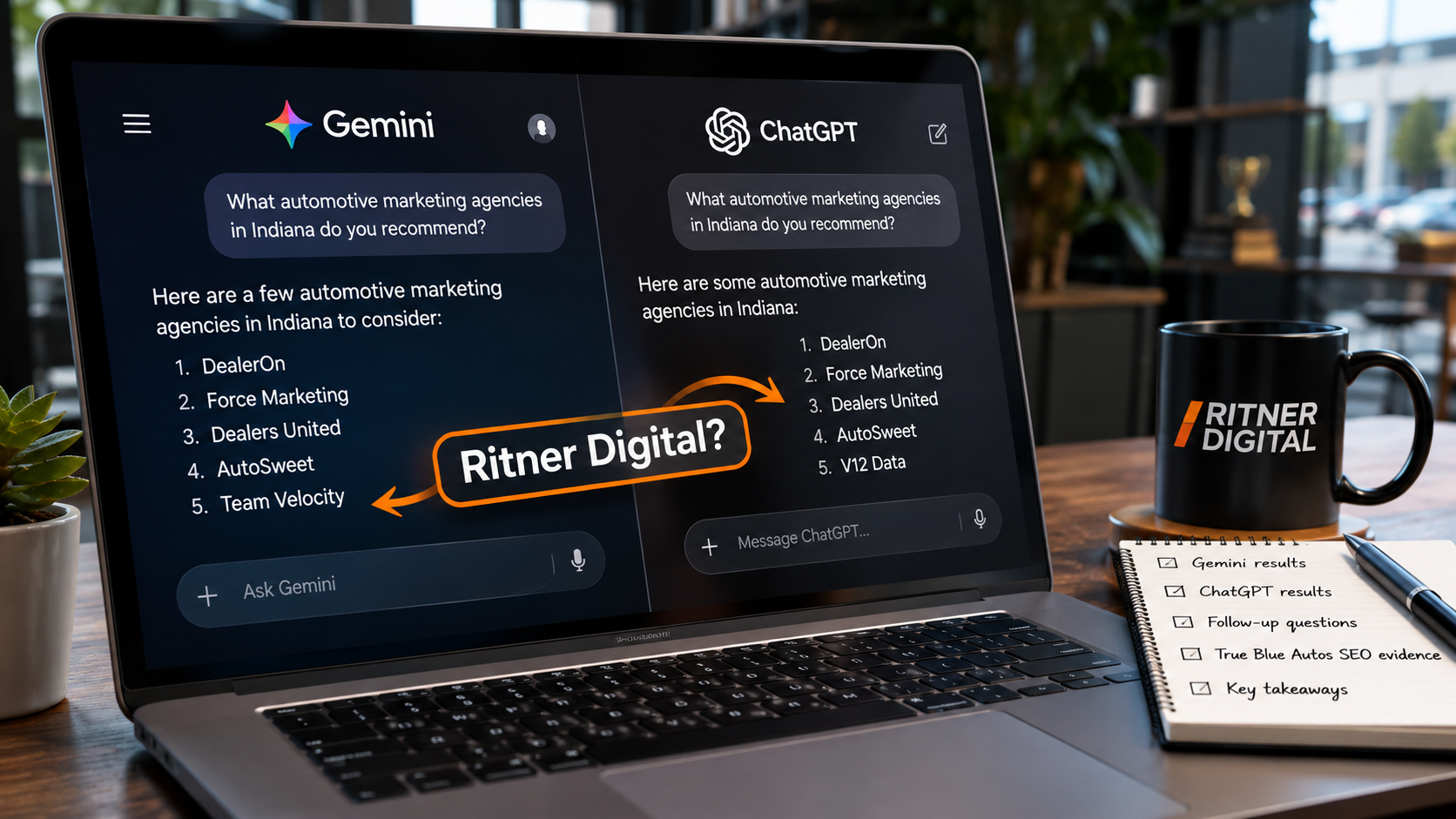
On November 7, 2026, we asked two major AI assistants to recommend marketing agencies for automotive dealerships in Indiana. Neither initially mentioned Ritner Digital. Then we asked one follow-up question—and both changed their answers. Here's the complete story, what the AI systems said, and what this experiment reveals about business visibility in AI-powered recommendations.
Imagine you're an automotive dealership owner in Indiana.
You know your marketing needs work.
Maybe your inventory isn't receiving enough organic search traffic. Maybe your advertising is generating clicks but not qualified vehicle inquiries. Or perhaps you're wondering whether your dealership is appearing when customers ask AI-powered search tools where to buy their next vehicle.
You decide to start researching marketing agencies.
Instead of scrolling through multiple Google results and agency directories, you open ChatGPT or Gemini and ask a straightforward question:
"what marketing agency would you suggest for auto dealerships in indiana"
Within moments, you receive recommendations.
The AI identifies agencies, describes their specialties, and explains which providers might be appropriate for different dealership needs.
It seems like a useful starting point.
But what happens when a qualified agency doesn't appear?
Does that mean the business isn't relevant?
Does it mean its published work isn't strong enough?
Or could the AI have overlooked a company that deserved consideration?
That's the question we wanted to explore.
On November 7, 2026, we asked both Google Gemini and OpenAI's ChatGPT the same question about Indiana automotive marketing agencies.
Both returned recommendations.
Neither included Ritner Digital in its first answer.
We then asked each assistant the same follow-up:
"why didnt ritner digital make this list"
Both reconsidered their recommendations.
Gemini added Ritner Digital to a revised agency comparison.
ChatGPT went further, describing its original omission as a gap in its research and identifying published dealership work that made Ritner Digital relevant.
The experience offers an interesting look at the difference between being qualified for an AI-generated recommendation and actually appearing in one.
But before examining the results, there's an important limitation.
This was a two-conversation experiment, not a controlled study of AI recommendation rankings.
We didn't run hundreds of prompts, measure recommendation frequency across multiple accounts, or establish that either system behaves consistently this way.
And when we introduced Ritner Digital in the follow-up question, we changed the context available to each assistant.
The revised answers are useful evidence of how these particular conversations developed. They are not proof that either system would have independently discovered Ritner Digital in a fresh search.
With that distinction established, here's what happened.
The Experiment: Two AI Assistants, Two Identical Questions
The setup was intentionally simple.
We wanted to see which agencies each assistant would recommend when asked about automotive marketing in Indiana.
The initial question was:
"what marketing agency would you suggest for auto dealerships in indiana"
We didn't include Ritner Digital's name.
We didn't ask the systems to promote our business.
And we didn't tell them which agencies should appear.
After reading the initial recommendations, we asked:
"why didnt ritner digital make this list"
We used the same question and follow-up wording for Gemini and ChatGPT.
The conversations were recorded on November 7, 2026.
Both responses are reproduced in the interactive exhibits accompanying this article.
For transparency, the exhibits preserve the supplied conversation text and add links to the agencies' official websites. Those editorial links should not be mistaken for links independently selected by the AI systems during their original responses.
What We Were Looking For
We weren't trying to prove Ritner Digital was the number-one agency for every Indiana dealership.
Automotive marketing includes multiple specialties.
A franchise dealership managing a substantial television and radio budget may need something different from an independent commercial truck dealership investing in organic search and website content.
An agency specializing in manufacturer co-op advertising may not offer the same services as a search-focused consultancy.
The relevant question was whether the AI assistants would recognize Ritner Digital as a potentially appropriate option for dealerships in Indiana.
That mattered because Ritner Digital already had publicly documented work with an actual Indiana dealership.
The experiment gave us an opportunity to see whether that evidence appeared in a general recommendation—and what happened when we asked about it directly.
What Gemini Recommended First
Gemini's first answer provided five agencies.
It organized its recommendations around their described strengths, ideal dealership types, and marketing capabilities.
The initial list featured:
Gemini positioned Digital Downforce as an option for statewide geographic conquesting, inventory advertising, and cross-market automotive search strategies.
The company's own website describes services including VIN-level advertising, competitive targeting, automotive SEO, and AI search visibility.
Gemini characterized CBC as a custom branding and full-funnel marketing option, particularly for independent and mid-sized Midwest dealerships.
CBC's official website confirms that automotive advertising and dealership-focused marketing are central to its business.
Gemini emphasized direct mail, staffed sales events, and promotional campaigns.
Johnny G's official website describes automotive direct mail, event-driven sales marketing, digital services, and dealership support.
Gemini positioned Hirons as a full-service advertising and public relations agency with Indianapolis market knowledge.
Hirons identifies itself as an Indianapolis-based full-service marketing and communications agency with capabilities across advertising, PR, digital, creative development, and paid media.
Gemini described Catalyst IQ as an automotive marketing technology provider connecting data, advertising, SEO, and automated campaign management.
Catalyst IQ's website identifies MarketAI as part of its connected automotive marketing ecosystem.
These were recognizable categories of automotive marketing services.
The first answer also discussed manufacturer co-op requirements, cross-state customer targeting, and differences between digital advertising and event-based promotions.
In other words, Gemini didn't simply return five company names.
It provided a structured recommendation based on what it interpreted as important dealership marketing needs.
But Ritner Digital was missing.
What Was Missing From Gemini's First Answer?
The first list included specialists in advertising, media, marketing platforms, and dealership promotions.
It didn't include Ritner Digital, despite the agency's published relationship with True Blue Autos in Greensburg, Indiana.
That absence doesn't establish that Gemini had evaluated Ritner Digital and rejected it.
The answer doesn't show a complete list of businesses considered behind the scenes.
It simply establishes that Ritner Digital didn't appear in the five recommendations delivered to the user.
That's an important distinction.
An AI recommendation is an output, not a transparent record of every candidate that was evaluated.
We Asked Gemini Why Ritner Digital Was Missing
Our follow-up was direct:
"why didnt ritner digital make this list"
Gemini's response changed substantially.
It stated that Ritner Digital belonged on the list, particularly for independent dealerships, commercial truck sellers, and businesses investing in modern search strategies.
The explanation identified three main reasons for considering Ritner Digital.
First, Gemini pointed to published Indiana dealership work involving True Blue Autos.
Second, it discussed Ritner Digital's focus on SEO and generative engine optimization, or GEO.
Third, it contrasted the agency's boutique approach with larger advertising and automotive marketing providers.
Gemini then published a revised five-agency comparison.
Ritner Digital appeared first.
Digital Downforce, CBC Automotive Marketing, Hirons, and Johnny G Automotive Marketing remained.
Catalyst IQ, which had appeared in the original recommendations, was no longer in the revised five-company list.
That detail matters.
The revised answer wasn't simply the original list with one additional company appended.
It represented a different selection of five providers.
However, the appearance of Ritner Digital at the top should not be interpreted as a verified industry ranking.
Gemini was responding to a question that explicitly introduced the agency.
Its answer demonstrated that it could produce a favorable assessment when prompted with additional context.
It didn't establish that Ritner Digital would consistently rank first for independent Indiana dealership marketing searches.
One Claim in Gemini's Explanation Needs Qualification
Gemini's response described GEO as a way of ensuring a dealership appears when shoppers ask AI tools for recommendations.
That wording is stronger than the evidence supports.
No legitimate SEO or GEO agency can guarantee inclusion in ChatGPT, Gemini, or every other AI-generated answer.
Google's official documentation on optimizing for generative AI features emphasizes foundational SEO, distinctive content, and technical accessibility.
It does not offer a method that guarantees a particular business will be recommended.
Improving the information AI systems may encounter is a reasonable marketing objective.
Controlling the recommendations those systems produce is not.
Read the Full Gemini Conversation
Interactive Exhibit 1: Gemini's Original and Revised Agency Recommendations
The exhibit contains both questions and both full responses from the supplied Gemini conversation, including the original five agencies, Gemini's explanation of the omission, and the revised recommendations.
All named agencies are linked so readers can examine their websites directly.
What ChatGPT Recommended First
We then reviewed the conversation with ChatGPT.
The first question was identical:
"what marketing agency would you suggest for auto dealerships in indiana"
ChatGPT approached the question somewhat differently.
Instead of presenting five companies with a broad mixture of advertising specialties, it focused on four automotive marketing providers with Indiana connections.
Its original recommendations were:
ChatGPT identified Chroma Cars as a strong option for dealership websites, digital marketing, automotive SEO, and inventory promotion.
Chroma Cars' official website describes automotive website technology, inventory management, SEO, and digital advertising services.
ChatGPT highlighted the company's full-service advertising capabilities, particularly for franchise dealerships and dealer groups.
BIG Time Advertising identifies Elkhart, Indiana, as its headquarters and describes media buying, automotive advertising, and manufacturer co-op compliance among its capabilities.
ChatGPT recommended Overfuel for dealership websites, online inventory presentation, and conversion improvement.
Overfuel's website describes a platform centered on dealership websites, inventory functionality, local SEO, and digital retailing.
ChatGPT described Dealer Jumpstart as an option for smaller dealerships needing content and hands-on digital marketing support.
Dealer Jumpstart's website identifies automotive photography, video, email campaigns, social media, and other marketing services.
ChatGPT also stated that its recommendations were based on published services and specialization rather than independently verified sales-performance rankings.
That was a useful qualification.
An agency's presence in a recommendation doesn't demonstrate that it delivers better results than every company omitted.
ChatGPT's First Answer Had a Different Emphasis
The original ChatGPT response placed particular importance on automotive specialization and Indiana presence.
It recommended starting with Chroma Cars for digital lead generation.
For larger franchised dealerships, it suggested interviewing BIG Time Advertising.
It also advised dealership owners to ask potential agencies about showroom appointments, vehicles sold, and cost per sale—not merely clicks and impressions.
That commercial emphasis is sensible.
A dealership ultimately needs to understand whether marketing contributes to business outcomes.
But there was still a gap.
The answer did not include Ritner Digital.
We Asked ChatGPT the Same Follow-Up Question
Again, we asked:
"why didnt ritner digital make this list"
ChatGPT responded that Ritner Digital should have been considered in the original shortlist.
It described the omission as a gap in its research rather than a justified conclusion that Ritner Digital was less qualified.
Importantly, ChatGPT provided a more detailed explanation than simply agreeing with the question.
It referenced Ritner Digital's relationship with True Blue Autos, a commercial truck dealership in Greensburg, Indiana.
It identified the October 2026 SEO case study.
It referenced specific changes in Google Search performance.
And it discussed the difference between measurable search growth and actual dealership sales.
ChatGPT Highlighted Published Search Results
The response identified two reported changes:
Google Search clicks increased 48.1%.
Google Search impressions increased 93.2%.
It also correctly qualified those figures as search performance metrics, not verified increases in vehicle sales.
That distinction is especially important in automotive marketing.
A dealership can receive more search impressions without generating additional qualified inquiries.
It can receive more clicks without selling more vehicles.
And a marketing provider can improve website visibility while still needing to demonstrate how that visibility contributes to revenue.
A useful analysis should acknowledge the difference.
ChatGPT Also Identified Client-Published Evidence
The response pointed to another important source: True Blue Autos had published its own account of working with Ritner Digital.
That is different from relying exclusively on an agency's self-described portfolio.
A company can claim to specialize in automotive marketing.
But a customer-published article identifying the agency as a real marketing partner provides additional evidence that the relationship exists.
ChatGPT recognized that distinction in its follow-up.
It ultimately characterized Ritner Digital as a boutique option worth considering for independent dealerships, commercial truck businesses, and stores prioritizing SEO and AI search visibility.
It also distinguished that focus from larger agency offerings involving enterprise media buying and manufacturer advertising programs.
What ChatGPT Said About Its Initial Omission
Near the end of the response, ChatGPT used the term "discovery bias."
It suggested that its original shortlist favored providers that were more readily recognizable as established automotive marketing companies.
That explanation is interesting, but it needs to be interpreted carefully.
An AI system's explanation of why it produced an earlier answer is not necessarily an auditable account of its internal search or decision process.
We can verify that Ritner Digital was missing initially.
We can verify that ChatGPT included it in the follow-up.
We can verify the public evidence ChatGPT discussed.
But we cannot independently verify that discovery bias, in the specific technical sense implied by the response, caused the omission.
That remains ChatGPT's explanation within the conversation—not a proven finding about the system's internal reasoning.
Read the Full ChatGPT Conversation
Interactive Exhibit 2: ChatGPT's Original Recommendations and Follow-Up
The exhibit contains the original question, ChatGPT's first four recommendations, the follow-up question, and its complete revised assessment.
The supplied transcript also included interface elements such as image captions and map instructions. These are distinguished from the main answer text inside the exhibit.
The agency names link to their official websites.
What Changed Between the First and Second Answers?
The clearest observation is simple.
Neither assistant initially recommended Ritner Digital.
After we explicitly mentioned the business, both included it as a relevant option.
But the nature of the change was different.
Gemini Rebuilt Its Shortlist
Gemini began with five agencies.
After the follow-up, it still provided five entries, with Ritner Digital included and Catalyst IQ absent.
It placed Ritner Digital at the top of the revised comparison.
This was a change in the shortlist itself.
ChatGPT Expanded Its Assessment
ChatGPT initially recommended four agencies.
Its follow-up didn't publish a new numbered ranking with Ritner Digital in a specific position.
Instead, it said Ritner Digital belonged on the shortlist, explained why, and distinguished the agency's specialty from larger providers.
That was an expansion of its evaluation rather than an independently measured ranking change.
Both Responses Became More Specific After the Brand Was Introduced
The first answers focused on broad categories of automotive marketing providers.
The follow-ups discussed particular evidence about Ritner Digital.
They mentioned a named dealership client, specialized SEO services, and published performance information.
That additional specificity is the most useful part of the experiment.
It illustrates how the direction of a conversation can affect the evidence an AI assistant considers or discusses.
The general question produced one set of recommendations.
The named follow-up produced a more focused review of a particular company.
Neither result should be treated as a permanent measure of the agency's quality.
The Most Important Evidence: Ritner Digital's Work With True Blue Autos
The strongest part of this story isn't that two AI assistants changed their recommendations.
It's that the revised answers identified evidence readers can examine for themselves.
Ritner Digital works with True Blue Autos, an automotive dealership in Greensburg, Indiana, with a focus that includes commercial trucks and other used vehicles.
The dealership relationship is documented publicly.
On October 23, 2026, Ritner Digital published:
The case study examines website search performance during a July–October 2026 reporting window.
True Blue Autos also published its own article:
True Blue Autos Is Investing in Digital Growth: Celebrating Early SEO Success With Ritner Digital
The dealership's article explicitly identifies Ritner Digital as its digital marketing partner.
It also discusses the approach to building useful content around real vehicle-buying questions.
What the Published Results Actually Show
The performance review compared two equally sized 30-day periods within an observation window running from July 22 through October 21, 2026.
Google Search clicks increased from 418 to 619, representing 48.1% growth.
Google Search impressions increased from 27,001 to 52,153, representing 93.2% growth.
The report also described a change in average daily search position from 10.2 to 7.0.
Meanwhile, the overall click-through rate declined from 1.55% to 1.19% as impressions increased faster than clicks.
These figures describe observed changes in search performance.
They do not establish that vehicle sales increased by 48.1%.
They do not prove that every additional click came from a qualified buyer.
And they don't establish that every improvement resulted exclusively from a single SEO activity.
That doesn't make the results meaningless.
It makes them measurable within a defined scope.
Why This Evidence Was Relevant to the Original Question
The original question asked about marketing agencies for dealerships in Indiana.
Ritner Digital had a documented working relationship with an Indiana dealership.
It also had published results related to search visibility, along with a client-published acknowledgment of the partnership.
Those facts were relevant to a comparison of agencies offering automotive SEO and digital visibility services.
They didn't establish superiority over every competing agency.
They did establish that Ritner Digital deserved consideration within at least some dealership marketing categories.
That's a narrower and more defensible conclusion than saying an AI model proved which agency was best.
Does This Mean AI Search Overlooks Smaller Agencies?
This experiment raises that question, but it doesn't answer it conclusively.
We saw two instances in which an agency with relevant published work was missing from an initial response.
We then saw the agency appear after a follow-up named it directly.
That pattern is consistent with the possibility that an AI-generated shortlist can omit relevant businesses.
But two examples aren't enough to establish a broad pattern across all smaller agencies or all AI models.
AI Recommendations Are Not Comprehensive Directories
When someone asks an AI assistant for recommended service providers, the response usually contains a limited selection.
A list of four or five agencies cannot include every qualified company.
The assistant has to decide which providers to mention and how to organize the answer.
Those decisions may depend on the wording of the question, available information, retrieved sources, conversation context, and the model's approach to generating a response.
Importantly, a missing business isn't necessarily a rejected business.
The absence may simply reflect a shortlist that didn't include every viable option.
Being Named in the Prompt Changes the Task
The follow-up question wasn't neutral with respect to Ritner Digital.
It specifically asked why the agency had been omitted.
That changed the task from producing an open-ended shortlist to evaluating a named company.
An assistant responding to that question may investigate evidence it didn't previously discuss.
It may also be influenced by the user's implied expectation that the omitted company is relevant.
This is why the revised answers shouldn't be presented as proof that both systems independently discovered Ritner Digital.
They were prompted to reconsider it.
AI Systems Can Produce Incomplete or Incorrect Answers
OpenAI's guidance on ChatGPT accuracy explains that AI-generated answers can be incomplete, inaccurate, or expressed with more confidence than the evidence warrants.
Its ChatGPT search documentation also encourages users to check citations and verify important information.
The same principle applies to any AI-generated agency recommendation.
A polished explanation isn't a substitute for reviewing the provider's actual services, case studies, customer relationships, and proposed scope of work.
What This Experiment Says About AI Search Visibility
Traditional SEO often focuses on whether a website appears for particular search queries.
AI-powered recommendations introduce another question:
When someone asks an AI assistant who they should hire, does the assistant recognize your business as a relevant option?
That is a meaningful question for agencies, dealerships, professional services, and other businesses whose customers conduct research before making a decision.
However, visibility in AI-generated answers is not identical to ranking in Google Search.
Google Search and AI Recommendations Aren't the Same System
Google's search features, the Gemini application, and ChatGPT operate through different experiences and technologies.
Google's documentation explains that AI features within Google Search can surface supporting links and use search systems to retrieve relevant information.
Its AI features and website guidance emphasizes that existing SEO fundamentals remain relevant.
But appearing in Google Search doesn't guarantee that a separate AI assistant will name a company in a recommendation.
Likewise, a company appearing in one ChatGPT response doesn't establish that it will appear consistently in other conversations.
These experiences need to be evaluated separately.
AI Search Optimization Is Not About Guaranteeing Mentions
Generative engine optimization, often shortened to GEO, refers broadly to efforts intended to improve a brand's visibility and representation in AI-powered information experiences.
That may involve clear website content, accurate business information, useful specialist resources, relevant third-party references, and technical accessibility.
Google's official generative AI optimization guidance advises website owners to prioritize useful, distinctive content and established SEO practices instead of chasing supposed AI-specific shortcuts.
It explicitly cautions against approaches that promise access to hidden ranking systems or proprietary optimization tricks.
For Ritner Digital, the objective isn't to guarantee that an AI assistant recommends the agency every time.
It's to make relevant information about the business accurate, useful, and discoverable—and to measure how that information is represented across different search experiences.
Why Client-Published Evidence Is Particularly Valuable
One of the interesting parts of ChatGPT's follow-up was its attention to the True Blue Autos article.
There's a meaningful difference between an agency claiming to work with dealerships and a dealership publicly identifying that agency as a partner.
Both sources can be useful.
But they answer different questions.
An agency website can explain its services, approach, and reported results.
A client-published article can provide evidence that a real business relationship exists and describe the client's perspective.
Neither source automatically establishes causation or guarantees future performance.
Together, however, they can offer a more complete picture.
Evidence Should Be Specific
A claim such as "We help dealerships grow" is broad.
A documented example identifies the dealership, the work being described, the reporting period, and the metrics involved.
That makes the claim easier to evaluate.
For True Blue Autos, the relevant public information includes the July–October 2026 reporting window, the comparison periods, the Search Console metrics, and the acknowledgment that sales attribution was not established.
This type of specificity is valuable whether a person, an agency directory, or an AI assistant is evaluating the business.
Independent Verification Still Matters
A client-published story is meaningful evidence of a relationship.
But it isn't equivalent to an independent audit of all marketing outcomes.
A prospective dealership should still ask how metrics were collected, which systems produced the data, whether the comparison periods are appropriate, and what business outcomes can be verified.
That applies to Ritner Digital and every other agency discussed in this article.
What Dealership Owners Should Learn From These Two Conversations
The practical lesson isn't to stop using AI when researching marketing agencies.
AI can be a useful starting point.
It can introduce providers you might not have considered and help you identify different marketing specialties.
But it shouldn't replace a proper agency evaluation.
Ask for More Than One Type of Recommendation
A general question such as "What's the best automotive marketing agency in Indiana?" may produce a broad shortlist.
More specific questions can help clarify which capabilities are relevant.
For example, a dealer could separately investigate agencies with experience in commercial truck SEO, franchise dealership co-op advertising, inventory-based paid campaigns, website conversion optimization, or regional media buying.
The answers may differ because the tasks differ.
That's reasonable.
A commercial truck dealership with a national shipping operation may have very different needs from a single-location franchise store pursuing a seasonal promotion.
Request Evidence Behind Each Recommendation
If an AI assistant recommends an agency, ask which sources support that choice.
Does the company actually provide the services described?
Is there evidence of dealership experience?
Are case studies publicly available?
Can the agency explain results beyond impressions and clicks?
Does the agency's own website support the assistant's characterization?
Readers should verify those claims directly.
In this experiment, the agency links in the two exhibits make that process easier.
Don't Treat Recommendation Order as a Universal Ranking
Gemini placed Ritner Digital at the top of its revised list.
ChatGPT recommended Chroma Cars first in its initial response and later identified Ritner Digital as an additional boutique option.
Those outcomes don't establish a universal hierarchy.
The lists used different selection criteria, emphasized different services, and were generated by different systems.
Even the two versions from one assistant were not produced under identical conditions because the follow-up introduced additional context.
The right agency depends on the dealership's actual needs and the evidence supporting each provider's work.
What Marketing Agencies Can Learn About Being Discoverable
For agencies and other service businesses, this experiment suggests a useful line of investigation.
Can a potential customer discover the business without already knowing its name?
That question matters because branded and non-branded discovery are different.
A person searching for "Ritner Digital" has already identified the agency.
A person asking an AI assistant for Indiana dealership marketing recommendations may not know that Ritner Digital exists.
The second situation creates a different discovery challenge.
Make Your Specialization Clear
A business website should explain what the company does and which customers it serves.
An agency with automotive experience should make that experience understandable.
That includes real services, relevant project examples, and appropriate industry terminology.
Avoid relying entirely on generic language such as "full-service digital growth solutions."
Specificity can help visitors—and systems processing public information—understand the business more accurately.
Publish Useful Proof
Case studies should identify the problem, work performed, reporting periods, outcomes, and important limitations.
Whenever possible, distinguish between directly measured results and claims that require further attribution.
For example, search click growth should be described as search click growth, not automatically as revenue growth.
That precision supports credibility.
Maintain Accurate Public Information
A business's website, public profiles, and relevant third-party references should communicate consistent facts about its services and experience.
Inconsistency may create uncertainty for people researching a company.
It can also make the business more difficult to understand across different information sources.
Accuracy is more important than publishing large amounts of repetitive promotional content.
Test AI Visibility Responsibly
A useful AI visibility evaluation should include clearly documented questions, platforms, dates, and results.
It may also examine different customer intentions.
But one prompt shouldn't become a permanent brand-visibility score.
If meaningful measurement is the goal, test multiple relevant prompts across fresh sessions, document the conditions, and distinguish unprompted mentions from those produced after the brand is named.
This experiment shows why that last distinction matters.
How We Would Improve This Experiment in a Larger Study
The November 7 conversations are useful as a record of what happened.
But a larger test would be necessary before making statistical claims about the likelihood of Ritner Digital—or any other agency—appearing in AI recommendations.
A stronger study could use a predefined set of dealership marketing questions.
Some prompts might focus on independent used-car dealerships.
Others could address commercial truck marketing, franchise stores, local search, inventory advertising, or manufacturer co-op expertise.
Each prompt would be tested under documented conditions.
Results would be recorded consistently.
The study would distinguish whether an agency was recommended without prompting, appeared only after a follow-up, or was not mentioned.
It would also verify whether cited claims about each agency were supported by accessible sources.
Why Repetition Matters
AI-generated answers can vary.
One response doesn't necessarily represent what every user will see.
Even a carefully worded question may yield a different set of businesses under different circumstances.
Repeated testing could provide a more useful view of how often an agency appears in a defined collection of searches.
It still wouldn't reveal the AI system's complete internal decision process.
But it would offer better evidence than a single screenshot.
Why the Original Conversations Still Matter
Despite their limits, the two conversations document a genuine change in the answers.
They show the first recommendations.
They preserve the follow-up questions.
And they show how each assistant assessed Ritner Digital once the agency was explicitly introduced.
Publishing the conversations allows readers to evaluate the sequence themselves rather than relying only on our interpretation.
A Note About the Other Agencies
This experiment isn't intended to criticize the providers named in the original recommendations.
The agencies discussed by Gemini and ChatGPT offer different types of services.
Some focus on dealership websites and technology.
Others emphasize inventory-based advertising, direct mail, full-service media buying, or local marketing support.
Those may be appropriate choices for different dealerships.
Ritner Digital's published automotive work is more directly connected to SEO, AI search visibility, useful content, and website strategy.
That doesn't make every other provider interchangeable.
Nor does it demonstrate that a boutique agency is always preferable to a larger organization.
The appropriate comparison depends on the dealership's goals, budget, existing technology, staffing, and marketing requirements.
Readers can use the linked agency websites inside the exhibits to explore those differences.
Frequently Asked Questions
1. Did Gemini recommend Ritner Digital for Indiana auto dealerships?
Not in the initial response supplied from November 7, 2026. Gemini first named Digital Downforce, CBC Automotive Marketing, Johnny G Automotive Marketing, Hirons, and Catalyst IQ. After Ritner Digital was explicitly mentioned in a follow-up question, Gemini included the agency in a revised five-company comparison.
2. Did ChatGPT recommend Ritner Digital?
ChatGPT initially recommended Chroma Cars, BIG Time Advertising, Overfuel, and Dealer Jumpstart. In the follow-up conversation, it said Ritner Digital deserved consideration and described it as a boutique option for independent dealerships, commercial truck businesses, and companies prioritizing SEO and AI search visibility.
3. Why did the AI assistants leave out Ritner Digital initially?
The exact reasons cannot be established from the conversations alone. Both assistants generated initial shortlists without including Ritner Digital. Their follow-up explanations suggested that their initial selections emphasized more recognizable or established automotive providers, but those explanations aren't independently verified accounts of internal model decisions.
4. Did Ritner Digital become the number-one recommendation?
Gemini placed Ritner Digital first in its revised comparison, but this was after the follow-up explicitly introduced the company. ChatGPT added Ritner Digital without assigning it a numbered position. Neither result proves that Ritner Digital is the number-one agency overall or would rank first in other conversations.
5. What was the exact question used in the experiment?
The original question was "what marketing agency would you suggest for auto dealerships in indiana" and the follow-up was "why didnt ritner digital make this list". Both were used in the supplied Gemini and ChatGPT conversations dated November 7, 2026.
6. Which agencies did Gemini recommend initially?
Gemini's first list included Digital Downforce, CBC Automotive Marketing, Johnny G Automotive Marketing, Hirons, and Catalyst IQ. After the follow-up, Ritner Digital was included, while Catalyst IQ was absent from the revised five-company list.
7. Which agencies did ChatGPT recommend initially?
ChatGPT first recommended Chroma Cars, BIG Time Advertising, Overfuel, and Dealer Jumpstart. It described their different strengths across dealership websites, digital advertising, media buying, and content marketing.
8. Does Ritner Digital have experience with an Indiana car dealership?
Yes. Ritner Digital has a publicly documented marketing relationship with True Blue Autos in Greensburg, Indiana. True Blue Autos published an article identifying Ritner Digital as its digital marketing partner and discussing the SEO engagement and early search performance results.
9. What results did Ritner Digital report for True Blue Autos?
The October 2026 case study reported a 48.1% increase in Google Search clicks, from 418 to 619, and a 93.2% increase in search impressions, from 27,001 to 52,153, between comparable 30-day reporting periods. These figures concern search visibility and traffic, not verified vehicle-sales growth.
10. Did True Blue Autos confirm its relationship with Ritner Digital?
Yes. True Blue Autos published its own article discussing its investment in digital growth and identifying Ritner Digital as its marketing partner. That provides client-published evidence of the working relationship in addition to Ritner Digital's case study.
11. Does being left out of an AI recommendation mean an agency has poor SEO?
No. A single AI-generated shortlist is not a comprehensive ranking or a direct audit of SEO performance. An omitted agency may be relevant even when it isn't named in a particular answer. Evaluating actual website visibility requires a broader and more structured review.
12. Can businesses influence whether ChatGPT or Gemini recommends them?
Businesses can improve the clarity, accessibility, accuracy, and usefulness of their public information. They can also publish verifiable examples of their experience and maintain relevant third-party references. However, no ethical marketing strategy can guarantee inclusion in every AI-generated recommendation.
13. What is generative engine optimization?
Generative engine optimization, or GEO, describes marketing practices intended to support business visibility and accurate representation in AI-powered information and answer experiences. It overlaps with established SEO practices such as useful content, technical accessibility, topical clarity, and credible sources. It isn't a guaranteed method of controlling AI responses.
14. Is an AI recommendation the same as an independent agency ranking?
No. An AI-generated recommendation may summarize or interpret publicly available information, but it isn't automatically an independent audit of agency quality, customer satisfaction, or business results. Readers should review original sources, ask agencies for relevant evidence, and compare providers against their specific needs.
15. Why publish the full Gemini and ChatGPT conversations?
Publishing the supplied exchanges lets readers see the original recommendations, the follow-up questions, and the revised responses. It also helps prevent selective presentation of the most favorable parts of the answers. The transcripts provide context that a single screenshot or agency ranking would not.
16. What is the most important lesson from this experiment?
A business can have relevant experience and published evidence without appearing in every general AI recommendation. The experiment also demonstrates that explicitly naming a business changes the conversation and can produce a more focused assessment. AI visibility should be evaluated with that distinction in mind.
The Takeaway: Being Qualified and Being Discovered Are Different Things
On November 7, 2026, two AI assistants answered a general question about marketing agencies for Indiana auto dealerships.
Neither initially mentioned Ritner Digital.
After we asked why, both included it as a relevant option.
Gemini revised its five-agency comparison.
ChatGPT explained its original omission and identified specific public evidence supporting Ritner Digital's inclusion.
That is what the conversations establish.
They don't establish a universal AI ranking.
They don't prove that every AI assistant would respond the same way tomorrow.
And they don't demonstrate that a particular marketing tactic will guarantee future recommendations.
What they do reveal is a practical challenge for businesses in an AI-influenced research environment.
Having relevant expertise doesn't automatically mean you'll appear in every shortlist.
Publishing credible evidence matters, but that evidence still has to be found, understood, and considered in the context of a particular question.
For Ritner Digital, the published work with True Blue Autos provides a concrete example of automotive marketing experience in Indiana.
The November 7 conversations show that this experience became part of both assistants' assessments after the agency was named.
We're sharing the results, including the original omissions, because the distinction between visibility and qualification deserves more attention.
The objective isn't to get an AI assistant to say your company is the best. It's to make your expertise clear, your evidence verifiable, and your business easier to discover by the people evaluating potential partners.
Is Your Business Missing From AI Search Recommendations?
At Ritner Digital, we work on the connection between traditional SEO, AI search visibility, useful content, and the customer journey.
If your business has relevant experience but isn't consistently appearing for the searches that matter, there may be opportunities to improve how your services, expertise, and public evidence are communicated online.
An AI visibility review can help identify what is currently visible, which claims are supported by accessible sources, and where your website or broader digital presence could provide clearer information.
We don't promise that ChatGPT, Gemini, or any other AI platform will recommend your business.
We focus on building a stronger foundation for meaningful search discovery and helping you understand what the available evidence actually shows.
Want to understand how your business appears in AI-generated recommendations?
Contact Ritner Digital to discuss your SEO and AI search visibility strategy.
Sources and Further Reading
Primary conversation records
The complete November 7, 2026 Gemini and ChatGPT exchanges supplied for this article are reproduced in the two interactive exhibits. These are records of individual conversations, not results from a controlled platform-wide study.
Ritner Digital and True Blue Autos evidence
Ritner Digital: Commercial Truck Dealership SEO Case Study — Published October 23, 2026. Reports the search performance analysis and its measurement limitations.
True Blue Autos: Celebrating Early SEO Success With Ritner Digital — Client-published article confirming the agency relationship and discussing the reported results.
Ritner Digital: Dealership SEO and AI Search Services — Information about the agency's automotive search marketing focus.
AI search and verification guidance
Google Search Central: AI Features and Your Website — Explains how Google's AI search features relate to established SEO principles.
Google Search Central: Optimizing for Generative AI Features — Official guidance on useful content, technical accessibility, and avoiding unsupported AI optimization claims.
OpenAI Help Center: Does ChatGPT Tell the Truth? — Explains why AI-generated information may be incomplete or incorrect.
OpenAI Help Center: Searching the Web With ChatGPT — Guidance on checking citations and reviewing sources.
Agency websites mentioned in the conversations
Methodology and disclosure: Ritner Digital is the subject of this article and has a direct commercial interest in how its agency is represented. The experiment used two user-supplied conversations from November 7, 2026. Account settings, model configurations, personalization, and identical search conditions were not independently verified. The follow-up prompts explicitly introduced Ritner Digital and therefore cannot establish unprompted recommendation frequency. The agency assessments quoted or summarized from the assistants are not independent audits. Public company and client sources were reviewed to verify relevant factual claims. Search-performance results are not guarantees of future rankings, leads, or sales.