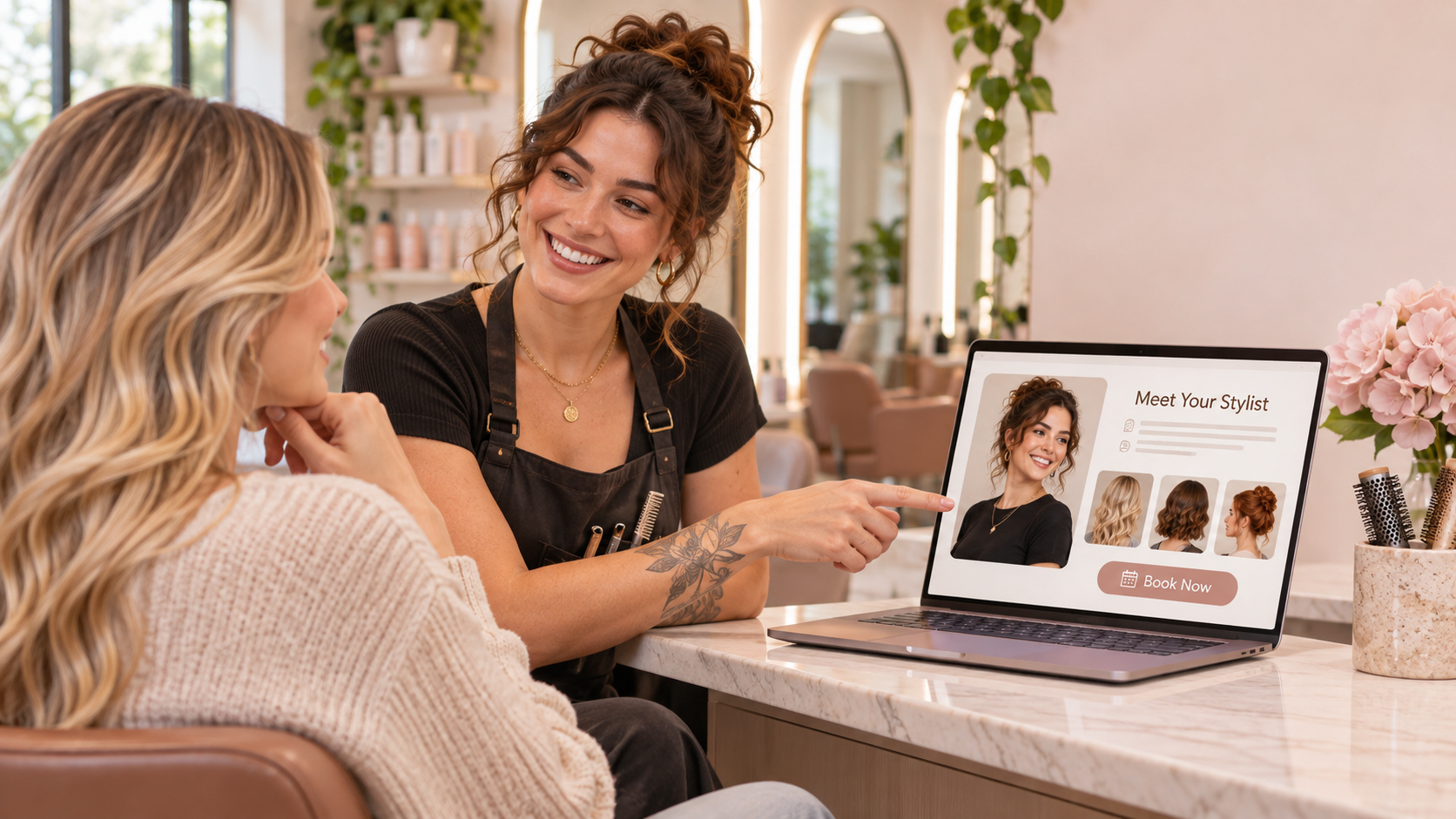
A potential client finds your salon on Google. Your homepage looks beautiful. The photography is professional, the colors feel cohesive, and your branding communicates exactly the kind of experience you want to offer.
They scroll through your services, check your reviews, and decide your salon looks promising.
Then they click “Meet Our Stylists.”
Suddenly, the decision becomes more personal.
They're no longer evaluating your salon as a business. They're evaluating the person who might be cutting their hair, changing their color, or helping them feel like themselves again.
They want to know whether that stylist understands their hair type, has experience with the service they're considering, and will listen when they explain what they want.
And if all they find is a headshot and a sentence about loving coffee, dogs, and making people feel beautiful, they may leave with more questions than answers.
That's where many salon websites miss an opportunity.
Your homepage introduces your salon. Your stylist bios help clients imagine trusting someone inside it.
That distinction matters because choosing a hairstylist isn't quite like choosing a coffee shop or purchasing something online. Hair is personal. A disappointing haircut can take months to grow out. An unsuccessful color appointment can mean additional time, money, and damage to correct.
For some clients, the stakes are even more personal. They may have struggled to find someone who understands their natural texture, experienced an uncomfortable salon appointment, or felt that a previous stylist didn't listen.
Before they book, they're looking for reasons to believe their next experience will be different.
Research supports the importance of what happens during this decision-making process. In a 2022 Boulevard consumer survey, 22% of respondents said a stylist's online portfolio was their primary influence when choosing a new stylist. Recommendations from friends influenced 27%, while availability was the leading consideration at 33%.
These findings don't establish that bios outperform homepages. They do show that the individual stylist's work is a meaningful part of how some clients choose.
For salon owners, that creates an opportunity to think differently about website design, branding, and the content that builds trust.
Your stylist bio shouldn't be an afterthought.
It should be one of the most useful pages on your website.
The Homepage Sells the Salon. The Stylist Bio Sells the Relationship.
A salon homepage typically communicates the business's overall identity.
It introduces your location, services, atmosphere, and visual aesthetic. It might explain your approach to haircare, showcase transformations, or highlight what makes your salon different from competitors.
Those elements are important. A well-designed homepage can establish credibility and encourage visitors to explore further.
But the homepage usually answers one broad question:
“Is this a salon I would consider visiting?”
A stylist bio answers something more specific:
“Is this the person I want working on my hair?”
Those questions are related, but they're not interchangeable.
Imagine two salons offering similar services at comparable prices.
The first has a beautifully designed website with editorial photography, sophisticated typography, and compelling brand messaging. Its team page includes a grid of headshots, first names, and job titles.
The second has a simpler website but gives every stylist a detailed profile. Visitors can see individual specialties, examples of finished work, experience with different hair types, communication styles, and direct booking links.
Which website makes it easier to choose a stylist?
The answer will depend on the client, but the second provides more information for making that specific decision.
This is an important distinction in conversion-focused website design.
A website doesn't succeed simply because someone likes how it looks. It succeeds when visitors can understand the business, evaluate whether it meets their needs, and confidently take the next step.
According to the Nielsen Norman Group's research on About Us information, website visitors value authenticity, transparency, understandable language, and photographs of real people. The research also found that people frequently compare company-provided information with outside reviews before deciding whether to engage.
Although this research examines websites across industries rather than salons specifically, the implications are especially relevant to businesses built around personal service.
A client might be attracted by your salon's branding.
But feeling comfortable with an individual stylist can be what helps them move from browsing to booking.
Why Choosing a Hairstylist Involves More Trust Than Many Businesses Realize
A salon appointment involves more than exchanging money for a service.
Clients are allowing another person to make decisions about their appearance. They're trusting that person to understand their preferences, communicate potential limitations, and perform a service they may not be able to evaluate fully until it's finished.
There is often an emotional component, too.
A client might be booking a haircut after a major life change. Someone might be considering their first professional color appointment. Another person could be looking for a stylist after years of feeling misunderstood about their curls or natural texture.
Your website doesn't need to know every customer's personal story.
But it should recognize that choosing a stylist can involve uncertainty.
And uncertainty creates questions.
Does this stylist know how to work with hair like mine? Will they explain what's realistic? Will they pressure me into services I don't need? Can I show them inspiration photos without feeling embarrassed? Will I leave understanding how to maintain the look?
These questions reveal why a good stylist profile needs more than credentials.
It needs to communicate both professional ability and a thoughtful approach to the client experience.
The Psychology of Warmth and Competence
One useful way to understand this is through the psychology of social perception.
In their research on warmth and competence, psychologists Susan Fiske, Amy Cuddy, and Peter Glick identified two foundational dimensions people use when evaluating others: perceived intentions and perceived ability.
In everyday language, people want to understand whether someone seems well-intentioned and whether they seem capable.
This research was not conducted specifically on salon website bios, so it shouldn't be treated as proof that a particular bio format increases bookings. But the framework offers a practical way to think about the information a stylist profile communicates.
Competence might be demonstrated through experience, education, technical specialties, and relevant examples of finished work.
Warmth might come through in how a stylist describes consultations, communicates with clients, or approaches people who feel nervous about an appointment.
A profile that communicates competence without approachability may feel intimidating.
A profile that communicates friendliness without specific evidence of skill may leave visitors wondering whether the stylist can deliver their desired result.
The strongest profiles help answer both questions.
Not by making dramatic claims, but by showing clients what they can reasonably expect.
Your Clients Are Already Researching You Before They Book
The stylist bio is one piece of a larger research process.
A potential client might first discover your salon through Google Maps. They may read reviews, browse Instagram, compare prices, and visit several salon websites before choosing where to book.
The process rarely follows a perfect sequence.
A client might see a stylist's work on Instagram, search the stylist's name, and then visit the salon website for pricing. Another might discover your homepage through Google and immediately head to the team page.
Others may arrive through recommendations and simply want reassurance before committing.
The 2026 BrightLocal Local Consumer Review Survey found that 66% of surveyed consumers conducted additional research after reading a positive local business review. The study also reported that 54% were likely to visit a business's website after reading positive reviews.
This research covers local businesses generally, not just salons. Still, it makes an important point: a positive review doesn't always end the decision-making process.
People often want more information.
Salon-specific research tells a similar story. Zenoti's reporting on its 2024 salon and spa consumer survey indicated that 78% of surveyed customers checked reviews before booking. The same research highlighted growing expectations for digital convenience and personalization.
These surveys were conducted by industry service providers, so their findings should be viewed within that context. They are useful indicators of consumer behavior, not guarantees about every salon's clientele.
The practical takeaway is straightforward.
Your website needs to support people who are already comparing their options.
If a client visits your stylist page looking for reassurance, that information should be easy to find.
What Potential Clients Actually Want to Know About Your Stylists
Many traditional stylist bios are written like short professional introductions.
They mention the number of years someone has worked in the industry, a few favorite services, and something personal.
There's nothing inherently wrong with that format.
But it often prioritizes what the stylist wants to say over what a potential client needs to know.
Consider the difference between these statements:
“I've been passionate about hair since I was young.”
And:
“I specialize in dimensional brunettes and lived-in color for clients who want a softer grow-out and fewer major color appointments.”
The first tells us something about the stylist's interests.
The second helps a potential client understand whether the stylist's approach matches their goals.
Neither sentence is automatically better in every situation, but the second offers more decision-making value.
A useful stylist profile should address several core questions.
What Does This Stylist Specialize In?
A stylist might provide cuts, highlights, color, extensions, treatments, and styling. But if they have particular strengths, make those strengths clear.
Someone searching for curly hair services needs different reassurance than someone looking for corrective color.
Specificity helps the right clients identify the right professional.
What Types of Clients or Hair Needs Do They Commonly Work With?
This might involve hair texture, density, length, maintenance preferences, or particular services.
A stylist experienced with fine-hair cuts could explain how they approach shape and volume. Someone offering extensions might describe their consultation process and available methods.
The goal isn't to exclude people.
It's to give prospective clients useful information about relevant experience.
What Is Their Approach to Consultations?
A first appointment can feel uncertain, especially for clients considering a dramatic change.
Does the stylist discuss maintenance before recommending a color service? Do they review inspiration photos and explain what is achievable? Do they offer a consultation before complex transformations?
These details communicate professionalism in a way that generic adjectives cannot.
What Does Their Actual Work Look Like?
Clients want to see evidence that a stylist can deliver the kind of result they're considering.
A portfolio doesn't need hundreds of images.
It needs relevant examples that accurately represent the stylist's work.
How Can Someone Book With Them?
This is one of the simplest questions, yet many salon websites make it unnecessarily difficult.
If someone knows which stylist they want, the next step should be obvious.
The less searching a potential client needs to do, the easier it is to continue toward booking.
The Anatomy of a Stylist Bio That Builds Trust
A strong stylist bio balances personality, professional credibility, and practical information.
That doesn't mean every stylist needs a thousand-word autobiography.
It means the page should contain the information that helps a visitor make a decision.
Here are the elements worth prioritizing.
1. A Real, Recognizable Photograph
Start with a photograph that shows the stylist clearly.
Professional photography can help establish a cohesive brand identity, but the image shouldn't feel so heavily edited that the person looks completely different in real life.
Facial expressions, posture, lighting, and the environment all influence the impression a photograph creates.
For a luxury salon, an editorial-style portrait might support the brand's aesthetic. For a relaxed neighborhood salon, a warm photograph taken inside the salon might feel more appropriate.
Neither approach is universally superior.
What matters is that the image feels consistent with the actual experience.
Research from the Nielsen Norman Group on photos as website content distinguishes between authentic, informative imagery and generic decorative photography.
For a stylist profile, the person behind the service is meaningful information.
A real photograph helps visitors connect a name with a face before they arrive.
2. A Clear Name, Role, and Specialty
Clients shouldn't have to read four paragraphs to discover what someone does.
Put the essential information near the top.
For example:
Morgan — Senior Color Specialist
Dimensional brunettes, lived-in highlights, and low-maintenance color.
That short introduction immediately communicates a professional identity.
The rest of the page can expand on Morgan's training, approach, and personality.
For salons with different pricing tiers, this is also a good place to explain what titles such as junior stylist, senior stylist, or master stylist mean within the business.
Industry titles aren't always used consistently.
Clarity prevents clients from having to guess.
3. A Specific Description of Their Expertise
Experience matters, but years alone don't fully explain a stylist's strengths.
Consider what someone has actually learned, practiced, and become especially skilled at.
A stylist specializing in textured cuts might explain their experience with particular curl patterns and cutting approaches.
Someone focused on blonding might discuss consultation expectations, hair integrity, and maintenance planning.
A bridal stylist could describe their process for trials, scheduling, and coordinating wedding-day services.
Credentials, certifications, and continuing education can support credibility when they're accurate and relevant.
Avoid presenting training as a universal qualification if it doesn't establish one.
Specific experience is more valuable than a vague claim of being an expert in everything.
4. A Client-Centered Philosophy
This is where a stylist can communicate how they approach their work.
Rather than writing something broad like “I love making people feel beautiful,” describe what that looks like in practice.
For example:
“My favorite part of a consultation is finding a style that fits someone's real routine, not just the inspiration photo they bring in. I want clients to understand how their hair will grow out, how much styling it requires, and what maintenance will look like.”
This statement communicates a philosophy through a recognizable client experience.
It also sets realistic expectations.
For someone who has previously felt pressured into a high-maintenance service, that detail may be particularly reassuring.
5. A Portfolio Connected to Their Specialties
A gallery is most useful when it demonstrates the services the stylist wants to be known for.
A color specialist could show examples of dimensional highlights, root blending, and brunette transformations.
A curly hair specialist could include results across different textures, lengths, and densities, accurately identifying the work performed.
When appropriate, image captions can explain the starting point, service, and maintenance considerations.
This gives viewers context.
Beautiful photographs attract attention.
Relevant photographs help visitors evaluate whether a stylist's skills match their needs.
6. A Little Personality
Professional information doesn't have to eliminate individuality.
A few personal details can make a stylist feel approachable.
Maybe they love creating dramatic transformations. Maybe they're known for thoughtful consultations and explaining every step. Maybe they're passionate about helping clients simplify their morning routines.
Interests outside the salon can also make a profile more memorable.
But personality should complement professional information, not replace it.
A visitor might appreciate knowing that a stylist loves dogs and iced coffee.
They still need to know whether that person specializes in the haircut they're considering.
Personal details should also be voluntary. A stylist shouldn't feel obligated to share information about their family, private life, or personal circumstances to appear relatable.
Authenticity doesn't require giving up privacy.
7. Practical Information About Booking
A useful profile should explain what happens next.
Is the stylist accepting new clients? Do they require consultations for major color changes? Can someone book directly with them? Are certain services available only after an assessment?
Provide accurate information wherever possible.
If prices vary based on hair length, density, product use, or service complexity, explain that clearly.
Uncertainty about the process can discourage someone who was otherwise interested.
The booking experience should feel like a natural continuation of the profile, not a completely separate search.
8. A Clear Call to Action
Once a client feels ready, don't make them figure out how to proceed.
A simple button labeled “Book With Morgan” can be more useful than a generic “Learn More.”
For services requiring a consultation, “Request a Color Consultation” may be more appropriate.
The language should reflect the actual next step.
A booking button that sends everyone to an unrelated service menu may create confusion. Whenever your booking software supports it, connect the profile to the relevant stylist and service options.
The goal is to make booking feel easy, not rushed.
What a Strong Stylist Bio Actually Sounds Like
Let's look at how a bio can improve without becoming overly promotional.
The following examples are fictional and intended to demonstrate the writing approach.
Before: A Typical Salon Bio
“Hi, I'm Morgan! I've loved doing hair for as long as I can remember. I've been behind the chair for eight years, and my favorite thing is making people feel confident. I love all things beauty, spending time with my family, and trying new coffee shops. I can't wait to see you in my chair!”
This introduction is friendly.
But it doesn't reveal much about the stylist's specific strengths.
Someone seeking a color specialist still doesn't know whether Morgan offers the service they need or what an appointment might be like.
After: A Bio Built Around the Client's Decision
Meet Morgan | Senior Color Specialist
Dimensional brunettes, lived-in highlights, and color designed around real life.
“Morgan specializes in natural-looking color for clients who want beautiful results without feeling committed to constant maintenance.
With eight years of experience behind the chair, she focuses on dimensional brunettes, soft highlights, and customized color placement. Her approach begins with a thoughtful consultation, where she discusses your inspiration photos, hair history, maintenance preferences, and what's realistic for your starting point.
Morgan believes great color should look beautiful when you leave the salon and still fit your lifestyle weeks later. She especially enjoys helping clients create a plan for maintaining healthy-looking hair between appointments.
Outside the salon, you'll usually find her exploring local coffee shops or spending time with family.
If you're considering a color refresh or want to explore a more low-maintenance look, Morgan offers consultations to help you choose the right starting point.”
Call to action: Book With Morgan
The revised version doesn't need exaggerated claims.
It simply provides more useful information.
The client can understand the stylist's specialty, approach, and next step.
Importantly, a real salon should only publish details like these after confirming that they accurately describe the stylist and available services.
Good copywriting makes real strengths clearer. It shouldn't manufacture expertise.
Website Design Determines Whether Your Stylist Bios Get Seen
Even the strongest biography won't help much if visitors cannot find it.
This is where website design and content strategy need to work together.
Many salons treat the team page as a secondary destination, placing it somewhere in the navigation without considering how clients actually choose providers.
But for a business where the individual professional matters, the team page can be a central part of the customer journey.
Give “Meet the Team” a Meaningful Place in Your Navigation
Use clear language.
A creative navigation label might sound appealing internally, but visitors shouldn't have to interpret it.
“Meet Our Stylists,” “Our Team,” or “Find Your Stylist” are easy to understand.
You can also introduce individual stylists on relevant service pages.
For example, a balayage page could feature the stylists who perform that service and link directly to their profiles.
That creates a natural connection between what the customer wants and who can provide it.
Create Individual Pages When They Offer Real Value
For larger salons, a team overview page might be the beginning rather than the end.
Individual profiles can provide room for portfolio images, training details, specialties, frequently asked questions, and stylist-specific booking information.
These pages should be genuinely different.
Duplicating the same generic text across ten stylist profiles and changing only the names doesn't give clients much additional information.
If a small salon can explain everything clearly on one team page, that may be sufficient.
Website structure should follow customer needs, not an arbitrary requirement to create more pages.
Design for Mobile Decisions
A potential client may be comparing stylists while scrolling on their phone.
They shouldn't need to enlarge tiny text, swipe through an awkward gallery, or search multiple pages for a booking link.
Use readable typography, comfortable spacing, responsive image sizes, and obvious navigation.
Important details should appear early enough that visitors can find them without excessive scrolling.
Booking buttons should be easy to tap and should lead somewhere useful.
Thoughtful mobile design isn't simply about making a desktop layout fit a smaller screen.
It's about recognizing what someone needs to accomplish on that screen.
Make the Page Accessible
Readable color contrast, descriptive headings, accessible navigation, and useful text alternatives for images all support a more inclusive experience.
The World Wide Web Consortium's image accessibility guidance explains that informative images need text alternatives that communicate their purpose.
For stylist portraits and portfolio photographs, the appropriate description depends on the information the image conveys.
Accessibility should be considered during the design process rather than added after launch.
Your Stylist Portfolio Is Part of Your Brand's Evidence
Salon marketing is visual.
Before-and-after photographs, color transformations, haircut examples, and styling videos help clients understand what a professional can create.
But a gallery isn't automatically persuasive because it contains beautiful images.
A potential client is often looking for work that resembles the result they want.
Someone interested in subtle brunette highlights might not gain much confidence from a gallery consisting entirely of dramatic platinum transformations.
Likewise, a client with tight curls may want to see whether the stylist has experience working with similar textures.
This is why portfolio organization matters.
Rather than uploading every available image into one gallery, consider selecting work that demonstrates the stylist's specialties and range.
Relevant context can make the images more informative.
A caption such as “Lived-in blonde with a soft root blend” provides more information than “Obsessed with this transformation!”
For major transformations, it may be helpful to explain when a result required multiple sessions.
That communicates realistic expectations without diminishing the work.
Authenticity Matters More Than Perfection
Photography should accurately represent the stylist's work.
Consistent lighting and professional presentation are valuable, but excessive editing can distort a potential client's expectations.
Google's Business Profile photo guidelines recommend in-focus, well-lit images without significant alterations or excessive filters.
Although those guidelines apply specifically to Google Business Profiles, the underlying principle is relevant to salon portfolios.
Clients should be able to trust that the work being presented reflects real results.
Get permission before publishing identifiable client photographs, follow applicable privacy requirements, and avoid disclosing personal information or hair history without consent.
A beautiful portfolio can strengthen a stylist bio.
An accurate portfolio makes the information more credible.
Salon Branding Should Create Consistency Without Erasing Personality
Salon owners sometimes worry that giving individual stylists their own profiles will make the website feel inconsistent.
One stylist might describe their work in an energetic, playful way. Another might communicate through thoughtful, understated language.
That difference isn't necessarily a branding problem.
It can be an asset.
The salon brand should establish the shared experience clients can expect.
Individual profiles can then show how different professionals contribute to that experience.
Think of Your Brand as the Foundation
Your salon's brand encompasses more than its logo.
It includes positioning, messaging, visual identity, service expectations, and the way customers experience your business across touchpoints.
A cohesive website can use consistent typography, photography standards, navigation, page structure, and booking design while allowing each stylist's personality to come through.
You don't need to make everyone sound identical.
You need the experience to feel connected.
For example, a salon built around approachable luxury might communicate thoughtful service, professional expertise, and a relaxed environment.
One stylist could emphasize precision cutting.
Another could focus on dimensional color and maintenance planning.
A third might specialize in bridal styling.
Their specialties differ, but the brand promise remains consistent.
Personal Branding Can Support the Salon Brand
Some stylists develop strong personal brands through social media, referrals, and their individual work.
That visibility can create opportunities for the salon.
A potential client might discover a stylist on Instagram and then research the salon where they work.
A well-designed website gives that relationship a stable destination outside social media.
It can explain the stylist's services, connect them to the salon's broader experience, and provide a direct booking pathway.
This also benefits clients who aren't active on social platforms.
The objective shouldn't be to compete with each stylist's personal brand.
It should be to make those brands work together.
Consistency Does Not Mean Everyone Needs the Same Story
Authenticity disappears quickly when every stylist bio follows an identical script.
If every profile claims the stylist is passionate, creative, dedicated, and committed to making clients feel beautiful, those words stop distinguishing anyone.
Use a consistent structure, but collect real answers from each professional.
Ask what services they genuinely enjoy, which client problems they like solving, and what they want someone to know before a first appointment.
Then write the bios in language that reflects those differences.
Your branding provides the framework.
Your people make it memorable.
Your Website, Instagram, Google Profile, and Reviews Need to Tell the Same Story
Trust isn't created in one place.
Clients may encounter your salon across several platforms before booking.
A stylist bio can explain specialties, but those claims become more convincing when other touchpoints support them.
Imagine a stylist profile emphasizing natural-looking blonde color.
The stylist's portfolio shows relevant work. Their social media includes similar examples. Reviews mention thoughtful consultations and beautiful blonde results.
Those details reinforce one another.
Now consider the opposite.
The website describes the stylist as a color specialist, but their portfolio is outdated, their social media links are broken, and the booking system doesn't list color services under their name.
Even if the stylist is excellent, the digital experience creates unnecessary uncertainty.
Use Google Business Profile as a Discovery Point
Your salon's Google Business Profile can display business information, photos, services, and other details.
Google's guidance for managing services on a Business Profile explains that eligible businesses can add services, descriptions, and pricing information.
This helps customers understand what the business offers before visiting the website.
Keep these details accurate and aligned with your current service menu.
Your Google Business Profile generally represents the salon business, while your website can provide more detailed information about individual team members.
Each platform has a different role.
Let Reviews Reinforce Real Client Experiences
Reviews can communicate qualities that a stylist bio alone cannot prove.
A stylist might describe their approach as patient and consultative.
A genuine review mentioning a thorough consultation can provide independent context.
Don't invent testimonials or attribute reviews to a specific stylist without a sound basis for doing so.
Instead, encourage honest customer feedback and make it easy for visitors to find legitimate third-party reviews.
The Stanford Web Credibility Project has long emphasized the importance of verifiable information and demonstrating the real organization behind a website.
That guidance remains relevant to the way service businesses present themselves online.
The strongest credibility signals can be checked.
Can Stylist Bios Help Your Salon's SEO?
A well-developed stylist page may also support search visibility.
However, creating individual bios doesn't automatically improve Google rankings.
The potential SEO value comes from publishing useful, distinct content that accurately describes the people, services, and expertise behind the salon.
Use Clear, Descriptive Page Titles
A page titled “Morgan | Dimensional Color Specialist at Example Salon” communicates more than one titled simply “Morgan.”
It gives both visitors and search engines useful context.
Google's title link guidance recommends descriptive, concise titles and discourages repetitive or keyword-stuffed wording.
That means a stylist profile shouldn't attempt to rank for every possible salon service.
Use language that reflects the actual person and their work.
Write Content That Matches Real Search Intent
Some potential clients search for a salon.
Others search for a specific service, a named stylist, or a combination of a service and a location.
A genuinely informative page can help address these different needs.
For example, a stylist offering curly haircuts might have a profile that naturally explains their relevant experience, consultation approach, and the services they perform.
A stylist specializing in bridal hair could describe trials, wedding-day preparation, and booking logistics.
These details provide useful context without forcing keywords into every paragraph.
Avoid repeating location names unnaturally or claiming services a stylist doesn't offer.
Connect Stylist Pages to Relevant Services
Internal links help people navigate between related content.
A salon website could connect a color service page to the stylists who perform that service.
The individual stylist pages could then link back to the relevant service details and booking process.
This creates a clearer content structure.
Google's Search Essentials recommend using the words people would use to find content in prominent, descriptive locations and ensuring links are crawlable.
The same approach can improve human navigation.
Optimize Images Thoughtfully
Portfolio images can include descriptive filenames, appropriate text alternatives, and relevant surrounding copy.
Google's image SEO documentation recommends high-quality images, descriptive information, and good image-loading performance.
For example, a filename describing a real color service is generally more meaningful than a random camera filename.
But don't fill image descriptions with repeated keywords.
The description should help explain the actual image.
Consider Appropriate Structured Data
Depending on the website, structured data may help search engines better understand page content.
Google's ProfilePage structured data guidance includes employee pages as a potential valid use case when the page primarily focuses on an affiliated person.
That doesn't mean every stylist profile needs additional markup or that markup guarantees enhanced search visibility.
It means structured data can be considered when the page and implementation meet Google's requirements.
Accurate, useful content should come first.
Prioritize Helpful Content Over More Content
Google's people-first content guidance emphasizes original information, accurate expertise, and content designed to help visitors.
For a stylist page, that means a thoughtful, accurate introduction is more useful than a long biography written only to include keywords.
Search visibility and customer trust don't have to be competing priorities.
Both benefit when your website clearly communicates who provides your services and what makes those services relevant to the visitor.
The Booking Experience Needs to Deliver on the Trust You've Built
Imagine a client reads a stylist profile, loves the portfolio, and decides to book.
They click the button.
Instead of seeing that stylist's availability, they're sent to a generic scheduling page with dozens of service options and no clear way to select the person they just researched.
The website has done the work of helping the client choose.
Then the booking process creates another obstacle.
This is why stylist bios and booking design should be planned together.
Keep the Next Step Relevant
If your booking platform allows stylist-specific links, use them.
If someone needs a consultation before booking a corrective color appointment, make that requirement clear on the profile.
If a particular professional isn't accepting new clients, provide accurate information and a helpful alternative.
Don't make the user discover important limitations after navigating through several screens.
Explain Important Policies Before Checkout
Clients may want to know about deposits, cancellation policies, starting prices, or consultation requirements.
You don't need to place your entire policy document inside every stylist bio.
But important information should be accessible before someone commits.
Transparency is part of the client experience.
The Nielsen Norman Group's research on trustworthy website design identifies upfront disclosure, current content, design quality, and connections to external information as important credibility factors.
These principles apply directly to service businesses where customers need to understand what they're agreeing to.
Reassurance Should Continue After Booking
The experience doesn't end when a client schedules an appointment.
Clear confirmation messages, preparation instructions, and realistic service expectations can help reinforce the confidence created by the website.
If someone books a color consultation, they may benefit from knowing whether to bring inspiration photos or share their color history.
If they book extensions, they may need to understand how the consultation works.
A thoughtful customer journey connects the information on the website to what happens inside the salon.
Seven Stylist Bio Mistakes That Can Undermine Trust
Even an attractive team page can become less useful when its content creates confusion.
Mistake 1: Every Stylist Sounds the Same
If every profile uses interchangeable adjectives, clients cannot easily identify meaningful differences.
Keep the structure consistent, but make the actual information individual.
Mistake 2: The Bio Focuses Only on Personal Interests
Personality matters, but favorite drinks and weekend activities shouldn't take the place of professional information.
Lead with relevant experience and approach, then add personal details that make the introduction feel human.
Mistake 3: There's No Evidence of the Claimed Specialty
Describing someone as a color expert without relevant work samples or accurate background information gives clients little to evaluate.
Provide examples and context where possible.
Mistake 4: The Photography Is Outdated or Inconsistent
A client should be able to recognize the person they booked.
Use current photographs and maintain reasonable visual consistency across profiles.
Mistake 5: The Website Hides Pricing or Booking Requirements
Not every salon can quote an exact price before a consultation.
But visitors should understand where to find pricing information and what affects the final cost.
Mistake 6: The Stylist Is No Longer at the Salon
An outdated team page creates confusion and can damage confidence.
Remove or update profiles when staff changes occur, and check related booking links.
Mistake 7: The Copy Makes Promises the Stylist Cannot Support
Avoid exaggerated credentials, unsupported claims, invented reviews, and unrealistic outcomes.
A thoughtful description of genuine experience is more credible than an impressive-sounding promise.
Trust begins with accuracy.
How to Refresh Your Salon's Stylist Bios in 30 Days
Updating your team page doesn't necessarily require a complete website redesign.
For many salons, the process can begin with reviewing the information already available and identifying what's missing.
Week 1: Review the Customer Experience
Visit your website on a phone as though you're a first-time client.
Find the team page, choose a stylist, look for relevant work examples, and attempt to reach the booking process.
Notice where information is missing or confusing.
Ask whether the page helps someone choose a professional or simply confirms that the salon employs one.
Review common questions your front desk receives.
Those questions are valuable indicators of what visitors may need to know before booking.
Week 2: Interview Your Stylists
Schedule short conversations with your team.
Ask each professional about their specialties, favorite services, training, client consultation approach, and maintenance philosophy.
Find out what they wish new clients understood before arriving.
Ask what services they want to be known for and whether they're currently accepting new clients.
Avoid forcing everyone into identical answers.
The goal is to collect useful, accurate information.
Week 3: Refresh the Content and Visuals
Write profiles using a consistent structure.
Update photographs, organize portfolios, confirm job titles, and check service descriptions.
Use individual wording that reflects each stylist's approach.
If the existing website has limited flexibility, focus on making the available content clear rather than adding unnecessary design elements.
A simple, useful page can outperform an elaborate page that doesn't answer customer questions.
Week 4: Improve Navigation and Booking
Review where the team page appears in your navigation.
Connect relevant service pages to stylist profiles.
Check booking links and confirm they direct visitors to the correct options.
Test the experience on multiple devices.
Finally, ask someone unfamiliar with your salon to find a stylist for a specific service.
Watch where they hesitate and what questions they ask.
Those observations can reveal opportunities that are easy to miss when you already know the business.
How Do You Know Whether Your Stylist Bios Are Working?
A more informative team page should support a clearer customer journey.
But the goal isn't simply to increase pageviews.
It's to help appropriate clients choose the right stylist and complete the next step.
Depending on your website and booking platform, useful indicators may include visits to stylist pages, clicks on stylist-specific booking buttons, completed bookings, and consultation inquiries.
You can also examine whether visitors move from service pages to relevant stylist profiles.
If a profile receives substantial traffic but few booking clicks, investigate what may be missing.
Are specialties clear? Are prices or consultation requirements difficult to find? Is the booking link functioning correctly?
Don't assume every visitor who leaves the page is a lost customer.
Some people may be researching for later, comparing options, or gathering information before contacting the salon another way.
Website analytics are most useful when interpreted alongside booking information and actual customer feedback.
The front desk can also ask new clients how they chose their stylist.
If someone says they appreciated seeing similar hair types in the portfolio or reading about the consultation approach, that's valuable feedback about the content's usefulness.
The objective is to make the decision easier for clients, not to force every visitor into an immediate booking.
Frequently Asked Questions
1. Why are stylist bios important for salon websites?
Stylist bios help potential clients understand the professionals behind a salon's services. They can communicate specialties, experience, consultation approaches, personality, and examples of completed work. This information helps visitors decide which stylist may be appropriate for their needs. A homepage introduces the overall business, while individual profiles provide more personal, service-specific information.
2. What should a hairstylist bio include?
A useful hairstylist bio should include the stylist's name, role, primary specialties, relevant experience, approach to client consultations, current photograph, and a clear next step for booking. Portfolio examples and accurate information about training can strengthen the page. Personal details can help make the introduction memorable, but they should not replace the professional information clients need.
3. How long should a stylist bio be?
There is no universal ideal word count. A short introduction may work well on a team overview page, while an individual profile can provide more detail. The length should reflect what clients need to know and the information the stylist can genuinely provide. Focus on relevance, readability, and clarity rather than writing to meet a specific number of words.
4. Should every stylist have an individual website page?
Not necessarily. A small salon may be able to present its team effectively on one well-organized page. Individual pages can be particularly useful when stylists offer different specialties, have substantial portfolios, or need distinct booking pathways. The decision should be based on the value each page provides, not simply on creating more URLs.
5. Can stylist bios improve local SEO?
Stylist bios can support a salon's overall SEO strategy when they provide useful, accurate information and connect naturally to relevant services and locations. They may help a website address searches involving individual professionals or specific specialties. However, publishing biographies does not guarantee higher rankings. Content quality, site structure, competition, and many other factors influence search visibility.
6. Should salons include personal information in stylist bios?
A small amount of personal information can help a stylist feel approachable, but sharing it should be optional. Details about interests, creative influences, or professional philosophy may be appropriate. Stylists should not feel pressured to disclose private family information or personal experiences. A compelling bio can be warm and human while maintaining professional boundaries.
7. What kinds of photographs work best on stylist pages?
Use clear, current portraits that accurately represent the stylist, along with relevant examples of their work. Consistent lighting and presentation can support the salon's visual identity. Portfolio images should be authentic, organized around meaningful specialties, and published with appropriate permission. Avoid excessive editing that changes the appearance of the results being shown.
8. How often should a salon update stylist bios?
Review profiles whenever team members change roles, complete relevant training, introduce specialties, modify availability, or leave the salon. A scheduled review every few months can also help identify outdated photographs, broken links, and inaccurate service information. The most important thing is keeping the content reliable for prospective clients.
9. Should stylist bios include booking buttons?
Yes, when the salon offers online booking or digital consultation requests. A relevant call to action can help visitors continue once they've identified a suitable stylist. Whenever possible, the link should lead to that person's services or availability. If the service requires a consultation, explain that requirement and direct visitors to the appropriate next step.
10. How can a stylist bio communicate a luxury salon brand?
A luxury salon profile can communicate its positioning through thoughtful writing, high-quality photography, refined page design, and specific explanations of the service experience. Luxury doesn't require vague language or exaggerated claims. Clear information about expertise, consultations, personalization, and attention to detail can establish a more meaningful impression of quality.
11. Can independent stylists use the same approach?
Absolutely. For an independent stylist or salon-suite owner, the distinction between business branding and personal branding may be smaller because the individual is also the business's primary service provider. An informative About page can introduce the stylist, explain their specialties, showcase their work, and guide visitors toward booking. The same principles of clarity, accuracy, and authentic presentation apply.
12. What's the difference between salon branding and stylist personal branding?
Salon branding represents the overall business, including its visual identity, positioning, values, and customer experience. Stylist personal branding communicates the individual professional's specialties, approach, and personality. These should complement each other. A cohesive salon website can maintain a consistent design while allowing every stylist to present their genuine strengths.
The Most Important Part of Your Salon Website Might Be the Person Behind the Chair
A beautiful homepage matters.
Your logo, typography, photography, colors, and overall website experience all contribute to the impression your salon creates.
But design should do more than make the business look impressive.
It should help people understand who you are, what you offer, and why your services may be right for them.
For salons, that often means giving more attention to the professionals delivering the experience.
Your stylists aren't simply names on a team page.
They're the people clients develop relationships with, recommend to friends, and return to see.
Their expertise and approach are part of what makes your salon different.
A thoughtful bio can make those qualities visible before the first conversation.
It can help a nervous client feel more prepared, show someone which stylist works with their hair type, or make it easier for a new customer to choose between different services.
And when those bios are supported by strong branding, relevant portfolios, clear navigation, accurate information, and convenient booking, the entire website becomes more useful.
Your homepage might be what makes someone notice your salon.
Your stylist bio might be what helps them decide to book.
Ready to Build a Salon Website That Earns Trust Before the First Appointment?
At Ritner Digital, we believe a great website should do more than look beautiful. It should communicate what makes your business different, help people find the information they need, and make the next step feel natural.
From website design and brand messaging to SEO and digital content strategy, the goal is to create an online experience that accurately represents your business and supports meaningful customer decisions.
If your salon website looks polished but doesn't fully communicate the talent behind your chairs, it may be time to rethink how your team is presented.
Contact Ritner Digital to talk about building a website and brand experience that gives potential clients more reasons to feel confident before they book.