What Google's AI Overviews Mean for Your New York Business Right Now
Something changed on Google and most New York business owners either didn't notice or didn't understand what it meant for them.
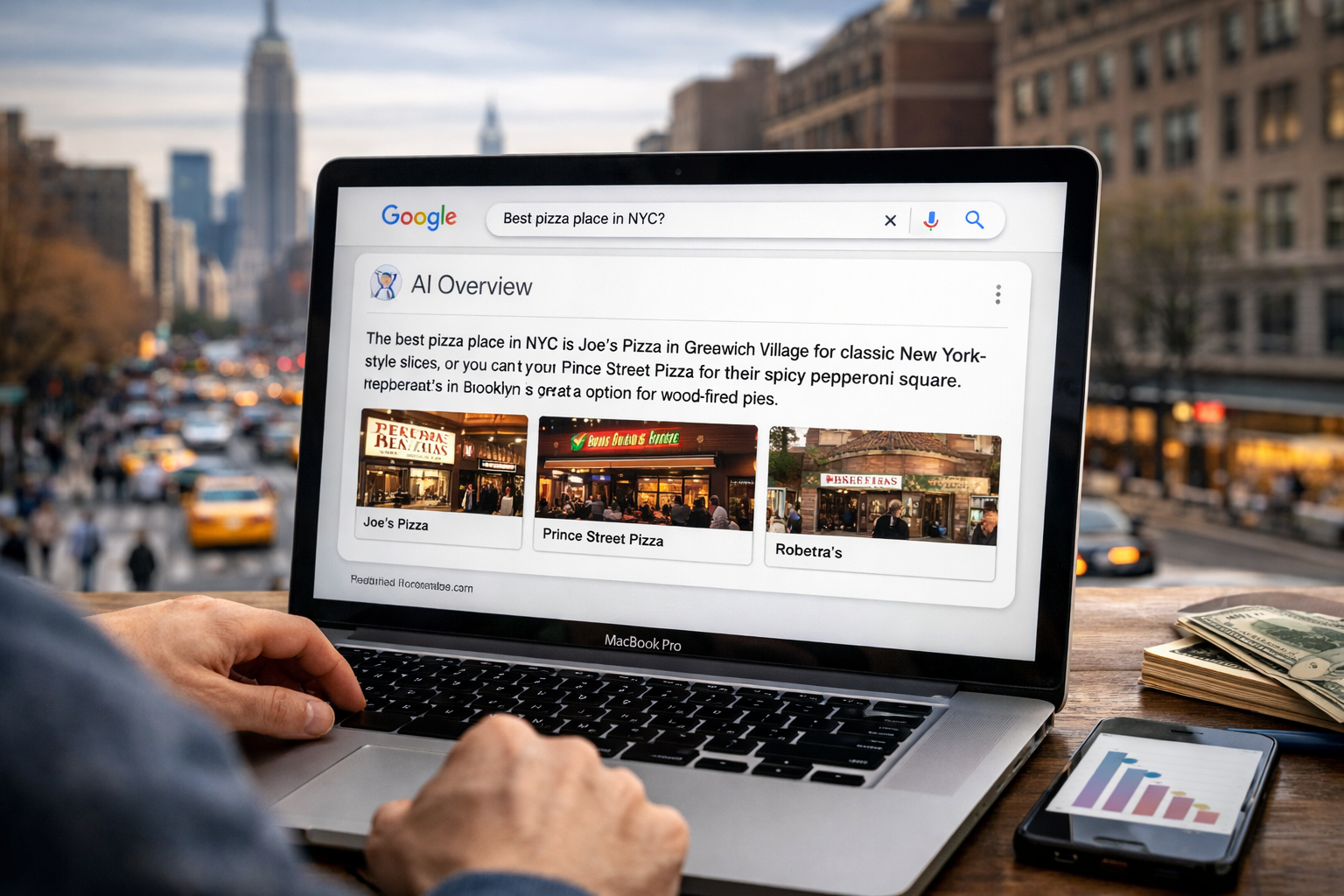
Open Google right now and search for almost anything informational — a service you offer, a question your customers ask, a problem your business solves. There's a decent chance the first thing you see is no longer a list of blue links. It's a boxed, AI-generated summary sitting at the very top of the page, synthesizing answers from across the web, with a handful of small source citations tucked underneath.
That box is Google's AI Overview. And if your business isn't cited in it — or worse, if your content is the kind that Google's AI is now answering directly so users never need to click anywhere — you have a problem that didn't exist eighteen months ago.
This is not a minor tweak to how search works. It is the most significant structural change to Google in a decade. And for New York businesses that depend on organic search traffic to generate leads, visibility, and revenue, understanding what's happening — and what to do about it — is no longer optional.
Let's break it all down in plain language.
What Google's AI Overviews Actually Are
Google's AI Overviews — formerly known as Search Generative Experience (SGE) during testing — are AI-generated summary panels that appear above traditional organic search results for a growing share of queries. Instead of showing users ten blue links and letting them click through to find answers, Google synthesizes information from across multiple web sources, writes a consolidated response, and displays it directly on the results page.
The format is hard to miss. It's a large, prominently placed box at the top of the page with a generated text answer and a small row of source links that Google cites as references. In many cases, the first organic search result you've spent months trying to rank for now appears significantly further down the page — or not at all on the initial screen view — because the AI box has taken over the top real estate.
Google rolled out AI Overviews to all U.S. users in May 2024, and they have been expanding rapidly ever since, now appearing in over 200 countries and 40 languages. Search Engine Journal
The growth rate since launch has been aggressive. By Q1 2026, analysis of 21.9 million searches showed 25.11% of all queries triggering an AI Overview — up dramatically from approximately 7.64% in February 2025. Some studies measuring specific query categories report rates as high as 48%. Digital Applied
In other words, roughly one in four Google searches now surfaces an AI-generated summary before any organic result. And that number is still growing.
The Traffic Numbers: How Much Are AI Overviews Actually Hurting Clicks?
This is where it gets serious for business owners, and where the data is stark enough that it's worth spending real time on.
When Google answers a question directly on the results page, users don't need to click anywhere to get what they came for. They read the summary, get their answer, and leave. Your website never enters the picture. This is what the industry calls a zero-click search — and AI Overviews are accelerating it dramatically.
Only about 8% of users click on a result when an AI Overview is present, compared to 15% without one. About 26% of users end their search session entirely after seeing an AI Overview — meaning they got their answer and left Google altogether. SeoProfy
The click-through rate data tells the same story from the performance side. Seer Interactive's September 2025 study — analyzing 3,119 informational queries across 42 organizations and tracking 25.1 million organic impressions — found that organic click-through rates plummeted 61% for queries where AI Overviews appear, dropping from 1.76% to 0.61%. Dataslayer
That's not a rounding error. That's losing more than half your clicks on affected searches.
The most rigorous controlled study on this subject — conducted by Pew Research Center across 68,000 real search queries — found a 46.7% relative decline in click rates when AI Overviews appear, with users clicking results just 8% of the time with AI Overviews present versus 15% without them. Stackmatix
And the damage is not evenly distributed. Informational content — the how-to posts, the explainer articles, the FAQ pages that most businesses use to attract top-of-funnel traffic — is hit hardest. Informational queries have seen 30 to 40% organic traffic declines, as AI responses answer these questions directly and users never scroll to organic results at all. Digital Applied
For New York businesses that have invested in content marketing as a traffic strategy, this is the specific area of exposure that demands immediate attention.
Which New York Businesses Are Most at Risk
Not every business is equally exposed to AI Overviews. The impact varies significantly by content type, industry, and the kinds of searches your customers are doing. Understanding where you sit on that spectrum determines how urgently you need to act.
Highest risk: Businesses whose website traffic comes primarily from informational searches — how-to content, definition pages, comparison articles, FAQ pages. If someone searches "how does X work" or "what is Y" and your blog post used to rank for that, Google's AI is now answering it directly. Health-related queries trigger AI Overviews in 51.6% of cases, and informational queries see the highest exposure rates overall. Stackmatix Professional services firms, financial advisors, healthcare providers, and legal practices in New York that built content around educational topics are squarely in the high-risk category.
Moderate risk: Businesses competing for commercial comparison queries — "best [service] in New York," "top [industry] companies," "[service] vs [service]" — are seeing growing AI Overview presence on these searches too. AI Overviews now appear in 82% of B2B technology searches, up significantly from 36% in 2025. Wyoming News If you're a B2B company in New York selling technology, software, or professional services and your prospects search comparative queries, AI Overviews are very likely intercepting those searches.
Lower risk — for now: Businesses whose customers primarily do transactional searches — "buy X," "schedule appointment," "contact [specific business name]" — are less immediately impacted because Google has strong commercial incentives to preserve ad-driven results on transactional queries. Local searches with immediate intent — "plumber near me," "restaurant open now" — also behave differently and are somewhat more protected. But even these categories are seeing AI Overview creep as Google expands the feature.
The honest assessment for most New York businesses is that if organic search is a meaningful part of how you get found, some portion of your traffic is already being affected. The question is how much, and whether you're measuring it.
The Most Important Number Nobody Is Talking About
Here's the data point that completely reframes how to think about AI Overviews — and why this is not purely a doom-and-gloom story.
Brands that are cited in AI Overviews — meaning Google's AI references your website as a source in its generated answer — earn 35% more organic clicks and 91% more paid clicks compared to brands on the same queries that are not cited. Dataslayer
Read that again. Being cited inside an AI Overview doesn't just protect you from the traffic loss. It actively generates more traffic than you were getting before.
AI Overview traffic converts at 14.2% versus traditional organic traffic's 2.8% — a five times quality premium. AveriThe visitors who arrive at your site from an AI Overview citation are not casual browsers. They've already seen a summary that referenced your business as an authoritative source. They arrive pre-qualified, more engaged, and more likely to take action.
This is the core strategic insight for New York businesses right now: the goal is not to mourn the loss of undifferentiated organic traffic. The goal is to become one of the small number of sources that Google's AI chooses to cite. That position is more valuable than a traditional ranking ever was.
Only 274,455 domains have ever appeared in AI Overviews out of 18.4 million domains in Google's index. Averi That's an extraordinarily competitive citation pool — but it's also an extraordinarily clear opportunity for businesses that act now while most of their New York competitors haven't started thinking about this yet.
How Google Decides Who Gets Cited
Understanding the selection process is essential before you can do anything about it. Google's AI doesn't select citations randomly, and it doesn't select them purely based on who ranks #1 organically. The selection criteria are meaningfully different from traditional SEO ranking factors — which is both the challenge and the opportunity.
When you are cited in an AI Overview, you get 35% more organic clicks and 91% more paid clicks compared to when you are not cited at all. And critically — 46.5% of cited URLs rank outside the top 50 in traditional organic results. Seer Interactive That means you do not need to be winning the traditional SEO game to get cited by Google's AI. You need to be the clearest, most trustworthy, most extractable answer to the question being asked.
The factors that drive AI citation are different from the factors that drive traditional rankings:
Clarity and extractability. The winning strategy is not "rank higher" — it is "become the safest, clearest source to cite." When your page makes extraction easy and risk low, Google has a strong reason to cite you. InfinitemediaresourcesThis means answering questions directly and immediately, not burying the answer in paragraphs of preamble. The AI is looking for a clean, specific, attributable answer it can pull and present with confidence.
Entity authority and brand consistency. Google's AI needs to know who you are across the web, not just on your website. Protecting your reputation requires consistent entity mapping across the web — ensuring your name, address, and phone data is consistent, focusing on high-quality PR, and cultivating authoritative mentions from third-party sites. Gracker For New York businesses, this means your Google Business Profile, your LinkedIn, your industry directory listings, and any press coverage all need to be consistent and authoritative.
E-E-A-T signals. Google's content quality framework — Experience, Expertise, Authoritativeness, and Trustworthiness — is the lens through which AI citation decisions are made. Every piece of content on your website should have a named author with a bio that includes their credentials, experience, and a link to their LinkedIn profile. The author's credentials should be relevant to the content. T2 Consulting Vague "posted by admin" attributions are invisible to AI systems. Named, credentialed experts with verifiable backgrounds get cited.
Specific, citable facts. The content that AI systems cite most frequently is specific, factual, and attributable. Vague claims — "we help businesses grow" — are not citable. Specific claims backed by data, named results, and verifiable evidence are exactly what AI systems are trained to surface. T2 Consulting
Off-site mentions and third-party citations. Online brand mentions show the strongest correlation to being cited in AI Overviews, even stronger than traditional backlink signals. Every time your brand appears in a credible context across the internet, Google's AI takes note. Growly Digital For New York businesses, this means digital PR — getting your company mentioned in legitimate publications, industry outlets, and credible third-party sources — has become more SEO-valuable than ever.
The Seasonal Calendar: Month-by-Month Reality Check
Understanding what AI Overviews mean is important. Knowing what to actually do about it is what matters. Here is a concrete action plan for New York businesses, organized from the most accessible moves to the longer-term strategic shifts.
Audit your current exposure first.
Before changing anything, find out how badly AI Overviews are affecting your specific business. Open Google Search Console, look at your top organic pages, and check whether click-through rates have declined over the past 12 months on pages that drive significant traffic. Then manually search your most important keywords in Google and observe how often AI Overviews appear. This tells you the scope of your exposure before you invest in solutions.
Restructure your content for extractability.
Every header in your content should be a gateway to a direct, factual answer. You need to be modular — if your article is a rambling essay without clear signposts, the AI will get lost. Gracker Practically, this means: put the direct answer to the question immediately after the heading that asks it. Use numbered lists and clear step-by-step structures. Add FAQ sections at the end of key pages. Make it as easy as possible for an AI system to pull a clean, specific answer from your content without having to read five paragraphs of context first.
Add schema markup to your key pages.
Adding structured data like FAQPage, HowTo, Article, Organization, and Person schema helps Google's AI understand your content faster and more accurately. Pages with proper schema are easier for AI systems to parse and extract information from, which increases the likelihood of being cited inside an AI Overview. Growly Digital This is a technical change that requires some development work, but it's one of the highest-leverage things you can do and most New York businesses have not done it.
Check your AI crawler permissions.
Most website platforms have robots.txt files that block AI crawlers by default or by accident. GPTBot from OpenAI, PerplexityBot, ClaudeBot from Anthropic, and Google-Extended all need explicit permission to crawl your site. If your robots.txt is blocking these crawlers, you are invisible to the AI systems that use them. T2 Consulting This takes five minutes to check and fix and could be the reason you're invisible in AI results right now.
Build your off-site presence deliberately.
For New York businesses, the city itself is an asset here. There are more legitimate press outlets, industry publications, trade associations, and local business media in New York than almost anywhere else in the country. A mention in a credible publication, a podcast appearance, a speaking engagement write-up, or a press release picked up by a wire service — all of these create the cross-source consistency that AI systems interpret as credibility. T2 Consulting A digital PR strategy that earns your business mentions in New York-relevant and industry-relevant publications is now a direct input into AI citation probability.
Shift your content focus toward specific, answerable questions.
Long-tail keywords with clear intent signals perform particularly well for AI Overview citations. Instead of targeting broad terms like "marketing strategy," focus on specific questions like "how to create a marketing strategy for a small business." Snezzi For New York businesses, this means creating content that directly answers the precise questions your customers are typing into Google — not broad category content, but specific, intent-driven answers to real buyer questions.
Start tracking AI visibility as its own metric.
Traditional rank tracking tools are not enough anymore. In 2026, you need to monitor AI visibility as its own metric. Growly Digital Tools like Semrush's AI Toolkit, Otterly.AI, and Profound allow you to track how often your brand appears in AI-generated answers across Google, ChatGPT, and Perplexity. If you're not measuring this, you have no idea whether your efforts are working.
The Bigger Picture: This Is Not Going Backward
It's worth being clear-eyed about the trajectory here, because some business owners are hoping this is temporary — that Google will dial back AI Overviews or that the landscape will normalize back toward traditional search.
The data does not support that hope. Google AI Mode has reached 75 million daily active users and over 100 million monthly active users by early 2026, representing a 4x increase since its May 2025 launch. It has expanded to 53 additional languages and over 40 markets, making AI-first search a mainstream behavior rather than an experimental feature. Digital Applied
Multiple analysts predict zero-click searches will continue rising toward 70% of all queries by late 2025 or early 2026. The Digital Bloom Google's own financial results suggest there's no business reason for the company to reverse course — Google's Q4 2025 search revenue of $63 billion was up 17% year-over-year, suggesting that AI features are expanding the advertising surface area rather than shrinking it. Digital Applied
The companies that will win in this environment are not the ones that wait and see. They're the ones that understand the new rules, restructure their content and digital presence accordingly, and get into the citation pool before it becomes even more competitive.
The vast majority of local service businesses have not updated their websites for AI visibility, have not implemented schema markup, and have not thought strategically about their E-E-A-T signals. The businesses that act in 2026 are building an advantage that will compound as AI search continues to grow. Get-ai-visible
That statement applies directly to New York. The competitive landscape here is intense — but the adoption gap is just as real here as anywhere else. Most of your New York competitors are not thinking about this yet. That gap will not last.
Bottom Line
Google's AI Overviews are not a bug. They are not temporary. They are the new architecture of search, and they are already changing how New York businesses get found — or don't get found — online.
The businesses that treat this as a passive problem to monitor will watch their organic traffic erode month by month. The businesses that understand the new rules — get cited, build entity authority, structure content for extractability, earn off-site mentions — will capture a more valuable kind of visibility than traditional search ever offered.
Your organic traffic number may get smaller. Your quality of traffic, and your ability to command the AI's recommendation, can get dramatically better. That's the trade, and the businesses that make it intentionally will be the ones still generating leads from Google in 2027 and beyond.
Not sure how exposed your New York business is to Google's AI Overviews — or what it would take to start getting cited?
Ritner Digital works with New York businesses to audit their current AI search visibility, restructure content for citation, and build the off-site authority signals that get brands into Google's AI recommendations. If you want to know exactly where you stand and what to do about it, let's talk.
Get your free AI search visibility audit from Ritner Digital →
Sources: Seer Interactive AIO CTR Impact Study (September 2025), Pew Research Center Search Behavior Study (68,000 queries), Digital Applied AI Search Statistics (Q1 2026), Conductor Query Analysis (21.9M searches, Q1 2026), Search Engine Journal AI Overviews Publisher Impact Report, Stackmatix Google AI Overview SEO Impact (2026), SeoProfy AI Overviews Statistics (2026), Dataslayer AIO CTR Analysis.
Frequently Asked Questions
My website traffic looks fine right now. Does that mean AI Overviews aren't affecting me?
Not necessarily, and this is one of the most dangerous assumptions a New York business owner can make right now. AI Overview impact is often invisible in top-line traffic dashboards because it shows up as a gradual, slow erosion of click-through rates rather than a sudden dramatic drop. Your impressions — the number of times your site appears in search results — may actually be increasing while your clicks quietly decline, because more people are seeing your page in results but getting their answer from the AI box above it and never clicking through. The way to actually know your exposure is to go into Google Search Console, look at your most important pages individually, and compare click-through rates over the past 12 to 18 months. If you're seeing impressions hold steady or grow while clicks and CTR decline on the same pages, AI Overviews are almost certainly the cause. Don't wait for a traffic cliff to investigate. The erosion is already happening for most businesses — it's just happening slowly enough that most don't notice until the damage is significant.
Are AI Overviews affecting my Google Ads too, or just organic search?
Both, and the paid search impact is actually more severe in some measurements than the organic impact. The same Seer Interactive study that found organic click-through rates falling 61% on AI Overview queries found paid click-through rates falling 68% on the same queries. The mechanism is the same — when an AI-generated summary answers the question at the top of the page, users have less reason to click on anything below it, whether that's an organic result or a paid ad. This has significant implications for New York businesses running Google Ads campaigns. If you're paying per click on informational or educational queries where AI Overviews are now appearing, you may be paying for impressions that are producing fewer clicks than they used to. The smart response is to audit your paid campaigns for query types that are most vulnerable to AI Overviews — primarily informational queries — and consider shifting that budget toward more transactional, intent-driven searches where AI Overview presence is lower and conversion probability is higher.
You mentioned that being cited in an AI Overview actually increases clicks. How does that work if fewer people are clicking overall?
It seems counterintuitive but the data is consistent across multiple studies. When an AI Overview appears and your business is cited as one of the source references, users who do click — and some always will, especially for complex or high-stakes decisions — are disproportionately likely to click on a cited source rather than a traditional organic result. Being cited functions as an AI endorsement. Google's system has essentially told the user "this is a trustworthy source for this information," and that implicit credibility drives higher click probability among the users who are still clicking. The traffic converts better too — cited visitors arrive having already seen your brand vouched for by Google's AI, which pre-qualifies them in a way that traditional organic clicks don't. So the total click pool is smaller, but cited businesses capture a larger and higher-quality share of that pool. It's a smaller river, but being cited is the equivalent of having a dam that captures most of what flows through it.
We're a local New York service business — plumber, contractor, that kind of thing. Should we be as worried about this as a B2B company?
Your exposure profile is different but it's not zero. Local transactional searches — "emergency plumber Brooklyn," "HVAC repair Manhattan," "contractor near me" — are currently less impacted by AI Overviews because Google has strong commercial incentives to preserve ad-driven local results on high-intent searches. Your Google Business Profile and local pack results are relatively more protected right now. However, the informational content that local service businesses often use to attract top-of-funnel traffic — "how much does a bathroom remodel cost in NYC," "signs you need a new roof," "when to call a plumber versus DIY" — is exactly the kind of content AI Overviews are answering directly. If you have a blog or resource section built around educational content, that portion of your traffic is at risk. The good news is that the citation opportunity exists for local businesses too, and your competitors in the New York trades market are almost certainly not thinking about this yet. Getting cited in AI responses for local informational queries is a meaningful competitive advantage that most local service businesses haven't even considered.
How long does it take to start getting cited in AI Overviews once you make changes?
It varies, and honest expectations matter here. Technical changes — restructuring content for extractability, adding schema markup, fixing AI crawler permissions in your robots.txt — can begin showing impact within four to eight weeks because they directly affect how Google's systems parse and evaluate your content. These are your fastest wins and should be prioritized first. Building entity authority and off-site mentions — the digital PR work, the third-party citations, the consistent brand presence across the web — is a three to six month effort before you see meaningful citation movement. This is similar to the timeline for traditional link building SEO, because you're essentially building the same kind of credibility signals, just optimized for AI selection rather than traditional ranking. The brands seeing measurable citation improvements within 90 days are typically the ones who combine the fast technical changes with immediate content restructuring. The ones waiting six months are usually the ones who only focused on one element and didn't take a comprehensive approach. Start with the technical and content changes immediately, run the off-site strategy in parallel, and measure monthly.
Does this mean our regular SEO work is now wasted? Should we stop focusing on traditional rankings?
No, and this is an important clarification. Traditional SEO and AI Overview optimization are not competing strategies — they're complementary, and strong traditional SEO is actually the foundation that makes AI citation more likely. The data is clear on this: while 46.5% of AI Overview citations come from pages that don't rank in the top 10, the majority of citations still come from pages with strong traditional SEO signals — good domain authority, quality backlinks, solid technical SEO. What's changed is that ranking alone is no longer sufficient. A page that ranks number one but is written as a flowing narrative essay with no clear extractable answers and no schema markup may get fewer AI citations than a page ranking number fifteen that is structured perfectly for AI extraction. The formula in 2026 is traditional SEO as the foundation plus AI optimization as the layer on top. Neither alone is as effective as both together.
What is GEO and how is it different from SEO? We're seeing this term more and more.
GEO stands for Generative Engine Optimization, and it's the emerging discipline of optimizing your content and digital presence specifically to appear in AI-generated answers — not just traditional search rankings. Traditional SEO is about getting your pages to rank high in the list of blue links. GEO is about getting your brand cited inside the AI summary that appears before those blue links. The underlying goal is similar — visibility and traffic — but the tactics are different enough that they warrant separate strategic thinking. SEO prioritizes keywords, backlinks, and technical site health. GEO prioritizes content clarity and extractability, entity authority and brand consistency across the web, off-site citations and mentions, named expert authorship, and specific factual claims that AI systems can pull and attribute confidently. For New York businesses in 2026, having an SEO strategy without a GEO strategy is like having a great storefront but no presence in the neighborhood everyone is moving to. Both matter. The businesses winning in search right now are doing both.
Can we just pay Google to appear in AI Overviews the way we pay for regular ads?
Not directly — at least not yet in the traditional sense. AI Overviews are organic citations, meaning Google selects them based on content quality and authority signals, not advertising spend. You cannot buy your way into a citation the way you buy a top ad position. However, Google is rapidly monetizing AI search surfaces in other ways. Ads are now appearing alongside AI Overview results, and Google has been testing sponsored content formats within AI responses. These are paid visibility opportunities adjacent to AI Overviews but distinct from organic citations. The important nuance is that being cited organically and running ads in the same AI Overview context creates a compounding visibility effect — users see your brand both as the cited expert source and as the advertiser, which reinforces credibility and significantly increases click probability. For New York businesses with advertising budgets, layering paid visibility in AI search surfaces on top of an organic citation strategy is the highest-leverage combination available right now.
Which New York industries are most at risk from AI Overviews right now?
Based on the data about which query types trigger AI Overviews most frequently, the New York industries with the highest exposure are professional services — law firms, accounting firms, financial advisors, management consultants — because their prospects search informational and educational queries heavily before making contact. Healthcare and wellness providers are similarly exposed, as health-related queries trigger AI Overviews at extremely high rates. B2B technology companies are seeing AI Overviews on over 80% of their category searches as of early 2026, making this one of the most urgently affected segments in the New York market. Real estate companies, insurance brokers, and marketing agencies are all seeing significant AI Overview presence on their most important search categories. The businesses with the least immediate exposure are those whose customers primarily search with direct transactional intent — specific product searches, brand-name searches, immediate local service needs — but even these categories are seeing growing AI Overview presence as Google expands the feature into commercial query territory.