Why New York's Most Competitive Businesses Are Investing in Digital PR Right Now
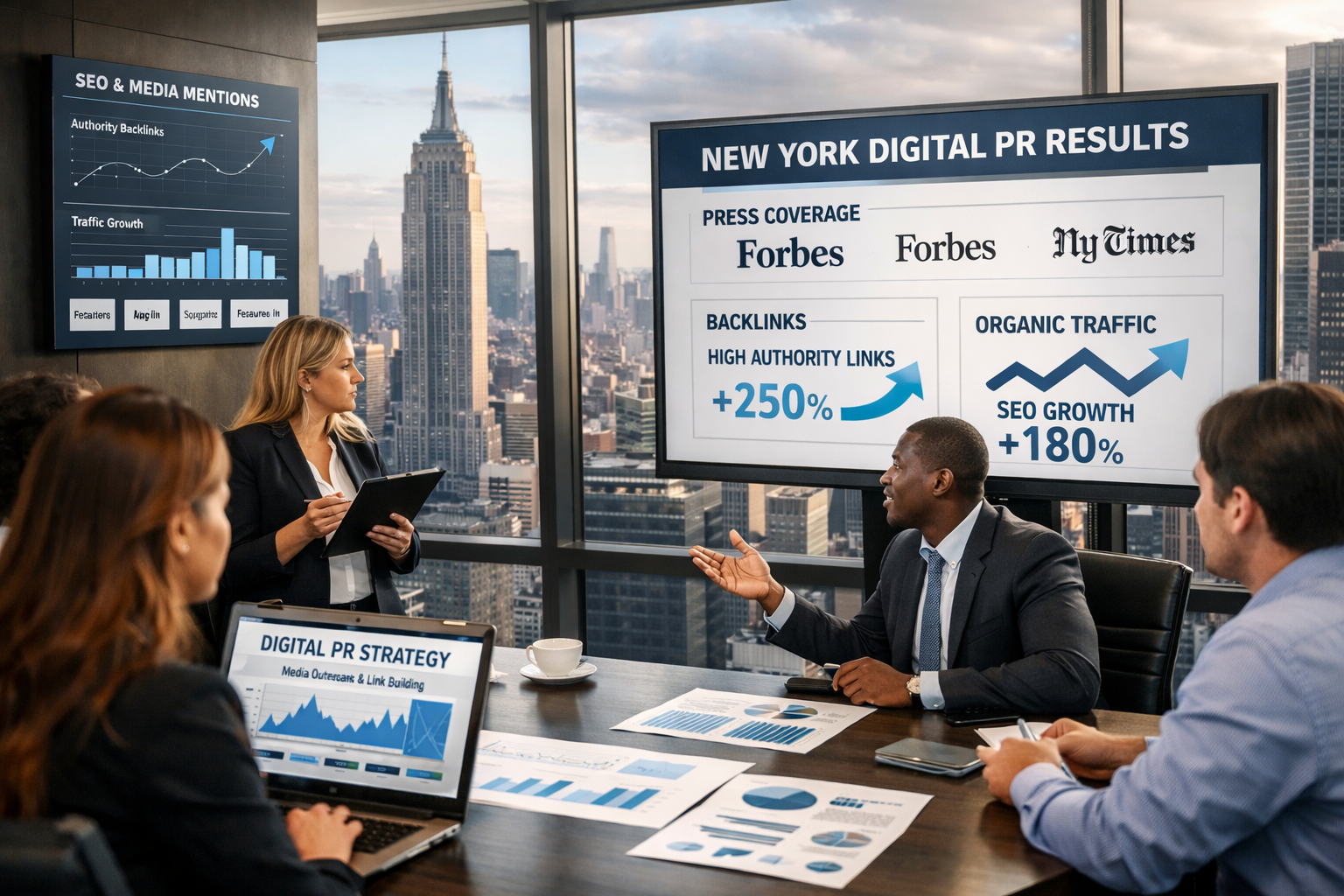
There's a strategy shift happening right now among New York's most competitive businesses that most business owners haven't noticed yet — and the ones who do notice it first are going to have a meaningful head start on everyone else.
The shift is this: the highest-performing companies in the most competitive markets are moving budget away from generic content production and toward digital PR — the deliberate, strategic work of earning editorial coverage, brand mentions, and high-authority backlinks from legitimate publications and credible third-party sources.
This isn't a trend born from a love of press coverage for its own sake. It's driven by two converging forces that are fundamentally rewriting the rules of digital visibility in 2026: Google's increasingly sophisticated ability to distinguish authoritative brands from commodity content producers, and the rise of AI-generated search that rewards third-party credibility over self-published claims.
For New York businesses operating in competitive markets — where the fight for first-page rankings and AI citation is genuinely intense — digital PR has moved from a nice-to-have to the single highest-leverage SEO investment available. Here's why, what the data says, and what it actually looks like in practice.
What Digital PR Actually Is (And What It Isn't)
Let's define the term clearly before we go further, because "digital PR" gets used loosely in ways that obscure what actually works.
Digital PR is the strategic practice of earning media coverage, brand mentions, and editorial backlinks from reputable online publications by creating genuinely newsworthy content, providing expert commentary, and building relationships with journalists and content creators who cover your industry.
The emphasis is on "earning." Digital PR earns links from high-authority domains — publications like major industry outlets, respected trade publications, and credible news sites — that competitors cannot replicate through standard outreach. Outpace These are not links you buy, not links from generic directory submissions, and not links from low-quality blogs that exist purely to host guest posts. They are editorial links — the kind that appear because a journalist or editor decided your brand, data, or expertise was worth referencing.
What makes digital PR different from traditional PR is that it's explicitly designed to produce SEO value alongside brand awareness. Every earned mention is a trust signal. Every editorial backlink is a vote of authority that search engines and AI systems use to evaluate whether your brand deserves to be recommended.
Digital PR is seen as the most effective link-building tactic by 48.6% of SEO professionals — far ahead of guest posting at 16% and creating linkable assets at 12%. Editorial That's not a close race. When the people who spend their careers building domain authority are asked what works best, nearly half of them point to digital PR without hesitation.
Why Digital PR Has Become the Highest-Leverage SEO Strategy Right Now
The timing of this shift is not accidental. Several forces have converged in 2025 and 2026 to make digital PR more valuable than it has ever been — and to make generic content production less valuable than it used to be.
The AI content flood has devalued undifferentiated publishing.
Every business can now produce content at scale using AI tools. The result is a web flooded with competent-but-generic articles, blog posts, and guides that say roughly the same things in roughly the same ways. Google has responded predictably. Google's March 2024 spam policy update targeted scaled content abuse — mass-produced AI content created with the intent to rank without adding real value — and subsequent 2025 updates continued penalizing low-effort AI-written sites with thin value signaling. Digital Web Solutions -
In this environment, generic content is a commodity. What isn't a commodity is third-party credibility — the kind that comes from being mentioned in real publications by real journalists. That credibility cannot be automated or scaled cheaply. It has to be earned, which is exactly why it's becoming more valuable as everything else gets cheaper.
Google's E-E-A-T framework rewards external validation above self-assertion.
Google's content quality framework — Experience, Expertise, Authoritativeness, and Trustworthiness — is the lens through which every piece of content is now evaluated. And the critical insight most businesses miss is where that evaluation actually happens.
E-E-A-T is often misunderstood. Most people believe it is something you personally control — authorship, author bylines, and having a page that explains why you are an expert. But what actually matters is that other people say you are the expert. Backlinks, brand mentions, podcast appearances, and social presence. You need consensus from others, not yourself. GoodFirms
In other words, writing blog posts explaining your expertise does not establish your expertise in Google's eyes. Other credible sources mentioning, citing, and linking to you does. Digital PR is the mechanism that generates that external consensus at scale.
Brand mentions now correlate more strongly with AI visibility than traditional backlinks.
The emergence of AI-generated search has added an entirely new dimension to why digital PR matters. As we covered in our previous post on Google's AI Overviews, getting your brand cited in AI-generated answers is one of the most valuable visibility positions in 2026 — and the path to citation is built almost entirely on third-party credibility.
Ahrefs studied 75,000 brands and found that branded web mentions — the exact type of coverage digital PR generates — had a correlation of 0.664 with AI Overview visibility. Traditional backlink metrics scored just 0.218. That's a three-to-one advantage. Reporteroutreach
90% of AI citations driving brand visibility originate from earned and owned media, not paid placements. Reporteroutreach You cannot buy your way into AI recommendations. You have to earn them through the kind of third-party credibility that digital PR builds.
The link quality gap has widened dramatically.
The average link earned with digital PR has a Moz Domain Authority of 43, with 32% of links coming from domains with a DA above 70. PRLab These are genuinely high-authority links from credible sources — the kind of links that meaningfully move domain authority, support competitive keyword rankings, and signal to both Google and AI systems that your brand is a trusted authority in your space.
Compare that to the links most businesses are building: directory submissions, low-DA guest posts, and link exchanges that Google has become increasingly sophisticated at identifying and discounting. The quality gap between a DA 70+ editorial link and a DA 20 directory link has never been wider, and the disparity in SEO value between them has never been greater.
The New York Advantage: Why This Market Is Uniquely Positioned for Digital PR
Here's something specific to the New York market that most generic digital marketing advice misses entirely: New York businesses have a structural advantage in digital PR that companies in most other markets simply don't have.
New York is home to a concentration of major media outlets, industry publications, trade journals, podcasts, and credible content platforms that is unmatched anywhere else in the country. The Wall Street Journal. Business Insider. Forbes contributors based in the city. Industry-specific publications covering finance, real estate, healthcare, technology, professional services, and virtually every B2B vertical that matters. Podcast networks. LinkedIn thought leaders with large professional followings. Local business press like Crain's New York Business.
Every one of these outlets is a potential source of the high-authority mentions and backlinks that digital PR is designed to earn. And because these outlets are geographically and contextually relevant to your business, coverage in them carries additional local authority weight that out-of-state competitors cannot easily replicate.
For local businesses, links from local chambers of commerce, community organizations, and local news outlets carry particular weight. Unlinked brand mentions where publications mention your brand without hyperlinking have also gained importance as trust signals even without direct link equity. ALM Corp
The businesses in New York that are winning the digital visibility game right now — in finance, real estate, professional services, B2B technology, healthcare, and legal services — are the ones who have figured out that their proximity to this media ecosystem is an asset, and that activating it through digital PR produces compounding returns that paid advertising cannot match.
What Digital PR Actually Looks Like in Practice
This is where many business owners get stuck. Digital PR sounds strategically compelling in the abstract, but what does it actually involve day to day? What are the specific activities that generate the coverage and links that matter?
Original data and research campaigns.
The most effective link-building strategies in 2026 include creating original research that naturally earns citations from journalists, researchers, and industry publications. ALM Corp When your business produces a survey, a data study, or an industry report that reveals something genuinely interesting or counterintuitive about your market, journalists have a reason to cover it and cite it. The story belongs to you. Competitors can't replicate it. And the links it earns point back to your site as the original source.
For a New York B2B company, this might look like: a professional services firm surveying 200 New York small business owners about their biggest operational challenges in 2026 and publishing the results. A technology company analyzing publicly available data to reveal something new about a trend in their industry. A financial services firm publishing proprietary insights about market behavior they observe in their client base. Original data is the single most effective content asset for earning high-authority editorial coverage.
Expert commentary and reactive PR.
Journalists covering breaking news and developing stories need expert sources. When a major story breaks in your industry, the reporters writing about it are actively looking for credentialed, quotable experts who can provide context and insight. Getting your executives positioned as go-to sources for journalists covering your industry is one of the most efficient forms of digital PR because it requires no upfront content creation — just timely, substantive commentary delivered quickly.
Google's own John Mueller has publicly stated that digital PR can be more impactful for SEO than technical optimization. Outpace The reason is precisely this kind of earned expert coverage — mentions in credible publications that establish your brand's authority far more powerfully than any amount of on-site optimization can.
Platforms like HARO (Help A Reporter Out), Qwoted, and Quoted allow businesses to respond directly to journalist source requests, making expert commentary scalable even for small teams.
Thought leadership placement.
Getting your executives' bylines placed in credible industry publications — not low-quality guest post farms, but genuine trade publications and respected industry outlets — builds both brand authority and the external citations that Google and AI systems use to evaluate credibility. A placement with a respected industry podcaster, a mention in a niche newsletter with a loyal following, or a guest contribution on an authoritative platform can all drive meaningful referral traffic and brand authority signals. Apache Interactive
For New York businesses in professional services, finance, real estate, and B2B technology, there are genuine opportunities to contribute substantive pieces to publications that their buyers actually read. This creates a double return: direct exposure to a relevant audience and the SEO authority that comes from the editorial backlink.
Data-led press release distribution.
A well-crafted press release built around genuine news — a client result, a product launch with meaningful data, a survey finding, a milestone — distributed to the right targeted outlets can earn multiple editorial pickups and the backlinks that accompany them. High-performing press releases typically earn between 5 and 20 backlinks per campaign, according to 54% of SEO experts. PRLab
The key distinction is "well-crafted" and "genuine news." Generic announcements distributed through mass wire services produce negligible SEO value. Targeted, data-rich press releases delivered to relevant journalists at publications with real editorial standards produce the kind of coverage that compounds over time.
Building a consistent cadence, not one-off campaigns.
The most important thing to understand about digital PR is that it's not a campaign you run once. It's a function you maintain. The brands winning in 2026 will be those who can tell a coherent story from PR mention to brand search volume increase to organic traffic to lead generation. Apache Interactive That story requires consistent activity over months and years, not a single spike of press coverage followed by silence.
Domains with millions of brand mentions on platforms like Quora and Reddit have roughly four times higher chances of being cited by AI systems than those with minimal activity. Position Digital Consistency of presence across the web — not just quantity of any single type of mention — is what builds the kind of brand authority that AI systems recognize and reward.
The ROI Case: Why Digital PR Outperforms Most Alternatives
The legitimate question any New York business owner should ask is: compared to what I'm currently spending on paid advertising, content production, or other SEO activities, what does digital PR actually return?
The honest answer is that digital PR has a higher upfront effort cost and a longer time-to-result than paid advertising. You won't see traffic from a digital PR campaign the week you launch it the way you might see clicks from a Google Ads spend. But the nature of the return is fundamentally different.
Paid advertising stops working the moment you stop paying. Every dollar you spend on Google Ads or Meta Ads produces traffic that disappears when the budget runs out. Digital PR produces assets — editorial links, brand mentions, indexed coverage — that continue generating SEO value indefinitely. A link from a DA 75 publication that you earned through a data study in 2026 is still passing authority and supporting your rankings in 2029.
AI-referred visitors convert at 23 times higher rates than traditional organic search visitors. Reporteroutreach If digital PR is what gets your brand cited in AI-generated answers — which the data strongly suggests it is — then the quality of the traffic it ultimately generates is dramatically superior to the commodity organic traffic that undifferentiated content production chases.
The digital PR services market is projected to reach $25.4 billion by 2032, more than doubling from 2023 estimates. Apache Interactive That growth trajectory reflects where budgets are moving as businesses recognize that earned media is becoming the foundation of durable digital authority — not a supplement to it.
For New York businesses specifically, the ROI calculation also includes competitive differentiation. In markets as competitive as New York finance, real estate, legal services, and B2B technology, the businesses that establish genuine editorial authority create a moat that is genuinely difficult for competitors to cross. You cannot outspend someone into DA 80 editorial links. You can only out-earn them through superior content, genuine expertise, and consistent relationship-building with the media ecosystem.
The Compounding Effect: Why Starting Now Matters
Here's the piece of the digital PR story that most urgently applies to New York businesses right now: the advantage of early movers compounds in a way that makes the timing of the decision genuinely important.
Domain authority builds on itself. A business with a DA of 45 today, running consistent digital PR for 24 months, might reach DA 60. That DA 60 position makes future PR placements easier to earn because journalists and editors evaluate the credibility of sources partly based on their existing authority. The high-authority links you earn today make it easier to earn more high-authority links tomorrow. This is the compounding effect, and it does not benefit latecomers.
The brands that establish citation authority now will have compounding advantages that late movers can't overcome. Once an AI system selects a trusted source, it reinforces that choice across related queries — creating winner-takes-most dynamics that are hard to break. Reporteroutreach
In a market like New York, where your competitors are sophisticated and well-funded, the window for establishing first-mover digital PR advantage in your specific niche is real but finite. The professional services firm that starts building editorial authority in their vertical now, while most of their direct competitors are still relying on generic blog content and paid ads, is building a position that will be genuinely difficult to dislodge two years from now.
In 2026, digital PR is not optional. It is how trust is built, how visibility is earned, and how brands grow. Linkifi That assessment is particularly acute in New York, where the concentration of media resources creates both exceptional opportunity and exceptional competition for the businesses that understand what's at stake.
What to Do First: Getting Started With Digital PR in New York
If you're a New York business that hasn't invested seriously in digital PR, here's where to start.
Audit your existing external mentions. Before building new coverage, understand what exists. Search your brand name in Google, use a tool like Ahrefs or SEMrush to check your existing backlink profile, and identify what publications have already mentioned you — and which haven't. This gives you a baseline and often surfaces existing relationships you can deepen.
Identify your most newsworthy data. Every business has internal data that would be interesting to journalists covering their industry. Client results, operational metrics, trend observations from your work in the market — identify what you know that others don't and that journalists covering your space would find genuinely useful. This becomes the foundation of your first data-driven PR campaigns.
Map your target publication landscape. Make a list of the 20 to 30 publications, outlets, journalists, and podcasts that your ideal buyers actually consume. These are your PR targets. They're not necessarily the biggest names — they're the most relevant ones. A mention in a respected industry trade publication read by your exact buyers is more valuable than a mention in a general business outlet that reaches a broad but unfocused audience.
Start with expert commentary. The fastest path to initial coverage is responding to journalist source requests via platforms like HARO or Qwoted. These let you get quoted in legitimate publications without needing to pitch original story ideas — you just need to provide timely, substantive, quotable expertise. Start here, build your first few editorial mentions, and use those as proof points for more ambitious outreach.
Commit to consistency over time. Digital PR that produces results is not a one-quarter initiative. It's a 12 to 24-month commitment to building the kind of external authority that compounds. Budget for it accordingly, track the right metrics — domain authority trajectory, referring domain growth, AI citation frequency, branded search volume — and measure against those metrics over realistic timeframes.
Bottom Line
The New York businesses that are pulling ahead of their competitors in organic search, AI visibility, and digital authority right now have one thing in common: they've recognized that genuine third-party credibility — earned through editorial coverage, expert mentions, and digital PR — is the foundation of durable digital visibility in 2026.
Generic content production is getting cheaper and more commoditized every month. Paid advertising continues to deliver diminishing returns as competition for clicks intensifies. But editorial authority — the kind that comes from being mentioned by credible sources, cited by AI systems, and recognized as an expert by the publications your buyers trust — is getting more valuable as everything around it gets noisier.
New York gives you access to one of the richest media ecosystems in the world. The businesses that are learning to activate it deliberately, consistently, and strategically are building a competitive advantage that their competitors cannot easily replicate or buy their way around.
Ready to build the kind of editorial authority that moves your New York business to the top of search results and into Google's AI recommendations?
Ritner Digital helps New York businesses develop and execute digital PR strategies that earn high-authority coverage, build domain authority, and position your brand for AI citation. We connect your expertise to the publications and platforms that matter most to your buyers — and we measure every step in terms of real SEO and business outcomes.
Talk to Ritner Digital about your digital PR strategy →
Sources: Cision Inside PR 2026 Report, BuzzStream State of Digital PR 2026, Editorial Link Link Building Statistics (518 SEO Experts, 2025–2026), Ahrefs Brand Mention & AI Citation Study (75,000 brands), Seer Interactive Digital PR Data, Digitaloft/Reboot Online Campaign Benchmarks, GoodFirms SEO Statistics 2026, Digital Web Solutions SEO Predictions 2026.
Frequently Asked Questions
What's the difference between traditional PR and digital PR? Aren't they basically the same thing?
They share the same core goal — getting your brand covered by credible sources — but the strategy, execution, and measurable outcomes are meaningfully different. Traditional PR is primarily focused on brand awareness and reputation management. It targets broadcast media, print publications, and mainstream press, and success is typically measured in impressions, reach, and sentiment. Digital PR is explicitly built around SEO outcomes. Every campaign is designed not just to generate coverage but to earn the editorial backlinks and brand mentions that improve domain authority, support keyword rankings, get your brand cited by AI systems, and ultimately drive organic traffic that converts. The channels are also different. Digital PR targets online publications, industry blogs, podcasts, newsletters, and digital-native outlets — the places where links actually live and where Google and AI systems crawl to evaluate credibility. A feature in the print edition of a trade magazine has real brand value but zero SEO value. The same story published on that magazine's website with a link to your site has both. Digital PR is traditional PR with SEO strategy built into every decision.
We're a small business, not a major brand. Is digital PR realistic for us or is it only for big companies with big PR budgets?
Digital PR is genuinely accessible to businesses of all sizes, and in some ways smaller, focused businesses have an advantage over large corporations because they can move faster and speak with more specific expertise. The most effective digital PR for smaller businesses doesn't require a massive budget or a full agency retainer — it requires genuine expertise, a willingness to share it publicly, and consistency over time. The fastest and most cost-effective entry point for a small New York business is expert commentary. Platforms like HARO, Qwoted, and Quoted are free to use and let you respond directly to journalist source requests. When a reporter covering your industry is looking for an expert quote, you can provide it, get cited in their piece, and earn a legitimate editorial backlink — all without pitching a story or paying for placement. Starting there costs nothing but time and produces real results. As you build your first mentions and establish credibility as a source, you can expand into more ambitious data-led campaigns and proactive media outreach. The compounding nature of digital PR means that even a modest, consistent effort over 12 months produces meaningful authority gains that a one-time campaign never could.
How is digital PR different from just buying backlinks? Both seem to involve getting links from other sites.
The difference is fundamental and the distinction matters enormously for your SEO. Bought backlinks come from sites that sell link placements — typically low to medium authority blogs, link farms, or private blog networks that exist primarily to sell links rather than to serve genuine audiences. Google has become increasingly sophisticated at identifying and discounting these links, and aggressive paid link building carries real penalty risk that can damage rankings rather than improve them. Digital PR earns editorial backlinks from publications that have genuine editorial standards and real audiences. A journalist or editor at a legitimate publication decided your brand, data, or expertise was worth referencing — and that editorial judgment is exactly what Google is trying to reward when it evaluates backlink quality. The links that result from digital PR are the kind that Google's own John Mueller has publicly said can be more impactful for SEO than technical optimization. The links that result from buying placements are the kind Google's algorithms are actively trying to identify and devalue. Beyond the quality difference, digital PR also produces brand mentions, referral traffic, audience exposure, and AI citation signals that purchased links never generate. It's not just a safer version of the same thing — it's a fundamentally different and more valuable strategy.
How long does it take to see results from digital PR? We need leads now, not in two years.
Digital PR works on a longer timeline than paid advertising, and being honest about that upfront is important. The first editorial placements can happen within the first four to eight weeks if you're actively responding to journalist source requests, which is the fastest path to initial coverage. Meaningful domain authority movement typically becomes visible within three to six months of consistent activity. Competitive keyword ranking improvements driven by digital PR backlinks generally take six to twelve months to materialize fully. The reason the timeline is longer is that you're building a durable asset — editorial authority — rather than renting visibility the way paid ads work. The trade-off is that once built, that authority continues generating value indefinitely without ongoing spend, whereas the moment you stop paying for ads, the traffic stops. For businesses that genuinely need leads right now, digital PR should be run alongside paid acquisition, not instead of it. Think of paid advertising as the short-term lead engine and digital PR as the long-term authority engine that eventually reduces your dependence on paid spend. Most New York businesses that are winning the organic search game right now are running both in parallel, with digital PR gradually shifting the balance as authority compounds.
What kinds of content actually earn editorial backlinks? We publish blog posts regularly but never get links from other sites.
This is the core content strategy question in digital PR and the answer is usually uncomfortable: most blog posts don't earn editorial backlinks because they don't give journalists or editors a reason to cite them. A well-written post about industry best practices, a list of tips, or a summary of common knowledge is valuable for your audience but it's not linkable in the editorial sense because there's nothing original in it that a journalist needs to reference. The content types that consistently earn editorial backlinks share one characteristic: they contain something that didn't exist before you published it. Original data from a survey you conducted. A proprietary analysis of trends your business observes in your work. A genuinely counterintuitive finding that challenges conventional wisdom in your industry. A comprehensive resource that becomes the definitive reference on a specific topic. Expert commentary that's more specific and credible than what other sources are providing. The formula isn't complicated but it does require investment: produce content that is genuinely original, backed by real data or expertise, and speaks to something journalists covering your industry actually care about. One well-researched data study that earns 15 links from legitimate publications does more for your domain authority than 50 generic blog posts that earn none.
Should we be targeting national publications or is New York-specific coverage more valuable for our business?
The honest answer is both, and the right balance depends on who your buyers are and where they go for information. For businesses whose customers are primarily in the New York market — local professional services, regional B2B companies, businesses targeting New York-based decision-makers — coverage in New York-specific publications like Crain's New York Business, local industry trade outlets, and NYC-focused digital media carries both SEO value and direct audience relevance. Your potential customers are more likely to see it, recognize the outlet, and associate your brand with local credibility. For businesses whose buyers are geographically distributed — national B2B companies, professional services firms serving clients across multiple markets, technology companies — national and industry-specific publications deliver broader reach and often higher domain authority. The practical strategy for most New York businesses is to start with hyper-relevant industry publications where your expertise is most directly applicable, layer in New York-focused business media for local authority, and pursue national tier-one placements as your digital PR program matures and your track record as a credible source grows. A mention in a respected New York industry outlet and a mention in a national publication are not competing for the same budget — they serve different but complementary purposes in your authority-building strategy.
We've tried pitching journalists before and never heard back. What makes digital PR actually work when cold outreach doesn't?
Cold outreach to journalists fails almost universally because journalists receive hundreds of pitches per week and most of them are irrelevant to what they're currently working on, generic in their framing, or self-promotional in a way that provides no value to the reporter's audience. The pitches that get responses share specific characteristics. They lead with a genuinely interesting finding or hook, not an introduction to your company. They explain immediately why the story matters to the journalist's specific readers, not why it matters to you. They're brief — three to five sentences maximum. They contain something the journalist can actually use: original data, a timely expert perspective on a breaking story, or a surprising angle on a topic they cover regularly. The most reliable path to consistent journalist engagement, though, isn't cold pitching at all — it's responding to active source requests through platforms like HARO and Qwoted, where reporters are explicitly looking for expert sources. Starting there builds your credibility as a reliable, quotable expert, and that track record makes your proactive pitches more likely to get read and responded to over time. Relationship building over time — engaging with journalists' published work, being a reliable and responsive source, and providing useful information even when you're not seeking coverage — also dramatically improves response rates compared to cold outreach to people who have never heard of you.
How does digital PR connect to getting cited in Google's AI Overviews? We read your previous post about AI Overviews and want to understand the link.
The connection is direct and it's one of the most compelling reasons digital PR has become so strategically important in 2026. When Google's AI system decides which sources to cite in an AI Overview, it is evaluating third-party credibility signals above almost everything else. The question the AI is essentially asking is: which brands are other credible sources referencing and trusting? Brand mentions across legitimate publications, editorial backlinks from authoritative sites, consistent presence in credible industry media — these are exactly the signals the AI uses to determine who deserves to be cited. Research tracking 75,000 brands found that branded web mentions had a correlation of 0.664 with AI Overview visibility, compared to just 0.218 for traditional backlink metrics. Digital PR is the primary mechanism for generating those branded web mentions at scale. Every time your business is quoted in a legitimate publication, every time an editor references your research, every time your brand appears in a credible third-party context, you are building the signal network that AI systems interpret as evidence of genuine authority. The businesses getting cited in Google's AI Overviews right now are overwhelmingly the ones with strong, consistent digital PR programs behind them — not just the ones with technically optimized websites. If AI citation is a goal, digital PR is not optional.
What metrics should we be tracking to know if our digital PR is actually working?
Most businesses track the wrong metrics for digital PR and end up either overvaluing vanity coverage or undervaluing genuine authority-building wins. The metrics that actually matter, in order of importance, are these. First, referring domain growth — the number of unique domains linking to your site, tracked monthly in Ahrefs or SEMrush. This is the purest measure of whether your digital PR is producing real backlink diversity. Second, domain authority trajectory — your DA or DR score trend over a three to six month rolling window. Single-month fluctuations are noise. A consistent upward trend over six months is signal. Third, organic keyword ranking movement for your target competitive terms — the downstream effect of authority-building on the rankings that actually drive leads. Fourth, branded search volume in Google Search Console — when your digital PR earns genuine coverage, people start searching for your brand directly, and that branded search growth is a strong proxy for real awareness-building. Fifth, AI citation frequency — how often your brand appears in AI-generated answers for your target queries, which you can track using tools like SEMrush's AI Toolkit or Otterly.AI. And finally, referral traffic from earned placements. Each of these metrics tells a different part of the story. Tracking all of them together gives you a complete picture of whether your digital PR investment is producing the compounding authority that justifies the work.