What It Means for a Site to Have "Expanding Trust" in Google — and Why It's the Real Engine of Long-Term Rankings
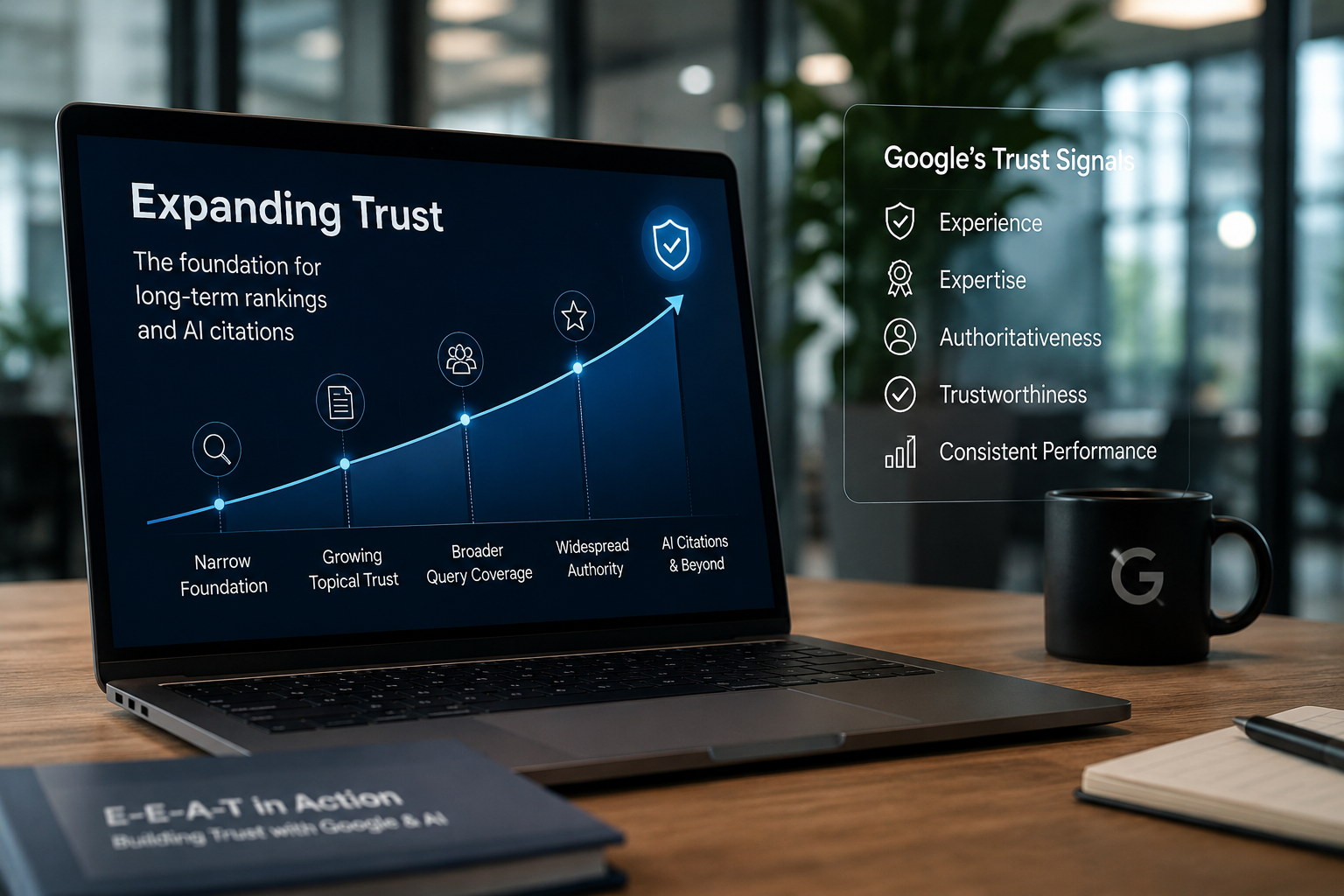
Most people think about Google rankings the way they think about a leaderboard: you're up, you're down, you fight for position on a given keyword. But that framing misses the thing that actually determines whether a site wins or loses over years rather than weeks. Underneath the rankings sits something slower, deeper, and far more durable — trust. And the most valuable property a website can develop isn't a high ranking on one term. It's expanding trust: a site's credibility with Google steadily broadening from a narrow foundation into a wider and wider footprint of topics, queries, and recognition.
Expanding trust is the difference between a site that ranks for a handful of terms and then plateaus, and one that keeps surfacing for more and more of its category over time — including in Google's AI Overviews and across answer engines. It's why some brands recover instantly after a core update while others vanish despite "doing SEO right." This piece explains what expanding trust actually means, how Google builds and observes it, why it compounds, and what a site has to do to grow it.
Trust, in Google's eyes, is observed — not declared
The first thing to understand is that you can't toggle trust on. Google's framework for evaluating credibility is E-E-A-T — Experience, Expertise, Authoritativeness, and Trustworthiness — and it's not a single ranking factor you optimize like a title tag. It's a quality framework that Google's human quality raters use to assess search results, and their ratings train the algorithms to replicate those judgments at scale. There's no "E-E-A-T score" hiding in the system. But the underlying signals that demonstrate trust — content depth, author reputation, backlinks, factual accuracy, brand mentions — are measurable, and they do influence rankings.
The crucial mental shift is this: in 2026, authority is not something you build directly. It's something search systems observe. As one analysis put it, you can optimize a page into the top ten, but you can't optimize a website into authority — authority must be earned and then recognized. Rankings are a fluctuating result; trust is the underlying condition that produces them. That's why two sites with nearly identical backlink profiles and on-page optimization can perform completely differently. Google is no longer primarily asking who is better optimized. It's asking who is trusted to answer this query.
And trust sits at the center of the whole model. Of the four E-E-A-T pillars, trustworthiness is the one without which the others collapse — the world's leading expert can write your content, but if your site lacks basic security, hides who's behind it, or publishes inaccuracies, Google won't reward it. Everything else builds outward from that center.
What "expanding" trust actually looks like
If trust is the center, expanding trust is the radius growing. A new or narrow site typically earns trust in a small, specific area first — a handful of closely related topics where it has demonstrated genuine expertise and earned some recognition. Expanding trust is the process by which that credibility broadens: Google grows more confident in the site, and that confidence extends to adjacent topics, more competitive queries, and a wider share of the site's category.
Concretely, expanding trust shows up as a few connected patterns. The site starts ranking not just for the exact terms it targeted, but for related and longer-tail queries it never explicitly optimized for, because Google now trusts it as a credible source in that broader subject area. It begins appearing in more competitive positions where, previously, only established players surfaced. It gets cited more often in AI Overviews and answer engines, because those systems select trusted sources rather than ranking pages. And it becomes more resilient — when a core update hits, a site with expanding, well-established trust tends to hold or recover quickly, while a site coasting on thin signals slips and doesn't know why.
The mechanism behind this is topical authority. Google builds confidence in a site's expertise within a subject by observing depth and breadth across that subject — comprehensive coverage, strong internal linking between related pieces, and consistent demonstration of knowledge. As a site proves it genuinely owns a topic cluster, Google's trust in it for that whole cluster expands, lifting the entire group of pages rather than each one in isolation. Trust earned on one well-covered topic becomes the launchpad for trust on the next.
Why expanding trust compounds (and why that matters)
The single most important property of trust is that it compounds and stabilizes over time, even when individual rankings move. This is what separates it from rankings, which are volatile by nature. A ranking can swing with every algorithm tweak or competitor move; accumulated trust is a slower, steadier asset that keeps appreciating as long as you keep feeding it.
This compounding cuts in a brand's favor in a way that's easy to underestimate. Every piece of genuinely expert content, every credible mention, every earned link from a reputable source, every positive signal of real-world reputation adds to a foundation that makes the next gain easier. A site with deep accumulated trust ranks new content faster, because Google extends its existing confidence to the new pages. A site without that foundation has to prove itself from scratch every time. The rich, in trust terms, get richer.
It also explains the resilience pattern. When Google runs a major core update — and the March 2026 update was the most volatile on record, reshuffling a large majority of top positions — sites with genuine, expanding trust tend to weather it, while sites that ranked through thinner tactics get exposed. Google's algorithms don't punish loudly; they simply stop rewarding. A site quietly coasting on decent-but-undifferentiated content, never updated, chasing keywords instead of building authority, slips gradually and inexplicably. The site with expanding trust has built something the update is designed to reward, not penalize.
The flip side is the warning: trust can stall or erode. Authority weakens when validation becomes inconsistent — a brand frequently mentioned but poorly reviewed sends mixed signals. Outdated information, broken links, misleading headlines, and poor user experience quietly corrode trust. Expanding trust isn't automatic; it's the result of sustained, consistent credibility, and neglect reverses it.
The signals that grow a site's trust
Because trust is observed rather than declared, growing it means deliberately strengthening the signals Google watches. They fall into a few categories.
Genuine experience and original substance. Google increasingly separates content created by people with real, first-hand involvement from generic copy that just summarizes the top search results. Pages that include original data, real case studies, documented results, screenshots, timelines, and first-hand insight perform better — and notably, sites with original data gained visibility after the March 2026 update while AI-paraphrased content lost a large share of its traffic. Original substance is the clearest separator between content that builds trust and content that gets ignored. This, incidentally, is the most direct lever a brand controls: publishing things only it can credibly say, backed by proof.
Demonstrated expertise and transparent authorship. Trust grows when content is clearly attributed to qualified people. Visible author names, credentials, professional affiliations, and relevant experience help Google connect your content to real expertise — and on sensitive (YMYL) topics like finance and health, this has moved from nice-to-have to non-negotiable. Depth matters more than volume: a page that explains how you solved a specific problem, with real detail, signals far more expertise than one that says "we provide tailored solutions for your needs."
Authority earned beyond your own domain. Authority is built when other reputable sources recognize you — through earned backlinks from high-authority sites, features and mentions in respected industry publications, digital PR, podcast appearances, and event participation. Increasingly, brand mentions matter even without links: Google notices when people search for you directly, and consistent brand presence across channels feeds authority. The signal is whether your business appears to exist and matter beyond its own website.
Reputation and validation that stay consistent. Reviews, sentiment, and reputation stability now factor into how search systems perceive authority. Consistent, positive external validation strengthens trust; inconsistent or contradictory signals weaken it. Actively earning and responding to reviews, and maintaining a coherent reputation across platforms, reinforces the foundation.
Technical and transparency trust markers. The basics underpin everything: HTTPS security, fast load times, mobile-first design, clear contact and about information, transparent policies, visible "last updated" dates, and accurate, current content. These don't earn rankings on their own, but their absence caps how far trust can grow — Google hesitates to send users to a site that looks unreliable or unaccountable.
Why expanding trust now matters across AI search too
Here's what makes expanding trust more valuable than ever: the same signals that grow trust in Google's traditional results increasingly determine visibility in AI Overviews and answer engines like ChatGPT, Perplexity, and Gemini. These systems don't "rank" content — they select sources, and that selection runs on clarity, consistency, and citation history. When a brand or its content is repeatedly referenced in AI answers, that itself functions as a trust proxy, much like editorial citations worked in traditional search.
In other words, expanding trust is no longer a single-channel asset. The credibility a site builds compounds across Google's blue links, Google's AI Overviews, and the standalone AI engines at once. Sites with strong, well-demonstrated trust signals get cited by AI systems because those signals reduce the uncertainty the engines face when deciding whom to surface. A site with expanding trust is simultaneously becoming more rankable and more citable — which is why building it is the highest-leverage long-term investment a brand can make in its search presence.
How to grow expanding trust deliberately
The practical playbook follows directly from how trust works. Start by owning a focused area completely rather than spreading thin — build genuine topical authority in a defined subject through comprehensive, well-linked content before reaching into adjacent ones, so each new area extends from established credibility rather than starting cold. Publish original substance relentlessly: real data, case studies, documented results, and first-hand insight that an AI can't paraphrase from elsewhere and that competitors can't easily replicate.
Make your expertise legible — clear author credentials, transparent authorship, and depth over volume — and earn recognition beyond your domain through digital PR, credible publication mentions, and the kind of work that gets you talked about and searched for by name. Keep your reputation consistent across reviews and channels, and maintain the technical and transparency basics that let trust accumulate without a ceiling. Then audit regularly: review whether your key pages demonstrate real experience, expertise, authority, and trust, and catch the quiet erosion — outdated content, broken signals, inconsistent messaging — before it drags rankings down.
Above all, internalize the time horizon. Expanding trust is measured in months and years, not days. The brands that start building it now own the rankings and the AI citations later; the ones that wait spend years clawing back ground they could have held from the beginning. It's a compounding asset, and the best time to start compounding is always now.
The bottom line
A site with expanding trust isn't just ranking well today — it's becoming a source Google grows more confident in over time, across more topics, more competitive queries, and more of the AI-driven answers its audience increasingly relies on. Trust is the engine underneath the rankings: observed rather than declared, earned rather than toggled, and compounding rather than fixed. The sites that win the long game aren't the ones that gamed a position on a keyword. They're the ones that built genuine, demonstrable credibility and kept expanding it, so that visibility follows believability — in Google's results and in the answer engines alike. The real question for any brand isn't "how do we rank for this term?" It's "is the trust Google places in us getting wider every month, or standing still?"
Frequently Asked Questions
What does "expanding trust" actually mean for a website?
It means a site's credibility with Google is steadily broadening — from being trusted on a few narrow topics to being trusted across a wider range of topics, more competitive queries, and increasingly in AI Overviews and answer engines. Rather than ranking for a fixed handful of terms and plateauing, a site with expanding trust keeps surfacing for more and more of its category over time, because Google grows progressively more confident in it as a credible source.
Is "trust" an actual Google ranking factor I can optimize?
Not directly. Google's E-E-A-T framework (Experience, Expertise, Authoritativeness, Trustworthiness) isn't a single ranking factor or a score in the algorithm — it's a quality framework human raters use to evaluate results, and their judgments train the algorithms. You can't toggle it on like a title tag. But the underlying signals that demonstrate trust — original content, author credibility, earned links, brand mentions, factual accuracy, technical health — are measurable and do influence rankings and AI citations.
Why does trust matter more than individual rankings?
Because rankings fluctuate with every algorithm change and competitor move, while trust compounds and stabilizes over time. A site with deep, expanding trust ranks new content faster, holds up better during core updates, and gets selected more often by AI engines — while a site coasting on thin signals slips gradually and inexplicably. As the saying goes in 2026 SEO, you can optimize a page into the top ten, but you can't optimize a website into authority; authority must be earned and then recognized.
How does a site actually expand its trust?
By strengthening the signals Google observes: publishing original, experience-driven substance (real data, case studies, documented results) rather than generic copy; making expertise visible through transparent, credentialed authorship; earning recognition beyond your own domain through digital PR, credible mentions, and brand searches; maintaining consistent reputation across reviews and channels; and keeping the technical and transparency basics (HTTPS, speed, clear contact info, current content) solid. Building genuine topical authority in a focused area first, then expanding outward, is the core pattern.
Does expanding trust help with AI search, or just Google?
Both — and that's what makes it so valuable now. AI engines like ChatGPT, Perplexity, and Gemini, along with Google's AI Overviews, don't rank pages; they select sources based on clarity, consistency, and citation history. The same trust signals that lift you in traditional Google results make you more likely to be cited in AI answers, because strong credibility reduces the uncertainty these systems face when choosing whom to surface. Expanding trust compounds across all of these channels at once.
Can a site lose trust once it's built?
Yes. Trust isn't automatic or permanent — it erodes when validation becomes inconsistent (for example, a brand frequently mentioned but poorly reviewed) or when content goes stale, links break, headlines mislead, or user experience degrades. Google's algorithms tend not to punish loudly; they simply stop rewarding, so the decline can be quiet and hard to diagnose. Sustaining expanding trust requires ongoing, consistent credibility and regular auditing to catch erosion before it drags rankings down.
How long does it take to build expanding trust?
It's a long-term, compounding effort measured in months and years rather than days. There's no shortcut, because trust must be earned through demonstrated credibility and then recognized by Google over time. The upside is that it compounds: every piece of genuine expertise, credible mention, and positive signal makes the next gain easier. That's why starting early is such an advantage — brands that build trust now own the rankings and AI citations later, while those that wait spend years recovering ground they could have held.
Is the trust Google places in your site expanding every month — or standing still? Most businesses can't answer that, because they're tracking rankings instead of the credibility underneath them. Ritner Digital builds the content, authority, and domain trust that compound into lasting visibility across Google, ChatGPT, Perplexity, and Gemini — then we publish our own Search Console data to prove it works. Book a free strategy call → We'll assess where your site's trust and authority actually stand today, show you the fastest opportunities to expand them, and give you a clear next step within one business day.