What the AI-Driven Finance Career Boom Tells Us About Search — and Why Finance Firms Should Pay Attention
There's a quiet signal in the way the next generation of finance professionals is being recruited. The CFA Institute — a global standard-setter that has shaped finance leaders for decades — now funnels aspiring analysts and advisors into a free digital career hub built around interactive tools, a "find your fit" career quiz, and on-demand guidance. The pitch is that confidence and direction in a finance career increasingly start with a self-directed, digital discovery experience rather than a campus career office or a cold call to an alumnus.
That's worth noticing, because it mirrors exactly what's happening on the other side of the desk. The same generation learning to discover finance careers through interactive digital tools is the generation that has already changed how clients discover finance firms. They don't start with a referral or a Google search for "wealth manager near me." They open ChatGPT and ask. And the financial brands that win the next decade — RIAs, wealth managers, fintechs, B2B finance SaaS, insurance and lending firms — are the ones being named when that question gets asked.
For finance marketers, the CFA story is a useful prompt to confront an uncomfortable reality: discovery in financial services is being rewritten, and most firms have done nothing deliberate to show up in the channel that's eating their lead flow. This piece lays out what's actually changing, why finance is uniquely exposed, and what firms should do about it.
Discovery in financial services is moving to the answer engines
The headline data is hard to wave away. According to AP-NORC, 60% of U.S. adults now use AI tools like ChatGPT, Gemini, Claude, Perplexity, and Copilot to search for information. That's not a niche of early adopters — it's a majority behavior, and it's reshaping how people find and vet the firms they trust with their money.
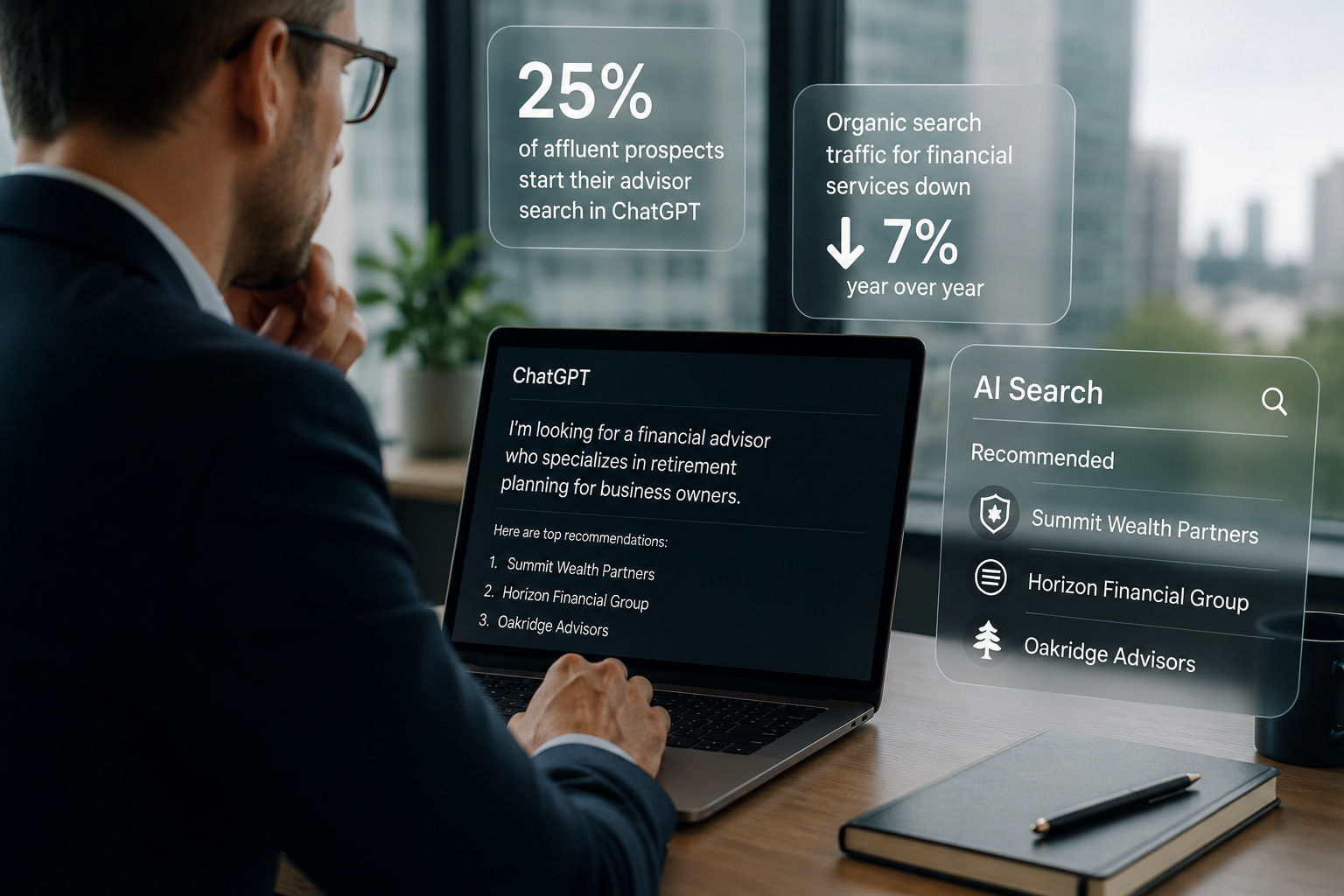
The financial-services-specific numbers are sharper still. A 2025 Wealthtender study of 500 affluent U.S. households (income above $100,000) planning to hire a financial advisor found that 25% said they will use AI tools like ChatGPT or Gemini to start their search — a number the study expects to grow quickly. One in four high-value prospects is now beginning the most trust-dependent purchase decision of their financial lives by asking an AI for a shortlist. And the affluent, professionally active 35-to-55 segment — the exact demographic most finance firms are built to serve — over-indexes on this behavior.
The nature of the search has changed too, not just the platform. Rather than typing "financial advisor near me" into Google and scrolling through proximity-ranked links and paid ads, these consumers craft detailed, personalized prompts that describe their specific situation — their income, their goals, their tax complications, their life stage. They're not ordering a pizza and optimizing for delivery distance; they're describing a problem and asking for the best fit. That fundamentally changes how advisor discovery works, because the AI is matching on relevance and specialization, not on who paid the most or sits closest.
Meanwhile, the old engine is sputtering. Similarweb data cited by WealthManagement.com shows organic search traffic for financial services dropped roughly 7% year over year. The steady stream of inbound prospects that once sustained lead generation is shrinking — not because demand fell, but because the discovery layer moved. As one industry analysis put it, Google is no longer the sole gatekeeper; increasingly, AI platforms are the arbiters of visibility, and a brand that isn't cited in AI search is invisible to a growing share of its future clients.
Why finance is uniquely exposed to this shift
Several dynamics make financial services more vulnerable to the AI-search transition than the average industry.
Trust is the entire product. When someone researches a doctor, a lawyer, or a financial advisor, search engines and AI tools weigh experience, expertise, authoritativeness, and trustworthiness more heavily than in lower-stakes categories. That cuts both ways: it means AI is cautious about who it names, and it means the firms that have built genuine, verifiable authority get a disproportionate share of the recommendations. There's no comfortable middle ground of "good enough to rank on page two" — in an AI answer, you're named or you're absent.
The recommendation functions like a referral. Getting cited by ChatGPT during a prospect's research phase creates a form of pre-credentialing no ad campaign can replicate. Because the prospect prompted the AI themselves with their specific situation, they treat the resulting recommendation with nearly the same weight as a peer referral. In an industry where word-of-mouth has always been the gold standard for client acquisition, an AI recommendation is the closest digital equivalent — and unlike a single referral from a single client, it scales to every prospect asking that question.
The prompt defines the playing field. This is the part finance marketers should find genuinely encouraging. In AI search, broad prompts like "best wealth managers in the U.S." reliably surface the giants — Morgan Stanley, Merrill, UBS, Fidelity. But long-tail prompts transform the result. A query like "best financial advisor in Chicago for physicians" or "fee-only planner for tech executives with concentrated stock positions" forces the engines to look at entirely different sources, and suddenly boutique firms, specialists, and regional players have a seat at the table. Specificity beats size. The firm that owns a clearly defined niche can out-surface a national brand for the queries that actually match its ideal client — which is precisely the kind of query a serious, high-intent prospect tends to write.
Regulation shapes what AI can say — and that favors the prepared. ChatGPT won't recommend a specific stock or tell someone to sell their portfolio; regulatory guardrails prevent that. But it readily recommends types of advisors, describes advisory structures, explains compensation models, and names specific firms when asked directly which wealth managers are worth considering for a particular situation. Firms that clearly articulate their fiduciary status, fee model, and specialization give the AI exactly the compliant, factual signals it's comfortable surfacing. Vague firms give it nothing safe to say.
Why your Google rankings don't automatically carry over
A dangerous assumption circulating in finance marketing is that strong SEO covers you. It doesn't. AI engines like ChatGPT don't simply read your Google rankings and mirror them — they read and evaluate your website content directly, looking for specificity, expertise, and trust signals. You can rank well on Google and remain completely invisible in ChatGPT if your content isn't built for how AI reads it.
The most common failure is vague positioning. Marketing language like "providing personalized wealth management solutions tailored to your unique financial goals" is not extractable by an AI engine — every firm says the same thing, so it gives the model nothing to latch onto. A clear, specific description — "fee-only retirement income planning for business owners transitioning out of their companies in [city]" — is a citable entity signal. The same applies to advisor bios: "John Smith, CFP, fee-only fiduciary specializing in retirement income for physicians in Atlanta" is something an AI can confidently recommend; "John brings decades of experience to his comprehensive practice" is not.
There's also a structural shift underneath all of this: the rise of zero-click outcomes. AI-powered search increasingly delivers answers directly in the interface, often without the user ever visiting a website. Financial Planning magazine has reported advisors seeing exactly this — users getting their answer in the search experience and never clicking through. That means your visibility can no longer be measured only by the traffic that lands on your site. A prospect can encounter your firm's name, your specialization, and your credibility signals entirely inside an AI answer, form an impression, and reach out directly — a journey your analytics dashboard may never fully capture.
This is why measurement has to change too. Traffic alone is no longer a valid KPI. What matters now is share of voice in AI answers — how often your brand is mentioned across engines, the quality of the referral traffic those mentions produce, and the conversions that follow. For a finance CMO, that reframes digital marketing from a volume game to a value game: not how many visitors reach your site, but how many high-intent prospects see your name at the exact moment they're asking for guidance.
What finance firms should actually do
The work that earns AI citations in financial services is concrete, and it builds on — rather than replaces — the SEO foundation most firms already have.
Own a specific niche and say it plainly everywhere. The single biggest lever is positioning. Decide exactly who you serve — physicians, tech executives with RSUs, business owners approaching a sale, divorced women rebuilding portfolios, multi-generational family offices — and make every page of your site reflect it in language an AI can extract. Niche clarity creates natural alignment with the long-tail, high-intent queries where smaller firms can actually win, and it's the difference between being recommended confidently and being skipped because the model couldn't tell what you specialize in.
Publish educational content that answers the follow-up questions. AI conversations don't stop at the first prompt. After "recommend a fee-only advisor for retirement," prospects ask "what's the difference between fee-only and fee-based?", "how do I verify a fiduciary?", and "what should I expect to pay?" Content that answers each of these specifically gets your firm cited at multiple points in the same conversation — compounding exposure before the prospect ever makes contact. Explaining genuinely complex topics in accessible language, like Roth conversion ladders or charitable remainder trusts, earns citations for situation-based queries because the AI extracts directly from that content when a prospect's question touches the topic. Bylined articles from your advisors in credible outlets reinforce individual practitioner authority that AI draws on when describing your firm.
Get the credential and directory signals right. AI engines heavily weight professional credentials and clean regulatory standing. CFP, CFA, and fiduciary status matter, and complete, accurate profiles on the directories these models reference — CFP Board's "Find a CFP," NAPFA for fee-only firms, FINRA BrokerCheck — are frequently pulled into AI answers. Make sure they're current and consistent, because an outdated or missing profile is a trust gap the model will quietly route around.
Implement the machine-readable layer. FinancialService and LocalBusiness schema markup, FAQ schema, and review schema — now permissible for registered investment advisers under the SEC's updated marketing rule — give AI systems the structured, machine-readable picture they need to categorize and trust you. Pair that with consistent name, address, and phone data across every platform you appear on. This is the layer that determines whether an AI can confidently understand what you do and where, even when it has found your site.
Audit where you stand, then monitor it. Open ChatGPT, Gemini, and Perplexity and run the prompts your buyers actually use — by niche and by city. The names that come back are your real competitive set in 2026, and it likely looks different from your Google rankings. Because AI outputs are inconsistent and each engine weights sources differently — the same query can return different answers an hour later — this is a monitoring discipline, not a one-time check. Build a map of the questions that matter most to your buyers and track them across engines over time, watching which sources get cited and which get dismissed.
None of this means abandoning traditional SEO. Google still crawls your site, still ranks your pages, still sends leads, and AI search largely builds on the same foundation of clear, credible, well-structured content. The firms winning in 2026 run both layers at once — earning rankings in the index Google still serves and earning citations in the answer engines their highest-value prospects now ask first.
The bottom line
The CFA Institute's bet — that the next generation of finance talent discovers its path through interactive, self-directed digital tools — is a small reflection of a much larger truth. The clients those professionals will one day serve are already discovering finance firms the same way: by asking an AI, getting a short list of names, and trusting it. Organic traffic is sliding, a quarter of affluent prospects start in ChatGPT, and AI recommendations carry the weight of a referral. The demand for trusted financial guidance hasn't shrunk — it's just being routed through a new front door. The only question is whether your firm is one of the names on the other side of it.
Frequently Asked Questions
Are people really using AI to find financial advisors and firms?
Yes, and the share is significant and growing. AP-NORC found that 60% of U.S. adults now use AI tools like ChatGPT, Gemini, Claude, Perplexity, and Copilot to search for information. More specific to the industry, a 2025 Wealthtender study of 500 affluent U.S. households planning to hire a financial advisor found that 25% will use AI tools to start their search — and the affluent, professionally active 35-to-55 segment that most firms target over-indexes on this behavior.
How is AI search different from traditional SEO for finance firms?
Traditional SEO aims to rank your web pages in Google's results so a prospect can click through and choose you. AI search optimization aims to get your firm named and cited when someone asks ChatGPT, Gemini, or Perplexity for a recommendation — often without the prospect ever visiting a site. Critically, AI engines don't just mirror your Google rankings; they read and evaluate your content directly for specificity, expertise, and trust signals. You can rank well on Google and still be invisible in AI answers if your content isn't built for how AI reads it.
Why are my strong Google rankings not enough anymore?
Because AI engines evaluate content on their own terms. They look for clear, specific, extractable signals about who you serve and how — and they weight credentials, fiduciary status, and regulatory standing heavily. A firm with great Google rankings but vague positioning ("personalized solutions for your unique goals") gives the AI nothing to recommend confidently. On top of that, organic search traffic for financial services has fallen roughly 7% year over year per Similarweb, so even strong rankings are delivering fewer prospects than they used to.
Can smaller or boutique finance firms compete against the big players in AI search?
Often, yes — and this is the encouraging part. Broad prompts like "best wealth managers in the U.S." surface the giants, but long-tail prompts change everything. A query like "best financial advisor in Chicago for physicians" or "fee-only planner for tech executives with RSUs" forces the engines to look at different sources, opening the door for specialists and regional firms. Specificity beats size, so a firm that clearly owns a niche can out-surface a national brand for the high-intent queries that match its ideal client.
What actually makes an AI recommend a financial firm?
A combination of signals: clear niche positioning the AI can extract, educational content that answers both the initial question and the follow-ups, properly attributed credentials (CFP, CFA, fiduciary status), complete profiles on directories like CFP Board, NAPFA, and FINRA BrokerCheck, structured schema markup, and review and authority signals. AI engines favor firms they can confidently identify, clearly understand, and credibly recommend — vague or thin presences get routed around.
How should we measure success if traffic isn't the right metric?
Shift from volume to share of voice. Track how often your brand is mentioned across ChatGPT, Gemini, and Perplexity for the prompts your buyers actually use, the quality of the referral traffic those mentions generate, and the downstream conversions. Because AI outputs vary by engine and even hour to hour, treat this as ongoing monitoring rather than a one-time audit, and build a map of your highest-value buyer prompts to watch over time.
Does optimizing for AI search create compliance problems?
It shouldn't, when done correctly. AI engines won't recommend specific securities or give individualized advice — regulatory guardrails prevent that — but they will name firms and describe advisory structures, fee models, and specializations. The work involves clearly stating factual, compliant information: your fiduciary status, your fee structure, your credentials, and who you serve. The SEC's updated marketing rule also now permits registered investment advisers to use client testimonials and reviews under specific conditions, which have become valuable AI trust signals.
How long does it take to show up in AI search?
It compounds over months, not days. Building the content depth, authority signals, and structured data that AI engines reward is a sustained effort, and AI tends to reinforce firms it already recognizes — so early movers widen their lead over time. The practical implication is that the cost of waiting is real: every quarter a competitor invests and you don't, the gap in AI visibility grows harder to close.
When a high-value prospect asks ChatGPT to recommend a firm like yours, does your name come up? Most finance brands have no idea — and no way to find out on their own. Ritner Digital builds the authority, content, and domain trust that get B2B and finance brands found and cited across Google, ChatGPT, Perplexity, and Gemini — then we publish the data to prove it works. Book a free strategy call → We'll run your firm's real buyer prompts through the AI engines, show you exactly where you stand, and give you a clear next step within one business day.