What's a Realistic Marketing Budget for a Dealership Doing $2M a Year in Revenue?
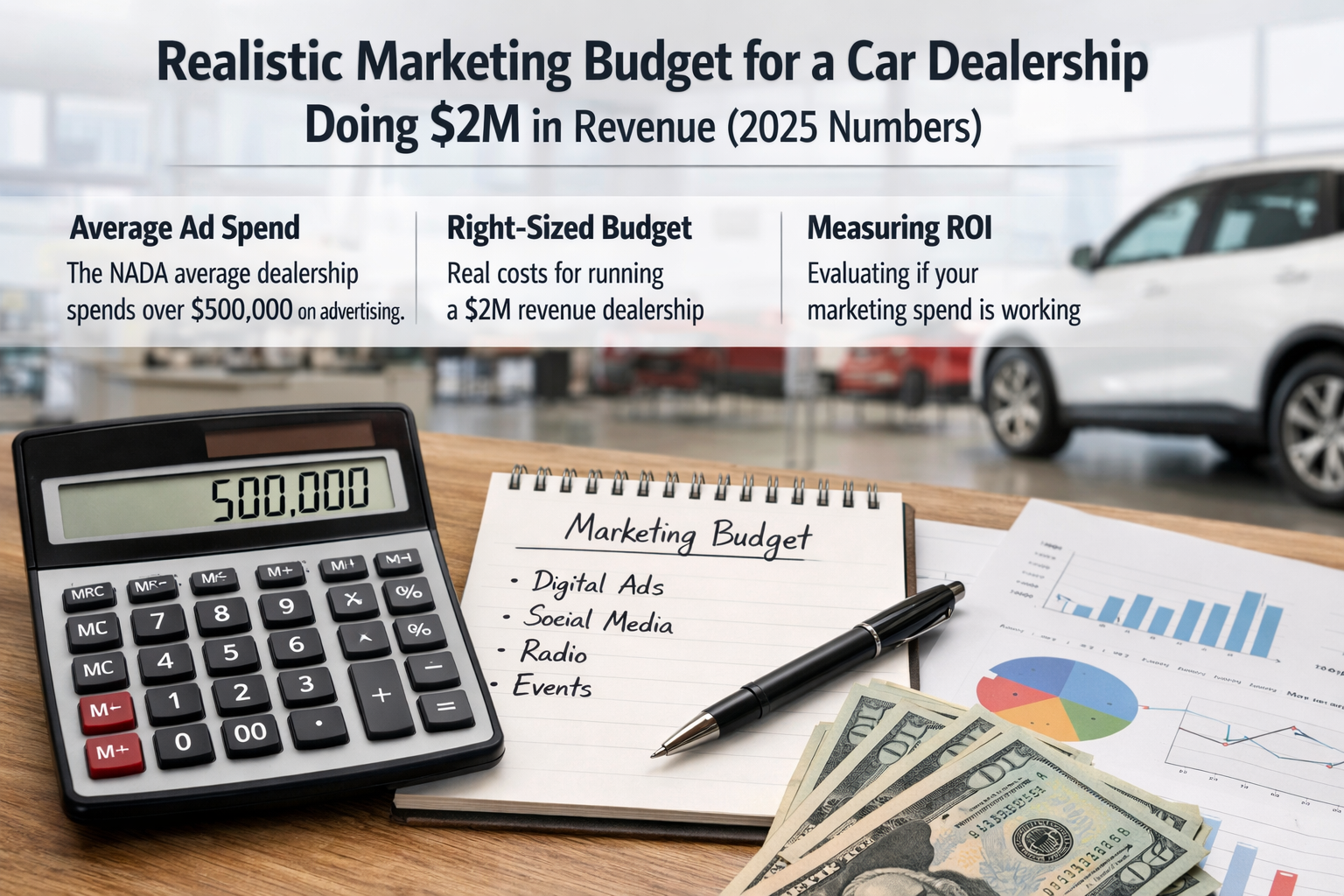
The Numbers, the Channel Breakdown, and the Honest Math — Before You Talk to Anyone
If you run a car dealership doing around $2 million in annual revenue and you've searched for a straight answer on marketing budget, you've hit the same wall most dealers at your size hit: every piece of industry data is built around franchise dealerships doing ten to fifty times your volume, and every vendor is happy to quote you a $15,000 per month retainer based on numbers that have nothing to do with your business.
This article is different. It starts with your revenue tier, works through the actual math of what your budget should be and why, and gives you a channel-by-channel breakdown that reflects the reality of running a smaller independent or boutique dealership — not the reality of a multi-rooftop franchise group with an OEM co-op advertising budget.
First: The Industry Benchmarks You'll See (and What They Actually Mean for You)
Let's address the NADA numbers upfront, because you'll encounter them constantly and they need context.
According to NADA's 2023 annual report, the typical new car dealership spent $528,923 on advertising — representing approximately 6 to 7 percent of total gross profit. Collectively, the nation's franchised dealers spent $8.9 billion on advertising that year. Demand Local
That $528,000 figure is almost meaningless for a $2M dealership. The average is dragged upward by large franchise operations with 20 to 50 rooftops, manufacturer co-op dollars, and regional advertising budgets that dwarf most independent dealers' total revenue. Strip those out, and the number looks very different.
The important takeaway from that data is not the dollar figure — it's the structure. Digital marketing is the dominant channel, accounting for 65 to 73 percent of all dealer advertising spend. And for practical budget guidance, the better anchor is cost per unit sold: dealerships should target a cost per unit sold of around $250 on any marketing channel. So if you're selling 50 vehicles per month, plan to spend around $12,500 per month on marketing. AutoSweet
That unit-based model is your real anchor at $2M in revenue. Let's build from it.
The Math That Actually Fits a $2M Dealership
A dealership doing $2 million in annual revenue is typically selling somewhere between 80 and 150 units per year, depending on whether you're primarily selling used vehicles, your average ticket price, and how much of your revenue comes from service and finance versus unit sales.
Let's work the two most common scenarios for a dealer at this revenue level:
Scenario A: Primarily used vehicles, average sale price around $15,000–$18,000 At $2M revenue and ~$16,000 average transaction, you're selling approximately 125 units per year — about 10 to 11 vehicles per month.
At $250 cost per unit sold: $10 to $11 per month × $250 = $2,500 to $2,750 per month in marketing spend.
Scenario B: Mix of used and lower-cost used, average around $12,000–$14,000 At $2M revenue and ~$13,000 average transaction, you're selling approximately 150 units per year — about 12 to 13 vehicles per month.
At $250 cost per unit sold: 12 to 13 per month × $250 = $3,000 to $3,250 per month in marketing spend.
This gives you a range of $2,500 to $3,500 per month — or $30,000 to $42,000 per year — as a realistic, defensible marketing budget for a $2M dealership using the cost-per-unit-sold framework.
That's your baseline. Now let's talk about what it buys.
A Note on the Right Mental Model for Budget
Before going channel by channel, there's a framing shift worth making. Most dealerships think about marketing spend as a monthly line item — "we budget $X per month." The dealers who get the most out of their marketing spend think about it differently.
Budgets are not about what makes you feel comfortable. They are about what sells cars. When you tie your budget to actual sales, every dollar has a job and every campaign has a purpose. Your marketing stops being a gamble and becomes a growth lever. The logic that applies: your advertising budget should flex with your sales seasonality. Spend more aggressively when demand is naturally higher. Stay present during slower times, but do not overspend trying to force something the market is not ready to deliver. Gowithbigtime
For a $2M dealer in South Jersey or the Philadelphia market, this means May through August and late September through October are your highest-return months to spend aggressively. February and December are not months where doubling your budget will double your volume. Calibrate accordingly.
The Channel Breakdown: Where $30,000 to $42,000 Per Year Goes
1. Third-Party Listing Sites (Cars.com, AutoTrader, CarGurus): $9,600–$18,000/year
For most dealerships at the $2M revenue level, third-party listing sites are the non-negotiable channel — the one place that sends high-intent shoppers directly to your inventory whether or not you've done anything else right.
Third-party listing sites receive the highest investment of any single channel among U.S. dealerships, with the average dealer spending $109,487 annually on these platforms. Statista That's the franchise average — but the structure of the investment is relevant regardless of your size. Buyers use these platforms the way buyers used to use classifieds: it's where they go when they've made the decision to buy and are comparing specific vehicles.
At your revenue tier, a focused presence on one or two platforms — rather than spreading across five — is the smarter play. CarGurus has grown significantly in used car market share and offers transparent price comparison tools that buyers trust. Cars.com and AutoTrader remain strong for visibility in the mid-Atlantic market.
A realistic budget for a dealer your size: $800 to $1,500 per month across one to two platforms, with package level tied to your inventory size. This is $9,600 to $18,000 annually.
What to watch: cost per vehicle detail page view and cost per lead generated, broken down by platform. If one platform is generating five times the leads of another for the same spend, reallocate.
2. Google Search Ads (PPC): $7,200–$12,000/year
Google Ads achieves a cost-per-lead for automotive repair, service, and parts of approximately $27.94 — compared to an industry average across all channels of $250 per lead. For vehicle sales specifically, properly managed Google Ads campaigns drive leads at a fraction of the unmanaged industry average. Demand Local
For a $2M dealership, Google Ads should be running on two types of campaigns: branded search (people searching your dealership name, your inventory, your specific vehicles) and local intent search (people searching "used trucks for sale [your city]," "buy used Honda near me," "[make model year] for sale South Jersey"). Branded search is inexpensive and essential. Local intent search is moderately competitive and produces high-quality leads because the searcher is already geographically qualified.
The average dealership allocates $105,256 annually to search engine marketing — but that's a franchise number. At your revenue tier, a focused Google Ads budget of $600 to $1,000 per month in ad spend plus management produces meaningful results without overpaying for volume you don't need. Demand Local
Plan for $600 to $1,000 per month in total Google Ads investment — $400 to $700 in ad spend plus management. That's $7,200 to $12,000 annually. This should be managed actively — bid adjustments, negative keywords, landing page optimization, call tracking — not set and forgotten.
3. Google Business Profile and Local SEO: $3,600–$7,200/year
This is the highest-return channel for dealers at your revenue level that most independent dealers significantly underinvest in.
Keeping your Google Business Profile active with up-to-date offers, Q&A responses, and review engagement strengthens local SEO visibility in ways that directly drive phone calls and showroom visits from nearby buyers who are ready to act. CF Search Marketing
For a dealership, your GBP is where local searches for "car dealers near me," "used cars [your town]," and your dealership name by reputation all converge. A fully optimized, actively maintained GBP — current hours, photos of your actual inventory, weekly posts with featured vehicles, prompt responses to all reviews — consistently generates in-market inquiries that cost you nothing in ad spend.
Beyond the GBP itself, local SEO means your website ranks for the geographic and inventory searches that your highest-intent local buyers use. Dedicated inventory pages optimized for your specific makes, models, and service area, combined with consistent NAP citations across directories (Yelp, Yellow Pages, Bing Places, Apple Maps), build the organic visibility that reduces your long-term dependence on paid channels.
At maturity, organic content delivers leads at 75 to 85 percent lower cost than paid search. The investment is front-loaded, but the returns compound every month. No other channel in automotive marketing gets cheaper over time. Hrizn
Budget: $300 to $600 per month for active local SEO management — GBP optimization, local content, citation building, and review management. That's $3,600 to $7,200 annually. This should be treated as foundational infrastructure, not discretionary spend.
4. Facebook and Instagram Advertising: $3,600–$6,000/year
Social advertising plays a specific, well-defined role at your revenue level: inventory promotion to a local, targeted audience. It is not brand awareness. It is not conquest conquest. It is: here are the vehicles we have right now, here is what they cost, here is why you should come see us this weekend.
The average dealership spent $60,030 on social media advertising in 2024, and 67% of recent car buyers said they would complete purchases through social media platforms. Social media leads have been demonstrated to cost significantly less than the $283 industry average for automotive leads. Demand Local At your revenue tier, you don't need $60,000 — but you do need a consistent presence.
Rotating inventory ads featuring your best vehicles, retargeting people who've visited your website or VDP pages, and periodic "special event" campaigns around tax season or end of month are the highest-return applications of social budget at your size.
Budget: $300 to $500 per month in ad spend plus minimal management. That's $3,600 to $6,000 annually. Meta's geographic targeting allows you to reach households within a precise radius of your lot — a significant advantage for a dealer with a defined local market.
5. Website: $1,800–$3,600/year in maintenance (assuming initial build cost is separate)
Your website is the destination that every other marketing channel points to. An outdated, slow, or poorly organized website wastes every dollar you spend on ads, listings, and SEO.
For a dealership, the website non-negotiables are: a functional, mobile-optimized inventory display that syncs with your DMS, fast load times (under three seconds), clear and visible phone number and contact options, a modern design that signals credibility before a buyer makes a decision, and integration with your listing platforms so inventory stays consistent.
If your website is built and functional, ongoing maintenance, hosting, and minor updates typically run $150 to $300 per month through a dealership-focused web provider. That's $1,800 to $3,600 annually.
If your website needs to be rebuilt, budget $3,000 to $8,000 as a one-time cost before anything else — because the rest of your marketing spend is undermined by a website that doesn't convert.
6. Email Marketing and Customer Retention: $1,200–$2,400/year
At $2M in revenue, your existing customer database is one of your most valuable and most underused marketing assets. Every buyer you've sold a vehicle to, every service customer in your system, every lead that came in but didn't purchase yet — these are people who already know you, and the cost to re-engage them is a fraction of what it costs to acquire a new customer.
Automotive email marketing averages 12.6% open rates, with email generating $36 ROI for every $1 spent. The channel works effectively for customer retention and repeat service marketing. Demand Local
A simple, consistent email program — a monthly update on new inventory arrivals, a service reminder campaign, a "we're buying cars" campaign targeting your customer base when you need used inventory — keeps your business top of mind and generates repeat and referral business at acquisition costs far below any paid channel.
Budget: $100 to $200 per month for email platform and management. That's $1,200 to $2,400 annually. This is where independent dealers consistently leave money on the table.
The Full Picture at $2M Revenue
Here's what a well-allocated, realistic marketing budget looks like for a dealership at your revenue level:
Conservative scenario (~$2,500/month total — $30,000/year): Third-party listings: $800/month Google Ads: $600/month (ad spend + management) Local SEO and GBP: $300/month Social media ads: $300/month Website maintenance: $200/month Email marketing: $150/month Miscellaneous (direct mail, print, signage): $150/month
Growth scenario (~$3,500/month total — $42,000/year): Third-party listings: $1,200/month Google Ads: $900/month (ad spend + management) Local SEO and GBP: $500/month Social media ads: $500/month Website maintenance: $250/month Email marketing: $200/month Miscellaneous: $250/month (seasonal direct mail, local event sponsorships)
These numbers work at your revenue tier because they're calibrated to your actual unit volume. You're not competing with a 500-car-per-month franchise group — you're competing for the local buyer who's looking online, checking your reviews, and comparing you to three other dealers within twenty miles.
The ROI Math: Does This Budget Actually Make Sense?
Here's how to evaluate whether the spend is working, using numbers that reflect your scale.
The average cost for an automotive lead is approximately $250. This is higher than most industries because buying a car is a complex decision — the average customer researches their purchase for months before actually visiting a dealership. Invoca
At $2,500 to $3,500 per month in marketing, and assuming a blended cost per lead across your channels of $80 to $120 (achievable with a well-managed mix of organic and paid), you should be generating 25 to 40 leads per month.
At a 25 to 35 percent lead-to-sale conversion rate — reasonable for a well-run smaller dealership with good follow-up — that produces 7 to 14 sales per month from marketing-generated leads.
At an average gross profit per vehicle of $2,000 to $3,500 (typical for used vehicle sales at this price tier), that's $14,000 to $49,000 in gross profit generated from $2,500 to $3,500 in marketing spend.
Even at the conservative end of that math, the return is strong. The budget makes sense. Where most smaller dealers lose the return on their investment isn't in the marketing spend itself — it's in lead handling.
43.2% of sales leads are mishandled on average, including missed calls, leads that never made it to the CRM, and flaky follow-up. Among leads that returned to the dealer website after already submitting a form or chat, 65% didn't hear back within 24 hours. Dealership Guy
If you're spending $3,000 per month generating leads and then losing nearly half of them to missed calls and slow follow-up, doubling your marketing budget won't fix your results. Fixing your lead response will. This is the most important operational insight for any dealer at your revenue level: the bottleneck is often not the marketing, it's the handling.
What the $2M Revenue Tier Needs That Franchise Dealers Don't
There are a few specific priorities for a dealership at your revenue level that don't get enough attention in generic automotive marketing content:
Reputation is everything and you have fewer reviews to absorb a bad one. A franchise dealer with 400 Google reviews can weather a few negative ones. A dealer with 30 reviews whose average drops from 4.8 to 4.1 after two bad months will feel it in showroom traffic. Active review management — asking every happy customer for a review, responding professionally to every review — is higher-stakes for you than for a larger operation.
Dealerships that improve their reputation score significantly experience measurable sales increases. Nearly three-quarters of car buyers require at least a 4-star rating before considering a visit to a dealership. Crossing into four-star territory dramatically expands your potential customer base. Demand Local
Your inventory is your marketing. At 100 to 150 units per year, your inventory photos, descriptions, and pricing are not a secondary consideration — they are a primary marketing asset. Buyers browsing CarGurus or AutoTrader decide whether to click through based on the photos and price before they read a word. Professional or high-quality mobile photography of every vehicle, honest and complete descriptions, and competitive market-based pricing generate more inbound leads than an equivalent increase in ad spend.
Speed to lead is a competitive advantage. Larger franchise dealerships have BDC teams dedicated to rapid lead follow-up. As a smaller operation, your competitive advantage is often being faster and more personal. A buyer who submits a lead on CarGurus at 7 PM on a Saturday and gets a call back within 10 minutes from an actual person who knows the vehicle will frequently close with you over a competitor who calls back Monday morning. That follow-up process is worth more than most marketing tactics.
Service marketing is undervalued at your tier. If you have a service bay, your fixed operations revenue is one of the most stable and high-margin sources of income in your business — and it gets almost no marketing attention from most independent dealers. A modest investment in Google Ads targeting service keywords ("oil change near me," "brake repair [your town]"), combined with a service-focused email program to your existing customer base, generates high-margin appointments that don't require you to acquire anyone new.
Vendor Pitfalls Specific to Your Revenue Level
A few things to watch for when vendors approach you:
Minimum spends that don't fit your volume. Many digital agencies have minimum retainer requirements built for larger dealers. A $5,000 per month retainer for a dealer doing $2M in revenue is 3 percent of total revenue in agency fees alone — before ad spend. Get specific line items for what that fee covers and compare it to the unit economics of your actual business.
Co-op requirements if you're a franchise rooftop. If you're affiliated with an OEM, co-op advertising dollars are available but often come with stipulations about approved vendors, approved formats, and required spend ratios. Know your co-op terms before committing to any vendor contracts that may or may not be eligible for reimbursement.
Third-party listing packages priced for larger inventories. Most listing platforms have tiered packages, and the premium tiers are designed for dealers moving 100+ units per month. For a dealer at your volume, a mid-tier package on one or two platforms will outperform a premium package spread across five.
"Full-service" agencies that don't specialize in automotive. Automotive retail has unique dynamics — inventory-level advertising, VDP optimization, co-op compliance, DMS integration, lead source attribution — that most general digital agencies don't know well. If an agency is pitching you automotive marketing but can't explain what a VDP is or how they track cost per sold versus cost per lead, they're going to waste a meaningful portion of your budget learning on your dime.
The Bottom Line
For a dealership doing $2 million in annual revenue, a realistic and defensible marketing budget is $2,500 to $3,500 per month — or $30,000 to $42,000 per year — allocated primarily across third-party listings, Google Ads, local SEO and GBP, and social media advertising.
That budget, built around a $250 cost-per-unit-sold target and calibrated to your actual volume, should generate a meaningful multiple of its cost in gross profit when channels are managed actively, lead handling is taken seriously, and your inventory presentation is competitive.
The dealers at your revenue tier who are growing fastest aren't necessarily spending the most. They're spending consistently on the channels that reach high-intent local buyers, maintaining the online reputation that converts those buyers into showroom visits, and following up on leads fast enough to compete with dealers who have bigger teams.
The budget is solvable. The discipline to execute it consistently — and the right partner to help — is where most independent dealers find their competitive edge or continue to lose ground.
Ritner Digital works with dealerships, home services businesses, and local companies across South Jersey and the Philadelphia region who want marketing that's tied to real business outcomes — not just activity reports. If you'd like an honest conversation about what your current marketing is actually producing and where the gaps are, let's talk.
Frequently Asked Questions
Is $250 per unit sold really the right benchmark, or is it too low?
It depends on your market and your margin. The range across dealers is wide — from $250 to $708 per unit sold — with the difference tied to market competitiveness, vehicle type, and how aggressively a dealer is trying to grow versus maintain share. Gowithbigtime For a dealer at $2M in revenue who isn't in an extremely competitive multi-rooftop market, $250 per unit is a reasonable and often conservative target. If you're trying to grow volume aggressively or you're in a dense market with heavy competition, $350 to $500 per unit may be needed in the short term.
Should I be spending on traditional advertising — TV, radio, direct mail?
At $2M in revenue, traditional advertising is a very difficult spend to justify. TV and radio require enough frequency to build recognition, which costs more than your monthly budget can sustain effectively. Direct mail to a targeted list — specifically a "we're buying cars" campaign or a seasonal service mailer to your existing customer database — can generate a positive return at modest scale. If you're going to try any traditional channel, direct mail to a tightly defined geographic or demographic list is the most controllable option.
How important is inventory photography at my revenue level?
Extremely important — arguably more important than any single marketing channel. Automotive consumers visit an average of 4.2 websites in their purchasing process and spend an average of nearly 14 hours online during their search. Invoca Most of those hours are spent looking at photos and descriptions of specific vehicles. If your photos are dark, blurry, or incomplete, buyers leave your VDPs to look at a competitor's. Professional or high-quality inventory photography is the highest-ROI investment many independent dealers aren't making.
What's the biggest mistake dealers at this revenue level make with their marketing?
Treating the listing platforms as the only marketing that matters while neglecting everything that supports conversion: the website, the Google Business Profile, the review count, and the lead follow-up speed. You can generate 40 leads per month from CarGurus and lose 20 of them to voicemail and slow response. The marketing generated the opportunity. The operation has to close it.
How do I know if my current marketing is working?
Track these numbers month by month: total leads by source, lead-to-appointment conversion rate, appointment-to-sale conversion rate, and cost per unit sold by channel. If you can't get clean answers to all four of those questions from your current vendor or internal tracking within five minutes, your attribution is broken and you can't make good budget decisions. Set these up before you spend another month without visibility into what's actually driving sales.