The Broad Street Bullies: A Marketing Analysis of Why a 50-Year-Old Hockey Team Still Lives Rent-Free in Our Heads
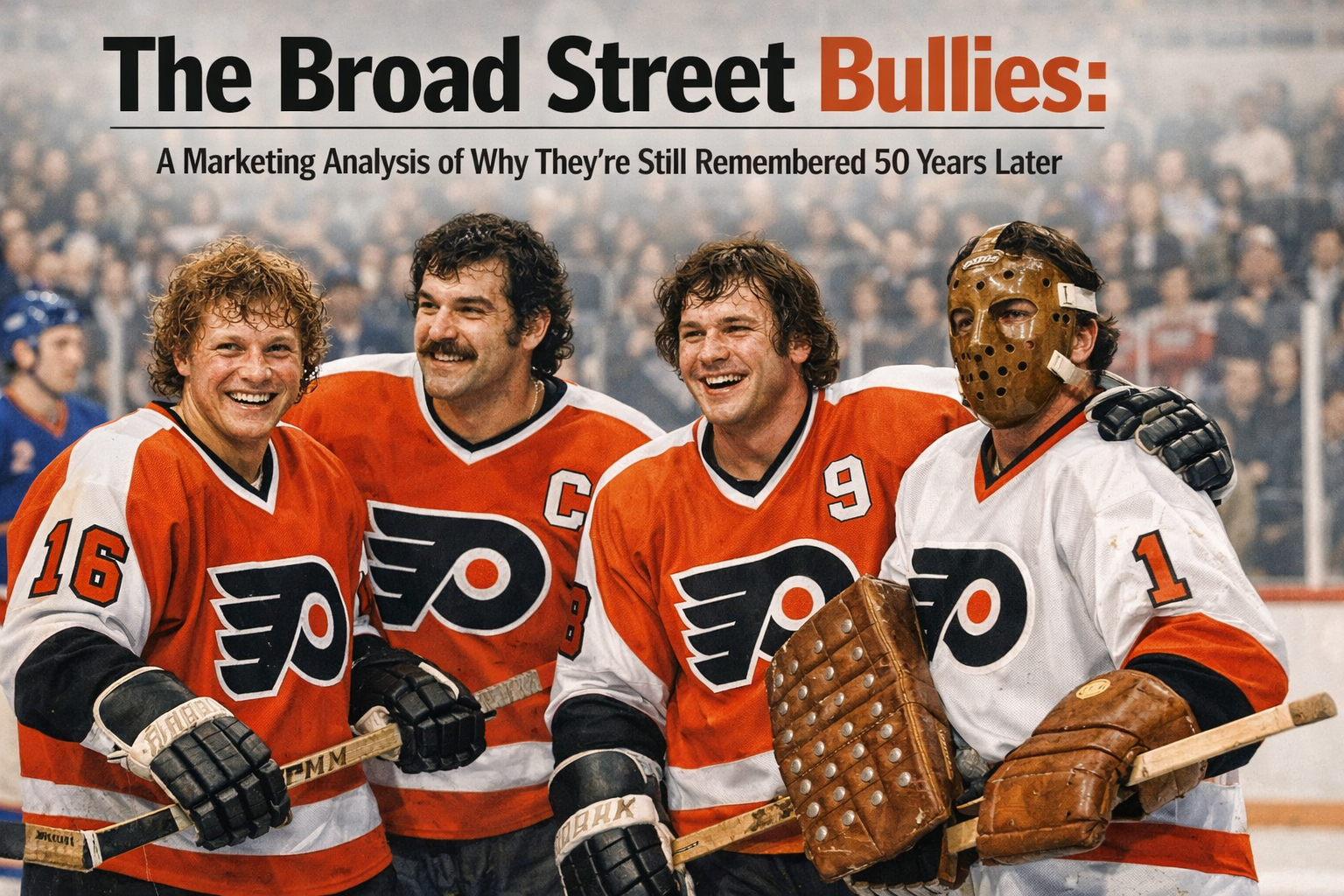
What the 1970s Philadelphia Flyers Can Teach Any Brand About Identity, Authenticity, and Why Polarization Is a Feature, Not a Bug
In the spring of 1974, a hockey team that had existed for only seven years — built in a city that barely knew what a blue line was — won the Stanley Cup. They beat the Boston Bruins, the reigning champions and one of the most storied franchises in the sport, in six games. Philadelphia lost its mind. Two and a half million people showed up to the parade.
The next year they did it again.
Fifty years later, the Broad Street Bullies are still one of the most viscerally remembered teams in North American professional sports. Not just in Philadelphia. Everywhere. People who were born after Bobby Clarke retired know the name. People who have never watched a hockey game know the name. People who despised them in the 1970s still talk about them in the present tense.
That doesn't happen by accident. And it doesn't happen just because a team won two championships. Plenty of teams have won two championships and been largely forgotten.
What happened with the Broad Street Bullies is a marketing phenomenon — one that nobody planned, nobody A/B tested, and nobody consulted a brand strategist to execute. And that's exactly why it worked so completely.
Here's the analysis.
The Context: A Brand With Nothing to Lose
To understand the Bullies, you have to understand what they were working with before they became the Bullies.
The Philadelphia Flyers were an expansion team created in 1967 as part of the NHL's doubling from six to twelve franchises. They played in a city whose sports identity was already firmly established around football, baseball, and basketball. Nobody had asked for hockey in Philadelphia. The early response was, as the HBO documentary put it, unenthusiastic.
Then came the St. Louis Blues in the 1969 playoffs. The Plager brothers and Noel Picard terrorized them in Game 7. Some of the Flyers' guys went down in a bloody heap after being suckerpunched. Ed Snider, the team's owner, watched all of this and couldn't stand it. His response became the founding document of the entire Broad Street Bullies identity: "We're an expansion team. We may not be able to skate. We may not have great players. But we can go out and get the toughest sons-of-bitches in the world, and I don't want to see our team ever get beat up again. I don't give a damn about having one policeman. Let's have five or six." The Hockey News
That moment is the brand brief. An owner who had just watched his players get beaten unconscious made a strategic decision about identity — not out of a conference room, but out of genuine outrage, genuine market analysis of what was and wasn't working, and a clear-eyed assessment of what they could actually do.
This is the first lesson: the best brand decisions come from honest self-assessment, not aspiration. Snider didn't say "let's build a technically excellent hockey team." He said "here's what we have, here's what we can acquire, and here's what that makes us." The identity followed from reality rather than the other way around.
The Name: Three Accidental Syllables That Changed Everything
The nickname "Broad Street Bullies" didn't come from the organization. It came from Philadelphia Bulletin sportswriter Jack Chevalier, who coined a version of the phrase following a brawling 3-1 victory over the Atlanta Flames on January 3, 1973. Chevalier actually started with "Blue Line Bandidos," then revised it to "Bullies of Broad Street." His copy editor Pete Cafone eliminated the "of" and rearranged the words to "Broad Street Bullies" to fit the print headline. That's how one of the most enduring brand names in sports history was born — to fit a headline. Inquirer
There's a genuine marketing lesson buried in this origin story. The name works for reasons that have nothing to do with luck:
Alliteration creates memorability. Broad Street Bullies. Three Bs. Try to forget it. You can't.
The street name grounds it in place. It's not the Philadelphia Bullies. It's not the Flyers Bullies. It's Broad Street — the specific arterial street that runs through the heart of Philadelphia from the Delaware River to the suburbs, the street where the Spectrum sat, the street where the championship parades eventually moved. The geography isn't incidental. It makes the team inseparable from the city.
"Bullies" is transgressive. Nobody names themselves bullies. It's the kind of thing your enemy calls you. Embracing it — and the Flyers embraced it completely, rapidly, and with obvious delight — turned an insult into armor. This is a classic identity move in branding: when someone tries to weaponize a label against you, the fastest way to defuse it is to own it louder than they said it.
The nickname basically symbolized the team's new identity and had the theme of the tough, working-class people of Philadelphia. The Bullies turned their physical style into a winning culture. 97.5 The Fanatic
The Product: When Your Strategy Matches Your Brand
Here's what separates the Broad Street Bullies from a thousand other teams with colorful nicknames: the product matched the brand completely, and the brand matched the city completely. There was no gap between the claim and the reality.
The 1973-74 Philadelphia Flyers led the NHL in penalty minutes. Dave Schultz — "The Hammer" — set the NHL record for penalty minutes in a single season with 472 during the 1974-75 season, a mark that still stands today. Broad Street Buzz The team didn't just play physically. They played with a specific kind of chaos that was simultaneously strategic and barely controlled. They were genuinely intimidating in a way that made opponents — even great opponents — play differently.
But here's the marketing insight that most analyses miss: the Bullies also had actual skill. Bobby Clarke was a generational leader and an elite player. Bernie Parent was arguably the best goaltender in the world during those two Cup runs, winning the Conn Smythe Trophy both years. The LCB line — Reggie Leach, Clarke, and Bill Barber — was one of the most dangerous offensive units in the league.
Not too many people talk about this: they had three players who ended up in the Hall of Fame. They had players who were willing to pay the price to make something happen. One of the most underrated things about the team was how hard they worked. The Hockey News
This matters enormously from a brand perspective. Intimidation without results is just theater. The Bullies were terrifying and they won. That combination — the aggression backed by genuine excellence — is what creates lasting mythology. It's why we still talk about them and don't talk about the fifty other rough teams that racked up penalty minutes and missed the playoffs.
The Authenticity: They Actually Were Philadelphia
Every sports franchise wants to be "authentic." Most achieve something closer to a branded version of authenticity. The Broad Street Bullies didn't have to try.
Philadelphia in the early 1970s was a city dealing with deindustrialization, racial tension, municipal dysfunction, and the ambient weight of a city that the American Dream seemed to have partly left behind. It was a tough city in the literal sense. Working-class, unpretentious, allergic to artifice, suspicious of polish, deeply proud of its own particular kind of hardness.
The players resonated so intensely with a city hungry for identity and pride. They gave the city's swagger a championship-caliber expression. Goodseatsstillavailable
The team didn't just play for Philadelphia. They lived in South Jersey. They hung out in a South Jersey bar called Rexy's. Clarke described it directly: "We practised over in South Jersey and most of the players lived in South Jersey. In those days you practised, and you went and had a couple of beers and lunch. And Rexy's was on our way home." The Hockey News
The players were accessible, human, and genuinely embedded in the community they represented. They weren't a franchise that performed Philadelphia for the cameras. They were people who lived the way their fans lived.
This is the brand quality that money can't buy and positioning can't manufacture: the belief, held by a real community, that these are our people. Not stars who condescend to visit. Not athletes performing relatability. People who happen to be excellent at something, living the same life you live.
When Rexy's burned down midway through the 1975 playoff run, the team mourned it like losing a teammate. That detail, passed from fan to fan for fifty years, communicates something no marketing campaign ever could.
The Polarization: Hated Everywhere, Adored Here
Here is the counterintuitive marketing principle the Broad Street Bullies teach better than any textbook can: being hated outside your market is not a weakness. It's a feature.
The documentary exploring their legacy opens with the line: "In any great drama, you need heroes and villains. The Flyers were both." The film explores the dichotomy between the love of the team in Philadelphia and the hate it generated in other cities, epitomized by Bobby Clarke. Wikipedia
Fans in Boston, New York, Minnesota, and Montreal despised the Broad Street Bullies with a genuine passion. They were accused of playing dirty. They were called thugs. They were accused of intimidating officials and hiding behind their violence. Much of this criticism was accurate.
None of it hurt them in Philadelphia. It made them more beloved.
Every time a columnist in another city wrote a screed about the Flyers being a disgrace to the sport, it was reprinted in Philadelphia as evidence that everyone else was scared of them. Every time an opponent complained about their tactics, it validated the identity. The national criticism was a brand amplifier.
This is the polarization principle that modern brand strategists have come to understand through costly research: a brand that nobody dislikes is probably a brand that nobody loves. Intensity of feeling — in either direction — is attention. And attention sustained over decades becomes legend.
The Bullies didn't try to soften their image for national audiences. They didn't hire a PR firm to humanize them for fans in cities they had just beaten. They leaned into exactly who they were, let the outrage be outrage, and watched the Philadelphia fanbase bond more deeply to them with every outside attack.
The Characters: A Cast That Creates Its Own Mythology
Every durable brand has characters. Not logos, not taglines — characters. People with names and nicknames and stories that get told in bars fifty years later.
The Broad Street Bullies had an almost unfair abundance of them.
Dave "The Hammer" Schultz — the enforcer whose penalty minute record will never be broken, who skated onto the ice and watched opponents recalculate their entire evening. The man whose name became shorthand for a specific kind of terrifying physical presence. He wrote a memoir called The Hammer: Confessions of a Hockey Enforcer. He had a villain's nickname and wore it like a crown.
Bobby Clarke — the captain with missing front teeth who played with a tenacity that bordered on malevolence, who slashed Valeri Kharlamov's ankle in the 1972 Summit Series with what was described charitably as competitive intensity and less charitably as assault. Clarke was the moral center of a team that didn't particularly worry about moral centers, and his biography — a diabetic kid from a mining town who worked harder than everyone else and won anyway — is the kind of narrative that sticks.
Bernie Parent — the quiet genius in the crease who won the Conn Smythe Trophy both years, who you could easily overlook while watching the chaos in front of him until you noticed that the other team simply wasn't scoring.
Bob "Hound Dog" Kelly.Andre "Moose" Dupont.Don "Big Bird" Saleski.
Every one of those men has a nickname that immediately conjures an image. That's not incidental. That's a roster of distinct, memorable characters operating inside a coherent brand identity. The nicknames gave fans specific people to attach to, specific stories to tell. You couldn't confuse this team with any other team in history because the cast of characters was completely singular.
The Game Against the Russians: The Moment That Made It Permanent
Every brand has a moment where it crystallizes into something permanent — a single event that clarifies and confirms the entire identity in a way that can be referenced forever.
For the Broad Street Bullies, that moment was January 11, 1976. The Soviet Red Army team, unbeaten in their North American tour, came to Philadelphia. The NHL's credibility was on the line. The Soviets had beaten the Montreal Canadiens — the classiest, most technically proficient team in North America — just days before.
They played the Flyers.
Ed Van Impe leveled a ferocious hit against Russian star Valeri Kharlamov — whose ankle had previously been shattered by Bobby Clarke in the 1972 series. The Flyers won. When the final whistle blew, relations between the teams improved, with players from both sides sharing drinks in the locker room. While that win might have saved face for the NHL, its legacy can be seen not just in what was proven that day, but in what was learned. theScore
The game was described as a collision of ideologies — Soviet precision and technical mastery against American physical dominance and chaos. The Flyers' brand was the American working-class values the city lived by: work harder, hit harder, take the ice like it's yours and make them take it from you.
They won.
That game didn't just confirm who the Bullies were. It put them into a historical frame that transcended hockey — a Cold War story, a values story, a city pride story. A win that meant something beyond the score.
This is the moment that ensures a brand gets taught in history class rather than just remembered by fans.
Why They're Still Remembered: The Marketing Mechanics of Permanence
Fifty years later, the Broad Street Bullies endure. Not as a historical footnote but as a living cultural reference — documentaries, oral histories, sold-out anniversary events, conversations between Philadelphians who weren't born yet when the Cups were won. Here's why.
The story has conflict. Every element of the Bullies narrative is built on tension: order versus chaos, tradition versus disruption, beloved at home and hated everywhere else. Stories with genuine conflict don't fade. Stories about teams everyone liked, quietly winning, fade fast.
The identity was specific, not aspirational. The Bullies didn't claim to be the best skaters. They claimed to be the toughest team in the world. Specific claims about who you actually are outlast aspirational claims about who you wish you were.
They won. All in all, the Broad Street Bullies legend endures because of their toughness, their colorful characters and the wild-and-woolly era in which they played, but it all would've been an orange-and-black sideshow without wins. The Flyers had plenty of those, too. And when considering the sum of their legacy, that's what scared opponents the most. The Hockey News
The city needed them. Philadelphia in the early 1970s had not won a championship in anything. The Phillies were perennial losers. The Eagles were mediocre. The 76ers had won in 1967 but were fading. The city's sports identity was built largely around suffering with dignity. Then a hockey team showed up and won back-to-back championships playing a style of hockey that looked exactly like what it felt like to be from Philadelphia. That alignment between team identity and city identity created a bond that fifty years of losing Flyers teams hasn't fully eroded.
The characters stay in the conversation. Bobby Clarke ran the Flyers front office for decades. Schultz stayed connected to the alumni. Parent remained close to the organization. The people who built the legend didn't disappear — they stuck around and kept telling the story, kept showing up, kept honoring what they'd built together.
The nickname is perfect. Broad Street Bullies. More than fifty years after the nickname was first coined, it remains synonymous with the franchise. Encyclopedia of Greater Philadelphia Three words, three Bs, one street, one perfect encapsulation of everything the team was. You cannot improve on it. You cannot mistake it for another team. It belongs entirely to one moment in one city and it always will.
The Lessons for Anyone Building a Brand
The Broad Street Bullies weren't a marketing strategy. They were a genuine expression of who a team was, what a city needed, and how a specific kind of excellence — physical, relentless, polarizing — could become permanent cultural mythology.
But the principles that made them work aren't specific to hockey or to Philadelphia.
Know what you actually are before you claim what you want to be. Ed Snider didn't pretend the Flyers could out-skill the Original Six. He built the identity around what they could actually do.
Specific beats aspirational every time. "The toughest team in the world" is a specific claim. "Excellence through teamwork" is not. One of those is remembered.
Polarization is not failure. Being hated by people outside your market while being beloved by people inside it is a sign that you've found something real. Generic likability is the enemy of genuine love.
Characters create culture. Logos don't tell stories. People do. The Bullies had more genuine characters per roster spot than any team in hockey history, and each one added a thread to a narrative that has lasted half a century.
Winning matters. Brand without performance is a costume party. You have to actually be excellent at the thing your identity claims you're excellent at.
Your community's identity is your brand's foundation. If there is a genuine alignment between who your customer is, who your city is, and who you are — and you can find the right words to name it — that's not a marketing advantage. It's a moat.
The Flyers won the Stanley Cup twice between 1974 and 1975. But what they actually built during those years was something rarer and more durable than a championship. They built a story that Philadelphia still needs.
That's the whole game.
Ritner Digital is based in South Jersey — the same South Jersey where the Bullies used to drink at Rexy's after practice. We build marketing for businesses that want to be remembered for who they actually are, not who they think they're supposed to be. If that sounds like the right approach for your business, let's talk.
Frequently Asked Questions
Why are the Broad Street Bullies remembered more vividly than other two-time Stanley Cup champions?
Winning twice gets you into the history books. The Bullies got into the culture. Teams like the 1975–76 Montreal Canadiens and the early 2000s New Jersey Devils also won back-to-back titles and are largely discussed only by hockey historians. The Bullies are discussed by people who've never watched a hockey game, because what they built wasn't just a winning team — it was a character, a place, a set of values, and a specific kind of defiance that attached itself to a city's identity in a way championships alone never produce. The wins gave the story credibility. Everything else made it permanent.
Was the Broad Street Bullies style actually legal under NHL rules at the time?
Mostly, yes — and that's part of what makes the story interesting. The Flyers operated at the edge of what the rulebook allowed, but they operated within it. They accumulated penalties because they committed penalties — roughing, cross-checking, fighting — all of which were permitted under the existing rules with the attached consequences. The league eventually changed rules in response to the Bullies' dominance, as the Flyers ultimately forced the NHL to institute new rules to clean up the game. Wikipedia That's the mark of a team that didn't just play within the existing system — they played it so effectively that the system had to change around them. From a brand standpoint, that's not a scandal. That's proof of concept.
What role did Bobby Clarke specifically play in the Bullies' identity?
Clarke is the most complicated and in many ways the most important figure in the Bullies story. He was simultaneously the team's best player, its moral center, its captain, and its most ruthless competitor. The combination is what made him irreplaceable to the brand. Without Clarke's skill, the physicality was just thuggery. Without his toughness, the team's intimidation would have been hollow. He was the figure who proved that you could be both genuinely excellent and genuinely feared — that the aggression wasn't compensating for anything but was simply another expression of competitive will. Clarke's galvanizing leadership gave the team its soul alongside Schultz's brute force and Parent's brilliance. Goodseatsstillavailable Every great brand needs someone who embodies the entire value proposition at once. Clarke was that person.
Could a team like the Broad Street Bullies exist in today's NHL?
No — and this is actually relevant to the marketing analysis. The modern NHL has dramatically reduced the tolerance for fighting, for intimidation tactics, and for the kind of physical play that defined the Bullies. The rules changed, the officiating changed, the culture of the game changed. What the Bullies built required a specific regulatory and cultural environment that no longer exists. This is worth understanding as a brand lesson: some identities are products of their moment and can't be reconstructed later. The Bullies worked in the 1970s because the 1970s allowed them. The enduring power of their brand isn't that their approach was timeless — it's that it was executed so completely in its moment that the moment became permanent.
Why did the nickname "Broad Street Bullies" stick when so many other sports nicknames fade?
Three reasons, examined structurally. First, the alliteration makes it phonetically sticky — three B sounds in four words creates a rhythm the brain holds onto easily. Second, the geography grounds it permanently in one place. You can't apply "Broad Street" to any other franchise. It belongs completely to Philadelphia. Third, and most importantly, the name was true. It described something real about how the team actually played and who they actually were. Nicknames that flatter without describing eventually feel hollow. The Bullies nickname described something you could watch with your own eyes and verify on the penalty scorecard, which meant it never needed defending.
How did the Flyers' relationship with Kate Smith contribute to the brand?
Kate Smith singing "God Bless America" before big games became one of the stranger and more effective rituals in NHL history. The Flyers had great affection for Smith, and in 1987 — a year after her death — a statue was erected outside the Spectrum. The Flyers continued to honor her legacy for decades, playing a video of her performing before important games. Encyclopedia of Greater Philadelphia From a branding perspective, the ritual worked because it was specific, personal, and genuinely believed in. The players actually credited it with performance outcomes. It wasn't a corporate activation — it was a superstition that became a ceremony. That kind of organic ritual, adopted by a team and then by a fanbase, creates the kind of shared experience that binds generations to a brand. The fact that the relationship eventually ended in controversy doesn't diminish what it meant during the Bullies era — it was another example of the team doing things entirely their own way.
What does the Bullies brand teach us about the relationship between violence and commercial appeal?
This is the tension at the center of the whole story and it's worth addressing honestly. The Broad Street Bullies built a brand partly on intimidation, physical aggression, and tactics that resulted in genuine injuries. The NHL eventually changed its rules because of them. This is not a sanitized legacy. The marketing lesson isn't "be violent and you'll be remembered." The lesson is more specific: when a behavior is authentic to who you are, consistent with your environment's rules, and produces genuine results, audiences will find it compelling even if — sometimes especially if — it makes them uncomfortable. The discomfort was part of the appeal. It created the polarization that made Philadelphia fans love them more fiercely and made everyone else hate them more specifically. Brands that produce no discomfort in anyone rarely produce fierce love in anyone either.
Is the Broad Street Bullies legacy an asset or a liability for the modern Flyers franchise?
Both, depending on context — which is itself a useful marketing observation. As a legacy brand asset, the Bullies give the modern Flyers a layer of cultural depth and historical significance that most expansion-era franchises don't have. When the franchise struggles — and the Flyers have struggled considerably in recent years — the Bullies era gives fans something to hold onto, a proof of concept that this organization has been genuinely great. As a potential liability, it creates a gap between expectation and reality that makes mediocrity harder to tolerate. Philadelphia fans know what it looks like when this franchise is operating at its highest level, and the contrast makes the distance feel farther. Legacy brands always carry both the richness of their heritage and the weight of it. The Bullies gave the Flyers one of the greatest brand inheritances in professional sports, along with the obligation to eventually honor it with something that comes close.