Why That 20K-Follower Account Liked Your LinkedIn Post in Under a Minute
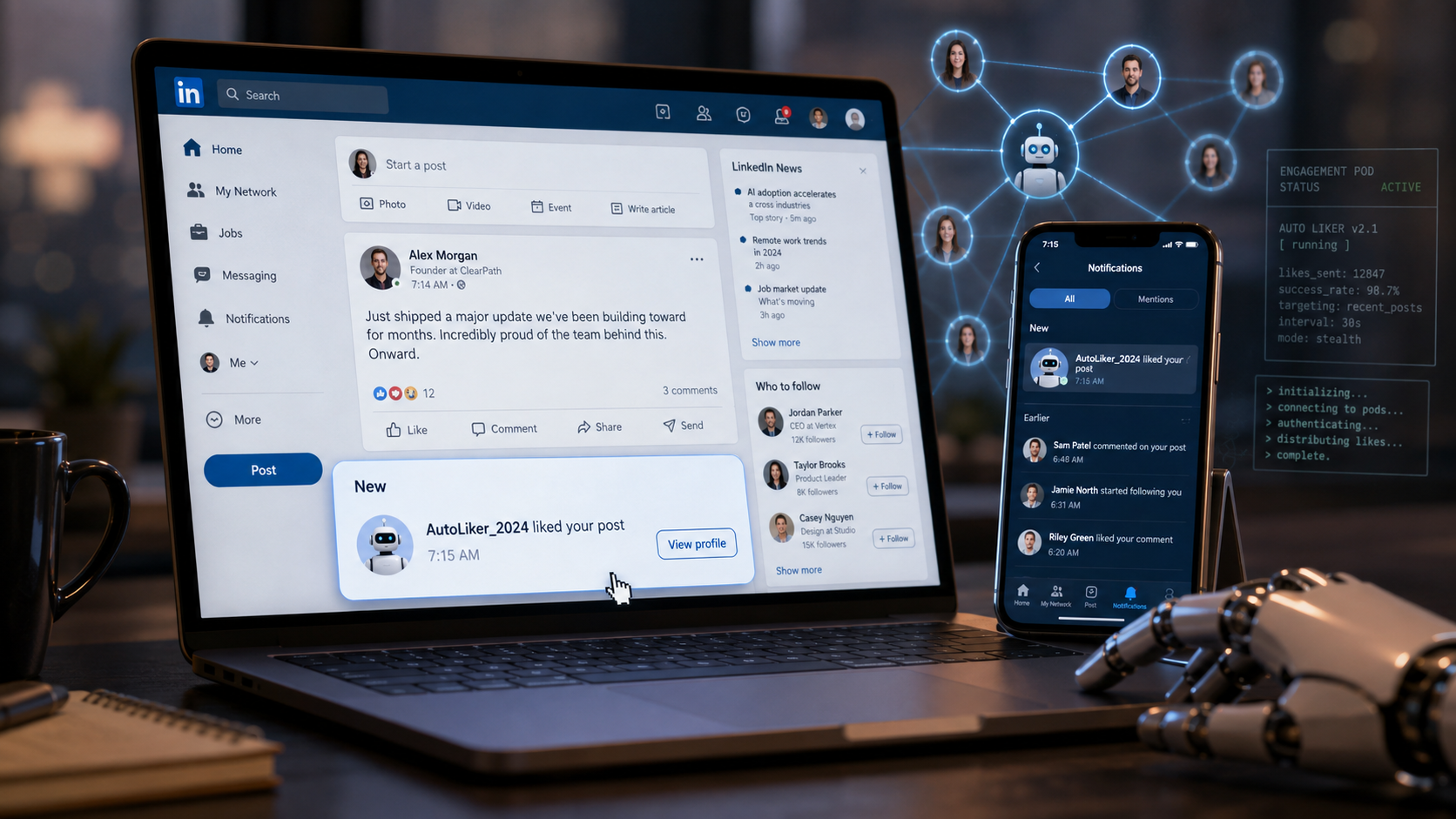
You know the moment, because it's happened to you — it's happened to us, and it's the reason this post exists.
You publish something on LinkedIn at 7:14. At 7:15 — sometimes faster — the notification arrives: a like from an account with 20,000+ followers. Someone you've never spoken to, never worked with, whose feed couldn't plausibly have surfaced your post, read it, and reacted, all inside sixty seconds. Then it happens again on your next post. Same account, or a different big one, same impossible speed. Two or three of them, and it stops feeling like luck and starts looking like what it is: a pattern.
Your instinct — "it's almost like they had an automated trigger set up" — is exactly right. That's precisely what it is. So this post answers the question properly: what the machinery is, who runs it and why, how to spot it, and — because this is still a marketing blog — the genuinely useful lesson buried under the weirdness. The best part: we barely have to speculate, because the industry that sells this behavior describes it openly in its own marketing copy, linked and sourced as always.
The short answer: you're on somebody's list
That instant like wasn't a person reacting to your post. It was software executing a rule — and the rule was probably about you, not your content.
An entire category of tools exists to automate LinkedIn engagement — auto-likers, auto-commenters, engagement bots. The mechanics are simple and openly documented: the tools monitor a feed, a keyword, a hashtag, or a predefined list of target profiles, check for new posts at set intervals, and fire a like the moment one appears. No native LinkedIn feature does this — any auto-like behavior comes from third-party tools, full stop — and the trigger conditions are exactly what you'd guess: your name on a prospect list, or a keyword in your post ("SEO," "AI," "dealership," whatever their niche watches).
And here's why the like arrived, which is the part worth understanding: the like is not engagement with you. It's marketing at you. The tools say so themselves, cheerfully. One popular auto-liker pitches that liking prospects' posts in real time keeps you "on their radar" and can lift pipeline visibility; its own customer testimonials describe the engine running overnight so that by morning, half a prospect list has seen the operator's profile — with cold-DM open rates up 40%. The product being purchased is your notification. You post, the software likes, you see "BigName liked your post," you get curious, you visit their profile, maybe you follow — and two weeks later, statistically, a connection request or a pitch DM arrives. The instant like is the cheapest cold-outreach touchpoint ever invented: one tap of social flattery, delivered by robot, at scale, to everyone in the operator's target market. Which, congratulations, apparently includes you.
The three flavors of the instant like
Not every fast like is the same scheme. There are three, and you can usually tell which one you got:
1. The prospector. You're on an ICP list — someone's "ideal customer profile," built from your title, industry, or a keyword you post about. Their tool engages target profiles automatically within campaign rules — so many likes per day, randomized timing, sometimes a like-then-comment sequence — as the warm-up phase of an outreach campaign. The choreography is standardized enough to predict: instant likes on two or three of your posts across a week or two (familiarity), maybe one AI comment (rapport), then the connection request (the ask), then the DM (the pitch) — each step designed so the final message opens on a "relationship" the software manufactured. The tell: the account sells something to people like you (coaching, lead gen, software), and once you know the sequence, you can usually call the DM's arrival date within a few days. This is the most common source of your 20K-follower mystery fan.
2. The growth-hacker. Some large accounts run auto-engagement not to sell to you specifically but as a pure visibility engine — keyword- and hashtag-triggered liking at volume, farming the reciprocal profile visits, follows, and "who is this person who's everywhere?" awareness that hundreds of daily automated touches produce. To them you're not a prospect; you're a rounding error in a numbers game. The tell: the account's own content is relentless personal-brand material, and the like pattern hits everyone in your niche, not just you.
3. The pod. Engagement pods are groups whose members agree to like — and often comment on — each other's posts, frequently via full automation: a tool detects a member's new post and fires the whole group's reactions at it. Some setups trigger on a hashtag; others watch a group chat and auto-like the moment a link drops. Pods explain the other version of the phenomenon — when you see a big account's post rack up fifty likes in ten minutes, many from the same recurring cast. If you got podded, it usually means a pod's keyword net caught you by accident, or a pod member added you to test the waters.
How to spot machine engagement, reliably
One fast like proves nothing — real humans do camp their feeds. A pattern is diagnosable, and the tells stack:
Speed plus consistency. A human is occasionally instant; software is always instant. If the same account has liked your last four posts inside two minutes each — including the one you published at 6:03 AM — you're looking at an interval-checking bot, which is literally how the tools describe their own operation.
No relationship, no relevance. They've never commented substantively, never replied, never connected — or connected once and pitched immediately. The like exists in a vacuum because it was never about the post.
The generic comment. The upgrade tier: auto-commenters now ship with AI that generates "personalized" comments from your post's content. You've seen the output — "Great insights! Consistency really is key 🚀" — three minutes after you posted something the comment only vaguely gestures at. Tools even pitch comments as superior to likes because comments land in your notifications harder. Once you know the genre, you can't unsee it.
The recurring cast. Pods leave a fingerprint: the same cluster of accounts, arriving together, on every post — theirs and each other's. Click into the likers of any suspiciously fast-blooming post and you'll often find the whole troupe.
The follow-up. The near-certain confirmation: the connection request or DM that arrives days later, warm-opening with "loved your recent post!" — from someone whose software loved it for them.
The timestamp experiment. If you want proof instead of suspicion, run the test we'd run: publish something at a deliberately odd hour — 5:40 AM on a Sunday works — with one of your usual keywords in the first line. Real humans are asleep; the interval-checkers are not. Whatever likes land in the first three minutes just introduced themselves, and you now have a list of every account watching your keywords with a robot. Keep it; it's oddly useful market intelligence about who considers you a prospect.
The escalation: from fake likes to fake conversations
One more layer worth documenting, because the instant like is only the entry-level product and the roadmap is visible in the tools themselves. The current generation doesn't stop at reactions — it runs like-then-comment sequences, with AI analyzing the target's profile and post to generate a "personalized" comment automatically. The vendors are explicit about why: comments hit your notifications harder than likes do, so a machine-written reply is a stronger touchpoint than a machine-tapped heart — which means the flattering two-sentence comment from a big account can be exactly as automated as the sixty-second like, just wearing better clothes.
You've already developed the ear for it without naming it: the comment that praises your post while describing it slightly wrong, the observation general enough to fit any post containing your keyword, the reply that arrives with suspicious polish three minutes after publishing. That's the genre. And its endgame is genuinely strange to think about: automated comments responding to posts that were themselves drafted with AI, liked by software, boosted by pods — machines applauding machines while the humans are elsewhere. The platforms know it, which is why detection keeps tightening, and why every fake signal a business rents today is a liability compounding toward the audit.
But flip it around and the strange picture contains the opportunity, the same one it always contains: as simulated engagement floods the feed, verifiably real engagement appreciates. The specific comment that could only come from someone who actually read the post. The reply that continues an actual conversation. The recommendation with a real relationship behind it. Those were always worth more; the bot economy just keeps repricing them upward — and a hometown business with real customers and real things to say mints them for free, one honest interaction at a time.
The marketing lesson — because there is one, and it's ours
Here's where this stops being a curiosity and becomes a strategy post, because the instant-like economy accidentally proves three things we argue constantly:
First: engagement metrics are inflated currency, so stop pricing your work in them. When likes can be purchased in volume packs or generated by mutual-automation pods, a like's information value approaches zero — and even the automation vendors admit the ceiling: engagement from people who wouldn't engage organically "remains largely cosmetic," producing no conversations, followers, or leads. That's the vendor's own fine print. Judge your content the way we tell clients to judge everything else: by conversations started, profile visits that become site visits, site visits that become leads. A post with four likes and one real inquiry beat the post with four hundred likes and none.
Second: it's the purest rented-attention theater on the internet. The pod economy is the rent-vs-own problem in miniature: manufactured social proof that exists only while the machine runs, on a platform that actively detects inauthentic patterns and answers them with cut reach and account restrictions — because none of this is permitted by LinkedIn's rules, and the platform monitors for exactly these non-human speed-and-volume signatures. It's the same story we told about content mills and watermarks: the machines are getting better at detecting fakes, and the accounts renting fake signals are stockpiling a liability. Meanwhile the hometown businesses with nothing to fake win every round of that detection arms race by default.
Third — and this is the funny one: the bots are a compliment. Somebody spent software budget to appear in yournotifications, because your attention — a business owner or operator in their target market — is worth acquiring. The instant like from the 20K account is proof that the attention economy considers you inventory. The strategic response isn't flattery or outrage; it's noticing that your prospects' attention is worth exactly as much, and choosing to earn it the durable way instead of renting it the detectable way.
So what should you actually do about it?
When it happens to you: nothing dramatic. No harm was done — if anything, a bot like is a free, tiny reach bump and a signal your post hit a monitored keyword. Glance at who it was, file them under "will probably pitch me," and decline the eventual DM with a clear conscience. Don't feel obligated to reciprocate, and don't read the like as validation of the content — the software didn't read it, so it doesn't get a vote.
What not to do: buy in. The pods, the auto-likers, the purchased packs — beyond the terms-of-service exposure, they're renting cosmetic numbers that convert to nothing, from a landlord actively hunting the tenants. The honest LinkedIn playbook for a local business is unglamorous and works: post real things in your real voice — the same fluency test as everywhere else — engage genuinely and manually where you'd engage anyway, and treat the platform as a party in a borrowed backyard: fun, useful, and never the foundation. Every post points home — to the site, the email list, the assets no algorithm can repossess. Ironically, that's also the strategy the bots are impersonating.
The honest part
Four caveats, plainly. Some fast likes are real — notification-watchers, genuine fans with alerts on, lucky feed timing all exist; one instant like proves nothing, which is why the diagnostic above requires a pattern. We can't prove any individual case — no outside observer can see which account runs which tool, so treat everything here as "how the machinery works," not an accusation against anyone specific. Automation isn't the villain — fake signals are: we schedule posts and use AI tools openly ourselves; the line is simple and bright — tools that help you do real things faster, fine; tools that simulate interest that doesn't exist, no. And yes, this post will probably get some instant likes. We'll check the timestamps.
The bottom line
Four sentences, like always. That 20K-follower account that liked your post in under a minute was software executing a rule — keyword- and list-triggered auto-likers whose vendors openly sell the tactic as staying on prospects' radar to warm up cold DMs — which means the like was marketing at you, not engagement with you. The pattern is diagnosable (speed plus consistency, no relationship, generic comments, recurring cast, the eventual pitch), against LinkedIn's rules, and cosmetic by the vendors' own admission. The lesson isn't paranoia; it's pricing: engagement metrics are inflated currency, so measure your content in conversations and leads, and build on property you own. The bots found you because your attention has value — your customers' attention does too, and it's earned the same slow, real way everything durable is.
Frequently Asked Questions
Why did a big LinkedIn account like my post within a minute?
Almost certainly automation: third-party tools monitor keywords, hashtags, or target-profile lists and fire likes the moment a matching post appears. You either match a keyword the account watches or sit on their prospect list — the like is a programmed touchpoint designed to put their name in your notifications, openly marketed as a way to warm up cold outreach. One fast like can be a real human; the same account doing it on every post, instantly, is software.
Are instant LinkedIn likes from bots?
When they form a pattern, usually yes — though "bot" here mostly means a real person's account running an automation tool, not a fake profile. The tells that separate software from an enthusiastic human: instant every time (including odd hours), no relationship or substantive interaction ever, generic AI-flavored comments ("Great insights! 🚀"), the same cluster of accounts arriving together, and a sales DM landing within a couple of weeks. Stack three of those and you've met the machine.
What are LinkedIn engagement pods?
Groups whose members agree to like and comment on each other's posts — often via full automation that detects a member's new post and triggers the group's reactions, sometimes firing off a hashtag or a link dropped in a group chat. They exist to game early-engagement signals for reach. The catch, per the platforms and even the vendors: inauthentic patterns get detected, reach gets cut, accounts get restricted, and pod engagement produces conversations and leads at roughly the rate you'd expect from people who never read the post — that is, barely.
Is auto-liking against LinkedIn's rules?
Yes — LinkedIn offers no native auto-like feature; all of it runs through third-party tools the platform's terms prohibit, and LinkedIn actively monitors for non-human speed, volume, and repetition patterns, with consequences ranging from reduced reach to account restriction. The entire tool category markets "safety features" — randomized delays, daily caps, human-like scrolling — which tells you everything: an industry engineering itself to evade detection is an industry that knows what it's evading.
Should my business use an auto-liker or join a pod?
Our honest take: no. The upside is cosmetic — the vendors themselves concede that engagement from people who wouldn't engage organically converts to essentially nothing — while the downside is real: rule-breaking exposure on a platform hunting the pattern, and a public engagement footprint that reads as fake to anyone paying attention, which increasingly includes the machines. Spend the same effort on genuine comments in your real voice and content that points to assets you own — slower, unfakeable, compounding.
Do fake likes at least help my post's reach?
Marginally and unreliably — early engagement can nudge distribution, which is the pods' whole theory — but the platform discounts and punishes engagement it identifies as inauthentic, so the boost decays as detection improves, and it never converts: no conversations, no followers who care, no leads. Meanwhile the metric it inflates — the like — was already the least meaningful number on the platform. Measure posts the way you'd measure any marketing: profile-to-site clicks, inquiries, and relationships started. Those can't be botted, which is exactly why they're worth counting.
Want your marketing measured in things bots can't fake?
Here's the offer, plainly: we'll run your business through the free visibility check — how you actually show up in Google, the map pack, and the answers ChatGPT, Gemini, and Claude give about your market — and give you a plain-English read on where your real, unfakeable demand signals stand: the searches, the citations, the leads. No vanity metrics, no engagement theater. Yours whether or not you ever hire us, with a real reply from the founder within one business day. No pressure, no pitch deck — and no bot will read your form submission; the founder does that personally.
Get your free visibility check → — mention "LinkedIn" in the form.
Sources
FatCamel — How auto-like systems work: feed and profile-list monitoring, interval checks, rule-based firing
OutX — Auto-liker marketing: real-time prospect liking as a radar/outreach play and product page: overnight prospect-list engagement, cold-DM lift claims
Linked Helper — Auto Commenter & Liker: campaign rules, like-then-comment sequences, AI-generated comments
Waalaxy — LinkedIn bots and pod mechanics, including Podawaa's automated mutual reactions and auto-liking guide: no native feature, ToS reality, "largely cosmetic" admission